The blizzard hit Detroit like a sledgehammer. Through frosted glass, 72-year-old Dorothy Washington watched nine massive motorcycles disappear under falling snow.
Nine leather-clad giants stood on her crumbling porch, ice clinging to their beards and desperation in their eyes. Outside, the temperature was dropping to 15 below zero.
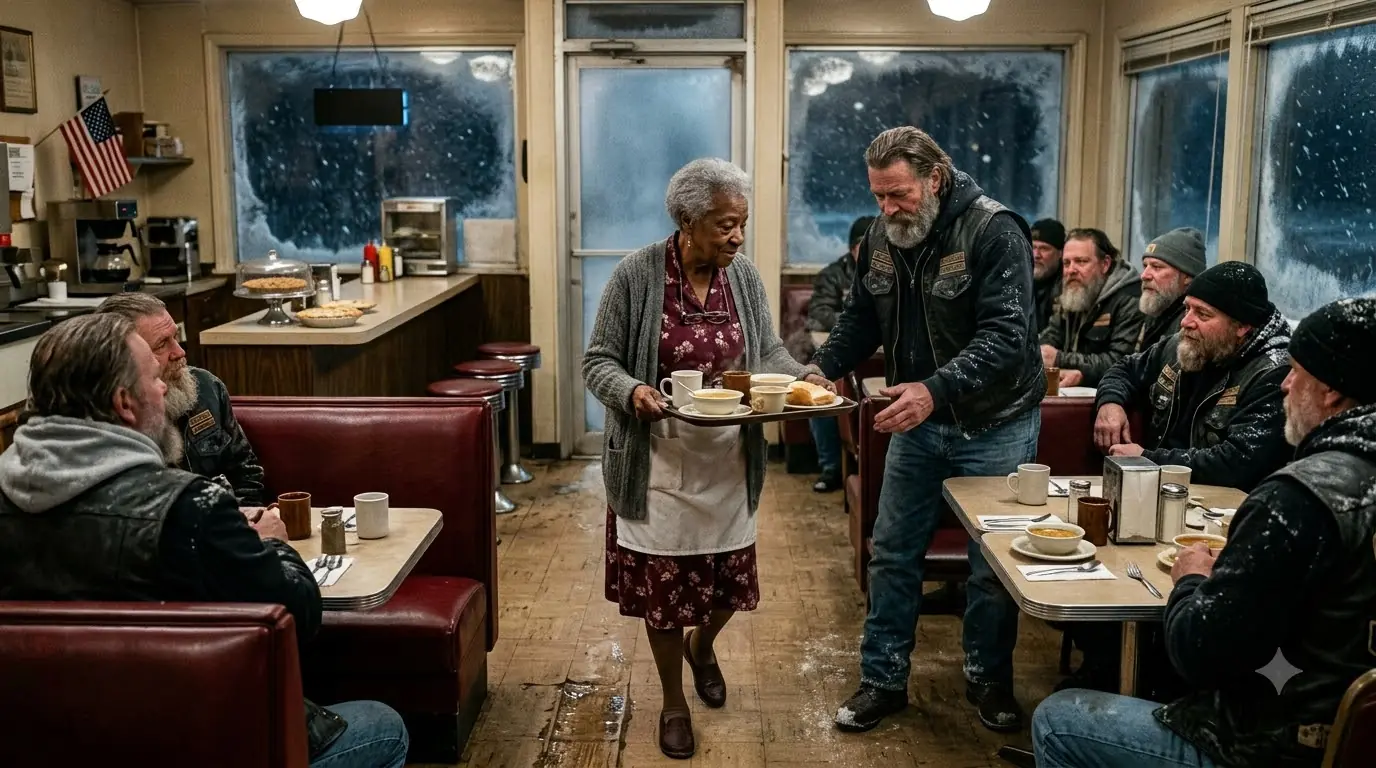
Without shelter, anyone caught in this storm could die tonight. Her arthritic hands trembled on the deadbolt, not from the cold, but from fear.
These men could overpower her in seconds, take everything she had, and hurt her in ways she did not want to imagine. But they were human beings, and they were dying out there.
Dorothy had an impossible choice. Lock the door and let nine strangers freeze to death, or open it and risk everything.
What she did not know was that the man standing in the center of that group was not just any biker. Her next decision would change not just nine lives, but transform her entire neighborhood forever.
But before that life-changing moment, Dorothy Washington was fighting a battle she seemed destined to lose. At 72, Dorothy lived alone in a two-story house that was slowly crumbling around her.
The paint peeled off the siding like old skin. Shingles had blown away in last year's storms, leaving dark patches on the roof where rain seeped through.
Every morning at 5:30, Dorothy made instant coffee with powdered milk. Real cream was a luxury she could not afford on her $1,200 Social Security check.
She would sit at her kitchen table reading her worn Bible by the light of a single bulb, praying for strength to make it through another day. The house needed at least $15,000 in repairs, maybe more.
The furnace wheezed and rattled, struggling to heat rooms that leaked warmth through cracked windows. Dorothy wore three sweaters indoors during winter, her breath visible in the kitchen some mornings.
When it rained, she placed pots and buckets around the house to catch dripping water. The steady ping, ping, ping echoed through empty rooms like a countdown timer.
Her medicine cabinet told the story of her sacrifices. Blood pressure pills that should have been taken daily were rationed to every other day.
Diabetes medication was stretched thin because the prescription cost more than her weekly grocery budget. She had learned to make hard choices between staying alive and staying fed.
Every Tuesday, Dorothy walked six blocks to the grocery store with a calculator in her purse. She added up prices as she shopped, putting items back when the total exceeded $47.
That was her weekly food budget after rent, utilities, and medicine. The neighborhood around her was dying, too.
Three houses on her block stood abandoned, their windows boarded up like closed eyes. Broken streetlights left long stretches of darkness where anything could happen.
Young men gathered on corners, suspicious of police but always respectful when they passed Dorothy's porch. "Morning, Miss Dot," they would call out, and she would wave back, knowing their mothers had raised them right even if the streets were trying to teach them wrong.
Despite everything, Dorothy maintained standards. She swept her front steps every morning, watered dying houseplants with dishwater, and kept an American flag displayed prominently despite the missing shingles above it.
Her late husband, Robert, had served in Vietnam, and that flag meant something. The old CB radio from Robert's trucking days still worked, crackling occasionally with voices she did not recognize.
Sometimes she heard motorcycle groups communicating in codes she did not understand. The radio was one of the few connections she had to the outside world when her cell phone had no signal.
Dorothy's posture remained military-straight despite her hardships. Robert had taught her that dignity was not something poverty could take away.
She still baked cookies for neighborhood children when she could afford the ingredients, let them use her bathroom when they played outside, and fed stray cats with food she could barely spare for herself. The loneliness was the hardest part.
Her daughter, Regina, lived in California, building her own life with her own family. Her son Jerome was deployed overseas, serving his country like his father had.
Dorothy was proud of them both, but pride did not fill the empty rooms or warm the cold nights. She refused to ask for help.
Her children had their own struggles and their own bills to pay. She would not become a burden or guilt them into sacrificing their futures for her comfort.
Some mornings, Dorothy would stand at her kitchen sink, looking out at the broken neighborhood, and whisper the same prayer. "Lord knows I've made it this far."
"Just need to make it through another winter. The house may be falling down, but I'm not."
Her neighbors had learned to keep their distance, not because Dorothy was unfriendly, but because she had standards. She called the police when drug dealers set up shop too close to the elementary school and reported loud parties that kept working families awake.
She maintained her property even when everyone else had given up. They thought she was difficult, but they did not understand she was fighting for something bigger than herself.
This neighborhood had raised five children. Every sidewalk crack held memories of scraped knees she had bandaged, and every tree had shaded birthday parties and barbecues when times were better.
Dorothy sorted her pills into a weekly container each Sunday, making them last as long as possible. She had learned which medicines were absolutely necessary and which ones she could skip when money was tight.
Her body ached constantly, but complaints would not pay the bills. The CB radio had been crackling more frequently lately, picking up transmissions from groups that seemed organized and disciplined.
Sometimes she heard fragments about road conditions, welfare checks, and community service. It reminded her of Robert's old trucking buddies looking out for each other on long hauls.
But that was a different world, a world where people still believed in helping strangers. A world where a man's word meant something and service to others mattered more than service to yourself.
Dorothy did not know that world was about to come knocking on her door. As she prepared for bed that March evening, checking the locks twice and adjusting the thermostat down to save money, she had no idea that the biggest test of her faith was less than 12 hours away.
Outside, the first snowflakes began to fall. Then came the storm that would test everything Dorothy believed about helping strangers.
The weather service had been warning about it for three days. An unprecedented March blizzard was heading for Detroit, bringing life-threatening conditions.
Temperatures would drop to 15 below zero with 60 mph winds. Power lines would snap, and roads would become impassable.
Dorothy had lived through plenty of storms, but something about this one felt different, more dangerous and more final. At 6:47 that evening, the ancient furnace in Dorothy's basement finally gave up.
She heard it wheeze, rattle, then fall silent with a mechanical sigh that sounded almost human. Within minutes, the temperature in the house began dropping.
Dorothy pulled on a third sweater and called her daughter Regina in California. "Just checking in, baby," she said, forcing cheerfulness into her voice.
"How are my grandbabies?"
She did not mention the furnace. She did not want Regina worrying about things she could not fix from 2,000 miles away.
Dorothy had learned long ago that some burdens were meant to be carried alone. By 7:23, her breath was visible in the kitchen.
The old space heater she plugged in immediately tripped the house's ancient electrical system. The lights flickered and died, leaving Dorothy in darkness.
She found the CB radio by feel, switching it on by the glow of its amber display. Static filled the air, broken by fragmented emergency calls.
"Roads blocked by fallen trees. Bikes won't start in this cold."
"Hypothermia risks increasing. Need shelter fast."
Dorothy realized motorcyclists were stranded somewhere nearby. In this weather, exposed to the elements, they would not survive the night.
The temperature inside her house was dropping rapidly. Without heat, Dorothy faced her own survival crisis.
Her diabetes made her circulation poor, and cold affected her worse than most people. Her fingers were already growing numb, making it hard to work the radio dial.
She might not survive the night either, but somehow strangers outside were facing immediate death from exposure. Dorothy Washington had been raised to believe that when someone needed help, you helped, no matter what.