A groom called his bride's father a beggar and had him thrown out of the wedding. But minutes later, a U.S. senator stepped out of a government motorcade and called that same man sir. Imagine spending your entire life helping people, expecting nothing in return, only to be humiliated in front of hundreds of strangers on what should have been your daughter's happiest day. Samuel Brooks arrived at a luxury Washington wedding carrying nothing more than a worn suit, a simple gift, and a father's love.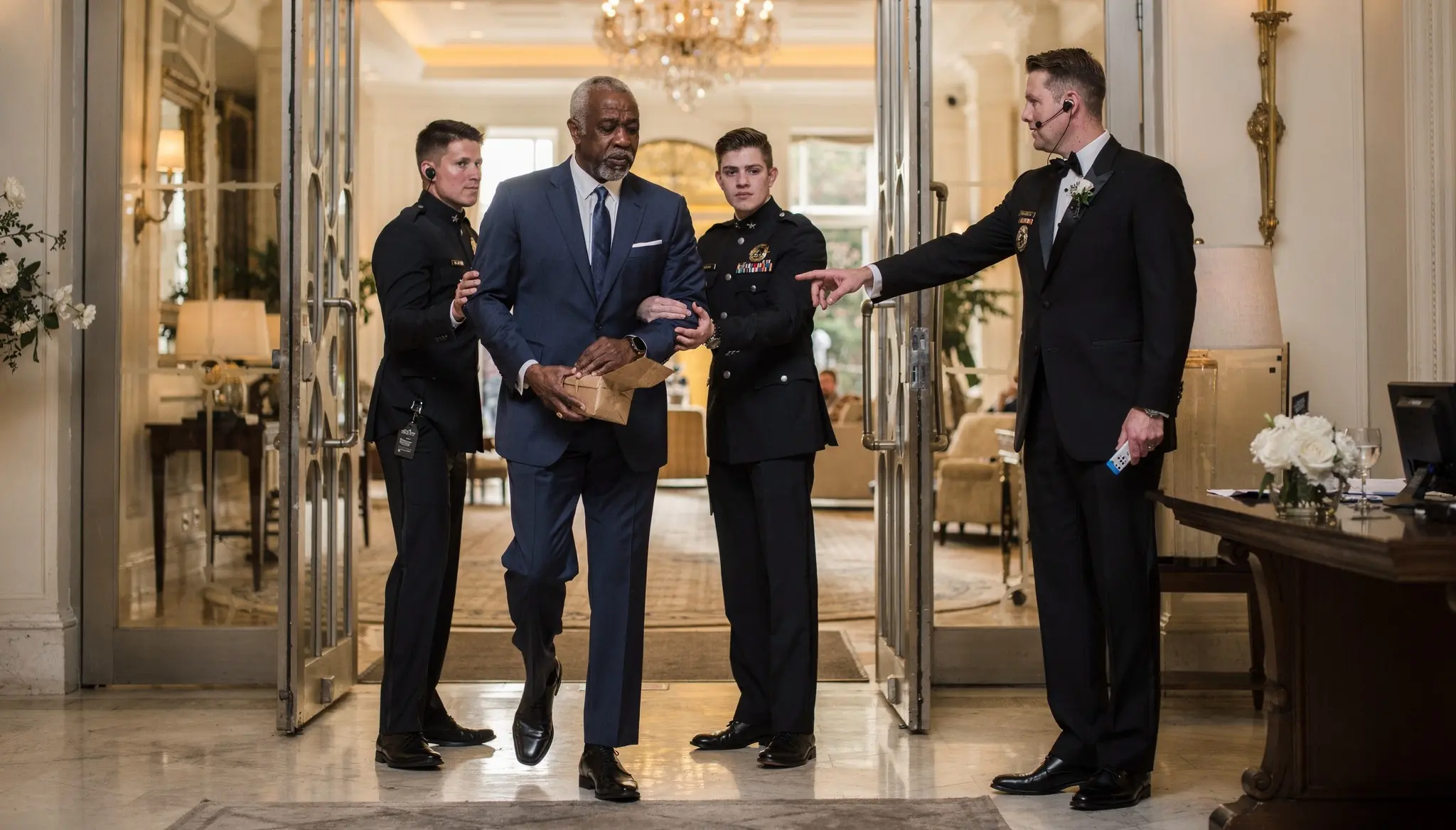
But before he could walk his daughter down the aisle, the groom publicly threw him out for looking too poor. What nobody knew was that a powerful figure from Samuel's past was only minutes away. And when a U.S. senator stepped out of a government motorcade and called the rejected father sir, decades of hidden sacrifice, kindness, and truth began crashing into the lives of everyone who had judged him. The chandeliers inside the Grand Georgetown Hotel glowed like captured sunlight.
Golden light spilled across polished marble floors. Crystal glasses sparkled on silver trays. A string quartet played softly near the grand staircase while guests in designer suits and elegant evening gowns drifted through the lobby with champagne in their hands. Everything about the place whispered wealth.
Everything except the man who had just stepped off a city bus three blocks away. Samuel Brooks adjusted the collar of his navy suit as he crossed the street toward the hotel. The suit was old, not dirty, not torn, just old. The fabric had faded slightly over the years, and the cuffs showed signs of careful repairs made by steady hands.
His black dress shoes were polished until they reflected the afternoon light, but they had clearly walked many miles. Under one arm, he carried a small package wrapped in plain brown paper. The package looked almost out of place against the luxury surrounding him. Samuel paused for a moment at the entrance.
A cold autumn breeze drifted through Georgetown, carrying the smell of rain from somewhere far away. Traffic hummed in the distance. The city moved around him without noticing him. He looked up at the massive building.
Today was supposed to be one of the happiest days of his life. His daughter was getting married. For a moment, he smiled. Not because of the hotel, not because of the wedding, because he suddenly remembered a little girl with pigtails and missing front teeth running through a playground in Baltimore.
Daddy, watch this. She had climbed the monkey bars and fallen after 3 seconds, then laughed so hard she couldn't stand up. Samuel could still hear that laugh. The memory warmed him. He touched the brown package gently.
Inside was the gift he had spent months preparing. Not jewelry, not money, not anything expensive, just something from his heart. The kind of thing only a father would understand. Taking a deep breath, he stepped through the revolving doors.
The atmosphere changed immediately. Cool air, expensive perfume, fresh flowers, soft music. A world that seemed designed for people who had never worried about bus schedules or overdue utility bills. Several guests glanced his way.
The looks were brief, quick, curious. Some looked away immediately, others stared a little longer. Samuel noticed. He had spent 60 years noticing.
When you grow up Black in America, you learn to recognize certain looks, the assumptions, the silent judgments, the calculations happening behind someone's eyes. He ignored them and continued walking. At the far end of the lobby stood a massive floral arrangement filled with white roses and orchids. Beyond it, wedding guests gathered near the ballroom entrance.
Laughter echoed through the room. Champagne glasses clinked. Everything seemed perfect until one man noticed Samuel. Ethan Caldwell, the groom, 34 years old, tall, handsome, expensively dressed, born into the kind of money that made people believe they understood the world before ever experiencing it.
He was standing near the registration table speaking with several guests when his eyes landed on Samuel. His smile disappeared instantly. Confusion crossed his face, then irritation, then something uglier. He started walking fast. The guests around him noticed.
Conversations began slowing. Heads turned. The string quartet continued playing. For now, Samuel recognized Ethan immediately.
They had only exchanged a few phone calls over the years. Maya had always promised they would spend more time together eventually. Life had simply gotten busy. At least that was what she said.
Samuel smiled politely. Good afternoon. Ethan didn't smile back. Instead, he stopped a few feet away and looked Samuel up and down.
The suit, the shoes, the package, every detail seemed to offend him. "Can I help you?" Ethan asked. The tone wasn't friendly. Samuel remained calm. "There seems to be some confusion. I'm Samuel Brooks. I'm Maya's father." For a moment, silence hung between them.
Several nearby guests began listening openly now. One woman lowered her champagne glass. A man near the staircase stopped checking his phone. Ethan blinked. Then laughed.
Not warmly, not kindly. A short laugh that carried across the lobby. "You're her father?" Ethan asked. Samuel nodded. "I came to walk my daughter down the aisle." More guests were watching now.
The room felt smaller. The music seemed quieter. The truth. Ethan shook his head slowly.
You've got to be kidding me. Samuel's smile faded. Excuse me. Ethan stepped closer. You showed up like this?
Samuel glanced down at his suit. I wasn't aware there was a problem. The groom looked genuinely embarrassed. Not for Samuel, for himself.
As though Samuel's very presence had somehow ruined the image he had spent months constructing. Around them, conversations stopped completely. The string quartet finally fell silent. The sudden quiet felt heavy.
Then Ethan said the words that would change everything. Who let this beggar into my wedding? The lobby froze. Nobody moved. Nobody spoke.
A champagne glass stopped halfway to someone's lips. Samuel felt every eye in the room settle on him. The word lingered in the air. Beggar. He could have responded with anger, could have defended himself, could have reminded Ethan that kindness mattered more than appearances.
Instead, he simply stood there, calm, dignified, the same way he had stood through countless humiliations before. "Son," Samuel said quietly, "I think you're making a mistake." Ethan's jaw tightened. My mistake was not setting stricter security.
A few guests exchanged uncomfortable looks. Others stared silently. Nobody stepped forward. Nobody said stop. Nobody said enough.
Samuel looked around the lobby. More than 200 people, educated people, successful people, influential people, and every one of them remained silent. That hurt more than Ethan's words. The silence, the willingness to watch.
Ethan snapped his fingers toward two security guards stationed near the entrance. "Remove him," Ethan ordered. The younger guard hesitated. "Now." The older guard approached first.
His expression was apologetic. "I'm sorry, sir." Samuel looked at him. The guard looked away. Not because he hated Samuel, because he needed his job.
Samuel understood. He always understood. That was both his strength and his burden. The guard gently touched his arm.
Please come with us. The entire lobby watched. Nobody moved. Nobody objected. Samuel looked toward the ballroom doors.
Somewhere upstairs, Maya was getting ready. She had no idea what was happening. For one brief moment, Samuel considered asking someone to get her. Then he stopped himself. This was her wedding day.
He didn't want her first memory of the afternoon to be a fight. So he nodded. All right. The guards escorted him toward the entrance.
Not roughly, not violently. But the humiliation remained. Each step echoed across the marble floor. Behind him, whispers started immediately.
Someone laughed softly. Someone else muttered something he couldn't quite hear. The brown paper package remained tucked safely beneath his arm. The gift never left his hands.
As the doors opened, cool air rushed in from outside. Samuel stepped onto the stone courtyard. The doors closed behind him. The sound echoed like the end of something.
For several seconds, he simply stood there alone. The city stretched beyond the hotel grounds. Cars moved through Georgetown traffic. A distant siren wailed somewhere across town.
Life continued. Samuel slowly walked toward a stone bench beneath a row of oak trees. He sat down. The package rested on his lap.
His shoulders slumped slightly for the first time all day. Not from anger, from sadness. The kind that arrives quietly. The kind that settles deep.
He looked toward the hotel entrance. His daughter was inside. The little girl from the playground. The teenager who cried when she got her first college acceptance letter.
The young woman who still called him every Sunday evening. He loved her more than anything. And somehow on the day that was supposed to celebrate love, people had forgotten what love looked like. Samuel lowered his eyes. Then something caught his attention.
Headlights. At the far end of the driveway, a black vehicle turned through the front gate. Then another, then another. A convoy. Government issued SUVs moving slowly toward the hotel.
Security personnel stepped out first. Earpieces, dark suits, professional movements, the kind of presence that made people notice immediately. Inside the lobby, guests rushed toward the windows. Outside, Samuel watched quietly from the bench.
He had no idea why they were there. He had no reason to think the arrival had anything to do with him. Still, something about the moment felt strange, as though the day had not finished unfolding. As though the story everyone thought they understood had only just begun, the lead vehicle stopped directly in front of the entrance, one of the agents opened a rear passenger door, and suddenly every eye in the hotel turned toward the arriving guest, including Samuel's, because whoever was stepping out of that vehicle seemed important enough to make an entire ballroom.
Forget the wedding for a moment. And before the man could even be seen clearly, the atmosphere around the hotel changed. Something was coming. Something nobody inside that building was prepared for.
But Samuel Brooks didn't know that yet. He sat quietly on the stone bench beneath the oak trees outside the Grand Georgetown Hotel while the black SUVs rolled through the gates. Their glossy paint reflected the late afternoon sun. Men in dark suits moved with practiced precision.
Guests pressed against the lobby windows trying to see who had arrived. The excitement spread instantly. Inside, people forgot about the wedding for a moment. Forgot about the champagne. Forgot about the string quartet.
Forgot about the Black father they had watched being escorted out less than 10 minutes earlier. Samuel watched the activity from a distance. Then he lowered his eyes to the brown paper package resting on his lap. His fingers brushed gently across the folded edges.
The package mattered more than the luxury hotel, more than the wedding, more than the opinions of strangers. Inside was 28 years of love. Nothing expensive, nothing flashy, just truth. A soft breeze moved through the trees.
The sound carried him backward. Back to the beginning. Back to Baltimore. Back to that morning. 6 hours earlier.
The alarm clock beside Samuel's bed buzzed at exactly 5:00. The room was still dark. Outside his apartment window, the city was sleeping beneath a blanket of fading night. Samuel opened his eyes immediately.
No snooze button, no complaints, just habit. For 30 years, he had started every day before sunrise. Some routines become part of a person's bones. This was one of them.
He sat up slowly and rubbed his hands together. The apartment was small. Two bedrooms, old hardwood floors, a kitchen barely large enough for two people. The radiator clicked softly in the corner.
Samuel stood by the window, holding a mug between his hands. The first hint of dawn painted the Baltimore skyline with pale shades of blue. Down below, the neighborhood slowly woke up. A delivery truck rattled past.
A bus sighed to a stop at the corner. Someone walked a dog beneath a street lamp. Ordinary life, the kind Samuel loved. He crossed the room toward a bookshelf.
On the highest shelf sat a worn leather notebook. He lifted it carefully. His smile appeared before he even opened it. Inside were letters, hundreds of them.
Letters he had written to Maya over the years. Some were only a few lines long. Others stretched across several pages. Letters written on birthdays. Graduations, hard days, happy days.
Moments he never wanted her to forget. Moments he never wanted to forget himself. He turned to one page. The date read September 14th.
2004. Dear Maya, today you started first grade. You were scared this morning, but you still walked through those doors smiling. I hope you always remember that courage isn't about being fearless.
It's about moving forward even when you're afraid. Love, Dad. Samuel chuckled softly. He remembered that morning perfectly.
The oversized backpack, the missing front tooth, the way she had squeezed his hand before walking into the classroom. He closed the notebook. Today, he planned to give it to her. Not after the ceremony, not during the reception, just before he walked her down the aisle.
A father's final gift before letting his little girl begin a new chapter. He carried the notebook to the kitchen table. A roll of brown paper waited nearby. Slowly and carefully, he wrapped the gift, each fold precise, each corner neat.
By the time he tied the string around the package, sunlight had begun filling the apartment. Samuel stepped back and admired his work. Simple, honest, perfect. A knock sounded at the door.
He opened it to find Mrs. Patterson from downstairs, an 82-year-old woman who was tiny, sharp-eyed, and never afraid to speak her mind. She held a covered plate. I made biscuits. Samuel smiled. You didn't have to do that.
I know I didn't. She handed him the plate. Today is your daughter's wedding. Samuel laughed. News travels fast, honey.
This building hasn't had a secret since 1987. They both laughed. Mrs. Patterson studied him carefully. You nervous? A little.
You'll be fine. Samuel looked down the hallway. I hope she has a good life. Mrs. Patterson reached over and squeezed his arm.
She already does. For a moment, neither of them spoke. Then she smiled. Now stop worrying and go be proud.
After breakfast, Samuel left the apartment carrying the wrapped gift. The morning air felt crisp. Leaves drifted along the sidewalk. Baltimore moved around him in familiar rhythms.
At the corner convenience store, the owner waved. Big day, Samuel. It is. Tell Maya congratulations. I will.
A few blocks later, he reached the bus stop. Several people waited beneath the shelter. Construction workers, students, an elderly couple, and a man Samuel recognized immediately. His name was Walter Green, a Vietnam veteran, 68 years old, recently homeless.
Samuel had met him months earlier at a community meal program. Walter sat alone on the bench, his shoulders slumped. Something seemed wrong. Samuel walked over. Morning, Walter.
The veteran looked up. His smile appeared briefly, then faded. Morning. You okay? Walter hesitated, then sighed.
Not really. Samuel sat beside him. What happened? Walter stared at the sidewalk.
The pharmacy called a pause. My heart medication went up again. Samuel listened quietly. I don't have enough. The words came out barely above a whisper.
Embarrassment filled his face. Samuel understood that look. Pride can be heavy, especially when life forces you to ask for help. Walter quickly added, "I'll figure something out." Samuel nodded.
Of course you will. Then he stood. Come on. Walter frowned. Where are we going?
The pharmacy. 20 minutes later, they stood at the counter together. Walter protested the entire time. Samuel ignored every protest. By the time they left, the prescription bag rested in Walter's hands.
The veteran stared at it. You didn't have to do this, Samuel smiled. Yes, I did. Why? Samuel looked toward the busy street.
Cars rolled past. People hurried to work. Life continued, then he answered. Because somebody once helped me when I needed it.
Walter shook his head slowly. I'll pay you back. No, Samuel. No. Walter's eyes grew wet.
Not because of the money, because kindness becomes rare when people are struggling, and rare things matter. The bus arrived moments later. Samuel climbed aboard. As the city passed outside the window, he thought about Maya, about the wedding, about the future.
He wondered if Ethan truly understood what kind of woman he was marrying. He wanted to believe he did. Maya deserved that. She deserved happiness. The bus moved south toward Washington.
Hours later, it would bring him to Georgetown, to the hotel, to the humiliation waiting for him. But Samuel didn't know that yet. Instead, he watched the passing landscape. Row houses, churches, factories, neighborhoods stitched together by stories.
The world felt peaceful. And as he held the brown paper package close to his chest, one thought stayed with him. No matter what happened today, he would show up for his daughter. Just like he always had.
What Samuel didn't realize was that the kindness he had shown a struggling veteran that morning wasn't unusual. It was simply another chapter in a pattern that stretched back decades. A pattern that had quietly changed countless lives, including one life that would soon change everything. Because far from Baltimore, in another city entirely, a powerful man was preparing to attend a wedding.
A man who had spent 20 years searching for someone. And before the day was over, their paths would finally cross again. Samuel Brooks knew nothing about that search. He knew nothing about powerful men looking for him, nothing about government motorcades, nothing about fate quietly moving pieces into place.
The only thing Samuel had ever focused on was the next person who needed help. That was how he had lived most of his life, and that was exactly why almost nobody knew the sacrifices hidden behind his gentle smile. The bus rolled toward Washington while memories drifted through his mind like old photographs. Some memories brought warmth. Others still carried a dull ache.
Samuel was 29 when his life changed forever. Not because he became successful. Not because he found wealth. Because he became a father.
The first time he held Maya in his arms, she weighed barely 6 lb. Tiny fingers, tiny nose, tiny heartbeat. But somehow she instantly became the biggest thing in his world. He remembered standing beside the hospital window that night, snow falling outside, street lights glowing through the darkness, his newborn daughter asleep against his chest.
He had whispered a promise she would never hear. I'll take care of you. At the time, he had no idea how difficult that promise would become. The marriage ended when Maya was seven.
There was no dramatic fight, no screaming, just two people who wanted different lives. Maya's mother eventually moved to another state and remained part of her daughter's life. But the day-to-day responsibility fell mostly on Samuel, and Samuel accepted it without complaint. Every morning began before sunrise.
Every night ended long after dark. He worked wherever work could be found. Warehouse shifts, delivery routes, maintenance jobs, security work. Sometimes two jobs at once, sometimes three.
There were months when he barely slept. Months when he ate instant noodles so Maya could have proper meals. Months when the electricity bill sat on the kitchen table like a threat. Yet Maya never knew. Samuel made sure of that.
When she wanted to join the school choir, he found the money. When she needed new glasses, he found the money. When she dreamed of attending summer science camp, he worked weekends until he found the money. The answer was always yes.
No matter how tired he felt, no matter how worried he became, no matter how empty his own wallet looked, the answer was always yes. That reputation followed him throughout the neighborhood. In Baltimore, everyone seemed to know Samuel Brooks. Not because he was rich, not because he was important, because he showed up.
When Mrs. Jenkins lost her husband, Samuel mowed her lawn for 6 months. When a teenager named Curtis got suspended and started hanging around troublemakers, Samuel spent evenings helping him apply for trade school. When a fire damaged an apartment building three blocks away, Samuel organized volunteers to help families move their belongings. Nobody asked him to do those things.
He simply did them. One summer afternoon, years earlier, 12-year-old Maya had asked him a question. They were walking home carrying grocery bags. Samuel had just spent nearly an hour helping an elderly stranger whose car had broken down.
The ice cream in their cart had melted. Dinner was late. The entire day had been delayed. Dad. Yeah, baby girl.
Why do you always help everybody? Samuel smiled. I don't help everybody. You kind of do. He laughed.
Maya looked genuinely confused. What if they never help you back? Samuel stopped walking. For a moment, he watched traffic moving through the intersection.
Then he knelt so they were eye level. You don't help people because they'll help you back. Then why? Because someday they might need it.
Maya frowned. That's it. That's it. The answer seemed too simple.
Maybe it was, but Samuel believed simple truths were often the strongest ones. Years later, Maya would remember that conversation, especially after the events of her wedding day. The bus continued south. Outside the window, neighborhoods blurred together.
Inside, Samuel's thoughts drifted toward another memory, one he rarely discussed, one that still hurt. He was 16 the first time someone called him a name he would never forget. A department store security guard. Baltimore. Samuel had spent three months saving money for a school jacket.
When he finally entered the store, the guard followed him through every aisle. Not discreetly, not subtly, openly, watching, waiting, assuming. Samuel remembered the humiliation more than the anger. The feeling of being judged before speaking a single word, the feeling that some people saw his skin before they saw his humanity.
Experiences like that never fully disappeared. They settled somewhere deep, quiet, invisible, yet always present. Over the years, there had been other moments. Job interviews, restaurants, stores, neighborhoods where people locked their car doors when he walked by.
Samuel learned something important during those years. Bitterness could become a prison. If he allowed resentment to define him, then the people who underestimated him would win twice. So he chose something harder.
He chose kindness. Not because the world always deserved it, because he refused to become the thing that hurt him. That choice shaped everything, including Maya. Especially Maya. By the time she graduated high school, everyone could see the influence Samuel had on her.
She volunteered at literacy programs, tutored younger students, spent weekends helping community projects. The same generosity lived inside her. The same instinct to care. Samuel remembered her college graduation like it happened yesterday.
The stadium packed with families. Thousands of people cheering. Maya crossing the stage with honors. The diploma in her hand.
Tears streaming down her face. The photograph from that day still sat on his bookshelf, his favorite picture in the world. Not because of the degree, because of her smile, because of the look in her eyes. She had achieved something neither of them thought possible during those difficult years.
And she had done it with integrity. The bus eventually stopped at a rest station outside Washington. Passengers stretched their legs, bought coffee, checked phones. Samuel remained seated. His gaze settled on the brown package beside him.
The notebook, the letters. 28 years of fatherhood wrapped in brown paper. A lifetime reduced to a simple gift. He wondered how Maya would react.
Would she laugh? Would she cry? Would she read the letters immediately? A smile appeared on his face, probably all three.
Then another thought surfaced. Ethan. Samuel's smile faded slightly. Not because he disliked the young man, because he wasn't sure he understood him.
Their conversations had always felt polite, too polite, like speaking through glass. Ethan never seemed interested in stories, never asked many questions, never showed curiosity about where Maya came from or who helped shape her. Samuel had noticed, but he told himself not to judge. Everyone deserved a chance. Still, somewhere deep inside, a quiet concern remained.
The concern of a father, the concern of a man who had spent decades learning how to read people. As the bus prepared to leave, Samuel looked out the window one last time. Clouds were gathering. Dark gray shapes rolling slowly across the afternoon sky.
The weather forecast had mentioned possible rain, a storm moving toward the city. Samuel watched the clouds, then looked down at Maya's gift. He had no idea that another storm was already waiting for him. One far more painful than any weather forecast.
One that would test every lesson he had spent his life teaching his daughter. And before the day was over, Samuel Brooks would discover whether kindness could survive humiliation, whether dignity could survive cruelty, and whether a lifetime of doing good could truly change a person's destiny. Because somewhere in Washington, a bride was getting ready. A groom was preparing to impress the world, and a secret from 20 years ago was about to step out of the shadows.
At that exact moment, Ethan Caldwell stood in front of a floor-to-ceiling mirror inside the Caldwell family estate overlooking the Potomac River. Everything around him looked perfect. The imported Italian marble, the antique paintings, the custom-tailored tuxedo hanging nearby, the view of Washington stretching beyond the massive windows. Even the weather seemed to cooperate.
The afternoon sun broke through the clouds just enough to bathe the property in golden light. Ethan studied his reflection, adjusted his cufflinks, straightened his tie, then smiled. The smile looked flawless. It was a smile he had practiced most of his life.
The kind of smile that impressed investors, the kind that charmed donors, the kind that convinced people he was exactly who they wanted him to be. Behind him, voices echoed from downstairs. Guests were already arriving. Luxury cars filled the driveway.
Valet moved constantly. The wedding was becoming the social event his family had spent months creating. Exactly as planned. A knock came at the door.
Without waiting for an answer, Tyler Reynolds stepped inside. 35 years old. Expensive watch. Expensive haircut. Expensive opinions.
He carried two glasses of whiskey. Thought you might need this. Ethan accepted one. Thanks. Tyler took a long sip.
Nervous? Ethan laughed. No. Liar. Maybe a little.
Tyler smirked. You spent more time planning this wedding than most people spend planning their retirement. Ethan glanced toward the window. It's not just a wedding.
No kidding. Tyler gestured toward the estate. 250 guests. He pointed toward the driveway.
Three senators, another gesture. Half the city's business elite. Then he grinned. And enough money in one place to buy a small country.
Ethan smiled proudly. Exactly. Tyler shook his head. You know, normal people get married in churches, right?
Ethan laughed. We're not normal people. The answer came so naturally that neither Cha noticed how revealing it sounded. For Ethan, life had always been measured differently.
Success wasn't enough. Success had to be visible. Admiration wasn't enough. Admiration had to be public.
Everything needed to communicate status. Everything needed to prove worth. That belief had been planted long before he ever met Maya Brooks. Long before he fell in love or thought he had.
Downstairs, Helen Caldwell was directing staff members with military precision, every flower arrangement, every table setting, every place card. Nothing escaped her attention. At 62 years old, she carried herself like a woman accustomed to getting exactly what she wanted. Her husband, Richard Caldwell, stood nearby, reviewing the guest list.
The family had spent decades building their reputation. This wedding wasn't simply a celebration. It was a statement, a showcase, a declaration that the Caldwell name still mattered, and Ethan intended to make sure everyone remembered it. Later that afternoon, while guests continued arriving at the hotel, Ethan found himself alone with Tyler near the estate's private bar.
The room smelled faintly of oak and cigar smoke. Sunlight reflected off rows of crystal bottles. Tyler leaned against the counter. So Ethan glanced over. So Tyler swirled the ice in his glass.
When are we finally meeting the famous father? Ethan's expression shifted slightly. The smile weakened. Samuel. Yeah.
Tyler shrugged. I've heard about Maya's mom. He shrugged again. I've heard about her cousins.
Another shrug. But somehow the father remains a mystery. Ethan took a drink. There's not much to know.
Tyler raised an eyebrow. Really? Really? What does he do? Ethan hesitated.
The pause lasted barely a second, yet it said everything. Community work. Tyler laughed. Community work? I think so.
You think so? Ethan sighed. You know what I mean? Tyler didn't. Neither did Ethan, because the truth was uncomfortable.
After 3 years together, Ethan knew surprisingly little about Samuel Brooks. He had never bothered to learn. Whenever Maya talked about her father, the stories focused on kindness, on sacrifice, on character. Those things never interested Ethan much.
He cared about measurable achievements, titles, connections, influence, the things Samuel never discussed. Tyler leaned forward. You ever meet him? Not in person. That surprised him.
You've never met your future father-in-law. Phone calls. That's it. That's it. Tyler laughed again.
That's weird. Maybe it was, but Ethan never viewed it as important. The man lived in a modest apartment, worked community jobs, took buses, volunteered. To Ethan, those details painted a complete picture.
He assumed he already knew everything that mattered. That assumption would soon become the biggest mistake of his life. Across town, Maya Brooks sat in a bridal suite overlooking Georgetown. The room buzzed with activity.
Makeup artists, hair stylists, bridesmaids, laughter, champagne. Yet Maya barely noticed any of it. She stood near the window, staring at the city below. The view stretched across rooftops and monuments.
The Washington Monument stood in the distance like a white needle against the sky. Her maid of honor, Jasmine Carter, approached quietly. You okay? Maya smiled. I think so.
You think so? The exact same answer, the exact same hesitation. Jasmine knew her too well. What is it? Maya looked down at the engagement ring, at the city, at everything waiting ahead.
Then she sighed. I'm worried about dad. Jasmine smiled gently. Why? He hates attention.
He'll survive one wedding. Maya laughed softly. That's not what I mean. Jasmine sat beside her. Maya hesitated, then spoke carefully.
You ever get the feeling two people are speaking different languages even when they're using the same words? Jasmine frowned. "Ethan." Maya nodded. A long silence followed.
Outside, church bells rang somewhere in the distance. Finally, Jasmine asked, "Do you love him?" "Yes." The answer came immediately. Yet, something felt uncertain afterward.
A shadow beneath the certainty. Jasmine noticed. "You don't sound convinced." Maya looked away. Sometimes I wonder if Ethan understands what matters.
What do you mean? My dad spent his entire life helping people. Her voice softened. He never cared about money.
She smiled. He never cared about status. Another smile. He just cared about people.
Then the smile faded. And sometimes I think Ethan sees that as a weakness. Jasmine didn't answer immediately. Instead, she looked toward the city, toward the horizon, toward whatever future waited ahead.
Eventually, she spoke. Maybe today will tell you what you need to know. The words lingered in the room long after they were spoken. Maybe today will tell you.
At nearly the same moment, Samuel's bus entered Washington. Traffic thickened. Government buildings appeared. Monuments rose above the skyline.
The city looked impressive. Important. Samuel barely noticed. His attention remained focused on one thing, his daughter.
He checked his watch. Plenty of time. Everything would be fine. He smiled. A father heading to his daughter's wedding.
Nothing more, nothing less. Yet, while Samuel looked toward a future filled with hope, another conversation was unfolding miles away. Back at the hotel, back among the guests, back where assumptions quietly multiplied, a wealthy donor standing near the ballroom glanced at the wedding program. Interesting. His wife looked over.
What? Dinner. Look at the bride's father. What about him? The donor shrugged.
Never heard of himwhere. His wife barely looked up. Does it matter? The donor smiled. Not kindly.
Sometimes the answer disappeared into the growing crowd. The kind of casual judgment that happened every day. The kind Samuel had encountered his entire life. The kind that was already waiting for him at the hotel.
And within hours, everyone who made those assumptions would discover how little they actually understood. Because the perfect wedding Ethan Caldwell imagined was beginning to crack. Not visibly. Not yet. But the first fracture had already formed, and once the truth started moving, nothing would stop it.
20 years earlier, Baltimore looked very different. The city was rougher around the edges. Factories still stood where luxury apartments would eventually rise. Old brick buildings lined streets that seemed permanently damp from rain and time.
On a cold October night, a storm rolled across the city. Rain hammered rooftops. Wind rattled loose signs. Street lights cast trembling circles of yellow across puddles and broken sidewalks.
Most people had already gone home. Most sensible people. Samuel Brooks was not one of them. At 40 years old, he had just finished a late maintenance shift at a warehouse near the harbor.
His paycheck wasn't much, but it paid the bills, mostly. His work boots splashed through shallow puddles as he walked toward a bus stop three blocks away. The rain had soaked through his jacket. His hands were cold. All he wanted was a hot shower and a few hours of sleep before starting another shift in the morning.
Then he heard something, a voice, weak, barely audible beneath the storm. At first he thought it might be the wind. Then he heard it again, a groan. Someone was calling for help.
Samuel stopped walking. Most people probably wouldn't have, not because they were bad people, because it was late, because it was dangerous, because everyone had somewhere else to be. Samuel turned toward the sound. The alley sat between two abandoned buildings, dark, narrow, almost invisible from the street.
Rainwater rushed through the cracked pavement like a shallow river. The sound came again. Without hesitation, Samuel stepped into the alley. His shoes splashed through standing water.
The darkness swallowed him. Then he saw him. A young man lay against a brick wall near a dumpster. Mid20s, white, well-dressed, or at least he had been before the storm ruined his clothes.
Are you all right? His face was pale. His eyes barely open. He looked terrified. Stay away.
More than injured, more alone than anything else. Samuel immediately knelt beside him. Hey. No response. Can you hear me?
The young man blinked slowly. His lips moved. Please. The word nearly disappeared beneath the rain.
Samuel looked around. No one else. No witnesses. No crowd. No cameras, just two strangers in a storm.
The easy choice would have been calling emergency services and walking away. Samuel never liked easy choices. He removed his jacket and placed it over the young man. Then he dialed 911. The ambulance arrived 10 minutes later.
Those 10 minutes felt much longer. Samuel stayed beside him the entire time, talking, keeping him awake, making sure he didn't feel abandoned. Because fear becomes heavier when faced alone, the paramedics eventually loaded the young man into the ambulance. One of them approached Samuel.
"Family?" Samuel shook his head. "No." "Friend?" "No." The paramedic looked confused. "Then who are you?" Samuel glanced toward the ambulance doors.
The young man was looking back at him, scared, exhausted, human. Samuel smiled softly. Just somebody who happened to be walking by. The ambulance drove away. Most people would assume that was the end of the story.
It wasn't. Not even close. 3 days later, Samuel visited the hospital. Not because anyone asked him to, because he wanted to know whether the young man survived.
The nurse at the desk checked the room number. "He's awake," she said. Samuel nodded. "Good." The nurse smiled. "You can visit if you'd like." Samuel hesitated, then followed her.
The young man sat upright in bed, staring out the window when Samuel entered. His face immediately changed. Recognition, relief, gratitude. You came back. Samuel smiled.
Looks like you're doing better. The young man laughed weakly. Thanks to you, Samuel shrugged. Thanks to doctors. The young man shook his head.
No. His eyes became serious. You stayed. The room grew quiet. Outside the window, sunlight reflected off parked cars.
Inside, neither man spoke for several moments. Finally, the young man extended his hand. I'm Marcus. Samuel shook it. Samuel.
That was how it started. Simple, ordinary. A handshake. Nothing more. Over the following weeks, Samuel visited several times.
Marcus had nobody nearby, no local family, few friends, at least none who showed up. Samuel brought books, coffee, newspapers, conversation, things people take for granted until they're lying alone in a hospital bed. The friendship surprised both of them. They came from different worlds.
Marcus had grown up privileged, private schools, political connections, prestigious universities. Samuel had grown up working class, in different neighborhoods, with different experiences and different obstacles. Yet somehow they understood each other because loneliness sounds the same no matter how much money someone has. One afternoon, near the end of Marcus's recovery, they sat together watching rain slide down the hospital windows.
Marcus finally asked a question that had been bothering him. Why? Samuel looked over. Why? What?
Why? Help me. Samuel smiled. There it is. Marcus laughed.
There. What is the question rich people always ask? Marcus shook his head. I'm serious. So am I. Samuel looked toward the gray sky outside, then answered because somebody needed help.
Marcus frowned. That's it. That's it. The answer felt incomplete. Marcus wanted something bigger.
Something dramatic, something inspirational. Instead, he received the truth. Samuel didn't help because Marcus was important. He didn't help because Marcus might become successful.
He didn't help because there was something to gain. He helped because another human being needed help. Nothing more, nothing less. That lesson stayed with Marcus far longer than either man expected.
Eventually, Marcus recovered. Life pulled him forward. Careers changed. Cities changed. Years passed.
Phone numbers disappeared. Addresses changed. The friendship faded into memory. But not entirely, because some people leave fingerprints on your soul.
Samuel became one of those people. Back in the present, a black SUV rolled through Georgetown toward the Grand Georgetown Hotel. Inside sat Senator Marcus Whitaker, 50 years old now, silver beginning to touch his temples, respected throughout the country, known for community initiatives, veterans programs, education reform, public service, the very causes that had shaped his career. The rain-soaked alley from 20 years ago occasionally visited his dreams, not because of fear, because of gratitude.
A leather folder rested beside him. Inside sat documents from the event he was attending, schedules, guest information, security notes, the wedding invitation. Marcus had reviewed the guest list earlier that week. Something about one name caught his attention.
Maya Brooks. The surname felt familiar. Very familiar. He couldn't explain why. Not at first.
Then memory arrived. Like a light turning on. Brooks. Samuel Brooks. He had spent days trying to verify it, searching old records, calling former contacts, following fragments of information, each clue leading closer.
Could it really be him? Could the man who changed his life be connected to this wedding? Hours earlier, Marcus had instructed his staff to investigate quietly. No publicity, no announcements, just answers.
An aide sitting across from him now glanced up from a tablet. We confirmed it. Marcus looked over. His heartbeat quickened slightly. The bride's father.
The aid nodded. Samuel Brooks. Silence filled the vehicle. For several seconds, Marcus simply stared through the window.
The city moved around them. Traffic lights, pedestrians, monuments. Yet, all he could see was an alley in Baltimore. Rain, a borrowed jacket, a man who stayed when nobody else did.
The aid smiled. Quite a coincidence. Marcus slowly shook his head. No. The aid looked confused.
Marcus gazed toward the approaching hotel. Not a coincidence. The answer came quietly, almost to himself. Some people enter your life for a reason.
Some debts cannot be repaid. Only honored. The motorcade turned through the hotel gates. Security teams moved into position.
Inside the lobby, guests rushed toward the windows. Inside the ballroom, conversations shifted. Inside the bridal suite, Maya was still trying to calm her nerves. And outside, beneath a row of oak trees, Samuel Brooks sat alone on a stone bench holding a brown paper package, completely unaware that the young man he once saved from a storm was only moments away.
Completely unaware that 20 years of silence were about to end. Because destiny had finally arrived at the hotel and it was looking directly at him. But Samuel Brooks didn't know that. He sat quietly beneath the oak trees outside the Grand Georgetown Hotel, watching the activity near the entrance without paying much attention.
The black SUVs, the security agents, the sudden excitement among the guests. None of it seemed connected to him. His attention remained fixed on the brown paper package resting in his lap. He ran his thumb gently along the folded edge.
The notebook inside contained 28 years of memories. 28 years of fatherhood, 28 years of loving Maya Brooks. A father could survive embarrassment. A father could survive humiliation.
What mattered was his daughter. Nothing else. Inside the hotel, however, emotions were beginning to spiral. The atmosphere in the lobby had changed.
What had started as a brief incident was now becoming a whispered conversation spreading from table to table. People spoke in lowered voices. Some looked uncomfortable. Others seemed entertained. A few convinced themselves they had witnessed nothing unusual.
After all, weddings were stressful. Misunderstandings happened. Life moved on. That was how people justified silence.
Near the ballroom entrance, Ethan Caldwell stood with a fresh drink in his hand. His friends surrounded him. The smile had returned to his face, at least on the surface. Tyler Reynolds leaned closer. Problem solved.
Ethan nodded completely. Tyler glanced toward the front doors. That was Maya's father. So Tyler hesitated. Even he seemed slightly uncomfortable.
Maybe it could have been handled differently. Ethan laughed. You serious? Just saying. Ethan shook his head.
I spent a year planning this wedding. His voice sharpened. One year. He gestured around the room.
The right venue, the right guests, the right partnerships, the right opportunities. Tyler remained quiet. Ethan continued. And then some guy shows up looking like he slept at a bus station.
The words hung in the air. Tyler took a slow drink. He wasn't brave enough to challenge them. Not completely. Not yet.
Across the room, several guests overheard portions of the conversation. Some looked away. Others nodded. A few even agreed. Money often creates its own version of reality.
One where appearance becomes mistaken for value. One where kindness gets ignored. One where people assume expensive means important. Ethan had lived inside that reality his entire life, and he had stopped noticing it years ago.
Upstairs, Maya Brooks sat in front of a large mirror while makeup artists made final adjustments. The bridal suite smelled faintly of hairspray and fresh roses. Soft music played from a speaker in the corner. Bridesmaids moved around the room carrying garment bags and bouquets.
Everything should have felt joyful. Instead, Maya couldn't shake an uneasy feeling. Something felt wrong. She couldn't explain it. A knot sat quietly in her stomach.
Jasmine noticed immediately. You still look worried. Maya forced a smile. I'm okay. You're terrible at lying.
That earned a small laugh. The first real laugh all afternoon. Then Jasmine's phone vibrated. She glanced down. Her smile disappeared.
The change happened instantly. A moment later, she looked up again. Maya immediately noticed. What? Jasmine didn't answer.
What happened? Still nothing. The room suddenly felt smaller. The music seemed distant. Maya.
The hesitation alone was enough. Fear crept into Maya's chest. What happened? Jasmine swallowed, then showed her the screen.
The text message came from one of Maya's cousins downstairs. Three sentences. That was all. Your dad just got thrown out.
The groom called him a beggar. Security escorted him outside. The world stopped for one long second. Maya couldn't breathe, couldn't think, couldn't process what she was reading.
Then she read it again and again and again. The words never changed. What? The whisper barely escaped her lips.
Jasmine stepped forward. Maya, what? Her voice cracked this time. The room fell silent. Every bridesmaid looked toward her.
The makeup artist slowly lowered her brush. Nobody moved. Nobody spoke. Maya stared at the phone.
Your dad just got thrown out. The groom called him a beggar. Security escorted him outside. No. The word came immediately.
A reflex. A rejection. A refusal to accept reality. No. Jasmine touched her arm gently.
I'm sorry. No. Tears filled Maya's eyes. He wouldn't do that. The statement sounded less certain now, less confident, because deep down another voice had begun speaking.
A quieter voice, one she had ignored for months, maybe years. The voice that remembered every uncomfortable comment Ethan had ever made, every judgment, every criticism, every moment he seemed embarrassed by her background, by her family, by her father. The voice she'd spent years excusing, explaining, defending. Now it grew louder. Maya stood so quickly the chair nearly tipped over.
The room startled. Her wedding dress swirled around her as she turned toward the door. Maya. Jasmine followed immediately. The bridesmaids exchanged nervous looks.
Nobody tried stopping her. They knew better. A daughter was going to find her father. Nothing in the world would stop that.
Maya hurried through the hallway. The train of her dress dragged across polished floors. Hotel staff stepped aside. Guests stared. She barely noticed.
Her heart pounded harder with every step. By the time she reached the grand staircase, she was running. The ballroom below looked magnificent. Hundreds of guests, white flowers, golden lights, crystal chandeliers, everything expensive, everything beautiful, everything suddenly meaningless.
Because standing near the entrance was Ethan Caldwell, laughing, smiling, holding a drink, looking completely unbothered. The sight stopped Maya in her tracks. Not because she was surprised, because she wasn't. And that realization hurt more than anything.
A few guests noticed her first, then more, then dozens. Conversations began slowing, heads turned. The room gradually quieted. Ethan looked up. His smile widened automatically.
Babe. He started walking toward her. You look amazing. Maya didn't move. The smile faded slightly.
What's wrong? The question sounded almost sincere. Almost. Then she spoke. "Did you throw my father out?"
The room froze. Every sound disappeared. No music, no conversation, no clinking glasses, nothing. Just silence. Heavy silence.
The kind that settles over a room before a storm. Ethan blinked once, twice. His expression hardened, not with guilt, but with annoyance, as though the timing inconvenienced him. "Maya..." "Did you throw my father out?" The second time she asked, her voice became stronger and sharper.
Ethan glanced around the room. Hundreds of eyes watched. He lowered his voice. "Can we not do this here?" The answer told her everything.
Maya stared at him. "You did," Maya said. "You did." Ethan sighed. The sound carried frustration rather than regret.
He showed up looking completely inappropriate. The words landed like stones. Maya couldn't believe what she was hearing. He's my father. I know that.
Then why? Ethan looked genuinely confused, as though the answer should be obvious. "Look around," he said, gesturing toward the room. "The governor's office is here. Major donors are here. Business leaders are here. So, so appearances matter." The sentence echoed through the lobby.
Several guests lowered their eyes. Others shifted uncomfortably. Nobody stepped in. Nobody challenged him. The silence continued.
Maya felt something breaking inside her. Not suddenly, not dramatically, quietly, like glass cracking beneath pressure. You called him a beggar. Ethan immediately looked defensive. I was upset.
You called him a beggar. It wasn't personal. The statement almost made her laugh. Not because it was funny, because it was absurd, not personal.
The man who raised her, the man who sacrificed everything for her, the man who taught her kindness, the man who worked himself exhausted so she could have opportunities. And Ethan called that not personal. Maya took a step backward, her eyes filled with tears, not tears of weakness. Tears of disappointment, the worst kind.
For the first time since she met Ethan Caldwell, she saw him clearly. No charm, no confidence, no polished image, just a man terrified of being associated with someone he viewed as beneath him. The realization hurt, but it also revealed the truth. And truth has a way of changing everything.
Outside, Samuel remained on the stone bench beneath the oak trees. The late afternoon sun had begun slipping lower in the sky. Long shadows stretched across the courtyard. The motorcade stood parked nearby.
Security personnel moved carefully around the vehicles. One agent spoke quietly into an earpiece. Another opened a rear passenger door. Then, a polished black dress shoe touched the pavement.
A familiar figure stepped out. Silver at the temples, confident posture, calm eyes. Senator Marcus Whitaker had arrived, and for the first time in 20 years, he was about to see the man who changed his life. Neither of them knew how much the next few minutes would alter everything.
But destiny was no longer approaching. Destiny had arrived. Senator Marcus Whitaker stepped out of the black SUV and paused for a moment beside the vehicle. The late afternoon sun reflected off the hotel windows behind him.
Secret Service agents moved into position. Hotel staff straightened their posture. Guests crowded near the lobby windows. Inside the building, excitement spread like wildfire.
People recognized him immediately. A U.S. senator, a nationally respected public figure, a man whose schedule was planned months in advance. His appearance alone was enough to change the atmosphere of the entire event. Yet Marcus wasn't looking at the hotel.
He wasn't looking at the ballroom. He wasn't looking at the guests pressing against the glass. His eyes had found someone else, a lone figure sitting quietly beneath the oak trees. A Black man in an old navy suit, a brown paper package resting on his lap.
Samuel Brooks. For a moment, Marcus simply stood there. 20 years. 20 years since the hospital.
20 years since the rain. 20 years since a stranger had refused to walk away. The memory remained as clear as yesterday. The jacket draped over his shoulders.
The calm voice in the storm. The man who stayed. The man who asked for nothing. Marcus felt emotion rise unexpectedly in his chest.
Some people influence your life. Some people change it. Samuel belonged in the second category. An agent approached quietly. Senator.
Marcus didn't answer immediately. His eyes never left the bench. Then he smiled. A genuine smile, the kind reserved for old friends.
I found him. The agent followed his gaze. You know that gentleman? Marcus nodded. You could say that.
Without another word, he started walking. Sir, not toward the hotel. Not toward the waiting guests. Toward Samuel. Excellent.
Inside the lobby, dozens of people watched in confusion. Why wasn't the senator coming inside? Why was he heading toward the parking area? What was happening? Nobody had an answer.
Near the ballroom entrance, Ethan Caldwell noticed the movement as well. At first, he smiled. A senator attending his wedding was exactly the kind of publicity he loved. He adjusted his jacket, straightened his tie, prepared his most polished smile.
Then his expression changed. Marcus wasn't coming toward him. He wasn't even coming toward the building. The senator was walking toward the stone bench toward Samuel.
Ethan frowned. What is he doing? Tyler followed his gaze. No idea. Upstairs, Maya stood near a window overlooking the courtyard.
Her heart still achd from the confrontation downstairs. The image of Ethan defending his actions replayed again and again in her mind. Every repetition made it worse. Then she noticed movement outside.
The motorcade, the senator, the crowd gathering, and her father sitting alone beneath the trees. A strange feeling settled over her. Something important was happening. Something she didn't understand. Outside, Samuel remained unaware until a shadow fell across the ground in front of him.
He looked up. At first, he saw only polished shoes, then a dark suit, then a familiar face. The years had changed it. Older, wiser, a little grayer, but unmistakable.
Samuel blinked. His eyes widened slightly. The senator stopped in front of him. For a moment, neither man spoke.
The world seemed to grow quiet. Then Marcus laughed softly. Not the laugh of a politician, not the laugh of a public figure, the laugh of someone unexpectedly finding a missing piece of his past. Samuel Brooks. Samuel stared.
The voice triggered memories immediately. Hospital rooms. Rain. Conversations by a window. A young man with uncertainty in his eyes.
Recognition arrived slowly, then all at once. "Marcus," Samuel said. The senator smiled. "There he is." Samuel rose from the bench.
For a second, neither man moved. Then Marcus extended both hands. Samuel took them. The handshake became something more.
Not dramatic, not theatrical, just two men reconnecting after two decades. A simple moment, yet somehow it carried the weight of 20 years. Samuel shook his head in disbelief. I'll be damned. Marcus laughed.
I've been looking for you. Samuel stared. "For years?" Samuel looked genuinely confused. Why? The answer came immediately.
To say thank you. The words hit harder than Marcus expected. Samuel looked away briefly toward the city skyline toward the traffic moving beyond the hotel, then back again. You don't owe me anything.
Marcus smiled, still saying the same thing. Because it's true. No. Marcus shook his head. It's not.
The senator glanced toward the hotel. People were openly watching now. Guests, staff, security. Nobody understood what they were seeing.
Marcus didn't care. For 20 years, he had imagined this moment. He wasn't going to rush it. You saved my life. Samuel sighed.
You've done enough with your life to repay that. Marcus looked at him carefully. You really have no idea, do you? Samuel frowned. No idea about what?
Marcus laughed softly, then sat down beside him on the bench. Just like two old friends, not senator and citizen, not powerful and powerless, just Marcus and Samuel. The sight alone confused everyone watching. Inside the lobby, whispers multiplied.
Who was that man? How did he know the senator? Why was Marcus sitting outside instead of attending the wedding? Questions spread through the crowd.
Answers did not. Back inside, Ethan felt irritation replacing curiosity. The entire event seemed to be slipping out of his control. And Ethan hated losing control, especially in public.
Tyler folded his arms. You know him? No. Then why is a U.S. senator sitting with your future father-in-law?
Ethan didn't answer because he didn't know and not knowing bothered him. Outside, Marcus and Samuel continued talking. The years disappeared quickly. They spoke about Baltimore, about old neighborhoods, about life, about time.
The conversation felt effortless, comfortable, familiar. The way certain friendships remain intact no matter how many years pass. Eventually, Marcus glanced toward the brown paper package. What's that? Samuel smiled.
A gift for Maya. Samuel nodded. A notebook. Marcus looked curious. What kind of notebook?
The smile on Samuel's face softened. The most important thing I own. Marcus studied him, then looked away because suddenly he understood and the understanding made his throat tighten. 20 years Samuel hadn't changed.
Not really. The world had changed around him. Titles, power, recognition, money, politics, all of it had shifted. Yet Samuel remained exactly who he had always been.
A man who valued people more than status, character more than appearance, kindness more than recognition. Marcus found himself wondering how many lives that kindness had touched, probably far more than Samuel realized. A breeze moved through the trees. Leaves drifted across the courtyard.
For a few seconds, neither man spoke. Then Marcus asked quietly, "What happened in there?" Samuel followed his gaze toward the hotel. The answer would have been easy. The humiliation, the insults, the embarrassment, the rejection.
Yet Samuel simply shrugged. Nothing important. Marcus looked at him. Really looked at him. Then he noticed something.
The slight redness around Samuel's eyes, the forced smile, the sadness carefully hidden beneath dignity. Marcus had spent years reading people. Samuel was hurting and he was trying not to show it. That realization changed everything. The senator's expression became serious.
What happened? Samuel hesitated. The silence lasted longer this time. Finally, he answered. My future son-in-law didn't want me at the wedding.
Marcus stared. The words landed heavily. He what? Samuel looked down at the package.
I think he was embarrassed. The senator felt something cold settle in his chest. Not anger. Disappointment. The deep disappointment that comes when someone reveals their character.
Marcus looked toward the hotel again, toward the people inside, toward the groom who had no idea what was about to unfold. Then he slowly stood. Samuel frowned. Marcus. The senator's eyes remained fixed on the building.
A calm determination settled across his face. The same look he wore before entering difficult negotiations. The same look he wore before confronting difficult truths. The same look he wore before making important decisions.
Samuel. Yeah. Marcus smiled gently. Would you do me a favor?
What kind of favor? Stay right here. Samuel looked confused. Why? Marcus turned toward the hotel entrance.
Because some moments arrive only once. Because some truths deserve witnesses. Because some people need to learn what real value looks like. And because 20 years ago, one man had changed a life without asking for anything in return.
Now destiny was preparing to return the favor. I'll explain in a minute. Then Marcus Whitaker started walking toward the hotel and every person watching could feel that something extraordinary was about to happen. The courtyard seemed to hold its breath.
Guests stood frozen behind the tall glass windows. Hotel employees stopped pretending to work. Even the Secret Service agents exchanged brief glances. Nobody understood what they had just witnessed.
A U.S. senator had arrived at one of the most prestigious weddings in Washington. Yet, instead of entering through the front doors and greeting the hosts, he had spent nearly 20 minutes sitting on a stone bench with the man who had been thrown out. The man everyone assumed didn't belong, the man many of them had ignored, the man Ethan Caldwell had called a beggar. Now Marcus Whitaker was walking toward the hotel with calm determination in his eyes and somehow that felt far more powerful than anger.
Inside the lobby, conversations erupted. Who is that guy? Does the senator know him? What did we miss? Why was he sitting outside?
Questions bounced from group to group. Answers remained elusive. Near the ballroom entrance, Ethan forced another smile. He hated uncertainty. Especially public uncertainty.
His entire life had been built around controlling perception, controlling outcomes, controlling narratives, and right now he controlled none of those things. Tyler leaned closer. You should probably go greet him. Ethan adjusted his jacket. I know you look nervous.
I'm not nervous. Tyler raised an eyebrow. You've adjusted your cuff length six times. Ethan immediately dropped his hands.
Tyler smirked. Seven. Before Ethan could respond, the main doors opened. Marcus Whitaker stepped inside. The entire lobby shifted.
People instinctively straightened their posture. Some smiled. Some moved closer. A few attempted casual waves.
The senator acknowledged them politely, but he didn't stop. He didn't mingle. He didn't shake hands. He walked directly through the center of the room, purposeful, focused, like a man headed somewhere important.
The crowd naturally parted. A path opened before him. The lobby fell silent, not because anyone requested silence, because curiosity had become stronger than conversation. Marcus finally stopped directly in front of Ethan Caldwell.
For a brief moment, relief washed across Ethan's face. "There it is," he thought. "This is how it's supposed to happen." The senator had finally come to greet the groom.
Everything would return to normal. Ethan extended his hand immediately. Senator Whitaker. His practiced smile returned. What an incredible honor.
Marcus looked at the offered hand, then at Ethan. The pause lasted only a second, but it felt much longer. The smile on Ethan's face began weakening. Finally, Marcus shook his hand.
Firm. Professional. Yes, sir. Nothing more. We are fully prepared, Mr. Caldwell.
Ethan nodded quickly. We're honored you could attend. Thank you. Another short answer. Another uncomfortable pause.
Ethan tried again. My family speaks very highly of you. Marcus smiled politely. That's kind again. Short, controlled, no warmth, no enthusiasm.
The senator's attention seemed somewhere else entirely. Ethan could feel it. Everyone could. Then Marcus asked a question, a simple question, one that immediately changed the atmosphere.
Where is Samuel Brooks? Silence. The room froze. The name echoed through the lobby.
Samuel Brooks. Not Maya. Not the bride. Not the Caldwell family. Not the wedding.
Samuel Brooks. Several guests exchanged confused looks. Ethan's expression tightened. Very slightly, barely noticeable, but Marcus noticed.
The senator noticed everything. Ethan forced a laugh. Actually, there was a bit of a misunderstanding. Marcus remained silent, waiting. The silence itself became pressure.
Ethan suddenly felt compelled to explain. He arrived earlier. Still silence. Ethan continued. There were some concerns.
Marcus's eyes narrowed almost imperceptibly. What concerns? The question landed softly, yet somehow it carried enormous weight. Ethan shifted uncomfortably. The answer sounded worse now than it had 30 minutes earlier.
He wasn't exactly. Ethan searched for the right word. Presentable, appropriate, professional. Every option sounded ugly. Every option revealed too much.
Marcus waited. Finally, Ethan said, "I wasn't sure he belonged here." The words escaped before he could stop them. The silence that followed felt endless.
Several guests lowered their eyes. Others suddenly found great interest in their champagne glasses. Nobody wanted to be looking at Ethan when realization arrived, because realization was arriving. Slowly, relentlessly, Marcus studied him.
Not angrily, not dramatically. The disappointment was somehow worse. Much worse. You weren't sure he belonged here.
Ethan immediately recognized the mistake. It wasn't like that. Marcus said nothing. It was complicated. Still nothing.
The senator simply looked at him. And for the first time that afternoon, Ethan Caldwell felt genuinely uncomfortable, not embarrassed, not irritated, uncomfortable, the kind of discomfort that comes when someone sees through you completely. Across the room, Maya stepped quietly into the lobby. She had come downstairs moments earlier.
She hadn't planned on interrupting. She only wanted answers. Now she stood near the staircase, watching everything unfold, watching Marcus, watching Ethan, watching dozens of guests suddenly become very interested in a conversation they previously ignored. Her eyes drifted toward the entrance, toward the courtyard, toward the empty bench outside.
A painful thought entered her mind. Her father should have been standing inside. Her father should have been treated with dignity. Her father should never have been sitting alone.
The realization deepened her heartbreak. Meanwhile, Marcus finally spoke again. "Mr. Caldwell." "Yes, Senator?" "Do you know how I met Samuel Brooks?" Ethan blinked. "No, sir." "I didn't think so." The senator looked around the room, around the guests, around the witnesses, around the people who had watched Samuel leave.
His voice remained calm, measured, but every word carried weight. 20 years ago, I was having the worst night of my life. The lobby grew quieter, if that was possible. Even the waiters stopped moving.
Marcus continued, "I was young. I was scared. I was alone. Nobody interrupted. Nobody dared. And the only person who stopped to help me was Samuel Brooks." A murmur moved through the crowd.
Small, subtle, growing. Marcus wasn't finished. He didn't know my name. He didn't know my background.
He didn't know whether I could ever help him. The senator's eyes swept across the room. He helped me anyway. The words settled over the crowd.
Some guests looked toward the courtyard windows. Others looked toward Ethan. A few looked ashamed. Marcus continued. He expected nothing.
He asked for nothing. He never tried to benefit from what he did. The senator paused, a long pause. Then he smiled, and for the first time that evening, genuine warmth appeared in his face.
The world would be a much better place if more people were like Samuel Brooks. The room absorbed the statement slowly, deeply, because many of the people standing there suddenly realized something uncomfortable. They had spent years admiring power, admiring wealth, admiring influence. Yet the person receiving the senator's highest praise was none of those things.
He was simply kind, and somehow that mattered more. Outside, Samuel remained on the bench, completely unaware that his name was now the center of every conversation inside the hotel. Completely unaware that hundreds of assumptions were collapsing, completely unaware that Marcus Whitaker had just begun revealing the truth. The first layer, only the first layer, because the senator still hadn't shared the most important part of the story.
And when he finally did, nothing about the wedding would ever be the same again. The lobby remained completely silent. 250 guests stood frozen beneath crystal chandeliers. The string quartet hadn't played a note in several minutes.
Champagne sat untouched. Servers stood motionless. Even the photographers had lowered their cameras. Nobody wanted to miss what came next.
Marcus Whitaker stood in the center of the room, calm, composed, patient. The kind of patience that comes from knowing the truth is powerful enough to speak for itself. Across from him stood Ethan Caldwell, the groom, the man who had spent his entire life believing appearances revealed character, the man who had thrown Samuel Brooks out less than an hour earlier. For the first time all day, Ethan looked uncertain, not embarrassed, not angry, uncertain.
The feeling was unfamiliar, and he didn't like it. Marcus glanced around the room, his gaze settled briefly on Maya. She stood near the staircase, eyes red from crying, wedding dress glowing beneath the chandeliers, heartbreaking and beautiful all at once. Then Marcus looked back at Ethan. "Mr. Caldwell," Marcus said.
Ethan straightened instinctively. Yes, Senator. Marcus smiled faintly. I think there's someone missing from this conversation.
Ethan didn't answer because he already knew exactly who Marcus meant. The senator turned toward the entrance, toward the glass doors, toward the courtyard outside. Every head in the room followed his gaze. Every guest looked through the windows and there he was, Samuel Brooks, still sitting quietly on the stone bench, still holding the brown paper package, still completely unaware of what was happening inside.
Marcus spoke softly, yet somehow every person heard him. Would someone please bring Samuel Brooks inside? The request wasn't loud. It didn't need to be.
Several hotel employees immediately looked at one another. Nobody moved at first, not because they didn't want to, because they were stunned. Then the younger security guard, the same guard who had escorted Samuel outside earlier, stepped forward. The guilt had been sitting on his shoulders ever since.
I'll get him. Marcus nodded. Thank you. The guard hurried outside. The lobby watched through the glass.
Samuel looked surprised when the guard approached, confused, then concerned. The two men exchanged a brief conversation. Finally, Samuel stood. The package remained tucked beneath his arm.
The guard held the door open, and together they walked back toward the hotel, toward the same entrance, toward the same room, toward the same people who had watched him leave. Only now everything felt different. Inside the lobby, guests instinctively stepped aside. A path opened. No one instructed them to move.
They simply did. Samuel crossed the threshold quietly. His expression remained calm. No anger, no triumph, no resentment, just dignity.
The same dignity he carried when he entered the first time. The same dignity he carried when he left. Marcus immediately walked toward him. The room watched. Nobody breathed.
Nobody blinked. The senator stopped directly in front of Samuel. For a brief moment, neither man spoke. Then something happened that nobody expected.
Marcus Whitaker stood a little straighter, his expression softened, and with complete sincerity, complete respect, and complete gratitude, he extended his hand. Sir, the word echoed through the room, sir. One word, one syllable. Yet, it landed like thunder.
Several guests visibly reacted. A woman near the front covered her mouth. Someone dropped a champagne glass. A photographer actually lowered his camera in disbelief.
Even Ethan looked stunned because there was something unmistakable in the senator's voice. Respect. Not political respect. Not public relations respect. Personal respect.
The deepest kind. Samuel looked almost embarrassed. A small smile appeared. Marcus. The senator shook his hand firmly.
No. Marcus laughed softly. I'm serious. The room remained silent, waiting.
Marcus turned toward the guests, toward the witnesses, toward every person who had formed an opinion about Samuel Brooks without knowing anything about him. Then he began speaking. 20 years ago, I was 28 years old. His voice carried effortlessly through the room.
20 years ago, I thought I knew exactly who I was. I thought I understood success. I thought I understood strength. He paused. I was wrong.
Nobody moved. Nobody interrupted. Marcus continued, "That night, I found myself alone in Baltimore during one of the worst storms I can remember. The city was drowning in rain. The streets were empty, and I was terrified." His eyes drifted briefly towards Samuel.
I needed help. Nobody stopped. Nobody. The room listened. Some guests shifted uncomfortably.
Others stared at Samuel, trying to reconcile the image in front of them with the assumptions they'd made earlier. Marcus continued, then one man stopped. One stranger, one ordinary man with no reason to care. He pointed gently towards Samuel.
That man. Samuel lowered his eyes. The attention clearly made him uncomfortable. Marcus smiled. He always hated attention.
That's one of the reasons I trust him. A few guests chuckled softly. The tension eased slightly. Then Marcus became serious again.
He stayed with me, made sure I got medical attention, visited me afterward, checked on me when nobody else did, not because he knew who I would become, not because he wanted something, because that's who he is. The room grew quiet again. The senator's words carried weight because they weren't rehearsed. They weren't polished. They were true.
I offered to repay him. Marcus laughed softly. Many times he refused every time. Samuel shook his head. Marcus.
The senator smiled. It's true. Several guests smiled. Others looked down, ashamed. The contrast was impossible to ignore.
The man they called a beggar had spent decades helping people. The people who called him a beggar had stood silently while he was humiliated. Truth has a way of exposing everyone. Marcus turned toward Maya, then back toward the crowd.
Do you know why I entered public service? Nobody answered. Of course they didn't. The senator pointed gently toward Samuel.
Because of him, the room froze again. Every eye widened. Marcus continued. The night Samuel helped me.
He taught me something. Not through speeches, not through politics, not through money, through action. His voice softened. He showed me what character looks like.
The words hung in the air long after he finished speaking. Then Marcus took a breath and revealed the part nobody expected. For the last 20 years, I've searched for him. A murmur spread through the crowd.
I lost contact with him after moving away. I tried finding him several times, but life kept moving. Years passed. Then I saw the name Brooks on a wedding invitation.
The room listened carefully. I hoped it might be him. I prayed it might be him. His eyes found Samuel again.
And today I discovered I was right. Silence. Deep silence. Emotional silence. The kind created when people realize they're witnessing something genuine, something rare, something real.
Then Marcus said the words that changed everything. The reason I came to this wedding wasn't because of politics. It wasn't because of the Caldwell family. It wasn't because of social connections.
His voice grew softer. I came because Samuel Brooks changed my life. Nobody moved. Nobody spoke. Nobody even seemed interested in the wedding anymore.
The wedding had become background noise. Samuel was the story now. The truth was the story. The senator looked toward Ethan, not angrily, just honestly.
And that's why I find today's events deeply disappointing. The words landed harder than any shout because disappointment from someone you respect hurts more than anger. Ethan swallowed. His confidence was gone now.
Completely gone. For the first time, he truly understood something. The issue was no longer status or money or appearances. The issue was character. And character was the one thing he couldn't buy.
Marcus finally turned back toward Samuel. The older man's eyes looked slightly wet. Not from humiliation, not anymore. From emotion, from gratitude, from surprise.
The senator smiled, then said quietly enough for only Samuel and those nearest to hear. You never stopped helping people, did you? Samuel smiled. Not a proud smile, not a heroic smile, just a simple smile.
The smile of a man who never saw kindness as extraordinary. I never saw a reason to stop. Marcus nodded slowly. Neither did I. And at that moment, Maya Brooks realized something important.
The greatest thing her father ever built wasn't a business, wasn't wealth, wasn't influence. It was a legacy. A legacy made entirely of kindness. And the truth about Samuel Brooks was only beginning to unfold.
For several long moments, nobody in the lobby spoke. The silence felt different now. Earlier, it had been the silence of judgment, the silence of assumptions, the silence of people watching someone be humiliated and choosing not to intervene. Now it was something else.
Reflection, regret, respect. The chandeliers still glowed overhead. The flowers still filled the room with fragrance. The wedding decorations remained exactly where they had been all afternoon.
Yet somehow everything looked different because the people inside were seeing the room through different eyes, and they were seeing Samuel Brooks through different eyes, too. Samuel shifted slightly, uncomfortable with the attention. He had spent his entire life avoiding spotlights. Helping people had never been about recognition.
Recognition always made him uneasy. Marcus Whitaker noticed immediately. The senator smiled. You're doing it again. Samuel frowned.
Doing what? Pretending none of this is a big deal. A few guests laughed softly. Samuel shook his head. It isn't.
Marcus looked around the room. See? The laughter grew slightly louder. Even Maya smiled through her tears.
The familiar humility sounded exactly like her father. Marcus turned toward the crowd again. You think the story ends with that night in Baltimore. His voice carried clearly through the room.
It doesn't. The guests listened carefully. Some moved closer. Others lowered their phones. No one wanted to miss a word.
Marcus continued, "After I recovered, I stayed in touch with Samuel for a while." Samuel immediately interrupted. "A little while." Marcus laughed. "A little while." Then he became serious again.
During that time, I learned something. The room quieted. He wasn't helping only me. Several people exchanged glances. Marcus nodded.
Not even close. His eyes found Samuel again. Everywhere he went, he helped somebody. The senator pointed toward the entrance.
I visited his neighborhood, then toward the windows. I met people who knew him. Then back toward Samuel, and every conversation sounded the same. The guests leaned in. Marcus continued.
One person said Samuel fixed her broken furnace during the winter and refused payment. A woman near the back slowly lowered her glass. Another said he spent months helping her son apply for college. A few heads nodded. Someone else told me he organized volunteers after an apartment fire.
The room remained silent, listening, absorbing. Marcus smiled. There was a pattern. Samuel sighed quietly. The senator ignored him.
Whenever somebody needed help, Samuel showed up. A long pause followed. Then Marcus added softly. Most people help when it's convenient.
His eyes swept across the room. Samuel helped when it wasn't. That statement landed heavily because everyone understood the difference. Convenient kindness requires little sacrifice.
Real kindness costs something. Time, energy, comfort, money, patience. Samuel had paid those costs for decades without applause, without headlines, without reward. Marcus turned toward Maya. Do you remember your science camp?
Maya blinked. The question surprised her. My science camp? Marcus nodded. The summer you were 14.
Maya frowned, then smiled. Of course, I know how that happened. Her smile disappeared. What do you mean? Marcus looked at Samuel.
Samuel immediately looked away. That reaction told Maya everything. Her eyes widened. Dad. Samuel rubbed the back of his neck.
Marcus chuckled. Here we go. Maya stepped forward. Dad. Samuel sighed.
You were supposed to enjoy it. Maya stared. The memory returned instantly. The science program, the tuition, the field trips, the opportunity that changed everything.
At the time, she'd assumed some scholarship helped cover the cost. Now she wasn't so sure. Marcus smiled gently. Samuel worked extra night shifts for 3 months.
The room fell silent again. Maya looked stunned. He what? Samuel tried shrugging. It failed.
Marcus continued. He finished work at one job and went directly to another. Maya's eyes filled. Dad, you loved science. The answer came quietly, as if that explained everything.
To Samuel, it did. The emotion in the room became almost tangible. Several guests looked down. Others blinked rapidly. Even people who had never met Samuel suddenly understood something important.
This wasn't a wealthy man hiding behind modesty. This wasn't a secret millionaire. This wasn't a powerful executive pretending to be ordinary. He was exactly who he appeared to be, an ordinary man, which somehow made him extraordinary.
Marcus continued, "You know what impressed me most over the years?" Nobody answered. The senator smiled. Samuel never talked about himself. A few people laughed softly because that was becoming obvious.
I've met billionaires. Marcus glanced around the room. I've met celebrities. Another glance. I've met presidents.
The room listened carefully. Most people spend time explaining why they're important. Then he pointed towards Samuel. He spent his life making other people feel important.
The statement settled over the crowd like sunlight after rain. For several seconds, no one spoke. Then something unexpected happened. An older man near the front stepped forward.
Expensive suit, silver hair, corporate executive, the type of guest Samuel would normally never meet. He cleared his throat. Mr. Brooks. Samuel looked surprised. The man hesitated, then extended his hand.
I owe you an apology. The room froze. Nobody expected that. The executive continued. I saw what happened earlier.
His voice softened and I said nothing. The honesty caught everyone off guard. The man looked genuinely ashamed. I should have. Samuel stared at him.
The executive swallowed. I'm sorry. Silence. Then Samuel smiled. A small smile.
The same smile he'd offered strangers his entire life. It's okay. The executive shook his head. No. His eyes lowered briefly.
It isn't. The moment touched something inside the room. A second guest stepped forward, then a third, then a fourth. Each one offering some version of the same thing.
Of course, an apology, a handshake, congratulations, an acknowledgement. The crowd slowly transformed, not completely. People rarely change completely in a single afternoon. But something had shifted. Perspective, humility, awareness, and standing at the center of it all was Samuel Brooks, looking more uncomfortable with every passing minute.
Marcus finally laughed. You hate this, don't you? Samuel nodded immediately. The room laughed. The tension eased.
For the first time all day, warmth entered the hotel. Real warmth, not the manufactured kind created by expensive decorations. Human warmth. Then Marcus noticed Maya standing nearby, still in her wedding dress, still holding herself together barely.
The senator looked at her carefully. You know what your father's greatest accomplishment is? Maya smiled through tears. Me? Samuel immediately pointed at her.
There. Marcus laughed. There. Several guests laughed too, but then the senator became serious.
Your father spent his life investing in people. His voice softened. And you're the best example. Maya's eyes filled again. Not from sadness this time.
From pride. Pure pride. She looked at Samuel. Really looked at him. The tired hands, the old suit, the quiet smile.
The man who never missed a school event, never missed a birthday, never stopped believing in her. The man who had given everything and asked for nothing. For the first time all afternoon, the pain inside her began changing, transforming. The hurt remained, but something stronger was emerging.
Clarity. Because standing a few yards away was Ethan Caldwell watching everything, watching the room shift, watching people rally around Samuel, watching Maya look at her father with admiration. And for the first time in his life, Ethan realized he was losing something he could never replace. The realization sat heavily on his chest.
Because while the guests were finally discovering the truth about Samuel Brooks, Maya was finally discovering the truth about Ethan Caldwell. And that truth would soon bring the entire wedding to an end. The lobby felt smaller now, not because the room had changed, because the illusion had. For years, Maya had looked at Ethan through the lens of hope.
She had seen the charming smile, the ambition, the confidence, the future they planned together. She had ignored the warning signs, the uncomfortable comments, the moments that made her stomach tighten, the subtle ways he dismissed people who couldn't help him, the way he treated status as character, the way he confused success with worth. Standing beneath the chandeliers, surrounded by hundreds of guests, Maya finally saw those pieces forming a complete picture. And she didn't like what she saw.
Across the room, Ethan watched her. The confidence that had carried him through most of his life was fading rapidly. He could feel it. People weren't looking at him the same way anymore.
The admiration was gone. The certainty was gone. Even his own friends seemed unsure where to stand. For the first time, Ethan felt exposed.
Not because of what Marcus had revealed, because of what Marcus had uncovered. Character. The one thing he couldn't fake forever. The senator stepped back toward Samuel.
The room remained quiet. Guests waited. No one wanted to interrupt what felt like a turning point. Maya slowly walked across the lobby.
Her wedding dress glided across the marble floor. Every step felt deliberate. Every step felt final. The crowd parted instinctively. No one spoke.
No one moved. Even Ethan remained frozen, watching her approach, hoping, praying, convincing himself everything could still be fixed. Maya. His voice sounded smaller than before.
She stopped several feet away. Not close enough to touch him. Not close enough to comfort him. Just close enough to tell the truth.
The silence stretched between them. Then Ethan tried again. Babe, let's talk. The word sounded wrong now, like something left over from another life.
Maya stared at him for a moment. She almost felt sorry for him. Almost. Then she remembered her father sitting alone on the bench.
The humiliation, the laughter, the silence, the look in Samuel's eyes when he said it was okay even though it wasn't. The sympathy disappeared. You called my father a beggar. The words landed heavily. Ethan immediately shook his head.
Maya, listen. No. Her voice was calm. That frightened him more than anger.
Anger can be negotiated. Calm usually means the decision is already made. You called him a beggar. Several guests lowered their eyes.
The memory remained fresh. Painfully fresh. Ethan swallowed. I made a mistake. The admission sounded hollow.
Not because it wasn't true. Because it came too late. Maya nodded slowly. You did? The groom took a step forward.
Desperation had begun replacing pride. I didn't know. The statement echoed through the room. Maya frowned. You didn't know what?
Ethan looked around nervously, then toward Marcus, then toward Samuel. I didn't know who he was. The room became silent again because everyone understood exactly what he meant and everyone understood exactly why it was the wrong thing to say. Maya's eyes closed briefly. The disappointment hurt more than she expected.
When she opened them again, tears glistened in the corners. Not tears of weakness, tears of clarity. There it is. Ethan froze. What?
There it is. She shook her head slowly. You still don't understand. The words hit harder than anything Marcus had said because they came from her, from the woman he loved or believed he loved.
Maya continued, "My father didn't become a better man because a senator knows him." Silence followed. "He didn't become more valuable because people are applauding him." More silence. "He didn't become worthy because someone important stood beside him."
The room listened. Every word mattered. "He was worthy when he stepped off that bus." A tear rolled down her cheek.
"He was worthy when he walked through those doors." Another tear followed. "He was worthy when you humiliated him." The lobby felt impossibly still.
Maya's voice trembled slightly, but only slightly. Because strength and heartbreak often exist together. "You treated him differently because you thought he couldn't do anything for you." Ethan opened his mouth, closed it, opened it again.
No words came because she was right. And truth leaves very little room for argument. Across the room, Samuel looked down. The attention made him uncomfortable.
But hearing Maya speak filled him with something else. Pride. Not because she defended him. Because she understood. She understood the lesson he had spent a lifetime trying to teach.
Character matters always. Maya reached up slowly. Her fingers touched the engagement ring. The diamond sparkled beneath the chandelier light.
Hours earlier, it had represented a future. Now it felt like a reminder, a reminder of everything she almost ignored. The room collectively held its breath. Ethan saw her hand. His face went pale.
Maya. The warning in his voice sounded desperate. Maya, don't. She looked at him one final time.
The sadness in her eyes was genuine. Because ending a dream hurts, even when it's the right thing to do. I loved who I hoped you were. The words nearly broke him.
But I can't marry who you actually are. Silence. Absolute silence. Then she removed the ring.
The movement took only seconds. Yet it felt monumental. The diamond caught the light one last time. Then Maya gently placed it on a nearby table.
The sound was almost inaudible. A tiny click against polished wood, but everyone heard it. The wedding was over. No announcement was necessary. No explanation was required.
The ring said everything. Ethan stared at it. Unable to move, unable to speak, unable to believe what was happening. Maya. His voice cracked.
The confident executive, the polished groom, the man who controlled every room he entered. Gone. Only a frightened man remained. Maya, please. She shook her head.
No. He stepped closer. Please. No. The answer remained calm, steady, final.
Around them, guests watched history unfold. Not political history, personal history, the kind that changes lives forever. Ethan's parents stood nearby, speechless. His mother looked horrified. His father looked defeated.
Neither knew what to say because there was nothing left to say. The truth had already spoken. Marcus Whitaker quietly stepped aside. This moment belonged to Maya, not him, not the crowd, not the media stories that would inevitably follow.
Just Maya and the choice she was making. The bride turned away from Ethan without hesitation, without looking back. Then she walked across the lobby towards Samuel, the man who had never stopped showing up. The man who never asked for recognition.
The man who never stopped loving her. The crowd parted again. This time, no one was watching a victim. They were watching a father.
Samuel looked surprised as Maya approached, then emotional, then worried. Because even now, his first concern was her. Baby girl. The words came softly. Maya immediately wrapped her arms around him.
The tears she had been holding back finally arrived. Not dramatic, not uncontrollable, just honest. Samuel held her gently, the way he had when she was six, the way he had when she was 16, the way he always would. Neither spoke for several seconds.
They didn't need to. Some things are bigger than words. Eventually, Maya looked up. I'm sorry. Samuel shook his head immediately.
You have nothing to apologize for. The answer came without hesitation. Because he meant it. Because he always would. Marcus smiled quietly.
Several guests wiped their eyes. Even some of the hotel staff looked emotional. The room had witnessed many expensive events, many elegant weddings, many powerful people. Yet somehow this felt more meaningful than all of them because it was real.
Outside, evening had begun settling over Georgetown. The sky glowed orange and gold beyond the windows. A new chapter waited somewhere beyond the hotel. Neither Maya nor Samuel knew exactly what it looked like.
But they knew one thing. They would face it together. And behind them, the wedding that had cost hundreds of thousands of dollars slowly came apart. Not because of money, not because of politics, not because of scandal, because one man revealed who he truly was.
And one woman finally believed him. The sun had almost disappeared behind the Washington skyline when Maya and Samuel walked out of the Grand Georgetown Hotel together. The evening air felt cooler now, softer. The city lights were beginning to glow.
Traffic moved through Georgetown as if nothing extraordinary had happened. But for Maya Brooks, everything had changed. The wedding dress still trailed behind her. The expensive fabric brushed against the stone walkway.
Hours earlier, it had symbolized a future she thought she wanted. Now it felt like something else, a reminder, a lesson, a doorway she had chosen not to walk through. Samuel stayed beside her. Neither spoke for a while.
The silence between them felt comfortable, the kind of silence shared by people who no longer need explanations. Behind them, guests slowly exited the hotel. Some left quietly. Others lingered in small groups discussing what they had witnessed.
Nobody talked much about the flowers or the ballroom or the decorations. They talked about Samuel, the man who had arrived on a bus, the man who had been humiliated, the man who somehow walked away with more respect than anyone else in the building. Marcus Whitaker joined them near the curb. The senator had removed his suit jacket.
For the first time all day, he looked less like a politician and more like the young man Samuel once met in Baltimore. A grateful man, a humble man, a friend. You two need a ride? Samuel smiled. We know how buses work.
Marcus laughed. That wasn't a no. Maya smiled for the first time in hours. A real smile. Not forced.
Not painful. Real. Samuel looked at Marcus. You don't have to keep doing things for me.
The senator shook his head. You still don't understand. Samuel sighed. There it is again. Marcus laughed.
There it is again. The three of them stood together beneath the fading evening sky. Three lives connected by a decision made 20 years earlier. One act of kindness, one choice, one moment.
That was all it took. Eventually, Marcus became serious. I've been thinking about something. Samuel immediately looked suspicious. That made laugh.
What? Marcus glanced between them. How many kids do you think never get opportunities because nobody opens a door for them? Samuel looked thoughtful. Too many.
Marcus nodded. That's what I think. A pause followed. Then the senator smiled. What if we changed that?
Several months later, Baltimore welcomed the first students into the Whitaker Brooks Fellowship Program. The idea began with a conversation, then a meeting. Then another. Soon, teachers, community leaders, veterans groups, and local organizations joined the effort.
The mission was simple. Help students from difficult backgrounds pursue education and service opportunities, no politics, no publicity stunts, no hidden agenda, just help. The same philosophy Samuel had lived by his entire life. The first scholarship ceremony took place inside a renovated community center in East Baltimore.
The building wasn't glamorous. No crystal chandeliers, no luxury ballroom, no imported flowers, just folding chairs, bright lights, and families filled with hope. Samuel preferred it that way. The room buzzed with excitement.
Students sat beside parents. Veterans shook hands with teachers. Volunteers moved through the crowd carrying coffee and cookies. Life. Real life.
Beautiful life. Marcus stood near the stage greeting guests. His staff had spent weeks organizing the event. Reporters arrived too. Not because of politics, because people genuinely wanted to hear the story.
The story of a man who changed lives simply by caring. Maya arrived early that morning. Much had changed during the months following the canceled wedding. She moved into a small apartment closer to Baltimore, returned to nonprofit educational consulting, and spent most of her time helping launch the fellowship program.
The work gave her purpose. The work gave her peace. Most importantly, the work reminded her of who she wanted to become. She found Samuel sitting alone in the front row before the ceremony began, exactly where she expected.
His navy suit looked the same, the familiar one, pressed carefully, worn proudly. He looked up and smiled. "There she is." Maya kissed his cheek. "You nervous?" Samuel laughed. "Terrified." She looked around the room.
Hundreds of people came. That's the terrifying part. They laughed together. Some things never changed. And Maya hoped they never would.
A few minutes later, the ceremony began. Students walked across the stage one by one. Each received a scholarship certificate. Each shared a brief story.
One student spoke about losing his father. Another discussed growing up in foster care. A young woman described being the first person in her family to attend college. Every story carried struggle. Every story carried hope.
Samuel listened carefully. His eyes occasionally drifted toward the families, toward the pride on their faces, toward the possibilities waiting ahead. This was what had always mattered most: people. At the end of the ceremony, Marcus stepped to the podium.
Applause filled the room. When it faded, he smiled. You've all heard me speak before. Laughter. Too many times.
According to some people, more laughter. Marcus looked towards Samuel, then back at the audience. But today isn't about me. Applause erupted immediately. The senator pointed toward the front row.
It's about him. Everyone turned. Samuel immediately looked uncomfortable. The crowd laughed affectionately. Marcus continued.
There are people who make headlines. A pause. And there are people who make a difference. The room quieted. Samuel Brooks never asked for recognition.
He never asked for praise. He never asked for any of this. The senator gestured around the room. Yet every student here today is connected to his example.
Silence settled over the audience. Powerful silence. The good kind. Marcus smiled. Samuel, would you come up here?
The answer came immediately. No. The room exploded with laughter. Marcus shook his head. You see what I deal with?
More laughter. Eventually, Samuel stood reluctantly, slowly. The audience rose with him. One person at first, then another, then another, until the entire room stood, a standing ovation.
Not for wealth, not for fame, not for influence, for kindness. Samuel looked genuinely overwhelmed. The applause continued. Several students wiped away tears.
Parents clapped harder. Veterans nodded with quiet respect. The ovation lasted nearly a full minute. When it finally ended, Samuel reached the podium.
He stared at the microphone, then at the crowd, then at Marcus. "You know I hate this." The audience laughed. "So do I." More laughter. Samuel smiled, then became thoughtful.
The room immediately grew quiet because everyone sensed something important was coming. Samuel looked at the students, the families, the teachers, the volunteers. Then he spoke. You never know what kindness becomes.
Silence. The good kind, the listening kind. 20 years ago, I helped somebody because they needed help. I didn't know who he would become.
I didn't know what that moment would lead to. I just knew somebody needed help. His eyes drifted toward Marcus, then back toward the audience. If you spend your life looking for rewards, you'll miss opportunities.
Several people nodded. If you spend your life looking for people, you'll find purpose. The room remained silent. Every word mattered. Samuel smiled gently.
The same smile he carried through every chapter of his life. You don't know what a kind word might do. You don't know what a helping hand might do. You don't know what one act of compassion might become.
His voice softened. But I promise you this. The audience leaned forward. Kindness never disappears. A pause.
It keeps traveling. The room erupted into applause, not because the speech was perfect, because it was true. Months later, people would still talk about that afternoon. Students would quote it in graduation speeches.
Teachers would repeat it in classrooms. Parents would share it at dinner tables. And somewhere in Baltimore, Samuel Brooks continued living exactly the way he always had. The same apartment above the laundromat, the same morning bus, the same coffee mug, the same neighborhood, the same heart.
People often asked why he didn't change, why he didn't move, why he didn't seek something bigger. Samuel always gave the same answer. I already have everything I need. And he did. He had respect.
He had purpose. He had his daughter. And most importantly, he had a life built on something stronger than money. Character. Years from now, many people would forget the details of the wedding that never happened.
They would forget the decorations, the ballroom, the expensive suits, the guest list. But they would remember Samuel Brooks not because he was wealthy, not because he was powerful, not because a senator called him sir. They remembered him because he treated people with dignity when nobody was watching. Because he helped others without asking what he would get in return.
Because he proved that the strongest legacy a person can leave behind is not success, it's kindness. And somewhere in the future, another young person would benefit from that kindness, then another and another. Because kindness never disappears. It keeps traveling.