The old woman moved slowly through the jewelry store, one hand wrapped around the carved handle of her wooden cane.
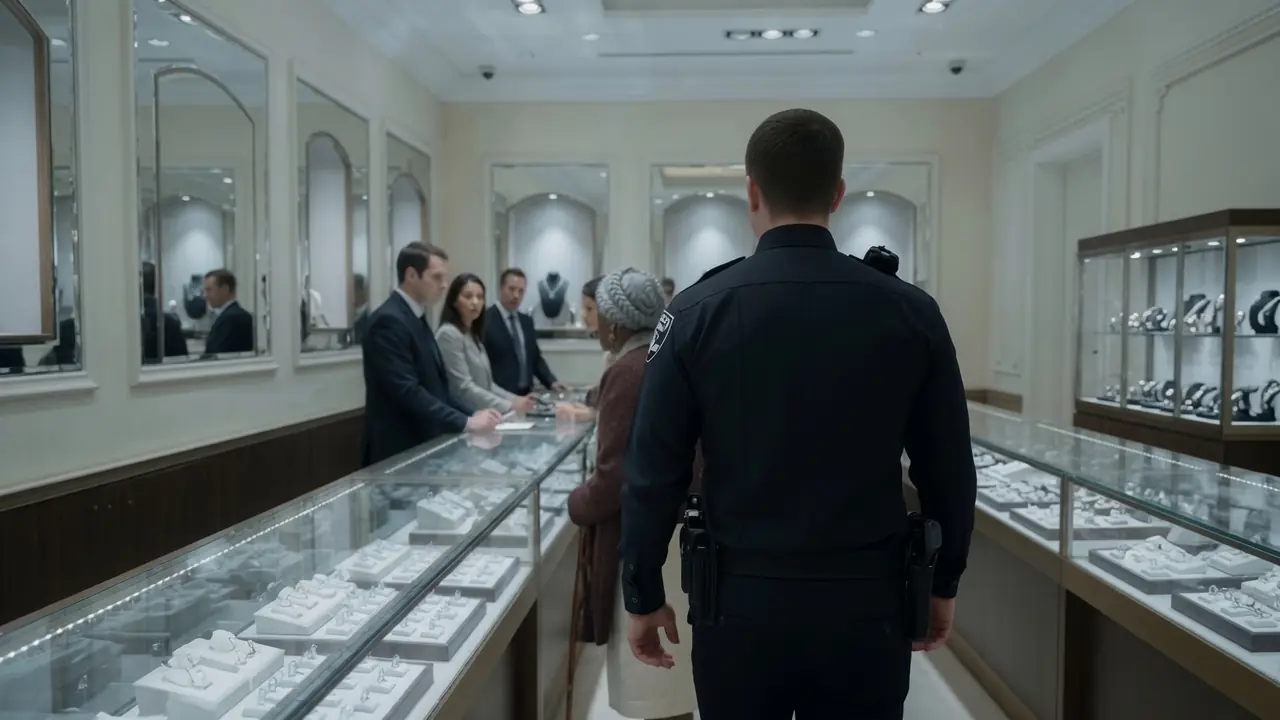
To anyone watching from across the showroom, she looked harmless. A small elderly Black woman with silver braids, a deep purple shawl around her shoulders, and careful steps that made the polished floor seem more dangerous than it was. Her cream dress brushed just below her knees, and her white shoes made almost no sound as she passed the glass cases filled with diamonds, pearls, gold bracelets, and watches worth more than some people’s cars.
The store was called Marlowe & Finch Fine Jewelry, one of the most expensive shops inside Crescent Mall.
Everything about the place was designed to make ordinary people feel small. Bright white lights shone down from recessed ceilings. Black velvet displays held necklaces beneath glass. Sales associates spoke in soft, practiced voices, as if money preferred quiet rooms.
The woman’s name was Ruth Bellamy.
At least, that was the name she had given when she entered.
She paused beside a case of pearl earrings and leaned slightly on her cane. Her face was lined with age, but her eyes were sharp behind the softness. They moved carefully, not with the wandering curiosity of a casual shopper, but with the patience of someone counting exits, cameras, employees, reflections in glass, and the movement of hands.
Nobody noticed that.
People often saw the cane first.
Then the gray hair.
Then the skin.
Then they stopped looking.
That was useful.
Ruth had built an entire career around the things people failed to notice when prejudice did the looking for them.
Near the entrance, security guard Blake Turner watched her from behind the counter with his arms crossed. He was young, broad-shouldered, and handsome in the clean, aggressive way of men who liked uniforms because uniforms made their ordinary cruelty look official. His black shirt was pressed, his badge polished, and his radio clipped high against his shoulder.
He had been watching Ruth since the moment she stepped inside.
Not because she had touched anything.
Not because she had acted suspiciously.
Because she did not look, in his mind, like the kind of person who belonged in a store where engagement rings cost six months of rent.
“Keep an eye on the woman by the pearls,” he murmured into his radio.
The sales associate near the bridal display glanced over.
“Which woman?”
Blake’s jaw tightened.
“The old lady.”
The associate hesitated.
“She’s just looking.”
Blake smiled without warmth.
“They always are.”
Across the showroom, Ruth bent slightly to study a necklace. Her hand trembled when she adjusted her shawl, but the tremor was not weakness. It was performance. Small, controlled, believable.
She knew Blake was watching.
She also knew he wanted her to know.
Men like him did not simply abuse power. They wanted an audience for it. They wanted the person beneath their suspicion to feel the pressure before anything happened, to become nervous enough to justify what the guard had already decided.
Ruth had seen it a hundred times.
In airports.
Banks.
Courthouses.
Luxury hotels.
Department stores.
Any space where wealth and whiteness had taught employees to treat a Black face as an exception requiring explanation.
A woman in a red blazer approached Ruth with a polite but guarded smile.
“Can I help you with anything today?”
Ruth looked up.
“Yes, dear. I’m looking for a gift.”
The associate’s expression softened slightly, though her eyes still flickered toward Blake.
“For someone special?”
“My granddaughter,” Ruth said. “She just graduated from Howard University.”
“That’s wonderful.”
“It is,” Ruth replied. “She wants to become a lawyer.”
The associate’s smile became more genuine.
“Then she’ll need something classic.”
“That’s what I thought.”
As the associate unlocked the case, Blake moved from his position near the entrance. He walked slowly, pretending to inspect the showroom, but every step brought him closer to Ruth. His hand hovered near his belt. His eyes kept dropping toward her shawl.
Ruth noticed the rhythm of his movement reflected in the glass case.
She also noticed the small object hidden in his right palm.
A pendant.
Gold.
Expensive.
Not from the case in front of her.
From the tray he had passed near the register.
There it was.
The first real confirmation.
For three weeks, the FBI’s financial crimes division had been investigating Marlowe & Finch after a pattern emerged across several high-end jewelry stores in three states. Elderly Black and Latino customers had been accused of theft, publicly humiliated, and pressured into signing civil settlement agreements to avoid arrest.
Most paid.
Some emptied savings accounts.
Some agreed to never return to the mall.
A few were arrested when they protested.
Later, missing inventory would be quietly written off through insurance. Store managers collected payouts. Security guards received cash bonuses for “loss prevention recoveries.” The customers became convenient villains in a scheme built on fear.
Ruth Bellamy was not an ordinary shopper.
Her real name was Special Agent Ruth Ann Bellamy.
She was sixty-eight years old, a senior undercover consultant with the FBI, and one of the most respected investigators in the bureau’s civil rights and financial exploitation unit. She had officially retired six years earlier. Unofficially, when cases required a person no one expected to be dangerous, people still called Ruth.
She had agreed to this operation because one of the victims reminded her of her sister.
Evelyn Bellamy had been seventy-one when a security guard at a luxury department store accused her of stealing a silk scarf she had never touched. Evelyn had cried in the security office while two managers threatened police involvement unless she paid “restitution.” She paid because she had grown up in a world where Black women learned that proving innocence was not always enough to survive an accusation.
Ruth never forgot the shame in her sister’s voice.
So when the FBI found a similar pattern at Marlowe & Finch, Ruth did not hesitate.
She put on the shawl.
She picked up the cane.
She walked into the store.
And Blake Turner decided to become exactly who the file said he was.
The sales associate laid a strand of pearls on black velvet.
“These are freshwater pearls,” she said. “Very elegant, but still modest.”
Ruth touched them lightly.
“My granddaughter has her mother’s neck,” she said. “Long and proud. Pearls would suit her.”
The associate smiled.
Behind Ruth, Blake moved closer.
His hand slipped toward the side pocket of her shawl.
It was quick.
Not quick enough.
Ruth felt the faintest tug against the fabric as the pendant disappeared into her pocket.
She did not react.
She did not look down.
She did not turn.
She only lifted the pearls a little higher, letting the store lights catch them.
“They’re lovely,” she said.
The associate began to answer.
Blake’s voice cut through the showroom.
“Ma’am.”
It was not a question.
The room changed immediately.
Customers looked over. A young couple near the engagement rings stopped whispering. A man in a gray suit paused with his wallet halfway out.
Ruth turned slowly.
Blake stood three feet behind her, his face arranged into a mask of stern satisfaction.
“Yes?” Ruth asked.
“I need you to step away from the case.”
The associate stiffened.
Ruth tilted her head.
“Have I done something wrong?”
Blake glanced toward the other customers, making sure they were listening.
“I think you know.”
Ruth’s face remained calm.
“I’m afraid I don’t.”
His eyes hardened.
“Empty your pockets.”
The sales associate whispered, “Blake, maybe we should—”
He raised a hand to silence her.
Not gently.
Not respectfully.
Like she was furniture that had made noise.
“I saw her take something,” Blake said.
A murmur passed through the store.
Ruth leaned on her cane.
“Did you?”
Blake smiled.
“Yes, ma’am. I did.”
The lie came easily.
That was the frightening part.
Not that he lied.
That he had done it enough times to sound comfortable.
Ruth looked around the showroom. She let her gaze move from customer to customer, from the cameras in the corners, to the manager now emerging from the back office, to the second security guard near the entrance who suddenly looked like he wanted to be somewhere else.
“Then perhaps you should call the police,” she said.
Blake laughed.
“Oh, we’ll get there.”
He stepped closer.
“But first, you’re going to hand back what you stole.”
Ruth’s fingers tightened slightly on the cane.
“I stole nothing.”
Blake’s voice grew louder.
“Ma’am, don’t make this harder than it has to be.”
It was one of those phrases people with power use when they have already decided hardness belongs to the victim. They create the situation, raise the threat, and then blame the other person for the tension.
Ruth had heard it in interrogation rooms.
She had heard it in civil rights complaints.
She had heard it from police officers who broke rules and called compliance peace.
She gave him a small smile.
“Hard for whom, Mr. Turner?”
His smile faded.
He had not told her his name.
His badge showed only B. Turner, but most people would not have noticed from that distance.
The manager, a thin white man named Leonard Price, stepped forward quickly.
“Is there a problem?”
Blake did not take his eyes off Ruth.
“She pocketed a pendant.”
The manager looked at Ruth.
Then at her shawl.
Then at Blake.
A flicker passed through his face.
Not surprise.
Calculation.
Ruth saw it.
So did the camera hidden inside the brooch at her collar.
Leonard sighed heavily, like this was all very unfortunate for him.
“Ma’am, we can handle this discreetly if you cooperate.”
Ruth looked at him.
“Discreetly?”
“Yes,” Leonard said. “Return the item, sign an acknowledgment, pay the recovery fee, and we won’t involve law enforcement.”
There it was.
The script.
Return the item.
Sign the paper.
Pay the fee.
Avoid police.
The entire scam compressed into one polished sentence.
Ruth lowered her eyes as if ashamed.
“How much is the fee?”
Leonard softened, sensing victory.
“That depends on the item, but usually between two and five thousand dollars.”
A woman near the watch display gasped softly.
Blake crossed his arms.
“You should be grateful he’s giving you a chance.”
Ruth looked at Blake.
“My, my,” she said quietly. “You rehearsed that.”
His face tightened.
“Empty your pocket.”
She did not move.
Blake stepped in and grabbed the edge of her purple shawl.
That was his second mistake.
His first had been planting the pendant.
His second was putting hands on her.
The showroom went silent.
Ruth looked down at his fist gripping the fabric.
Then she looked up into his face.
Her expression changed.
Not much.
Just enough for Blake’s confidence to hesitate.
“Take your hand off me,” she said.
He sneered.
“You don’t give orders here.”
Ruth smiled.
It was small.
Controlled.
Almost invisible.
“Are you certain?”
Blake jerked the shawl aside and reached into the pocket himself.
The gold pendant appeared in his fingers.
Several customers gasped.
The manager exhaled as though the matter had resolved exactly as expected.
Blake lifted the pendant high enough for everyone to see.
“What did I tell you?”
Ruth looked at the pendant.
Then at Blake.
Then at the cameras.
“I have never seen that before.”
“Of course you haven’t,” Blake said. “That’s what they all say.”
“They?”
He leaned toward her.
“You know exactly what I mean.”
The words were quiet enough that some customers missed them.
The brooch camera did not.
Ruth stepped closer.
Blake did not expect that.
Most victims stepped back at this point.
Most lowered their eyes.
Most began explaining too quickly, begging to be believed, trying to solve a game that had been rigged before they entered.
Ruth did none of those things.
She moved until she was close enough to see the sweat forming at his hairline.
Then she reached up with both hands and gripped the front of his uniform shirt.
The room erupted.
Blake froze.
For one wild second, he thought this old woman was going to attack him.
Instead, Ruth pulled him close and spoke softly enough that only he, Leonard, and the nearest customers could hear.
“You planted it with your right hand at 10:42 a.m., reflected in the south display case. Your manager offered the settlement script at 10:44. The hidden camera in my brooch has audio and video. The FBI van outside has been recording the store’s internal feed since opening.”
Blake’s face drained.
Ruth’s smile widened by a breath.
“Would you like to keep performing?”
He stared at her.
“What?”
Ruth released his shirt with one hand and reached into the inner fold of her shawl.
Out came a leather credential case.
She flipped it open.
Gold shield.
Federal Bureau of Investigation.
Special Agent Ruth Ann Bellamy.
The pendant slipped from Blake’s hand and clattered against the glass case.
Nobody spoke.
For a moment, the entire jewelry store seemed to lose gravity.
Blake looked from the badge to Ruth’s face.
“No,” he whispered.
Ruth tucked the badge close to his chest, close enough that he could see every engraved line.
“Yes.”
Leonard Price backed up one step.
Then another.
Ruth did not look away from Blake.
“You framed a federal agent for theft,” she said. “You placed stolen merchandise on my person, attempted to extort payment, and touched me without consent while doing it.”
Blake’s mouth opened.
No sound came out.
Ruth turned her head slightly.
“Leonard, if you take one more step toward that office, agents will meet you before you reach the door.”
The manager froze.
The customers turned toward the front of the store just as two men and one woman entered in plain clothes. They moved with calm precision, not rushing because rushing was for people who were not already in control.
Behind them came uniformed mall security, looking suddenly much less confident than before.
The lead FBI agent, Marcus Vale, stepped beside Ruth.
“You all right?” he asked.
Ruth released Blake’s shirt.
“I’ve had better shopping trips.”
Marcus glanced at the pendant on the glass.
“Is that the plant?”
“Yes.”
The female agent photographed it before placing it into an evidence bag.
Blake suddenly found his voice.
“I didn’t know she was FBI.”
Ruth turned toward him.
“That is not a defense.”
His eyes darted toward Leonard.
“I was following store policy.”
Leonard snapped, “Don’t say another word.”
Ruth smiled faintly.
“How quickly partnerships fail when prison enters the conversation.”
Marcus gave a small nod to the agents.
“Blake Turner, you are being detained pending charges related to fraud, civil rights violations, evidence tampering, extortion, and conspiracy.”
Blake recoiled.
“Conspiracy? This was a misunderstanding.”
“No,” Ruth said. “A misunderstanding is when you read the wrong price tag. What you did has paperwork.”
The associate in the red blazer covered her mouth.
She was crying.
Ruth looked at her gently.
“What’s your name, dear?”
“Marina.”
“Marina, did you know what they were doing?”
The young woman shook her head quickly.
“I thought—I mean, I saw them take people back sometimes. I thought maybe they really stole things. I didn’t know.”
Ruth studied her.
Fear.
Guilt.
But not the same cold calculation she had seen in Leonard’s face.
“Then tell the truth now,” Ruth said.
Marina nodded through tears.
“I will.”
Leonard tried to recover his dignity as the agents approached him.
“This is outrageous. I want my attorney.”
“You should call one,” Marcus said. “You are going to need someone with stamina.”
The arrest did not happen loudly.
That was what made it powerful.
No shouting.
No drawn weapons.
No dramatic tackle near the diamond cases.
Just handcuffs closing around the wrists of men who had spent months terrifying people who could not afford to fight back.
Customers recorded everything.
Within minutes, the video was online.
Elderly woman accused of stealing reveals she is FBI.
Security guard plants jewelry on Black shopper, immediately arrested.
Jewelry store scam exposed in real time.
But what the viral clips did not show was what happened in the back office after the store was cleared.
That was where the real story lived.
Agents opened file cabinets and found settlement forms organized by month. Ruth stood beside the desk and watched Marcus flip through folders.
Names.
Dates.
Fees.
Amounts paid.
Notes written beside customer descriptions.
Older Black female. Paid cash.
Latino couple. Threatened immigration comment effective.
Disabled male. Confused, easy.
Young Black mother. Refused payment. Police called.
Ruth’s face hardened with every line.
Marina sat in the corner, hands wrapped around a paper cup of water.
“I didn’t see those,” she whispered.
Ruth believed her.
Mostly.
But belief did not erase responsibility.
“Did you ever wonder why the same kinds of customers were always accused?” Ruth asked.
Marina cried harder.
“Yes.”
“And?”
“I told myself loss prevention knew more than I did.”
Ruth closed one folder.
“That is how bad systems survive. They borrow the silence of people who know enough to be uncomfortable but not enough to be brave.”
Marina covered her face.
“I’m sorry.”
Ruth’s voice softened, but not completely.
“Then be useful.”
By evening, Marlowe & Finch was closed.
By midnight, agents had warrants for three other stores connected to the same ownership group. By the next morning, the story had spread far beyond Crescent Mall.
Families who had signed settlement agreements began calling.
An elderly man from St. Louis said they had accused him of stealing cufflinks and made him pay four thousand dollars from his retirement account.
A grandmother in Atlanta said she had been held in a back room for ninety minutes while her granddaughter cried outside the door.
A nurse in Dallas said a guard told her she could either pay or explain to her employer why she had been arrested for theft.
The pattern grew.
So did the anger.
For Ruth, the case was no longer only professional.
It had never been only professional.
Two days after the arrests, she visited her sister Evelyn.
Evelyn lived in a small brick house with lavender bushes by the porch and photographs of grandchildren across the mantel. She opened the door with a crossword puzzle in one hand and immediately knew Ruth had come carrying something heavy.
“You got them?” Evelyn asked.
Ruth sat at the kitchen table.
“We got some.”
Evelyn poured tea.
“That means not all.”
“Not yet.”
The sisters sat quietly for a moment.
Then Evelyn said, “Did they do to you what they did to me?”
Ruth looked down at her hands.
“They tried.”
Evelyn’s face tightened.
“Were you scared?”
Ruth thought about lying.
Instead, she said, “For a second.”
Evelyn nodded.
“Good.”
Ruth looked up.
“Good?”
“If you had said no, I would know you were still carrying it wrong.”
Ruth understood.
Fear did not make her weak.
It made her human.
The difference between Ruth and the victims was not courage.
It was backup.
A badge.
A wire.
A team outside.
A system, for once, ready to believe her.
That thought stayed with her through the next week.
It stayed with her when the federal complaint was filed.
It stayed with her when Blake Turner’s attorney claimed he had been “overzealous but not criminal.”
It stayed with her when Leonard Price tried to say he was protecting the store from theft losses.
It stayed with her when the ownership group insisted the settlements were voluntary, as if fear did not know how to hold a pen.
Three weeks later, Ruth walked into the federal courthouse wearing a tailored gray suit, pearl earrings, and the same purple shawl.
Reporters filled the hallway.
Cameras turned toward her.
A young journalist asked, “Agent Bellamy, why did you personally go undercover?”
Ruth paused.
She could have said duty.
She could have said procedure.
She could have said the bureau needed evidence.
Instead, she said the truth.
“Because people believe old Black women when they are accused less often than they believe them when they are harmed. I wanted that on record.”
The hallway went quiet.
Then she walked into court.
Blake Turner sat at the defense table in a suit that did not fit his fear. Leonard Price sat beside his attorney, eyes fixed on the table. Behind them were executives from the ownership group, all suddenly invested in looking distant from policies that had made them money.
Ruth took the stand.
The prosecutor played the video.
There she was, bent slightly over the pearl case.
There was Blake’s hand, slipping the pendant into her pocket.
There was his accusation.
There was Leonard’s settlement offer.
There was Ruth’s badge.
The courtroom watched the whole trap reverse itself in silence.
When the defense attorney stood, he tried to sound calm.
“Agent Bellamy, isn’t it true that my client had no idea you were law enforcement?”
Ruth folded her hands.
“Yes.”
“So he could not have intended to frame a federal agent.”
Ruth smiled.
“He intended to frame a Black woman he believed had no power. The fact that he miscalculated which Black woman does not improve his character.”
The jury heard that.
So did the judge.
So did every reporter in the back row.
By the time Ruth stepped down, the case had already changed shape in the public mind. It was no longer a strange viral story about a guard accidentally targeting the wrong person.
It was a window into a machine.
A machine that needed certain people to be doubted quickly.
A machine that turned humiliation into revenue.
A machine that survived because most victims could not afford the time, money, or risk required to prove innocence.
The trial lasted nine days.
Marina testified on the fourth day.
Her voice shook as she described the settlement scripts, the back-room intimidation, the way employees were told to watch “certain profiles” more closely. She admitted she had not done enough. She admitted discomfort had not become action until the FBI arrived.
Ruth watched from the gallery.
She did not despise the young woman.
But she did not excuse her either.
That was the hard thing about justice. It had to make room for truth without sanding down the edges.
On the seventh day, victims testified.
Evelyn did not.
Ruth had asked her if she wanted to.
Evelyn said no.
“I lived it once,” she said. “I don’t need strangers grading my pain.”
Ruth respected that.
Instead, an elderly man named Walter Greene took the stand and described using his rent money to pay a false settlement because he feared dying in jail. A mother named Sofia Martinez described her twelve-year-old daughter watching security guards call her a thief. A college student named Alana Brooks described being handcuffed in a storage room over earrings that later appeared in an employee locker.
The jury did not look comfortable.
Good, Ruth thought.
Comfort had protected the wrong people long enough.
The verdict came late on a Friday.
Guilty on conspiracy.
Guilty on extortion.
Guilty on evidence tampering.
Guilty on civil rights violations.
Blake stared ahead as if language had stopped meaning anything.
Leonard lowered his face into his hands.
Outside the courthouse, reporters shouted questions.
Ruth did not answer many.
But when one asked what message she wanted the case to send, she stopped.
“The message is simple,” she said. “Do not confuse someone’s age, race, clothes, or cane for weakness. And do not build a system that only tells the truth when the victim turns out to have a badge.”
Months later, the Crescent Mall jewelry space reopened under a different name.
Not Marlowe & Finch.
Not even a jewelry store.
A community legal clinic moved into the space, funded in part by restitution from the ownership group. On opening day, Ruth stood in the doorway and looked at the spot where Blake had planted the pendant in her shawl.
The glass cases were gone.
So were the velvet displays.
In their place were desks, chairs, intake forms, and a play corner for children whose parents needed legal help.
Evelyn stood beside her.
“Better use of the room,” she said.
Ruth smiled.
“Much better.”
Near the front desk, Marina handed a clipboard to an elderly woman and helped her sit. After the trial, Marina had gone back to school for social work. Ruth had not expected that. She did not know if redemption was the right word.
Maybe repair was better.
Repair took longer.
Repair did not ask to be applauded.
As they turned to leave, a little girl tugged on Ruth’s purple shawl.
“Are you a lawyer?” the child asked.
Ruth bent slightly, one hand on her cane.
“No, baby.”
“Are you a judge?”
Evelyn laughed softly.
Ruth smiled.
“No.”
“What are you then?”
Ruth thought about it.
FBI agent.
Sister.
Witness.
Old woman in a jewelry store.
Trap.
Truth.
She tapped the child gently on the nose.
“I’m someone who checks pockets before believing stories about what’s inside them.”
The little girl frowned, confused.
Evelyn laughed harder.
Ruth straightened and looked once more at the room.
For years, people like Blake Turner had counted on shame doing half their work for them. They counted on victims lowering their heads, signing papers, paying fees, staying quiet. They counted on the world believing a guard before an old Black woman with a cane.
This time, they had been wrong.
Ruth stepped outside into the afternoon sun, her purple shawl moving softly in the breeze.
She walked slowly.
Not because she was weak.
Because she had nowhere to rush.
The work had been done properly.
And somewhere, in file rooms and court records and the memory of everyone who watched that video, the truth now stood exactly where the planted pendant once had.
In plain sight.