The fourth time Deputy Caleb Ward rode toward Rose Creek with a warrant folded inside his coat. He did not feel like a lawman. He felt like a fool. The Texas wind pushed dust across the road in thin brown sheets, rattling the dry grass and making the leather reins creak in his hands.
His badge sat heavy on his vest. His horse, Jasper, knew the road well by now. Too well. Three times before, Caleb had followed the same trail to bring in the same woman.
Maribel. The first time, he had found her on a stolen mare. The second time, beside two half-starved draft horses. The third time, kneeling in the dirt with blood on her sleeve and a broken stallion breathing against her lap.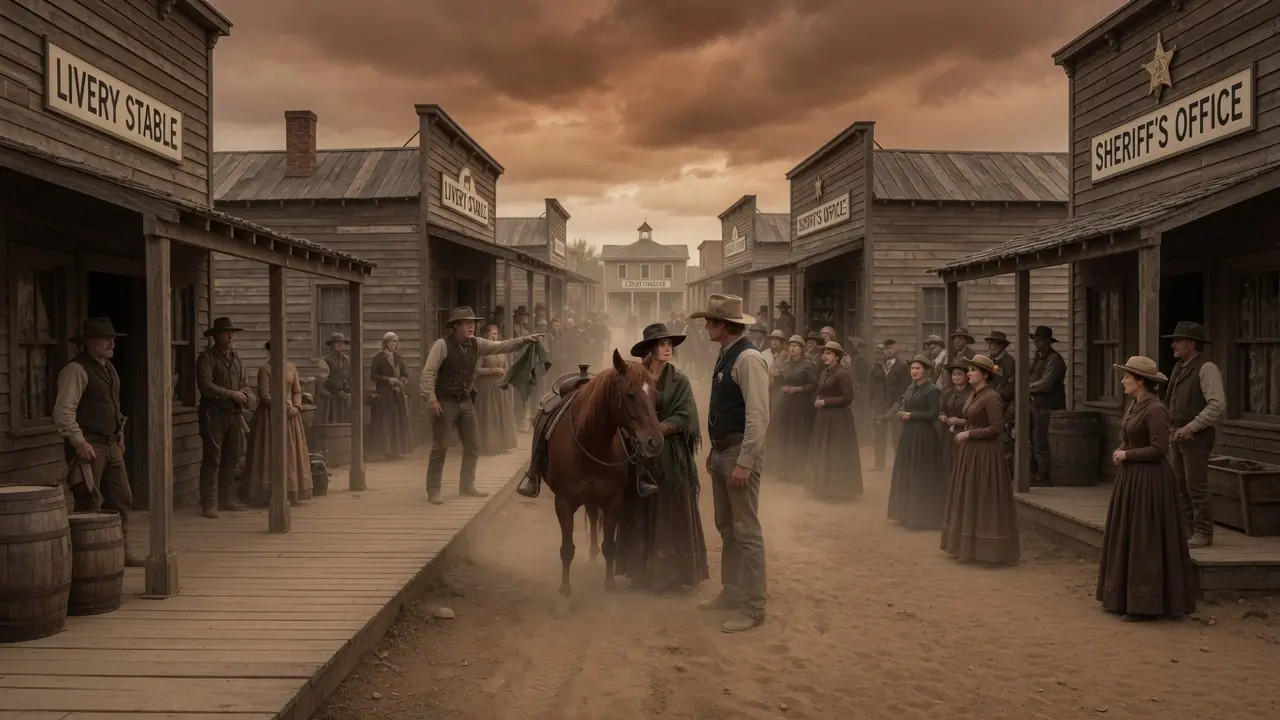
And now there was a fourth warrant. Only this time, Caleb had something else in his pocket, too. A small gold ring wrapped in a piece of blue cloth. A warrant in one pocket.
A ring in the other. No man in Rose Creek had ever carried two things that fought each other so badly. By law, he was supposed to arrest her again. By the truth that had been growing in him for over a year, he was supposed to ask her to stay in his life forever.
He could still turn back. He could ride to the sheriff's office, hand the paper to another deputy, and pretend his heart had not been ruined by a woman with dust on her boots and kindness in her hands. But Caleb Ward had spent too many years pretending. So, he rode on.
To understand why a deputy would fall in love with the woman he kept taking to jail, folks in Rose Creek would have to remember the first arrest. It happened on a cold January morning in 1886, when the town still wore frost along the edges of its watering troughs. Rose Creek was not much more than a courthouse, a church, two saloons, a livery stable, and a row of wooden buildings that leaned into the wind like tired men. Caleb Ward had been deputy there for three years.
He was twenty-nine, tall, quiet, and careful with his words. People trusted him because he did not shout unless there was no other choice. He had gray eyes, a strong jaw, and hands that looked too gentle for the work they did. He believed in the law because for most of his life the law had been the only thing standing between good people and men who took whatever they wanted.
Then Maribel walked into that belief and cracked it down the middle. Her name first came to him on a warrant signed by Judge Amos Reed. Maribel, age twenty-six, charged with stealing a chestnut mare from Silas Crow, owner of the Crow Livery Stable. Caleb had never heard of her.
That alone surprised him. In a town like Rose Creek, a woman could not sneeze without three people claiming to know why. He found her two miles south of town near a dry creek bed where cottonwood stood bare against the pale sky. She was sitting on the chestnut mare like she had all the time in the world.
One boot rested loose in the stirrup. Her dark auburn hair was tucked under a worn black hat. A faded green shawl hung over her shoulders and she was eating a biscuit from a cloth bundle. The mare stood calm beneath her, head low, ears soft.
Caleb stopped his horse a few yards away. “Maribel.” She looked at him without fear. “Depends who is asking.” “Deputy Caleb Ward.” “Then yes,” she said, “I reckon I am Maribel.” He glanced at the mare. “That horse belongs to Silas Crow.” Mara looked down and patted the mare's neck.
“That horse was beaten by Silas Crow.” “That is not what the warrant says.” “No,” she said softly. “Warrants do not mention the things men are ashamed of.” Caleb frowned. He had heard many excuses in his time. Men blamed whiskey, hunger, bad luck, and sometimes the devil himself.
But this woman did not sound like she was making an excuse. She sounded like she was stating a weather report. He dismounted and stepped closer. “You stole the mare.” “I took her before he ruined her.” “That is still stealing.” Mara's mouth tightened, but her eyes stayed calm.
“Then do what you came to do, Deputy.” There was something strange about the way she held herself. No begging, no running, no false tears. She simply sat there waiting as if she had known this moment would come from the second she untied the horse. Caleb reached for his handcuffs.
The mare shifted nervously, but Mara whispered something to her and ran a hand down the animal's neck. The mare settled. Caleb noticed the sores beneath the saddle blanket then. Raw patches, poorly hidden.
He noticed how thin the horse was across the ribs. He noticed the way Mara had placed a folded cloth under the girth to keep the leather from rubbing the wounds. His hand slowed. Mara saw him looking.
“Now you see her,” she said. “I saw her before.” “No,” Mara said, “you saw property. Now you see her.” The words struck harder than Caleb wanted to admit. He put the cuffs on her anyway.
He had no choice. At least that was what he told himself. Mara did not fight him. She only looked at his hands when he fastened the iron around her wrists.
“You do that gently,” she said. Caleb looked up. “Most men do not,” she added. He had no answer.
On the ride back to town, she sat straight in the saddle while Caleb led the mare beside his own horse. The road was quiet except for hoofbeats and the cold wind dragging dust over dry grass. After a long while, Caleb said, “Why take the horse yourself? You could have filed a complaint.” Mara gave a small laugh, but it held no humor.
“With who?” “The sheriff.” “The sheriff drinks coffee with Silas Crow every morning.” “Judge Reed, then.” “Judge Reed buys his carriage horses from Silas Crow.” Caleb looked ahead, jaw tight. Mara turned her face toward him. ““You still believe every door opens the same for everyone, Deputy.”” He did not answer because something in the question made him uneasy. At the courthouse, folks gathered quickly.
Word spread fast whenever a woman was brought in wearing cuffs. Mara stepped down from the horse with her chin lifted, but Caleb saw the way her fingers curled when people stared. Silas Crow stood by the courthouse steps, smiling like a man who had already won. “That is my mare,” he called.
“And there's the thief.” Mara did not look at him. But the mare did. The animal pulled back hard when Silas came near, eyes wide, hooves scraping the dirt. Caleb had to tighten his grip on the reins to keep her from rearing.
For the first time that morning, Mara's calm face broke. “Do not let him touch her,” she said. It was not a demand. It was a plea.
Caleb looked from Mara to the trembling mare, then to Silas Crow's polished boots and smug face. Something small shifted inside him. Not enough to change what he did next. Not enough to make him brave yet.
But enough that he remembered it. Judge Reed fined Mara fifteen dollars and ordered the horse returned to Crow. Mara paid with coins taken from a small cloth purse. Her hand trembled only once when she counted the last few pennies.
As she left the courthouse, Caleb stood near the door. “You should stop doing this,” he said. Mara paused. “Doing what?” “Taking horses that do not belong to you.” She looked past him to where the chestnut mare was tied outside, head low, body tense.
Then she looked back at “Caleb.” “When the law protects the cruel man and punishes the one who stops him, maybe it is the law that should stop first.” Caleb's face hardened because he did not know what else to do. ““That kind of talk will get you in trouble.”” Mara gave him a tired smile. “Deputy, trouble already knows my name.” Then she walked down the courthouse steps into the cold afternoon, leaving Caleb Ward with a badge on his chest, a question in his heart, and the uneasy feeling that he had just arrested the wrong person. He watched her until she disappeared beyond the livery stable.
He told himself he would forget her by supper. He did not. And three months later, when the second warrant landed on his desk, Caleb knew before he unfolded it whose name he would find. He would not forget her by supper.
He would not forget her at all. And as Mara disappeared into the gold dust beyond Rose Creek, Caleb did not yet know that the next time he rode to her land, it would not be with a warrant. It would be because his heart had already started making excuses to find her. For two weeks after the second arrest, Caleb Ward kept finding reasons to ride south.
At first, he told himself it was duty. Judge Reed had ordered Bellamy's draft horses kept under temporary care, and someone from the sheriff's office needed to check their condition. That someone did not need to be Caleb every time, but he volunteered before anyone could ask. The first Sunday afternoon, he rode to Mara's place with a notebook in his pocket and a serious look on his face.
Mara was mending a fence rail when he arrived. Her sleeves were rolled up, her hat was pushed low, and the same stubborn goat stood on top of a barrel as if guarding the yard. Mara glanced at Caleb's badge, then at his horse. “Is this an arrest or an inspection?” “Inspection.” “Of the horses.” ““Yes.”” “Then why are you staring at me?” Caleb looked away so fast she almost smiled.
“I was not.” “You are a poor liar for a lawman.” He cleared his throat and tied Jasper near the trough. “How is the gray?” “Samson stood this morning.” Caleb could not hide his relief. “Good.” “It was good,” Mara said. “He ate, too.” Not much, but enough to make me cry like a fool behind the barn.
You do not seem like a fool. No, she said, picking up her hammer. Just a woman who keeps getting arrested for caring too loudly. That should have ended the talk, but Caleb stayed.
He looked at it. “What is this?” “Water bucket.” “I know what it is.” “Then carry it.” “I came to inspect.” “And I am letting you inspect how heavy water is.” Caleb stood there silent. Mara turned back to the fence. Unless the sheriff's office forbids deputies from being useful.
A corner of Caleb's mouth moved before he could stop it. He carried the bucket. By sundown he had carried water, lifted a feed sack, and held a post steady while Mara nailed it in place. He told himself each thing was connected to the horses.
The lie became weaker every hour. When he finally mounted to leave, Mara stood by the fence with sawdust on her skirt. You helped today, she said. I inspected thoroughly.
She shook her head. Good night, Deputy. Good night, Ms. Bell. The next Sunday he came with oats.
The Sunday after that he brought liniment. By the fourth visit, he came with nothing at all and still stayed until the sky turned copper. They began to talk more. Not about love.
Not about longing. Not about the feeling that passed between them when their hands touched over a feed bucket and both pulled away too late. They talked about safer things. Horses, weather, bad fences, good coffee, the way Rose Creek changed when cattle drives passed through, the way lonely land could still feel full if a person listened long enough.
Mara told him she had been born near San Antonio and had learned horses from her father, Thomas Bell, a quiet man who could calm a wild colt just by standing near it. Her mother had died when Mara was young, and after her father passed, every safe thing in her life had been sold, taken, or buried. “Horses were the only creatures that never asked me to be softer than I was,” she said one evening. Caleb sat on the fence rail, his hat in his hands.
“And you?” Mara asked. “What about me?” “Lawman with sad eyes, there has to be a story.” Caleb looked out toward the pasture, where Samson grazed with careful steps. “My father was killed by men who knew no law.” Mara's face softened. “I am sorry.” “I was 16.
My mother said the law was all we had left. I believed her.” ““And now?”” He rubbed the edge of his hat with his thumb. “Now I think maybe the law is only as good as the hands holding it.” Mara did not answer, but the quiet between them changed. It grew warmer, deeper, more dangerous.
Folks in Rose Creek began to notice. A deputy riding south every Sunday was not a secret for long. A stable boy saw Caleb buying oats and laughed behind his hand. Mrs. Lindley at the general store asked if he wanted sugar for coffee or for Miss Bell's horses.
Men at the saloon made jokes when they thought Caleb could not hear. He heard. He said nothing. But Sheriff Nolan Price did.
One morning, Nolan called him into the back room of the office. The room smelled of old paper, tobacco smoke, and rain leaking somewhere behind the wall. Nolan shut the door. “Caleb?” “Yes, Sheriff.” “You are a good deputy.” Caleb went still.
Men did not start with praise unless trouble was standing close behind it. Nolan leaned against the desk. I will ask once. Are you sweet on Mara Bell?
Caleb looked at the floorboards. “That is not a law question.” “No, it is a man question.” Caleb took a slow breath. “I respect her.” Nolan snorted. “Respect does not ride five miles every Sunday carrying horse medicine.” Caleb said nothing.
The sheriff's voice lowered. You know what people are saying. ““I know.”” You also know another warrant could come across that desk any day. Caleb's jaw tightened.
Nolan stepped closer. If it does and her name is on it, can you do your job? The question sat between them like a loaded gun. Caleb wanted to say yes, a clean yes, a deputy's yes.
But all he could see was Mara's hands wrapped around a wounded horse's face. Mara counting coins with pride and shame fighting in her eyes. Mara standing in the evening light asking him if every door opened the same for everyone. “I do not know,” he said.
Nolan's face did not harden like Caleb expected. It grew tired. Then you better find out before Rose Creek finds out for you. That night Caleb did not sleep well.
Rain tapped against the window. The little room behind the sheriff's office felt smaller than ever. His badge hung on the chair beside his bed catching pale lamp light like an eye that would not close. He thought of his father.
He thought of his mother saying the law was all they had left. Then he thought of Mara. And he wondered what a man was supposed to do when the thing he had trusted all his life began pointing at the wrong person. The next Sunday he did not ride south.
He stayed in town, polished his boots, checked the jail locks, and told himself distance was wisdom. By noon he hated the silence. By evening he was standing outside the livery with a sack of sugar cubes in his hand feeling like the biggest coward in Texas. He turned to put the sack away.
That was when Mara rode into town. She came on the chestnut mare from the first arrest, the same one Crow had once claimed. Only now the horse's coat shone rich in the sun and her head was high. Mara had bought her back through three months of hard work and quiet deals.
Mara stopped near the watering trough. Caleb walked toward her before he could decide not to. “You did not come today,” she said. “I thought it was better.” “For whom?” He had no answer.
Mara looked at the sugar sack in his hand. Her expression softened then closed. “I see.” “It is not what you think.” “No.” She leaned slightly in the saddle. “Then tell me what it is.” Caleb glanced around.
Too many eyes watched from windows and porches. Not here. Mara's voice grew quiet. That is the trouble with you, “Caleb.” You keep choosing where the truth is allowed to stand.
The words struck him hard. Before he could answer, hoofbeats thundered at the far end of the street. A rider came in fast, dragging dust behind him. It was one of the hands from the Whitmore ranch, face pale, hat nearly gone.
He pulled up outside the sheriff's office and shouted, “Deputy! Sheriff! Mr. Whitmore's black stallion has been taken.” The street went still. The rider pointed straight at Mara.
“And she was seen near the pasture gate.” Mara's face lost color. Caleb turned toward her, the sugar sack slipping from his hand and spilling white cubes into the dust. The third warrant had not even been written yet. But in that one frozen moment, every soul on Main Street had already decided who was guilty.
The whole street seemed to hold its breath. Mara Bell sat frozen on the chestnut mare, while the Whitmore ranch hand pointed at her like his finger was already a sentence. Caleb Ward heard the wind scrape dust along the road. He heard a shutter creak somewhere above the general store.
He heard one sugar cube roll from the torn paper sack and tap against his boot. Nobody spoke at first. Then Silas Crow stepped out from the livery porch with a smile too thin to be honest. “Well,” he said loud enough for half the street to hear, “some habits are hard to kill.” Mara turned her head toward him, slow and sharp.
“You know nothing about my habits.” “I know horses go missing when you come around. A few men muttered. A woman pulled her child closer. The old fear of public judgment gathered fast, the way storm clouds gather over open prairie.
Caleb stepped into the road. Enough. His voice was not loud, but it carried. The Whitmore hand swallowed.
His name was Davey Pike, a young rider barely past twenty with dust in his hair and panic in his eyes. Sheriff Nolan came out of the office hat in hand. Start from the beginning, Davey. Davey pointed again at Mara.
I saw her near the north pasture this morning. Then Mr. Whitmore's black stallion was gone. Gate open, tracks heading south. Mara's jaw tightened.
I rode past the Whitmore fence at sunrise. I did not open any gate. Crow laughed under his breath. Course not.
Caleb turned on him. One more word and I will put you in a cell for disturbing the peace. Crow's smile faded, but not fully. Sheriff Nolan looked at Caleb, then Mara, then the watching street.
Davey, did you see her take the horse? No, sir, but who else would? Mara's face changed at that. Not anger this time, hurt deep and tired.
Caleb saw it and felt something twist in his chest. Sheriff Nolan spoke carefully. “No warrant yet, no arrest yet.” Crow shook his head. So, she gets special treatment now.
Nolan's eyes narrowed. She gets the same law as anyone else. Proof first. For a moment Caleb felt thankful.
Then Davey pulled a strip of green cloth from his coat pocket. Found this on the pasture gate. Mara looked at it. So did “Caleb.” It was the same faded green as the shawl she often wore.
The street went quiet again, but this quiet was worse. It was hungry. Mara's hand moved to her shoulder where her shawl lay folded. Caleb saw the torn edge before she did, a narrow piece missing from one corner.
Her lips parted. I do not know how that got there. Crow lifted both hands. Imagine that.
This time Caleb did not look at Crow. He looked at Mara. She met his eyes. There was fear there, but not the fear of being caught.
It was the fear of not being believed by the one person whose belief had started to matter. Caleb wanted to speak. He wanted to tell the whole town she had not done it. He wanted to stand in front of her and make every whisper stop.
But he had no proof. Only faith. And faith did not hold much weight in a courtroom. Sheriff Nolan took the cloth from Davey.
Caleb, ride out and look at the pasture. Take Davey with you. Caleb nodded. Mara sat straighter.
I am coming, too. No, Caleb said. Her eyes flashed. That stallion may be hurt.
If tracks head south, they may lead near dry gullies. A panicked horse can break a leg out there. This is an investigation. This is a living animal.
The two looked at each other while Rose Creek watched. Finally, Sheriff Nolan sighed. She can ride behind you, but Caleb, you keep her in sight. Crow snorted.
That should not be hard for him. Caleb took one step toward him. Crow stepped back. Mara said quietly, leave him.
Men like that feed on attention.” Caleb stopped. The words cooled him more than the wind could have. They rode out within minutes. Davey led the way, Caleb beside him, Mara a few lengths behind on the chestnut mare.
Sheriff Nolan stayed in town to speak with Mr. Whitmore and keep the crowd from growing into something uglier. The Whitmore ranch lay north of Rose Creek, spread across rolling land where mesquite trees broke the horizon. Its fences were tall, its barns freshly painted, and its gate bore a carved W that had cost more than Mara's whole cabin. The north pasture gate hung open when they arrived.
Caleb dismounted and crouched in the dirt. There were hoof prints, many of them. The black stallion had gone through fast. A rider's track stood near the gate, but the ground was too chopped up to make sense of them at first glance.
Mara slid from her saddle and moved toward the fence. Caleb looked up. ““Stay back.”” She stopped, but her eyes stayed on the ground. ““That is not where he left.”” Davey frowned.
“What?” Mara pointed. “A horse running scared does not step clean through a gate like that. Look at the deeper marks near the hinge. He fought before he moved.” Caleb studied the dirt.
She was right. The marks were uneven, torn into the earth. The stallion had not simply walked out. Something had frightened him or forced him.
Mara moved closer despite Caleb's warning. She knelt, her skirt brushing dust. “There,” she said. Caleb followed her gaze and saw a small dark smear on the fence rail.
Not much, just a streak. Mara touched it then smelled her fingers. “Coal oil.” Davey's face went pale. Why would there be coal oil on a pasture fence?
Mara looked toward the South Ridge. “Because someone wanted a horse afraid enough to run.” Caleb felt the case shift beneath his feet. A stolen horse was one thing. A frightened horse driven from a pasture was another.
They followed the tracks south. The trail led through scrub land and across a dry wash where the stallion had stumbled. Twice Mara dismounted to study the ground. Twice Caleb wanted to tell her to stay back.
Twice he held his tongue because she saw what he missed. By late afternoon the wind rose hard. Dust blew sideways across the land. The sky turned pale yellow.
Davey tied a cloth over his mouth. We should go back. Storm's coming. Mara did not slow.
He is close. How do you know? Caleb asked. She pointed toward a line of cottonwoods near the creek bed.
Birds keep lifting from there then settling again. Something large is moving under them. Caleb looked. He saw it then.
A dark shape beyond the trees. They rode closer and heard the stallion before they saw him. A wild broken sound cut through the wind. The black stallion stood trapped in an old wire fence near the creek bed.
One leg tangled. His coat shining with sweat. His eyes were wide. Foam marked his mouth.
Every time he pulled the wire cut deeper. Mara was off her horse before Caleb could speak. “Mara, wait.” She did not. The stallion reared as she approached nearly striking her shoulder with his head.
Caleb ran forward but she lifted one hand without looking back. “Do not rush him.” The wind whipped her hair loose from beneath her hat. Dust clung to her face. Her torn green shawl snapped against her back as she lowered her voice.
“Easy, boy, easy now. Nobody here is taking more from you.” The stallion trembled. His injured leg shook violently. Caleb stood a few steps behind her, helpless and amazed.
Mara moved closer inch by inch, not fearless. Caleb could see fear in the tight line of her mouth, but she did not let it rule her. The stallion tossed his head. She spoke again, softer.
That is right. Look at me, not the wire. Something in the horse changed. Not trust, not yet, just a pause.
Caleb used that pause. He pulled his knife and crouched beside the wire. Keep him steady. Mara placed both hands on the stallion's neck.
“I have him.” The wire was tight. Caleb sawed through one strand then another. The stallion jerked hard and Mara nearly fell, but she held on. Davey shouted, he will kill her.
“He will not,” Caleb snapped, cutting the last strand. The wire gave way. The stallion stumbled free and lurched sideways. Mara moved with him, one hand still pressed to his neck.
The horse took three uneven steps then stopped, shaking from nose to tail. For a long moment, no one spoke. Then Mara looked down. Caught on a broken piece of wire was a strip of cloth.
Not green. Blue. Caleb picked it up. Davey stared, that is not hers.
No, Caleb said. He knew that shade of blue. He had seen it that morning on Silas Crow's new neckerchief outside the livery. Mara saw recognition cross his face.
Caleb, she whispered, ““Someone sent this.”” Before Caleb could answer, a gunshot cracked far behind them. Not close enough to hit anyone. Close enough to warn. The stallion screamed and pulled against Mara's hands.
Caleb grabbed her arm and pulled her down behind the creek bank as another shot struck the dirt above them. Davey fell flat beside his horse, shaking. Mara's eyes locked on Caleb's. The accusation against her had become something far worse.
Someone did not just want her arrested. Someone wanted her silent. Caleb Ward kept Mara low behind the creek bank while dust drifted down over both of them. For one breath, then two, the world was nothing but wind, frightened horses, and the hard pounding of his own heart.
The black stallion pulled against Mara's grip, trembling from the gunshot. Mara held him with both hands, her cheek pressed near his neck, whispering through clenched fear. ““Easy, boy, easy. Do not give them what they want.”” Caleb lifted his head just enough to look over the bank.
The ridge behind them was empty now. Whoever had fired was gone, hidden by blowing dust and the crooked line of mesquite trees. Davey Pike lay flat on his stomach near his horse, face white as flour. “Deputy,” he whispered, “are they shooting at us?” Caleb looked at the bullet mark in the dirt, then at Mara's torn sleeve where he had dragged her down.
““Yes.”” Mara's eyes did not leave the stallion. ““Not us. Me.”” Caleb wanted to deny it, but the words would have been weak. Someone had planted green cloth to blame her.
Someone had frightened the stallion from Whitmore's pasture. Someone had left blue cloth on the wire, and now someone had fired warning shots as soon as the truth began to show. It was no longer a horse theft case. It was a trap.
Caleb crouched beside Mara. Can you move him? Mara studied the stallion's injured leg. Slowly.
If he bolts, he will tear it worse. The wind pushed loose hair across her face. Dust clung to her lashes. She looked scared, but not broken.
Caleb had seen men twice her size lose their nerve under less. He cut the last thin wire from the stallion's leg while Mara kept the horse steady. The wound was ugly, but not deep enough to ruin him if they got him back carefully. They finally stood, hands shaking.
We should ride straight to town. Caleb picked up the blue cloth from the wire and put it inside his vest pocket. “We will. But we do not ride in a line.” Whoever fired may still be watching.
Mara looked at him. “You think Crow did this?” “I think Crow is part of it.” “Part of what?” Caleb glanced toward the ridge. “That is what I need to find out before the whole town hangs guilt around your neck.” The words struck both of them. He had not meant hanging in the cruel sense.
He meant judgment, ruin, prison, a life marked by one more lie. Still, Mara's face tightened, and he wished he could take the word back. They moved slowly across the open land. Mara led the black stallion from the ground, speaking to him every few steps.
Caleb rode near her, one hand close to his holster, but never drawn. He did not want another shot to become a fight. He wanted truth. Truth was cleaner if a man could live long enough to bring it home.
By the time they reached Rose Creek, evening had turned the sky a bruised purple. Lamps glowed behind windows. Folks had gathered near the sheriff's office waiting for a story they could chew on. When they saw Mara leading Whitmore's black stallion, whispers ran through the street.
Mr. Grant Whitmore stood on the courthouse steps, stiff-backed in a dark coat. Silas Crow waited near him, blue neckerchief tied at his throat. Caleb saw it at once. A corner was missing.
His jaw tightened. Sheriff Nolan came down the steps. ““What happened?”” Caleb dismounted. “We found the stallion caught in old wire near the South Creek.
Someone drove him out with coal oil on the fence. Someone planted cloth from Miss Bell's shawl at the gate. And someone fired two shots at us when we found proof.” The crowd stirred. Crow gave a sharp laugh.
“That is a fine tale, Deputy. Convenient, too.” Mara stood beside the stallion, one hand still on his neck. Caleb turned toward Crow. ““Where were you this afternoon?”” Crow's eyes narrowed.
“At my livery.” ““All afternoon?”” ““Ask anyone.”” ““I will.”” Crow's smile returned. “Do that.” Mr. Whitmore stepped forward, his face troubled now instead of angry. He looked at the stallion's leg, then at Mara. “You brought him back.” Mara nodded.
“He needs cleaning, rest, and a good hand, not a proud one. He was frightened hard.” Whitmore swallowed. “I thought you took him. You and everyone else, she said.
There was no bitterness in her voice, and somehow that made it worse. Caleb pulled the green cloth from the sheriff's hand and held up the blue strip from the wire. This was caught where the horse was trapped. Crow's face changed so quickly most people missed it.
Mara did not. Sheriff Nolan did not. Caleb did not. Crow lifted his chin.
Lots of men wear blue cloth. Lots of men do, Caleb said, but yours is torn. All eyes shifted to Crow's neck. For the first time his confidence slipped.
Before anyone could speak, Mara stepped forward. Silas, why? Crow looked at her with a hard, ugly hurt in his face. Because you cost me money.
Because folks started asking questions after you took that mare. Because men used to bring me horses and not care what shape they were in, but now they look twice because of you. Mara's hand tightened on the stallion's lead rope. So, you blamed me.
I showed Rose Creek what you are. No, Caleb said, you showed what you are. Crow's eyes snapped to him. Careful, Deputy.
You are already too close to this woman. The crowd went silent. Caleb felt the words hit exactly where Crow meant them to. His badge, his duty, his secret heart no longer much of a secret.
Sheriff Nolan stepped in. Silas Crow, you will come with me. Crow took one step back. “For what?
A scrap of cloth?” “For questioning.” Crow's mouth twisted. You cannot prove I fired those shots. Caleb moved closer. “Maybe not yet.” Crow looked between the sheriff and the crowd, then threw up his hands like an innocent man insulted by fools.
But when Nolan took him inside, the street did not follow Crow with pity. It followed Mara with shame. That was worse for her. People looked away when she met their eyes.
Mrs. Lindley from the general store pressed a hand to her mouth. Davey Pike removed his hat and stared at the dirt. Mr. Whitmore walked to Mara slowly. I owe you an apology.
Mara's face stayed guarded. Your horse needs water. ““I know.”” No, she said, her voice low. You do not not yet.
Whitmore nodded as if accepting a sentence. Will you show my men how to tend him? Mara looked toward “Caleb.” He could not read her expression, but he saw the weariness behind it. Being right had not made her safe.
Being innocent had not erased the wound of being doubted. I will show them, she said, for the horse. She spent the next hour at Whitmore's stable, cleaning the stallion's leg by lantern light. Caleb stood near the doorway, watching without speaking.
The black stallion flinched at every sudden sound, but he let Mara work. Outside, the town murmured and shifted, hungry for the next version of the truth. When she finished, Mara washed her hands in a tin basin. The water turned brown with dirt and faint red from the horse's wound.
Caleb handed her a clean cloth. She took it without looking at him. Mara. She dried her hands slowly.
“I believed you.” At last, she looked up. “Did you?” The question hurt because he knew what she meant. “I did not arrest you.” “But you hesitated.” Caleb had no defense. She stepped closer, her voice quiet enough that only he could hear.
Do you know what it feels like to watch a whole town decide your soul by your worst rumor? I am trying to understand. No, “Caleb.” You are trying to stand in the middle. The lantern moved in the wind, throwing light across her face, then shadow.
The middle feels fair until someone is bleeding on one side of it. He looked down. “I have a badge.” ““I know.”” “And I have duties.” “I know that, too.” Her eyes softened for a moment, and that softness nearly undid him. But one day, Deputy Ward, you will have to choose whether you serve the law because it is right or because you are afraid to be wrong without it.
She walked past him before he could answer. Then Mara stepped into the dark street and rode home alone. Caleb watched her go with the blue cloth still in his pocket, and her words burning deeper than any bullet. That night, Silas Crow sat in a cell and said nothing.
But before dawn, someone slipped a note under the sheriff's office door. Caleb found it when the first gray light touched the floor. It had only one sentence. Leave Maribel alone, or the next shot will not miss.
Caleb Ward read the note three times before he breathed properly again. Leave Maribel alone, or the next shot will not miss. The words were written in dark pencil, each letter pressed hard enough to tear the paper in places. There was no name, no seal, no mistake about what it meant.
Sheriff Nolan stood beside him in the pale dawn light, shirt half-buttoned, gray hair still wild from sleep. Behind them, Silas Crow sat on the cot inside the cell, watching through the bars with a face too calm for a man in trouble. Nolan took the note from Caleb's hand. When did this come in?
“Before sunrise. I found it under the door.” Nolan looked toward Crow. You know anything about this? Crow leaned back against the wall.
I have been in your jail all night. That does not mean your friends have. Crow smiled faintly. Friends?
I thought I was the most hated man in Rose Creek this morning. Caleb stepped closer to the bars. Who helped you at Whitmore's fence? Crow's eyes moved to him.
I do not know what you are talking about. You planted Mara's cloth. You drove the stallion out, but you did not fire those shots from the ridge while standing in town. Crow's smile faded.
Caleb's voice lowered. So, who did? Crow stood slowly. You should listen to the note, Deputy.
Nolan moved between them before Caleb could step closer. That is enough. But it was not enough, not even close. Caleb knew it in his bones.
Crow was guilty of something, but not all of it. The blue cloth had exposed him, yet the warning note had widened the danger. Someone else wanted Mara frightened. Someone with enough nerve to shoot near a deputy, and enough hate to threaten another shot.
Caleb folded the note and placed it in his pocket beside the blue cloth. “I am riding to Mara's.” Nolan's face hardened. You are not going alone. “I have to warn her.” I said you are not going alone.
Caleb stopped. His hand was already on his hat. Nolan sighed. Take Deputy Finch and “Caleb.” “Yes.” “Do not let your heart outrun your head.” That is how good men get buried.
Caleb did not answer because his heart had already left town. By the time he and Deputy Finch reached Mara's land, the sun was climbing behind thin clouds. The little cabin stood quiet beneath the cottonwood tree. The paddock gate was open.
The stubborn goat was gone from its barrel. Caleb felt the world tilt. Mara, he called. No answer.
He dismounted before Jasper fully stopped and ran to the cabin. The door hung open, moving slightly in the morning wind. Inside, the room was small and neat. A kettle sat cold on the stove.
A chair had been knocked over. A cup lay broken near the table, coffee dried across the floorboards. Caleb's hand went to his revolver, but he did not draw. Mara.
Deputy Finch stepped in behind him. Looks like a struggle. Caleb saw something on the table then. A folded letter pinned beneath a small horseshoe.
His name was written across it. Caleb picked it up with a hand that did not feel like his own. Deputy Ward, do not come after me unless you are willing to lose that badge. I am going to settle this before more animals or people get hurt.
Crow is only the small end of a larger rope. If I am right, Whitmore's stallion was not the first horse they used, and it will not be the last. Tell Samson and Moses I will be back. Mara.
Caleb read the letter again, anger and fear tightening around each other inside him. She left on her own, Finch said. Caleb looked at the broken cup, the overturned chair, and the tremble in the handwriting near the end. Maybe.
Finch frowned. What do you mean? She wanted me to think she left on her own. Caleb moved through the cabin, seeing small things now.
The drawer near her bed was open. A blue ribbon lay on the floor. Her spare coat was still on its peg. A woman riding out to face danger did not leave without her coat when clouds were building over the north hills.
Then he saw tracks outside the back window. Two horses, one with a chipped shoe. The same mark he had noticed in the dirt near Whitmore's gate. Caleb knelt, touched the print, and felt cold certainty settle in him.
“She was taken.” Finch swallowed. “By whom?” Caleb stood. “Someone who wanted a letter left behind.” They followed the tracks east, keeping low through the brush as the wind rose. The trail crossed the creek, circled behind a stand of mesquite, then bent toward an abandoned line shack near the old cattle road.
Caleb knew the place. Years ago drovers had used it when storms caught them between ranches. Now it leaned crooked under the sky, its roof sagging, one wall patched with hides and boards. Smoke rose from the chimney.
Caleb and Finch tied their horses in the trees. From behind a fallen log, Caleb saw two men outside the shack. One was narrow and quick-looking with a red scarf around his neck. The other was heavy-set, holding a rifle loose in his hands.
Neither was Silas Crow. A third horse stood tied near the door. Mara's chestnut mare. Caleb's chest tightened until it hurt.
Inside the shack, Mara Bell sat tied to a chair, wrists bound in front of her. Her hat was gone. Her hair had come loose around her face. There was dust on her cheek, but her eyes were clear and sharp.
A man stood before her, tall and well-dressed for such a rough place. Grant Whitmore. Caleb stared, not understanding at first. Then every piece began to turn.
Whitmore's anger had faded too quickly. His apology had come too smoothly. His ranch hand had pointed at Mara with fear that might not have been fear of her at all. Whitmore held Mara's folded shawl in one hand.
You should have stayed with sick horses and poor women's pride, he said. You should not have started asking where Crow got his orders. Mara lifted her chin. You used Crow to ruin me.
I used Crow because he was cheap. And the stallion? Whitmore's mouth tightened. The stallion was becoming a problem.
Too wild to sell, too famous to destroy without questions. If he disappeared and you were blamed, both problems solved. Mara's voice stayed steady, but Caleb saw her fingers twist against the rope. How many horses before him?
Whitmore leaned closer. Enough that a woman like you should have known better than to count. Caleb's hand closed around the note in his pocket. Finch whispered,”“We need to go back for help.”“Caleb did not move.
Inside, Whitmore placed the green shawl on the table.”You will sign a confession. You will say you stole the stallion, Crow helped sell it, and then you ran after threatening the deputy.“Mara gave a small, bitter laugh.”You really do think money can write truth.“Whitmore struck the table with his palm.”Money writes most of what people believe.“The heavy-set man outside turned toward the sound, but did not enter. Caleb looked at Finch.”“Circle behind. When I move, cover the back door.”“Finch's eyes widened.”“Sheriff said not to let your heart outrun your head.”“”“My head heard a confession.”“Before Finch could argue, Caleb stood and walked straight into the clearing.
The heavy-set man lifted his rifle.”Stop there.“Caleb raised both hands, but his voice was iron.”“Deputy Caleb Ward. Put the rifle down.”“The man hesitated. Whitmore stepped into the doorway, face pale with shock, then anger.”Deputy,“he said,”you are far from town.“”“So are you.”“Whitmore recovered quickly.”Miss Bell broke into my property. We found her trying to flee.
I was bringing her in.“Caleb looked past him. Mara's eyes met his through the dim doorway. For one second, all the fear in her face disappeared. Then Whitmore saw it.
He smiled slowly.”Oh,“he said,”Crow was right. You are too close to this woman.“Caleb lowered his hands.”“I heard enough.”“”“You heard nothing that will matter.” ““I heard you say you used Crow. I heard you demand a false confession.” Whitmore stepped down from the doorway. And who will believe you?
The deputy who has been visiting the accused woman every Sunday? The words hit hard because they were dangerous. True in one way, twisted in another. Whitmore came closer.
You think your badge protects her? That badge is the only reason anyone listens to you. Take it off and you are just another fool with feelings. Caleb looked at Mara again.
She was watching him with that same question she had asked without speaking since the day he first put cuffs around her wrists. Who are you when the law is not easy? Caleb reached slowly to his vest. Whitmore smiled thinking he had won.
But Caleb did not reach for his gun. He unpinned his badge. The clearing went silent. Caleb held the badge in his hand feeling the weight of every year he had trusted it more than his own heart.
Then he placed it on a flat stone between himself and Whitmore. “You are wrong.” Caleb said. “This badge never made me honest. It only gave me a duty to prove I was.” Whitmore's smile vanished.
From behind the shack, Finch shouted, ““Drop the rifle.”” The heavy-set man turned too late. Finch had him covered. The man with the red scarf bolted toward the trees, but Caleb moved fast, caught him by the coat, and drove him hard into the dust without firing a shot. Whitmore reached for the pistol under his coat.
Mara kicked the chair sideways with all her strength, slamming into him before he could draw clean. Caleb crossed the distance in three strides and seized Whitmore's wrist. The pistol fell into the dirt. For a moment, Caleb and Whitmore stood chest to chest, both breathing hard.
Then Caleb twisted his arm behind his back. “Grant Whitmore,” Caleb said, voice shaking with anger he barely held back, “you are under arrest.” Mara, still tied to the fallen chair, looked up at him. “For what?” Whitmore spat. Caleb looked at Mara first, then at the badge lying on the stone.
““For trying to bury the truth and calling it law.”” The ride back to Rose Creek felt longer than the road had any right to be. Caleb Ward rode in front with Grant Whitmore's wrists tied and his own badge wrapped in a handkerchief inside his coat pocket. Deputy Finch followed with the two hired men, both quiet now that their rifles were gone. Mara rode behind them on her chestnut mare, free from the ropes but not free from what had happened.
The sky had gone heavy with storm clouds. Thunder moved far away over the plains like a wagon rolling across heaven. Nobody spoke for the first mile. Caleb kept looking back.
Each time, Mara was still there, sitting straight in the saddle, one hand pressed around the red mark the rope had left on her wrist. Her face was calm, but Caleb had learned her silences by now. This one was not peace. It was pain held together by pride.
He wanted to ride beside her. He wanted to ask if she was hurt. He wanted to tell her he should have protected her sooner. But Whitmore rode between them like the living shape of every mistake Caleb had made.
At last Whitmore broke the silence. “You understand this will ruin you.” He said. Caleb did not look at him. ““Save your breath.” “You had no warrant for me.”” ““I heard your confession.” You heard words in a shack from a man you already wanted guilty.” Deputy Finch called from behind.
““I heard him, too.”” Whitmore twisted in the saddle. “You are a fool if you stand with him.” Finch's young face flushed, but his voice stayed steady. ““Maybe, but today I reckon I am standing on the right side.”” Mara's eyes lifted to Finch with quiet thanks. Caleb saw it and felt both gratitude and shame.
It had taken a young deputy only one day to choose what Caleb had taken months to understand. The storm followed them into town. Rose Creek's main street was crowded before they reached the sheriff's office. Word traveled faster than hoofbeats on the frontier.
Folks had heard Mara was missing. They had heard Caleb had ridden after her. They had heard shots, lies, and guesses, each version worse than the last. When the riders appeared, every porch filled.
Silas Crow stood behind the bars of the sheriff's front window, watching like a caged fox. Sheriff Nolan came into the street. His expression hard until he saw Whitmore tied on a horse. Then he looked at “Caleb.” Then at Mara.
““What happened?”” Caleb dismounted. His legs felt stiff, but his voice did not shake. “Grant Whitmore held Miss Bell against her will and tried to force a false confession. He admitted using Crow to frame her for the stallion's disappearance.
Deputy Finch heard enough to confirm it. The crowd stirred. Whitmore laughed sharply. This is madness.
A deputy chasing skirts and calling it justice. The words moved through the crowd like poison. Mara went pale, but she did not lower her head. Caleb stepped toward Whitmore.
For one dangerous second, he wanted to silence him with his fist. Instead, he reached into his coat and took out the handkerchief. He unfolded it. His badge lay in his palm.
Every whisper died. Sheriff Nolan's face changed. “Caleb.” Caleb held the badge out. I took it off before I arrested him.
Nolan stared at it. “Why?” Caleb looked at Mara first, then he faced the town. Because he said this badge was the only reason anyone would believe me. I needed to know if I was telling the truth because I wore it or because it was true.
The street went still. A wagon horse shifted near the mercantile. A child coughed. Rain began to tap lightly on the porch roofs.
Whitmore smiled, sensing weakness. There, you heard him. He acted as a private man, not an officer. Sheriff Nolan's eyes moved to Deputy Finch.
Did Whitmore confess? Finch nodded. Yes, sir. He said he used Crow.
He said the stallion was a problem. He told Miss Bell to sign a lie. Nolan turned to the two hired men. And you two?
The man with the red scarf looked at Whitmore, then away. The heavy-set one swallowed. Mr. Whitmore paid us to watch the shack. Said the woman was dangerous.” Mara gave a small, tired laugh.
“Dangerous.” The word broke something in the crowd. Mrs. Linley stepped off the general store porch. “She saved my boy's pony last winter.” A blacksmith near the hitching rail cleared his throat. “She patched up my mule when I had no money.” An old ranch hand removed his hat.
“She never took a horse that was treated right, not once that I know of.” One by one, Rose Creek began remembering what it had chosen to ignore. Whitmore's face reddened. “You people are fools. She stole horses.” Mara looked at him then.
“No, I saved what men like you wanted to break quietly.” Sheriff Nolan took the badge from Caleb's hand, studied it, then pressed it back against Caleb's chest. “You can wrestle with your conscience later,” Nolan said. “Right now, I need my deputy.” Caleb looked down at the badge. He did not feel clean, not yet.
But he pinned it back on. Nolan turned to Whitmore. “Grant Whitmore, you are under arrest for unlawful restraint, attempted coercion, conspiracy, and filing false claims before this office. There may be more after Judge Reed hears the evidence.” Whitmore's face went white.
“You cannot do this.” Nolan took his reins. “I believe we just did.” As Whitmore was led inside, Silas Crow began shouting from his cell. “He made me do it. Whitmore paid me.
I did not know they would take the woman.” Nolan stopped in the doorway. “You can tell that to the judge.” The rain came harder. People hurried under awnings, but stayed in the street. Water darkened her shawl.
Dust turned to mud around her boots. Caleb walked toward her slowly, afraid that if he came too fast, she might leave. “Mara,” he said. She looked exhausted.
““Are you hurt?”” ““Not much.”” ““That is not an answer.”” ““It is the answer I can afford right now.”” He swallowed. ““I should have believed faster.”” Her eyes softened, but only a little. ““Yes.”” The word was plain and deserved. Caleb nodded as if accepting a sentence.
“I thought standing in the middle made me fair,” he said. “But you were right.” “The middle can be a cruel place when one side is lying.” Mara looked toward the jail, where Whitmore and Crow were being locked away. “I did not need you to be perfect, “Caleb.”” ““What did you need?”” Her voice grew quiet beneath the rain. ““I needed to know you would stand where the truth stood.”” “Even if I was the only one standing there.” Caleb felt the words enter him and settle deep.
““I am standing there now.”” “““I know.””” But she did not smile. That was when he understood. Some choices, even right ones, came late enough to leave bruises. Sheriff Nolan called from the office.
“Caleb, Judge Reed wants statements before dark.” Caleb looked at Mara. ““Will you come inside?”” She shook her head. ““Not yet.”” “Mara.” “I need to see Samson and Moses.” “I need to know my place is still standing.” “I need to breathe where nobody is looking at me like a case.” He wanted to argue. He wanted to keep her near where he could guard the door and the road and every shadow.
But love, if that was what this had become, could not begin as another kind of cage. So he stepped back. I will ride out after the statements. Mara mounted slowly.
Before she turned away, she looked down at him. You should finish what the law needs from you first. And after? For the first time that day, a faint, sad smile touched her face.
“After, Deputy Ward, we will see what is left of us when the dust settles.” She rode south through the rain. Caleb stood in the muddy street and watched until the gray curtain swallowed her and the chestnut mare whole. Inside the sheriff's office, men were waiting to confess, deny, bargain, and lie. But Caleb's mind stayed on Mara's last words.
What is left of us? By nightfall, he would learn the answer might depend on a hidden ledger, a burned barn, and one more secret Whitmore had buried deeper than anyone knew. By the time Caleb Ward finished taking statements, night had settled over Rose Creek like a wet blanket. Rain tapped against the sheriff's office windows.
Lantern light shook on the walls. The floorboards were muddy from boots coming in and out. Grant Whitmore sat in the first cell, silent now, his fine coat hanging damp from his shoulders. Silas's crow sat in the second, talking too much and saying too little.
Deputy Finch had written until his fingers cramped. Sheriff Nolan had sent a rider to Judge Reed's house. Mr. Whitmore's hired men had given statements that matched in the places fear made men honest. But it still was not enough.
Caleb knew it. Whitmore had money, lawyers, and friends who owed him favors. A few frightened men and a deputy's word might bruise him, but it might not break him. By morning, some powerful person would start whispering that Mara Bell had confused everyone again.
By noon, somebody might call Caleb too emotional to be trusted. Truth needed roots. Not just words. Proof.
Caleb stood near Crow's cell holding the blue cloth from the wire. Crow watched him with red eyes. “I told you already, Whitmore paid me to plant the shawl strip.” “Who gave you Mara's shawl?” Crow looked away. Caleb stepped closer.
“Silas.” Crow's mouth twisted. “You think you are better than me now because you fell for her.” Caleb did not answer. Crow gripped the bars. “You do not know what it is like to owe money to a man like Whitmore.
You do not know what he can take.” “What did he take from you?” For once Crow's face lost its sneer. “My livery if I crossed him, my feed contracts, my credit at the bank.” “So you helped him ruin an innocent woman.” Crow looked at the floor. “He said she would only be scared out of town.” Caleb's voice hardened. “She was tied to a chair.” “I did not know that.” “But you knew enough to keep your mouth shut.” Crow did not answer.
Sheriff Nolan came in from the back room wiping rain from his hat. “Judge wants formal testimony at nine o'clock in the morning. Whitmore's lawyer is already making noise.” Caleb turned. “We need more.” “““I know.””” “There has to be a record somewhere.
Payments, horse sales, something.” At the word horse, Crow's eyes flickered. Caleb saw it. He moved back to the bars. “Where is the ledger?” Crow swallowed.
“What ledger?” The one Whitmore used to track the horses he moved through you. Crow laughed weakly. You are guessing. Yes, Caleb said.
And your face just told me I guessed right. Crow backed from the bars. Sheriff Nolan stepped beside “Caleb.” Silas, you are already standing in deep mud. You can either sink with Whitmore or start walking toward daylight.
Crow looked toward Whitmore's cell. Whitmore did not move, but his eyes were sharp and cold. Say nothing, Whitmore said. Crow's face went pale.
Caleb lowered his voice. He will not save you. Men like him do not share ropes. They hand one end to poorer men and ride away.
Rain rattled harder against the roof. Crow closed his eyes. “In the old tack room,” he whispered. Whitmore stood.
You fool. Crow flinched but kept talking. Behind the loose plank under the saddle rack, small brown ledger. Names, dates, marks, payments.
I kept it because I knew he would blame me someday. Caleb looked at Nolan. Nolan took down a shotgun from the wall. Finch stays here.
You and I ride. Caleb reached for his hat. Then he stopped. Mara.
Her place lay south alone in the rain. She had been threatened, taken, and nearly ruined. Every part of him wanted to ride there first. Nolan saw the struggle.
Go check on her, the sheriff said. I will get the ledger. Caleb shook his head. No.
If that ledger disappears, everything today becomes a story people can doubt. Nolan studied him for a moment. Then he nodded. The ride to Crow's livery was short, cold, and quiet.
They entered through the back, lanterns low. The tack room smelled of leather, dust, and old hay. Caleb found the loose plank beneath the saddle rack and pulled it free. The brown ledger was there.
So was a small bundle of cloth. Green cloth. Pieces from Mara's shawl, cut and saved. Caleb felt anger rise so strongly, he had to close his hand around the lantern handle until it hurt.
Nolan opened the ledger. Page after page showed horse descriptions, owners, false sale dates, and payment marks. Some horses had been listed as stolen, some as dead, some as transferred through Crow's stable to buyers two counties away. At the back, Caleb found a note in Whitmore's handwriting.
Bell woman becoming trouble. Make her the answer before she becomes the question. Sheriff Nolan read it once. “That will hold,” he said.
Caleb folded the note carefully and slipped it inside the ledger. Then a red glow flashed through the rain outside. For a second, Caleb thought lightning had struck. Then someone shouted from the street.
““Fire!”” Caleb ran out into the rain. At the south edge of town, beyond the last buildings, an orange glow rose against the wet black sky. His heart stopped. South.
Mara's direction. He was on Jasper before Nolan could call his name. The rain should have slowed a fire, but when Caleb reached Mara's land, her barn was burning hot and wild, fed by oil and dry hay stacked inside. Flames climbed the walls.
Smoke rolled under the low clouds. Horses screamed from the paddock. Mara was already there. Of course she was.
She was dragging open the barn door with a wet blanket wrapped around her shoulders, coughing hard, hair loose, face streaked with soot. “Mara!” Caleb shouted. She did not hear him over the fire. Samson and Moses were trapped inside.
The black draft horse slammed against the stall door. The gray cried out, weak and terrified. Caleb leapt from Jasper and ran to her. ““Mara, get back!”” ““I cannot leave them.”” ““The roof will fall.”” ““Then move faster.”” There was no time to argue.
Together, they went into the smoke. Heat struck Caleb's face like an open furnace. His eyes burned. Mara moved low, knowing the barn in darkness better than he knew it in daylight.
She reached Moses first, fumbling with the latch while Caleb pulled at the swollen wood. The door burst open. Moses bolted past them into the rain. A burning beam cracked overhead.
Mara turned toward Samson's stall. Caleb grabbed her arm. “I will get him.” ““He trusts my voice.”” She tore free and stumbled through smoke toward the gray horse. Caleb followed, coughing, half blind.
Samson was panicking, backing away from the flames, tangled in a rope that had been left too neatly across the stall. Not accident. Trap. Mara climbed over the lower rail and reached for him.
“Samson, listen to me. Listen. The horse shook violently. Caleb cut the rope with his knife.
Another beam cracked. “Mara, now.” Samson lunged forward. Caleb threw his shoulder against the stall gate and forced it open. The grey horse rushed out, knocking Caleb into the wall.
Pain shot through his side, but he stayed standing. Mara pushed Samson toward the door. For a moment, it looked like they would all make it. Then the roof above the far corner gave way.
A burning section crashed down between Mara and the doorway. Caleb's blood turned cold. Mara stood on the other side of the flames, coughing, one hand over her mouth. “Caleb.” He looked around desperate.
The side wall was weaker, patched with old boards. He grabbed a shovel and swung hard, once, twice. The boards cracked, but did not give. Smoke swallowed the room.
Mara dropped to one knee. Caleb swung again with everything he had. The wall broke open. Rain rushed in.
He climbed through the gap and reached for her. She took his hand. For one awful second, the burning frame caught her shawl. Caleb yanked it loose, pulled her through the broken wall, and they fell together into the mud outside.
Behind them, the barn groaned and collapsed inward, sending sparks into the rain. Mara lay coughing against the wet ground. Caleb turned her carefully.”Look at me,“he said, voice breaking.”Mara, look at me.“Her eyes opened. Soot marked her cheek.
Her hand trembled as it gripped his sleeve.”“The horses.”“He looked over his shoulder. Samson and Moses stood in the rain near the paddock, shaking but alive.”They are out,“he said. Only then did Mara close her eyes and let herself breathe. Caleb bowed his head over her hand, rain running down his face.
For all his badge, all his laws, all his careful pride, he had nearly lost her to a truth they found too late. Mara's fingers tightened weakly around his.”“Now do you see?”“she whispered. Caleb looked at the burning barn, the rescued horses, the ledger tied inside his coat, and the woman who had risked everything for lives no one else counted.”Yes,“he said. And this time, he did not mean the case.
He meant her. By sunrise, the burned barn looked like a black wound against the gray Texas sky. Smoke still lifted from the fallen beams in thin, bitter lines. Rainwater had turned ash into dark mud.
The fence near the paddock was broken where the horses had pushed through in fear, and the cottonwood tree beside Mara Bell's cabin dripped steadily, leaf by leaf, like it was counting what had almost been lost. Mara sat on the porch, wrapped in Caleb's coat. Her face was pale beneath the soot. One hand held a tin cup of coffee she had not touched.
The other rested on the porch rail, fingers curled loosely around the edge as if she needed to feel something solid under her palm. Caleb stood near the steps, watching the road. He had not slept. Neither had she.
Sheriff Nolan had arrived before dawn with Deputy Finch and two men from town. They had searched the burned ground and found what Caleb already feared. A broken coal oil jug near the back wall. Boot prints behind the barn.
A rope tied across Samson's stall in a way no frightened horse could have done by accident. The fire had not been bad luck. It had been a message. But this time, Whitmore's message had come too late.
The ledger was safe inside Caleb's coat, wrapped against the rain. The note in Whitmore's handwriting was safe inside the ledger. Crow's hidden cloth bundle had been found. The hired men had confessed enough to begin pulling down the whole lie.
Truth at last had weight. Sheriff Nolan walked from the barn ruins, his boots black with ash.”Mara,“he said gently, “I am sorry.” She looked at him tired but steady.”“For the barn. For the town.”“That quiet apology did more to Mara than any big speech could have. Her eyes lowered.
She blinked once slowly. Nolan removed his hat.”We let easy stories stand where hard truth should have been.“Mara's mouth trembled but she held herself together.”“People like easy stories.”“”Yes,“Nolan said,”but decent people learn when they are wrong.“Caleb looked toward the road. Rose Creek was waking now. Riders would be coming soon.
Some to help. Some to stare. Some to carry shame in baskets and blankets because that was easier than carrying it in their hearts. Mara stood too quickly and swayed.
Caleb was at her side at once.”“Sit down.” “I can stand.” “I know you can. Sit down anyway.” She looked at him and for a moment the old spark returned. “Still giving orders, Deputy?” His face softened. “Only when the woman I love nearly falls off her own porch.” The words left him before he could stop them.
Mara went still. So did “Caleb.” The morning seemed too quiet around them. Even the horses near the paddock lifted their heads. Mara stared at him like she had heard a sound from very far away.
“What did you say?” Caleb swallowed. There was no taking it back and perhaps he was tired of hiding behind careful words. “I love you.” Her fingers tightened on the porch rail. “Caleb.” “I know this is not the time.” “No,” she whispered.
“It may be the only time honest enough for it.” He stepped back giving her room. I should have said it in a better place with clean hands and no smoke in the air. Mara looked toward the burned barn. “Clean places do not always make true words.” For one breath he thought she might reach for him.
Then a wagon creaked up the road. Mrs. Linley from the general store climbed down with blankets and bread. Behind her came the blacksmith, two ranch wives, Mr. Whitmore's former ranch hand Davey Pike, and half a dozen men carrying tools. More riders followed behind.
Rose Creek had come. Not all of it. But enough. Mrs. Linley stepped onto the porch with tears in her eyes.
Miss Bell, we brought what we could. Mara looked at the blankets, the bread, the men with tools, the women carrying buckets, the young boys leading extra horses. For the first time since Caleb had known her, Mara looked overwhelmed. “I did not ask for this.” The blacksmith nodded.
No, ma'am, that is why we came. Davey Pike removed his hat and held it against his chest. I pointed at you in the street. I should not have.
Mara's eyes moved to him. I was scared, Davey said. Mr. Whitmore told us you were dangerous. I believed him because it was easier than thinking for myself.
Mara looked at him for a long moment. Then think better next time. Davey nodded. Yes, ma'am.
It was not forgiveness, exactly. But it was a door left unlocked. By noon, the ruins were being cleared. Men pulled charred boards away.
Women washed smoke from the rescued tack. Someone repaired the paddock fence. The stubborn goat returned from wherever it had hidden and climbed onto a crate like nothing had happened. Mara watched from the porch, wrapped in Caleb's coat, looking like a woman who did not know what to do with kindness when it came from more than one pair of hands.
Caleb sat beside her, leaving space between them. I did not know the town could look like this, she said. It should have looked like this sooner. “Yes.” A small silence followed.
Then Mara looked at him. “What happens now?” Judge Reed will hear the evidence this afternoon. Whitmore will fight. His lawyer will argue.
Crow will bargain. But the ledger will speak louder than all of them. And me. Caleb's voice grew firm.
The charges against you should be dropped. “Should be?” They will be if there is any justice left in that courthouse. Mara looked toward the road to town. And if there is not Caleb touched the badge on his vest.
For the first time, he did not touch it like a shield. He touched it like a responsibility. “Then I will say the truth until they are tired of hearing me.” Mara studied him and after that he knew what she was really asking. After the court after the fire after the town looked away again after love had been spoken into smoke and mud.
Caleb took the ring from his pocket. Not the one wrapped for the fourth warrant yet. That day had not come in this telling. This was different.
This was the small garnet ring his mother had left him. The only thing he owned that had belonged to a home before loss took it. He did not open his hand fully. “Not yet.” “I have something to ask you,” he said.
Mara saw enough of the gold edge to understand. Her breath caught. Caleb closed his hand again. ““But not today.”” Her brow furrowed.
““Why?”” “Because today you have nearly died, lost your barn, faced a town's apology, and still have to stand before a judge. I will not ask for your heart while everything around you is burning.” Mara looked down and a tear finally slipped through the soot on her cheek. ““That may be the kindest thing you have ever said.”” Caleb wanted to wipe the tear away, but he did not. He let her own hand find it.
Some pain did not need to be touched to be honored. That afternoon, Rose Creek crowded into the courthouse. Judge Reed sat high behind the bench, stern and tired. Grant Whitmore stood with his lawyer, his fine clothes clean again, but his face drawn tight.
Silas Crow sat apart, smaller than he had looked behind his livery counter. Mara stood near the front beside Sheriff Nolan. Caleb took the witness chair. He told everything.
The first arrest, the second, the planted cloth, the blue strip, the shack, Whitmore's confession, the fire, the ledger. Whitmore's lawyer tried to twist the story. Deputy Ward, is it not true you have personal affection for Miss Bell? The courtroom went silent.
Caleb looked at Mara, then at the judge. “Yes.” A murmur ran through the room. The lawyer smiled. So, your judgment is clouded.
Caleb leaned forward. “No, my judgment was clouded when I tried to pretend I did not care.” The lawyer's smile faltered. Caleb continued. “Caring made me look closer.
Looking closer showed me the truth.” Judge Reed's eyes sharpened. The ledger was entered. The note was read. Crow confessed enough to save himself from the worst of Whitmore's anger.
The hired men repeated what they had heard. Davey Pike admitted he had been told to accuse Mara before he had proof. By the end, Whitmore no longer looked like a cattle king. He looked like a man whose money had finally run out of road.
Judge Reed struck his gavel once. “All charges against Mara Bell are dismissed.” Mara closed her eyes. The sound that went through the courtroom was not a cheer. It was softer, a release, like a town exhaling after holding its breath too long.
Judge Reed turned to Whitmore. Grant Whitmore, this court will hold you for trial on charges of conspiracy, unlawful restraint, false accusation, destruction of property, and cruelty related to the animals named in this ledger. More may follow. Whitmore shouted something, but nobody listened.
For once, Rose Creek did not bend toward the loudest man. Outside the courthouse, the rain had stopped. Sunlight broke through the clouds and turned the wet street gold. Mara stepped onto the porch.
People parted for her, not in fear now, but respect. Caleb followed behind. She stopped at the bottom step and looked back at him. “You told the court you had affection for me.” “I told the truth.” “Is that what we are calling it?” He almost smiled.
“For now.” Mara looked toward the road south, where smoke from her burned barn no longer rose. Then she looked at him again. I am going home, “Caleb.” ““I know.”” “I need to rebuild.” ““I know.”” “I cannot promise I am ready for anything more.” He nodded though it hurt. “I know that, too.” She stepped closer.
“But when you come tomorrow,” she said quietly, “bring nails, not a warrant.” Then she turned and walked into the sunlight. Caleb stood on the courthouse steps with the ring still hidden in his pocket, his badge on his chest, and a heart that had never felt so frightened or so hopeful. Tomorrow he would bring nails. But before long, he would bring the question he had been carrying since the first day her eyes made him doubt the easy side of the law.
Caleb Ward came to Mara's place the next morning with a sack of nails, a hammer, and no warrant. He rode slow down the South Road as the sun lifted over Rose Creek, turning the wet grass silver and the burned edges of Mara's barn into dark lines against the light. His badge was still pinned to his vest, but for the first time in a long while, it did not feel like a wall between him and the world. It felt like a promise he had finally learned how to keep.
Mara stood near the ruined barn with her sleeves rolled up and her hair tied back with a strip of plain cloth. Samson grazed close to the fence, still weak, but alive. Moses stood beside him like a dark guard. The chestnut mare lifted her head when Caleb rode in, then went back to eating as if she had decided he was no longer trouble.
Mara looked at the sack in his hand. “Nails.” “Nails.” “No warrant.” “No warrant.” Her mouth curved softly. “Then you may stay.” They worked all day. Not alone.
Rose Creek came again, but quieter this time. Men set posts, women brought food, boys carried boards. Sheriff Nolan sent two deputies with tools. Even Judge Reed stopped by near sunset, pretending he only came to inspect the road, though everyone saw him leave a small envelope of money beneath Mara's coffee tin.
The new barn did not rise in one day, but its shape began. And sometimes that was enough. As the weeks passed, Whitmore's trial pulled more truth into daylight. The ledger proved he had used Crow's livery to hide the sale of injured horses and blame missing stock on poor hands, drifters, and finally Mara.
Crow lost his livery and left Rose Creek before summer. Whitmore lost his ranch piece by piece, not through revenge, but through debts, testimony, and the weight of his own lies. Mara's name was cleared. But healing took longer than a judge's words.
Some days she still went quiet when strangers rode too close. Some nights Caleb saw lantern light burning in her cabin long after midnight. He never forced questions. He came with lumber, feed, coffee, and patience.
Slowly, Mara began to trust the peace. Slowly, Caleb began to trust himself. One evening in June, when the new barn stood finished and the sky above Rose Creek glowed pink and gold, Caleb found Mara hanging a small horseshoe above the barn door. “That one from Samson?” he asked.
She nodded. “The old cracked shoe, I kept it.” “For luck?” “For memory.” Caleb stood beside her. “Some memories hurt.” “Yes,” she said, “but some remind you what survived.” A horse shifted softly inside the barn. The evening wind moved through the grass.
Caleb reached into his pocket and felt the ring wrapped in blue cloth. This time, he did not wait for a perfect moment. He had learned perfect moments were mostly made by honest hearts, not clean floors or easy days. “Mara.” She turned.
Caleb opened his hand. The small gold ring rested against his palm, its garnet catching the last light. Her breath trembled. “My mother wore this,” he said.
“She believed a home was not a place where nothing bad ever happened. She said home was where someone stayed after it did.” Mara's eyes filled, but she did not look away. Caleb's voice grew rough. I arrested you three times because I thought the law was always the answer.
You taught me that truth needs courage and kindness needs hands willing to work. I do not want to stand in the middle anymore. I want to stand beside you. The wind lifted a loose strand of her hair.
“So, I am asking, Maribel, will you marry me?” For a moment, she only stared at the ring. Then she looked at his hands. “The first time you arrested me,” she whispered, “I noticed your hands.” Caleb swallowed. ““My hands?”” “You put iron on my wrists like you were sorry the world had come to that.” A tear slipped down her cheek.
“I thought, this man is not finished becoming who he is.” Caleb could barely breathe. ““And now?”” Mara smiled through the tears. ““Now I think he came around.”” She placed her hand in his. ““Yes, Caleb, I will marry you.”” He slid the ring onto her finger with a care so gentle it felt like prayer.
They were married two weeks later at the Rose Creek Courthouse in the same room where Mara had once stood accused. Judge Reed performed the ceremony. Sheriff Nolans stood beside “Caleb.” Mrs. Lindley cried into a handkerchief. Davey Pike brought flowers.
Samson and Moses waited outside the courthouse rail because Mara said the witnesses who suffered most deserved to see the happiest ending. When Judge Reed cleared his throat and looked over the room, he said, “This court is pleased to see Miss Bell here today for a reason that does not involve a warrant.” Even Mara laughed. After the wedding, Caleb did not ask Mara to stop rescuing horses. He helped her do it the right way.
Together, they built a small rescue ranch outside Rose Creek, where worn-out horses, broken mules, and frightened animals found rest instead of punishment. Caleb helped Sheriff Nolan write a complaint process so cruelty could be brought before the law before Mara had to cross it. Years later, folks would still tell the story. They would say Caleb Ward arrested Maribel three times.
They would say on the fourth ride, he came with a ring. But Mara always told it differently. She said Caleb did not save her from the law. He learned how to bring the law back to its heart.
And Caleb, when asked when he first loved her, would look toward the barn where the old horses grazed in the sun and say, “Maybe the first day. I just needed three arrests and one brave woman to admit it.” The final image Rose Creek remembered was simple. A deputy's badge hanging beside a cracked horseshoe above a barn door. One stood for duty.
One stood for mercy. And between them, Caleb and Mara built a life strong enough to hold both.