The laughter began before Captain Evelyn Carter reached the back row.
It was not loud enough for anyone to claim later that the entire hall had joined in. Loud laughter would have required ownership. This was quieter, broken into short breaths and half-covered smiles, the kind people used when they wanted the entertainment without accepting responsibility for participating in it.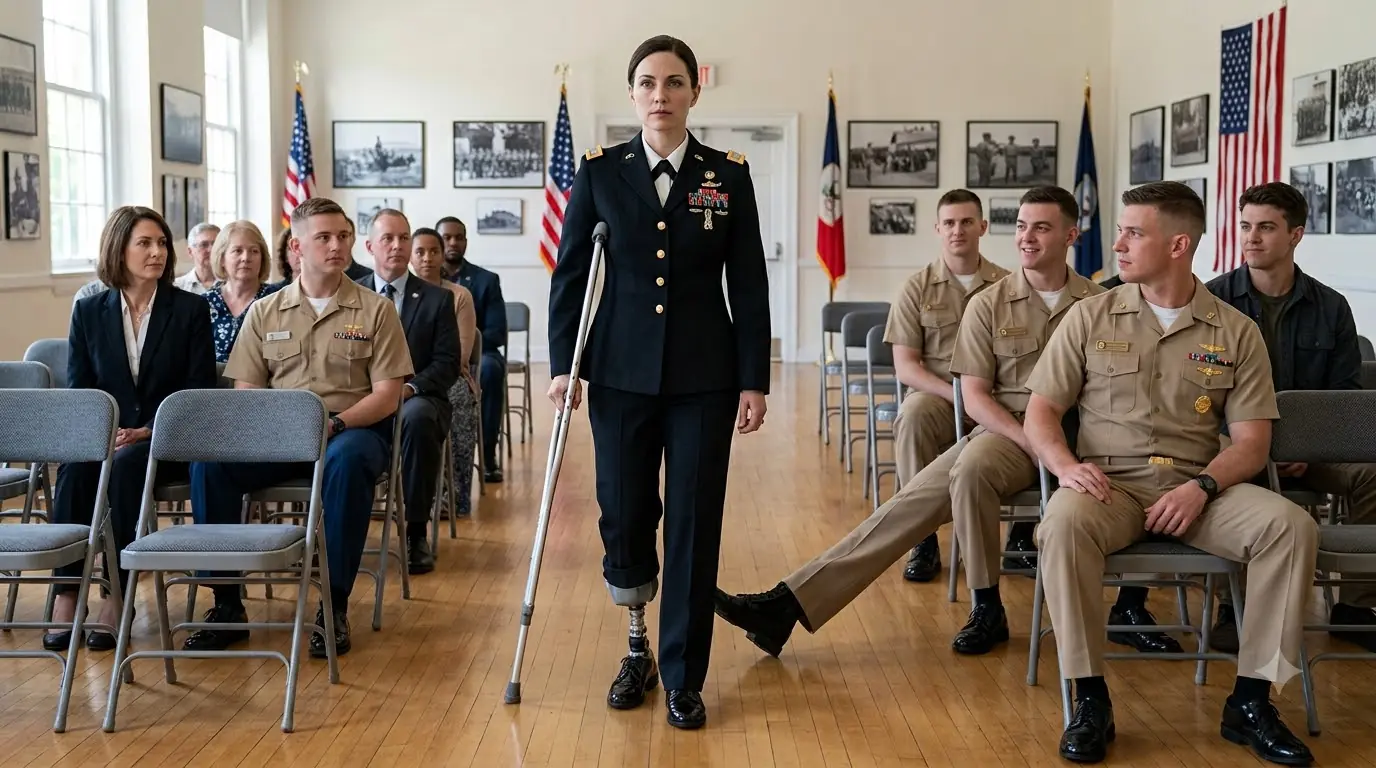
Evelyn heard every sound.
Tap.
Step.
Shift.
The polished metal tip of her forearm crutch touched the floor between each controlled movement of her right leg and the prosthetic beneath her left trouser leg. She had learned the rhythm during eleven months of rehabilitation, though on difficult mornings it still sounded foreign to her.
Tap.
Step.
Shift.
The hall in Norfolk, Virginia, had been converted from an old municipal ballroom into a veterans’ gathering center decades earlier. Large American flags hung from the walls. Framed photographs of service members filled narrow spaces between windows. Gray folding chairs formed rows facing a small stage where a remembrance ceremony had just ended.
Coffee sat untouched in paper cups.
People gathered in small circles.
Old friends embraced.
Young veterans compared assignments.
Families waited near display tables filled with photographs and handwritten notes.
Evelyn wanted only to reach the back aisle.
Then Lieutenant Mason Reed extended both boots across her path.
“Move your feet,” Evelyn said.
Mason leaned farther back in his chair.
“Or what?”
Three men beside him smiled.
One laughed under his breath.
Evelyn stopped.
Her right hand remained wrapped around the crutch handle. Her dark navy dress jacket was perfectly fitted despite the hours she had spent adjusting it that morning. Her ribbons sat level. Her dark hair was pulled into a neat bun, not a strand loose.
Everything about her appearance communicated discipline.
Mason saw only the crutch.
And perhaps the outline beneath her left trouser leg.
He was twenty-eight, broad-shouldered and athletic, with the relaxed confidence of someone whose career had moved almost exactly as expected. His tan uniform was immaculate. The qualification badge above his pocket caught the afternoon light.
His friends were younger.
Impressed by him.
That mattered.
Mason looked toward them before speaking again.
“I thought this hall was for veterans.”
Nobody replied.
His smile widened.
“Not charity cases.”
The laughter died.
Evelyn’s expression did not change.
Someone behind Mason whispered:
“Come on, man.”
He ignored it.
Evelyn repeated:
“Move your feet.”
Mason crossed one ankle over the other.
“Did you hear that?”
He looked toward his friends.
“Ranger Barbie wants the aisle cleared.”
One of them glanced toward the floor.
Another pretended to examine his coffee.
The third gave Mason a nervous smile.
Evelyn studied him.
His ribbons.
His nameplate.
His posture.
The expensive confidence.
She had known men like him.
Good at difficult things.
Talented enough that people ignored the damage caused by their worst instincts because replacing them seemed inconvenient.
Mason looked toward her crutch.
“What are you going to do, Captain?”
His eyes moved toward her prosthetic.
“Fight me with that?”
Nobody laughed.
The small metallic vibration traveling through Evelyn’s crutch suddenly seemed louder than the entire room.
She loosened her grip.
Not because her anger had disappeared.
Because it had not.
Violence would have been easy.
She could still remember exactly how quickly she once moved before the explosion took part of her leg. Muscle memory remained long after anatomy changed.
But Evelyn had spent too many years learning that discipline was most valuable at the precise moment anger offered a simpler choice.
She met Mason’s eyes.
“Move them while I’m still asking.”
Then a voice came from behind him.
“Lieutenant Reed.”
Mason’s expression collapsed.
His boots came off the aisle before he consciously decided to move them.
The three men beside him stood almost simultaneously.
Evelyn did not turn immediately.
She recognized the voice.
Retired Admiral Thomas Calder walked into view behind the chairs.
At sixty-two, Calder was tall, silver-haired, and carried the weight of authority without appearing to seek it. His dark formal uniform remained immaculate even though he had officially retired two years earlier. He had attended the event as keynote speaker but disappeared after the ceremony to speak privately with several families.
Now he stood directly behind Mason.
No smile.
No confusion.
Only disappointment.
Mason stood.
“Admiral.”
Calder’s eyes never left him.
“Were you having difficulty understanding the captain?”
“No, sir.”
“Interesting.”
Calder glanced toward the empty aisle.
“Because from behind you, it appeared she had to repeat herself.”
Mason swallowed.
“We were joking, sir.”
Calder’s eyes sharpened.
“With whom?”
Mason looked toward Evelyn.
She said nothing.
Calder continued:
“I asked you a question.”
Mason’s voice dropped.
“With Captain Carter.”
Calder finally looked toward Evelyn.
Something shifted in his face.
Not surprise.
Recognition.
Old pain.
“Evelyn.”
She nodded once.
“Admiral.”
Mason looked from one to the other.
His friends did too.
Calder stepped around the chairs.
He did not extend a hand because Evelyn was supporting herself with the crutch and carrying a slim folder beneath her other arm.
Instead he placed one hand over his heart.
Not ceremonially.
Personally.
“I didn’t know you were coming.”
“I wasn’t sure I would.”
Calder looked toward her left side.
Then quickly back to her face.
“How are you?”
“Standing.”
The answer brought the smallest smile to his mouth.
“Still difficult.”
“Rehabilitation didn’t fix that.”
Calder almost laughed.
Then he remembered Mason.
The smile vanished.
“Lieutenant.”
“Yes, sir.”
“What exactly did you say to Captain Carter?”
Mason hesitated.
Evelyn spoke.
“You don’t need to repeat it.”
Calder looked toward her.
“I think I do.”
“No.”
Her voice remained calm.
“He knows what he said.”
Mason looked grateful for perhaps half a second.
Then Evelyn continued.
“The more important question is why he thought he could say it.”
Calder nodded.
“That is the better question.”
The room had gone silent.
People who had been pretending not to watch were no longer pretending.
Mason’s face reddened.
“Captain Carter, I apologize.”
Evelyn studied him.
There was urgency in the apology.
Not understanding.
Not yet.
“You apologize because Admiral Calder heard you.”
Mason opened his mouth.
She continued:
“That is not the same as regretting what you said.”
His face tightened.
Calder remained silent.
Mason looked toward him, instinctively searching for guidance.
The admiral gave none.
Evelyn moved her crutch forward.
Tap.
Step.
Shift.
She passed Mason.
He stepped completely away from the aisle.
As she moved toward the back row, Calder turned toward Mason.
“Stay here.”
“Sir?”
“You and I are going to talk.”
Then Calder followed Evelyn.
Evelyn sat near the final window overlooking the harbor.
Calder brought two coffees.
He placed one beside her.
“You still drink it black?”
“Yes.”
“Some things survived.”
She looked at him.
“Most things.”
Calder sat.
For several seconds neither spoke.
The hall slowly returned to conversation, though the atmosphere had changed. People avoided looking directly toward Mason, who remained standing beside the chairs with his three friends several feet away.
Calder stared at the harbor.
“I should have stopped him sooner.”
“You weren’t there.”
“I was in the doorway.”
Evelyn looked toward him.
“How much did you hear?”
“Enough.”
She took the coffee.
“Then you heard me handle it.”
“I did.”
He smiled faintly.
“You always did hate people rescuing you.”
“Depends whether I need rescuing.”
“And today?”
“I needed an aisle.”
Calder laughed once.
Then his face softened.
“I heard about the surgeries.”
Evelyn looked at the cup.
“Everybody heard.”
“That isn’t what I meant.”
She knew.
There had been fourteen procedures.
Three within the first week.
Two revisions.
Nerve reconstruction.
Months of infection monitoring.
A prosthetic fitting that failed.
Another that worked.
Physical therapy.
Then more physical therapy.
Then the humiliation of learning how far exhaustion could reduce a person who once believed she understood her own body.
Calder had visited during the first month.
Evelyn remembered very little of it.
Morphine had turned days into fragments.
She remembered him sitting near the bed.