The deed in Samuel Hart’s hand should have felt like a victory.
Instead, standing there in the dust with the wind pushing dry grass against his boots, it felt like a warning.
He had spent twelve years saving for a place like this. Twelve years repairing other men’s fences, breaking other men’s horses, hauling other men’s hay, and sleeping in bunkhouses where the walls were thin and nobody cared what dreams a hired hand carried in his chest.
Now the land was supposed to be his.
The house.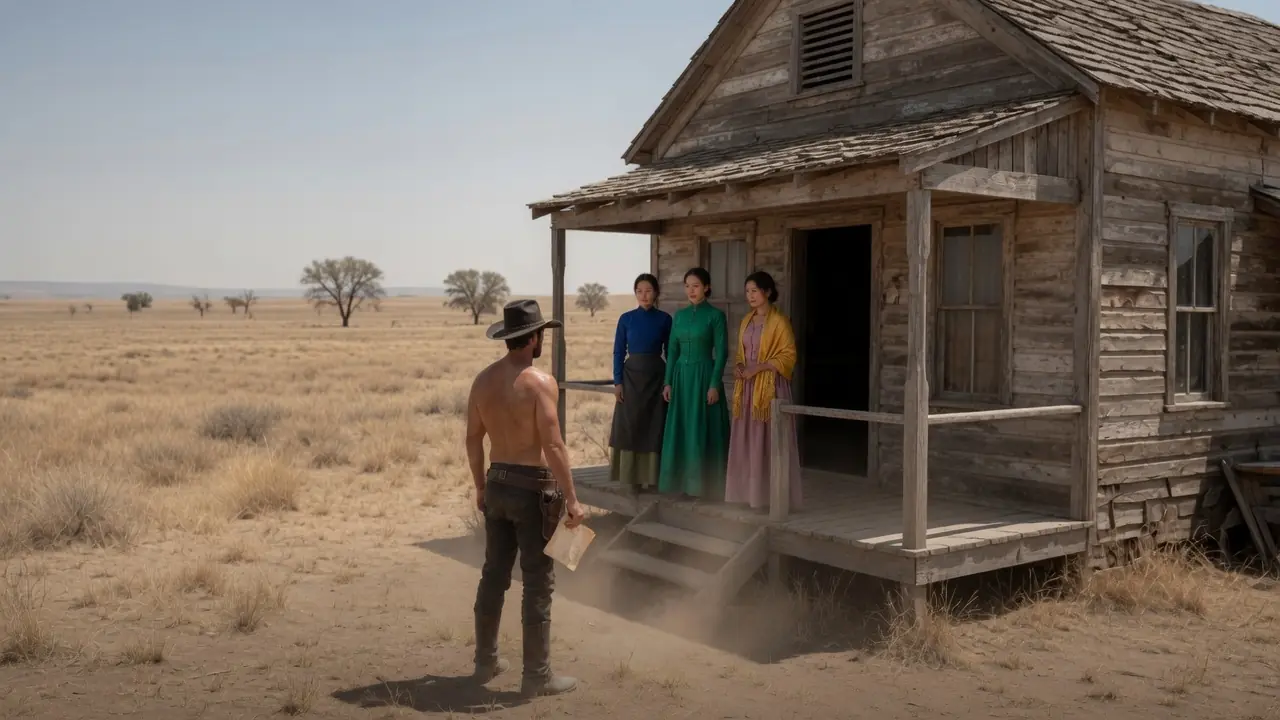
The barn.
The well.
The grazing acres stretching toward the blue line of the hills.
At least, that was what the paper said.
But the farmhouse was not empty.
Three women stood on the front porch as if they had known exactly when he would arrive. They were not hiding behind curtains or scrambling to gather belongings. They stood in the open, shoulder to shoulder, watching him with the steady calm of people who had already survived worse than a stranger holding a deed.
The woman in the center stepped forward first.
She was in her late thirties, maybe early forties, with black hair pinned at the back of her neck and sharp eyes that missed nothing. Her dress was plain and dust-marked, but she wore it with the authority of a judge in a courtroom. The two women behind her waited in silence, not because they lacked courage, but because they trusted her to choose the first words.
“You must be Samuel Hart,” she said.
Samuel stopped near the water trough, one hand still resting on the folded deed.
“That depends on who’s asking.”
“My name is Lian Foster.”
She nodded toward the woman on her right, a broad-shouldered red-haired woman with work gloves tucked into her belt.
“That’s Edith Malloy.”
Then she turned slightly toward the third woman, younger, sun-browned, with dark eyes and a half smile that looked more cautious than friendly.
“And this is Maribel Torres.”
Samuel looked from one face to the next.
The silence around them seemed too large.
Behind the women, the farmhouse door stood open. Laundry moved on a line near the side yard. Fresh-cut wood was stacked beneath the eaves. A row of herbs grew in clay pots along the porch rail.
This was not an abandoned ranch.
This was a home.
“There’s been a mistake,” Samuel said.
He pulled the deed from his coat pocket and unfolded it.
“I bought this property from Elias Granger three weeks ago. He said the place had been empty since spring.”
Lian glanced at the paper, then back at him.
“Yes,” she said quietly. “That sounds like Elias.”
Samuel’s jaw tightened.
“You know him.”
“We all do.”
“That so?”
Edith gave a short laugh without humor.
“We built half this place beside him.”
Samuel looked past them toward the barn. The roof had been patched recently. The fences were straight. The water channels through the lower field were clean and smartly cut, too well made for land that had supposedly been neglected.
A bad feeling moved through him.
Not fear exactly.
Recognition.
The kind a man feels when he realizes he has been sold more than land.
“Tell me what’s going on,” he said.
Lian stepped down from the porch.
Not far.
Just enough to show she was not afraid of him.
“Elias came here seven years ago with nothing but a horse, a bad cough, and a story about starting over. He said the ranch was ruined. He said he needed partners, not servants. We believed him.”
Samuel looked at the deed again.
“He owned the land.”
“He held the title,” Lian said. “That is not the same thing as building a life.”
Those words landed harder than Samuel wanted them to.
He had spent too many years working for titled men who believed a signature made them responsible for labor they never performed. He knew the difference between owning and building. He knew it in his hands, his back, his knees, and the scars across his palms.
Maribel finally spoke.
“We cleared mesquite from the lower field. Edith rebuilt the smokehouse. Lian kept the books and negotiated with traders who thought women couldn’t count. I dug half the irrigation ditch before the first decent crop ever came in.”
Edith crossed her arms.
“Elias did some work too. I won’t lie. But he never did anything alone.”
Samuel heard that.
The honesty made the accusation stronger.
People who were only trying to manipulate him would have made Elias pure villain and themselves pure victims. These women were not doing that. They were telling him something messier, which meant it was probably closer to true.
Still, the deed was in his hand.
“I paid for this place,” he said.
“We know.”
“With every dollar I had.”
Lian’s expression softened, but only a little.
“And we paid with seven years.”
The wind moved through the yard.
A loose shutter tapped once against the house.
Samuel looked toward the fields again, then toward the barn, the well, the stacked wood, the mended porch, the vegetable rows, the washed clothes, the signs of a life the seller had erased with one sentence.
Empty since spring.
That lie suddenly felt loud.
“What do you want?” Samuel asked.
Maribel looked at Lian.
Edith looked at the ground.
Lian met his eyes.
“We want you to hear the truth before you decide whether paper matters more than people.”
Samuel almost laughed.
Not because it was funny.
Because a week ago, he would have sworn nothing mattered more than that deed. He had chased land so long that ownership had become the shape of salvation in his mind. Now three women were standing on his new porch asking him to see what the paper had left out.
“Show me proof,” he said.
Lian nodded as if she had expected the answer.
“Come inside.”
The farmhouse smelled of coffee, dried sage, old wood, and bread cooling somewhere near the stove. The front room was clean but not delicate. Tools hung near the back door. A rifle rested above the mantel. Quilts covered two chairs, both mended more than once.
This was a place where comfort had been made by hand.
Lian opened a tin box on the kitchen table and pulled out a stack of papers tied with blue thread.
She untied them carefully.
The first document was an agreement.
Samuel recognized Elias Granger’s signature immediately. He had seen it on the sale papers. Same slanted letters. Same dramatic flourish at the end. A man who liked his name to take up space.
The agreement was not vague.
It named Lian Foster, Edith Malloy, and Maribel Torres as working partners in the ranch. It listed contributions, shares of profit, responsibilities, and future ownership rights if the ranch became profitable. It bore a witness signature from a traveling notary and a county stamp, faded but legible.
Samuel read it twice.
Then a third time.
“This is real.”
“Yes,” Lian said.
“Why didn’t you file it with the county?”
Edith laughed bitterly.
“We tried.”
Maribel leaned against the counter.
“The clerk told us Elias had to be present. Elias said he’d go with us after harvest. Then after winter. Then after the next cattle sale. There was always a reason.”
Samuel closed his eyes for a moment.
He knew men like Elias.
Men who did not have to break a promise all at once because delay did the work for them. Men who spoke warmly enough to make betrayal sound temporary. Men who kept people waiting until waiting became its own prison.
“What happened?” Samuel asked.
Lian sat across from him.
“The ranch started making money.”
That was answer enough.
But she continued.
“The first years were hard. Dry soil. Sick cattle. One collapsed well. Elias nearly gave up twice. Edith didn’t let him. Maribel found the old spring line in the lower pasture. I negotiated credit with merchants who would not have lent him a nail if I had not backed the order with my own savings.”
Edith looked toward the window.
“When things turned around, Elias changed.”
“No,” Maribel said quietly. “He became what he had been hiding.”
No one argued.
Samuel placed the agreement on the table.
“And he sold the ranch.”
Lian nodded.
“Without telling us.”
“He took the money?”
“Most of it.”
“Most?”
Edith reached for another paper and pushed it across the table.
“He left debts too.”
Samuel unfolded the page.
His stomach sank.
Supply notes.
Equipment loans.
Seed advances.
A lien against two sections of the upper pasture.
Elias had borrowed against future yield using the ranch’s improved production as proof of value. Then he sold the land and ran before payment came due.
Samuel sat back slowly.
The anger came late.
But when it arrived, it came clean.
He was angry at Elias.
Angry at himself.
Angry that he had wanted land so badly he had ignored every warning sign: the low price, the rushed sale, the seller’s eagerness, the way Elias refused to answer simple questions about why such a productive place had been left behind.
A man can be fooled.
But sometimes he helps the lie because he wants the lie to be true.
Samuel looked up.
“Where did he go?”
Lian smiled without warmth.
“If we knew, I would not be standing here calmly.”
That made Maribel laugh.
Even Edith’s mouth twitched.
The sound changed the room, just slightly.
Samuel stood and walked to the window.
Outside, the fields rolled toward the west in long bands of green and gold. Irrigation water flashed silver in the late sun. A pair of horses moved near the far fence, their tails flicking at flies.
The place was beautiful.
But not in the easy way.
It was beautiful like scarred hands, like patched roofs, like bread made from the last flour in the sack. Beautiful because someone had fought the land until the land stopped fighting back and began to answer.
Samuel turned around.
“I don’t know what the law will say.”
Lian’s face did not change.
“We know.”
“I don’t know if your agreement outweighs my deed.”
“We know that too.”
“I can’t promise what I don’t understand yet.”
“Good,” she said. “Elias promised everything.”
That sentence left the room quiet.
Samuel folded both documents and set them side by side.
“I need to walk the land.”
Edith pushed away from the wall.
“I’ll show you.”
Samuel expected suspicion.
Instead, Edith gave him facts.
She showed him where the north fence had been moved after a flood took the old line. She explained which cattle belonged to the ranch and which were being held for a widow three miles west. She pointed out the shallow stretch of creek that needed stonework before winter.
She did not try to flatter him.
She did not try to soften him.
She spoke like a person who knew every inch of the place and had no patience for anyone who did not respect it.
At the lower field, Maribel joined them.
She walked barefoot along the irrigation channel, measuring water flow with a glance.
“Elias said this field would never grow anything,” she said.
“What changed it?”
“Listening.”
Samuel looked at her.
“To what?”
“To the land. To Lian. To Edith. To myself, eventually.”
Maribel crouched and cleared leaves from a narrow side channel.
“Men like Elias always talk before they listen. That’s why they miss things.”
Samuel accepted the hit.
He had arrived with a deed and a suspicion, ready to remove three strangers from his property if necessary. The thought shamed him now, though not enough to make him pretend he had not thought it.
“Why didn’t you leave?” he asked.
Maribel stood.
“And go where?”
The answer was too simple.
Too honest.
Edith looked across the field.
“Lian had already lost her husband’s store to creditors. I had two brothers who thought a woman alone should work for room and board until she died. Maribel had crossed half the territory to get away from men who believed her labor belonged to them. This ranch was not easy, but it was ours.”
“Ours,” Maribel repeated.
The word carried weight.
Samuel said nothing.
That evening, they ate together at the long kitchen table.
Beans, cornbread, salt pork, coffee strong enough to argue with.
The meal should have been uncomfortable, but hunger and work have a way of stripping drama from a room. Edith told Samuel which traders cheated on weight. Maribel warned him not to stand behind the gray mule unless he had made peace with God. Lian asked quiet questions about his experience, his money, his plans.
She asked like a woman reading more than answers.
After dinner, Samuel stepped onto the porch.
The sky had gone deep blue.
Stars were beginning to burn through the dusk one by one. The ranch stretched in every direction, no town noise, no saloon music, no men laughing in bunkhouses. Just wind, crickets, and the occasional creak of the barn.
He had wanted silence.
Now he understood silence was not the same as peace.
Lian came out with two mugs of tea.
She handed one to him and leaned against the porch post.
“You’re thinking of leaving.”
Samuel looked at her.
“You always say things like you already know the answer?”
“Only when the answer is standing in front of me looking guilty.”
He almost smiled.
“I don’t know what I’m thinking.”
“Yes, you do.”
He took a sip of tea.
It was bitter and warm.
“I used every dollar I had to buy this place. If I walk away, I have nothing.”
Lian nodded.
“And if you stay by throwing us out?”
Samuel looked across the yard.
The question did not need finishing.
He had spent half his life angry at powerful men who took what other people built. He had sworn he would never become one of them. Now the first chance he had to own something was asking him what kind of man ownership would make him.
“I came here to start over,” he said.
“So did we.”
That was the trouble.
Everyone had.
The next morning, Samuel woke before sunrise on the bunkhouse cot they had offered him.
For a moment, he forgot where he was.
Then he heard movement outside.
The ranch was already alive.
Edith was in the yard sharpening a broken plow blade. Maribel stood near the trough, checking the horses. Lian sat at the kitchen table with account books open, one hand resting against her temple and a pencil tucked behind her ear.
They were not waiting to be rescued.
That became clear quickly.
They were already holding the place together.
What they needed was not a hero.
They needed someone with legal title to stop pretending the title told the whole story.
Samuel spent three days asking questions.
Real questions.
Who owed money.
Who was owed money.
Which fields produced.
Which merchants could be trusted.
Which debts were urgent and which could be renegotiated.
The more he learned, the more obvious the truth became. Elias had not sold him an empty ranch. He had sold him the labor of three women, then vanished with the cash before the consequences found him.
On the fourth day, a rider came from town.
He brought a notice from the bank.
Payment was due in thirty days on a loan Elias had taken against the equipment shed, the south field, and half the cattle herd.
Samuel read the notice twice, then handed it to Lian.
Her face went pale.
“We knew it was coming,” she said.
“No,” Edith muttered. “We hoped it wasn’t.”
Maribel kicked dirt from the toe of her boot.
“What happens if it isn’t paid?”
“The bank can seize equipment,” Lian said. “Maybe cattle.”
Samuel looked at the ranch.
Then at the women.
He felt the old instinct rise in him, the hired hand’s instinct to protect himself before someone else’s disaster swallowed him too.
He could leave.
He could take the deed to court.
He could argue fraud.
He could spend years trying to recover his money from a man already gone.
Or he could stay and fight for the place in front of him.
Not because it was simple.
Because it was right.
“I have some cash left,” he said.
Lian looked up.
“No.”
“You didn’t hear what I was going to say.”
“I know what pride sounds like when it tries to become sacrifice.”
Samuel frowned.
“I am not sacrificing.”
“Then what are you doing?”
He looked at the deed in his hand.
Then at the agreement on the table.
“I’m buying time.”
That was the first real decision.
They rode into town together the next morning.
Not all four.
Just Samuel and Lian.
The banker, Mr. Aldridge, was a thin man with soft hands and a voice that got friendlier when money appeared. He had expected to deal with Samuel alone. When Lian sat beside him, the banker’s smile faltered.
“Miss Foster,” he said.
“Mr. Aldridge.”
“I was not aware you were involved in this matter.”
“That has been a common problem.”
Samuel placed the deed on the desk.
Then Lian placed the partnership agreement beside it.
Aldridge leaned back.
“I see.”
Samuel doubted he did.
But he would.
They negotiated for two hours.
Lian knew every number.
Every yield.
Every debt.
Every dishonest fee Elias had accepted without question because the money was never meant to be his burden. Samuel watched her work and felt the first clear edge of admiration sharpen inside him.
She was not asking for fairness.
She was forcing the room to become fair by refusing to let anyone stay vague.
When they left the bank, the debt had been restructured.
Not forgiven.
Not solved.
But survivable.
Outside, Lian stopped near the hitching post.
“You didn’t have to back me in there.”
“Yes, I did.”
“No. You could have let me speak and stayed polite. Men do that when they want credit for listening.”
Samuel met her eyes.
“I didn’t want credit. I wanted him to understand there were two signatures at that table.”
Something shifted between them then.
Not romance.
Not yet.
Respect.
The kind that arrives quietly and stays longer than attraction.
Over the next month, they created a new agreement.
No poetry.
No hidden promises.
No language that could be twisted into ownership by whichever person held the pen last.
The document named the ranch as a partnership between Samuel Hart, Lian Foster, Edith Malloy, and Maribel Torres. Samuel held legal title until the county dispute could be resolved, but profits, labor, debt responsibility, and future ownership were divided clearly. Every major decision required recorded consent from all partners.
Lian wrote most of it.
Samuel insisted on plain language.
Edith demanded a clause stating no one could sell livestock without approval from at least three partners.
Maribel demanded one saying no person could bring a husband, wife, cousin, brother, or “useless sweetheart” onto the ranch and give them authority without agreement.
Samuel laughed when she said it.
Maribel did not.
So the clause went in.
The first year nearly broke them.
A hailstorm tore through the south field in June.
Two calves were lost to fever.
The well rope snapped in August, and Edith nearly broke her shoulder fixing the pulley before Samuel could get there.
A trader out of Silver Bend tried to underpay for cattle until Maribel stared at him long enough to make him discover honesty.
Through it all, the ranch held.
Not gracefully.
But it held.
Samuel learned where he fit slowly.
He was good with contracts, repairs, horses, and long days that started before dawn and ended when the stars were high.
He was poor at asking for help.
Edith told him so after he reopened a cut on his hand trying to mend a gate alone.
“You got partners now,” she said, wrapping his palm too tightly on purpose.
“I know.”
“No, you don’t. Knowing is when you act different.”
He acted different after that.
Mostly.
With Edith, he found a kind of blunt friendship he had not known he needed. She had no patience for self-pity, even her own. She could cut through a room’s nonsense with one sentence and had once chased off a traveling salesman with a skillet because he called her “sturdy” in the wrong tone.
With Maribel, he found laughter.
She had survived enough to take joy seriously.
She sang while repairing harness, danced with the gray mule when she thought no one was looking, and told Samuel that if he kept frowning at the accounts, his face would dry that way and scare the hens off laying.
With Lian, things grew slower.
They spoke most often after dark, when the day’s labor ended and the porch became a kind of courtroom for honest thoughts. She told him about the store her late husband had lost, about learning numbers because men tried to cheat her when they thought grief had made her stupid, about how Elias had sounded kindest when he was preparing to take the most.
Samuel told her about bunkhouses, bad bosses, his mother’s death, his years of believing that owning land would finally prove he had not wasted his life.
Lian listened.
Not gently, exactly.
Accurately.
That was better.
One night, he asked if she had loved Elias.
She took a long time answering.
“I loved who I thought he was.”
Samuel looked toward the dark fields.
“That sounds worse.”
“It is.”
“Do you miss him?”
“No.”
The answer came quickly.
Then she added, “I miss the version of myself that believed him.”
Samuel understood that too well.
Two years passed.
The ranch became known as Four Lantern Ranch because Maribel hung four lanterns across the porch every night—one for each partner, she said, and one extra whenever they were mad at each other so nobody forgot they still had to come home.
The name stuck before anyone agreed to it.
Traders began using it.
Then neighboring ranchers.
Then the bank.
Four Lantern Ranch produced good cattle, steady hay, and the cleanest water rights records in the county because Lian trusted no man with a handshake alone.
Elias Granger was finally found in a town two hundred miles east, living under a shortened name and courting a widow with two profitable orchards.
The sheriff brought back enough of the stolen money to cover part of the old debt.
Not all.
Never all.
Men like Elias rarely leave behind enough to repair what they broke.
But his arrest mattered.
His confession mattered more.
He admitted he had hidden the partnership agreement from Samuel. He admitted the ranch had been built by all four original partners. He admitted selling the land quickly because he feared the women would file their claim before he could leave.
When the county judge heard the matter, the courtroom filled.
People came to watch because people always came when someone else’s pain promised entertainment.
They left quieter.
Lian testified first.
Then Edith.
Then Maribel.
Samuel testified last.
The judge asked him whether he believed the deed made him sole rightful owner.
Samuel looked at the three women seated across the aisle.
Then he answered.
“No, Your Honor. It made me the man Elias fooled last. It did not make me the man who built the ranch alone.”
The judge studied him for a long moment.
Then wrote for nearly ten minutes.
The final order recognized the partnership.
Four legal owners.
Four signatures.
Four names on record.
When they returned home, Maribel lit all four lanterns before sunset.
Edith opened a bottle of whiskey she claimed was medicinal.
Lian stood on the porch holding the court order in both hands.
Samuel watched her read it again and again.
As if the words might vanish if she trusted them too quickly.
“They can’t erase you now,” he said.
Lian folded the paper carefully.
“No.”
Then she looked at him.
“And neither can you.”
He smiled.
“I know better.”
“Yes,” she said. “You do.”
By the third year, Samuel no longer thought of the ranch as the thing he had bought.
He thought of it as the place that had claimed him after forcing him to earn the right to stay.
The farmhouse changed.
A new roof.
A wider porch.
A proper stove.
A second barn raised after a winter storm took the old shed.
Edith designed the cattle pens.
Maribel expanded the garden until it fed half the ranch and annoyed the other half.
Lian turned the office into a place no dishonest trader entered twice.
Samuel built a long table for the kitchen because the old one had become too small for hired hands, neighbors, guests, arguments, laughter, and the kind of family that forms without asking permission from blood.
His love for Lian arrived quietly.
It was not sudden.
Not the kind of thing that knocks a man flat and leaves him making speeches in the rain.
It came in smaller ways.
The sound of her pencil against account paper.
The way she tucked loose hair behind one ear when thinking.
The way she looked at a problem until it became ashamed of hiding.
The way she trusted him slowly, as if trust were a bridge built plank by plank over deep water.
One spring evening, after a day spent repairing the east fence, Samuel found her on the porch watching storm clouds gather over the hills.
He sat beside her.
Neither spoke for a while.
Then he said, “I’m going to say something, and you can tell me I’m a fool if you need to.”
“That has never stopped you before.”
He smiled.
“I love you.”
Lian did not look at him immediately.
The wind moved the lanterns softly.
Samuel kept his hands folded because he knew better than to reach for an answer before it was offered.
Finally, she turned.
“I know.”
“That all?”
“No.”
She looked back toward the fields.
“I’m deciding whether to be afraid first or happy first.”
Samuel waited.
Lian took his hand.
“Happy,” she said.
So he stayed still while she chose it.
They married that autumn under the four lanterns.
Not because she needed a husband to secure her place.
The papers had already done that.
Not because the ranch required it.
The ranch had already survived worse than loneliness.
They married because choice, once returned to a person, becomes sacred.
Edith stood as witness with clean boots and suspiciously wet eyes. Maribel decorated the porch with wildflowers and threatened to hit anyone who called it pretty in a sentimental voice. The preacher forgot Samuel’s middle name, and Lian corrected him before the vows could continue.
Everyone laughed.
Even Samuel.
Especially Lian.
Years later, people told the story of Four Lantern Ranch in different ways.
Some said Samuel Hart bought a ranch and found three women waiting on the porch like ghosts of a promise.
Some said he was a fool who nearly lost everything by doing the honorable thing.
Some said Lian Foster out-negotiated half the county and married the one man smart enough to admit when he was wrong.
Edith said most people got the story crooked because they wanted one hero and had no room in their heads for four.
She was right.
The truth was not that Samuel saved the ranch.
The ranch saved him too.
It took a man who believed ownership would cure loneliness and taught him that belonging could not be purchased. It took three women who had been betrayed and gave them a partner who understood that trust was not owed because of a signature. It took a ruined agreement, a dishonest seller, a stack of debts, and a house that was never empty at all.
On the tenth anniversary of Samuel’s arrival, they sat together on the porch as evening settled over the fields.
Four lanterns glowed along the rail.
Edith sat with her boots on a crate, cleaning a rifle she insisted needed cleaning though everyone knew it was already spotless. Maribel shelled peas into a bowl and sang under her breath. Lian leaned against Samuel’s shoulder, the silver in her hair catching lantern light.
The ranch stretched before them, alive and loud with crickets, cattle, wind, and distant laughter from the bunkhouse.
Samuel looked at the yard where he had first stood with a deed in his hand and suspicion in his chest.
“I thought I was buying an empty place,” he said.
Maribel snorted.
“You bought trouble.”
Edith nodded.
“Expensive trouble.”
Lian smiled.
“Worthwhile trouble.”
Samuel looked at them all.
Then at the fields.
Then at the house that had become more than any paper could promise.
“Yes,” he said. “That’s about right.”
The deed was still kept in the office.
So was the old partnership agreement.
So was the court order with all four names written plainly where no one could erase them again.
But none of those papers made the ranch a home.
The work did.
The truth did.
The mornings when someone rose early so another could rest.
The arguments that ended at the same table.
The debts paid together.
The fences mended together.
The silence after betrayal slowly replaced by laughter that no longer sounded afraid.
Samuel had arrived looking for land that belonged to him.
What he found was harder.
Better.
A place where belonging had to be chosen every day.
And after everything they survived, he finally understood the difference between owning a house and being welcomed home.
A deed can give a man property.
But only people can give him a place to stay.