“Did anything happen between us?”
The question landed in the middle of the kitchen so softly that it was almost worse than if she had shouted.
Caleb Turner stood beside the stove with one hand still resting on the coffee pot. He was a thirty-seven-year-old Black single father, tall, broad-shouldered, with tired brown eyes, close-cropped hair, and a neatly trimmed beard that made him look calmer than he felt. Across from him, his boss, Vivian Hart, stood barefoot in borrowed sweatpants and one of his old college hoodies, her hair still pinned badly from the night before.
At the table, Caleb’s eight-year-old daughter, Lily, sat with a bowl of cereal in front of her, watching cartoons on a tablet with the volume low. She was a small Black girl with two puff ponytails, sleepy eyes, and a loose front tooth she had been wiggling for three days. She had no idea that her father’s career, reputation, and place in the life he had built for her were suddenly standing on thin ice.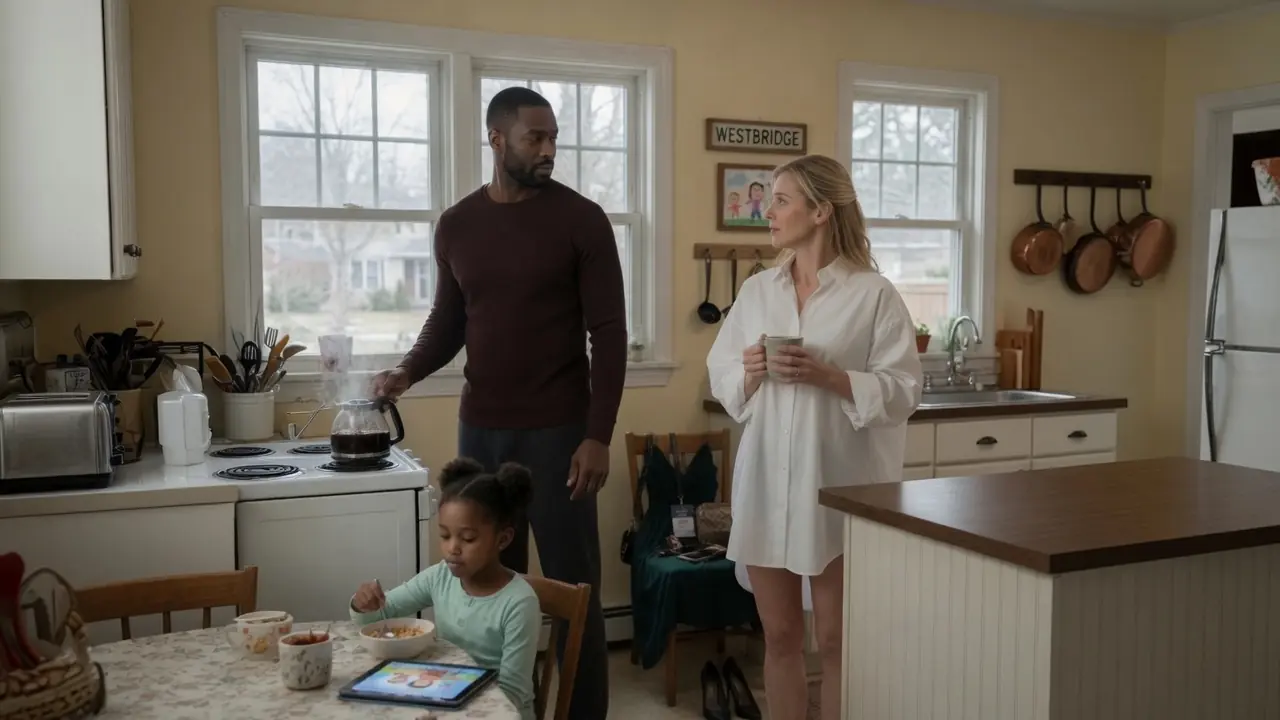
Nothing inappropriate had happened.
No flirting.
No touching beyond what was necessary to keep a drunk woman from falling in a hotel parking lot.
But the question still changed the temperature of the room.
Caleb looked at Vivian, then at his daughter, then back at the mug in Vivian’s hands. She had not taken a sip. Her fingers were wrapped around it like she needed something warm to anchor herself to the morning.
He understood why she was scared.
That did not make him less afraid.
“No,” he said carefully. “Nothing happened.”
Vivian closed her eyes.
For a second, relief passed through her face so clearly that Caleb almost felt sorry for her. Then he felt something else. Something colder. Because relief meant she had wondered. And if she had wondered, other people could wonder too.
Lily looked up from her tablet.
“Dad?”
Caleb forced his voice to soften.
“Yeah, bug?”
“Can I have more cereal?”
The normalness of the question nearly broke him.
“Sure.”
He crossed the kitchen, took the box from the cabinet, and poured another small mountain of cereal into Lily’s bowl. She smiled and went back to her cartoon, unaware that her father was standing three feet away from the white woman who controlled his promotion, his flexible schedule, and the fragile peace their household depended on.
Vivian set the mug down.
“I’m sorry,” she said.
Caleb nodded once.
He did not know which part she was apologizing for.
The night before had started as something simple.
Annual leadership dinner.
One hotel ballroom.
One mandatory networking event Caleb did not want to attend but had shown up for anyway because he understood how companies measured loyalty. He worked as a senior project analyst at Larkwell Systems, a logistics software company based in the fictional city of Westbridge, a clean little Midwestern place with brick offices, cold winters, and enough ambition to call itself a tech hub.
Caleb was widowed, Black, and tired in the specific way single parents become tired when they have learned to do everything before anyone asks.
His wife, Hannah, had died four years earlier from a sudden brain aneurysm while making Lily’s lunch. There was no warning, no drawn-out goodbye, no final speech that turned grief into something cinematic. One morning Caleb had a wife, a daughter, a house, and plans for the weekend. By evening, everything had become emergency contacts, hospital lights, and a small child asking why Mommy was sleeping somewhere else.
Since then, Caleb had built life out of routine.
Breakfast at 7:00.
School drop-off by 8:10.
Work by 8:35.
Leave by 4:45 on Wednesdays for Lily’s dance class.
No late meetings unless scheduled two weeks ahead.
No overnight travel unless his sister could take Lily.
No pretending he had the same flexibility as people whose lives came with backups.
Vivian had been the first executive who understood that without making him beg.
When she became division director, she looked at his record, listened to his situation, and said, “You do strong work. I don’t care where the work happens as long as it gets done.”
He never forgot that.
So when Vivian asked him to attend the leadership dinner, he went.
Not because he wanted free steak.
Not because he liked small talk beside ice sculptures.
Because she had protected his time when nobody else did, and respect mattered to him.
He planned to stay one hour.
Two at most.
Lily’s school was hosting a winter music night the same evening, and Caleb had promised he would make it for her class song. His sister, Maren, was taking Lily early and saving him a seat. Lily had practiced “Silver Bells By The River” for three weeks and warned him that if he missed the hand motions, she would make him watch them at home five times.
At 7:20, Caleb texted Maren.
Leaving soon.
At 7:32, Vivian found him near the hotel bar.
“One drink before you escape,” she said.
She was smiling then, still composed in a dark green dress and black heels, the kind of woman who looked like she had never misplaced a receipt in her life.
Caleb lifted his soda.
“I’m driving.”
“Then one ginger ale while I have one drink.”
He stayed because it seemed harmless.
One drink for her became two.
Two became a third poured by a senior vendor who kept telling stories nobody wanted to interrupt because his company had just signed a major contract. Vivian laughed too loudly at one of them, then reached for the bar to steady herself. Caleb noticed before anyone else did.
“Vivian,” he said quietly. “You should call a car.”
“I already have a room upstairs,” she said.
“Good. Let me walk you to the elevator.”
She shook her head too quickly.
“No. Not upstairs.”
He frowned.
“What do you mean?”
Her eyes moved toward the ballroom.
Caleb followed her gaze and saw Patrick Sloane, the chief operating officer, watching from near the dessert table. Patrick was handsome, married, powerful, and famous for standing too close to women who were too junior to tell him to step back.
Vivian’s voice dropped.
“I can’t let him see me like this.”
That was when the night stopped being easy.
Caleb should have found another woman to help her.
He thought of that later.
Again and again.
But in the moment, the women Vivian trusted had already left, Patrick was still watching, and Vivian’s hand had started shaking around the glass. If Caleb walked away, she would either go upstairs alone in a hotel full of coworkers or let the wrong person decide what happened next.
He called a rideshare.
Vivian refused to give her home address.
“I don’t want anyone at work seeing it in the app,” she said, not entirely logical but scared enough for logic to have left the room.
He called his sister.
No answer.
He texted Maren that he might be late.
Then Vivian nearly fell stepping off the curb.
Caleb caught her by the elbow.
That was the first touch.
Necessary.
Visible.
Memorable.
And because Caleb was a Black man helping an intoxicated white female executive out of a hotel, he felt the eyes before he saw them. A valet glanced too long. A manager at the door paused with one hand on his radio. A vendor near the smoking area looked from Vivian’s unsteady body to Caleb’s hand on her arm and built a story with no facts at all.
Caleb let go the second she had her balance.
He held both palms open.
“You okay?”
Vivian nodded, but she was not okay.
By the time he got her into his car, he had already missed Lily’s class walking onto the stage.
By the time he reached his house, Lily’s song was over.
Maren finally called him from the school hallway.
“She did great,” she said carefully.
Caleb gripped the steering wheel.
“Put her on.”
Lily’s voice came small through the phone.
“Dad?”
“Hey, bug. I’m so sorry.”
“You missed the bell part.”
“I know.”
“I looked for you.”
The sentence stayed in his chest all night.
He brought Vivian inside through the side door because she was too unsteady for the front steps. Maren arrived twenty minutes later with Lily, saw Vivian asleep on the couch under a blanket, and looked at Caleb with a question she did not ask in front of his daughter.
He explained in the kitchen.
Maren listened.
Then she said, “You need to be careful.”
“I was being careful.”
“No,” she said. “You were being decent. That is not always the same thing, especially for a Black man in a room where people are already deciding what they want to believe.”
He hated that sentence because he understood it immediately.
Vivian woke at 3:40 a.m. disoriented and panicked. She did not know where she was at first. She looked at the sweatpants folded on the chair, the hoodie on the counter, the blanket around her, and then at Caleb standing six feet away with both hands visible like a man trying to prove he was not dangerous inside his own home.
“You got sick,” he said. “My sister helped you change. She left the clothes. You slept on the couch. I slept upstairs. Lily was in her room.”
Vivian covered her face.
“I’m sorry.”
He believed her.
That was not the problem.
Morning came with cereal, cartoons, coffee, and the question.
Did anything happen between us?
Caleb answered truthfully.
No.
Nothing happened.
But truth did not erase the fact that the question had existed.
At work, nobody said anything the first day.
That was almost comforting until Caleb realized silence could grow teeth.
Vivian stayed professional. Too professional. Her emails became shorter. Her office door remained open during conversations that used to happen seated across from her desk. She no longer stopped by his workstation to review project timelines. If he entered a meeting, she acknowledged him with the same tone she used for everyone else.
That should have been fine.
It was not.
People noticed changes before they knew causes.
On Wednesday, he walked into the break room and two analysts stopped talking. On Thursday, a meeting invite for the Hamilton rollout did not include him, though he had led the planning for six months. When he asked the project coordinator about it, she blinked too quickly and said, “Oh, I thought Vivian was handling that directly now.”
Vivian.
Not Director Hart.
Vivian.
The first name made it worse.
By Friday, Caleb understood that nothing had been accused, but something had been suspected.
That was how reputations began to bend.
Not with facts.
With rearranged air.
At home, Lily asked why he was checking his phone so much.
He said work was busy.
She accepted that answer for about four seconds.
“Are you in trouble?”
“No.”
“Are you sure?”
He looked at her across the dinner table, at the gap where one of her front teeth had just started to loosen, at the glitter glue still stuck to her sleeve from art class. He thought about how much of his life was built around making her feel safe.
Then he lied.
“I’m sure.”
The call came the following Monday from Martin Hales, a senior manager Caleb barely knew.
“Just checking in,” Martin said with artificial warmth. “How are things?”
Caleb sat at his desk, staring at the spreadsheet he had not been able to focus on for twenty minutes.
“Fine.”
“Good, good. We’re reviewing team structures for Q1. Nothing formal. Just looking at dynamics.”
Dynamics.
Caleb wrote the word on a sticky note and stared at it.
“What dynamics?” he asked.
There was a pause.
“General alignment. Reporting clarity. Leadership comfort.”
Leadership comfort.
The new language of being moved without being told why.
After the call, Caleb sat very still.
He thought about Hannah. Not because she would have known what to do. She probably would not have. But she would have sat across from him at the kitchen table, bare feet tucked under her, and said the one thing he most needed to hear without making it pretty.
“You did right. Now don’t let them make you apologize for it.”
He could almost hear her.
That hurt.
That night, after Lily fell asleep, his phone buzzed.
Vivian.
The message sat there for a long time before he opened it.
I’ve been meaning to ask if you’re okay.
Caleb almost laughed.
Not because anything was funny.
Because okay was too small a word for the kind of slow pressure sitting on his life.
He typed: I’m fine.
Deleted it.
Typed: Are you?
Deleted that too.
Finally, he wrote: I don’t know how to answer that.
Dots appeared.
Disappeared.
Then came back.
I’m worried I put you in a position you didn’t deserve.
He stared at the sentence.
Worried.
Not accusing.
Not denying.
Worried.
And somehow, that was worse than a clean attack.
Because if Vivian was worried, she might try to fix it.
And people with power often fixed discomfort by moving the person with less power farther away from the room.
They agreed to meet the next evening at a public place, not at the office and not at his house. Vivian suggested a coffee shop. Caleb suggested a bench outside the old civic library where anyone could see them and nobody could say they had hidden.
It was cold enough that both wore coats.
Vivian sat at one end of the bench.
Caleb sat at the other.
The space between them was deliberate.
“I remember pieces,” she said. “The bar. Patrick watching me. Your car. Your sister, I think. Then your kitchen.”
“My sister was there.”
“I believe you.”
He looked at her.
“That sentence is part of the problem.”
Her face tightened.
“I know.”
For a while, traffic moved past them, headlights sliding over wet pavement. The library windows glowed behind them. Across the street, a man walked a dog in a red sweater. Life continued with no respect for crisis.
Vivian clasped her hands.
“I reported the incident.”
Caleb’s chest tightened.
“To HR?”
“Yes.”
“Why?”
“Because if Patrick says something first, it becomes his story. If anyone saw us leave, it becomes rumor. I thought documentation would protect both of us.”
Caleb looked away.
Protection.
That word had become dangerous.
“What exactly did you report?”
“That I drank too much. That you helped me leave safely. That your sister was present. That nothing happened.”
“Then why am I being pulled from projects?”
Vivian closed her eyes.
So she knew.
That mattered.
“I did not authorize that.”
“But you knew.”
“Yes.”
He nodded slowly.
The honesty did not comfort him.
“Martin called about team dynamics.”
Vivian looked tired.
“Patrick has been asking questions.”
There it was.
The other shape behind the story.
Patrick Sloane had watched Vivian leave the ballroom with Caleb. Patrick had wanted access to a vulnerable woman and resented the man who prevented it. Caleb had not merely helped Vivian. He had interrupted someone more powerful.
“He’s framing it as concern,” Vivian said.
Caleb gave a humorless laugh.
“Men like him always do.”
Her eyes lifted.
“You know?”
“I saw him watching you.”
She looked down.
“I should have said something sooner.”
“Yes,” Caleb said.
No softness.
No cruelty.
Just truth.
Vivian nodded once, accepting it.
“I’m sorry.”
“For which part?”
She inhaled.
“All of it.”
That was the first answer that did not make him feel crazy.
The next day, HR requested his statement.
It came in the form of a polite email with neutral language and too many words like “clarify” and “document.” Caleb read it three times. Each time, the same sentence stood out.
Please provide your recollection of the events following the leadership dinner.
Recollection.
Not defense.
Not accusation.
But Caleb knew how files worked.
Words placed in files did not remain words. They became future context. They became risk evaluation. They became the thing someone quoted two years later when denying a promotion for reasons unrelated on paper.
He also knew how quickly a Black man’s tone could be described as “defensive,” how quickly his fear could be misread as anger, how quickly his need for fairness could be called hostility.
So he wrote the statement at his kitchen table after Lily went to bed.
Maren sat across from him, reading every sentence.
“Too apologetic,” she said.
He frowned.
“I didn’t apologize.”
“You wrote like you’re asking permission to have helped.”
He read it again.
She was right.
He deleted half of it.
The final version was plain.
Dates.
Times.
Actions.
Vivian’s condition.
Rideshare attempt.
Sister present.
Vivian slept on couch.
No inappropriate conduct.
No private contact afterward except to discuss workplace documentation.
He signed it.
Then sat back.
Maren looked at him.
“You okay?”
“No.”
“Good. That means you’re still telling the truth.”
Work became thinner after that.
No one fired him.
No one accused him.
No one even treated him openly badly.
They simply reduced him.
The Hamilton rollout moved to another analyst “temporarily.” His presentation role in the Q1 planning summit disappeared. Two junior staff who used to ask him for guidance began routing questions through Martin. Caleb remained employed, paid, and politely respected in the way institutions politely respect people they are quietly moving away from.
He understood then that punishment did not always arrive wearing anger.
Sometimes it wore caution.
At home, Lily noticed the cost before anyone else.
“You don’t sing in the car anymore,” she said one morning.
Caleb glanced at her in the rearview mirror.
“What?”
“You always sing bad when we go to school.”
“I sing bad?”
“Very bad.”
Despite himself, he smiled.
“I didn’t know there was a review board.”
“I’m the review board.”
He turned onto Maple Ridge Road.
“Maybe I’ve been tired.”
“You were tired before.”
The sentence hit harder than she meant it to.
He had been tired for years.
He had still sung.
That evening, he sat in the driveway for ten minutes before going inside. The porch light glowed. Lily’s backpack was visible through the front window, dumped sideways by the couch. A house can look peaceful from outside while the person sitting in the car feels like the whole world has become one long hallway of closed doors.
His phone buzzed.
Vivian again.
Patrick is pushing for your removal from the Hamilton account. I’m fighting it.
Caleb read it twice.
Then wrote: Stop fighting it privately.
She responded after a moment.
What do you mean?
He typed slowly.
If my work is being questioned, put the reason in writing. If my conduct is being questioned, say it clearly. If neither is being questioned, I’m not stepping back.
He stared at the message before sending it.
Then he hit send.
For the first time in two weeks, his hands stopped shaking.
The meeting happened on Friday morning.
Conference Room 4.
Glass walls.
One long table.
Vivian, Martin, HR, and Caleb.
Patrick did not attend, which told Caleb he was either confident or careful. Maybe both.
The HR representative, a woman named Elaine Foster, opened with a smile that had been trained by policy.
“We want this to feel supportive,” she said.
Caleb nodded.
“I appreciate that. I also want it to be specific.”
The smile faltered.
“Of course.”
Martin shuffled papers.
“We’re looking at temporary adjustments to reduce unnecessary visibility while things settle.”
Caleb folded his hands.
“What things?”
Martin blinked.
“The recent situation.”
“What about it remains unresolved?”
Elaine stepped in.
“No one is saying anything remains unresolved.”
“Then why am I being removed from work I led?”
Vivian looked at him across the table.
There was something like respect in her face.
Martin cleared his throat.
“It’s about perception.”
Caleb nodded.
“Whose perception?”
Silence.
There it was.
The room did not have a good answer because the truth was not professional enough to say out loud.
Caleb continued.
“I submitted a statement. Vivian submitted a statement. My sister can verify the timeline. No misconduct occurred. If my work performance is an issue, I want that documented separately. If my conduct is an issue, I want the concern stated clearly.”
He paused.
Nobody interrupted him.
“I am not agreeing to disappear from projects because someone uncomfortable with the facts prefers a quieter story. I am not going to let a room full of people turn my restraint into suspicion just because it is easier than confronting the man who made this situation dangerous in the first place.”
Elaine looked down at her notes.
Martin’s face tightened.
Vivian spoke then.
“Caleb is right.”
Everyone looked at her.
She sat straighter.
“I reported the incident because I wanted the truth documented. Not because I wanted Caleb sidelined. He acted appropriately when I was vulnerable, and the company should not make the safest person in the situation bear the highest cost.”
The room changed.
Not dramatically.
Corporate rooms rarely change dramatically.
But Caleb felt the shift.
A door opening somewhere.
Martin recovered first.
“We also need to consider leadership perception.”
Vivian’s eyes sharpened.
“Then leadership should examine why Patrick Sloane began asking questions about Caleb after Caleb prevented me from leaving the hotel alone while intoxicated.”
Elaine looked up.
That was new information.
Martin went still.
Caleb did not move, but his pulse changed.
Vivian continued.
“I did not include Patrick’s behavior in my original report because I was embarrassed. That was a mistake. He watched me repeatedly that night. He offered to walk me upstairs twice. I declined. Caleb saw enough to understand I did not feel safe. That is the context.”
Elaine’s pen moved quickly now.
Martin looked like a man watching the meeting he planned become another meeting entirely.
Caleb said nothing.
For once, silence was not shrinking.
It was allowing truth to stand without being interrupted.
Afterward, Vivian caught him near the elevator.
“Thank you,” she said.
He shook his head.
“No. Don’t thank me for surviving something I didn’t create.”
She accepted that.
“You’re right.”
The investigation shifted.
That was the word people used.
Shifted.
What it meant was Patrick Sloane had made the wrong woman feel cornered and the wrong man look disposable. Once HR began pulling prior complaints, the story grew legs none of them expected. Two former employees had mentioned Patrick in exit interviews. A vendor representative had requested not to meet with him alone. A junior manager had once asked to be transferred after a conference trip and then withdrawn the request.
Patterns, Caleb learned, were often visible only after someone stopped calling each piece isolated.
Patrick went on leave two weeks later.
Officially, personal reasons.
Unofficially, the building breathed easier.
Caleb’s projects returned gradually. Not all at once. Not with apology wrapped in ceremony. The Hamilton rollout came back first because nobody else knew the vendor integration as well as he did. Then the Q1 summit. Then the weekly planning call.
People stopped pausing when he entered rooms.
Mostly.
Some still did.
He no longer adjusted himself around those pauses.
That was the real change.
Not the work.
Him.
At home, Lily heard him singing again before he noticed he had started.
It was a terrible version of a pop song she hated.
She laughed from the back seat and covered both ears.
“Dad, no.”
“You said I stopped singing.”
“I did not say start with that.”
“Too late. The review board has lost authority.”
She laughed harder.
For the first time in weeks, Caleb felt the sound reach somewhere work had not been able to touch.
Life did not become perfect after that.
That would have been too neat.
Vivian remained his boss, but the easy warmth between them never returned exactly. Maybe it could not. Maybe boundaries, once rebuilt after fear, do not look like they did before. Their relationship became cleaner, more formal, but also more honest.
He did not hate that.
He had learned to distrust comfort without clarity.
Maren still checked in too often, which annoyed him because he needed it. Lily still asked questions too big for bedtime. Bills still came. Groceries still cost too much. His car still made a clicking sound every time he turned left in cold weather.
But the ground beneath him felt solid again.
Not because the system had proven fair.
It had not.
Not because truth had protected him automatically.
It had not done that either.
The ground felt solid because he had stopped asking permission to stand on it.
A month after Patrick left, Caleb found a card on his desk.
No envelope.
Just a plain note in Vivian’s handwriting.
You did the right thing when it was costly. I am sorry the cost became yours.
He read it once.
Then put it in his drawer.
He did not need to frame it.
He did not need to forgive everything.
But he kept it because acknowledgment matters, even when it arrives late and insufficient.
That evening, Lily had a spring choir performance in the school gym. Caleb arrived twenty minutes early. Front row. Phone charged. Flowers on the chair beside him because Lily had once said flowers after performances were “dramatic but acceptable.”
When she walked onto the risers and found him immediately, her whole face changed.
Not relief.
Confidence.
That hurt and healed him at the same time.
She sang every word.
She did the hand motions too big.
At the end, she bowed in the wrong direction and then laughed at herself.
Caleb clapped until his palms stung.
Afterward, she ran to him.
“You saw the bell part this time.”
“I saw all of it.”
“Even when I messed up?”
“Especially then.”
She leaned against him, flowers crushed between them.
On the drive home, she fell asleep holding the bouquet.
Caleb drove slowly through Westbridge, past closed shops, porch lights, wet pavement, and the quiet windows of houses where other people were living through things nobody outside could see.
He thought again about that morning in his kitchen.
Vivian barefoot in borrowed clothes.
Lily eating cereal.
The question that could have ruined him.
Did anything happen between us?
For a long time, Caleb believed that question was the moment everything changed.
Now he understood it differently.
The question did not change who he was.
It revealed how fragile safety can be for someone with less power, how quickly a good act can be folded into suspicion, how easily institutions protect themselves before they protect people.
And for him, it revealed something even sharper.
A Black father raising a Black daughter does not get to be careless with perception. He had known that already, but knowing a thing and feeling it close around your throat are not the same. He had spent years being calm, measured, respectful, careful with his tone, careful with his hands, careful with his expressions, careful with his size in rooms where people noticed his body before his character.
But it also revealed something else.
Kindness alone was not enough.
He still believed in kindness. More than ever, maybe. He would still help someone in danger. He would still choose the harder right over the easier wrong. He would still teach Lily that decency mattered even when nobody rewarded it.
But kindness needed a spine.
A record.
A boundary.
A refusal to disappear afterward.
Being good did not mean being endlessly convenient. It did not mean accepting every cost in silence so other people could feel less uncomfortable. It did not mean shrinking because someone else’s fear had filled the room.
That was the lesson he carried forward.
Not bitterness.
Not cynicism.
Something sturdier.
Months later, a new analyst at Larkwell found herself in a difficult situation after a client dinner. A vendor had drunk too much, a senior manager wanted to send her alone in a rideshare with him, and everyone seemed to be pretending discomfort was logistics. Caleb saw her face across the lobby.
He walked over.
Not alone.
He brought Elaine from HR, another woman from operations, and the hotel security manager. He made sure the vendor got home safely. He made sure the analyst did too. He made sure every step had witnesses, clarity, and respect.
The next morning, the analyst stopped by his desk.
“Thank you,” she said. “For not making it weird.”
Caleb smiled faintly.
“It was already weird. We just made it safe.”
She laughed because she thought he was joking.
He was not.
That night, when he tucked Lily in, she asked him if being brave meant not being scared.
“No,” he said.
“What does it mean?”
He thought for a moment.
Then answered carefully.
“It means doing what is right, and then standing beside it after.”
Lily considered that.
“Even if people get mad?”
“Especially then.”
She nodded, satisfied in the way children are when an answer fits somewhere inside them.
After she fell asleep, Caleb stood in the doorway for a long time. The hall light spilled across her room. Her backpack leaned against the wall. Her choir flowers, now half-wilted, sat in a cup on her dresser.
He thought about Hannah.
He thought about Vivian.
He thought about Patrick.
He thought about the version of himself who had once believed staying quiet was the same as staying safe.
That man had been trying his best.
Caleb did not hate him.
But he was glad he had outgrown him.
The world had not become simpler. People still misunderstood. Systems still protected themselves. Kindness still carried risk. None of that changed.
What changed was Caleb’s willingness to vanish inside other people’s uncertainty.
He would not do that again.
He had brought a drunk woman to safety because leaving her alone would have been wrong. He had missed his daughter’s performance and carried the ache of that. He had been questioned, sidelined, and nearly erased by the very caution that claimed to protect everyone.
But in the end, the thing that saved him was not silence.
It was not politeness.
It was not hoping the truth would speak for itself.
It was learning to speak with it.
And that, quietly, became the kind of man his daughter could watch and trust.
Not perfect.
Not fearless.
Just present.
Still kind.
Still standing.