Ethan Cole had spent most of his thirty years learning how little a man truly needed.
A horse when he could afford one. A blanket when winter came early. Enough beans, coffee, and dried meat to keep hunger from becoming weakness. Work whenever someone needed a fence repaired, cattle moved, horses broken, hay stacked, or a drunk ranch hand replaced before payday.
He had learned not to ask for more.
Men who wanted too much usually had something to lose.
Ethan owned almost nothing.
Therefore, at least in theory, the world could take almost nothing from him.
That belief had carried him from Texas to Colorado, from Colorado into Nebraska, and eventually across the dry late-summer plains of Kansas in 1889.
By the time he reached Red Creek, he had four dollars and eleven cents left.
His horse, Buck, looked as tired as he felt.
His shirt had been washed so many times the cloth had gone thin at the shoulders, and the brown leather vest over it had been repaired twice with mismatched stitching. Dust coated his boots. His beard needed trimming.
He had eaten his last piece of salt pork the previous evening.
Still, he considered himself fortunate.
He had heard about work.
A widow named Clara Bennett supposedly needed a ranch hand badly enough to hire a stranger.
That was all Ethan knew when he turned Buck toward the weathered white farmhouse with the green door.
The ranch appeared at the end of a long rise.
Two hundred forty acres, someone at the Red Creek mercantile had told him. Good grass. Better water. Seventy head of cattle if the winter had not taken any more.
The creek caught Ethan’s attention immediately.
It curved through the southern pasture like a piece of polished silver beneath the afternoon sun.
In dry country, a creek like that was not scenery.
It was power.
Ethan understood cattle well enough to know the land around that water was worth more than almost anything else visible from the ridge.
He also understood immediately why a widow might have trouble keeping it.
He tied Buck beside the front fence.
Then removed his hat before climbing the porch.
That mattered to him.
His mother had taught him little he remembered clearly, but she had been strict about hats indoors, language around women, and never crossing another person’s threshold until invited.
He raised one hand.
Knocked twice.
Footsteps moved inside.
The green door opened.
For a moment, Ethan forgot the sentence he had rehearsed for four days.
The woman standing there looked younger than he expected.
Twenty-nine, perhaps.
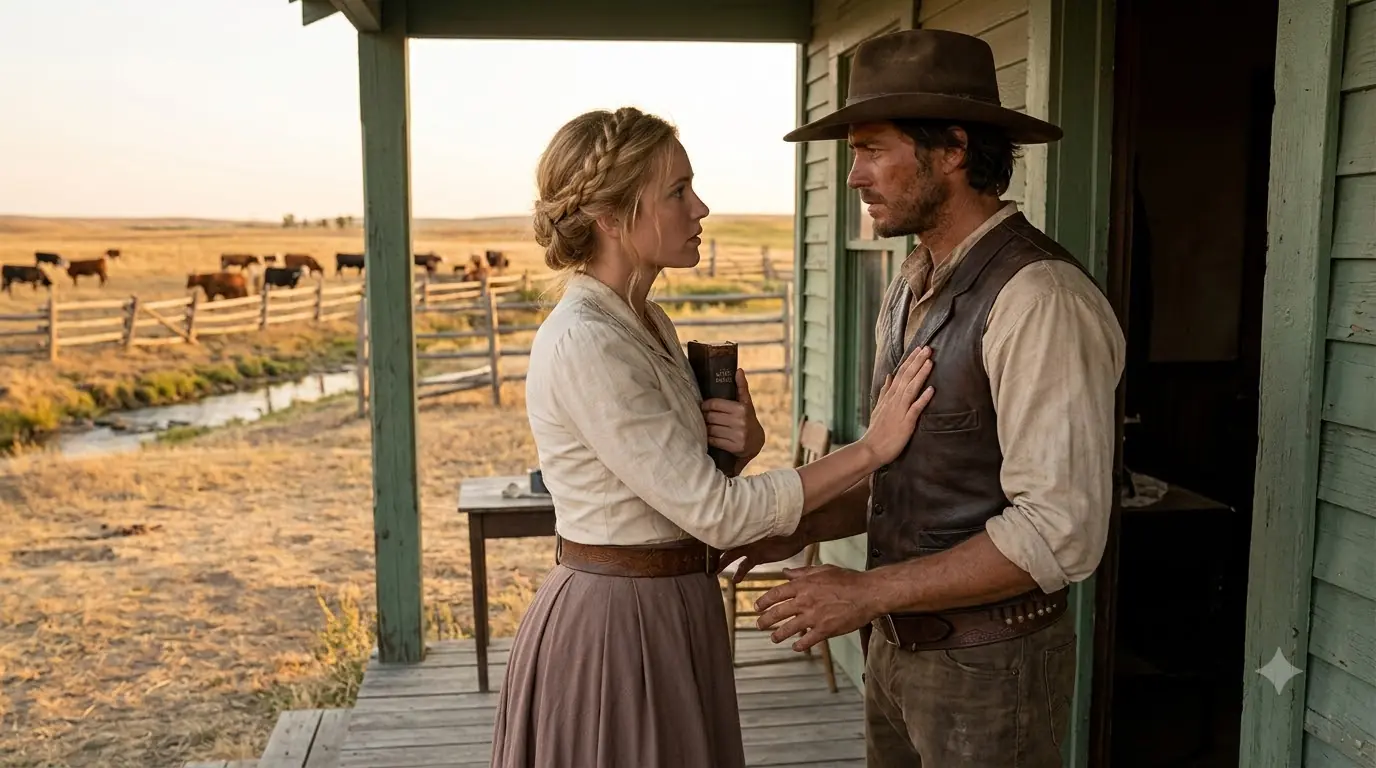
Honey-blonde hair had been braided around the crown of her head, though loose strands had escaped around her cheeks. Her face was sun-touched rather than delicate, and the pale cream blouse she wore showed the faint marks of work near the cuffs.
She held a brown leather Bible against her chest.
Her eyes were gray-green.
Calm eyes.
Not timid.
Not welcoming either.
They studied Ethan from boots to hat.
Then returned to his face.
Ethan cleared his throat.
“Ma’am.”
She waited.
“I heard you needed a ranch hand.”
Something changed in her expression.
Not surprise.
Recognition.
Her fingers tightened around the Bible.
“How far did you travel?”
“Four days from Red Creek if you count the detour around Dalton’s wash.”
“You come alone?”
“Yes.”
“You drink?”
“Coffee.”
The corner of her mouth moved.
“Whiskey?”
“When somebody else is paying.”
That nearly produced a smile.
“Fight?”
“Only when leaving seems less sensible.”
“Steal?”
“No.”
“Lie?”
Ethan considered.
“Not often enough to be good at it.”
This time she did smile.
Briefly.
Then the strange look returned.
She looked toward the sky.
Then back at him.
“I’ve been praying for you for two months.”
Ethan stared.
He looked behind himself as though another cowboy might be standing on the porch.
There was no one.
“For me?”
“For a man.”
“That’s different.”
“Maybe.”
Ethan shifted awkwardly.
“Ma’am, I think somebody may have told you I was more impressive than I am.”
“Nobody told me anything about you.”
“That somehow makes this worse.”
She opened the door farther.
“Come inside, Mr...?”
“Cole.”
“Ethan Cole.”
“Clara Bennett.”
He stepped across the threshold.
The house smelled faintly of bread, woodsmoke, and lavender soap.
Ethan immediately noticed that everything was clean but worn.
A patched curtain.
A repaired chair leg.
A chipped enamel basin.
Nothing neglected.
Everything stretched.
The home of someone making one dollar perform the work of three.
Clara led him toward the kitchen.
A ledger sat open on the table.
Beside it lay several bank letters.
Ethan looked toward them.
Then away.
“Sit.”
He did.
Clara put down the Bible and sat opposite him.
For several seconds, she studied him.
Ethan began feeling as though he were livestock at auction.
Finally:
“You know cattle?”
“Yes.”
“How many?”
“Depends how angry they are.”
She did not smile.
“Real answer.”
“Largest herd I worked was eight hundred.”
“Horses?”
“Yes.”
“Hay?”
“Yes.”
“Fencing?”
“Yes.”
“Calving?”
“Plenty.”
“Blacksmithing?”
“Enough to embarrass a blacksmith.”
“Carpentry?”
“Enough to embarrass a carpenter.”
That earned another small smile.
Clara opened the ledger.
“I have seventy-two cattle.”
“Three horses.”
“One milk cow.”
“Twenty-six acres in hay.”
“North fence needs replacing.”
“Barn roof leaks.”
“Pump on the east well fails when it feels insulted.”
Ethan nodded.
“Sounds like a ranch.”
“It is.”
Then Clara turned the ledger toward him.
At the bottom of the page, written carefully:
Bank note due in sixty days: $2,800.
Ethan stopped.
That was not ranch-hand information.
“That’s a large note.”
“Yes.”
“You planning to pay it with wages you give me?”
“No.”
“Good.”
Clara folded her hands.
“My husband died fourteen months ago.”
Ethan glanced at her ring finger.
No ring.
“He was kicked by a horse?”
“Pneumonia.”
“Oh.”
“I’m sorry.”
“Thank you.”
She said it without collapsing into grief.
The grief had settled deeper than that.
Ethan knew the look.
He had seen it in mirrors.
Clara continued.
“My husband, Matthew, borrowed against part of the herd and the south acreage to purchase another eighty acres beside the creek.”
“Then cattle prices dropped.”
“He died before spring.”
“The bank allowed one extension.”
“Now they won’t give another.”
Ethan looked toward the figures.
“Why?”
Clara met his eyes.
“Because I’m a woman.”
Ethan did not pretend surprise.
Banks were willing to lend men money to make foolish decisions and refuse women money for sensible ones.
“What do they say?”
“That a ranch this size requires stable male management.”
Ethan’s mouth tightened.
“Stable male management.”
“Yes.”
“That sounds expensive.”
“It is.”
Clara pushed another paper toward him.
A refinancing proposal.
Borrower required to demonstrate household management continuity.
Ethan read twice.
Then looked toward her.
“You need a partner.”
“Yes.”
“A foreman.”
“No.”
He looked again.
The wording became clearer.
Household.
Permanent.
Financial interest.
“You need my signature.”
Clara did not answer.
Ethan looked up.
“You didn’t bring me inside because you need somebody to fix a fence.”
“I do need someone to fix the fence.”
“But?”
Clara closed the ledger.
“I need more than that.”
The room became extremely quiet.
Ethan leaned back.
Clara’s hands remained folded on the table.
“I need a husband.”
Ethan stared at her.
Then laughed.
One short, startled sound.
Clara did not.
His laughter stopped.
“You’re serious.”
“Yes.”
“You’ve known me perhaps ten minutes.”
“Twelve.”
“That doesn’t improve things.”
“I know.”
Ethan stood.
Then sat again because his legs apparently had not decided whether leaving was appropriate.
“You cannot marry some dusty stranger who knocks on the door.”
“I can.”
“That doesn’t mean you should.”
“Probably not.”
“Then why are we discussing it?”
Clara looked toward the Bible.
“Because I spent two months praying before you knocked.”
Ethan rubbed one hand across his face.
“Mrs. Bennett—”
“Clara.”
“Clara.”
He said the name slowly.
“I am not whatever answer you think God sent.”
“How do you know?”
“Because I know me.”
“So far I know you removed your hat before approaching my door.”
“You tied your horse where he wouldn’t damage my fence.”
“You answered questions without boasting.”
“You looked at the ledger before you looked at the land through that window.”
“And when I told you the bank thinks a woman can’t run a ranch, you looked angry instead of amused.”
Ethan stared.
“That is a low standard for choosing a husband.”
“It is higher than what most women get.”
He had no answer to that.
Clara continued.
“I’m not asking for romance.”
The statement disappointed him in a way he did not understand.
“I’m asking for honesty.”
“Work.”
“A legal name beside mine.”
“Equal partnership if the bank accepts refinancing.”
“You would own half?”
“Eventually.”
“No.”
Ethan frowned.
“No?”
Clara shook her head.
“I’m not giving a stranger half my ranch on the first morning.”
“That is the first sensible thing you’ve said.”
“I said partnership.”
“Not surrender.”
She opened another page.
“I would retain title.”
“You would receive wages until refinancing.”
“If we remain married through one year, you receive a twenty-percent interest.”
“Five years, forty percent.”
Ethan stared at her.
“You planned this.”
“I prayed.”
“And then planned.”
“Yes.”
He almost smiled.
That combination frightened him more than desperation.
“What if we hate each other?”
“We sleep in separate rooms.”
“What if I leave?”
“You leave with whatever wages you earned.”
“What if you decide I’m useless?”
“You leave faster.”
Ethan laughed despite himself.
Then his expression became serious.
“What if this marriage becomes real?”
Clara’s eyes changed.
That question had not been in her ledger.
She looked at him longer than necessary.
“Then we deal with that if it happens.”
Ethan looked toward her mouth.
Immediately looked away.
Clara noticed.
He knew she noticed.
Neither said anything.
Finally, Clara stood.
“You have until morning.”
“What happens tomorrow?”
“If you say no, I pay you two days’ wages for helping me repair the south gate and you ride away.”