I came home early because I wanted to do one simple, decent thing for my wife.
That was the truth of it.
No suspicion.
No grand instinct.
No husbandly sixth sense warning me that my life was about to split down the middle.
My meeting in Boulder had ended ahead of schedule, the rain had finally stopped, and for the first time in nearly a month, I wasn’t tired enough to drive home in silence. I stopped at a small bakery near Ashwood Avenue and bought Miriam’s favorite honey-pecan pastries. Four of them, because she always said three felt selfish and five felt like a cry for help.
I even asked for the white box with the gold string.
Miriam liked pretty packaging.
I used to tease her for it, but the truth was, I loved the way she noticed small things. Ribbon on a box. Fresh flowers near a kitchen window. The first snow on the porch rail. Little things had always been her way of telling the world she was still willing to be gentle with it.
When I turned onto our street in Fairbrook Glen, the neighborhood looked freshly washed.
Rainwater shone on the pavement. Leaves stuck to the gutters. The low afternoon sun had begun breaking through the clouds, casting pale light across the houses. Everything looked ordinary enough that I almost missed the first warning.
The porch light was on.
It was 4:18 in the afternoon.
Miriam never turned the porch light on before dusk.
The second warning was the front door.
It wasn’t standing open.
It wasn’t damaged.
It was just barely unlatched, resting against the frame with a thin black line of shadow showing between the wood and the wall.
I stopped on the porch with the pastry box in one hand and my keys in the other.
“Miriam?” I called.
No answer.
The air inside smelled like rain, lavender soap, and something sharp underneath.
Not blood.
Not smoke.
Something metallic and old, like wet keys.
I pushed the door open with my foot.
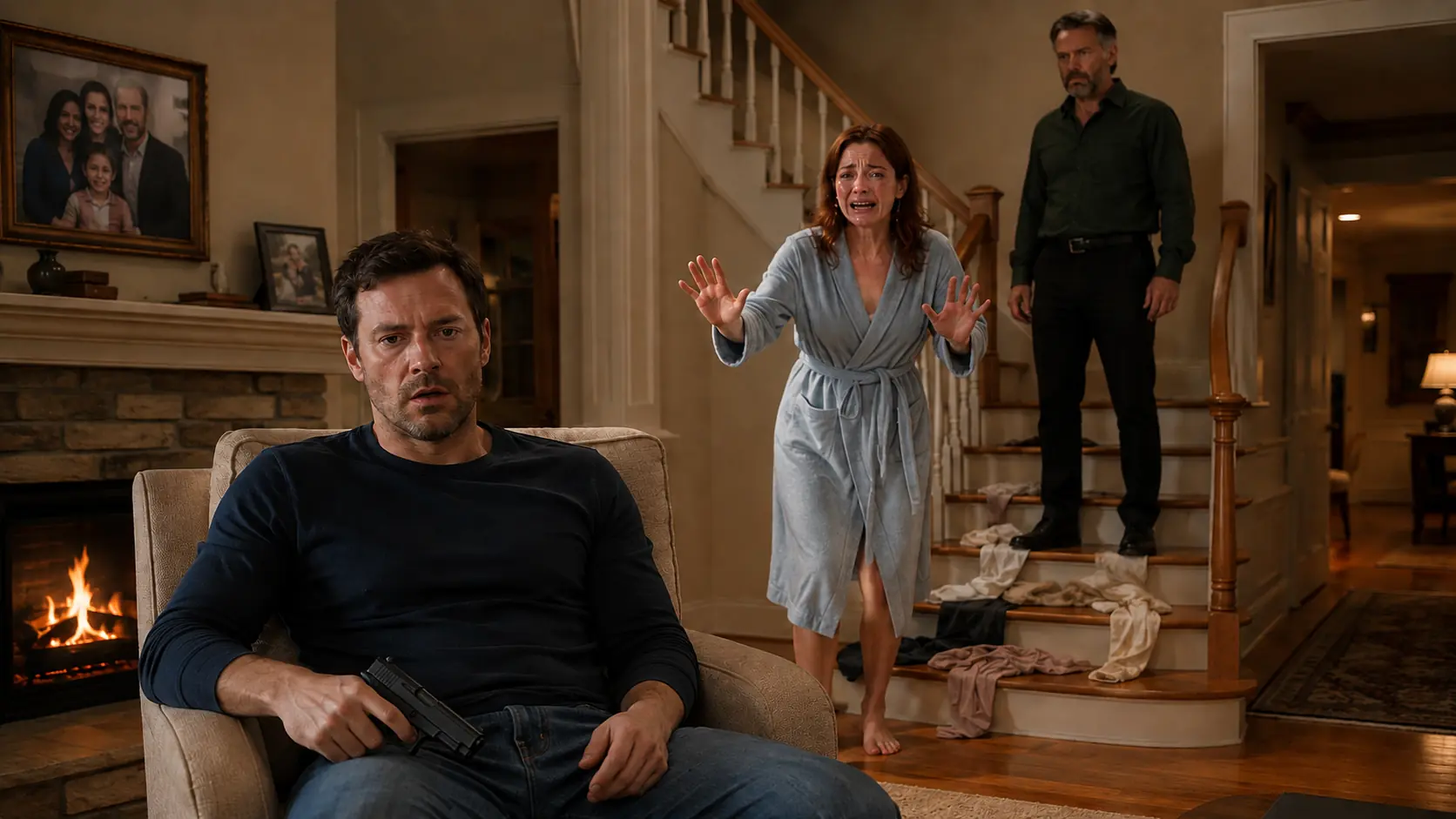
The first thing I saw was her jacket.
Her navy rain jacket lay on the floor beside the entry table, one sleeve turned inside out, the zipper half-pulled like someone had tried to remove it too fast. One of the buttons from her blouse rested near it, white against the dark wood.
Then I saw her shoe.
One tan heel lying sideways by the first stair.
The other was halfway up.
Her scarf, pale green silk, hung over the banister as if it had caught there while falling. I had given it to her on our last anniversary, badly wrapped and overpriced, and she had worn it even though the color made her look softer than she liked to admit.
I looked up the staircase.
Clothes were scattered along the steps.
Her cream blouse lay on the fourth stair. A skirt was twisted near the landing. One stocking had caught on the rail. A pearl hairpin glinted near the wall, small and bright as an accusation.
For several seconds, I did not breathe correctly.
The pastry box bent in my hand.
I should have called out again.
I should have backed outside.
I should have done many reasonable things a man does when he has not just seen his wife’s clothing trailing toward the bedroom like evidence.
Instead, I stood at the bottom of my own stairs and felt the world become narrow.
“Miriam,” I said.
My voice sounded wrong.
From upstairs, a man answered.
“Stay where you are, Andrew.”
He knew my name.
That was the part my mind grabbed first.
A man was in my house.
A man was upstairs.
A man was near my wife.
And he knew my name before I knew his.
I set the pastry box on the entry table so carefully it felt insane.
“Who are you?”
There was silence.
Then Miriam’s voice came from the hallway outside our bedroom.
“Andrew, please. Listen before you come up.”
There are sentences that do not sound dangerous until they finish changing your life.
That one did.
Before it, I was a husband who had come home early with pastries and a tired hope for a quiet evening.
After it, I was a man staring at his wife’s clothes on the stairs while another man stood above me telling me not to come closer.
“Miriam,” I said, “come downstairs.”
“I can’t.”
“You can’t?”
The man spoke again.
“She can. But not until you understand why I came here.”
I laughed once.
It was not a real laugh.
It was the sound people make when reality has become too ugly to accept cleanly.
“You’re in my house,” I said. “Upstairs with my wife. I don’t care why you came here.”
I stepped onto the first stair.
The bedroom door opened.
Miriam appeared at the top of the stairs wearing my old charcoal robe.
Her hair was damp and loose around her face, and one cheek was marked red where something had scraped across the skin. Her eyes were swollen from crying, but not with the shame of a woman caught in a secret affair.
They were worse than that.
They were the eyes of someone who had been carrying fear for too long and had finally dropped it in front of me.
Behind her stood a man in a dark wool coat.
He was older than I expected, maybe early fifties, tall and broad across the shoulders, with gray at his temples and a scar near his left eyebrow. He held a worn leather case in one hand. He did not look guilty. He did not look afraid of me either.
That made me want to hit him.
“Andrew,” Miriam whispered, “his name is Julian Pike.”
The name meant nothing to me.
Julian looked at me directly.
“I am not sleeping with your wife.”
“You may want to try a sentence that doesn’t make me want to break your jaw.”
Miriam began crying again.
Not loudly.
Not theatrically.
Just tears slipping down her face like her body had no strength left to hold them back.
“He knocked at the kitchen door,” she said. “I was changing after my appointment. He said he knew my father.”
I looked at the robe.
The clothes.
The man.
“My wife opened the back door while half-dressed because a stranger claimed he knew her dead father?”
She flinched.
“My father has been gone thirteen years.”
Julian’s eyes stayed on mine.
“And mine has been gone thirty-one.”
Something in his voice stopped me.
Not because I trusted him.
Because grief has a weight when spoken honestly, and even rage can recognize it.
Julian stepped to the hallway table and opened the leather case.
Inside were old papers wrapped in waxed cloth, a black-and-white photograph, a cracked silver compass, a cassette tape, and a faded hospital bracelet sealed in a plastic sleeve.
My anger faltered.
Not disappeared.
Faltered.
The photograph lay on top.
A little boy sat on the steps of an old farmhouse beside a girl with dark braids and a serious mouth. The boy held a wooden boat in his lap. He looked about five years old, small and solemn, with one hand resting strangely against the porch step.
I stared at that hand.
The smallest finger bent slightly inward.
Just like mine.
My mother always said I broke it in a fall when I was too young to remember. She said I cried for an hour and then demanded pancakes. She had told that story so many times it had become family furniture.
Julian lifted the photograph.
“That boy is you.”
“No.”
The answer left me instantly.
I didn’t think it through.
“No.”
Miriam gripped the robe at her throat.
“Andrew—”
“No.”
Julian turned the photograph over.
On the back, written in faded ink, were three names.
Rosie.
Caleb.
Thomas.
I read the second name twice.
Caleb.
Not Andrew.
Julian pointed to the girl.
“That was my sister Rosie. I was fifteen when this was taken. And the boy beside her was my little brother.”
He looked at me.
“Caleb Pike.”
I heard my own breathing.
Too loud.
Too shallow.
“My name is Andrew Whitman,” I said.
Julian nodded once.
“That is the name they gave you after the fire.”
Fire.
The word moved through the hallway and struck a door somewhere deep inside my mind.
For half a second, I smelled smoke.
Not imagined smoke.
Real memory.
Burning pine.
Wet wool.
A woman screaming my name through heat.
Then it was gone.
I grabbed the railing.
Miriam took one step down.
I lifted my hand.
“Don’t.”
She stopped.
The hurt in her face almost broke my anger, and that made me angrier because I needed something solid to hold.
Julian reached into the case and pulled out a newspaper clipping yellowed with age.
FIVE-YEAR-OLD CALEB PIKE PRESUMED DEAD AFTER RANCH HOUSE FIRE.
The date beneath the headline was October 9, 1993.
I turned toward the wall calendar near the entryway.
October 9.
Today.
Miriam had circled it in red.
Underneath, in her handwriting, were four words.
Tell him tonight. Please.
I looked back at her.
“You knew?”
Her face crumpled.
“For twenty-four days.”
Twenty-four days.
She had eaten dinner with me.
Slept beside me.
Asked about my work.
Smiled too quickly.
Gone quiet too often.
And I had thought she was hiding a doctor’s appointment, maybe bad news, maybe something between us that marriage had grown too tired to name.
“You knew my life was a lie,” I said.
“I suspected,” she whispered. “Then I found enough to be afraid it was true.”
I looked at the clothes on the stairs again.
The scene still looked like betrayal.
But now betrayal had too many faces.
“What happened here?” I asked.
Miriam wiped her cheek with the sleeve of my robe.
“When Julian showed me the photo, I panicked. I was trying to get dressed before you came home. Then someone knocked at the front door.”
“Who?”
She looked toward Julian.
He answered.
“Your uncle.”
My stomach tightened.
“Uncle Raymond?”
Raymond Sutter was not my uncle by blood, not exactly. He had been my father’s closest friend and business partner, then my mother’s protector after my father died. He had been at birthdays, holidays, graduations, and every hard day that required someone older to say things would work out.
Julian’s expression hardened.
“He calls himself Raymond now?”
I stared at him.
“What does that mean?”
Julian pulled out another photograph.
Three men stood outside a county courthouse. One was younger, thinner, and unmistakable.
Raymond.
Same narrow eyes.
Same sharp nose.
Same slight tilt of his head, as if he was listening only for advantage.
On the back of the photo, someone had written:
Silas Greer.
I shook my head.
“That isn’t his name.”
“It was.”
Miriam’s voice trembled.
“He came to the front door about ten minutes after Julian arrived. I looked through the side window and saw him. I don’t know why, but I felt sick. Julian told me not to open it.”
“So you hid?”
“I tried to get dressed first. I had the clothes in my arms when Raymond went around the side of the house. Julian pulled me away from the window. Everything fell.”
The image rearranged itself in my mind.
The coat by the door.
The blouse on the stairs.
The stocking over the railing.
Not passion.
Panic.
Not adultery.
A woman trying to dress while danger circled the house.
I sat down on the stairs before my knees made the decision for me.
“Why is Raymond involved?”
Julian’s face turned colder.
“Because Silas Greer was the man suspected of setting the fire that killed our parents.”
“My parents are not dead.”
The sentence came out like instinct.
Then the truth behind it opened.
My father was dead.
My mother lived twenty minutes away in a white cottage full of quilts, family photos, and careful stories.
The woman who raised me.
The woman who made soup when I was sick.
The woman who cried at my wedding.
The woman who might have known I belonged to somebody else.
I looked at Miriam.
She pressed a hand against her stomach.
It was small.
Automatic.
But I saw it.
“Miriam.”
Her eyes flooded.
“I was going to tell you tonight.”
The hallway went silent.
“How long?” I asked.
“Ten weeks.”
My mouth went dry.
A baby.
Our baby.
The night that should have held that truth had been turned into a crime scene.
Miriam’s hand stayed on her stomach.
“I asked your mother about family medical history because of the appointment,” she said. “Blood disorders. Heart issues. Genetic risks.”
“My mother gets nervous about medical things.”
“She said something strange.”
I could barely ask.
“What?”
Miriam swallowed.
“She said, ‘That line should have ended in the fire.’”
The words passed through me slowly, like poison entering water.
Julian looked down at the case.
I looked toward the door.
“And then?”
“Then she called Raymond. He called me five minutes later and asked why I was asking questions that had nothing to do with me.”
My phone buzzed.
Then Miriam’s.
Then Julian’s.
All at once.
We looked at each other.
Miriam checked hers first.
Her face went white.
She turned the screen toward me.
A photograph of our staircase.
Taken from outside the front window.
Miriam in my robe.
Julian in the hallway.
Me sitting on the stairs.
Her clothes scattered below.
Under the photograph was a message.
He already believes what he sees.
For a moment, I felt physically sick.
Someone had staged this.
Not perfectly.
Worse than perfectly.
Humanly.
They had counted on the oldest weakness in marriage: the fear that love has already been lying.
Miriam shook her head hard.
“Andrew, no. I swear to you. Nothing happened.”
I looked at her.
Really looked this time.
The terror was real.
The exhaustion was real.
The insult of being doubted was real too, because she knew exactly what the scene looked like and could not escape it fast enough to protect herself.
I closed my eyes.
When I opened them, I looked at Julian.
“Why now?”
He reached into the case and removed the cassette tape.
The label was written in handwriting I knew.
Not from old documents.
From birthday cards.
From notes taped to fishing poles.
From the signature on the back of my first truck title.
My father’s handwriting.
For Andrew, when Raymond stops protecting the lie.
My hands went numb.
“That’s my father’s writing.”
Julian nodded.
“Harold Whitman was not your father by blood. But he left this with an attorney in Cheyenne. The attorney died last month. His daughter found the sealed file and contacted me.”
“Why you?”
“Because I have been searching for Caleb Pike for thirty-one years.”
The rain started again outside.
Soft against the windows.
Miriam came down one more step and sat beside me, not touching me, but close enough that I could feel her shaking.
Julian took an old cassette player from the case, set it on the stair below us, and pressed play.
Static filled the house.
Then my father’s voice came through.
“Andrew,” he said, and hearing him alive again nearly took the breath from my body. “If you are hearing this, I either died before finding courage, or fear made a coward of me longer than I can forgive.”
Miriam covered her mouth.
I stared at the little machine.
My father continued.
“Your name was Caleb Pike when Evelyn and I took you in. You were five years old, barefoot, burned on one arm, and coughing smoke on the side of County Road Twelve. Raymond brought you to us before sunrise and said men were looking for the boy who survived.”
The tape hissed.
“I wanted to call the sheriff. Evelyn wanted to hold you. Raymond said the sheriff was bought, the family was dead, and anyone who returned you would be signing your death warrant.”
There was a long pause.
A cough.
A sound like a dying man swallowing guilt.
“I believed him because fear is very good at dressing itself as wisdom. Then I loved you because you were a child in my kitchen asking for water. After that, every day made the truth harder to speak.”
I bent forward, hands over my face.
The tape went on.
“Do not trust Raymond Sutter. His real name is Silas Greer. He knew the Pike family before the fire. He knew where the land records were hidden. He knew too much for an innocent man and gave too little for a savior.”
Another pause.
“I was your father in every way I knew how to be. That part was not false. But love does not turn a stolen life into a clean one. I am sorry, son. I am so sorry.”
The tape clicked off.
No one moved.
Then the doorbell rang.
Once.
Miriam gasped.
Julian crossed to the front window and looked through the edge of the curtain.
His jaw tightened.
“Raymond.”
A second ring.
Then a familiar voice came through the door.
“Andrew? Open up. Your mother collapsed.”
Every instinct in me lurched toward the door.
Miriam grabbed my wrist.
“Call her.”
I looked at her.
“Call your mother first.”
Raymond knocked.
“Andrew, son. Now.”
I pulled out my phone with shaking hands and called my mother.
She answered on the first ring.
“Andrew?”
Her voice was wet with tears.
“Mom, are you okay?”
Silence.
Then a whisper.
“Is he there?”
I stared at the door.
“Raymond?”
“No,” she said. “The other man.”
Julian’s eyes sharpened.
“How do you know there’s another man?”
My mother began to cry.
“Raymond said he found you.”
The hallway seemed to tilt.
Raymond knocked harder.
“Andrew, open this door.”
My mother whispered, “Don’t let him in.”
That sentence came from somewhere older than fear.
“Mom, what does he want?”
“The compass,” she said.
Julian looked down at the silver compass in the case.
“What compass?” I asked.
“The one your real father hid the key inside.”
Raymond stopped knocking.
The silence outside grew sharper than the sound.
Julian opened the compass with careful hands.
The glass face lifted.
Inside, beneath the old needle, was a flat brass key no bigger than a fingernail.
Julian stared at it.
“I never found this.”
My mother sobbed.
“I’m sorry. I’m sorry.”
The line went dead.
A car engine started outside.
Julian looked through the curtain again.
“He’s leaving.”
I ran to the window before he could stop me.
A black sedan rolled away from the curb.
Raymond did not look back.
For a long moment, I stood there with my phone in my hand, watching taillights disappear beneath the rain-blurred trees.
Then I turned to Miriam.
“I thought you were cheating on me.”
She flinched as if she had known the sentence was coming and still could not bear it.
“I know.”
“I saw the clothes.”
“I know.”
“I heard him upstairs.”
“I know.”
“I believed the ugliest version because it made more sense than this.”
Her eyes filled again.
“That is what Raymond wanted.”
I crossed the room slowly.
This time when she reached for me, I did not stop her.
She put one hand on my chest, the other still protectively near the life neither of us had properly named yet.
“I should have told you sooner,” she said.
“Yes.”
“I was trying to be certain.”
“Yes.”
“I was scared it would destroy you.”
“It might still.”
She nodded.
“I know.”
That honesty held us better than comfort would have.
Julian looked away, giving us what privacy he could in a house where every wall seemed suddenly full of strangers.
I touched Miriam’s stomach with two fingers.
Ten weeks.
Our child existed inside a story I did not yet understand.
“No more secrets,” I said.
“No more,” she whispered.
I looked at Julian.
“What does the key open?”
He held it between his fingers.
“My mother used to talk about a box in Laramie. She said our father hid proof there before the fire. I thought grief had tangled her memory.”
“And Raymond wants it.”
“Yes.”
“Then we find it first.”
We left through the back door fifteen minutes later.
Not because we were afraid to face Raymond.
Because Raymond knew the front.
Miriam changed in the laundry room while Julian watched the yard. I picked up her clothes from the stairs one by one. Jacket. Blouse. Skirt. Stocking. Scarf. Hairpin.
The scarf stayed in my hand longest.
Green silk.
Anniversary morning.
Miriam laughing because I had spent too much and then lied badly about a sale.
A memory from my real life.
Whatever my name had been before, that moment was still mine.
At the back door, Miriam saw the pastry box on the entry table.
“You brought honey pastries?”
I looked at it.
“Four.”
Her face folded.
“I had a little box upstairs,” she whispered. “With the ultrasound appointment card inside. I was going to tell you over dinner.”
That nearly broke me.
Not the fire.
Not the tape.
Not the hidden name.
A small box upstairs that had been waiting to become joy.
I picked up the pastry box.
Julian gave me a strange look.
“We’re taking pastries?”
“Yes.”
He looked like he might object.
Then he seemed to decide a man whose childhood had just been stolen could carry whatever box he wanted.
Our first stop was my mother’s house.
I insisted.
Miriam wanted safety first.
Julian wanted the key secured first.
But I needed to look at the woman who raised me before I let a storage box decide what she was.
My mother opened the door before we knocked.
She was smaller than I remembered, wrapped in a brown cardigan, her hair unpinned and messy, her face lined by hours of crying.
When she saw Julian, she grabbed the doorframe.
“Margaret’s boy,” she whispered.
Julian went still.
Margaret.
My real mother.
The name entered me like a bell rung in a house I had never visited.
My mother looked at me.
“Andrew.”
Then, softer, “Caleb.”
I thought the name would make me angry.
It did not.
It made me feel lost.
Inside, her living room smelled like cinnamon tea and old books. Photographs lined the mantel. Me at seven holding a baseball bat. Me at fifteen beside my father’s truck. Me and Miriam on our wedding day. A whole life staring back at me, suddenly both true and false.
My mother sat in her chair and told us everything she could.
Not cleanly.
Not without excuses trying to crawl into the gaps.
But enough.
Raymond, then Silas Greer, had brought me to their house the morning after the fire. I was burned, coughing, and nearly silent. He told them my family was dead and that whoever had killed them was hunting for the surviving child. He said going to the police would get me killed.
My parents had lost two sons before me.
That part I knew.
One stillborn.
One who lived only six days.
My mother said when Raymond placed me in her arms, she stopped thinking like a citizen and started thinking like a woman being offered the child she believed God owed her.
Julian stood by the mantel, hands curled into fists.
“My mother searched for Caleb until she died.”
My mother covered her mouth.
“I saw her once.”
The room went silent.
“When?” I asked.
“Four years after. On television. She was begging anyone with information to come forward.”
Julian’s voice was low.
“And you said nothing.”
She closed her eyes.
“I was afraid if I gave him back, I would die.”
“He was not yours.”
“I know.”
The words came out with no defense left.
That was the first answer I could believe.
She went to the hallway closet and returned with a cardboard box full of letters.
All unopened.
All addressed to police departments, newspapers, churches, and unknown witnesses.
All from Margaret Pike.
Julian took the first one with shaking hands.
For the first time since entering my house, he looked like a boy.
My mother said, “I could not throw them away.”
Julian looked at her.
“But you could hide them.”
She nodded.
“Yes.”
There was no forgiveness in the room.
Not then.
Only truth.
And truth does not always feel like freedom when it first arrives.
The brass key opened a lockbox at a private storage office in Laramie.
Inside were documents, land deeds, photographs, and a handwritten ledger kept by my real father, Daniel Pike. The ledger named Silas Greer in a scheme that stole ranch land from widows, immigrants, and families who lacked the money to fight forged claims in court. My father had gathered proof. My mother had hidden copies. The farmhouse burned three days later.
Raymond had not saved me.
He had preserved me.
There is a difference.
He believed I knew where the compass was hidden, or that someday my memory would return. When it did not, he stayed near the Whitman family, playing uncle, friend, protector, waiting for the past to loosen. It never did.
Until Miriam became pregnant.
Until she asked about bloodlines.
Until my mother panicked and called the one man she should never have trusted.
Raymond disappeared before the authorities arrived.
Not forever.
Men like him mistake flight for intelligence.
It is usually only delay.
Federal investigators caught him nine months later in Utah, living under another name and trying to sell forged mineral rights documents to a mining company. Julian testified. My mother testified. I did too, though I still did not know which name to give at first.
The judge asked me to state my full legal name for the record.
I paused.
Then I said, “Andrew Caleb Whitman Pike.”
The courtroom went silent for a beat.
Not because the name mattered legally.
Because it mattered to me.
Miriam gave birth to our son the following spring.
We named him Daniel Harold Pike Whitman.
Too many names, maybe.
But each one carried a complicated truth, and we had decided our child would inherit honesty even when it was uncomfortable.
The day we brought him home, I paused at the bottom of the stairs.
No scattered clothes.
No overturned shoes.
No robe visible in the hallway.
Just sunlight through the window and Miriam moving carefully ahead of me, carrying a sleeping baby while I hovered behind them like a man guarding glass.
The green scarf hung on the coat rack.
I had placed it there deliberately.
A reminder.
Not of betrayal.
Of the day I almost believed the story someone else wrote for me.
Miriam and I did not heal quickly.
Anyone who says truth fixes everything has not lived through enough of it.
For weeks, I woke at night and remembered seeing her clothes on the stairs. For weeks, she cried when I got too quiet, afraid I had returned to that first conclusion. For months, we went to counseling because love can survive suspicion only when both people stop pretending the wound is smaller than it is.
But we chose the harder road.
No more secrets.
No more protecting each other with silence.
No more letting fear decide what truth the other person could bear.
I visited my mother often.
At first, because I needed answers.
Later, because grief had room for more than one feeling. She had stolen me from another family, and she had also loved me through fevers, nightmares, school plays, broken bones, and my father’s death. Those facts did not cancel each other. They simply refused to become simple.
Julian became my brother slowly.
Not by blood.
That part was already true.
By coffee.
By awkward phone calls.
By the first Thanksgiving when he stood in my kitchen holding the baby and cried so silently I pretended not to notice.
People love clean stories.
A husband comes home early.
His wife’s clothes are on the stairs.
A stranger is in the bedroom.
A marriage ends.
That was the story Raymond wanted me to believe because simple stories move faster than complicated truth. He knew jealousy could outrun reason. He knew a robe, a closed door, and another man’s voice could do more damage than any weapon if placed correctly.
He almost succeeded.
That is the part I still hate.
Not that I doubted Miriam.
I was human.
I saw what I saw.
I hate that the lie was built from ordinary fears every marriage carries somewhere in the dark.
Fear of not being enough.
Fear of being replaced.
Fear that the person beside you has a life you do not know.
Years later, when Miriam asks what I remember most from that day, she expects me to say the tape or the photograph or Raymond’s voice at the door.
I never do.
I remember the pastries.
Four honey-pecan pastries in a white box with a gold string, sitting on the entry table while my entire life rearranged itself around them.
We ate them after midnight, when investigators had left, Julian was asleep on the couch, and Miriam and I sat on the kitchen floor because chairs felt too formal for grief.
She opened the box.
The icing had smudged against the lid.
She handed me one.
“I’m still angry,” I said.
“I know.”
“I may be angry for a while.”
“I know.”
“I love you.”
She cried then.
So did I.
Not because everything was fixed.
Because love had survived the first honest sentence after the worst wrong assumption.
Outside, rain tapped against the windows.
Inside, the house looked strange and familiar at once.
The stairs were clear now.
The clothes had been folded on the chair, not hidden, not washed in panic, not thrown away. Folded. Placed where we could see them until they stopped belonging to the lie.
That is what we did with the rest of it too.
The names.
The photographs.
The letters.
The grief.
The anger.
The mother who raised me.
The mother who lost me.
The brother who found me.
The wife I nearly misjudged.
The child who entered the world carrying more history than any baby should, and somehow made it feel lighter.
We folded each piece carefully.
We placed it where truth could reach it.
And slowly, not all at once, we learned which story it really belonged to.