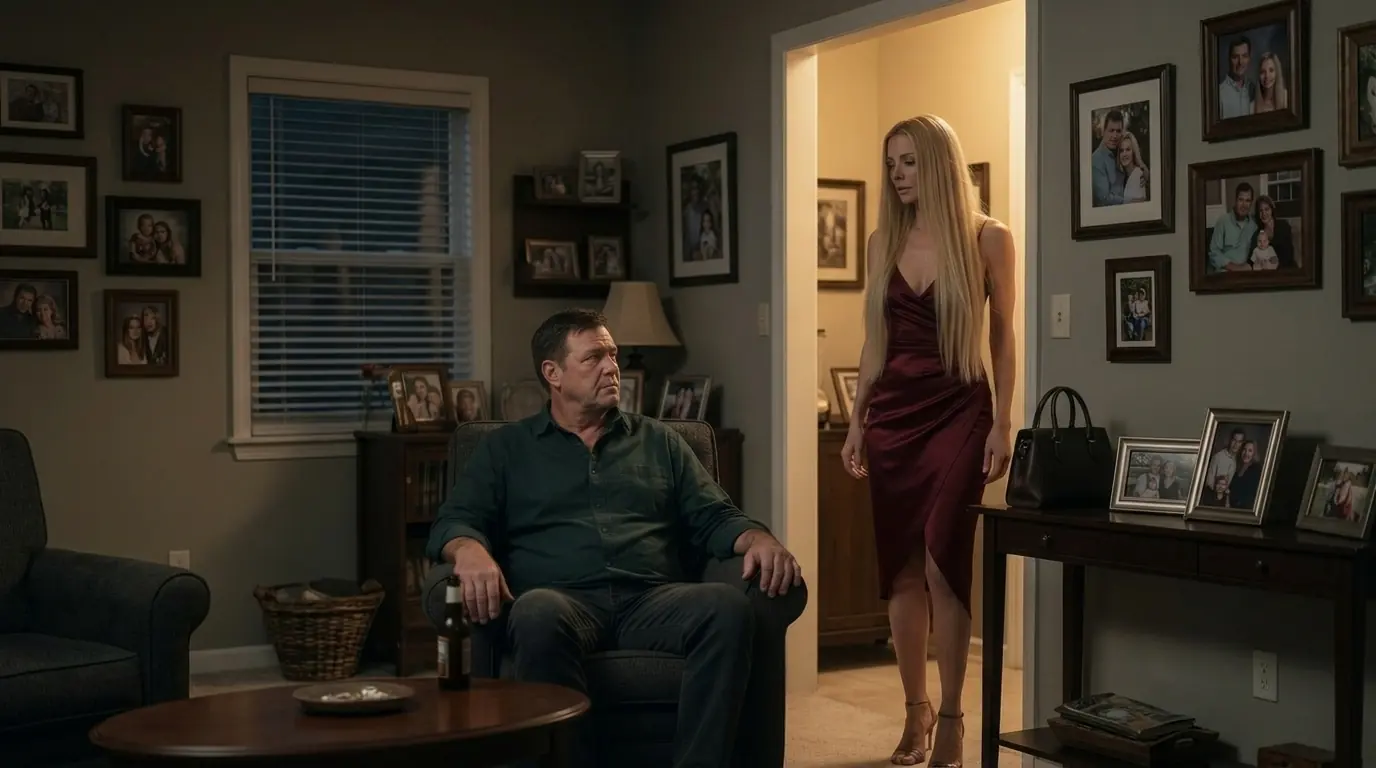
I thought twenty-three years of marriage meant a person owed you the truth.
Not perfection. Not constant romance. Not some storybook version of loyalty where nobody ever gets tired, disappointed, or lonely. Just the truth. After twenty-three years, after a mortgage, funerals, bad winters, medical scares, business risks, and thousands of ordinary dinners at the same kitchen table, I thought the truth was the smallest thing my wife could still give me.
Then I saw her come through our front door at 12:52 in the morning with her hair ruined, her lipstick nearly gone, and another man’s cologne sitting on her skin like evidence.
My name is Everett Cole. I was forty-nine years old then, and I owned a specialized fishing gear company called Cole River Tackle. I built it in a rented garage with secondhand tools, bruised hands, and a kind of stubbornness that probably saved me more than talent ever did. We made custom rods, precision reels, fly kits, and specialty gear for serious anglers who cared about balance, durability, and craftsmanship.
For most of those years, I believed my wife, Serena, was proud of what I had built.
Maybe she was once.
Or maybe she was proud only when the business started paying for the house, the vacations, the boutique she wanted, and the lifestyle she slowly began pretending had appeared by magic. That is one of the cruel things about betrayal. It makes you revisit every memory and wonder where the truth ended.
The Thursday night everything changed, I was supposed to be in Portland for a supplier conference.
A plumbing disaster at the hotel canceled the opening events, and the organizers pushed everything to Friday morning. I could have called Serena. I nearly did while walking back to my truck with my overnight bag over one shoulder. But then I thought maybe I would surprise her, bring dinner home, sit with her for once without one of us checking emails or pretending we weren’t tired.
I drove two hours through rain, thinking like an idiot that a delayed conference might become a gift.
When I pulled into our driveway, Serena’s car was gone.
At first, that didn’t mean anything. She owned a vintage clothing boutique called Magnolia Thread, and lately she had been obsessed with evening pop-ups, influencer events, styling videos, and whatever else she called “brand growth.” I had heard that phrase so many times it had become the background music of our marriage.
So I went inside, set down my bag, opened a beer, and waited.
An hour passed.
Then two.
Then three.
I checked the boutique’s Instagram page. Nothing was posted about an event that night. I texted her and got no answer. I called once and went straight to voicemail. At midnight, the beer sat untouched on the coffee table, and my stomach had gone cold in a way I recognized from bad business deals and worse phone calls.
Something was wrong.
Or maybe something had been wrong for a long time, and I had only finally come home early enough to meet it.
At 12:52, headlights swept across the living room wall.
I turned off the lamp and sat in the dark.
Outside, her car door opened. Then nothing happened for several seconds. That pause told me more than movement would have. She was sitting in the driveway gathering herself, fixing her face, preparing the version of the night she planned to bring inside.
The front door opened.
Serena stepped in quietly, but not carefully.
She was not drunk. She was too steady for that. Careless, maybe. Confident. A woman coming home to a house she believed was empty and a husband she believed was still a hundred miles away.
Her hair was loose around her shoulders, styled in soft waves she had not worn for me in years. Her burgundy dress was riding higher than it should have, and one seam near her hip had torn slightly. She hummed under her breath as she dropped her purse on the entry table.
Then she flipped the light switch.
She froze.
I sat in the chair near the window, still on the entry table.
Then she flipped wearing the flannel shirt I had driven home in, hands resting on my knees like a man waiting for a doctor to say the scan was bad.
“Everett,” she gasped. “God, you scared me.”
I looked at her.
“What are you doing here?” she asked.
That was the first mistake.
Not where have you been. Not I missed you. Not why are you sitting in the dark.
What are you doing here?
“In my house?” I asked.
Her expression tightened. “You know what I mean. I thought you were in Portland.”
“Conference got delayed,” I said. “Hotel had a burst pipe.”
She took one slow breath, then tried to smile.
It was a terrible smile.
“Why didn’t you call?”
“Where were you, Serena?”
She looked down, kicked off one heel, then the other. The movement felt rehearsed, a little show of normalcy, as if shoes on the floor could make 1 a.m. ordinary.
“I was with Natalie,” she said. “A few of us had drinks after a client preview.”
“There was no preview.”
Her eyes flashed.
“You checked?”
“I checked because my wife vanished until almost one in the morning and didn’t answer her phone.”
“My phone died.”
“Call Natalie.”
“It’s late.”
“Exactly.”
The house went quiet.
Rain tapped against the windows. The refrigerator hummed. Somewhere upstairs, the heating system kicked on with a soft groan. I remember all those small sounds because my mind was trying to hold on to anything except the truth standing ten feet away from me.
Serena folded her arms.
“I don’t appreciate being interrogated.”
I stood.
“I don’t appreciate being lied to.”
Her face hardened in a way I had not seen before. Not guilt. Not panic. Irritation. As if my being there had inconvenienced the life she was living behind my back.
“You’re being controlling,” she said.
That word landed like a slap.
In twenty-three years, I had never tracked her location, checked her phone, monitored her spending for personal purchases, or questioned her nights at the boutique. I had trusted her so completely that my trust had become useful to her.
“Controlling?” I said.
“Yes. You’re standing here like some jealous maniac because I came home late one night.”
“One night?”
Her mouth closed.
That was the second mistake.
She realized it as soon as I did.
“Who is he?” I asked.
For one second, her face gave me the answer before her mouth tried to hide it.
“There is no he.”
“Your dress is torn.”
“I caught it on a chair.”
“You smell like cologne I don’t wear.”
The color left her cheeks.
She looked down at her dress, touched the tear near her hip, then lifted her chin with a strange kind of defiance.
“You want the truth?” she said.
“No,” I answered. “But I need it.”
That seemed to anger her more than shouting would have.
“The truth is I’m lonely,” she snapped. “The truth is I’ve been lonely for years while you worship that fishing business like it’s your real wife.”
I stepped back.
“You could have said that.”
“I did.”
“No,” I said. “You complained about long hours after spending the profit from those hours. That is not the same as fighting for a marriage.”
Her eyes narrowed.
“You always do that. You make everything sound so simple because you think being calm makes you right.”
“Who is he?”
She looked toward the stairs.
“I’m going to bed.”
I moved just enough to block the hallway without touching her.
“His name.”
For a moment, hatred moved through her face so clearly I almost forgot I had once loved it.
“Dane,” she said. “His name is Dane Mercer.”
I did not know the name.
Then I did.
A model from the boutique’s social media page. Twenty-eight, maybe twenty-nine, with a jawline built for photographs and an expression that seemed permanently halfway between boredom and self-admiration. He had been in half the videos Serena posted over the last few months.
“How long?” I asked.
“Does it matter?”
“Yes.”
She looked at me as if deciding whether cruelty might be easier than shame.
“Four months.”
The words did not explode.
They sank.
Some pain enters quietly because it knows it will be staying awhile.
“Does he know you’re married?”
“Yes,” she said. “And he doesn’t make me feel invisible.”
I almost laughed.
Not because anything was funny.
Because the woman standing in front of me lived in a house paid for by invisible work. She ran a boutique funded by invisible sacrifice. She had built a second life on the back of a man she now accused of not seeing her.
I moved aside.
She walked past me and up the stairs.
I did not follow.
Instead, I sat in my workshop behind the garage until dawn, running my hands over a half-finished bamboo fly rod clamped to the bench. Work had always cleared my mind. Rod building demanded patience. The angle had to be right. The wrapping had to be even. The finish had to be clean, or the flaw would reveal itself later under pressure.
By morning, I understood my marriage had been showing stress fractures for years.
I had simply mistaken them for grain.
Serena came downstairs at seven wearing black fitted pants, a silk blouse cut low enough to make a statement, and earrings I had never seen before.
She looked ready for a photo shoot, not a conversation.
“Coffee’s made,” she said, not looking at me.
“We need to talk.”
“I really don’t want to do this before work.”
“You should have thought about timing before you came home smelling like another man.”
Her shoulders stiffened.
She turned slowly.
“I told you the truth.”
“No,” I said. “You told me enough to wound me and not enough to take responsibility.”
She laughed softly.
“That sounds like something from a self-help book.”
“It sounds like a husband who has finally stopped being convenient.”
That took some of the confidence from her face.
Good.
“How long have you been planning to leave?” I asked.
She looked away.
There it was again.
The little flash of truth before the lie.
“I don’t know.”
“Does Dane love you?”
“That’s not the point.”
“It is if you’re destroying a twenty-three-year marriage for him.”
She leaned against the counter, arms crossed, eyes cold.
“Maybe I’m destroying it for myself.”
“Then own that.”
“I am.”
“No,” I said. “You’re blaming me so you don’t have to call betrayal what it is.”
Her face changed.
For the first time, she seemed to understand that the conversation was not going the way she expected. Maybe she had imagined me begging. Maybe crying. Maybe raging so she could make me the villain in the story she had already started telling herself.
Instead, I was calm.
That scared her more than anger would have.
“I’m moving into the guest room,” I said.
Her eyes widened.
“That’s it?”
“No,” I said. “That is the beginning.”
Over the weekend, the house became a museum of everything we were not saying.
Serena spent most of her time at Magnolia Thread, or claimed she did. I stopped asking. When she returned, she moved through the house like a tenant who had already decided which furniture she wanted to keep. She took long calls behind closed doors and used a soft voice I now knew was not for me.
By Monday morning, I was sitting in the office of Russell Dean, an old fishing friend who also happened to be one of the sharpest divorce attorneys in Oregon.
He listened without interrupting.
Then he leaned back in his chair and said, “Do not leave the house. Document everything. Protect the business immediately.”
“I thought infidelity mattered.”
“Emotionally, yes,” he said. “Legally, not as much as people want it to. Oregon is no-fault. The fight will be assets, and Cole River Tackle is your biggest target.”
I nodded.
“I had the company before the marriage.”
“Good.”
“And a prenup.”
Russell sat forward.
“You have the signed original?”
“In a fireproof box.”
He smiled for the first time.
“Then your wife is about to learn the difference between underestimating a husband and defeating one.”
The prenup had been her father’s idea, ironically.
Back then, he thought Serena was marrying beneath her. I was a young craftsman with a small shop, big ideas, and not enough capital. Her father insisted I protect what little business equity I had, not because he cared about me, but because he wanted to prove he was the practical one in the room.
I had nearly refused.
Serena told me to sign it so he would stop talking.
Twenty-three years later, that old document sat between me and financial ruin.
When Serena came home that evening, I was at the dining room table with bank records, business valuations, inventory files, tax returns, and old corporate documents spread in neat piles.
She stopped in the doorway.
“What is this?”
“Paperwork.”
“For what?”
“Russell Dean is filing for divorce.”
Her face flushed.
“You talked to a lawyer?”
“Yes.”
“Without discussing it with me?”
I looked up at her.
“You had a four-month affair without discussing it with me.”
Her mouth tightened.
“That’s not the same.”
“No,” I said. “Mine was responsible.”
She walked to the liquor cabinet and poured whiskey into a glass, though she rarely drank whiskey unless she wanted to look dramatic.
“You’re overreacting.”
“I am responding.”
“You’re throwing away twenty-three years.”
“You threw them away slowly. I am just refusing to live in the wreckage.”
Her hand shook slightly as she lifted the glass.
“I am entitled to half.”
“Yes,” I said. “Half of marital assets.”
Her eyes narrowed.
“Don’t play games with me, Everett.”
“I am not playing. Cole River Tackle is protected. The prenup is valid. Russell confirmed it this morning.”
For the first time since she had walked in at 1 a.m., Serena looked genuinely afraid.
“The prenup?” she said.
“You remember it.”
“That was decades ago.”
“Contracts age better than lies.”
She stared at me.
“You’ve been planning this.”
“No,” I said. “I have been keeping records because I run a business. You mistook trust for carelessness.”
That was the moment the power shifted.
We both felt it.
Three days later, an unknown number called me while I was sanding a reel seat in the workshop.
“Is this Everett Cole?” a woman asked.
“Yes.”
“My name is Tessa Grant. I work at Magnolia Thread. I think you need to know what’s happening.”
We met forty minutes later at a roadside coffee shop two towns over.
Tessa was twenty-six, nervous, and angry in the way honest people get when they have waited too long to speak. She wore a denim jacket and kept twisting the paper sleeve around her cup until it tore.
“I shouldn’t be here,” she said.
“Then why are you?”
“Because your wife is not just cheating on you.”
I waited.
Tessa took a breath.
“Dane is using her. He’s been pushing her to get money out of the divorce. I heard them arguing in the back office. He told her she needed to secure assets before you got smart.”
The words settled coldly.
“What kind of assets?”
“Inventory. Cash sales. Some vintage designer pieces that never made it into the books. She’s been moving them to a storage unit under her cousin’s name.”
I sat back.
“Tessa, why tell me this?”
Her eyes met mine.
“My mother did this to my father. Cheated, lied, took everything, then acted like survival made him cruel. He never recovered.”
She looked down at her torn coffee sleeve.
“And Serena treats everyone at that boutique like we’re props in her little reinvention story. She steals our ideas, belittles us in front of clients, and takes credit when something goes well. I should have left months ago.”
Then she slid a folded envelope across the table.
Inside were printed screenshots.
Texts between Serena and Dane.
Dane: Make sure the boutique looks weaker on paper.
Serena: I’m moving inventory this week.
Dane: What about his tackle company?
Serena: Prenup may be a problem.
Dane: Then claim emotional abuse. Judges love that.
Serena: Everett is too sentimental to fight dirty.
Dane: Then make him pay for being soft.
I read the messages twice.
By the second time, my hands were steady.
That frightened me a little.
“When were these taken?” I asked.
“Yesterday. She left her laptop open in the office. I know that sounds bad.”
“It sounds useful.”
Tessa swallowed.
“There’s more. She mentioned selling part of your antique reel collection. Dane found a buyer.”
My jaw tightened.
That collection had taken twenty years to build.
Some pieces had belonged to mentors. One rare Hardy reel had been gifted to me by a client who died of cancer two summers later. To Serena, apparently, they were just valuables she could convert into cash.
I called Russell from the parking lot.
“We need a forensic accountant,” I said.
Russell did not ask whether I was sure.
Within a week, we had one.
The audit found missing inventory at Magnolia Thread within days. High-value garments had been transferred off the books. Cash deposits did not match sales records. Expenses had been inflated. Social media contractor payments had been routed through Dane under vague marketing categories.
It was not a messy affair.
It was a plan.
While Russell handled the legal side, I locked down Cole River Tackle.
I changed passwords, updated banking permissions, restricted access to company accounts, and moved my private collection to a secure storage facility with appraisals and photographs. Then I called a meeting with my core team.
There were only six of us then.
Mike Alvarez, my production manager, had been with me for sixteen years. He could wrap guides cleaner than anyone I had ever hired and had once driven through an ice storm to deliver a custom order to a client whose father was dying. June Keller handled shipping and wholesale accounts with a ferocity that made suppliers afraid to disappoint her. The others had been with me long enough to deserve honesty.
“I’m getting divorced,” I told them. “Serena may try to target the business. I need to protect what we built.”
Mike did not hesitate.
“Tell us what you need.”
No speech.
No drama.
Just loyalty.
I almost had to look away.
That night, Serena was waiting in the kitchen when I got home.
She wore a cream dress and had curled her hair the way she used to for our anniversary dinners. There was wine on the counter, two glasses out, soft music playing from her phone. Once, the scene would have hurt me with hope.
Now I saw staging.
“We need to talk,” she said.
“About?”
“Us.”
“There is no us right now.”
Her smile faltered.
“Everett, don’t be cold.”
“Cold is coming home at 1 a.m. after four months of lying. This is clarity.”
She walked closer.
“Maybe Dane was a mistake.”
“Only maybe?”
Her eyes flashed, then softened again.
“I got carried away. I was unhappy. He made me feel young.”
“That must have been expensive.”
The softness vanished.
“What does that mean?”
“It means reconciliation seems to have arrived right after the audit found your missing inventory.”
Her face went pale.
I stepped past her and set my keys on the counter.
“It also arrived after Dane’s texts about the prenup, emotional abuse claims, and selling my reel collection.”
For once, she had no immediate answer.
Then came anger.
“You had people spying on me.”
“No,” I said. “You had people watching you become exactly who you are.”
Her eyes filled with tears.
Not sadness.
Frustration.
“What do you want?”
“A clean divorce.”
“I deserve more than being discarded.”
I looked at her for a long time.
“Serena, you discarded me while still using my last name, my house, and my trust.”
She flinched.
Good.
Not because I wanted to hurt her.
Because sometimes truth has to make contact.
“The offer will be fair,” I said. “You keep the house and receive a cash settlement. I keep Cole River Tackle, my tools, my private collection, and all business interests. We both walk away.”
“And if I don’t agree?”
“Then Russell files everything. The audit. The screenshots. The inventory diversion. The plan to manufacture abuse claims.”
Her lips parted.
“That would destroy me.”
“No,” I said. “It would show what you did. There is a difference.”
The settlement meeting took place in Russell’s office.
Serena arrived with Patricia Wynn, a divorce attorney known for smiling while sharpening knives. Patricia entered ready to fight. She had the kind of confidence lawyers bring when clients tell them only the useful half of a story.
Russell was polite.
That made him more dangerous.
He laid out the proposal: Serena would keep the house, receive a structured cash settlement, and get one year of health insurance coverage. I would retain full ownership of Cole River Tackle, all intellectual property, all workshop equipment, and the antique reel and rod collection documented as separate property.
Patricia leaned forward.
“This is wildly inadequate after a twenty-three-year marriage.”
Russell slid the prenup across the table.
“It is also better than what she is likely to receive after litigation.”
Patricia glanced at it.
Then at Serena.
“We will challenge enforceability.”
Russell nodded as if he had been expecting that.
Then he slid over the second folder.
“This contains documentation of inventory transfers from Magnolia Thread, business valuation manipulation, communications with Dane Mercer regarding asset concealment, and proposed false claims against my client.”
Patricia opened the folder.
Her expression changed before she finished the first page.
Serena looked down at her hands.
The room went very quiet.
Patricia asked for five minutes alone with her client.
They took twelve.
When they returned, Patricia’s voice had lost its blade.
“My client is prepared to accept the core framework,” she said. “We request an additional forty thousand dollars and health insurance for eighteen months.”
Russell looked at me.
I nodded once.
“Done,” he said.
Serena finally looked at me.
“You really kept everything.”
“No,” I said. “I kept enough records to protect what you tried to take.”
Her eyes hardened.
“Tessa told you.”
“Tessa chose integrity.”
“She betrayed me.”
I shook my head.
“You keep using that word for people who stop helping you lie.”
Something passed over Serena’s face then.
Maybe regret.
Maybe anger wearing a softer coat.
“Dane left,” she said.
“I assumed.”
“He said I had too much baggage.”
I felt nothing sharp.
No satisfaction.
No triumph.
Just exhaustion, old and deep.
“I’m sorry,” I said.
She studied me.
“Are you?”
“Yes,” I answered. “Twenty-three years deserved a better ending than this.”
For a moment, she almost looked like the woman I had married.
Then she stood, gathered her purse, and said, “The house will need a roof before winter. Just so you know.”
And there she was again.
The divorce finalized two months later.
The house sold shortly after.
Serena moved to Arizona, chasing some apparel partnership with a boutique chain. Magnolia Thread closed before the end of the year. Too much missing inventory, too much damaged trust, too many unpaid invoices hidden beneath curated social media posts.
I moved Cole River Tackle into a larger workshop on the outskirts of town.
It was a risk.
A serious one.
But grief had a strange way of clearing space. For years, I had kept the business at a size that fit the marriage. Not too much travel. Not too much expansion. Not too many risks that might make Serena complain I was choosing work over her.
Now I could choose without apology.
The new workshop had tall windows, concrete floors, custom benches, storage for blanks and cork, a finishing room with proper ventilation, and enough wall space to display the best rods we had ever built. The first morning we opened, sunlight came through the windows and hit the polished reel seats like something holy.
Mike stood beside me with a box of imported components from Japan.
“Looks good, boss.”
“It looks expensive.”
“That too.”
June walked in carrying a tablet.
“Website traffic is up forty percent since the Angler’s Monthly feature. Also, a lodge in Montana wants a wholesale call.”
I looked around the room.
For the first time in a long time, I felt tired in a clean way.
Not drained.
Used well.
I hired Tessa a month later to run digital marketing and customer relations.
She accepted only after asking twice whether it would be awkward.
“It won’t,” I told her.
“You sure?”
“You helped save my company. I think we can survive newsletters.”
She turned out to be better at it than anyone I had ever paid. Our online sales doubled within six months. She understood customers without flattering them and understood storytelling without lying. That was rarer than people think.
One year after the divorce, Cole River Tackle earned a booth at the National Fishing Expo in Chicago.
It was the kind of event I used to dream about when I was twenty-six and working in a garage with a space heater and a folding table. Our display featured a limited series of custom fly rods, three new reel designs, and a restoration case showing vintage craftsmanship next to modern materials. I should have been nervous.
Instead, I felt centered.
A man named William Hargrove stopped at our booth on the second day. He owned a chain of high-end fishing lodges across the Rockies and Alaska. He picked up one of our signature rods, tested the balance, and smiled like a man who had just heard music.
“This is yours?” he asked.
“Our design,” I said. “Built in Oregon.”
He looked at the finish.
“I want these in every lodge shop I own.”
By noon, we had our largest wholesale agreement to date.
By two, I saw Serena three booths away.
She looked different.
Not ruined. I will not pretend that. Life had not destroyed her. It had simply stopped editing her in soft light. Her clothes were simpler, her hair shorter, her face thinner. She was speaking with a vendor from Western Outfitters, gesturing toward a rack of women’s outdoor apparel.
When she turned and saw me, we both paused.
Then she walked over.
“Everett.”
“Serena.”
“I heard your company would be here.”
“That makes sense. It’s a fishing expo.”
She smiled faintly.
Fair enough.
“I’m working with Western Outfitters now,” she said. “Product development. Mostly apparel.”
“I hope it goes well.”
The civility surprised both of us.
She looked at our display.
“You always were good at making things people wanted to touch.”
I did not know what to do with that sentence.
So I accepted it as professionally as I could.
“Thank you.”
An awkward silence stretched between us.
Then she said, “I saw the article about the expansion.”
“Yes.”
“You look good.”
“I’m doing well.”
Her face tightened a little, but not with anger.
Maybe with recognition.
“I’m back in Oregon,” she said. “Arizona didn’t work out.”
“I heard.”
She looked at me sharply.
“I didn’t mean that as a weapon,” I said.
She softened again.
“No. I know.”
My team called me over before the conversation could become something neither of us needed. I excused myself, and Serena nodded.
That night, in my hotel room, I realized seeing her had not reopened anything.
No rage.
No longing.
No desire to punish her with my success.
She felt like someone from a house I used to live in before a storm took the roof off and forced me to build somewhere stronger.
My phone buzzed.
A text from Tessa.
Hargrove contract confirmed. Team is losing its mind responsibly.
I smiled.
Tell them irresponsibly is allowed for one hour.
Two years after the divorce, I bought a lakeside cabin on twenty acres of wooded shoreline.
It had been a dream I postponed during the marriage because Serena hated quiet places without boutiques nearby. The cabin became a retreat, a testing ground, and sometimes just a place where I could stand on the dock at sunset with a rod in my hand and remember that peace did not have to be loud to be real.
Cole River Tackle had grown to fifteen employees.
Our custom rods carried a six-month waitlist. The new reel design received patent approval that spring. We had clients in Canada, Scotland, New Zealand, and Japan. I still built pieces by hand because if I stopped touching the craft, the business would become something I owned instead of something I loved.
Tessa and I had dinner once.
Then again.
Then once more, with less pretending that it was only friendship.
She was honest in a way that made me both grateful and cautious. Neither of us rushed anything. She had her own history, and I had enough broken trust behind me to know that slow was not fear if it was chosen with care.
One evening, Russell called while I was casting from the dock.
“Thought you might want to know,” he said. “I saw Serena at the courthouse today.”
“Everything okay?”
“She’s fine. Western Outfitters seems stable. She asked how you were.”
I watched the line settle across the water.
“What did you say?”
“That you were well.”
“And?”
“That you had earned it.”
I laughed softly.
“Did she say anything?”
“Only that she hoped you were happy.”
I looked across the lake.
The sun was lowering behind the pines, turning the water copper and gold. A fish rose near the reeds, leaving rings that spread slowly, widening until they disappeared into the rest of the surface.
“I am,” I said.
After we hung up, I stood there longer than necessary.
For a while after the betrayal, I had imagined happiness would arrive as vindication. Serena failing. Dane leaving. The business thriving. People learning the truth. That was the kind of happiness pain dreams up before it heals.
Real happiness was quieter.
It was a clean workshop.
A team dinner where nobody had to perform loyalty because they were already living it.
A new rod design that behaved exactly the way I imagined.
A woman like Tessa telling me the truth even when it cost her something.
A lake at sunset.
A phone that could ring with news of my ex-wife and not ruin the evening.
At fifty-one, I understood something I should have learned earlier.
Betrayal does not end your life.
But it does reveal which parts of your life were built on rotten wood.
Serena did not destroy me.
She exposed the weakness in a structure I had been maintaining alone for years. It hurt. It cost me sleep, pride, money, and memories I had once trusted. But once the damaged pieces were removed, I discovered the foundation was still sound.
My hands still knew how to build.
My mind still knew how to plan.
My heart, though slower now, still knew how to open without surrendering its dignity.
That was the part I was proudest of.
Not the settlement.
Not the business growth.
Not even the fact that I walked away without letting Serena and Dane turn me into the fool they expected.
I was proud that I did not become cruel just because I had been treated cruelly.
I protected myself.
I protected my company.
I told the truth.
Then I built forward.
People like to say revenge is sweet.
Maybe it is.
I would not know.
What I found was better than revenge.
I found quiet.
I found purpose.
I found mornings where nobody lied from the other side of the kitchen island. I found evenings where work ended when I wanted it to, and the house did not feel like a courtroom waiting for testimony. I found the pleasure of making something honest with my hands and watching it hold under pressure.
That is how I think about my life now.
Like a well-built rod.
Flexible enough to bend.
Strong enough not to break.
And shaped, finally, by the hand of the man who owns it.