The cold metal of the desk scissors slid against my chest before I fully understood what the security guard intended to do.
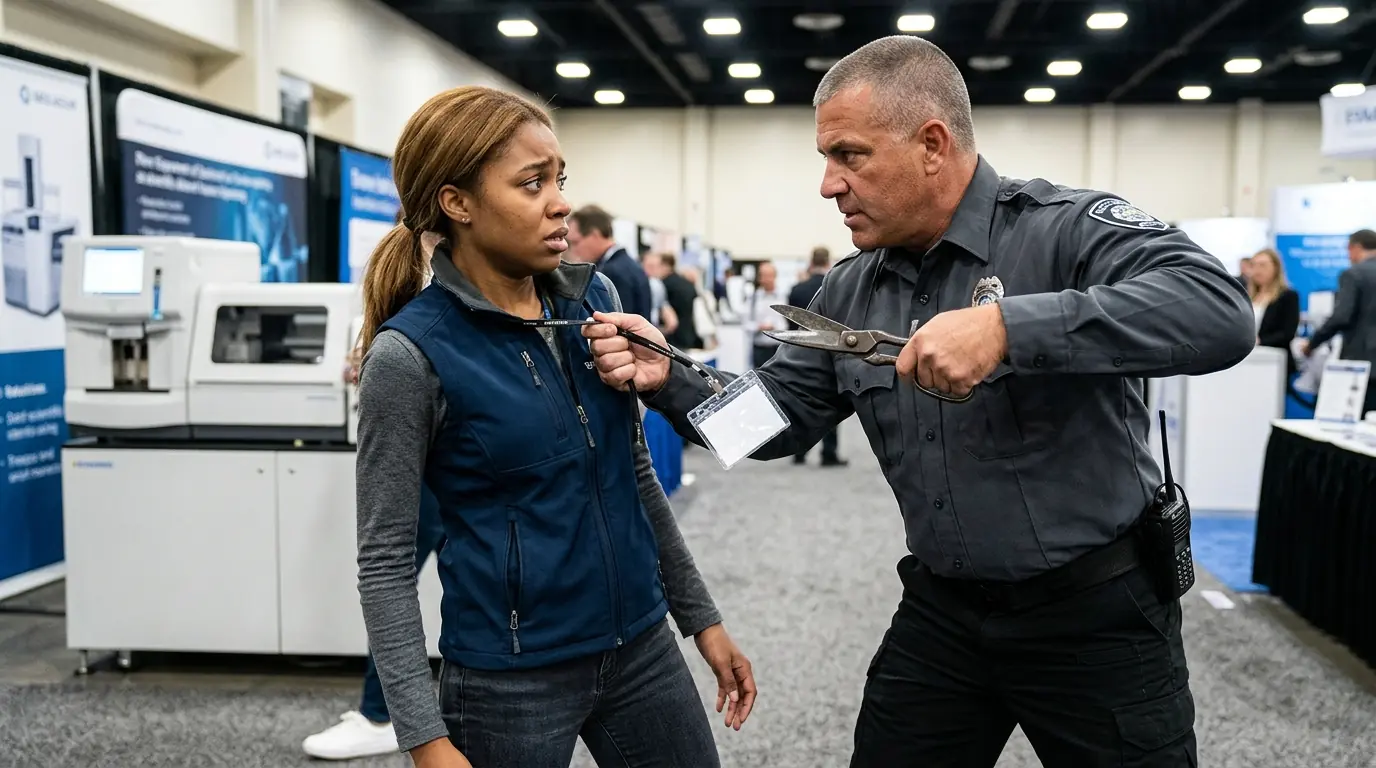
One second, I was standing beside the main laboratory display, checking a pressure sensor I had already calibrated twice that morning.
The next, a stranger in a dark security uniform had one fist wrapped around the blue lanyard hanging from my neck.
His other hand held a pair of heavy registration scissors.
“Visitors do not touch the equipment,” he snapped.
His voice carried across the nearly empty exhibition hall.
I froze.
The public doors were not scheduled to open for another twenty minutes, and the hall still had that peculiar quiet that large buildings have before an event begins. Custodians moved between rows of tables. A few teachers were arranging posters. Somewhere near the far entrance, someone tested a microphone and produced a short burst of static.
I had been there since 6:15 that morning.
My name is Daniel Mercer.
I was seventeen years old, a senior at Franklin Ridge High School, and that laboratory display the guard was accusing me of touching did not belong to the museum.
It belonged to me.
More accurately, I had built almost everything sitting on that table.
The pressure chamber.
The digital monitoring system.
The emergency release valve.
The transparent piping network mounted to the aluminum frame.
Even the little red warning light that blinked whenever the internal pressure crossed the safety threshold.
For nine months, the entire thing had occupied nearly every spare hour of my life.
Now a security guard was holding scissors against my chest because he had decided, without asking a single real question, that I did not belong beside it.
I tried to keep my voice calm.
“I’m not a visitor, sir. I’m—”
He never let me finish.
“Don’t.”
He tightened his fist around my lanyard.
“I’ve already watched you putting your hands all over this station.”
“Yes, because—”
“You think because the doors aren’t open yet, you can sneak around and play with things?”
“No. I’m trying to tell you—”
He looked past me toward the display.
“You could damage equipment worth thousands of dollars.”
That almost made me laugh.
Not because anything was funny.
Because I knew precisely what the equipment had cost.
I had spent $1,842.16 building it.
I knew because I had saved every receipt.
My school district had paid for some of the components. A local engineering company had donated several sensors. My physics teacher, Mr. Alvarez, had quietly bought the final pressure regulator himself after our grant money ran out.
The clear tubing had come from three different suppliers because the first type developed microscopic fractures under repeated testing.
The aluminum mounting rails had been cut in my uncle’s garage.
I had soldered the control board at our kitchen table while my mother complained about the smell.
If anybody in that room knew what could damage that machine, it was me.
But the guard was not interested in any of that.
His name tag read MARTIN KELLER.
He looked to be somewhere in his late forties, broad through the shoulders, with closely cut gray hair and a heavy radio clipped to his belt.
He had approached me already angry.
That was what I remembered most afterward.
There had been no confusion on his face.
No curiosity.
No moment when he seemed to be trying to understand what was happening.
He had reached his conclusion before he reached me.
“Where did you get that?” he demanded, staring at my lanyard.
“This?”
“The badge.”
“It was issued to me at registration.”
He gave a short, humorless laugh.
“Sure it was.”
I looked down.
The credential hung against my navy button-down shirt inside a thick protective plastic sleeve. The sleeve was unusually rigid because presenters had been told we would be moving through several secured areas during the state exhibition.
The card inside it had my name, school, presentation number, QR verification code, and a gold state education seal.
Keller never read any of it.
Instead, he reached for the badge.
I instinctively stepped backward.
That seemed to irritate him even more.
“Don’t pull away from me.”
“I’m not pulling away. I just don’t want you grabbing—”
“You don’t tell me what to do in this building.”
A custodian pushing a gray trash cart slowed near the end of the aisle.
For half a second, our eyes met.
Then he lowered his gaze and kept moving.
Keller pointed toward the lobby.
“Public entrance is outside.”
“I know.”
“Then use it.”
“I’m supposed to be here.”
“You’re supposed to be outside until we open.”
“No, sir. I’m a presenter.”
That should have ended it.
At least I thought it should have.
Keller looked at me for a long second.
Then his mouth tightened.
“A presenter.”
“Yes.”
“At the state science exhibition.”
“Yes.”
“You?”
There was something about the way he said it that made the word feel different.
Not quite a question.
More like a verdict disguised as one.
I felt heat rising into my face, but I refused to give him the reaction he seemed to want.
“Yes, sir.”
He looked at the pressure apparatus again.
The central frame stood nearly six feet tall. A digital display showed pressure readings from four separate points in the system. Beside it was a poster board with diagrams, testing data, and photographs from earlier prototypes.
At the top, in letters large enough to read from twenty feet away, was the title:
LOW-COST PRESSURE FAILURE DETECTION FOR RURAL WATER SYSTEMS
Directly beneath the title was my name.
DANIEL MERCER — FRANKLIN RIDGE HIGH SCHOOL.
Keller could have turned his head three inches and seen it.
He did not.
Instead, he said, “Anybody can print a badge.”
I stared at him.
“You think I printed a state credential?”
“I think teenagers do stupid things when they want to get somewhere they’re not supposed to be.”
“I’m not trying to get somewhere. My project is right there.”
“Enough.”
He stepped closer.
I could smell coffee on his breath.
Then he grabbed my lanyard.
Everything happened very quickly after that.
The strap tightened against the back of my neck.
I raised both hands.
“Sir, let go of me.”
“You’re leaving.”
“You’re pulling on my neck.”
“Then stop resisting.”
“I’m not resisting.”
He jerked the lanyard downward.
The plastic badge holder struck one of the buttons on my shirt.
For the first time, I saw two registration volunteers watching from the table near the entrance.
Neither moved.
Keller looked at the credential.
But instead of turning it over or scanning the QR code, he glanced toward the registration desk.