“Cut them down first.”
The woman hanging from the cottonwood said it with blood on her lips and rope burned deep into both wrists. Her voice was cracked almost beyond use, but the command inside it was steady. Not a plea for herself. Not even fear. Just one final act of protection from a woman who looked like she had spent her whole life standing between death and the people she loved.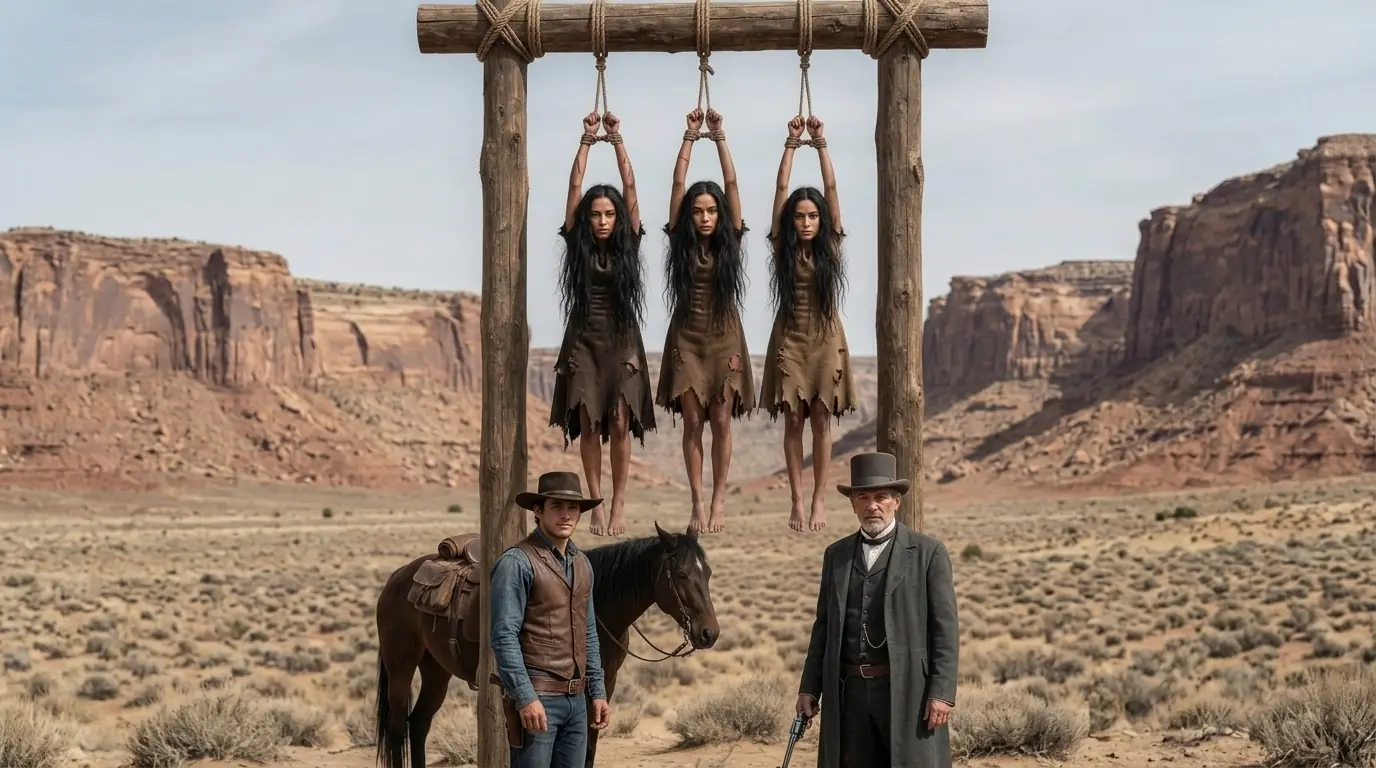
Jonah Mercer had seen men break under cannon fire, seen horses scream in snowstorms, and watched whole wagon parties vanish into the bad decisions of greedy men.
But nothing in his thirty-six years had prepared him for the sight waiting in Broken Mesa Wash that late October afternoon.
Three Apache women hung from the branches of an old cottonwood near the dry creek bed. Their feet barely touched the ground. Their wrists were swollen purple where the rope had bitten through skin. Two were unconscious, heads slumped forward, hair falling over their faces, but the eldest lifted her eyes when Jonah rode closer.
Those eyes made him stop breathing.
They were pale green, almost gray in the harsh desert light, wrong and impossible against her bronze face. They looked like storm clouds caught in river water. They looked like a secret no one had survived long enough to explain.
“Please,” she whispered again. “My sisters first.”
Jonah swung down from his horse before he had a plan.
He was an ex-army scout, a man who had lived long enough by caution to trust his instincts when caution had no time to speak. His Winchester came off the saddle with him. His eyes moved across the wash, up the ridges, into the mesquite and rock shadows where riflemen might be waiting.
No movement.
Only wind, sage, and three women dying beneath a tree.
“How long?” he asked.
“Since sunrise.”
Her English was careful, shaped by effort and pain. She nodded toward the youngest. “She stops breathing sometimes.”
Jonah cut the youngest down first.
She dropped into his arms like a bundle of sticks wrapped in skin. He laid her in the shade, checked her throat for a pulse, then moved to the second. The eldest watched every movement, her own body swaying slightly from the branch, but she did not ask him to hurry for her.
That was the thing that lodged itself in him.
Not the blood.
Not the bruises.
The discipline.
Her world had narrowed to pain, rope, and death, yet she was still counting others before herself.
“What’s your name?” he asked as he sawed through the second rope.
The woman swallowed. “Nayeli.”
“It means?”
She hesitated. “I love you.”
Jonah caught the second sister as she fell, then laid her beside the first. Only after both were down did he step in front of Nayeli. Her wrists were worse than theirs. Her lips were dry and split. One eye was swelling from a cut along her brow.
“You waited,” he said.
“I told you to.”
He cut the rope.
She fell hard, but Jonah caught her before she hit the dirt. For one second, her body leaned fully against him, all heat, blood, and trembling strength. Her heartbeat pounded against his chest like a trapped bird trying to break free.
Then she pushed herself away.
“My sisters,” she said.
Jonah handed her his canteen.
She crawled to the younger women, wetting their lips, whispering Apache words so soft the wind nearly stole them. The youngest coughed and turned her head. The second groaned, eyes fluttering.
Jonah looked at the sun.
Less than two hours before dusk.
Whoever had done this would likely return after dark, either to finish the work or enjoy what they had left behind.
“We have to move,” he said.
“Why help us?” she asked.
Jonah did not have a clean answer.
He had killed Apache fighters when he wore army blue. He had tracked raiders, carried messages, scouted passes, and done things that still came for him at night when the fire burned low. Mercy was not something he had earned easily.
So he told her the only truth he had.
“Because no one deserves to die tied to a tree.”
Her mouth twisted, not quite a smile. “Many men here disagree.”
“I’m not many men.”
She stared at him another second, then nodded once.
That was how Jonah Mercer brought three Apache women into his life and lost the lonely peace he had spent six years building.
His cabin sat north of Broken Mesa, hidden in a pocket canyon where red stone rose on three sides and the winter wind could not easily find its way in. He had built it after leaving the army, stacking stone, notching timber, and making a place that looked more like a piece of the land than a home. That suited him.
Homes held ghosts.
Cabins only held weather.
The ride took nearly an hour.
Jonah placed the two younger sisters across his saddle, wrapped in his blanket, while Nayeli walked beside the horse despite his attempts to make her ride. She said she needed to keep moving or her legs would forget they belonged to her. He understood that better than he wanted to.
The sisters were named Sehana and Yiska.
Sehana, the middle one, had a deep cut along her temple and bruising dark around her ribs. Yiska, the youngest, could not have been more than seventeen. Her breathing came thin and uneven, and every few minutes Nayeli touched her throat to make sure life still moved there.
At the cabin, Jonah carried Yiska inside first.
The room was small but solid. A stone hearth took up one wall. A cot sat in the corner beneath a wool blanket. The table was rough pine. Two rifles hung above the door. A coffee pot, a stack of tin plates, and a single chair made up most of what he owned.
Nayeli entered behind him with Sehana leaning hard against her.
Even wounded, she moved with purpose. She laid Sehana down, checked Yiska again, then turned toward Jonah’s shelves without asking permission. Her eyes found the bandages, the whiskey, the needles, the thread, the clean cloth folded by the wash basin.
“You know medicine?” Jonah asked.
“My mother knew,” she said.
She filled his cooking pot with water, set it above the fire, then opened a small leather pouch tied at her waist. Dried leaves and roots rested inside, wrapped in scraps of cloth. She worked them between her fingers, releasing scents Jonah recognized and others he did not.
Sage.
Yarrow.
Osha root.
Something sharper, almost sweet, like rain striking hot stone.
“What is that one?” he asked.
Nayeli did not look up. “For pain that stays after skin closes.”
Jonah went still.
He had a great deal of pain like that.
The fire grew brighter, filling the cabin with orange light. Outside, dusk folded itself into the canyon. Inside, Nayeli cleaned her sisters’ wounds with hands so gentle Jonah found himself looking away.
Not because he could not bear blood.
Because tenderness made him feel unarmed.
Yiska woke first.
She came up gasping, hands clawing at the blanket as if rope still held her. Nayeli caught her wrists carefully, despite the burns on her own.
“Little moon,” she whispered. “You are not there. Feel my hand. Hear the fire. You are in a stone house. You are safe.”
Yiska’s wild eyes found Jonah near the door.
Fear rushed across her face.
Jonah lifted both hands slowly, empty palms toward her. “I won’t hurt you.”
Yiska looked at Nayeli.
“He cut us down,” Nayeli said in English, including him in the truth. “He brought us here.”
Yiska did not relax, but she stopped fighting the blanket.
Sehana woke later, quieter, though her fear went deeper. She spoke quickly in Apache, too fast for Jonah to follow. Nayeli listened, then answered in a firm voice. When Sehana finally stopped, Nayeli turned to Jonah.
“She says they will come.”
“Who?”
Nayeli’s face shut down. “Barlow’s men.”
The name passed through the cabin like a match through dry grass.
Augustus Barlow.
Railroad owner. Cattle investor. Territorial power broker. The kind of man newspapers called visionary because newspapers belonged to men who borrowed money from him. Jonah had seen Barlow once in Santa Fe, clean white shirt, gold watch chain, senators laughing beside him like boys near a schoolmaster.
Barlow wanted a rail line through the southern mesas.
Everyone knew it.
Everyone also knew land, water, and law had a way of moving aside when Augustus Barlow needed room.
“What does he want with you?” Jonah asked.
Nayeli looked at her sisters.
Sehana closed her eyes.
Yiska whispered something.
Nayeli nodded slowly, as if accepting a burden she had already carried too long.
“We know where the hidden spring begins,” she said. “Under Black Antler Ridge. Water enough for trains, towns, cattle. Water enough to make a kingdom.”
Jonah understood.
In that country, water was not just water.
It was land.
Money.
Survival.
Power.
“If Barlow controls it,” Jonah said, “he controls every mile between here and the railhead.”
Nayeli nodded. “But the spring is protected by treaty. Old Apache ground. If people know where it is, railroad cannot cross without federal review.”
“And you’re the last witnesses?”
“The last who know the path,” Sehana said, her English rough but clear.
Jonah looked toward the window.
Darkness had arrived fully now.
“Why hang you?” he asked. “Why not just shoot you and be done with it?”
The three sisters went silent.
It was Yiska who finally spoke.
“Because of Nayeli.”
Nayeli turned sharply. “Enough.”
“No,” Yiska said, surprising them all with the strength in her voice. “He saved us. He must know what hunts us.”
Nayeli stood and walked to the window. Firelight caught one side of her face, leaving the other in shadow. Her green eyes reflected the flames strangely, like a wild animal’s eyes caught in the brush.
Jonah waited.
He had learned long ago that some truths needed space before they could cross a room.
“My mother survived Red Ash Creek,” Nayeli said at last.
Jonah’s stomach tightened.
He knew that name. Every scout in the territory did, though most pretended otherwise. The official report called it a battle. The men who had been there called it cleaning out hostiles. Drunk soldiers around dying campfires had called it something else when guilt loosened their tongues.
A slaughter.
Women.
Children.
Elders.
A village erased before dawn.
“I was not born yet,” Nayeli continued. “My mother was taken that night. Barlow was not railroad king then. He was a cavalry lieutenant. He gave orders. He chose who lived long enough to suffer.”
The room seemed to shrink.
Jonah heard Sehana begin crying softly behind him.
“Nine months later,” Nayeli said, “I was born with his eyes.”
Jonah looked at her.
Those pale green eyes.
Impossible eyes.
A white man’s eyes in an Apache woman’s face.
“Barlow is your father,” he said quietly.
Nayeli’s jaw tightened. “He is nothing of mine.”
“No,” Jonah said. “He is the man who caused your birth. That is different.”
She turned then.
For the first time since he had cut her from the tree, he saw not only strength in her face, but the wound beneath it. The shame had been planted before she had words for it. People had probably looked at her all her life and seen the crime before they saw the child.
“My mother loved me,” Nayeli said. “But others looked and remembered. I carried his eyes into every room. Barlow thought I died with the others. Now he knows I live. He wants the spring, and he wants the evidence of Red Ash Creek buried with me.”
Jonah stepped closer.
Nayeli lifted her chin, ready for disgust.
He gave her none.
“You are not evidence,” he said.
Her face flickered.
“You are not his sin,” Jonah continued. “You are the woman who told me to save your sisters before yourself.”
Her lips trembled once, but she forced them still. “You should not risk your life for me.”
“I was risking it before I knew your name.”
“Then you are foolish.”
“Been called worse.”
A sound came from outside then.
Not wind.
Hooves.
Two horses moving slowly through the canyon mouth.
Jonah blew out the lamp.
The cabin went dark except for the low red pulse of the fire.
Nayeli moved instantly, all softness gone. She grabbed Jonah’s spare Winchester from above the door and checked the chamber like she had been born knowing rifles. Sehana forced herself upright and took the revolver Jonah handed her. Yiska, still weak, gathered cartridges into her lap.
“How many?” Jonah whispered.
“Two close,” Nayeli said. “More behind later.”
“You can tell that from sound?”
“I can tell many things from men trying to be quiet.”
Outside, a voice drifted through the dark.
“Barlow said the green-eyed one alive if possible.”
Another voice laughed. “After today, alive might be asking too much.”
Nayeli’s face went still.
Jonah positioned himself by the left window. “I take the one nearest the wash.”
“I take the other,” Nayeli said.
He looked at her.
She was already aiming.
The riders entered the narrow moonlit opening without caution. That was their mistake. Men who spend too long hurting the helpless begin to believe no one will ever shoot back.
Jonah fired first.
The first rider dropped from the saddle before the echo left the canyon wall. The second jerked his rifle up, but Nayeli’s shot cracked almost at the same time. He spun backward, hit the dirt, and lay still.
For three heartbeats, nothing moved.
Then Nayeli crossed the open ground.
Jonah hissed her name, but she did not stop. She knelt by the second man, searched his coat, then pulled out a folded paper sealed with dark wax. When she returned, she handed it to Jonah without looking at him.
The letter was written in a fine hand.
Colonel Harrow,
Find the three Apache women taken near Broken Mesa. The green-eyed one is priority. She is the living proof of Red Ash Creek and must not reach any federal court. Extract the spring route if possible. Dispose of the others and leave Apache signs near the bodies.
Burn this after reading.
A. Barlow.
Jonah read it once.
Then again.
The rage that came into him was old and cold.
“Now we have him,” he said.
Nayeli looked toward the bodies outside. “No. Now he comes himself.”
She was right.
By dawn, storm clouds had gathered above the mesa, dark and low, dragging cold wind across the canyon. Sehana said the storm would break by evening. She knew because an old bullet scar near her shoulder ached when bad weather came. Jonah did not doubt her.
They spent the day preparing.
Jonah moved rifles to the canyon rim and showed Sehana the best firing angles. Nayeli cleaned the captured weapons, checked ammunition, and drew a rough map of the canyon floor in ashes on the table. Yiska, pale but determined, loaded cartridges and refused every suggestion that she rest.
“You are shaking,” Nayeli told her.
“I can shake and reload.”
That settled it.
As afternoon faded, the cabin seemed to hold two kinds of waiting. One for Barlow. One for whatever truth had begun growing between Jonah and Nayeli despite every sane reason it should not.
They sat outside the door as the sky turned bruised purple.
Jonah kept his rifle across his knees.
Nayeli braided and unbraided a strip of leather torn from her sleeve. He had noticed she did that when thought or pain threatened to spill over. Her fingers moved constantly, even when her face gave nothing away.
“Why did you become a scout?” she asked.
He almost laughed. “You ask that now?”
“We may die tonight.”
“Fair enough.”
He watched a hawk ride the wind along the canyon rim. “I was nineteen and wanted to be useful. The army was good at finding young men who wanted that. By the time I understood usefulness and goodness were not the same thing, I had already helped men find villages they planned to burn.”
Nayeli looked at him.
“Red Ash?” she asked.
“No. I was farther north. But close enough to know better about other things.”
“At least you know shame.”
“That is not redemption.”
“No,” she said. “But a man without shame is more dangerous.”
Thunder rolled far away.
Jonah turned toward her. “Do you really believe you are worth less because of him?”
She gave a bitter smile. “You ask like it is a thought I chose.”
“Maybe it was given to you.”
“That does not make it easier to put down.”
“No.”
The wind moved through her hair.
“I used to hate my eyes,” she said. “When I was little, I would rub them until they hurt. I thought maybe if I pressed hard enough, they would turn dark like my mother’s.”
Jonah felt something twist behind his ribs.
“She ever tell you they were ugly?”
Nayeli looked shocked. “Never.”
“Then why believe people who loved you less?”
She looked away.
He had not meant to strike that deep.
“I am not good with words,” he said.
“I noticed.”
That almost made him smile.
Then she said, “When you cut my sisters down first, I thought you understood me.”
“I understood enough.”
“What did you understand?”
“That you would rather die than fail them.”
She was quiet.
Then, so softly he almost missed it, she said, “I am tired of being willing to die.”
Jonah turned toward her fully.
The storm wind pushed dust across the canyon floor.
“Then live,” he said.
Her eyes filled, but the tears did not fall. “You say that like it is simple.”
“It isn’t.”
“Then why say it?”
“Because someone should.”
The first raindrops hit the dirt just before sundown.
Barlow arrived with eight men.
They rode into Red Lantern Canyon under a darkening sky, coats slick with rain, rifles carried easy but ready. Augustus Barlow sat at the center on a black horse, older than Jonah remembered but no smaller. He had a white beard trimmed neatly, a broad hat, and the polished calm of a man who believed history itself could be bought by the acre.
When he saw Nayeli standing in the open with her hands bound in front of her, his face did not soften.
It sharpened.
“My God,” he said. “You do have my eyes.”
Nayeli stood ten paces from Jonah.
The rope around her wrists was loose. Jonah had tied it that way himself. From the canyon rim above, Sehana and Yiska waited with rifles, hidden behind stone and storm shadow.
Barlow did not know that.
Men like him rarely imagined women surviving long enough to become dangerous.
“You know who I am?” Barlow asked her.
“I know what you are.”
His smile thinned. “Your mother was a difficult woman.”
Nayeli’s face did not move. “She was stronger than any man who touched her.”
Barlow’s hand twitched near his pistol. “Careful.”
Jonah stepped forward.
Barlow looked at him then. “You must be Mercer. Ex-scout. Deserter of civilized society.”
“Civilized society got hard to recognize.”
“And now you protect Apache women.”
“I protect people from murderers.”
Barlow laughed. “You have one chance. The green-eyed girl tells me the route to the spring. You hand over the letter you stole from my rider. I let you walk away with the two younger ones.”
“And Nayeli?”
Barlow’s eyes returned to her. “She was dead the moment she was born.”
The words struck the canyon.
Nayeli did not flinch.
Jonah did.
Barlow drew his Colt and aimed at her chest.
“Shoot her, Mercer,” he said. “Or I kill her sisters first, then make you watch what comes after.”
Jonah’s hand tightened on his revolver.
There it was.
The choice no man should have to make, and yet every violent century seemed determined to create it. One life against two. The woman he had known for less than two days and somehow could not imagine leaving. The sisters she had protected since childhood.
Nayeli looked at him.
Not begging.
Never begging.
“Do not let him take the spring,” she said.
Jonah lowered his gun.
Barlow smiled.
Then Jonah said, “No.”
The smile vanished.
“No?” Barlow repeated.
“I’m done letting men like you decide which innocent person dies to protect your empire.”
Barlow’s jaw hardened. “Kill them.”
The canyon erupted.
Two shots cracked from above before Barlow’s men could lift their rifles. Sehana dropped the first gunman clean. Yiska, shaking and pale but steady enough, hit the second in the shoulder and sent him spinning into the mud.
Jonah fired.
Nayeli slipped free of the loose rope and dove for the rifle hidden behind a rock.
The storm broke fully then.
Rain hammered the canyon floor, turning dust to red mud. Horses screamed. Men shouted. Gun smoke mixed with rain and vanished almost as fast as it appeared. Jonah moved behind a boulder, firing, reloading, firing again while bullets sparked off stone around him.
Nayeli fought like someone who had been preparing for this moment since birth.
She shot one man from the saddle, rolled beneath another’s aim, and came up with her mother’s knife in her hand. Sehana and Yiska kept firing from the rim, their shots forcing Barlow’s men into confusion. Men who expected helpless captives found themselves caught in a canyon that had already chosen sides.
Within minutes, only Barlow remained standing.
He seized Nayeli from behind and pressed his revolver to her temple.
“Stop!” he shouted.
Jonah froze.
Rain ran down his face and into his eyes.
Nayeli stood in Barlow’s grip, breathing hard, blood on her cheek, knife still in her hand but pinned uselessly between them.
“You think the law will believe you?” Barlow hissed. “I own judges. I own senators. I own the men who write maps and the men who erase names from them.”
“The law maybe,” Nayeli said. “Not the earth.”
She drove her heel into his foot, snapped her head back into his chin, and twisted hard.
The gun went off.
The bullet struck Jonah in the shoulder.
Pain burst white across his body, but he stayed upright.
Nayeli turned with the knife already moving.
The blade entered Barlow’s chest just below the ribs.
He stared at her, stunned, as if betrayal required love to exist first.
Blood spread across his vest.
Nayeli held him close enough to hear her. “My mother’s name was Elu. Say it before you die.”
Barlow’s mouth opened.
No sound came.
Nayeli twisted the knife.
“Say it.”
“Elu,” he whispered.
Then he fell into the mud.
For a moment, the only sound was rain.
Nayeli stood over him, shaking, her mother’s knife dark in her hand. Jonah tried to move toward her, but his knees buckled. She reached him before he hit the ground.
“No,” she said, pressing both hands over his shoulder wound. “No, no, no.”
“I’ve had worse.”
“Liar.”
“Probably.”
She laughed and sobbed at once, bending over him as rain ran through her hair. Above them, Sehana shouted that the riders were dead. Yiska cried out in victory, her voice echoing off the stone walls until it sounded like more than one girl, more than one life, more than one story refusing to end.
Three weeks later, Jonah stood near Bitter Creek with his arm in a sling and watched Nayeli scatter her mother’s ashes into the soil.
The spring still flowed beneath Black Antler Ridge.
Now federal witnesses knew it. So did a circuit judge in Santa Fe, a church lawyer from Tucson, and an army officer who had never liked Barlow much and liked signed confessions even less. The letter had survived the rain in Jonah’s oilskin pouch. So had two of Barlow’s ledgers, taken from his saddlebag by Sehana while everyone else thought the shooting was finished.
Augustus Barlow died in the canyon, but his empire kept bleeding for months.
Land deeds were challenged.
Railroad claims froze.
Men who had served him suddenly discovered morals when prison began looking likely.
The hidden spring was placed under protection by treaty review, and no rail line crossed Apache ground without consent.
Jonah used bounty money from Barlow’s wanted men to buy a small piece of legal land near Bitter Creek. Not the sacred ground. Not the spring. Just enough for a stone house, an apple orchard, and a corral where horses could grow lazy in peace.
Sehana planted the first tree.
Yiska planted the second and said it was hers because it leaned stubbornly into the wind.
Nayeli planted the third with her mother’s ashes mixed into the roots.
“You are home,” she whispered in Apache. “And so are we.”
Jonah stood behind her, watching sunlight touch the river stones.
When she rose, he held out a small ring made from hammered silver and a piece of green stone the color of her eyes. It was not fine. It was not polished perfectly. He had made it with clumsy hands and too much determination.
Nayeli looked at it.
Then at him.
“You ask me with no words?”
“I was hoping the ring did the hard part.”
She smiled then, small but real. “You are still not good with words.”
“No.”
“But you are good with staying.”
He swallowed. “I plan to be.”
She held out her hand.
He slid the ring onto her finger.
For a moment, neither moved.
Then she said, “Why did you cut me down last?”
He had known the question would return.
This time, he had an answer that did not frighten him.
“Because you asked me to save what you loved first,” he said. “And I knew then that anyone who could suffer like that and still think of others was someone worth finding again, even if she was standing right in front of me.”
Nayeli’s eyes filled.
“You saw me before you knew me.”
“I’m still learning.”
“You may not like all of what you learn.”
“I’ll stay anyway.”
She kissed him there beside the young apple trees, on land where death had once seemed more certain than morning. Behind them, Sehana and Yiska argued over whether the house needed a bigger cooking hearth or stronger door hinges. Beyond them, the creek moved through stone and sunlight, carrying secrets no railroad king would ever own.
Years later, people would tell different versions of the story.
Some said Jonah Mercer killed Augustus Barlow in a gunfight over railroad land. Some said three Apache sisters tricked a corrupt empire into exposing itself. Some said a woman with green eyes stood in a canyon and made her monster of a father say her mother’s name before dying.
All of those were true enough.
But the truest part lived quietly near Bitter Creek, where apple trees grew tall in red soil, where a hidden spring kept flowing under protected stone, and where a former scout and an Apache woman built a life no one had believed they were allowed to want.
Nayeli never called herself Barlow’s daughter again.
She called herself Elu’s daughter.
She called herself sister.
She called herself wife.
And on some evenings, when the canyon wind moved gently through the orchard, Jonah would find her standing beneath the third apple tree, touching the silver ring on her finger as if reminding herself that she had survived more than one kind of rope.
He never interrupted her.
He only stood beside her.
Because some people are not saved once.
They are chosen every day afterward.