The room goes completely silent. 53 executives sit frozen around the glass conference table as Daniel Sterling rises from his chair, straightens his cufflinks, and points one long finger toward the door. "People like you," he says, his voice low and deliberate, "don't build empires. You maintain them. And right now, I'm not sure you can even do that."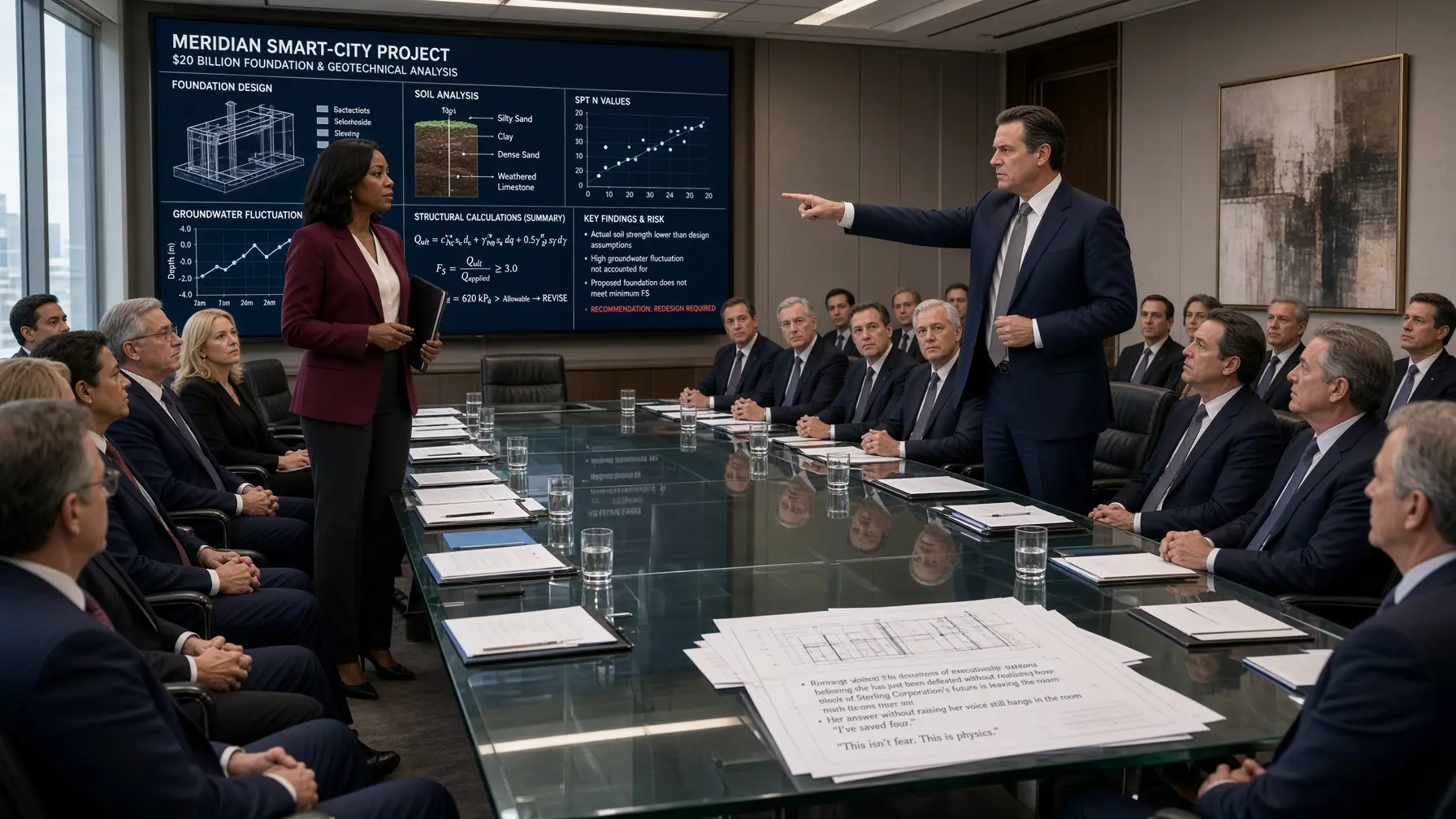
Margaret Carter doesn't flinch. She stands at the head of the presentation screen, her calculations still glowing behind her, her portfolio pressed against her chest. She looks at him once, just once, and in that single look is 10 years of silence finally considering whether it was worth it. It wasn't. She gathers her things, tucks her portfolio under her arm, and walks out without a word.
No argument. No tears. No threat. Just the soft click of the conference room door closing behind her. The board members exchange glances.
A few lean back in their chairs. One whispers to another that it was long overdue. They assume she has been defeated. They have no idea what she just walked out with. Margaret Carter had spent a decade being invisible inside Sterling Corporation, and she was very good at it.
Not because she lacked ambition, but because she understood something most people in that building never would. The work speaks. Everything else is just noise. While celebrity architects collected awards at industry galas and senior executives gave speeches at groundbreakings they barely understood, Margaret was in the back room. She was the one on the phone with the structural engineers at midnight when the foundation calculations didn't line up.
She was the one who quietly revised the load-bearing specs on the Harlow Tower project 3 weeks before construction began. A change that prevented what would have been a catastrophic and very public collapse. She was the one who redesigned the entire ventilation system on the Creston complex when the original contractor's plan failed a city inspection, saving the company $42 million and a lawsuit. Nobody sent her a thank you note. Nobody knew her name in the lobby, but every landmark building that carried Sterling Corporation's logo carried traces of her mind inside its walls.
Daniel Sterling had built his reputation on presence. He was magnetic, sharp-jawed, the kind of man who could walk into a room and immediately become the most important person in it. His father, Harold Sterling, had built the company from a regional developer into a national force. Daniel had taken it global. He had an eye for opportunity, a ruthless instinct for competition, and an absolute inability to tolerate being corrected, especially in front of an audience.
International investors had already committed preliminary funds. Daniel had been on three magazine covers in 2 months. Margaret had flagged the problem 6 weeks before the board meeting. She had found a critical error in the proposed foundation design. A miscalculation from the lead contractor that, if built as approved, would create progressive settlement issues within 8 to 12 years.
The buildings would look fine. The opening ceremony would be beautiful. And then, slowly, invisible to the eye, the ground beneath the towers would begin to shift. She had documented everything. Calculations, soil analysis reports, third-party structural assessments.
She had even prepared two alternative design solutions that preserved Daniel's vision while eliminating the risk entirely. She had submitted the report to his office four times. The first three times, his assistant told her he was traveling. The fourth time, she was told her concerns had been noted and would be reviewed by the internal team. They were not reviewed.
So, she did what she had always done. She brought it directly, professionally, and with full evidence to the board meeting itself. "Mr. Sterling," she had said, advancing her slide to the comparative soil analysis, "the proposed foundation approach was designed for a stable clay subsoil. What we have on the southern coastal site is a mixed substrate with measurable groundwater fluctuation.
If we proceed with the current specifications, we are looking at differential settlement that will be invisible at completion but structurally significant within a decade." The room had shifted slightly. A few board members leaned forward. Daniel had looked at her the way someone looks at an interruption. "You're telling me," he said slowly, "in front of our investors, that my architects are wrong?"
"I'm telling you the soil report doesn't match the design assumptions. I have two solutions ready." "Margaret." He said her name like a period. "How long have you been with this company?"
"10 years." "10 years." He nodded as if confirming something to himself. "And in 10 years, have you ever led a project of this scale?" She met his eyes.
"I've saved four." A murmur ran through the table. That was the moment Daniel Sterling decided she was a problem. "Your concerns," he said, standing now, voice hardening, "come from someone who is more comfortable with spreadsheets than with vision. This company didn't become what it is by letting fear drive decisions."
"This isn't fear. This is physics." The room went completely still. Daniel straightened his jacket. Pack your things.
She had looked at him one last time. Not with anger, not with desperation, with something that would take him years to properly identify. The steady, unmoved expression of a person who already knows how a story ends. She left and tucked inside the portfolio under her arm were the architectural drawings, the development strategies, the sustainability frameworks, and the decade of unreleased innovation that had been quietly waiting for exactly this moment. The Empire had just made its most expensive mistake, and it didn't even know it yet.
The package arrived at her apartment 4 days after she left Sterling Corporation. No return address, only a law firm's embossed seal in the corner, Whitmore and Associates. A name she recognized immediately. Harold Sterling's personal attorneys. Inside was a letter handwritten, sealed in a secondary envelope marked to be opened only if my son forgets what this company was built to do.
Margaret sat at her kitchen table for a long time before opening it. Harold Sterling had died 18 months earlier. She had attended the funeral quietly, stood near the back, left before the reception. He had been the one who hired her, the one who had walked the floor of the Harlow Tower project on a cold construction site morning and stopped to ask the young architect standing alone with a set of blueprints what she thought needed improving. She had told him directly for 11 minutes without stopping.
He had laughed. Not the dismissive kind, but the kind that meant he was genuinely delighted. You see things other people don't, he had told her. Stay close to the work. Don't let them pull you away from it.
She had never fully understood what he meant until now. The letter was three pages long, clear, measured, written in the voice of a man who had spent his life watching the gap between what people said and what they actually did. Harold Sterling had privately commissioned a long-range development initiative, a master blueprint for the company's next 20 years. He had called it the Legacy Project. It included sustainable city frameworks, infrastructure integration models, proprietary green construction technologies, and expansion strategies across four continents.
The total value of the plans, properly executed, was estimated at several billion dollars. He had given it to Margaret, not to his board, not to his legal team, not to Daniel, to her. "If my son ever forgets that greatness is built by people, not by power, then the future belongs to the person who remembered. Build it without him." Margaret set the letter down, looked out her window at the city, thought about 10 years of silence, 10 years of invisible solutions and uncredited genius and professionally managed invisibility.
Then she opened her laptop and started working. She didn't launch her company with a press release. She didn't announce herself with a gala or a pitch event or a profile in an architecture magazine. She filed the paperwork, leased a small office on the 14th floor of an unremarkable building in the financial district, hired three people she trusted completely, and began making phone calls. The first call was to the city infrastructure director she had met 3 years earlier at a sustainability conference.
The one who had quietly told her that Sterling Corporation's proposal for the Westgate Corridor was all presentation and no substance. She laid out what she could do. He listened for 40 minutes. The second call was to a private equity group that had been quietly dissatisfied with Sterling's Meridian project delays. They had questions.
She had answers, specific, technical, financial answers. And by the end of the call, they had requested a formal meeting. The third call was to a former Sterling client, a regional government body in the Eastern District that had been waiting 14 months for design revisions on a public transit hub project that Sterling's team kept deprioritizing. Margaret's company, Carter Design and Development, submitted a proposal within 3 weeks. It was approved in two.
Nobody in the industry paid attention at first. That was fine. She had spent 10 years being unnoticed. She knew exactly how to use it. Meanwhile, inside Sterling Corporation, the cracks were beginning to show.
Daniel had moved forward with the Meridian project exactly as planned. He had brought in a new internal review team, dismissed Margaret's soil analysis as overcautious, and publicly reaffirmed commitment to the original timeline at an investor briefing. The coverage was good. The optics were confident. But 3 months into construction, the site engineers filed the first anomaly report.
Groundwater levels in the Eastern sector were inconsistent with preliminary surveys. Foundation drilling in the third zone had revealed substrate variants that didn't match the approved specifications. The project paused, then paused again. Then the lead contractor submitted a formal request for design revision. Daniel replaced the contractor.
The new contractor came back with the same finding. Costs began climbing, quietly at first, the kind of increase that gets buried in monthly reports, then loudly, the kind that gets its own line item and eventually its own emergency board call. In the same month that Sterling Corporation announced a revised timeline and a projected cost overrun of $340 million on the Meridian project, Carter Design and Development completed its first commission project, a transit integration hub that came in on budget, ahead of schedule, and was immediately cited by the city planning board as a model for sustainable infrastructure development. A small architecture journal ran a two-paragraph piece on the firm. One of the investors who read it made a call the next morning.
Then another investor called. Then a government infrastructure committee in the western region reached out for a consultation. Margaret took every meeting. She spoke precisely, showed her work, answered the hard questions without deflection. She was the same person she had always been, except that now the room she was sitting in belonged to her.
Back at Sterling Corporation, Daniel sat in his own boardroom and read a quarterly report that read like a slow inventory of everything going wrong. Budget overruns, client departures, two senior architects who had resigned in the past 60 days, a flagship retail development in the north corridor that was stalling for reasons nobody could clearly articulate, but that any competent structural review would have caught in the design phase. He told himself it was a difficult economic climate. He told himself it was a contractor problem. He told himself it was temporary.
He never once considered the possibility that the quiet woman he had pointed toward the door was the reason everything had worked, and that her absence was the reason everything was now slowly, irreversibly, beginning to fall apart. The announcement came on a cold Thursday. No, it came without warning, the way real turning points always do. The city's metropolitan development authority released the shortlist for the most significant urban redevelopment initiative in the country's history. A complete redesign of the southern waterfront district, commercial towers, residential communities, public green spaces, integrated transit, sustainable energy systems built into the architecture from the ground up.
14 blocks, projected value $6.3 billion, a 20-year legacy contract. Sterling Corporation had been preparing that bid for 2 years. Carter design and development had submitted there's quietly 3 weeks before the deadline. The morning the decision was announced Daniel was in a meeting with his board when his chief of staff walked in and placed a single sheet of paper on the table in front of him. He read it once, then again.
Carter design and development had been awarded the contract. The room waited for him to speak. He didn't. For the first time in his professional life, Daniel Sterling had nothing to say. The industry coverage was immediate.
Every major publication ran the story not just as a contract announcement, but as a narrative. The quiet architect who had been publicly dismissed by Sterling Corporation, who had launched her own firm in relative obscurity, and who had just been selected over the industry's most established players to design the most important project of the decade. Her name, for years invisible in the industry, was now appearing in headlines across the country. Three days later, Sterling Corporation's stock dropped 11%. The board called an emergency session.
Investors who had been patient began asking questions that Daniel no longer had confident answers for. The Meridian project's revised cost overrun had climbed to $520 million. Two major clients had formally moved their relationships to Carter design and development. A third was in negotiation. The Glass King's empire was not collapsing dramatically.
It was doing something worse. It was quietly, methodically revealing itself the way old foundations do when the pressure gets too consistent for the surface to keep pretending. Daniel requested a private meeting with Margaret 6 weeks after the contract announcement. She agreed. Not out of curiosity.
Not out of any desire to witness his humiliation. She agreed because she believed that honest conversations, even difficult ones, were part of how the industry eventually corrects itself. They met in a conference room in her building, her building, with her name on the floor directory and her firm's completed projects displayed in framed photographs along the corridor outside. He looked different, not just older, quieter, as if the noise that had always surrounded him had gradually lost its source. "I owe you an apology."
He said before she could speak. "You do." She said. "I dismissed your findings on Meridian because I felt challenged. I was wrong."
He paused. "Not just strategically. I was wrong as a person." Margaret looked at him steadily. "The structural report I submitted was accurate.
The revised cost projections your team is now managing prove that. But that's not what made what you did wrong." "Then what did?" "You decided that someone being quiet meant they had nothing worth hearing. You mistook the absence of performance for the absence of value."
She leaned forward slightly. "The engineers who flagged the same problems after me, you eventually listened to them. You just had to humiliate me first to feel secure enough to do it." He was silent for a long moment. "My father trusted you with the legacy project."
He said finally. "He did. I've read it now. What you've already built with Carter Design is based on those frameworks." He looked at the table.
"He was right about you." "He was right about what greatness requires." Margaret said. "He understood that you cannot build anything lasting on a foundation of how you make people feel. Character is structural.
It either holds weight or it doesn't." Daniel nodded slowly. Not the brisk, commanding nod of a man performing agreement, the measured nod of someone absorbing something they can't undo. Is there a path forward? He asked.
Any version of this where Sterling Corporation recovers? That depends entirely on whether you're willing to change what the company is built on. She said. Not the projects, not the brand, the way you treat the people whose intelligence makes everything possible. He left without making any promises.
She didn't need him to. Margaret walked back to her office, sat at her desk, and looked out at the city she was rebuilding. One precise, honest, structurally sound decision at a time. Three years later, she stood on the observation deck of the waterfront development's central tower. The skyline below her had been transformed.
Communities that had spent decades in disrepair were thriving. Small businesses filled the ground-floor commercial spaces her team had specifically designed to prioritize local enterprise. The transit integration ran seamlessly through the district. The green energy systems were producing 17% more output than projected. Her name was on the building, not in a large font, not in a way designed to demand attention, just there, carved simply into the cornerstone at street level, the way a signature belongs on work that doesn't need to shout to be heard.
Sterling Corporation had since restructured. Daniel had stepped back from the CEO role and brought in new leadership. The company was recovering slowly under people who had learned painfully that competence cannot be replaced by confidence alone. Margaret never gloated. It wasn't in her nature, and it wasn't useful.
What she did do, every time she hired someone new, was tell them the same thing Harold Sterling had told her on that cold construction site morning years ago. The work speaks. Everything else is noise. Stay close to the work because the greatest structures in the world are not held up by the people who demand credit.
They are held up by the people who simply refuse to stop building. If the story moved you, share it with someone who needs to hear it. And if you haven't yet, subscribe. The next story is already waiting for you.