Clara Miller knew the fence was slipping away from her the same way everything else in her life was slipping. The broken posts leaned like tired old bones. The barbed wire was twisted into a cruel snarl, and the dry Texas wind pushed dust into her eyes until she could hardly see. She braced her boot against a splintered post and pulled with all her strength, but the wire only dug deeper into her gloves.
Her younger sister, Lillian, let out a frustrated sigh as she wiped sweat from her forehead. “We’ll never fix this, Clara. The storm ruined the whole line.” Clara didn’t answer. Her jaw tightened the way it always did when fear tried to break through.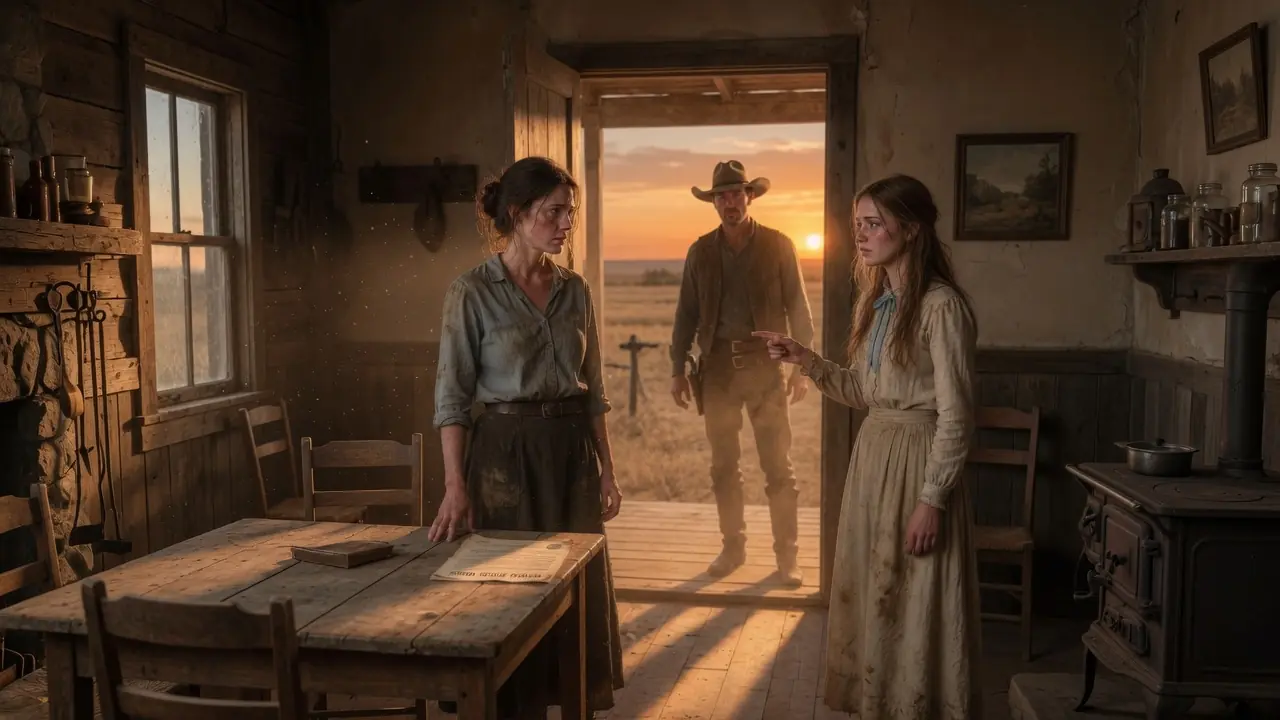
Their cattle had already wandered. Their water source was nothing more than cracked stones and dried mud. Their father’s land was dying, and she was the only thing standing between it and ruin. Then, out of the wavering heat, a man appeared.
At first, he was only a shape, a tall rider slowly forming out of the shimmering haze of the dirt road. He rode a strong roan horse, its sides coated in dust. The stranger sat tall, his shoulders broad, his hat tipped low enough to hide his face. When he drew closer, Clara noticed the dark stubble on his jaw, the trail-worn coat, and the quiet heaviness in his posture.
This was a man who knew long roads and hard years. He stopped his horse a few yards from them. With a small nudge of his thumb, he pushed his hat back and revealed eyes as sharp and blue as a mountain lake. “Afternoon, ma’am,” he said.
His voice was steady and deep, the kind that didn’t need to be raised to be heard. He nodded at Clara, then at Lillian. “Fence took a beating.” Clara wiped her palms on her skirt and stood straighter.
Strangers were rare in this part of Texas, and a lone man was even more dangerous. “We’re managing,” she said, even though they weren’t. “No, we’re not,” Lillian said quickly. “The storm tore it apart.”
The man dismounted with the easy grace of someone born in a saddle. Up close, he was taller than Clara expected, his frame strong but lean. He ran his hand over the broken post, testing the shattered wood with his thumb. “This is tough work for two,” he said.
“I’ve got tools in my saddle. I can fix this for you by sundown.” Clara’s suspicion rose. Nothing in their world came free. “We don’t have much to pay,” she said stiffly.
The man met her guarded stare. In his eyes, she saw something unexpected, a flicker of understanding. “Didn’t ask for money,” he said quietly. “A hot meal and water for my horse is more than enough. Name’s Silas.”
Clara hesitated. She knew the dangers. Two unmarried women living alone, with a strange man on their land. Every choice carried risk.
But their cattle were wandering, and losing even one could mean losing everything. Finally, she gave a small nod. “You may help.” Silas set to work with steady purpose.
He removed his coat, revealing a sweat-damp shirt stretched across strong shoulders. He dug new post holes, untangled the snarled barbed wire, and handled the sharp metal with a calm skill that came from years of practice. He didn’t talk much, but when he did, his words were simple and honest. Lillian hovered nearby, watching him work with open curiosity.
“Are you a ranch hand?” she asked. “Sometimes,” he said. “Other times, whatever work I can find. Headed east now. Heard there might be railroad jobs.”
Clara sat on the porch pretending to mend an old piece of canvas, but she wasn’t fooling anyone, not even herself. Her eyes kept drifting back to Silas. His silence wasn’t threatening. It was steady and dependable, and yet she refused to trust him.
She couldn’t afford that, not now. As the sun sank lower, painting the sky in reds and golds, Lillian shared little pieces of their lives. She told him how their parents died three winters ago, how their neighbor Henderson had tried to take their land, and how hard it was for two women to survive alone. Clara stiffened every time Lillian spoke.
Those were private wounds. Silas listened without pity, only quiet respect. “You’ve done well to hold this place,” he said. Clara froze.
No one had ever said that to her, not once. She looked away quickly, the words almost too heavy to bear. By nightfall, the fence stood straight and strong again, a dark, clean line against the twilight. Inside the small cabin, Clara set supper on the table.
The warm glow of the kerosene lamp softened the hard edges of their rough life. Silas sat at the table like a man not used to being invited in. He ate slowly, grateful for each bite. Lillian asked him about the towns he’d seen, the places he’d traveled, and the people he’d met.
Silas spoke in short, careful answers. Clara noticed the way he watched the window, as if he was always listening for something outside. A man like him carried his past the way other men carried saddlebags. When supper was done, Clara stood.
“You’ll sleep in the barn,” she said. “Blankets are in the loft.” Silas nodded. “Thank you.”
When he stepped out into the night, closing the door behind him, the small cabin felt strangely empty, emptier than before he’d walked in. Clara went to the window. A lantern flickered in the barn loft. His light.
A stranger’s light. A piece of the world she had tried so hard to keep out. In the stillness of that Texas night, Clara felt something she had not felt in years. A shift.
A tremor. The beginning of something she wasn’t ready for. But it had already begun. The next morning, Silas found Clara in the barn before sunrise.
She was wrestling with a broken hinge on the barn door, her movements sharp and tired. The wood was splintered, and the iron was rusted. She pushed and pushed, but the hinge wouldn’t hold. “That hinge is gone soft,” Silas said quietly from behind her.
“I can fix it.” Clara jumped slightly. She hadn’t heard him approach. Her eyes were guarded again.
She wanted him gone, wanted her world simple and small, the way it had been before he arrived. But the hinge was broken. The axe was dull. Every single day was a battle she barely won.
Silas wiped his hands on his pants. “I’ll work for my keep,” he said. “I don’t want money. Just a roof for my horse and a plate at your table.”
“I’ll be out of your way in a couple of days.” It was the kind of offer a woman alone shouldn’t accept, but Clara wasn’t just alone; she was drowning. “All right,” she said softly. Silas stayed.
Every day after that, the rhythm of the farm changed. Silas sharpened tools, replaced weak rails on the corral, and cut new fence posts that would last years instead of months. He moved through their land as if he understood it and respected it. But the world around them also took notice.
One afternoon, Clara looked up from hauling water and saw a man watching from the ridge. It was Henderson, their greedy neighbor. He sat on his bay horse like a vulture perched on a cliff. He didn’t wave.
He didn’t ride closer. He just watched Silas working on their land. Clara’s stomach tightened. By the next day, the gossip had spread.
When Clara went to town for supplies, two women fell silent the moment she walked past. The storekeeper, who had known her since girlhood, suddenly spoke to her like she was a stranger. Men on the street looked past her as if she weren’t there at all. Two women living alone with a strange man was a story the West loved to whisper.
Clara carried the heavy sack of flour back to her horse with her chin high, but inside she felt hollow. That night, she and Lillian argued. Lillian’s voice trembled with fury. “You wanted him gone, but now you let him stay, and now they all think we’re—”
She couldn’t finish. Shame burned too hot. Clara’s voice broke. “We need his help.”
“Or maybe you need him,” Lillian snapped, her eyes full of hurt. They didn’t speak again until morning, but the land waited for no one. Days were spent rounding up stray cattle, repairing storm damage, and working until sweat soaked their clothes and dirt coated their skin. Silas worked with them through every aching hour.
In that hard labor, something new formed between him and Clara, a quiet trust and a shared strength. Lillian saw it, and it sparked something dangerous inside her. She began bringing Silas fresh water, even when his canteen was still full. She stood too close when he taught them how to mend a saddle strap.
She laughed at his smallest comments. Her heart reached for him with a young woman’s desperate hope. One morning, Silas was showing Clara how to brace a weak wall on the chicken coop when Lillian approached. “That’s a good idea,” Clara said to Silas.
“You always think his ideas are good,” Lillian snapped. “You tried to send him away, but now you listen to everything he says.” “Lillian, don’t,” Silas said gently, but she turned and ran to the house, her shoulders shaking. Silas watched her go, troubled.
“I didn’t mean to cause trouble between you.” “The trouble was already there,” Clara said. That night, a storm rolled in, a violent, roaring storm that cracked the sky open with blinding flashes of lightning. The wind tore across the prairie like a beast.
Coyotes howled too close, making the cattle huddle in panic. Clara grabbed the old shotgun and ran outside. The darkness swallowed her. Moments later, Silas appeared with a torch, its fire fighting the wind.
“I heard the coyotes,” he said. “Thought you might be out here.” They walked the fence together, the torch casting wild shadows. Clara’s shoulders were tight, her breath uneven.
“You’re always listening for trouble,” Silas said quietly. “What choice do I have?” Clara whispered. “Everything is always breaking. A calf gets sick, a fence falls, a drought comes.”
“This land gives just enough to make you hope, then finds a new way to take it away.” Silas looked at her, really looked. “I know something about losing everything.” She turned to him.
Their faces were inches apart, lit gold and shadow by the torch. The wind whipped around them, but for a moment they were still. “What are you afraid of, Clara?” he asked. The question pierced straight into her chest.
“Everything,” she whispered. “I’m afraid of failing, of losing this place, of letting Lillian down, of being alone forever. Of never knowing anything except this hard, lonely life.” Silas stepped closer.
“You’re not alone tonight.” In that small circle of firelight, the air thickened. Something unspoken pulled them together. Clara felt the world tilt.
His nearness, his warmth, and his understanding were too much and not enough all at once. But before anything more could happen, the sky cracked open with a fresh blast of thunder. The moment broke. Clara pulled back, breathless and overwhelmed, and fled into the storm-dark night.
Silas stood frozen, the torchlight flickering in his eyes. He had seen her walls break. He knew now they weren’t just fighting the land. They were fighting their own hearts.
The trouble came harder and faster than Clara ever expected. Two afternoons after the storm, Henderson rode straight into their yard. This time, he didn’t come alone. Two armed men rode at his sides, and a lawyer in a black wool suit sat stiffly on a fourth horse.
Clara stepped onto the porch, her hands tight in her apron. Lillian stood just behind her. Silas paused his work at the corral and watched with slow, alert stillness. “Miller,” Henderson said sharply.
He didn’t use her first name. “Your time is up.” The lawyer stepped forward, opening a leather case. “Miss Clara Miller, we have a judicial writ authorizing temporary seizure of this property due to neglect.”
“You will vacate by sundown.” Clara’s breath vanished. It felt like the earth dropped beneath her feet. Everything she loved—her parents’ land, her home, her purpose—was being ripped away with a few cold words.
Silas walked toward them calmly. “Let me see the writ.” Henderson laughed. “Who are you to ask anything, boy?”
Silas ignored him. The lawyer hesitated, then handed over the paper. Silas read it once, then twice, his jaw tightening. “This writ is worthless,” Silas said calmly.
“It was signed without an inspection or formal process. This judge has done it before.” His voice grew harder. “He stole my father’s farm the same way.”
“I spent two years studying the law to understand how I could challenge this writ and win.” Henderson’s face burned red. “You think you can stand against me?” Silas didn’t raise his voice.
“I already am.” Silence fell heavy across the yard. Then Mr. Abernathy, the storekeeper, rode up the track. “Henderson,” he called.
“You’ve gone too far.” Henderson sputtered with rage. “This is none of your business.” “It became my business when you started lying about these girls,” Abernathy said.
“This land stays theirs.” Henderson knew he had lost, for now. He jerked his reins and stormed off, his men scrambling after him. The lawyer followed, clutching his case like a shield.
Clara nearly collapsed from relief. But her relief didn’t last long. That night, a greater storm erupted inside the house. Lillian had seen the way Clara and Silas stood together in the yard.
She had seen the look in Silas’s eyes. She had seen Clara’s, too. “You wanted him gone,” Lillian whispered. “But now you hold on to him for yourself.”
Clara shook her head, her heart aching. “Lillian, no. That’s not...” “You warned me about my reputation while you were sneaking off with him,” Lillian said, tears filling her eyes.
“You stole the only hope I had.” “It wasn’t like that,” Clara pleaded. “I never meant to hurt you.” But Lillian turned away.
Her voice broke in a small, hollow whisper. “You already did.” Days passed in heavy silence, but the land didn’t stop for heartbreak. They all worked through the pain, side by side.
Slowly and painfully, something began to heal. A week later, the church in town was packed for the hearing. The whole community had come. Henderson sat with his lawyer at one table, smug and sure of victory.
Clara, Lillian, Silas, and Mr. Abernathy’s lawyer sat at the other. Davies, the lawyer, painted Clara and Lillian as helpless women in over their heads. He called Silas a worthless drifter. He praised Henderson as a generous neighbor.
Then Elias, the quiet older lawyer, stood and called Silas to speak. Silas didn’t try to sound fancy. He didn’t use big words. He spoke straight from the heart.
He told the story of his father losing their farm. He explained how the law had been twisted against a good man. He spoke of how he had spent years studying legal books in boarding houses, trying to understand how justice could be so easily stolen. “I’m no lawyer,” Silas said, “but I know right from wrong.”
“Taking this land from these two women would be wrong. They fight harder than any rancher I’ve ever known. This place isn’t neglected. It’s held together by grit.”
“The only mismanagement is Henderson’s greed.” The room was silent. Then the judge spoke, his voice firm and final. “The petition for seizure is denied.”
“The Miller deed stands. Henderson is ordered to cease all threats or contact.” The gavel hit the table. The sound echoed like thunder.
They had won. Back on the farm, life slowly returned to its rhythm. The dust settled. The fences held.
The land felt safe again. Lillian, once jealous and hurting, began to see clearly. One evening, she sat beside Clara on the porch, watching Silas repair a gate. “I was wrong,” Lillian said softly.
“He was never my escape. He was yours. I tried to make him something he wasn’t.” Clara looked at her sister, her chest tight with emotion.
“You deserve happiness, Clara,” Lillian whispered. “And I think he’s the man who can give it to you.” Clara squeezed her sister’s hand, tears in her eyes. The wound between them finally healed.
Not long after, Lillian packed a small trunk. She had found work in a town two hundred miles east. There was a school, a dress shop, and a place she had dreamed of. “You’ll write every week,” Clara said, swallowing tears.
“I promise,” Lillian said as Silas lifted her trunk onto the wagon. She hugged Silas, too. “Take care of her.” “With my life,” he answered.
When the wagon disappeared on the horizon, Clara stood alone with Silas. The prairie stretched golden around them. A warm breeze drifted across the land. Silas nudged his chin toward the field he had cleared.
“Thinking of planting corn when the rains come,” he said. Clara smiled softly. “We’ll need a better plow.” “I’ll build one,” he said.
It wasn’t a proposal. It was something stronger, a promise of a life together. The next morning, the sun rose bright. Its light glimmered across the fence Silas had rebuilt, the fence that had started everything.
The posts stood deep and straight. The wire shone like silver in the dawn. It was a symbol of a beginning, a symbol of hope taking root, and a symbol of the cowboy who fixed their fence for free. He had found a home in the heart of a woman who thought she would be alone forever.