Chapter 1: The Cricket Match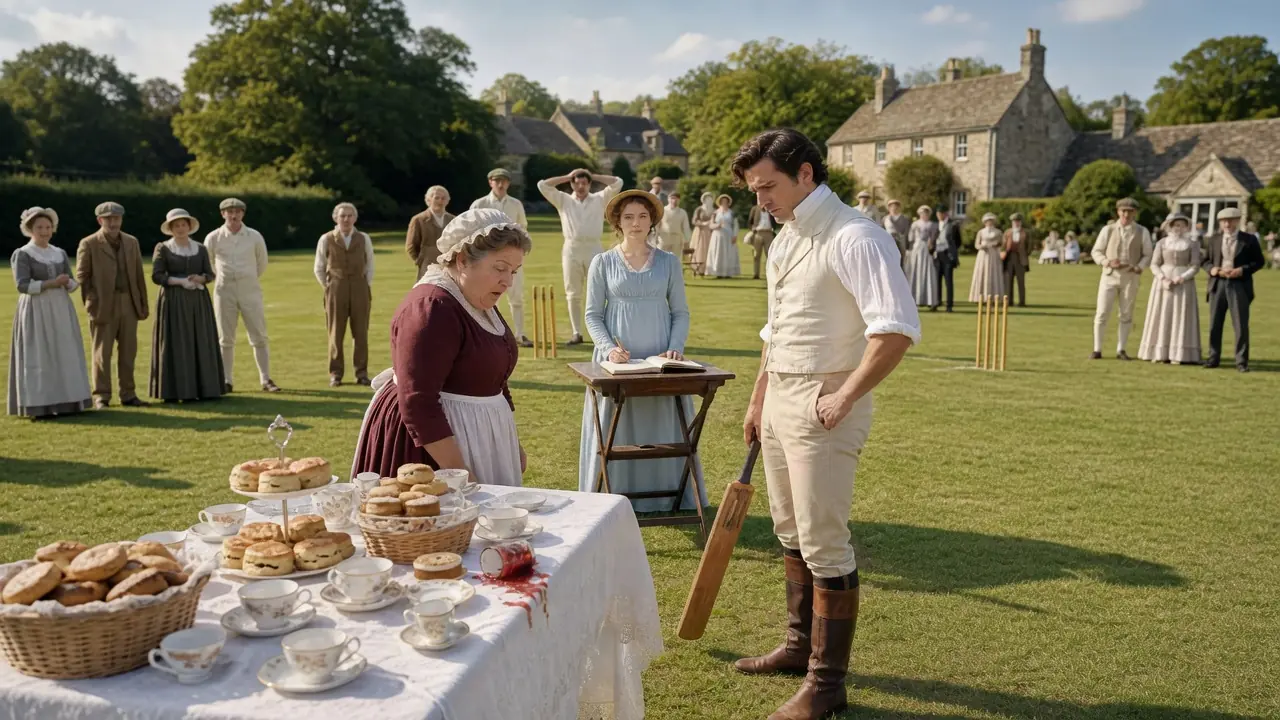
The trouble with Lord Hartwell, Prudence Ellery decided, was that he was terrible at cricket and did not yet know it. She was aware this was an uncharitable opening assessment of a man she had met approximately four minutes ago, but the evidence was substantial and continuing to accumulate.
He had missed the ball twice—which was forgivable, the light being what it was—but he had also managed to obstruct Mr. Jennings' approach to the crease, step on the boundary marker in a manner that required a brief consultation with the umpire, and raise his bat at precisely the wrong moment, so that the ball, which had been going wide, struck it at an angle that sent it directly into the refreshment table, unseating Mrs. Hartfield's strawberry jam and causing a small commotion that the vicar's wife was currently managing with her customary composure.
Prudence, who was keeping the score—she always kept the score at the Hartwell Fen Village Cricket Match because she was the only person present who could perform the arithmetic quickly enough to be useful—made a note in her book and looked up to see Lord Hartwell himself standing at the edge of the pitch with the expression of a man who has committed an error he cannot entirely account for and is not sure whether to laugh or apologize.
He was taller than she had expected from what little she had heard of the Earl of Hartwell, dark-haired with the particular quality of a man who had once been comfortable in his own skin and had recently, through some difficulty she didn't yet know, lost some of that ease. He was perhaps thirty. He wore the expression of someone who had come to the Cotswolds specifically to avoid attention and was finding the cricket match considerably more attentive than anticipated.
"The jam," Prudence said, when he came near enough. She did not move from the scoring table.
He looked at the table. He looked at Mrs. Hartfield, who was reorganizing the refreshments with a skeptical eye toward the new arrival. He looked back at Prudence. "I'll replace it," he said.
"Mrs. Hartfield made it herself," Prudence said. "You can't replace it. You could apologize."
He looked at her with the slight recalibration of a man who has expected social deference and received instead a practical assessment. "Yes," he said. "Of course."
He went and apologized to Mrs. Hartfield, who received it with the gracious forgiveness of a woman who makes excellent jam and knows it, and then returned to the scoring table.
"You're keeping score," he said.
"Someone must." She did not look up from the book. "You're Lord Hartwell."
"I am."
"And you are?"
"Miss Prudence Ellery. My father is the vicar." She made a notation. "You should go back to the crease. Mr. Jennings will want to close out the over."
He looked at the pitch and then at her book, which she held angled slightly away from him in the manner of a woman who is not concealing anything, but does not invite examination as a matter of policy. "What is the score?"
"Forty-three to twenty-seven," she said. "Your side is twenty-seven."
"Ah."
"You have not contributed to the twenty-seven," she added. "Though you have contributed considerably to the afternoon's entertainment."
He was quiet for a moment. Then he said, with a quality in his voice she hadn't expected—something dry and self-aware—"I was not aware I was so thoroughly observed."
"Everyone is thoroughly observed at a village cricket match," Prudence said. "That is the primary function of a village cricket match. The cricket is incidental."
"You should really go back," she said. "They'll dock your score for obstruction again if you're off the field when the next ball is bowled."
He went back. He was out on the very next ball, which was unfortunate, but Prudence noted, not unexpected.
***
The cricket match concluded at half past four with a result that surprised no one who had been following the arithmetic, and the village adjourned to the green for the customary refreshments. Prudence packed her scoring book into her basket, accepted a cup of tea from the vicar's wife, and kept a mild eye on the proceedings in the way she always did—not from social calculation, but from the simple habit of a woman who finds people more interesting to observe than to manage.
Lord Hartwell was, she noticed, not being managed well. The village had opinions about him. She was aware of this, had been aware of it since the news of his taking Hartwell Park for the summer had circulated with the efficiency of all Cotswold news—which was to say, immediately and with embellishment.
The embellishment varied. He had been jilted, or he had done the jilting, or the engagement had been mutual and terrible, or there had been no engagement, but there had been a very public embarrassment involving a ball in March, a piece in the social papers, and something about a young woman whose name no one in the Cotswolds could agree on. What the embellishments agreed on was that he had come here to escape something, and that he was not doing it with any great success.
He was standing now with Mr. Jennings and Mr. Parrish, who were both perfectly pleasant men with nothing particular in common with a dejected Earl, and he was performing the sociability of a man who has been raised to it and has temporarily lost the energy for it. She watched him do it: the correct responses, the appropriate smile, the inclination of the head when Mr. Parrish said something intended to be interesting.
*You are very tired,* she thought.
She refilled her teacup and did not approach him, because it was not her business, and she was a vicar's daughter with no particular stake in the welfare of visiting Earls.
He approached her.
"The scoring book," he said by way of opening. "You did the sums in your head."
"It's faster," she said.
"Faster than what?"
"Than writing each one individually and adding afterward. I keep a running total." She looked at him over the rim of her cup. "It's not a remarkable skill."
"I couldn't do it," he said.
"You could learn it. It's arithmetic." She paused. "Though, if the cricket is any indication, I'd focus on one thing at a time."
The self-aware quality appeared again—that flicker of something that was not the social performance, but was actually him.
"You are very direct, Miss Ellery."
"I'm a vicar's daughter with no dowry and no prospects to preserve," she said pleasantly. "I have very little incentive for management." She looked at the green where the village children had appropriated the cricket equipment for a game of their own devising that bore no relation to the official rules. "What brings you to Hartwell Fen, Lord Hartwell, other than the cricket?"
He was quiet for a moment. She did not fill the silence.
"Quiet," he said.
"You have found the wrong village for quiet. We are very thoroughly interested in each other here." She looked at him sidelong. "You will be discussed at every supper table in the parish this evening."
"I know." He said it without resentment, carrying only the tired resignation of a man who has been discussed at every supper table in London and has come some distance without escaping it.
"For what it's worth," she said, "we are not malicious about it. Interested is different from unkind."
He looked at her with the expression she had noted earlier—the uncertain category. "Most people I have met recently have not distinguished between the two."
"Most people you have met recently have been in London," she said. "The rural interest is of a different quality. We know each other too well and for too long to sustain malice. It becomes tedious." She finished her tea. "I should help my father close up the scoring table. Good afternoon, Lord Hartwell."
"Good afternoon, Miss Ellery."
She walked away and did not look back, which was partly habit and partly because she was thinking about the tired resignation in his voice. And thinking about things while walking away from them was, she had always found, the most productive arrangement.
Chapter 2: The Parish
He stayed.
This was news Prudence gathered from the supper tables she was told about but did not attend. Being a vicar's daughter meant being adjacent to information without being its primary recipient. It was both surprising and not: surprising because visitors to Hartwell Park rarely extended beyond a fortnight; not surprising because he had come for quiet and a fortnight was not enough to find it.
She encountered him twice in the first week. Once at the lending library, where she was returning a volume of natural history and he was examining the shelves with the expression of a man who would read anything that was not a London newspaper. And once on the lane between the vicarage and the church, where he had apparently walked several miles with no clear destination and had reached the lane through default rather than design.
Both encounters were brief, and neither was awkward—which she noted, because awkwardness would have been the expected result of a man of his rank and a woman of her position meeting in lanes and lending libraries. He was not awkward in the way she had anticipated: not condescending, not stiffly formal, not performing the particular indifference that some men of his class wore as armor. He was simply present. He responded to what she said rather than to what he expected her to say, which was, in her experience, rarer than it ought to be.
On the Sunday of his third week, he came to morning service.
This was observed by the entire congregation with the collective attention of thirty people who had been waiting for it. Prudence, who played the church organ with sufficient competence for the parish's purposes, watched from her position at the instrument as he was shown into the Hartwell pew—the carved oak pew with the Hartwell crest that had been there for two hundred years and that the last Earl had used perhaps six times. He sat with the ease of a man returning to something familiar.
Her father preached well that morning. He usually did. He was a man of genuine faith and genuine learning, and his sermons were the kind that required attention and rewarded it, which was not universal in country parishes. She watched Lord Hartwell listen with the full, unhurried attention she had seen him give to the lending library shelves and thought, *You are looking for something. Not rest, exactly. Something more specific.*
Afterward, in the churchyard, he spoke to her father. This was not unusual. Visitors to the parish often spoke to the vicar after service, and her father had the quality of easy welcome that made such conversations natural. What was slightly unusual was the length of the conversation, and the way her father's expression shifted from courtesy into genuine interest, which meant that Lord Hartwell had said something worth responding to. Her father's genuine interest was not casually engaged; he had standards.
She finished speaking with Mrs. Dawson about the harvest festival arrangements and came to collect her father for Sunday luncheon, only to find Lord Hartwell was still there.
"Ah, Prudence," her father said, with the mildly transparent delight of a man who has been having a good conversation and is pleased to extend its company. "Lord Hartwell has been asking about the field system—the medieval strips in the north field. I mentioned your records."
"My records," she said.
"You've been documenting the field boundaries for three years," her father said to Lord Hartwell, with a pride he never attempted to conceal. "She has the most complete account of the Hartwell Fen strip cultivation system in existence. The enclosure records are in county archives, but Prudence found the earlier material."
Lord Hartwell looked at her with the expression that was becoming familiar—the recalibrating look, adjusting for information that did not fit the previous category. "Miss Ellery is a historian?"
"Miss Ellery is interested in a great many things," her father said cheerfully. "She will tell you she is merely thorough. Lunch, Prudence? Will Lord Hartwell join us?"
Prudence looked at her father, who had the expression of a man who has invited someone to lunch because the conversation was good and has not thought further than that. She looked at Lord Hartwell, who had the expression of a man who had been invited to lunch without quite realizing he was being invited, and was not sure whether to accept.
"If it's not an inconvenience—" he said.
"My father does not issue invitations as inconveniences," Prudence said. "Come and have lunch, Lord Hartwell."
They walked together across the churchyard in the June morning, her father a few paces ahead, engaged in an internal calculation about what the housekeeper had prepared. She was aware, with the specific awareness that had been accumulating over three weeks of lending libraries, lanes, and morning service, that this was the beginning of something different. Not the cricket match, which had been observation and incident; not the brief encounters, which had been information. This was the thing that followed information: the decision made by proximity and by the quality of attention that a particular person was worth more of your time than you had initially allocated.
She was not alarmed by this. She was, characteristically, simply noting it.
***
The lunch lasted three hours. This was her father's doing as much as anyone's. He was delighted to find a man who had read Gibbon and had opinions about him, and the conversation moved from medieval field systems to Roman administration, to the current question of agricultural improvement, to a disagreement about the Corn Laws that was the most animated her father had been at table since Christmas.
Prudence contributed to each subject as it arose, which was her habit, and Lord Hartwell—Gideon, as her father had moved to within the hour, in the way he moved to given names when he had decided he liked someone—received her contributions with the directness she was coming to identify as his most consistent quality. He argued with her twice, both times about the Roman occupation. She held her positions because her positions were correct, and he eventually agreed that they were, doing so without particular drama and without the slight, wounded quality of men who found their positions corrected by women an affront to the natural order. She noted this.
Afterward, when he had gone, her father sat in his armchair with the satisfied expression of a man who has spent a Sunday afternoon exactly as it should be spent.
"He is a good man, I think," her father said in the tone he used when he was making a pastoral assessment rather than a social one. Her father's pastoral assessments were not to be dismissed; he had been making them for thirty years with a reliability that was approximately that of his scripture.
"He has been badly treated," Prudence said from the window seat. "I don't know the particulars, but the effect is visible."
"Mmh." Her father opened his book and then didn't read it. "He asked me about the field records. I heard him ask."
"He asked whether you would be willing to show him the documentation—in an entirely correct manner," her father added, which meant that Lord Hartwell had framed the request in terms that made clear he was asking about the records and not about Prudence, which her father was noting as a specific kind of consideration.
"If he wants to see the records," Prudence said, "he's welcome to come to the vicarage. The light is better at the north window for the older documents."
"I'll tell him," her father said.
"Papa?"
"Yes?"
"Don't tell him anything else."
Her father smiled at his book. "I never do," he said, which was entirely untrue, and they both knew it.
Chapter 3: The Records
He came on Wednesday, and she showed him the records.
They were three years of meticulous work: maps traced from older maps, field names cross-referenced against tithe documents and enclosure agreements, and the medieval strip system reconstructed from boundary evidence that had to be read against the landscape itself—which she had done on foot over two summers with a notebook and her father's old surveying compass. The result was a history of the land the Hartwell estate sat on that went back five hundred years, and that no one, as far as she knew, had assembled before her.
She showed it to him with the matter-of-fact quality she brought to things she had made carefully and was not embarrassed about. Some people found this disarming. They expected either self-deprecation or the pointed display of achievement, and she offered neither. The work was what it was; it could speak for itself.
He looked at it for a long time—not with the polite interest of a man performing attention at a woman's hobby, but with the actively engaged silence of someone encountering something they had not expected and were recalibrating around. He asked questions. Good ones—the kind that indicated he was following the argument of the documents rather than the surface of them. She answered, and his questions built on the answers, which meant he was thinking rather than performing thinking.
"The north strip," he said, pointing to a boundary she had marked in red on the composite map. "This cuts through what is currently the parkland."
"Yes. The present park dates to 1742. Before that, those thirty acres were in cultivation." She pointed to the supporting evidence. "The enclosure record names four families who held strips in that section. They were compensated—you can see the payment record here—but their cultivation rights went back at least three generations before the enclosure."
He looked at the payment record. He looked at the composite map. He was quiet for a moment.
"My great-grandfather did this," he said.
"Yes."
"I've been in that parkland every summer since I was seven." He said it without accusation, carrying only the particular quality of a man looking at something familiar with a new set of information. "I didn't know."
"Most people don't. The records are there to be found, but they require looking." She straightened the documents. "The families in question have long since established themselves elsewhere. The Jennings family at the cricket match are probably descended from one of the strip holders. But the history is in the land, if you know where to look."
He looked at her. "How did you begin this project? What made you start?"
She considered the question, because it was genuine and deserved a genuine answer. "My father inherited a curate's annotated Bible that had been passed down through four previous incumbents of this parish," she said. "Each of them had made notes in the margins. You could read one hundred and fifty years of a parish's life in the marginalia—births, deaths, harvests, and local disasters layered on top of each other. I found I couldn't stop reading it." She looked at the composite map. "The land is the same kind of document, if you know how to read it."
He looked at her for a moment with the open expression she had seen at Sunday lunch—the one that was not his London face, his social face, or the tired, resigned face of a man escaping something, but simply his.
"I should have been looking at my own land this way," he said.
"You have been occupied with things that mattered less."
He said it with a directness that surprised her slightly—not because he had said it, but because he was saying it without the deflection she would have expected.
"May I ask you something?"
"You have been asking me things for an hour," she said. "Continue."
"The London business," he said. "You know something of it, I assume."
"The village is interested," she said. "As I told you on the first day, the version that circulates here involves an engagement and an embarrassment. The specifics vary by storyteller."
"There was no engagement," he said flatly. "There was an understanding, on my side at least. There was a woman who I believed shared that understanding, and a ball in March at which I discovered, quite publicly, that she had formed a different understanding entirely involving another man, and had been in the process of forming it for some months while maintaining the appearance of our arrangement."
Prudence was quiet for a moment. "I'm sorry."
"I'm sorry to have been the kind of man who didn't see it until a ballroom full of people did." He said it with a quality that was not self-pity, but genuine—the honest assessment of a man who has been sitting with a thing for several months and has reached the point of looking at it directly. "I was deceived, which is her fault. I was also credulous, which is mine. I spent four months after the ball being unable to separate the two." He looked at the window. "I came here because I needed to not be in a city that had watched it happen and formed a view."
"And what does the view from here look like?" she asked.
He looked at her, and for a moment his expression was entirely open—the man without the management. "Considerably better," he said. Then, as if catching himself, "The fields, I mean. The history."
"I know what you meant," she said, and returned to the composite map, not making it difficult for him, because that was not the kind of woman she was.
***
They worked for another two hours on the records, and the afternoon light moved through the north window the way she had described—good for old documents: clear and honest. And neither of them spoke of London again.
He came back on Friday. He came back the following Wednesday. He developed the habit of appearing at the vicarage in the mornings with a look of moderate surprise at his own presence that she found quietly charming, and that she had the sense concealed something more deliberate beneath it. Her father received each visit with the transparent satisfaction of a man who has decided his hospitality is being well used and does not intend to restrict it.
She showed Gideon the rest of the records: the tithe maps, the boundary disputes archived at the county level, and the notebook from her fieldwork that contained the raw observations before they became the composite document. He received all of it with the same genuine attention, and she found herself showing him things she had not shown anyone—not because she concealed them, but because no one had previously asked.
In exchange—not a formal exchange, but the natural reciprocity of two people spending time in honest conversation—he showed her things, too. Not documents, but the particular quality of a man thinking aloud: about the estate's current management, which he was reviewing with the fresh eye of someone who had been absent from it for too long; about the tenants he was beginning to know, having ridden the farms in the weeks since arriving; about what he thought he ought to do, which was not always what he had been doing, and the distance between those two positions.
She listened with the same quality she gave to the records: full attention, no performance of it.
"You should speak to Mrs. Jennings," she said on one of the Wednesdays, regarding a question of the South Cottage drainage he had been describing. "Her family has worked that ground for three generations. She knows where the water goes in a wet winter better than any surveyor you'll hire."
He looked at her. "You know everyone in this parish."
"I have lived here all my life," she said. "It would be strange if I didn't."
"It is not strange. It is—" He stopped.
"Useful?" she suggested.
"That, too." He looked at the composite map, which had become a fixture of their Wednesday mornings—the thing they always seemed to return to. "I have been here two months and I know twelve people by name. You have been here twenty-six years and you know everyone's grandmother and the drainage patterns of their south fields."
"I have had more time," she said.
"It's not time," he said. "It's—" He stopped again.
He had a habit, she had noticed, of stopping before the important word. She had stopped filling the gap, because when she left it long enough, he usually found his way to it.
"You're interested," he said finally, genuinely. "In all of it. The fields, the families, the records, the drainage. It's not duty or obligation. You're actually interested."
"Yes," she said.
"I had forgotten," he said quietly, "that people could be like that." He looked at the map. "In London, the interest is generally in something else—the surface of things, the management of how things appear."
"I have very little surface to manage," she said. "It focuses one's attention on what's actually there."
He looked up at her with that open expression, and she looked at him steadily. The north light was clear between them, and the composite map was on the table with its five hundred years of a particular piece of land, and she thought, *Here it is—the thing I have been noting.*
She did not say it. It was not yet the moment to say it, because they were both people who needed to arrive at things by honest degrees, and the degrees were not yet complete. But she noted it with the thoroughness she gave to important evidence, and she filed it with care.
Chapter 4: The Churchyard
The harvest festival was the last Sunday in September, and Hartwell Fen did it properly. This meant the church was decorated with sheaves, late dahlias, and the particular orange of gourds that Mrs. Hartfield grew specifically for the occasion. It meant the choir performed with the enthusiastic imprecision of a choir that meets once a week and has never entirely agreed on the tempo of the fifth hymn. It meant a congregation swelled by families from the outlying farms who came for the harvest and stayed for the occasion. And it meant her father's annual harvest sermon, which was the one he most enjoyed giving, because the text—*"Consider the lilies of the field"*—lent itself to the kind of thinking he found most natural.
Prudence played the organ, as always, and between the hymns she watched the church with the mild peripheral vision of a woman who has done this many times and knows where to look.
Gideon was in the Hartwell pew, which he had occupied every Sunday for eight weeks, and he was listening to her father with the full attention that by now she recognized as simply his manner in the presence of something that required it. He had been to the vicarage eleven times. He had read the entirety of the field documentation and had begun, on his own initiative, to commission a professional survey of the north strip—citing the historical records as the basis for the commission, and citing Miss Ellery as the historian responsible for identifying their significance. He had spoken to Mrs. Jennings about the South Cottage drainage and had acted on what she told him. He had argued with Prudence twice more about the enclosure system and about the interpretation of a particular boundary marker, and had been right the first time and wrong the second, managing both outcomes with the same equanimity.
He had not said anything.
This was, she was aware, partly patience and partly—she had thought about it in the direct way she thought about things—a particular kind of uncertainty that she understood and did not intend to force. He had been made to look foolish in front of a room full of people by a woman he had trusted. The mechanism of that kind of damage was not fixed in a summer. She knew what it was to have your expectations comprehensively revised and to spend some months being cautious afterward.
She had not forced anything. She had been entirely herself, which was not a strategy, but was also not incidental.
***
After the harvest service, in the slow dispersal of the congregation into the churchyard, she found herself trapped between Mrs. Hartfield and a gatepost in a way that blocked the direct path to where she needed to be. Mrs. Hartfield was detailing the provenance of each gourd by name. By the time Prudence had finally, diplomatically extracted herself, the churchyard had mostly emptied.
Gideon was standing by her father, as he often was after Sunday service now. They were speaking about the South Field drainage, and her father was making the face he made when he was about to suggest something.
She moved toward them and arrived in time to hear her father say, with the transparency of a man who has had an idea and is pleased with it, "I think Prudence should show you the North Strip *in situ*. The composite map is one thing, but on the ground, she can show you where the boundary markers actually are."
Prudence looked at her father. Her father looked into the distance. Gideon looked at Prudence with the slightly startled expression of a man who has found himself in an arranged situation, is identifying it as such, and is deciding how he feels about it.
"If Miss Ellery is willing," he said, which was a careful answer.
"Miss Ellery," said her father, who had conducted thirty years of pastoral ministry and understood the human heart considerably better than he pretended to, "is free this afternoon."
She was, in fact, free this afternoon. She had not planned otherwise, which might, she admitted privately, have been a choice of its own kind.
"Shall we walk?" she said to Gideon.
***
They walked.
The North Strip in late September had the quality of a season preparing to end: the hedges thick and dark, the ground soft underfoot from the week's rain, the oak at the boundary showing the first credible signs of color. It was not a dramatic landscape; it was a working one, with the particular, unpretentious beauty of land that has been tended for a long time and shows it.
She showed him the boundary markers she had found in her fieldwork—stones that were not quite field stones, placed with too much intention at intervals that corresponded to the strip divisions on the oldest map. He looked at each one with the attention she had described the map requiring: not the surface, but what was beneath it.
"Here," she said at the northern marker. "This is the edge of what was your great-grandfather's enclosure. Everything to the north was the strip cultivation. You can still see the ridge and furrow if you know what you're looking at."
He looked across the north field. The ridge and furrow was faint—the centuries had softened it—but it was there: the long, gentle undulations of a cultivation pattern that had fed a parish before the world arranged itself differently.
"I can see it," he said.
"Most people walk across it without seeing it," she said. "You see it because you've been reading the records."
He turned to look at her. "I see it because you showed me how."
She looked at the field.
"Prudence," he said.
She had not, she realized, heard him say her name without the 'Miss' before it. He had said it now with the particular quality of a man who has decided to say a thing and has said it as a beginning.
"I want to tell you something," he said. "And I would like to do it without being eloquent, because I have found that I am not as good at eloquence as I once thought. And the people who appear eloquent are sometimes saying considerably less than the people who are simply direct."
She looked at him. "Be direct, then."
"I came here to be quiet," he said. "I have not been particularly quiet. I have been at the vicarage eleven times, at the church every Sunday, and at the lending library twice. And I have argued about enclosure law, Roman administration, and the interpretation of a boundary marker. I have spoken to Mrs. Jennings about drainage and commissioned a survey of the north strip, and I have not at any point done the thing I came here to do." He looked at the field, and then at her. "I find I don't want to be quiet. I find I want this—the arguing, the records, the Wednesday mornings, and the north light through the window—to continue. Specifically with you."
He held her gaze.
"I am aware that this requires saying clearly rather than leaving as implication. So I am saying it clearly."
Prudence Ellery—vicar's daughter, possessor of a thorough documentation of five hundred years of Cotswold field history, keeper of a running total in her head at all times, and practitioner of absolutely no management of anything she actually thought—looked at Gideon Hartwell in the September field. She felt, with the honest directness she brought to all conclusions, that she had known this was where the accumulation of evidence was pointing, and had been quietly, privately, in the internal register she did not generally make public, waiting for it.
"I have a question," she said.
He waited.
"The eleven visits," she said. "Were they for the records?"
He looked at her steadily. "The first two were for the records."
"And the other nine?"
"The other nine," he said, "were for the company."
She considered this. "Good," she said.
Something in his expression moved. The tension she had been watching him carry all summer—the London business and the managed, careful quality of a man who had made himself cautious—shifted. Not disappeared—these things did not disappear cleanly—but moved like weather changing.
"I should like," he said, "to speak to your father."
"My father," Prudence said, "has been waiting for you to speak to him since approximately the second Sunday."
He blinked. "That long?"
"He is not subtle when he has made up his mind about something." She looked at the ridge and furrow, the gentle evidence of five hundred years of tending. "He told me, after the first lunch, that you were a good man, he thought."
"And what did you tell him?"
"I told him," she said, "that you were terrible at cricket."
He laughed—the real laugh, not the social laugh. The laugh of a man who has been holding something for a long time and has put it down. She had not heard him laugh like that before, she realized, though she had heard all the other versions.
"I am," he said, "genuinely terrible."
"Yes." She smiled—the full version, not the managed smile that served social occasions, but the real one, the one she kept for things that warranted it. "You'll improve with practice."
"Will you keep score?"
"I always keep score," she said. "It's faster."
He looked at her in the September field, with the ridge and furrow behind him, the harvest festival still ringing from the church, and the afternoon light doing what September afternoon light does in the Cotswolds—settling slowly, golden without urgency.
"I would very much like your father to consider a proposal," he said.
"He will consider it," she said. "He will also agree to it."
"You're certain?"
"He has been making pastoral assessments for thirty years," she said. "His record is reliable." She looked at Gideon steadily. "As is mine."
He took her hand in the field, with no one present except the boundary markers, the ridge and furrow, and five hundred years of a particular piece of land bearing witness. She let him, and the afternoon continued around them in the easy way of Cotswold Septembers—unhurried, golden, and entirely itself.
***
Her father was in the garden when they returned, wearing the expression of a man who has been performing ignorance of the time and is glad to stop.
"Ah," he said. "The north strip."
"The north strip," Prudence confirmed.
"Instructive," her father said, looking between them with an assessment thirty years refined.
"Lord Hartwell—"
"Vicar," said Gideon. "I wonder if I might... that is, I would very much like to speak with you about your daughter."
He said it with the slight, nervous directness of a man who has decided to be direct about something that is making him nervous, which Prudence found she liked considerably.
Her father looked at Gideon with his pastoral assessment, which took approximately four seconds, and then at Prudence, who was standing with her hands folded, her expression composed with a particular quality of composure that her father had known all her life, and knew now.
"Come in," said her father. "I'll make tea."
***
They were engaged before supper.
The proposal was, as Gideon had warned, not eloquent. It was direct and honest, saying the things that mattered: that he had found in her company something he had not known he was looking for; that the summer had changed the terms of what he thought his life contained; and that he was asking with complete awareness of what he was asking, without any expectation that the answer was owed to him.
He said all of it in the vicar's parlor with the afternoon light fading and her father conveniently occupied with the tea things in the kitchen. She listened to the whole of it.
Then she said, "Yes."
Not because it was the only proposal she had received—it was, in fact, the only proposal she had received, she having long since settled into the honest acceptance that proposals were not a feature for vicar's daughters without prospects. Not because he was an Earl and she was without a dowry, making the match remarkable by the world's accounting. But because she had been conducting her own accounting all summer in the direct, internal register that was the most honest part of her.
And the accounting was complete. Its result was this: a man who argued correctly and incorrectly with an equal lack of drama, who looked at ridge and furrow and saw what was actually there, who had been terrible at cricket, had apologized for the jam, and had come back eleven times—nine of which were for the company.
It was, she thought, the most thorough assessment she had ever made of anything. It was also, entirely and without management, the right one.
***
The village discussed it with the thoroughness it brought to all significant events. The consensus reached by the following Sunday was that it had been apparent from the cricket match. Mrs. Hartfield said she had known from the moment he apologized for the jam. Mr. Jennings said he had known from the second Sunday, when Lord Hartwell had taken a full cup of tea and not managed to spill it. The vicar said he had known from the first lunch, which was true.
Prudence, who was keeping score, noted all of this with the running total she always maintained. She concluded that the village's collective average was approximately four weeks earlier than she herself had formally concluded the thing, which was either evidence of the village's perceptiveness or her own management of the internal register.
*Probably both,* she decided. She was, after all, a vicar's daughter. She was accurate about most things. She had not been wrong about this.