Daniel Carter knew something was wrong before he reached the kitchen.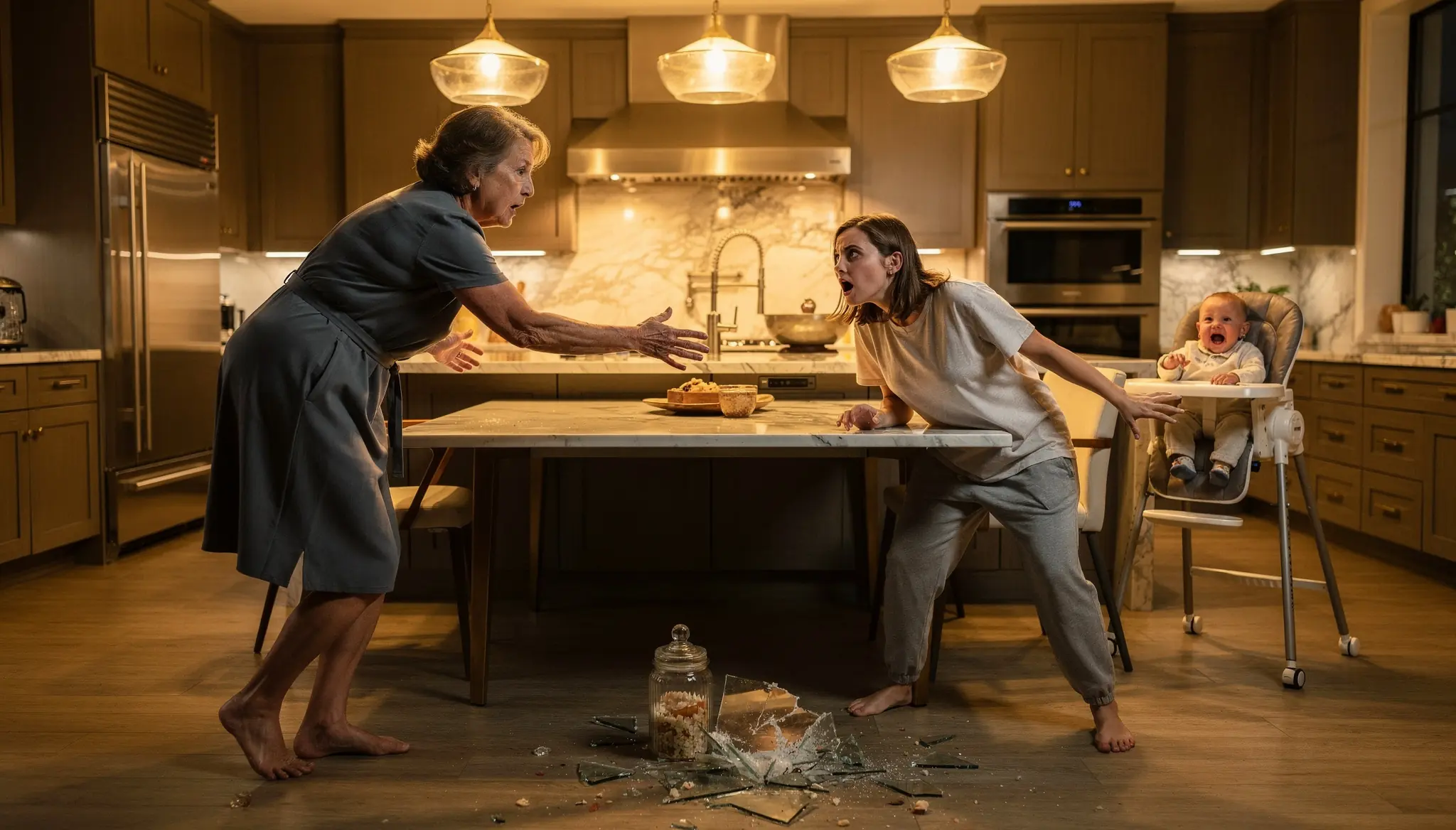
The house was too quiet. No music drifted from the small speaker Emily usually kept near the sink. No soft babble came from Sophie’s high chair. Even the refrigerator’s hum seemed sharp enough to cut through the silence.
Then he saw his wife on the floor.
Emily lay on one hip beside the kitchen island, one hand braced against the tile and the other wrapped around their daughter. A red mark spread across her cheek. Sophie was pressed against her chest, crying with the breathless panic of a child who did not understand why the room had become dangerous.
Margaret Carter stood near the table, pale but composed, as if she had already rehearsed the scene she intended Daniel to believe.
“Thank God you’re home,” she said. “Emily lost control. She started screaming, grabbed Sophie, and nearly dropped her.”
Daniel’s eyes moved from his mother to his wife. Emily’s lower lip trembled, but not from shame. It was rage held in place by fear.
“Don’t touch the jar,” she whispered.
A small glass container lay shattered near the base of Sophie’s high chair. The sweet smell rising from it reminded Daniel of pears, but underneath it was something chemical and bitter.
Margaret drew in a wounded breath. “She has been watching me for days. She put a hidden camera under the table. She used that baby as bait.”
Daniel froze.
Emily shifted Sophie higher against her shoulder and looked at him with an exhaustion that seemed older than their marriage. “There is a camera,” she said. “Watch it before you decide who to believe.”
The device was fixed beneath the kitchen table, angled toward Sophie’s chair. Emily had connected it to an encrypted storage account Daniel had never seen. Her hands shook as she opened the recording on her phone.
The video began twelve minutes earlier.
Margaret entered carrying the same glass jar. She checked the doorway, leaned over Sophie, and dipped a spoon into the pale mixture inside. Emily stepped into frame and caught Margaret’s wrist before the spoon reached the child’s mouth.
“What are you doing?” Emily demanded on the recording.
Margaret tried to pull free. Emily moved between her and Sophie. The jar struck the table, and Margaret slapped Emily hard enough to turn her face. Emily still did not strike back. She reached for Sophie instead, and Margaret shoved her.
That was how Emily had landed on the floor.
Daniel watched the clip twice. His mother’s version collapsed in under a minute, yet Margaret did not look defeated. She looked furious that evidence existed.
“You staged this,” Margaret said. “You replaced what was in that jar. You knew I would come near Sophie.”
Emily stared at her. “I replaced it because six days ago Sophie slept for nine hours after you fed her something from a jar just like that. Her breathing was shallow. I could barely wake her.”
“You should have told me,” Daniel said, but the words came out wrong. Too quickly. Too much like accusation.
Emily’s face hardened. “Every time I have ever told you I was worried about your mother, you repeated it to her. I needed proof before she could prepare another explanation.”
The truth of that landed harder than any shouted answer. Daniel had always believed that keeping peace meant sharing concerns before they became conflict. He had not understood that every confidence Emily gave him became advance warning for Margaret.
Before he could speak, the front door opened.
Marcus Vane entered without waiting to be invited. He had been the Carter family’s attorney for more than twenty years, and he wore authority the way other men wore tailored suits. His expression moved over the broken jar, Emily’s cheek, Sophie’s crying face, and Daniel’s phone.
“Margaret,” he said quietly. “You should leave.”
Daniel stepped between them. “No one is leaving until the police arrive.”
Marcus gave him a patient look. “Then preserve the family’s legal position. Do not make statements while emotions are high.”
Margaret gathered her handbag. As Marcus guided her toward the hall, Daniel noticed the leather folder on the kitchen counter was gone.
It contained the financial reports he had brought home from Carter Holdings that afternoon.
He ran after them, but Marcus was already closing the front door. At the same moment, Daniel’s phone vibrated with an alert from the company network. Every electronic copy of the reports had been deleted remotely.
The police arrived seven minutes later. Emily gave her statement without embellishment. She described Margaret approaching Sophie, the jar, the slap, and the shove. Daniel confirmed what he had seen on the recording, though he hated how weak his voice sounded when asked whether his mother had ever ignored boundaries before.
“Yes,” he said. “I didn’t understand how serious it was.”
After the officers collected the broken jar and copied the video, Sophie finally fell asleep against Emily’s chest. Daniel found his wife standing alone in the nursery doorway.
“There’s more,” she said.
He waited.
“My name was not always Emily Hart.”
Daniel felt the floor shift beneath him even though he had not moved.
“My father was Thomas Bennett,” she continued. “He was head of internal audit at Carter Holdings twelve years ago.”
Daniel knew the name. Every Carter executive knew it. Thomas Bennett had allegedly stolen eight million dollars, falsified pension accounts, and died in a car crash before standing trial.
Emily’s eyes filled, but her voice remained steady. “He did not steal that money. He found it missing. Then they made him the thief.”
She explained that after her father’s death, her mother had changed their surname to Hart. Emily had grown up with a closed casket, unanswered questions, and newspaper articles that called Thomas a criminal. Five years earlier, she had applied to Carter Holdings using her mother’s name. Her original purpose had been simple: find the evidence her father never got to present.
“And me?” Daniel asked.
“I did not plan you,” she said. “I did not plan to love you. I did not marry you to get access to the company. But I stayed in the records department longer than I should have. I copied files. I kept looking.”
Daniel turned away because he did not know which pain to face first. His wife had hidden the foundation of her identity. His mother had attacked his child. The company that carried his name might have destroyed Emily’s father.
A crash from the study ended the conversation.
Someone had thrown a storage drive through the window.
On the casing, written in black marker, were six words.
THOMAS BENNETT DID NOT DIE.
Emily went white.
“Emily,” Samuel said, breathing hard, “the coffin was empty. Your father’s coffin was empty. I helped—”
A heavy sound cut him off.
Someone else picked up the phone.
Margaret’s voice came through, calm and cold.
“You should have let your father remain dead.”
The call ended.
Daniel immediately contacted the police. They ordered him and Emily to stay home, but Samuel’s address was only twenty minutes away on Briar Lane. Emily was already reaching for her coat.
“If he knows where my father is, I’m going.”
Daniel looked at Sophie sleeping in Rosa Delgado’s arms. Rosa had worked for Emily’s mother years before and had joined Daniel’s household after Sophie was born. She nodded once.
“I will keep her with me,” Rosa said. “Go.”
Samuel’s house showed signs of a violent struggle. A lamp lay broken near the front door. Blood marked the edge of a desk. Drawers had been pulled open and emptied.
On the wall, Daniel found an old photograph of four men standing outside Carter Holdings: his father Richard Carter, Thomas Bennett, Samuel Price, and Marcus Vane.
A black circle had been drawn beneath Thomas’s face.
Emily lifted the photograph by its frame. On the glass was a greasy half-moon impression. Daniel recognized the carved pattern immediately. Marcus wore a signet ring with the same ridged edge.
Sirens approached outside. The police had tracked Samuel’s phone to a ravine two miles away. He was found alive at the bottom of the slope with a head injury and a broken wrist.
Daniel and Emily reached the ambulance before the doors closed.
Samuel opened his eyes only once.
“The blue room,” he whispered. “Find the blue room.”
Then he lost consciousness.
Back at the house, Daniel searched old insurance records connected to the Carter estate. Seventeen years earlier, the original mansion had burned almost completely. One room appeared repeatedly in restoration claims: a music room lined with blue silk.
The rebuilt mansion had no such room.
Several fire-damaged safes were listed as transferred to an Aster Foundation storage facility. Daniel knew the name because it appeared in the financial reports Marcus had stolen. The foundation operated medical charities, equipment donation programs, and pediatric centers across the state.
The moment Daniel opened the archived transfer file, his computer screen went black.
A blue star appeared.
STOP LOOKING FOR THE BLUE ROOM.
Daniel unplugged the machine, but the message remained on the screen for several seconds before disappearing.
In the nursery upstairs, a heater clicked on.
Emily smelled smoke first.
She ran into Sophie’s room and found the portable unit positioned beneath the curtains. Someone had plugged it back in, turned it to maximum heat, and set a timer. Flames had begun climbing the fabric.
Daniel tore the curtains down while Emily carried Sophie outside. The fire department contained the damage, but by evening Margaret’s attorneys had already filed an emergency petition claiming Daniel and Emily had created an unsafe environment for their child.
A judge ordered Emily and Sophie moved to a confidential protective location while investigators reviewed the threats. Daniel watched the car take them away and felt the first clean break inside him.
For most of his life, he had mistaken his mother’s certainty for strength.
Now he understood it as appetite.
The next morning, he entered Carter Holdings to face the board.
Margaret was waiting.
The boardroom lights were too bright, the table too polished, the city beyond the windows too calm for what Margaret had prepared.
She stood at the head of the room beside Marcus. On the screen behind them was a security recording of Emily entering the archives five years earlier. She copied files to an external drive, photographed ledger pages, and used credentials outside her assigned access level.
The footage was real.
The access logs displayed beside it were not.
Margaret told the directors that Emily had created illegal accounts under Thomas Bennett’s name and manipulated Daniel into marriage. She described the kitchen recording as another example of a woman who staged crises to control him.
Then she turned toward Daniel with carefully measured sorrow. “I knew who she was from the day she applied. I allowed her to remain because I wanted to know what Thomas Bennett’s daughter was looking for.”
Daniel stared at her. “You watched my wife for five years.”
“I protected you for five years.”
“You let me marry someone you believed was dangerous so you could monitor her.”
Margaret’s jaw tightened. “I let you make your choice while ensuring the family survived it.”
She advanced a motion to suspend Daniel’s voting authority pending a competency review. The supporting documents claimed he had exposed Carter Holdings to extortion by allowing Emily access to sensitive records.
Daniel listened until she mentioned Sophie.
Under the Carter family trust, Sophie already held half of the family’s voting interest. Daniel and Emily exercised those rights as her parents. If both were declared unfit, a court-appointed guardian could control the shares.
Margaret had petitioned to become that guardian.
Daniel finally understood the shape of the plan. The jar, the nursery fire, the accusations against Emily, and the attempt to portray him as unstable were not isolated acts. Margaret intended to take Sophie and the company at the same time.
He left the boardroom before security could stop him and entered his late father’s office. Richard Carter had died two years earlier after a sudden cardiac event. The room had remained mostly untouched because Margaret claimed changing it would be disrespectful.
Daniel remembered a childhood game in which his father hid notes behind the carved panels near the fireplace. He pressed the old release point.
A narrow compartment opened.
Inside was a blue key and a folded warning written in Richard’s hand.
If your mother ever tries to take your child, Thomas was right about everything.
Daniel heard the office door open. Margaret entered alone.
“You have always been too emotional,” she said. “That is why people use you.”
He slipped his phone into his pocket with the recorder active.
“What happens when you control Sophie’s shares?” he asked.
“I protect them until she is old enough.”
“And mine?”
Margaret gave him a thin smile. “Your ownership is already moving beyond your reach. You signed more than you remember.”
There it was.
Daniel backed toward the old document lift built into the wall. Before Margaret understood what he was doing, he pulled the lever and stepped into the narrow service cage. It dropped one floor into the records department.
He left the building through a loading entrance and drove to the protective house.
Emily examined the key. A-317 had been engraved along one side.
She searched the Aster transfer documents and found a matching storage designation. Unit A-317 was beneath a warehouse owned by the foundation.
They planned to go at dawn.
They never got the chance.
Rosa entered the protective house carrying Sophie’s formula container. “This smells wrong.”
Emily took it from her. The powder carried the same sweet chemical note as the jar in the kitchen.
Before she could react, Sophie began to go limp in Rosa’s arms.
The baby had finished a bottle fifteen minutes earlier.
Emily called emergency services while Daniel laid Sophie on the floor and followed the dispatcher’s instructions. The child’s breaths became shallow, then nearly stopped. By the time paramedics arrived, Emily’s hands were shaking so hard Daniel had to hold her wrists away from Sophie’s face.
At the hospital, an independent toxicology team compared the residue from the kitchen jar, the formula, and Sophie’s blood. All three contained the same prescription sedative.
The medication had been prepared by a pharmacy within Carter Medical under the electronic signature of Dr. Adrian Lowe, the clinical director of St. Catherine’s Pediatric Center.
Before detectives could arrest him, Judge Charles Weller signed an emergency order removing Daniel and Emily’s medical decision-making authority. The petition named Margaret temporary guardian.
Naomi Pierce, the attorney Emily had contacted after the kitchen attack, arrived with a copy of the order.
“This was drafted before Sophie reached the hospital,” Naomi said. “The filing metadata proves it.”
Margaret and Marcus appeared with a private transport team. They demanded Sophie be transferred to St. Catherine’s, where Lowe could supervise her care.
Daniel blocked the room. “She is not leaving.”
A hospital administrator presented a transfer authorization bearing Daniel’s electronic signature.
“It’s forged,” he said.
While everyone argued, an ambulance crew entered through the pediatric service corridor. Their uniforms, badges, and paperwork looked legitimate. They moved a covered pediatric stretcher out of the wing before a nurse noticed the transport number did not exist.
When Emily returned to Sophie’s room, the crib was empty.
A small storage tag lay on the blanket.
A-317.
Margaret saw it and lost control for the first time.
“Marcus sealed that room years ago,” she said.
Silence followed.
Daniel turned toward her. “What room?”
Margaret recovered too late. Marcus pulled her away while police locked down the building.
The investigation shifted immediately to the Aster Foundation warehouse. Federal agents joined local detectives because the foundation’s equipment records crossed state lines. They found pediatric monitors, dialysis machines, and surgical devices purchased with charitable donations, declared exported, then resold through private brokers.
Beneath the main storage floor was a freight elevator not shown on the plans.
The blue key opened its control panel.
A-317 was hidden two levels underground.
The door revealed a room that did not belong beneath a warehouse. Blue silk lined the walls. A black grand piano stood beneath a chandelier wrapped in protective cloth. Family photographs covered one cabinet, and glass-fronted shelves held ledgers, tapes, old medical files, and objects from Emily’s childhood.
Her first school ribbon. Her mother’s silver comb. A wooden horse Thomas had carved for her.
Emily touched the horse and stopped breathing.
A false window clicked open behind the blue curtain.
An older man stepped through.
His hair was white, his body thinner, and a scar crossed his forehead. But Emily recognized his eyes before she recognized anything else.
“Dad?”
Thomas Bennett looked at his daughter as if the twelve missing years were a wall he did not know how to cross.
“My Emily.”
A shot shattered the chandelier.
Daniel pulled Emily down as more bullets struck the piano and shelves. Thomas opened a panel behind the instrument and pushed them into a maintenance tunnel. The gunman fled through another passage and escaped on a motorcycle before agents could reach the lower level.
Inside the tunnel, Emily turned on Thomas.
“You were alive.”
He closed his eyes. “Yes.”
“You let me bury an empty coffin.”
“I believed they would kill you if they knew I survived.”
Thomas explained that Aster Foundation was not a charity at its core. Marcus had built it into a laundering system for stolen company funds, medical equipment, fraudulent insurance payments, and payments to officials. Margaret approved transfers under the language of family protection. Richard discovered enough to understand the fraud but lacked the courage to expose his wife and closest attorney.
Samuel Price had helped stage Thomas’s death because the police assigned to arrest him were already controlled by Marcus. Thomas was moved to a hidden safe house, but the protection failed. Men connected to Aster captured him and confined him in an illegal psychiatric facility under another name.
“They used the same methods on me that Margaret tried to use on Emily,” Thomas said. “False diagnoses. Sedatives. Records that made every protest sound like illness.”
He escaped years later but remained hidden because Marcus threatened Emily’s life whenever Thomas approached authorities.
Emily’s anger did not disappear because the explanation was plausible. “You still chose for me.”
“I know.”
Thomas looked toward the tunnel entrance. “Sophie is below St. Catherine’s. There is an abandoned maternity ward beneath the chapel. Lowe uses it for patients who must not appear in the electronic system.”
The police moved before dawn.
The chapel at St. Catherine’s looked peaceful above ground. Beneath it, locked corridors led to treatment rooms without numbers, pharmacy storage without inventory logs, and beds equipped with restraints.
Every electronic record denied Sophie had ever entered the building.
Physical evidence did not.
A baby sock lay near a service elevator. Fresh wheel marks crossed the dust. A used pediatric oxygen line had been discarded behind a cabinet.
They found Dr. Lowe in the underground pharmacy. Before he could be questioned, vents opened overhead and anesthetic gas began filling the corridor.
Daniel covered Emily’s face with his jacket while officers broke a maintenance window. Thomas led them through an old laundry passage.
When they reached clean air, every phone in the building displayed a live video.
Sophie was in the arms of a woman Daniel had never seen. She stood in a river house owned by the Carter family. Margaret waited near the dock, and Marcus faced the camera.
“Bring the blue ledger before sunrise,” he said. “Or your daughter disappears into a system you will never penetrate.”
The woman holding Sophie looked directly into the lens.
For one instant, her expression changed.
Not cruelty.
Fear.
Her name, according to Thomas, was Claire Rowan.
The police prepared a false ledger fitted with a tracker. The original remained in federal custody. Daniel and Emily were ordered to follow the exchange plan exactly.
At the river house, mist covered the dock and the water beyond it. Margaret stood beside a motorboat. Marcus held a gun. Claire cradled Sophie beneath a gray blanket.
Emily carried the false ledger alone.
“You drugged my child,” she said to Margaret.
Margaret’s face twisted. “I gave her enough to make people see what you were doing to her. Nothing more.”
“You almost killed her.”
“I was trying to save this family.”
Marcus laughed softly. “You still think you are leading, Margaret.”
The truth moved across Margaret’s face. She had built her identity around control, yet Marcus had used her ambition as efficiently as he used forged accounts and frightened doctors.
He extended his hand for the ledger.
Claire suddenly ran toward Emily.
“Take her!”
She transferred Sophie into Emily’s arms. Daniel struck Marcus’s gun hand, and the weapon fell. Claire kicked it from the dock into the river while officers moved from the tree line.
Margaret and Marcus escaped through a hatch beneath the boathouse. An explosion tore through the dock seconds later, collapsing the tunnel entrance and destroying the river house’s lower floor.
Emily held Sophie under her coat while Daniel shielded them from falling debris.
The child was alive.
At the hospital, the sedative level began to fall. Doctors found no immediate sign of neurological injury, though they warned that follow-up would be necessary.
In an old boat tied farther downriver, investigators found a recorder left by Richard Carter.
Daniel listened to his father’s voice in a private room beside Sophie’s bed.
Richard admitted that he and Thomas had discovered the missing money. Thomas wanted to go to regulators. Richard delayed, allowing Margaret and Marcus time to construct the accusation against him.
“I told myself I was preserving peace,” Richard said on the recording. “What I preserved was fear. Margaret controlled the company. Marcus controlled the law. Lowe controlled the hospital. I taught my son that keeping peace meant obeying the most dangerous person in the room.”
The recording included dates, account numbers, and names. It also contained an apology Daniel had not known he needed.
He sat beside Emily after the recording ended.
“I betrayed you without meaning to,” he said. “Every time you trusted me with a concern, I took it to my mother. I thought I was solving conflict. I was giving her time to hide it.”
Emily looked through the glass at Sophie. “Intent matters. It just does not erase consequence.”
“I know.”
That night, a cyberattack shut down the hospital’s monitoring network.
A blue star appeared on every screen.
FAMILY SURVIVES WHEN DISOBEDIENCE IS REMOVED.
Independent monitors kept Sophie stable while technicians isolated the hospital from the compromised system.
Daniel and Emily made a rule before sunrise.
No more secret plans. No private deals. No deciding alone what the other person could survive.
Emily gave him a complete account of her years inside Carter Holdings. Daniel gave her every trust document and security credential he possessed.
Neither called it forgiveness.
They called it the beginning of truth.
The federal task force believed the Carter Foundation gala offered the best chance to force Margaret and Marcus into the open.
The annual event was too valuable for them to abandon. Hundreds of donors, executives, hospital administrators, judges, and contractors would gather in one building. Thomas recognized the tower’s original plans and remembered a concealed accounting room beneath the thirty-ninth-floor ballroom.
“That is where Marcus moved donations before they became payments,” he said. “Temporary accounts, layered transfers, false medical grants. The money passed through that room for less than an hour, then disappeared.”
The gala would proceed under federal control. Guests would be screened without being told the full reason. Agents would occupy service floors, communications rooms, and stairwells.
Marcus called Naomi the afternoon before the event.
“Cancel it,” he said. “Margaret built a mechanism into the founders’ bell. If the tower is threatened, the records burn and everyone in the ballroom becomes collateral.”
He ended the call before the trace completed.
Claire asked to cooperate.
Her real name was Claire Elise Vane.
Marcus was her father.
He had never publicly acknowledged her. Instead, he raised her in private schools under changing surnames and trained her to enter spaces where his own face would attract attention. Her fingerprints and retinal pattern had been enrolled as security keys for accounts, vaults, and medical systems.
“He called it inheritance,” Claire said. “It was ownership.”
She described the widow switch hidden inside the founders’ bell. The visible transmitter was only a decoy. The real device controlled ventilation dampers and chemical dispersal lines connected to the document destruction system. Once activated, the system would flood the accounting room and ballroom ducts with a corrosive vapor strong enough to ruin paper and injure or kill anyone trapped inside.
Margaret had approved the design after Richard’s death.
On the night of the gala, four hundred guests entered the Carter Foundation tower beneath crystal lights and orchestral music. Daniel wore a transmitter under his collar. Emily remained near the ballroom entrance with Claire and Detective Luis Ortiz.
Thomas was hidden in a protected witness suite. Samuel Price, recovered from his injuries, waited with federal agents one floor below.
At nine seventeen, every elevator stopped.
The ballroom doors locked.
Margaret appeared on the upper balcony holding a silver transmitter.
Conversations died beneath her.
“Daniel,” she said, her voice carried through the sound system, “bring me the blue ledger.”
Cameras from three news networks were already streaming. Margaret had expected to use them to accuse Emily publicly and restore her authority. Daniel stepped onto the stage before she could control the story.
“My daughter owns half of the Carter family voting trust,” he said. “My mother drugged Sophie, staged a fire in her nursery, and used a corrupted guardianship process to take control of those shares.”
Margaret raised the transmitter. “Your wife manipulated you.”
Daniel looked directly at the cameras. “Emily placed a camera because my mother had already sedated our child once. The recording shows Margaret approaching Sophie with the drug. It shows her striking Emily. It shows Emily protecting our daughter.”
The video appeared on the ballroom screens.
Margaret’s face changed as four hundred people watched the truth she had first tried to reverse.
Samuel Price entered through a service door with two agents. He identified the accounts created under Thomas Bennett’s name and confirmed that Marcus’s office generated the documents used to frame him.
While Margaret lost control of the room, Marcus entered the concealed accounting chamber below the ballroom. He initiated a transfer of ninety-two million dollars from temporary foundation accounts.
The system had scanned Daniel’s face when he entered the tower. It still required a voice command tied to his biometric profile.
An agent whispered instructions through Daniel’s earpiece. He repeated a prepared sentence within his public statement, embedding the reversal command without alerting Margaret.
The transfer paused.
Margaret pressed the silver transmitter.
Nothing happened.
Claire had warned them that the device was a decoy.
In the ventilation room, Caleb Mercer guarded the real control. Emily and Claire found him beside the duct manifold, a pistol in one hand and the chemical trigger in the other.
Mercer fired once. The bullet struck a pipe above Emily’s shoulder. Claire drove into him before he could fire again, and the two crashed against the control cabinet.
Emily grabbed the trigger cable. Mercer kicked her backward and reached for a row of colored wires.
“Cut the red one,” he shouted when Ortiz arrived. “The black wire arms it.”
Claire shook her head. “He lies when he is cornered.”
Ortiz restrained Mercer, but the countdown continued. The control diagram had been erased.
In the ballroom, Daniel understood that only Margaret knew the emergency bypass.
“If you let those people die,” he called toward the balcony, “the company you claim to love dies with them.”
Margaret stared at the trapped donors, employees, and hospital workers. Her identity depended on being the woman who preserved Carter Holdings, even when her methods threatened everyone inside it.
“The black wire,” she said at last. “The black wire is the emergency break.”
Emily cut it.
The ventilation dampers locked before the chemicals released.
The ballroom doors opened.
But Marcus had completed the first stage of the transfer. He seized Special Agent Levin inside the accounting room and ordered Claire brought to him.
When Claire entered, Marcus held a gun against Levin’s neck.
“Your finger,” he said. “Then your eye.”
Claire placed her thumb on the reader. The first lock opened.
The retinal scanner rose from the console.
She closed both eyes.
Marcus struck her across the face. “Look at it.”
“No.”
“You exist because I made you useful.”
Claire opened her eyes, but not toward the scanner. She looked at Levin.
The agent understood.
They moved together. Claire knocked Marcus’s wrist aside while Levin drove his shoulder into him. The gun discharged into the ceiling. The retinal scan failed and the transfer entered automatic recovery.
The ninety-two million dollars froze between accounts.
Marcus escaped through a hidden document chute carrying a black ledger.
Margaret was arrested on the balcony.
In custody, stripped of her office, her family access, and the certainty that Marcus would protect her, she began to talk.
“The original archive is beneath the foundation of the old mansion,” she said. “Patient names. Judges. Hospitals. Contractors.”
“Payments. Real identities behind every code.”
She described a vault accessible only through the bloodline of Richard Carter.
Daniel assumed that meant him.
Margaret laughed without humor. “Richard had a daughter before he married me.”
The child had been privately adopted and removed from the family record. Marcus had paid intermediaries for forty years to keep her unaware of her parentage.
Her name was Rebecca Hale, now Rebecca Shaw, a librarian living in Vermont.
Marcus reached her before the task force did.
He showed Rebecca selected records proving that Richard had concealed her existence. He told her Daniel had inherited the company, houses, and trust interests that should have belonged to Richard’s first child.
By the time Daniel, Emily, and federal agents located her, Rebecca had already agreed to meet Marcus at the ruins of the Carter estate.
Daniel spoke to her by phone before she entered the property.
“I will not pretend my family treated you fairly,” he said. “They erased you. You have every right to be angry.”
“And your wife?” Rebecca asked. “Marcus says she entered the company under a false name.”
“She did. She was looking for evidence that my family framed her father. I should have learned the truth years earlier.”
Rebecca was silent.
Marcus had given her outrage. Daniel gave her facts that did not protect him.
That difference kept her listening.
The old Carter mansion had burned seventeen years earlier, but the memorial garden and stone fountain remained. Beneath the fountain’s carved swan, a stairway descended into the original foundation.
Rebecca’s blood opened the first lock.
Daniel’s opened the second.
Marcus followed them into the vault and immediately drew a gun.
“You were both necessary,” he said. “Now neither of you is.”
He activated a self-destruct sequence designed to burn the servers, paper archives, and ventilation shafts. Then he ordered Daniel to open the primary system so he could copy the files that protected him and erase the rest.
Folders filled the screen.
Patients poisoned under false treatment plans. Judges paid through foundation grants. Children moved under fraudulent custody orders. Contractors who staged accidents. Police officers who delivered witnesses to psychiatric facilities.
Emily found a file labeled BENNETT, THOMAS.
Inside were original bank records, an audio device, and a mirrored data archive. She copied the package to a portable drive, placed it in the old document lift, and sent it toward the surface.
Rebecca seized the black ledger while Marcus focused on Daniel.
He fired at the control panel.
The servers ignited one after another.
Federal agents began forcing the vault door, but Marcus escaped through a drainage passage leading to the memorial garden.
Daniel followed.
Outside, Rebecca appeared on the opposite side of the fountain holding the ledger.
Marcus aimed at her.
She threw it into the water.
He lunged toward the fountain, then caught Rebecca and pressed the gun beneath her jaw.
A black sedan waited beyond the garden gate.
Marcus dragged her toward it.
The driver’s door opened, but no loyal operative stepped out. Federal agents controlled the vehicle.
A voice came through its external speaker.
Margaret’s.
“Your accounts are frozen, Marcus. I gave them the decryption keys.”
Marcus’s grip tightened. “You stupid woman.”
“You planned to leave me.”
Their argument became a confession neither could stop.
Margaret admitted ordering the sedative used on Sophie and directing Marcus to create accounts under Thomas Bennett’s name. She admitted the guardianship plan and the widow switch.
Marcus shouted that he had arranged Thomas’s confinement, purchased Judge Weller, and followed Samuel to the staged crash. He accused Margaret of ordering medication that could stop Richard’s heart.
She responded that Marcus had supplied it and convinced her Richard’s death would save the family.
Every word transmitted into the federal recording system.
Marcus released Rebecca only when agents surrounded him.
The black ledger survived the fountain because its pages were written in waterproof archival ink. More importantly, Emily’s document lift had carried the Bennett evidence beyond the vault before the fire consumed the servers.
Thomas Bennett was no longer a dead criminal in a closed file.
He was a living witness with proof.
Margaret tried one final act of retaliation. Through her attorney, she demanded Thomas be prosecuted for staging his death and using false identities.
The investigation established that Samuel had created the crash scene to prevent corrupted officers from delivering Thomas to Marcus. Thomas’s later false identity followed years of unlawful confinement, drugging, and threats against Emily.
The government pursued only limited documentation offenses. The central fraud case against him collapsed completely.
For the first time in twelve years, official records stated that Thomas Bennett had not stolen the eight million dollars.
He had discovered the theft.
The formal reconstruction of the case took weeks.
Agents laid the evidence across three secured rooms: medical records from St. Catherine’s, financial ledgers from Aster Foundation, recordings from Richard and Marcus, the kitchen video, the surviving black ledger, and the archive Emily had sent out of the burning vault. Each item answered one question and created another.
The prescription history showed that the sedative used on Sophie had been ordered in small quantities over several months. Lowe had divided the doses among pediatric research accounts so no single purchase appeared unusual. Margaret’s assistant had collected the medication under different names, while Mercer transported it through Carter Foundation vehicles that were rarely searched.
The kitchen jar contained pear puree because Emily had replaced the original mixture. Residue around the lid still held traces of the sedative from an earlier preparation. That small ring of evidence became one of the clearest links between Margaret’s hand and the drug in Sophie’s body.
Emily watched a forensic chemist explain it to the task force.
“If I had washed the jar,” she said, “that would be gone.”
Naomi looked at her. “But you did not.”
“I almost did. I was afraid Daniel would find it and ask his mother before I had proof.”
Daniel heard the words from the other side of the table. Months earlier, he might have defended himself by saying he only wanted everyone to talk. Now he understood why Emily had experienced his instinct for reconciliation as danger.
Samuel recovered slowly. His broken wrist required surgery, and the head injury left him with gaps in short-term memory. He could remember the morning before the attack but not the moment Marcus’s men entered his house.
He did remember Thomas.
Samuel described the night of the staged crash. Thomas had discovered that the officers assigned to arrest him were receiving money through an Aster contractor. Richard was supposed to help them expose the accounts, but he failed to arrive. Samuel drove Thomas toward a safe location, changed vehicles beneath an overpass, and sent the first car through a damaged barrier after removing every personal item they could find.
“The coffin was sealed because there was nothing inside that could survive examination,” Samuel said. “Marcus arranged the paperwork before anyone asked for a body.”
Emily sat beside Thomas during the interview but did not touch him. She was not ready for the physical ease of a daughter who had grown up with a father present.
“Did you ever come near me?” she asked.
Thomas looked down. “Twice.”
The first time was outside her high school graduation. He watched from a parked car across the street until a man photographed the crowd from another vehicle. Thomas believed the man worked for Marcus and left before Emily saw him.
The second time was on her wedding day. He stood behind a service van near the church and saw Daniel take Emily’s hand before they entered.
“You could have spoken to me,” Emily said.
“I told myself that seeing you happy was enough.”
“It was enough for you.”
Thomas accepted the sentence without argument.
Daniel later found Emily alone in the hospital garden. Sophie was asleep in a stroller beside her, wrapped in the blanket Rosa kept carrying from room to room.
“You do not have to forgive him because he suffered,” Daniel said.
Emily looked up. “I know.”
“You also do not have to refuse him because he made the wrong choice.”
“I know that too.”
They sat without solving it. That became another change in their marriage. Daniel no longer treated unresolved pain as an emergency requiring immediate closure.
Sophie’s follow-up tests were encouraging, but every examination frightened Emily. She watched the monitors as if they might suddenly display false information again. Daniel requested paper copies of every order, medication, and result. The nurses initially found the process excessive, then learned why the parents of a kidnapped child could not place blind faith in electronic records.
Dr. Ruiz, an independent pediatric toxicologist brought into the case, explained that Sophie’s quick treatment had prevented the most serious complications. No test could promise the future, but the child’s responses, movement, and breathing were normal.
“She is not evidence,” Ruiz reminded them. “She is a baby recovering from something done to her.”
Emily repeated that sentence whenever reporters called Sophie the heir at the center of the Carter war.
Daniel stopped using the word heir entirely.
The grand jury heard Margaret’s kitchen statement before hearing Emily’s. Prosecutors wanted the contrast preserved. Margaret’s voice sounded confident as she claimed Emily had become unstable. Then the hidden-camera recording showed the jar, the slap, and Emily’s body moving between Margaret and Sophie.
One juror asked why Emily had not gone to the police after the first suspected drugging.
Emily answered honestly. “I was afraid they would ask my husband, and my husband would ask his mother. I believed she had people inside the company, the hospital, and the courts. I did not yet understand how many.”
Daniel testified after her.
“I gave Margaret information,” he said. “I did it because I had been trained to believe she was the person who solved family problems. In reality, I gave her the opportunity to hide them.”
The statement damaged him publicly. It also prevented Margaret’s attorneys from arguing that Emily had invented Daniel’s pattern of disclosure.
Claire’s testimony revealed the hidden structure behind the network. Marcus rarely issued direct written commands. He created dependencies. A doctor with gambling debt received a foundation loan.
A judge’s relative obtained treatment that insurance would not cover. A contractor gained access to profitable hospital work. Each favor became leverage.
“He wanted everyone to believe they had chosen freely,” Claire said. “Then he kept records proving the choice belonged to him.”
She identified the anonymous accounts linked to her biometric profile. Some had been opened when she was seventeen. Marcus had told her the retinal scans were for family security.
When asked why she returned Sophie at the river house, Claire struggled to answer.
“She looked at me,” she said at last. “Not like a witness. Like a child asking why the person holding her was not helping. I realized I had spent my life becoming someone my father could use, and I was about to make her life part of that system.”
Rebecca attended one hearing from the back row. She had not yet decided whether to claim Richard’s trust interest. Seeing Daniel testify made her anger more complicated.
Afterward, she met Emily in a courthouse conference room.
“Did you know Richard had another child?” Rebecca asked.
“No.”
“Did Thomas?”
“Not until the archive opened.”
Rebecca studied her. “You came into this family looking for proof against them.”
“Yes.”
“And you stayed.”
“I loved Daniel. Sometimes I also hated what his family represented. Both things were true.”
Rebecca gave a small, tired smile. “That may be the first honest answer anyone connected to Richard Carter has given me.”
The public story changed with each release of evidence. At first, newspapers described a domestic conflict inside a wealthy family. Then they called it a custody conspiracy. Later, it became a medical fraud investigation, an adoption scandal, and a corporate corruption case.
Emily disliked every version because each reduced people to roles. Thomas became the framed auditor. Claire became the secret daughter of a criminal lawyer. Rebecca became the hidden Carter heir. Sophie became the drugged baby whose shares motivated a conspiracy.
Only in private could they remain more than evidence.
Rosa made soup no one felt hungry enough to eat. Samuel complained about physical therapy. Thomas learned Sophie preferred wooden blocks to expensive electronic toys. Rebecca sent library books with handwritten notes. Daniel changed diapers during conference calls and refused to let assistants describe that as admirable.
One evening, Emily found him asleep in a chair beside Sophie’s crib, a printed medication chart on his chest.
She covered him with a blanket.
The gesture did not erase his failures. It did not erase hers. But healing, she began to understand, was not a verdict delivered once. It was evidence accumulated through repeated conduct.
By the time prosecutors filed the final indictments, Daniel and Emily no longer stood together because danger had forced them into the same room.
They stood together because each had begun to tell the truth before the other had to discover it.
The prosecutions unfolded across several courts because the crimes crossed corporate, medical, and state lines.
Marcus faced the broadest case. Prosecutors charged him with conspiracy, kidnapping, attempted murder, financial fraud, witness tampering, unlawful confinement, obstruction, and multiple offenses connected to medical records and guardianship orders. His attorneys argued that Margaret had been the true power behind the network, but the ledgers, recordings, and Claire’s testimony showed that Marcus designed the systems that allowed her power to operate.
During Marcus’s trial, prosecutors rebuilt the network transaction by transaction. They showed the jury how a charitable equipment grant became a payment to a private broker, how the broker paid a shell company, and how the shell company financed the officers who guarded Thomas under a false name. Claire identified the phrases Marcus used when he wanted an illegal order carried out without writing it directly: protect the institution, preserve continuity, and resolve the exposure.
Marcus never raised his voice in court. He watched each witness with the mild expression of a lawyer evaluating someone else’s case. When Emily testified about Sophie’s abduction, he suggested through his attorney that she had misunderstood a medical transfer made necessary by her own instability.
Naomi placed the kitchen video, the false guardianship order, and the river-house recording in sequence. The pattern was impossible to miss. Every time Emily resisted, Marcus created a document claiming resistance proved she was unwell.
Thomas testified for two days. He described waking in the illegal facility with a different name printed on his wristband and being told that Emily had died. Marcus’s attorney attacked the gaps in his memory caused by years of medication.
Thomas answered, “The gaps are evidence of what was done to me. They are not evidence that it did not happen.”
Richard’s recording was played last. The courtroom heard a dead man admit that fear had made him useful to people he knew were dangerous. Daniel listened without lowering his head. He had decided shame would not be allowed to become another private room where the truth could disappear.
The jury deliberated less than two days before returning guilty verdicts on every major count.
Marcus showed no emotion until the judge ordered him removed. Then he turned toward Claire.
“You would have nothing without me,” he said.
Claire remained seated. “That was the lie you needed most.”
Margaret accepted a plea agreement after learning Marcus intended to blame every violent act on her. She admitted her role in drugging Sophie, framing Thomas, pursuing fraudulent guardianship, approving the widow switch, and concealing crimes committed through Aster Foundation. Her cooperation reduced her sentence, but it did not preserve the life she valued.
She lost the company, her homes, her board seats, and any unsupervised contact with Sophie.
At sentencing, Margaret asked to address Daniel.
“I did what I did because I loved you,” she said. “I was afraid Emily would take you, and I was afraid the company would fall into the hands of people who did not understand what it cost to build.”
Daniel stood beside Emily in the courtroom.
“You did not protect a family,” he said. “You protected your ability to control one.”
Margaret looked at him as though he had struck her. Perhaps for the first time, he had answered without asking permission for his own judgment.
Dr. Adrian Lowe pleaded guilty to falsifying medical records, distributing controlled medication, participating in unlawful confinement, and assisting the abduction of Sophie. His license was permanently revoked. Investigators later discovered that he had used St. Catherine’s underground ward for other patients whose families were trapped in contested guardianship cases.
Caleb Mercer admitted setting the nursery fire, contaminating Sophie’s formula, firing into the Aster warehouse, and sabotaging the gala’s safety systems. He also identified several contractors who had installed hidden passages and false ventilation controls in Carter properties.
Judge Charles Weller was removed from the bench and indicted for bribery, conspiracy, and abuse of judicial authority. The metadata from his emergency order proved that Margaret’s guardianship petition had been prepared before Sophie’s hospitalization. His signature had not responded to a crisis. It had been waiting for one.
Police officers, hospital administrators, pharmacists, equipment brokers, and foundation contractors were investigated in the months that followed. Some had participated knowingly. Others had accepted payments while refusing to ask why ordinary procedures required extraordinary secrecy.
Claire pleaded guilty to her role in Sophie’s abduction and in unauthorized access to hospital and financial systems. Prosecutors considered her cooperation, her decision to return Sophie, her resistance to Marcus in the accounting room, and her testimony about the biometric network. She received a reduced sentence and entered a protected rehabilitation program designed for witnesses who had been groomed into criminal activity by family members.
Before she was taken into custody, Claire asked to see Emily.
“I held your child,” she said. “I knew she was afraid, and I still followed him.”
Emily did not offer quick forgiveness. “You gave her back.”
“I should never have taken her.”
“No. You should not have.”
Claire nodded through tears. “I wanted you to know I understand the difference.”
Thomas’s exoneration came in a hearing that lasted less than an hour and contained twelve years of stolen life.
The original bank records proved the missing eight million dollars had moved through accounts created by Marcus’s office. Richard’s notebooks showed that Thomas had reported the discrepancy before any false document appeared under his name. Samuel testified that he helped stage the crash only after learning the officers assigned to arrest Thomas planned to deliver him to an Aster facility.
The judge vacated every finding that described Thomas as an embezzler.
Emily sat behind him and felt no triumph. The word innocent could repair a record. It could not restore birthdays, graduations, her wedding day, or the years Thomas spent medicated under a false name.
After the hearing, Thomas approached her in the courthouse corridor.
“I do not expect you to call me Dad because a judge corrected a file,” he said.
“You are my father,” Emily replied. “That is not the same as saying everything is repaired.”
“I know.”
They began meeting once a week.
At first, they chose public places because Emily did not trust the weight of private rooms. Thomas told her about the illegal facility, the names he had been forced to answer to, and the letters he wrote but never sent. Emily told him about growing up with newspaper clippings hidden in a drawer and about the first day she entered Carter Holdings carrying his shame as if it were a weapon.
Sometimes they argued. Thomas insisted that disappearing had protected her. Emily told him protection without consent could become another form of abandonment. He learned not to answer every accusation with the reason he had made the choice.
One afternoon, Thomas visited while Sophie practiced standing beside the sofa. She released the cushion, took two uncertain steps, and fell into his knees.
“Grandpa,” she said, because Emily had been using the word carefully for weeks.
Thomas left the room.
Emily found him in the hallway with one hand over his mouth, unable to stop crying.
Rebecca’s identity was confirmed through DNA and sealed adoption records. She was Richard Carter’s first child, born before his marriage to Margaret and privately placed with another family. Payments from Marcus’s accounts had followed her through foster placements, college applications, and anonymous grants.
What Rebecca had believed were moments of unexpected kindness were investments in her silence.
The trust documents entitled her to a substantial portion of the Carter family voting interest. Corporate commentators expected a battle between Rebecca and Daniel.
Instead, they dissolved the family control structure.
Voting authority moved to an independent council with employee representatives, patient advocates, financial experts, and members chosen by communities affected by Aster Foundation. No Carter descendant could hold a majority alone.
Rebecca used part of her settlement to create a legal fund for adults separated from their families through coercive adoption, fraudulent custody orders, or falsified medical records. She returned to Vermont but joined the council remotely.
“I spent my whole life thinking I had been forgotten,” she told Daniel. “I will not build power by making someone else disappear.”
Daniel resigned as CEO of Carter Holdings.
At a public meeting, he released the complete internal audit and announced a compensation process for patients, employees, and families harmed by the Aster network. The Carter name was removed from the medical foundation. Samuel Price became head of a new independent audit committee with authority to report directly to regulators.
Some investors accused Daniel of destroying shareholder value. Several board members argued that public disclosure exposed the company to lawsuits it might otherwise settle quietly.
“That is the point,” Daniel said. “Quiet settlement is how this survived.”
He placed Richard’s final recording in a public archive beside Thomas’s evidence.
Daniel refused to turn his father into either a hero or a monster. Richard had loved him. Richard had also betrayed Thomas, feared Margaret, and remained silent until the cost of action belonged to the next generation.
The company survived, smaller and less admired.
For the first time, it was also easier to examine.
Daniel and Emily’s marriage did not heal at the speed of the investigation.
They attended therapy twice a week. Some sessions ended in silence. Others ended with one of them walking to the parking lot alone before returning ten minutes later to finish the conversation.
Emily admitted that placing the camera without telling Daniel had been necessary for Sophie’s safety, but it also revealed how little she trusted him to stand beside her. Daniel admitted that he had made trust impossible by carrying every private concern to Margaret.
They argued about the files Emily copied, the surname she hid, and the years she investigated his family without telling him. Emily did not apologize for searching for the truth, but she apologized for allowing Daniel to build a marriage around a version of her history that was incomplete.
Daniel apologized for demanding honesty while treating his mother’s explanations as more credible than his wife’s fear.
They created rules that seemed small compared with criminal conspiracies but mattered more to daily life.
No legal paper was signed without both reading it. No family member received private information about the other spouse. Passwords could be shared for emergencies but never used for surveillance. Silence could mean a pause, but not a secret agreement with someone outside the marriage.
When Daniel needed to speak with Margaret’s attorneys, he told Emily before the meeting. When Emily visited Thomas, she did not hide difficult conversations to protect Daniel from discomfort.
Trust returned in ordinary pieces.
Daniel learned to ask, “Do you want help, advice, or only someone to listen?”
Emily learned to say, “I am afraid you will choose your mother’s version,” instead of storing the fear until it hardened into certainty.
Sophie’s medical follow-up became part of their routine. Neurological exams remained normal. She had no lasting respiratory damage, though certain smells made Emily panic and certain hospital sounds caused Daniel to stop breathing for a moment before he remembered where he was.
Rosa stayed close without taking control. She reminded them that survival could become another prison if every room remained arranged around the danger that had already passed.
They renovated the kitchen.
The shattered tile was replaced. The high chair moved closer to the windows. The table remained, but the hidden camera was removed after its footage had been secured in the evidence archive.
Emily held the small device in her palm before placing it in a box.
“It did not record everything,” she said.
“No,” Daniel replied. “It recorded enough.”
On their wedding anniversary, Daniel asked Emily to meet him in the kitchen after Sophie was asleep.
Her wedding ring lay on the table. She had removed it when she entered protective custody and had never put it back on.
Daniel did not kneel.
“I am not asking you to forget,” he said. “I am not asking to begin again as if none of this happened. I am asking whether we can continue, with the second truth when the first one is uncomfortable.”
Emily looked at the ring for a long time.
Then she picked it up and placed it on her finger.
“Yes,” she said. “But continuing is something we keep choosing.”
“I know.”
Eight months after the kitchen attack, Sophie took her first confident steps across the repaired floor.
She moved from Rosa to Thomas, then from Thomas to Rebecca, laughing each time an adult reached too quickly and she changed direction. Samuel Price stood near the window with a cup of coffee. Emily’s mother, who had spent years believing Thomas dead, was not ready to join every gathering, but she had sent Sophie a handmade blanket.
A new family photograph was taken that afternoon.
Daniel, Emily, Sophie, Thomas, Rebecca, Rosa, and Samuel stood together without anyone placed at the center according to title, wealth, or inheritance. Some relationships were biological. Others had been chosen. None gave one person the right to own the rest.
Margaret’s first lie had been simple: Emily was dangerous, and Margaret was protecting Sophie.
That lie had opened the door to every older one.
The missing money. The empty coffin. The blue room. The hospital ward. The stolen baby.
The guardianship order. The secret daughter. The poisoned founder. The charity that had served as a marketplace for fear.
The family Margaret built had depended on obedience, hidden accounts, and love used as a threat. When that structure collapsed, it left grief, debt, and people who could never recover every stolen year.
But it also left space.
In that space, Daniel learned that peace without truth was only surrender. Emily learned that evidence could expose a lie, but healing required more than winning a case. Thomas learned that sacrifice did not excuse deciding another person’s life without them. Rebecca learned that inheritance could be transformed instead of possessed.
Sophie learned none of those lessons yet.
She only knew that when she crossed the kitchen, several people opened their arms and no one fought to decide who owned her next step.
Emily watched her daughter wobble toward Daniel and remembered the day she had lain on the same floor, one arm around Sophie while Margaret tried to turn violence into proof of instability.
The camera beneath the table had captured enough to contradict the first story.
After that, the truth had required witnesses, records, courage, and people willing to lose power rather than protect it.
Daniel lifted Sophie and carried her back to Emily.
Their family was smaller than the Carter dynasty had once appeared. It was imperfect, supervised by boundaries, and still marked by harm.
But it was real.
And for the first time, no lie stood at its center.