Dakota Territory, 1876.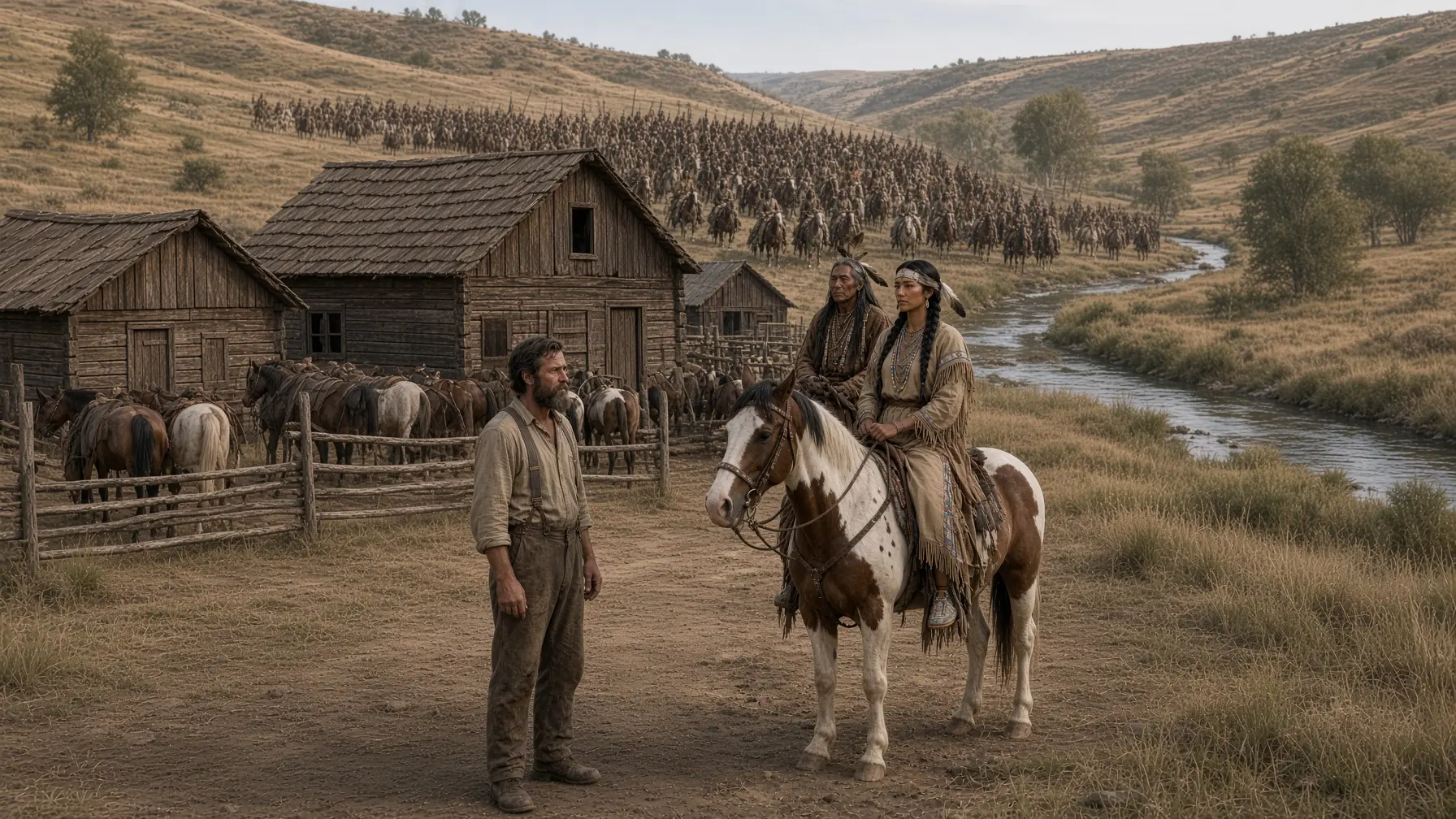
Thomas Weller found her beside the creek just before the heat swallowed the afternoon whole. At first, he thought she was a bundle of hides caught in the grass, something dropped by riders passing through before sunrise. Then the bundle moved, and Thomas saw a hand reach weakly toward the water.
He froze.
The woman lying near the creek bank was Lakota. Her dress was torn, darkened with sweat, dust, and blood. A cut above her brow had dried black down one side of her face, and her lips had cracked so badly they looked white against her skin.
Thomas stood there with his canteen in his hand, feeling the old fear of the territory rise in him.
A man could get killed for helping the wrong person out here.
He had heard enough stories in Fort Harrow to know that. Settlers burned out of cabins. Hunting parties found dead in ravines. Cavalry patrols disappearing beyond the ridge and coming back with fewer horses than they left with.
But he had also seen white men make monsters out of everyone who frightened them.
That was the part nobody in town liked to discuss.
Thomas was forty-three years old, a widower, and stubborn in the quiet way lonely men become stubborn. His wife, Clara, had died of fever three years earlier, leaving him with a rough cabin, forty acres of wheat, six horses, and a silence so complete that sometimes he spoke aloud just to prove he was still a living man. He had come west because land was cheaper than grief, or so he had thought.
Grief followed anyway.
It lived in the empty chair by the stove.
It lived in the dress Clara had left folded in the cedar trunk.
It lived in the way Thomas still set two cups on the table some mornings before remembering there was only one mouth in the house.
The creek was the only reason his farm survived.
It ran thin in August, barely enough to keep the horses watered and the wheat from surrendering completely. He had walked down that afternoon to check the flow, expecting drought, stones, and maybe a dead jackrabbit in the shallows. Instead, he found a woman who looked one breath away from becoming part of the dry grass.
His first thought was to leave.
That shame stayed with him later.
For a full five seconds, Thomas imagined stepping backward, returning to his cabin, shutting the door, and telling himself the world was too dangerous for kindness. No one would know. No one would blame him. A man alone on the frontier had the right to survive, did he not?
Then he heard Clara’s voice in memory.
A man’s soul is measured by what he does when nobody is there to praise him.
Thomas cursed softly.
Then he knelt.
The woman’s eyes fluttered open when he lifted her head. They were dark, sharp, and aware despite the fever burning through her. She looked at him not like a helpless person, but like someone committing his face to memory in case memory became useful later.
“I’m not going to hurt you,” Thomas said.
He did not know if she understood.
He uncorked the canteen and tipped water to her lips.
She drank like the earth after rain.
Once.
Twice.
Then she choked, and he pulled the canteen back, waiting until her breathing steadied before giving her more. When she tried to lift her hand toward the creek, he shook his head and gave her another careful sip.
“Slow,” he said. “You’ll make yourself sick.”
Her eyes stayed on him.
Not grateful.
Not trusting.
Watching.
When she lost consciousness again, Thomas looked around at the empty ridges, the dull gold wheat, the hawks circling high above the valley. The smart thing would have been to leave her there with the canteen and walk away. The decent thing was harder.
So he carried her to the barn.
She was taller than any woman he had ever known, solid with muscle and long bone, heavy in his arms despite how starved and fevered she was. By the time he reached the barn, sweat had soaked through his shirt and his bad knee had begun to throb. He laid her on clean hay in the corner stall and brought water, rags, a blanket, and the small jar of salve Clara used to make from pine resin and beeswax.
Through the afternoon, he cleaned the wound on her head as gently as he could.
Through the evening, he pressed cool cloths to her forehead.
Through the night, he sat on an overturned bucket near the stall door while she muttered in a language he did not understand. Once, she cried out sharply, and one of the horses startled against the rail. Thomas stood but did not touch her until the cry passed.
At dawn, she woke.
Not slowly.
All at once.
Her hand moved toward a knife that was no longer at her belt, and her eyes found him sitting by the open barn door with the canteen beside his boot. For a long moment, neither moved. Then she sat up, touching the bandage on her head, testing her own balance like someone unwilling to show weakness twice.
Thomas rose carefully.
“You should rest.”
She looked at him.
Then past him.
Then at the open barn door.
He understood.
“You can leave if you want.”
She stood.
Thomas had to tilt his head slightly to meet her eyes. She was near six and a half feet tall, maybe more, straight as a young cottonwood even wounded. Her presence changed the shape of the barn.
He took a cloth sack from a peg and filled it with bread, dried venison, and two apples from the basket near the door. Then he handed her the canteen.
She accepted both.
Her eyes studied him again.
That same measuring stare.
Then, without a word, she stepped out of the barn and walked toward the western hills.
Thomas watched until heat shimmer and distance swallowed her.
It was not.
That night, the horses would not settle.
The bay mare kicked once against the stall, hard enough to make the barn boards shudder. The old gelding, who feared nothing except snakes and thunder, stood at the fence with his head high, ears locked toward the ridges. Thomas sat up in bed and listened to the dark.
No hoofbeats.
No voices.
No war cries.
Only wind moving low through the wheat.
He lay back down, but he did not sleep much.
At first light, Thomas stepped onto the porch in his trousers and suspenders, coffee not yet made, eyes narrowed against the pale blue morning.
Then he saw them.
At first, they looked like shadows on the ridge.
But shadows did not sit horses.
Shadows did not hold rifles.
Shadows did not watch a man’s farm from every direction like judgment given a body.
Thomas counted ten on the northern bluff.
Then twenty near the cottonwood line.
Then another group behind the red rocks east of the wheat field.
Then more.
And more.
He stopped counting because the number had become meaningless.
Hundreds of Lakota warriors surrounded his farm.
Not charging.
Not shouting.
Not circling with raised weapons.
Just there.
Still.
Silent.
Patient.
The horses in his corral pressed against the far fence, nostrils wide, bodies trembling. They could smell danger in the air, and Thomas could too. It felt thick and bitter, like smoke before flame.
His rifle leaned inside the cabin near the door.
His hand moved toward it by instinct.
Then stopped.
One rifle against an army was not defense.
It was decoration.
Thomas stepped into the yard with both hands visible at his sides.
The warriors did not move.
For several minutes, nothing happened.
Then a single rider broke from the northern ridge and began descending the slope. His horse moved with careful confidence over the rocks. Behind him came another rider, tall and unmistakable even from a distance.
The woman.
No longer broken.
No longer fevered.
She rode a painted horse with a straight back and a calm face, dressed in clean deerskin trimmed with beadwork. Turquoise and silver hung at her throat, catching sunlight when the horse shifted. Her hair was braided now, and the wound on her brow had been wrapped neatly.
Beside her rode an older warrior.
He was lean, broad in the chest, and carried authority in the way some men carry weapons. His long hair was streaked with gray. Eagle feathers moved behind him in the morning wind. He wore no expression that Thomas could read.
The two riders stopped fifty feet from the cabin.
The older man dismounted first.
He walked forward ten paces, then stopped.
Waiting.
Thomas understood without knowing how.
This was a test.
If they had wanted him dead, he would already be dead. He had slept under their eyes all night, defenseless, unaware. The fact that he was standing meant they wanted something else.
He stepped forward ten paces.
Dust shifted under his boots.
The old warrior looked at him for a long time.
Then he lifted one hand and pointed toward the creek.
Thomas turned his head slightly, then back.
The old warrior made a gesture, cupping his hand, lifting it to his mouth.
Water.
Thomas nodded.
“Yes,” he said. “I gave her water.”
The old man’s expression did not change.
He called out in Lakota, voice sharp and commanding.
The woman rode forward until she was only ten feet away. Up close, Thomas could see the fever had not fully left her. Her skin still held the faint grayness of exhaustion, but her eyes were alive and steady.
“You give water,” she said.
Her English was rough, but clear.
Thomas nodded.
“Yes.”
“You did not know me.”
“No.”
“You did not ask name.”
“You were dying.”
Something flickered in her eyes.
She turned to the old warrior and spoke quickly in Lakota. He listened without blinking, then replied with a single low sentence.
The woman faced Thomas again.
“My father says you are either brave or foolish.”
Thomas swallowed.
“Likely both.”
She studied him.
“My father is Hehaka Sapa. Black Elk Horn. War leader of our band.”
Thomas felt the words settle.
The old man was not merely her father.
He commanded the hundreds of warriors surrounding the farm.
“I am called Winyan Cikala,” she continued. “But traders call me Little Woman because they think jokes make them brave.”
Thomas looked up at her height before he could stop himself.
For the first time, her mouth nearly changed shape.
Not a smile.
Close.
“My mother named me before she knew how tall I would grow,” she said.
Thomas nodded once.
“It’s a good name.”
She translated that for her father.
The old warrior made no visible reaction.
Winyan looked back at Thomas.
“I walked four days alone. A test. No food. Little water. To prove strength for my path.”
“What path?”
Her eyes sharpened.
“To lead.”
Thomas said nothing.
She continued.
“I fell near creek. Hit head. Lost sun. You gave water and let me go. You did not bind me. You did not ride to soldiers. You did not ask reward.”
“I didn’t know there was one.”
“That is why you are alive,” she said.
The words were flat.
Factual.
Not cruel.
A shiver moved through Thomas despite the heat.
The chief spoke again, longer this time. His voice carried across the yard, and though Thomas could not understand the words, he could feel the weight inside them.
Winyan translated.
“My father says we watch eight days.”
Thomas stared at her.
“Watch what?”
“You.”
“Why?”
“To learn if your kindness was truth or accident. To learn if you run to Fort Harrow. To learn if you tell bluecoats where we are. To learn if you are a good man or only a white man who had no audience.”
Thomas looked at the ridges.
Hundreds of warriors watched without movement.
“And if I fail?”
Winyan’s expression did not soften.
“You die. Your house burns. Your name blows away.”
The answer was so direct that Thomas almost appreciated it.
“And if I pass?”
She glanced at her father.
“We see if you pass first.”
The old warrior spoke once more, short and final.
Winyan said, “You stay, maybe live. You run, you die. You bring soldiers, many die, then you die.”
Thomas looked toward the wheat field.
Then the creek.
Then the cabin he had built with Clara’s hands beside his own.
“Do I have a choice?”
Winyan tilted her head.
“Always. But not always good ones.”
With that, she turned her horse.
The chief mounted again.
Together they rode back toward the ridge, leaving Thomas standing in the yard beneath the eyes of five hundred warriors.
The first three days moved like a bad dream under a merciless sun.
Thomas worked because work was all he had. He fed the horses, chopped wood, carried water, checked the wheat, mended the south fence, and repaired the loose hinge on the barn door. Every movement felt too visible, as if the entire valley had become a courtroom and every ordinary chore was evidence.
The warriors remained.
At dawn, their silhouettes lined the eastern ridge.
At noon, smoke rose from small camps beyond the bluffs.
At dusk, fires appeared in the hills, little orange stars close enough that he could smell woodsmoke on the wind. They rotated watch positions with quiet discipline. They ate, rested horses, changed sentries, and never once gave the impression of disorder.
This was not a mob.
This was an army choosing stillness.
Thomas slept poorly.
He kept the rifle near his bed, though he knew it would not save him. Every sound became a warning. Wind against shutters. Hooves shifting. A coyote call in the distance. The creak of old wood cooling after sunset.
On the fourth morning, he found a bundle on his porch.
It was wrapped in hide and tied with sinew.
Inside were strips of dried buffalo meat and a clay jar sealed with beeswax, filled with clean water. No note. No explanation. Only survival.
Thomas sat on the porch step and stared at it.
Were they honoring him?
Or simply keeping him alive long enough to finish the test?
He ate anyway.
A hungry man does not argue with meat.
On the fifth day, Winyan rode down alone.
She stopped twenty feet from the porch and remained mounted, her painted horse shifting beneath her. Thomas was carrying a bucket from the well. He set it down slowly and waited.
“You could try to run,” she said.
“I could.”
“Take horse at night. Go east. Tell soldiers.”
“I won’t.”
“Why?”
Thomas wiped sweat from his brow with his sleeve.
“Because I’d die before reaching the second ridge.”
Winyan studied him.
“That is true.”
“And because I gave water to a woman,” he said. “I didn’t enlist in a war.”
Her eyes stayed on him.
“Most men make pride bigger than life.”
“I’ve buried enough pride already.”
She looked toward the small fenced grave near the cottonwoods.
“Your woman?”
“My wife.”
“She died?”
“Cholera.”
Winyan was silent for a moment.
Then she said, “Grief makes some men empty. Some men cruel. Some men wiser.”
Thomas looked at her.
“Which one am I?”
“I am still watching.”
Then she turned and rode back to the ridge.
On the sixth day, the heat became almost unbearable.
The air above the wheat shimmered. The horses stood in the shade and hardly moved. Thomas soaked a cloth in creek water and wrapped it around his neck. He spoke aloud while he worked, not to the warriors, not to God, but to the silence.
“Fence holds another week.”
“Need to sharpen the plow blade.”
“Clara would say I planted too close to the wash.”
His own voice sounded strange after so much watching.
He began to understand that the test was not simply whether he would betray them.
It was whether he could remain himself under the weight of fear.
It is easy to claim honor when nobody is pressing on it.
Harder when every ridge holds death.
On the seventh morning, Thomas allowed himself one small thought.
Maybe I will live.
Then he heard the bugle.
The sound came from the south, thin and bright, cutting through the morning like a knife drawn across bone. Dust rose beyond the low hills. Then the cavalry appeared.
Forty blue-coated soldiers rode in formation toward his farm, guidon snapping in the wind, rifles across their saddles, horses dark with sweat.
Thomas stood on the porch.
His rifle leaned near the door, too far to reach and close enough to be noticed.
The officer leading the column was Captain Elias Rusk, a tall, narrow man with pale eyes and a mouth that looked built for orders. Thomas had seen him once in Fort Harrow. Men like Rusk did not greet civilians. They inspected them.
Rusk raised one hand.
The column halted in Thomas’s yard.
“Weller,” Rusk said.
“Captain.”
The officer looked past him toward the barn, the creek, the wheat, the ridges.
“We’ve had reports of hostiles in this valley.”
Thomas said nothing.
A young lieutenant rode near the barn, then pointed toward the ground.
“Tracks, sir. Many horses. Fresh.”
Captain Rusk dismounted.
His boots hit the dirt with deliberate force.
“You’ve had visitors.”
Thomas kept his hands visible.
“I found an injured woman by the creek. I gave her water.”
“A Lakota woman?”
“Yes.”
Rusk’s jaw tightened.
“You brought a hostile into your barn?”
“I brought a wounded person into my barn.”
A soldier came out of the barn holding a strip of beadwork that had torn from Winyan’s dress and fallen into the hay.
“Found this, Captain.”
Rusk took it, studied it, then looked at Thomas.
“Where did they go?”
“I don’t know.”
“You expect me to believe that?”
Thomas met his eyes.
“I expect nothing from you.”
The lieutenant spat into the dirt.
“Maybe he’s gone native.”
Rusk stepped closer.
“I will ask once. Where is the band?”
The truth sat heavy in Thomas’s throat.
They were everywhere.
Behind the wheat.
In the rocks.
Along the creek.
In the trees.
Watching.
Waiting.
One word from him could send the soldiers into the worst kind of slaughter. Forty men against hundreds, on land the soldiers did not know and warriors knew like breath. Rusk would order an advance because pride was louder than mathematics until bullets started speaking.
Thomas looked at the captain.
“I gave water to a dying woman,” he said. “That is all I know.”
Rusk’s face darkened.
“You are lying to a United States officer.”
“I am standing on my own porch.”
“I can hang you for aiding hostiles.”
“You can try.”
The yard went very quiet.
The lieutenant’s hand moved toward his pistol.
Then one of the cavalry scouts shouted from near the creek.
“Captain! Movement on the northern bluff!”
Rusk turned.
Thomas spoke before the order could come.
“There are at least five hundred warriors watching this farm,” he said.
The captain froze.
Thomas continued.
“They have been here seven days and have not fired a shot. That tells me something about their intentions. If you ride after them, you will kill some and lose many. Maybe all.”
Rusk stared at him.
“You knew?”
“I knew they were watching.”
“And you said nothing?”
“I just did.”
That was when the war cries rose.
From the north ridge.
Then the east.
Then the west.
Then behind the wheat field.
The sound rolled over the valley like thunder made of human voices. Warriors appeared from behind rocks, from the cottonwood line, from the folds of the land itself. Dozens became hundreds in the space of a breath.
The cavalry horses panicked.
Some reared.
Some pulled at their bits.
The young lieutenant went pale enough to look sick.
Captain Rusk’s hand moved toward his pistol, then stopped.
He understood.
So did every man behind him.
Forty soldiers against a valley that had just become a living trap.
“Mount up,” Rusk snapped.
No one argued.
The column turned in a tense, ragged motion, discipline struggling against fear. As he rode past Thomas, Captain Rusk leaned low in the saddle.
“You chose your side today, Weller.”
Thomas looked up at him.
“No,” he said. “I refused to choose death for everyone.”
Rusk’s eyes burned with hatred.
“You’re finished in every white settlement from here to Fort Pierre.”
Then the cavalry rode out hard, dust rising behind them like a curtain closing.
The warriors stayed visible for nearly an hour.
Not advancing.
Not celebrating.
Simply reminding the land who held it.
Then, one by one, they disappeared.
That evening, Hehaka Sapa rode down with Winyan and four elders.
They came to Thomas’s cabin after sunset. No army this time. No ridges full of silhouettes. Just five figures moving through long shadows with the weight of ceremony.
Thomas opened the door before they reached the porch.
The chief entered first.
The cabin felt smaller with him inside.
His eyes moved across the rough table, the stove, the shelves, Clara’s photograph on the mantel, the second cup Thomas still kept beside the first. He looked at the photograph longer than Thomas expected. Then he spoke in Lakota.
Winyan translated.
“My father says you passed.”
Thomas did not know what to do with that sentence.
“He says you could have bought safety with our blood. You did not. You risked your own place among your people for truth.”
The chief unwrapped a bundle.
Inside lay a pipe carved from red stone, its stem decorated with feathers and beadwork. Beside it was a vest worked in blue, white, and yellow patterns. The colors seemed to hold both sky and storm.
Thomas stared at the objects.
Even he knew enough to understand they were not ordinary gifts.
Winyan’s voice lowered.
“These are not payment. These are word. Every Lakota who sees them knows my father has spoken over you. No raiding party from our people takes your horses. No warrior burns your wheat. No child goes hungry near your door if you have bread.”
Thomas looked at the chief.
The old man’s face remained unreadable.
“But,” Winyan continued, “white men see these, and they know also. They call you traitor. They spit on your name. Maybe they come to kill you.”
The chief spoke again.
Short.
Final.
Winyan said, “You cannot walk two paths forever.”
Thomas looked at Clara’s photograph.
He thought of Fort Harrow.
The general store.
The men who already thought kindness was treason if the thirsty person had the wrong skin.
He thought of Winyan’s cracked lips at the creek.
He thought of the cavalry riding toward death because a captain needed an enemy more than he needed wisdom.
Then he picked up the vest.
The beadwork felt heavier than it looked.
He put it on.
It settled across his shoulders like a second life.
Thomas took the pipe carefully in both hands.
“My wife used to say character is what a man does when nobody is watching,” he said. “Turns out I had five hundred people watching, and I still had to decide who I was.”
Winyan translated.
The chief stepped forward.
He placed one hand on Thomas’s shoulder.
The grip was brief.
Strong.
Then he spoke one English word.
“Brother.”
The elders nodded.
One by one, they left the cabin.
Winyan was last.
She paused at the doorway and looked back at Thomas in the beaded vest, pipe held carefully like a newborn thing.
“You are brave,” she said.
Thomas gave a tired laugh.
“Could be foolish.”
“Yes,” she said.
This time, she did smile.
“Could be both.”
Then she disappeared into the night.
Three weeks later, Thomas was cutting wheat when two young Lakota riders approached from the west.
He straightened, hand moving instinctively toward the rifle leaning against a fence post. The riders stopped at the edge of his property. They were young, maybe eighteen or nineteen, both watching him with open curiosity and careful respect.
A pack horse stood behind them with a fresh elk quarter wrapped in hide.
One rider gestured toward the meat.
Then toward Thomas.
No words.
Thomas touched his hand to his chest and nodded.
The riders nodded back and left.
That became the rhythm of autumn.
Sometimes meat appeared near the barn.
Sometimes a bundle of dried berries.
Once, when a storm tore part of his roof loose, Thomas woke to find two men repairing it before dawn. They vanished before he could thank them.
Winyan came every few days.
Sometimes with messages from her father.
Sometimes with no reason she cared to explain.
She helped him haul water, repair fence, split logs, and patch the barn roof before the first hard snow. While they worked, she taught him Lakota words.
Water.
Horse.
Sky.
Wheat.
Friend.
Brother.
He was a poor student, and she told him so without mercy.
“You speak like a mule chewing tin,” she said one afternoon.
Thomas leaned on the axe handle.
“Mules are useful animals.”
“Not for speaking.”
He laughed, and the sound surprised him.
It had been a long time since laughter came easily.
But peace did not arrive without cost.
By October, no trader from Fort Harrow would stop at Thomas’s farm. The general store refused him flour. A letter sent to his brother in Missouri came back unopened, the word TRAITOR written across the front in block letters. When he went to town once for salt, three men stepped into the street and one rested his hand on a pistol until Thomas turned around.
The beaded vest hung from a peg in his cabin when he slept.
When he worked outside, he wore it.
Not because it protected him from white men.
Because hiding it felt like cowardice.
Word spread quickly.
Indian lover near Whitewater Creek.
Traitor farmer.
Lakota pet.
A white man who sold his own blood for safety.
The words reached him through passing drifters and reluctant traders who still valued money over opinion. Thomas listened, paid when there was business to pay, and said little. A man who chooses a path cannot complain every time the stones are sharp.
Then the vigilantes came.
There were twelve of them, riding from the south in a hard line, dust rising behind their horses.
Thomas saw them while stacking firewood. He knew the kind before they reached the yard: settlers, prospectors, failed ranchers, grieving fathers, angry sons, men who carried loss like a burning brand and wanted to press it into someone else’s skin.
Their leader was Harlan Pike, a thick-bearded man from Fort Harrow whose wife and daughter had died two years earlier in a raid near the Slim Creek crossing. Grief had eaten the softness from his face. All that remained was bone, beard, and revenge.
Harlan stopped his horse twenty feet from the porch.
His eyes locked on the vest visible through Thomas’s open cabin door.
“We heard about you, Weller.”
Thomas stood in the yard.
“I expect you have.”
“You wearing their colors?”
“Yes.”
A younger rider spat into the dirt.
“My brother died fighting those people.”
Thomas looked at him.
“I’m sorry.”
The young man’s face twisted.
“Don’t you dare sound sorry while standing there marked like one of them.”
Harlan reached behind his saddle and pulled out a rope.
A noose had already been tied at the end.
Efficient.
Prepared.
That told Thomas everything.
“One chance,” Harlan said. “Take off that vest. Denounce the Lakota. Come with us and stand proper judgment in Fort Harrow.”
“And if I don’t?”
Harlan’s mouth tightened.
“We hang you from that cottonwood.”
Thomas looked at the tree near the well.
Clara used to sit beneath it in summer.
He looked back at Harlan.
“This is my land.”
“Not anymore.”
“My wife is buried here.”
“She married a white man,” the young rider snapped. “Not a red man’s dog.”
Thomas’s jaw tightened.
But he did not reach for the rifle.
Instead, he touched the pipe at his belt.
Harlan noticed.
His face darkened.
“You really did cross over.”
“No,” Thomas said. “I finally stopped pretending decency had a color.”
The men dismounted.
Slow.
Deliberate.
Their boots hit the dirt in a wide circle around him.
Then the war cry came.
It split the yard open.
Warriors rose from the wheat field where they had been lying hidden beneath cut stalks. More appeared behind the barn, along the tree line, and near the creek. Thirty became fifty in seconds.
Winyan rode forward on her painted horse and stopped between Thomas and Harlan Pike.
Her rifle lay across her saddle.
Casual.
Ready.
“You leave,” she said. “Or die here.”
Harlan’s hand shook near his rifle.
“This is not your fight.”
Winyan looked at him.
“He gave water when I was dying. You bring rope when he is standing. I know which man has honor.”
Thomas stepped beside her horse.
“Nobody dies today.”
Harlan laughed bitterly.
“You don’t get to decide that.”
“No,” Thomas said. “But you can count.”
The vigilantes looked around.
Twelve men.
Fifty visible warriors.
Maybe more unseen.
The arithmetic was plain.
Thomas took a step closer.
“You want justice for your dead. I understand that more than you know. But hanging me won’t bring them back. It will only make more widows, more graves, more sons riding out with rope because nobody ever stopped the first man from doing it.”
The young rider’s eyes flickered.
Harlan’s did not.
“You’re dead to us,” he said.
Thomas nodded.
“I know.”
“Dead in Fort Harrow. Dead in Deadwood. Dead in every white town from here to the river.”
“I know.”
Harlan threw the rope into the dirt at Thomas’s feet.
“Then die out here with them.”
He mounted.
So did the others.
They rode away with the tight, humiliated posture of men who had come to kill and been forced to live.
The warriors stayed until the dust faded.
Winyan looked down at Thomas.
“You should have let us kill them.”
“Maybe.”
“They will come back.”
“Maybe.”
“You still choose not to kill?”
“When I can.”
She studied him.
“You are a very strange man.”
Thomas picked up the noose from the dirt.
“No argument there.”
The first snow came in November.
Before it, Thomas harvested the last of the wheat with help he never asked for and could not have managed without. Lakota men and women arrived one gray morning and worked beside him in steady silence. They bundled stalks, loaded wagons, repaired a broken wheel, carried grain sacks, and shared dried meat by the barn when the work was done.
Thomas understood more of their words now.
Not all.
Enough.
They spoke of hunting grounds lost, promises broken, children hungry, soldiers moving like fences with rifles. They spoke of old rivers and new boundaries. They spoke of winter as if it were an enemy everyone respected.
That night, after they left, Thomas sat beside Clara’s grave.
Snow clouds gathered low over the hills.
“I don’t know if I’ve done right,” he said.
The grave gave no answer.
It never did.
But for the first time in years, the silence did not feel empty.
When snow finally fell, it came heavy and slow, covering the wheat field, the barn roof, the creek stones, the cottonwood branches, and the rope scar still visible in the dirt near the well.
Thomas stood on the porch wearing the beaded vest beneath his open coat.
The pipe hung at his belt.
Hoofbeats approached through the snow.
Winyan rode alone.
She dismounted near the porch and walked up the steps. Snow gathered on her braids and shoulders. For a moment, she looked like something carved from winter and memory.
“My father asks if you regret,” she said.
Thomas looked across the white fields.
He thought of the store that would not sell him flour.
The brother who returned his letter.
The cavalry captain’s threat.
The vigilantes’ rope.
The warriors fixing his roof without waking him.
The elk meat in his cellar.
The woman who had nearly died by his creek and now stood on his porch asking the question his own people never had.
“No,” Thomas said. “I regret that kindness costs so much. But I don’t regret paying it.”
Winyan nodded slowly.
“White men say you belong nowhere now.”
“I’ve heard.”
“Lakota say you are not Lakota.”
“I know that too.”
“Then where do you belong?”
Thomas looked toward the creek.
Then the cabin.
Then the small grave beneath the cottonwood.
“Here,” he said. “Right where I have to live with what I chose.”
Winyan watched him for a long moment.
“My father says sometimes the bravest warrior is one who wins no battle.”
Thomas smiled faintly.
“That sounds like something an old man would say after letting younger people do all the riding.”
She almost smiled.
“He also says your Lakota is still terrible.”
“That sounds more honest.”
Winyan mounted her horse.
Before riding away, she looked back once.
“You fought with water,” she said. “That is harder than fighting with a rifle.”
Then she disappeared into the snowfall.
Thomas remained on the porch until the cold reached his bones.
The valley lay silent around him.
No cavalry.
No vigilantes.
No army on the ridge.
Just snow, wheat stubble, creek water, and a farm that had become both exile and refuge.
He had given water to a dying woman and lost nearly everything his own people used to call belonging.
But he had kept the one thing the territory tried hardest to take from men.
His soul.
And in Dakota Territory, where fear could turn neighbor against neighbor and grief could make murder sound like justice, that was no small harvest.
Thomas Weller went back inside, added wood to the stove, and placed two cups on the table out of old habit.
Then he paused.
After a moment, he set out a third.
Not for Clara.
Not for himself.
For whoever might come thirsty next.