The first thing Gideon Cobb noticed about Henrietta Miller was not her size.
It was the fact that she stopped his door with one hand.
Most people stepped backward when Gideon moved toward them.
Etta Miller planted her broad palm against six inches of heavy oak and held it there.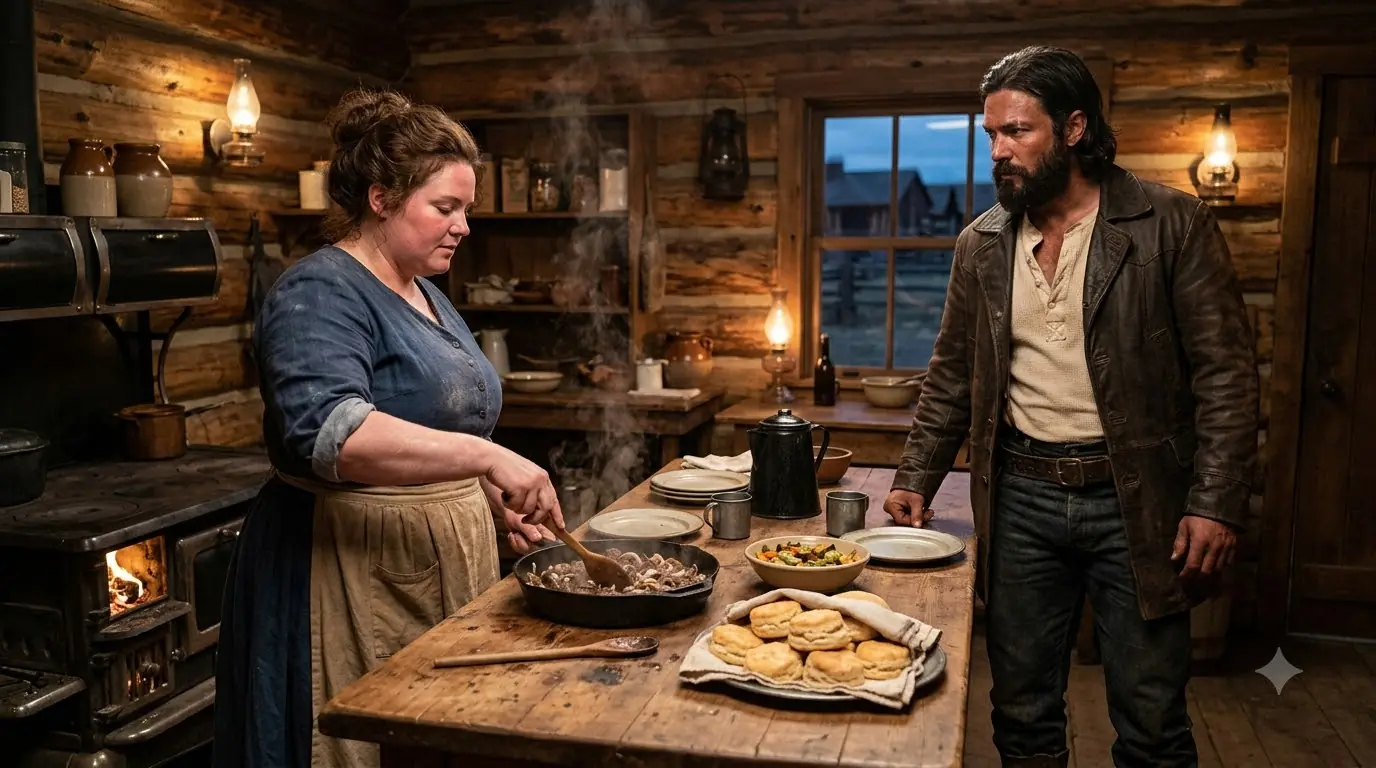
For a second neither of them spoke.
Cold wind tore through the gap between door and frame.
Behind Etta, the borrowed wagon leaned slightly on one damaged wheel. Two children sat beneath a thin blanket, watching Gideon with expressions he knew too well.
Hunger made children quiet.
Gideon hated recognizing that.
He looked back at the woman.
Her face was round and flushed from cold. Damp strands of chestnut hair clung to her temples beneath a worn bonnet. She wore a brown wool coat too thin for the mountains and boots stained white with dried road salt.
Her breathing was hard.
Not from fear.
From climbing his steps after a journey that had probably taken everything she had left.
“I have nothing to go back to, Mr. Cobb,” she said.
Gideon’s hand remained on the door.
“That doesn't make this ranch a charity house.”
“I didn't ask for charity.”
Her voice trembled once.
Then steadied.
“My children haven't eaten a hot meal in four days. Your advertisement said you need a cook.”
“I need someone who can work.”
“I can.”
“You know what winters are like here?”
“No.”
“Then you don't know what you're agreeing to.”
Etta glanced toward the wagon.
The older child, a boy, had one arm around the smaller girl.
When Etta turned back, something had changed in her eyes.
“I know what happens if I leave.”
Gideon said nothing.
She continued.
“Give me one hour.”
He almost laughed.
Etta did not.
“One hour for what?”
“To cook.”
“In that?”
She looked down at herself.
“My coat?”
“Your condition.”
Her expression sharpened.
Gideon immediately realized how the sentence sounded.
He had meant exhausted.
Frozen.
Near collapse.
Etta had heard something else.
Her chin lifted.
“I have worked sixteen-hour days in a bakery carrying flour sacks men complained were too heavy. I baked before sunrise while pregnant. I buried my husband in January, fought a banker until August, loaded everything I owned into that wagon in September, and crossed frozen roads with two children because I refused to let strangers decide where they would sleep.”
She took a breath.
“If my condition bothers you, close the door.”
Gideon stared.
The wind moved between them.
Finally Etta added, quieter:
“But don't pretend you're sending me away because I can't work.”
That did it.
Gideon stepped aside.
“Sixty minutes.”
Etta entered.
The children followed.
The little girl looked around as though she had crossed the threshold of a castle.
The boy looked for exits.
Gideon noticed that too.
“My name's Toby,” the boy said.
Gideon grunted.
“This is Clara.”
Clara hid behind Etta.
Gideon looked at her.
She looked at him.
“You're very big,” she whispered.
Etta closed her eyes.
“Clara.”
“What?”
Gideon almost smiled.
Almost.
“The kitchen is through there.”
Etta turned immediately.
She removed her coat, folded it over a chair, tied a faded apron around her waist, and looked at the mess surrounding the stove.
The last cook had left three days earlier after calling Gideon an impossible bastard and riding south before breakfast.
Gideon had not disagreed with the description.
Grease coated the pan handles.
Burned beans had fossilized inside a pot.
A cutting board smelled vaguely sour.
Etta stared at the room.
Then rolled up her sleeves.
“Children.”
Toby and Clara straightened.
“Toby, water.”
“Where?”
Etta looked toward Gideon.
“Pump outside.”
Gideon pointed.
Toby grabbed a bucket.
“Clara, collect every spoon you can find and put them on the table.”
Clara hurried away.
Gideon remained by the doorway.
Etta looked at him.
“Do you plan to stand there?”
“Yes.”
“Fine.”
She moved.
Gideon had expected effort.
He had not expected command.
Within five minutes Etta had identified everything edible in the pantry.
Venison.
Flour.
Lard.
Dried onions.
Black pepper.
Salt.
A small crock of buttermilk.
Coffee.
Three wrinkled potatoes.
She looked toward Gideon.
“You have a ranch with two hundred head of cattle and this is your pantry?”
“Closer to four hundred.”
“That makes it worse.”
Gideon crossed his arms.
“You've got fifty minutes.”
Etta ignored him.
She scrubbed the skillet.
Toby returned with water.
She washed potatoes.
Clara lined up spoons by size.
Toby chopped kindling.
Gideon watched the three of them move through his kitchen as if they had been doing it there for years.
There was coordination.
Habit.
Etta did not need to explain twice.
The children were not perfectly behaved.
Clara dropped a spoon.
Toby spilled water.
Etta snapped at him.
Then apologized because she had snapped too sharply.
Gideon found that more remarkable than the mistake.
Adults rarely apologized to children where he came from.
By the time the first chopped onion hit hot bacon grease, the cabin smelled different.
Not cleaner exactly.
Alive.
Etta browned venison.
Added onion.
Pepper.
Flour.
Stock.
The skillet thickened into gravy.
She worked biscuit dough so quickly Gideon almost missed the movement.
Flour.
Lard.
Buttermilk.
Fold.
Press.
Cut.
She arranged the rounds inside a second pan and pushed it into the stove.
Forty-eight minutes after she entered his kitchen, she set a plate in front of him.
Biscuits.
Venison gravy.
Fried potatoes.
Coffee.
Nothing fancy.
Gideon sat.
Etta stood opposite him.
Toby and Clara remained near the wall.
Everyone waited.
Gideon broke a biscuit.
Steam escaped.
He dragged it through gravy.
Ate.
The kitchen disappeared.
For one impossible moment he was fourteen again.
His mother was alive.
Snow pressed against the windows of a smaller cabin farther north.
His younger brother Samuel was stealing biscuits off a tray.
His father was cursing because a calf had broken through a fence.
Someone was laughing.
Gideon stopped chewing.
Etta's hands tightened around her apron.
He took another bite.
Then another.
He finished everything.
Coffee too.
When he stood, Etta's shoulders became rigid.
Gideon wiped his mouth.
“You stay until spring.”
Etta blinked.
“What?”
“Room and board. Wages paid monthly. Children help where they can. They don't interfere with ranch work.”
Toby frowned at the word interfere.
Etta stared at Gideon.
“You mean it?”
“Did I look like I was joking?”
“No.”
“Then stop asking.”
Clara raised her hand.
Gideon looked at her.
“What?”
“Can we eat now?”
Etta covered her face.
Gideon looked at the remaining biscuits.
“Yes.”
Clara smiled.
That was the first crack in the walls.
Gideon did not know it yet.
The ranch had been quiet for eleven years.
Not peaceful.
Quiet.
There was a difference.
Peace rested.
Silence waited.
Gideon's house waited.
It waited in the unused chairs.
In the upstairs hallway.
In the dining room built for twelve people where Gideon ate alone at one end.
It waited in the locked bedroom facing east.
It waited inside the desk drawer holding a gold wedding ring that had never reached a bride's finger.
The ranch had been successful.
That was not the same as being alive.
Gideon owned nearly twelve thousand acres between mountain and river.
His cattle grazed across three valleys.
He had twenty-six employees at peak season.
Two barns.
Three bunkhouses.
A sawmill share.
A freight contract.
Money no longer frightened him.
People did.
Etta discovered this during the first week.
Gideon spoke easily about work.
Fences.
Feed.
Weather.
Horses.
Contracts.
He became nearly mute when conversation touched anything personal.
On the third morning Toby asked:
“Were you ever married?”
Gideon stopped sharpening a knife.
“No.”
“Did you want to be?”
Etta almost dropped a bowl.
“Toby.”
“What?”
“Stop questioning Mr. Cobb.”
Gideon continued sharpening.
Toby watched.
“Do you have children?”
“No.”