Chapter 1
The House Behind the Walls
Thornhallow Hall stood at the edge of the moor like a house determined not to be loved. Its gray stone walls rose against a winter sky, stern and weathered, with ivy clinging to the western face and narrow windows gazing outward like suspicious eyes. As the hired carriage approached through rain and mist, Miss Rosalind Keene sat very still, her gloved hands folded over the letter that had brought her there.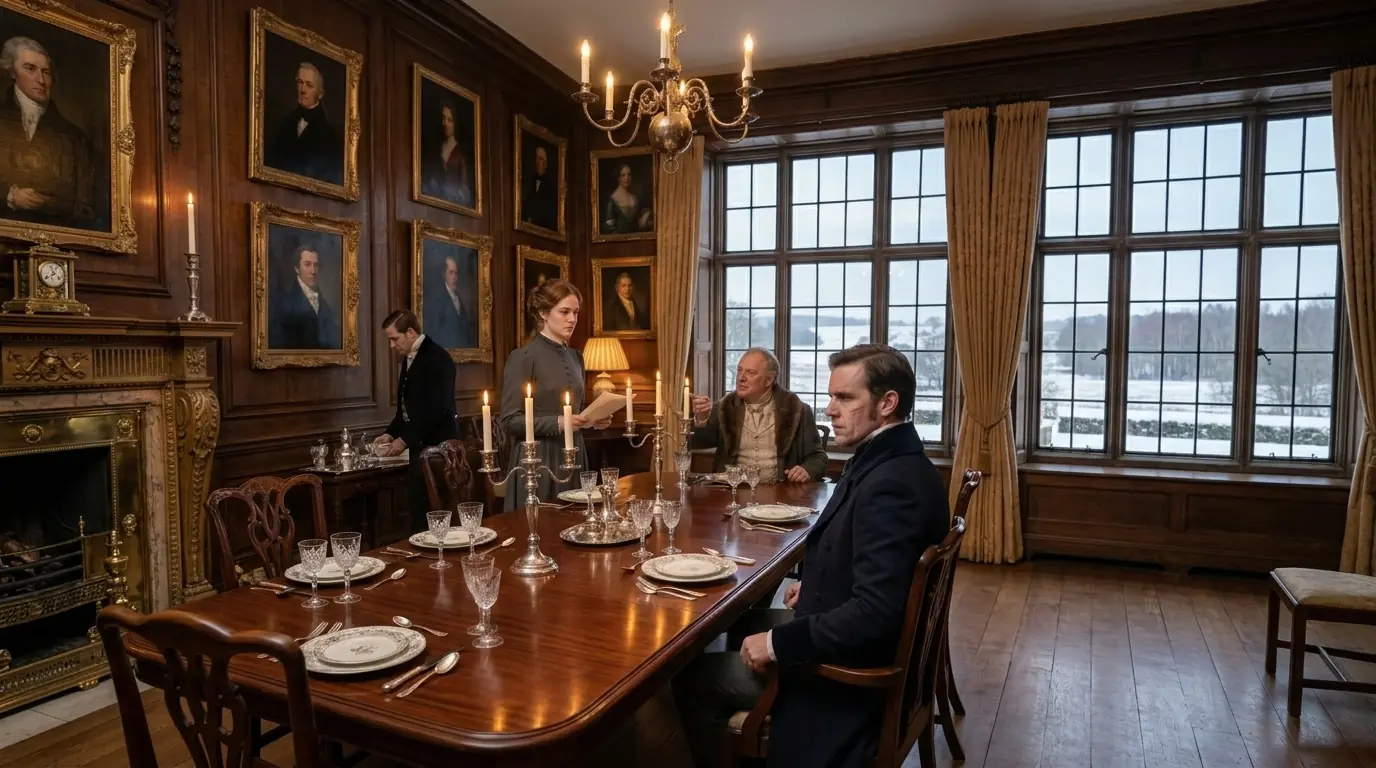
“Miss Keene, your references have been reviewed. You may present yourself at Thornhallow Hall on the 15th of November. The position is that of governess to my daughters, Lady Beatrice Tremaine and Lady Lucy Tremaine. Order, discretion, and discipline will be expected. Sentimentality is neither required nor encouraged.
—Cavendish”
There had been no warmth in the words, but Rosalind had accepted all the same. She was 26, a clergyman's daughter without fortune, and possessed of a mind people praised only when it remained hidden.
Her father had educated her as thoroughly as any son might have been educated, teaching her Latin, Greek, philosophy, history, and scripture. Yet since his death, Rosalind had learned that a woman's intelligence was safest when worn like a plain shawl, useful, modest, and never displayed too brightly. Thornhallow's great door opened before the footman knocked. A severe woman in black stood within.
“Miss Keene, I am Mrs. Vale, the housekeeper. His Lordship is occupied. The young ladies are in the schoolroom.” Rosalind followed her through a grand, dim hall lined with portraits. The air smelled of wax, rain, and silence.
Upstairs, Mrs. Vale opened a door onto a room made cheerful by firelight but disordered by neglect. Books lay in untidy piles, maps curled at the corners, and an ink stain darkened the table. Two girls stood in the center of the room. Lady Beatrice Tremaine, aged nine, was fair, proud, and watchful.
Lady Lucy, aged six, had dark curls and solemn eyes. She held one hand behind her back. "This is Miss Keene, your new governess," Mrs. Vale announced. Beatrice looked Rosalind over.
"You are very plain." "Beatrice," Mrs. Vale said sharply. Rosalind smiled. "That may prove useful.
Plain people are often underestimated." Lucy brought her hidden hand forward.
Upon a scrap of paper lay a dead beetle. "For you," she said. Mrs. Vale looked horrified, but Rosalind bent to examine it. "A stag beetle," she said.
"Though a small one." "Did you find him near old timber?" Lucy's eyes widened. "Near the woodpile." "They like old wood.
He must have had a dignified life." Beatrice's mouth twitched despite herself. When Mrs. Vale left, Rosalind removed her bonnet.
A sad house must be studied carefully.
One must discover whether it wishes to remain sad, or whether it has simply forgotten how to be otherwise." That afternoon, Rosalind opened curtains, arranged books, cleaned what she could of the ink stain, and began lessons not with French or deportment, but with observation. Beatrice pretended indifference, but corrected the placement of the atlas. Lucy followed Rosalind everywhere. Near dusk, as Rosalind gathered papers, a deep voice spoke from the doorway.
You permit them Shakespeare?
She turned. Gabriel Tremaine, Marquess of Cavendish, stood there in dark clothes, leaning slightly upon a cane. He was tall, broad-shouldered, and marked by a pale scar running from temple to jaw. His face was controlled, handsome in a severe way, and shadowed by old pain. My lord.
Rosalind curtsied. “They are children,” he said, glancing at the open book. “Children often understand storms, shipwrecks, and forgiveness better than adults.” His eyes sharpened. “That is an unusual answer.”
“I can provide a plainer one. Shakespeare improves language, imagination, and moral judgment.” “Miss Armitage can confine them to approved extracts.” “Miss Armitage is no longer here.” The words came too quickly, but Rosalind did not retreat.
Lord Cavendish studied her. “You speak as though from experience.” “I am a clergyman's daughter, my lord. One learns to appear less clever than one is. It comforts people.”
“And do you intend to comfort me, Miss Keene?” “No, my lord. I intend to teach your daughters.” For the briefest moment, amusement touched his eyes, then it vanished.
There are rules at Thornhallow. The girls are not to enter the west wing. They are not to disturb me before noon. Music is not permitted in the main rooms. Questions about their mother are to be handled with care.
“Does that mean answered gently or not answered at all?” His face hardened. “It means you will use judgment.” “Then I shall.” He turned to leave, but paused when he saw the dead beetle carefully placed in a little paper box upon the sill.
“Lady Lucy gave you that.” “Yes, she gave it sincerely.” His hand tightened on his cane. “Good evening, Miss Keene.” That night, in her small chamber, Rosalind unpacked her few possessions.
Plain gowns, her father's Greek Testament, a miniature of her mother, and a notebook filled with translations no one had ever praised except her father.
She listened to the wind circle the house. Somewhere below, a child laughed once, then stopped as though laughter after dark were forbidden. Rosalind opened her notebook and wrote, Thornhallow, a sad house, not beyond repair.
Chapter 2
Lessons in Silence
By the end of her first fortnight, Rosalind understood that Thornhallow was not truly quiet. It was full of footsteps, bells, servants' whispers, coal scuttles, and wind. What it lacked was ease. The children tested the silence first. One rainy morning, Lucy hummed during copy work.
Beatrice hissed at her to stop. Rosalind looked up. “Do you know the whole tune?” Lucy shook her head. “Did your mother sing it?”
Both girls froze. Beatrice's voice was guarded.
“We are not to trouble Papa with questions about Mama.” “I did not ask whether you trouble your father. I asked whether your mother sang that tune.” Lucy nodded. “When my hair was brushed.”
“Then perhaps we ought to write down what you remember.” “Are we allowed?” Beatrice whispered. “Memory is not disobedience.” So their lesson changed.
Grammar became sentences about Lady Eleanor Tremaine.
Drawing became an attempt to sketch her favorite rose. Geography became the places she had wished to visit. Beatrice remembered her mother's laugh. Lucy remembered a shawl that might have been blue or green. By tea time, the girls were brighter than Rosalind had yet seen them.
Then Lord Cavendish entered. His gaze fell upon the papers, the drawings, and Lucy's slate where she had written, "Mama sang when it rained." "What is this?" he asked. "A writing exercise." Rosalind replied.
Beatrice sprang up. "It was my fault, papa." "No." Lucy said, "mine." "It was mine, my lord."
Rosalind said.
His expression darkened. "I gave instructions." "You gave me responsibility." "I told you matters concerning their mother were to be handled with care." "And so they were."
The girls looked frightened. Lord Cavendish ordered them from the room. When the door closed, he turned on Rosalind. "You have been here 14 days and already presume to overturn my household." "No, my lord.
I'm trying to understand its disorder." "You call grief disorder?" "I call silence a poor substitute for comfort." "You know nothing of it." "I know enough to see two little girls who believe loving their mother allowed is a trespass against their father."
His face went still. "Take care, Miss Keene. I am taking care of them. For a long moment, she thought he would dismiss her. Instead, he moved to the window.
“My wife died in this house,” he said at last. “Fever took her in three days. I was recovering from wounds and could barely stand. Beatrice was old enough to know her mother had vanished. Lucy cried for her every night.”
His voice remained controlled, but sorrow lived beneath every word.
“I removed reminders because they caused distress.” “To whom?” Rosalind asked softly. His eyes met hers. The question had struck home.
She lowered her head. “Forgive me.
That was too sharp.” “Yes,” he said. Then, after a pause, “But perhaps not false.” He picked up Beatrice's page and read it. His face altered almost imperceptibly.
“She remembers Eleanor's laugh.” “Yes.” “I had forgotten how to hear it.” After that day, Lord Cavendish did not forbid the memory lessons. He came more often to the schoolroom, though never as if he meant to stay.
He corrected Beatrice's Latin pronunciation, examined Lucy's drawings of insects, and stood awkwardly while his daughters offered him small treasures, feathers, stones, leaves, and once a moth cocoon. Rosalind also discovered the library. Its door stood ajar one morning. Inside were shelves of Greek histories, Latin poets, sermons, essays, maps, and scientific volumes. Hunger rose in her at the sight of them.
She had just reached for Thucydides when Lord Cavendish spoke behind her. “Do you read Greek, Miss Keene?” She almost dropped the book. “The door was open, my lord.” “That was not my question.”
She considered denying it, then remembered her father's voice. “Hide it when you must, Rosa, but never despise it.” “Yes,” she said. “Well enough to know when translators have become lazy.” To her astonishment, he laughed.
It was brief, rusty, and quickly suppressed, but it transformed his face. “My daughters’ governess is a scholar.” “My father was a generous teacher.” “And Oxford?” Rosalind's mouth tightened.
“Oxford educates men, my lord. It tolerates women only when they are safely outside its gates.” “You sound resentful.” “I hope I sound accurate.” He handed her the volume.
“Read.” She did.
At first carefully, then with growing confidence. The old language returned to her tongue like something beloved and long denied. When she finished, the room was silent. “My tutor at Oxford would have wept to hear you,” he said, with admiration. “With humiliation.”
She smiled before she could stop herself.
His gaze rested on that smile. “You may use the library,” he said, “for the girls’ education.” “Of course.” “And for your own.” The library became the heart of a quiet change.
Beatrice devoured histories. Lucy studied insects with scientific seriousness. Lord Cavendish sometimes joined them, offering dry remarks from his desk.
The curtains were opened. Fires were lit in unused rooms. The garden paths were cleared. The music room, long shut, was dusted. One afternoon, while the girls searched for Lucy's moth cocoon, Rosalind and the marquis stood together in the library.
"She has your mind," Rosalind said of Beatrice. "God help her," he replied. "Why?" "Because a sharp mind in a woman is treated as a fault unless softened beyond use." "Then teach her not to apologize for it."
He looked at Rosalind. "Is that what your father taught you?" "Yes." "And did it serve you well?" "It made me lonely at times, but it saved me from becoming false."
Something softened in his face. He told her then, not much, but enough, of war, smoke, a charge gone wrong, men lost, wounds that ended his command, but not his memories.
He had returned home broken, only to lose Eleanor soon after. "I built walls," he said. "At first, real ones, then others." "And your daughters were inside or outside those walls?" His face tightened.
"That is the question, is it not?" Before she could answer, Lucy burst in. "Papa, the cocoon has moved." The moment broke, but something between them remained.
As Gabriel followed his daughters out, Rosalind stood alone in the library and understood that Thornhallow was waking. And, perhaps foolishly, so was her heart.
Chapter 3
The Storm at the West Wing
The trouble arrived in January in the person of Lord Armitage. He was Gabriel's older cousin, a stout gentleman with a fur-collared coat, a taste for snuff, and the settled belief that every family improved when he directed it. Beatrice groaned when his carriage appeared. Lucy hid under the schoolroom table. "He pinches cheeks," Lucy whispered.
“And tells Papa what to do,” Beatrice said. “Papa becomes dreadful after he visits.” At dinner, Lord Armitage proved every bit as unpleasant as promised. He spoke of discipline, family duty, and the dangers of modern education. He regarded Rosalind as one might regard an unexpected ink stain.
“Female intelligence,” he declared, “is best kept within careful boundaries.” Rosalind lowered her gaze.
“How fortunate that boundaries are so often movable, my lord.” Gabriel coughed into his wine glass. Lord Armitage was not amused. Over the meal, he suggested Beatrice was becoming forward and Lucy peculiar. “Lucy is observant,” Gabriel said.
“Of beetles, perhaps.” “Of nature.
And Beatrice has spirit.” “Spirit must be broken early in girls of rank, otherwise it becomes opinion.” Gabriel set down his knife. “In my house, opinion is not a disease.” Later, Rosalind went to the library while the gentlemen remained in the dining room.
The door between the rooms had not fully closed. She did not intend to listen, but Lord Armitage's voice carried. “The woman is overstepping.” Gabriel's reply was low.
“Take care how you speak of Miss Keene.” “Ah, there it is. She is a clergyman's daughter with no fortune. Clever, perhaps, in that troublesome way plain women cultivate when beauty has failed them. But you cannot raise her above her station.”
Rosalind stepped back, cheeks burning. She had heard such words before.
Plain, clever, troublesome. Useful when modest. Laughable when seen. What shook her was not the insult. It was Gabriel's defense and the danger of needing it.
She was the governess. He was the Marquess of Cavendish. Affection between them, if affection was what had grown, stood upon dangerous ground. The next morning, she went early to return the Thucydides to the library shelf. Gabriel was already there.
Miss Keene. My lord. The return to formality struck them both. “You heard my cousin.” “Enough.”
“I apologize.” “You did not say the words.” “I permitted the man who did to sit at my table.” “He is your family.” “An affliction, not an excuse.”
Despite herself, she almost smiled. “I think,” she said carefully, “that I must remember my place more clearly.” His face changed.
“And where is that?” “In the schoolroom, with your daughters.” “And not in the library?” “Only as needed. Not at my table.”
“That is not customary.” “Custom has done very little for this house.” “My lord.” “Gabriel,” he said, with quiet strain. She looked away.
“That is precisely the danger.” Before either could say more, Mrs. Vale appeared, pale and breathless.
“My lord, Lady Lucy is missing.” The room altered at once. “What do you mean, missing?” Gabriel demanded. “She was not in the nursery or schoolroom.
Her cloak is gone.” Rosalind's heart lurched. The cocoon.
Lucy had placed it near the old conservatory beyond the west garden. Mrs. Vale swallowed. The west wing door was found open. Gabriel went white.
The west wing had been closed since Lady Eleanor's death. He moved at once, Rosalind following without permission. They passed through cold corridors and sheet-covered rooms until they found a muddy footprint in the old music room. A faint sob came from beyond an inner door. “The blue chamber,” Gabriel whispered.
The room where his wife had died. Inside, Lucy sat beneath a writing desk, crying silently and clutching the broken remains of the cocoon. Rosalind knelt and gathered her close. “I only wanted to show Mama,” Lucy sobbed. “Beatrice said Mama liked butterflies.”
Gabriel stood frozen at the threshold.
Rosalind looked at him. “Come in.” “I cannot.” “Yes,” she said softly. “Not for the past.
For her.” Lucy lifted her tear-stained face. “Papa.
I am sorry.” That did what courage alone could not. Gabriel stepped into the room. He lowered himself painfully to one knee and Lucy flung herself into his arms. For a moment, he seemed bewildered by the force of her need.
Then he held her tightly.
“My little one,” he said hoarsely. “You need never apologize for missing your mother.” Beatrice arrived soon after and broke into tears, too. “I told her Mama liked butterflies. It was my fault.”
Gabriel held out his arm. “Come here, Bea.” She went to him.
The three Tremaines held one another in the blue chamber and Rosalind understood that some locked doors, once opened, could not be closed again. Lord Armitage left the next morning in anger. "You are governed by emotion," he told Gabriel, "and by a woman who forgets herself." Gabriel stood tall, scarred, and stern. "Miss Keene has done more good in this house in 2 months than you have done in 6 years.
She has made you vulnerable." "No," Gabriel said, "she has reminded me I was not born stone." That afternoon, Gabriel asked Rosalind to walk in the garden.
The paths had been cleared, though frost still touched the rose beds. "I have been a coward," he said. "No, wounded. There is a difference." "Yes, a coward refuses love because it is inconvenient.
A wounded man may refuse it because he thinks he cannot survive losing it again." His gaze settled on hers.
"And can he?" "I do not know," she said, "but I believe he cannot survive never trying." The wind moved between them. "Rosalind," he said, using her Christian name for the first time beyond accident, "if I were only a man and not what the world has made me, I would ask whether your heart might ever turn toward mine." Her breath caught.
"And if I were only a woman," she replied, "and not what the world permits me to be, I might answer." "I would not expose you to gossip." "I know." "I would not trifle with you." "I know."
"I would marry you before I let one whisper touch your name." She stared at him. "Do not say such things from gratitude." "Gratitude does not keep me awake wondering whether you are warm enough in your chamber. Gratitude does not make me listen for your step in the corridor.
Gratitude does not make the library seem empty when you are not in it. Tears filled her eyes. "I will not marry where I am raised in rank but lowered in myself." She said. "I will not become decorative.
I would sooner board up the library." "That is a dreadful proposal." "Then I withdraw the image, not the sentiment." She laughed softly.
He bowed over her hand but did not kiss it. "I will ask again." He said, "when you have had time to decide freely. If you refuse, you may remain as governess as long as you wish or leave with a year's salary and my lifelong respect." There lay the difference between possession and love.
Possession demanded an answer. Love made room for freedom.
"I will consider." Rosalind said.
Chapter 4
The House That Opened
Spring came slowly to Thornhallow. The frost loosened. Birds returned to the ivy. Green appeared in the borders. The dry fountain in the inner garden was cleared and restored under Beatrice's strict supervision and Lucy's chaotic enthusiasm.
When water flowed again, the whole household came to see it. Mrs. Vale declared that the fountain had always been troublesome and wiped her eyes when no one was meant to notice. Lucy floated three leaves in the basin and named them after Greek philosophers, though she confused Plato with a moth. Gabriel stood beside Rosalind.
"They sound like children." He said quietly. "They are children." "I had forgotten." "You are remembering."
Since the day in the garden, he had behaved with perfect restraint. He wrote to Rosalind's aunt in Bath, ensuring all propriety. He consulted his solicitor. He invited the local vicar and his wife to dine, making clear that Rosalind was not hidden within his household, but honored in it.
And he asked her nothing. His patience tested her more than persuasion would have done. Rosalind considered everything: rank, gossip, his grief, her dependence, the girls, Lord Armitage's disapproval, and the cruel certainty that some would call her ambitious. But she also considered Gabriel himself. She loved his mind, his dry humor, his grave tenderness, the way he listened as though listening were an act of honor.
She loved that he did not ask her to become smaller. She loved Beatrice's fierce intelligence and Lucy's odd, tender heart. She loved Thornhallow, not as it had been, but as it was becoming. One evening in April, Rosalind found Beatrice crying angrily in the library over a letter. "It is from cousin Edmund's wife," Beatrice said.
"She says I am to visit in June and learn proper manners. She says girls who become too clever make poor wives and unhappy households." Rosalind sat beside her. "And what do you think?" "I think I would rather be unhappy than stupid."
Rosalind laughed gently. "I once said something very similar to my father." Gabriel entered then and read the letter. His face became dangerously calm.
"Am I to go?" Beatrice asked. "No," he said. "No?" "No daughter of mine will be sent away to have her mind trimmed into a parlor ornament."
Beatrice threw herself into his arms. He held her tightly. Over her head, his eyes met Rosalind's.
In that moment, Rosalind saw that he was no longer a man wondering whether life might return. He was a man choosing it. That night, she found him in the music room standing before Lady Eleanor's portrait. "I think she would have liked you," he said. "I hope so."
"She was clever." "I know.
The girls remember." He turned toward her. "Rosalind, I have waited as I promised. I will wait longer if you require it, but my heart has only become more certain." "I have thought of everything," she said.
"I feared you might." "I have thought of rank, gossip, your daughters, my dependents, your grief, my pride, and whether I could bear to be called ambitious by women who have never needed employment." "And what conclusion did you reach?" "That fear is a thorough adviser, but not a wise one." His face changed.
She stepped closer.
"I love you, Gabriel Tremaine. Not because you are a Marquess, not because this house needs me, not even because your daughters have taken hold of my heart, though they have. I love you because with you, I am neither too much nor too little. I am simply myself." He closed his eyes briefly.
"My dear Rosalind." "And if you still wish it," she said, "I will marry you." He bowed his head over her hands.
"I wish it more than I have wished anything in years." This time when he lifted one hand to his lips, she did not stop him. They told the girls the next morning. "You mean Miss Keene will be our stepmother?" Beatrice asked.
“If she consents to tolerate us in that capacity,” Gabriel said. “Will she still teach us?” Lucy asked in alarm.
“Yes,” Rosalind replied, “though perhaps not every hour of every day.” Beatrice studied her. Do you love papa truly? Not because he is a marquis. Titles are poor company at breakfast.
Gabriel laughed.
Will you make us stop keeping beetles? Certainly not. Will you send me to cousin Edmund? Never for the purpose of becoming less intelligent. Beatrice flung herself into Rosalind's arms.
Lucy joined them because she disliked being excluded from emotion. The wedding took place in June when the white roses by the fountain had bloomed again, fragrant after rain just as Beatrice remembered. Rosalind wore ivory muslin and carried white roses, lavender and rosemary from Lady Eleanor's restored garden. Gabriel waited at the altar in dark blue, his scar visible, his cane in hand, his eyes fixed on her with reverent certainty. You are sure?
He whispered when she reached him. She smiled. Still giving me freedom at the altar. Always. Then yes.
I am sure. The ceremony was simple and filled with light. Beatrice tried not to cry and failed. Lucy cried openly, then became distracted by a ladybird on the pew. Afterward, Thornhallow opened its doors.
Tables were set in the garden. Servants, tenants, neighbors, and children gathered under garlands of greenery. There was music in the open air and later in the music room itself. Beatrice played with many mistakes and received applause as though she had conquered Europe. Lucy released a moth she had raised in a jar, and insisted it circled Gabriel twice before flying away.
At evening, Gabriel and Rosalind stood beside the restored fountain. "Are you happy?" he asked. She looked at the house. The windows were open. Light spilled from its rooms.
Children ran across the lawn. Music drifted into the summer dusk. "I am," she said. "For years," Gabriel murmured, "I thought this house held my grief. I feared that if I opened it, grief would overrun everything."
"And did it?" "No." He looked down at her.
"Love did." She slipped her hand into his arm. "Love is often more persistent, and far less obedient, thankfully." In the years that followed, Thornhallow did not forget sorrow. Lady Eleanor's portrait remained in the music room.
Gabriel's limp remained. His scar remained.
Some days were still quiet, but quiet no longer meant emptiness. The schoolroom rang with questions. The library became the heart of the house. Beatrice studied Latin with alarming speed. Lucy kept beetles, moths, caterpillars, and once disastrously, a frog in a teacup.
Rosalind read Greek aloud by the fire, and Gabriel listened as though every word returned something to him. Visitors who came up the long drive no longer thought Thornhallow a fortress. They saw open windows, restored gardens, books in use, children at play, and a marquis who had learned to smile again. They thought it a home. And if they listened closely, they might hear the turn of a page in the library, the murmur of a woman's clear voice reading in Greek, and the low answering warmth of a man who had once shut his heart behind walls until a governess with a hidden Oxford mind taught him that love, like learning, grows stronger when it is shared.
The End.