The first lie Caleb Mercer heard that Tuesday morning was that the wagon climbing toward his ranch carried nothing but a cook.
The second was that the woman sitting inside it was nobody.
The third was the one Caleb told himself.
He would never care about her.
At thirty-nine, Caleb had become extremely skilled at believing things that made life simpler.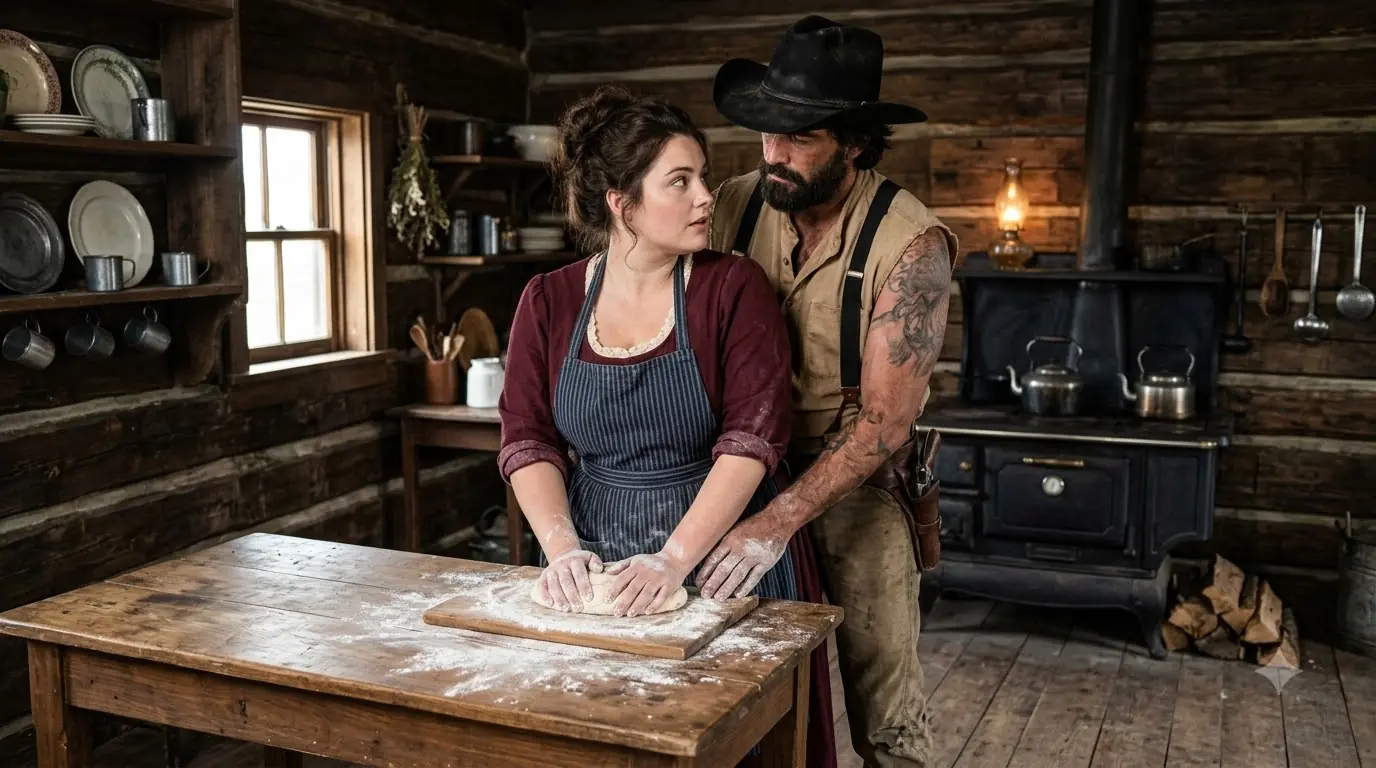
The roof leaked because replacing it cost money.
The western pasture was dying because the summer had been cruel.
His foreman had left because men always left when someone else offered better wages.
The unpaid feed invoices stacked inside his desk were temporary.
The mortgage note was manageable.
The ranch was not failing.
And loneliness?
That was simply peace with fewer witnesses.
He repeated all of those ideas regularly.
Especially the last one.
Then the wagon appeared between the cottonwoods shortly after noon.
Caleb stood beside the corral repairing a split rail when he heard the wheels.
He straightened.
A small two-horse wagon climbed the dusty track leading from Mercy Ridge.
An older woman held the reins.
Beside her sat no one.
At least that was what Caleb thought until the wagon stopped.
The older woman climbed down first.
She was perhaps fifty-five, thin through the shoulders, wrapped in a faded black shawl despite the September heat.
“Mr. Mercer?”
Caleb rested the hammer against his thigh.
“Yes.”
“Alice Vaughn.”
He nodded.
She looked toward the wagon.
“My daughter came about the cooking position.”
Caleb frowned.
His advertisement had been simple.
Cook wanted.
One dollar weekly.
Meals.
Lodging.
Laundry extra if agreed.
No promises beyond winter.
He had placed the notice at Harlan’s Store because his previous cook quit after Caleb threw a burned biscuit into the yard and called it masonry.
He had regretted the remark.
Not enough to apologize before the man left.
Alice turned.
“June.”
For several seconds, nobody moved.
Then a woman emerged slowly from beneath the wagon cover.
Caleb understood immediately why she had remained seated.
Not because she was frightened of him.
Because she was accustomed to being watched.
June Vaughn stepped down carefully.
She was twenty-eight.
Perhaps five-foot-six.
Dark-brown hair pinned low behind her head.
A plain gray traveling dress repaired at both elbows and along the skirt.
Brown eyes.
Soft face.
Full mouth.
A body considerably heavier than the women featured in catalog illustrations and considerably more beautiful than Caleb expected himself to notice.
She was a large woman.
Broad through the hips.
Soft around the waist.
Full through the chest.
Strong hands.
Strong forearms.
The kind of body built for carrying sacks, kneading dough, lifting children, surviving winter.
Yet she held her shoulders inward.
As if years of jokes had taught her that occupying less space might make people kinder.
It rarely did.
Caleb looked at Alice.
“Can she cook?”
Alice lifted one eyebrow.
“Better than anyone you've hired.”
June’s face changed slightly.
Not embarrassment.
Annoyance.
Caleb liked that better.
“Can she work?”
June answered this time.
“I can work.”
Three words.
Quiet.
Steady.
No pleading.
Caleb looked at her properly.
Her gaze did not drop.
That surprised him.
Most people who came asking for employment treated him as though they needed permission to breathe.
June looked as if she needed money, not mercy.
Good.
Caleb nodded toward the house.
“Kitchen's a disaster.”
“I assumed.”
His brow lifted.
“Why?”
She glanced toward the chimney.
“No cooking smoke.”
Then toward his shirt.
A flour stain from breakfast.
“Somebody tried.”
Alice coughed into one hand.
Caleb stared.
June’s mouth moved slightly.
Almost a smile.
He asked:
“You always this bold before being hired?”
“No.”
“After?”
“Depends on the employer.”
Alice looked horrified.
Caleb nearly laughed.
Instead:
“One dollar a week.”
“Food.”
“Barn loft until winter quarters are repaired.”
“Work six days.”
“Sunday morning off.”
June looked toward the barn.
Then the house.
“What about supper?”
“What about it?”
“If Sunday morning is off, somebody still has to eat Sunday evening.”
Caleb stared.
She waited.
He said:
“You're hired.”
Alice closed her eyes in relief.
June did not.
She simply nodded.
Caleb pointed toward the house.
“You do the work, I don't ask questions.”
“You bring trouble here, you leave.”
June's expression shifted.
Very slightly.
But Caleb noticed.
Fear.
Gone almost instantly.
She said:
“Understood.”
He should have asked then.
What kind of trouble?
Why had the word affected her?
Why had Alice looked toward the road?
He did not.
That was another decision he would later regret.
By six that evening, Caleb understood that hiring June Vaughn for one dollar a week might have been the best business decision he had made all year.
He walked into the ranch house and stopped.
The kitchen floor had been swept.
The stacked dishes were clean.
Three months of grease had vanished from the stove.
The cracked window had been stuffed with fresh cloth to stop the evening draft.
And something was simmering.
Beef.
Onion.
Potato.
Carrot.
Thyme.
Bread baked inside the oven.
The smell hit him harder than hunger.
It smelled like a house where somebody expected another person to return.
Caleb had forgotten that feeling.
June stood at the counter with her sleeves rolled.
She turned when he entered.
“You're late.”
He blinked.
“For what?”
“Supper.”
“This is my house.”
“And the stew doesn't care.”
Caleb looked toward the pot.
Then back.
“You did all this?”
“I was hired to work.”
“You've been here six hours.”
“I had six hours.”
Caleb pulled out a chair.
June watched.
“Aren't you washing?”
He stared at her.
She nodded toward the basin.
“Your hands.”
Caleb looked down.
Dirt.
Fence tar.
Horse sweat.
He had eaten like that for years.
June pointed.
“Wash.”
He almost told her she had worked one day and already forgotten who paid her.
Instead he washed.
That irritated him more.
Then he tasted the stew.
He stopped chewing.
June stood near the counter pretending not to watch.
Caleb swallowed.
“What?”
She asked.
“Nothing.”
“Is it bad?”
“No.”
“Too much salt?”
“No.”
“Then what?”
He looked at the bowl.
“My mother used rosemary like this.”
June's face softened.
“I found some dried behind the flour barrel.”
Caleb looked toward the old shelf.
His mother had planted rosemary beneath the kitchen window seventeen years earlier.
She had been dead twelve.
He had forgotten the dried bundle existed.
June sat opposite him.
Not at the table.
On a stool near the wall.
Caleb frowned.
“You're not eating?”
“After.”
“Why?”
“You're the employer.”
He stared.
“You cooked it.”
“Yes.”
“Sit.”
She hesitated.
“June.”
She sat.
He pushed the bread toward her.
The old house changed almost imperceptibly that evening.
Caleb did not recognize it yet.
He would later.
A second bowl on the table.
Another voice in the room.
Someone opening a cupboard.
Someone laughing when Caleb tried pretending he disliked turnips after eating three servings.
Tiny things.
The kind that made emptiness visible only after they arrived.
The next morning, June repaired three grain sacks before breakfast.
By noon, she reorganized the pantry.
By evening she had discovered Caleb was paying almost twice the county price for cattle feed.
She stood beside his desk holding an invoice.
“Who is Silas Crowley?”
Caleb was removing his boots.
“Supplier.”
“Only one?”
“For bulk feed.”
June looked at the paper.
“What?”
He noticed her face.
Pale.
“June?”
“Nothing.”
“You know him?”
“No.”
Too fast.
Caleb straightened.
“You asked like you did.”
“I've heard the name.”
“Where?”
“Mercy Ridge.”
“Everybody has.”
June folded the invoice.