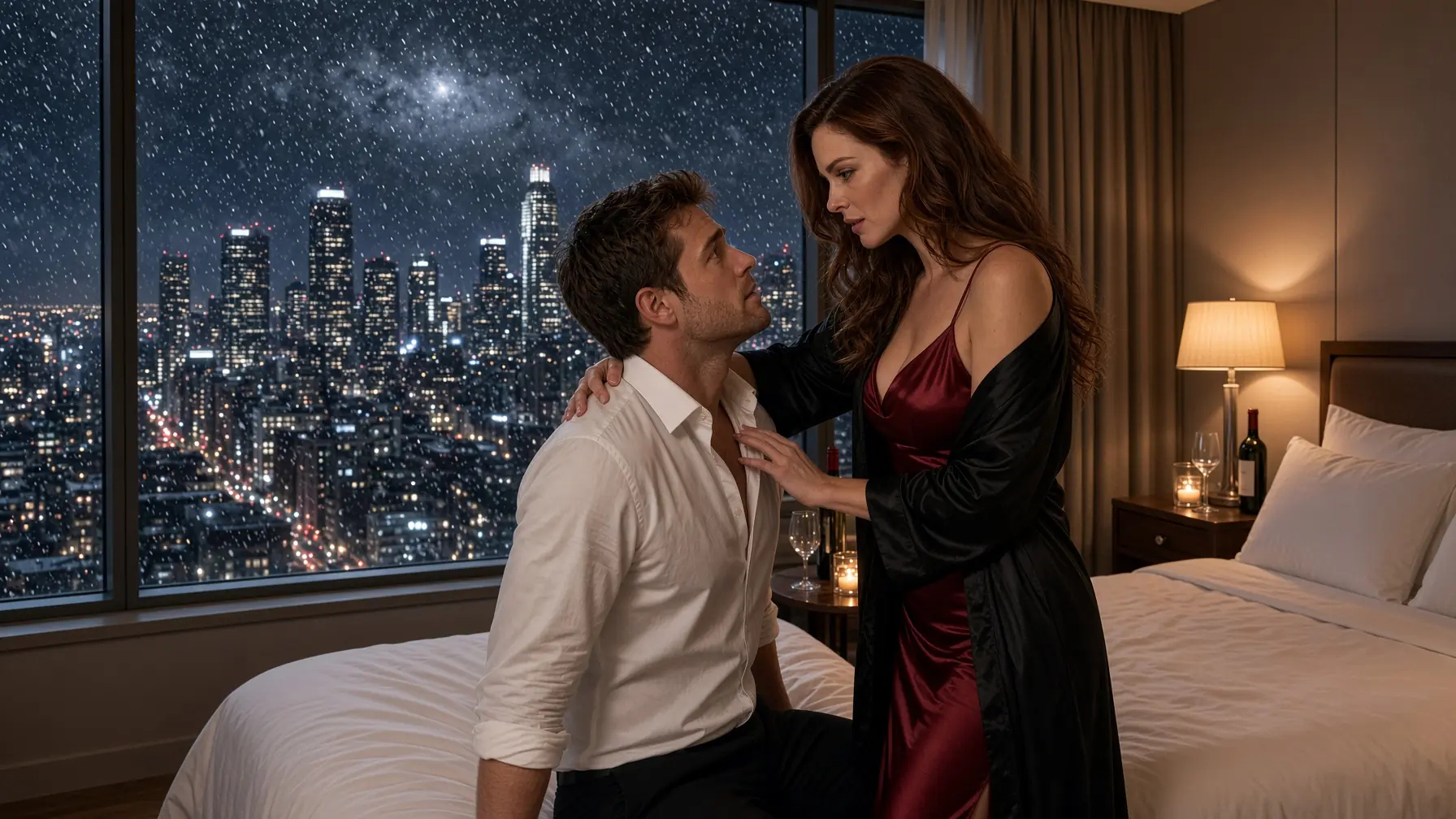
Ryan Foster said it as a joke. He said it in a Tuesday morning meeting in front of six colleagues without looking up from his laptop that what Victoria Lane needed was a husband. The table went quiet. He looked up. His boss was staring at him.
Not with anger, with something he couldn't read. He laughed it off. She moved on to the next slide, but 3 weeks later alone in a hotel room in the middle of a blizzard, Victoria Lane looked at him and said very quietly, very clearly then be mine. She wasn't joking. The joke slipped out before Ryan Foster had time to think.
It was a Tuesday, which meant the weekly creative sync at Oakridge Design Studio, which meant 40 minutes of watching Victoria Lane stand at the head of the conference table and make everyone else in the room feel like they were running at half speed. She had the client deck spread across the wall screen. The kind of deck that looked effortless because she'd probably reworked it at 2:00 in the morning, and she was walking through the revised identity concepts for the Halcyon Hotel Group rebrand with this calm, unhurried confidence that Ryan had spent 3 years trying not to pay too much attention to. He was supposed to be tracking the timeline on his laptop. He was, mostly.
But then Marcus from the design team asked in that nervous way he had whenever he was genuinely curious about something he suspected might land wrong, whether Victoria had anyone helping her manage the client communication side of things outside the official account team, because it was a lot, Marcus said. That's a lot for one person, Victoria. Victoria looked at him. Not unkindly. Just with that particular brand of patience she reserved for questions that revealed the asker hadn't quite done the math.
And Ryan, without looking up from his laptop, said what she needs is a husband. The table went quiet. Ryan looked up. Victoria was looking at him. Not with the patient expression she'd just aimed at Marcus.
This one was different. Her head was tilted about 4 degrees to the left, which was a thing she did when she was recalibrating, and there was something around her mouth that was either the beginning of a smile or the beginning of a very controlled response, and he genuinely could not tell which. "To manage communications," Ryan added, and he could hear how that didn't help at all. Marcus made a small sound like a man stepping carefully away from a minor explosion. Victoria's mouth did the thing.
It went smile, not the wide-open kind she gave clients, the narrow, precise one that meant she'd filed something away. "Noted," she said, and moved on to the next slide. The meeting ended 14 minutes later. Ryan spent 11 of those minutes pretending to have opinions about typeface weights. That was 3 weeks ago, and things at Oak Ridge had continued the way they always did, which is to say that Ryan ran point on timelines, budgets, and the particular kind of chaos that followed Victoria whenever she had three concurrent clients and a vision that outpaced the production calendar.
Victoria made things that were genuinely good. Ryan made sure those things actually shipped. They had been doing this for 3 years. In that time, Ryan had learned the following things about Victoria Lane. She took her coffee black until about 2:00 in the afternoon, then switched to tea.
And if you brought her the wrong one at the wrong time, she wouldn't say anything, but you'd know. She edited in silence and presented out loud, which meant if you caught her working quietly on something, you were probably seeing the real version before it was polished for consumption. She had a younger sister in Portland she called on Friday evenings, and you could tell it was the sister because her whole posture changed. She stopped being the creative director and became someone who laughed at things without curating the laugh first. She had been in a serious relationship that ended about 18 months before Ryan joined the studio, and she'd never talked about it directly, but there were architectural details, the way she handled certain kinds of conversations about the future, the way she could be perfectly warm and still maintain about 6 in of structural distance that told him it had cost her something significant.
He had no business knowing any of this. He'd noticed it anyway. Victoria, for her part, knew the following things about Ryan Foster. He was organized in the way that people are organized when they've trained themselves out of a natural inclination toward chaos. The systems were too deliberate, too load-bearing.
He had an ex-fiancée named Dana, which Ryan had mentioned exactly once in the context of explaining why he'd moved from Portland to Seattle 3 years ago, and then never again. And Victoria had understood the shape of that silence immediately because she'd built a few of her own in the years since Marcus. She understood the principle of it. You take the thing that wrecked you. You note its dimensions carefully.
You build your life around its edges. She hadn't realized until much later that Ryan had probably done the same kind of structural analysis on her. They were good at this. At existing in the same professional orbit, close enough to function as a real team, calibrated enough not to cross the line they'd both drawn without discussing it. The problem was the Harmon and Wells pitch.
Harmon and Wells was a mid-size commercial real estate firm in Denver that had decided, in a move their communications director described as bold repositioning, that they wanted to look like a design brand, which meant the pitch needed to be architectural, experiential, and done in a format their board could understand. Which was not, their communications director emphasized, a standard slide deck. Ryan had been running the project for 8 weeks. Victoria had been on the creative side. The pitch was in Denver Friday.
On Thursday afternoon, Ryan's flight was canceled due to weather and rebooked on a direct flight that left from a different airport. And Victoria's flight was delayed by 4 hours, and then, at the gate, canceled outright due to a mechanical issue that became visible to everyone in the terminal when they could see the actual maintenance crew on the tarmac. They ended up on the same rebooked flight, which landed in Denver at 11:47 at night. The hotel had their reservations under different rooms on different floors. What the hotel did not have, it turned out, was either of those rooms.
There had been a system error during a software migration, a phrase the front desk associate delivered with the kind of weary precision that meant he'd said it 30 times that week, and the hotel was overbooked. They had one room available. It was a suite because the suite had been held for a corporate client who'd called to cancel an hour ago, and the hotel would of course discount the rate. And they were deeply sorry for the inconvenience. Ryan looked at Victoria.
Victoria looked at Ryan. Outside the floor-to-ceiling lobby windows, the storm that had scrambled their original flights was now arriving in Denver in its full form, dropping what the weather app was calling significant accumulation and what Ryan was mentally categorizing as a structural problem. "We'll take it," Victoria said, because there was no alternative. The suite was on the 14th floor. It had a living area with a couch that could in theory function as a bed, a king-sized bed in the adjacent room, floor-to-ceiling windows currently demonstrating the full commitment of the storm, and a mini-bar that Ryan noticed immediately and then decided not to mention.
Victoria set her laptop bag on the kitchen counter and looked around the suite in the way she looked at a space she was assessing for functional use. "I'll take the couch," Ryan said. "You're 6-ft 1. The couch is long. " "Ryan, I'm fine on the couch. " Victoria looked at him with the 4° head tilt. "The bed is a king.
It's roughly the size of my actual apartment. We're both adults with a pitch in 9 hours, and I need you functional tomorrow. " She paused. "We can put pillows in the middle if it makes you feel better. " It was such a Victoria thing to say. Practical, slightly dry, delivered with perfect equilibrium. "Sure," Ryan said.
They ordered room service because the hotel restaurant had closed at 11:00, and neither of them had eaten a real meal since noon. It arrived as pasta and a Caesar salad they split without discussing it, because that was also just how they operated. Ryan set up the presentation materials on the suite's work desk, while Victoria ran through her part of the pitch on the couch, speaking quietly but at full pitch pace, the way she did when she was committing something to muscle memory. At some point around 1:00 in the morning, the work wound down the way it naturally did before a big client day. Not because everything was done, but because everything that could be done was.
Ryan was at the window with what was left of his coffee, watching the snow aggregate on the streets below. Behind him, he could hear Victoria closing her laptop. "You know," she said, and there was something slightly different in her voice. Not the pitch voice, not the director voice. The Friday evening voice.