Luke Barrett did not ask me to marry him beneath a flowering tree, beside a river, or anywhere a sensible woman might later describe as romantic.
He asked across the back table of the Red Rock Hotel dining room while rain struck the windows hard enough to make conversation difficult. Between us sat two cups of coffee, a plate neither of us had touched, and a sheet of paper on which Luke had written the monthly expenses of Barrett Ranch as though he were presenting figures to a banker rather than discussing marriage with a woman he had known for six weeks. I remember staring at that page and thinking it was the strangest proposal any woman in Wyoming Territory had probably received that year.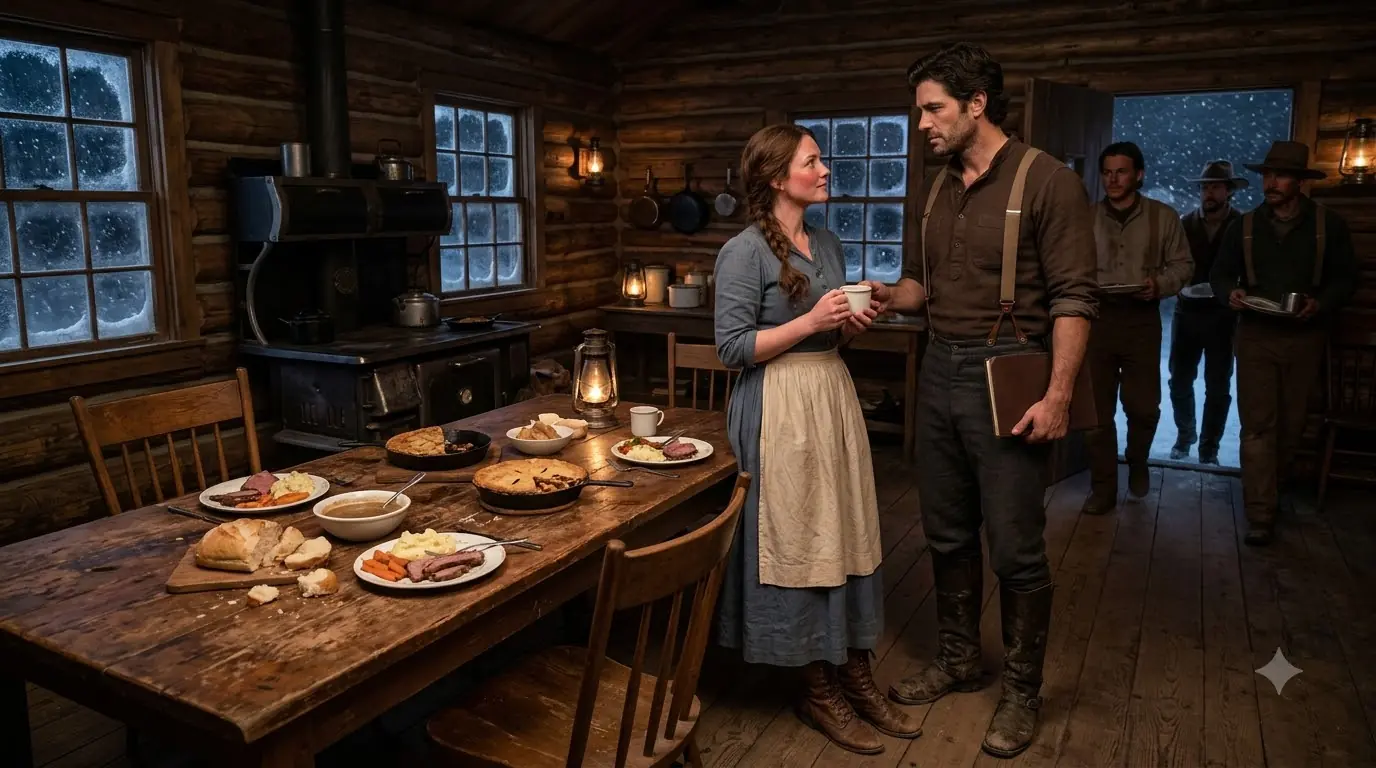
“I need a wife,” he said.
I looked up.
Luke Barrett was thirty-six, tall enough that he seemed uncomfortable beneath most indoor ceilings, broad through the shoulders from fifteen years of cattle work, with dark wavy hair that never stayed combed and serious gray eyes beneath a brow permanently narrowed against sun, snow, wind, or difficult decisions. He was handsome, though he appeared almost offended by the possibility that anyone might notice. He wore a clean dark-brown shirt that evening, but there was still dirt beneath one thumbnail.
“I gathered that,” I said.
Luke frowned.
“You did?”
“You’ve asked me to meet you three Saturdays in a row.”
“That could mean friendship.”
“You bring account books to friendship?”
He looked down at the ledger beside his elbow.
“That’s fair.”
I nearly smiled.
My name was Clara Bennett then.
Twenty-nine years old.
Unmarried.
No children.
I had spent most of my twenties keeping books and cooking at my uncle’s boarding house outside Cheyenne after my parents died within a year of each other. My uncle was not cruel, but he had six children, a wife with bad lungs, and absolutely no financial talent, which meant I became indispensable enough that everyone forgot indispensable women sometimes wanted lives of their own.
Luke had first met me while delivering cattle records to a livestock broker staying at the boarding house.
He found me correcting the broker’s arithmetic.
The broker disliked that.
Luke did not.
Two days later, he returned with another question about feed costs.
Then fencing.
Then wages.
Eventually I understood he was not returning because he enjoyed my uncle’s coffee.
It was terrible coffee.
That rainy evening, Luke pushed the paper toward me.
“Barrett Ranch has four full-time hands.”
“I know.”
“You’ve met Ned.”
“Once.”
“And Frank.”
“He tried to flirt with your horse while I was standing beside it.”
Luke considered.
“That sounds like Frank.”
“What about the other two?”
“Hugh Lancaster and Wesley Crane.”
I nodded.
Luke continued.
“The house needs managing.”
“That phrase makes me nervous.”
“Why?”
“Because men often say managing when they mean doing every miserable task nobody else wants to notice.”
Luke looked genuinely startled.
“That isn’t what I mean.”
“What do you mean?”
He thought carefully before answering.
“I mean I need someone who sees the ranch as a household, not just cattle and acreage.”
That answer was better.
I leaned back.
“And what do I get?”
Luke did not flinch.
“Half interest in household income after ranch expenses.”
I stared.
He continued.
“Your name added to the property account.”
“Personal allowance separate from ranch expenditures.”
“A room of your own if you want one.”
I blinked.
“A room of my own?”
Luke’s face turned slightly red.
“I don’t know what happens after marriage.”
The honesty surprised a laugh out of me.
Luke looked embarrassed.
“That came out wrong.”
“No, it came out honestly.”
He rubbed his jaw.
“I mean I don’t expect…”
He stopped.
I waited.
Luke was a man who could probably drag a steer through mud but apparently could not drag one delicate sentence across a table.
Finally he said:
“I will not treat marriage papers as permission for anything you do not want.”
My smile disappeared.
He looked directly at me.
“Ever.”
The word settled between us.
I had rejected two earlier marriage proposals partly because both men seemed to think a wife was a position already defined before the woman arrived. One wanted children immediately. The other wanted unpaid labor and a respectable woman beside him at church.
Luke wanted something too.
Of course he did.
But at least he was naming it.
“What else?” I asked.
He looked puzzled.
“You told me what you offer.”
“What do you expect from me?”
Luke looked down at the figures.
“Honesty.”
“That sounds easy until someone gives it to you.”
“I know.”
“Work?”
“Yes.”
“How much?”
“Fair share.”
“According to who?”
He looked at me again.
“Both of us.”
That answer mattered more than he understood.
“Anything else?”
Luke hesitated.
“Steadiness.”
I laughed quietly.
“How romantic.”
“I warned you.”
“You actually didn’t.”
“I should have.”
Rain rattled the glass.
I looked at the ranch figures again.
Barrett Ranch was not wealthy, but it was stable.
One hundred eighty head of cattle.
Two hundred forty acres deeded.
Seasonal grazing lease beyond that.
Moderate debt.
Reasonable equipment.
Four experienced employees.
The kind of operation that could become prosperous with discipline or collapse during two bad winters.
Luke knew cattle.
I knew households, books, food, people, and how quickly small waste became large debt.
“What about love?” I asked.
He became very still.
“I won’t promise something I don’t know how to promise.”
That was the least romantic sentence imaginable.
It was also the reason I said yes.
Neither of us would begin by lying.
We married three weeks later.
Small church.
My uncle’s family.
Luke’s ranch hands.
A preacher who looked disappointed that neither bride nor groom cried.
When he told Luke he could kiss the bride, Luke looked at me first.
I nodded.
His kiss was brief.
Warm.
Careful.
I thought about it the entire wagon ride to Barrett Ranch.
I did not tell him.
Barrett Ranch sat in a shallow Wyoming valley surrounded by low ridges and miles of grass already turning brown beneath October cold. The main house stood near a cluster of cottonwoods beside a narrow creek, weathered but solid, with a wide porch, gray shingles, two chimneys, and a barn larger than the house itself.
Luke stopped the wagon.
I looked around.
“This is it.”
His voice sounded strange.
Nervous.
I had never heard Luke Barrett nervous.
“It’s beautiful.”
He looked at me sharply, as though checking whether I meant it.
I did.
Not polished.
Not delicate.
But open.
Space in every direction.
A place that could become something.
Luke lifted my trunk from the wagon.
I reached for one handle.
“I can carry that.”
“I know.”
“Then why are you carrying it alone?”
“Because I’m stronger.”
I stared.
He stopped.
“That sounded worse than I meant.”
“It sounded exactly like you meant.”
“Yes.”
He considered.
“Want one side?”
“Yes.”
We carried the trunk together.
That became our marriage in miniature.
Luke often attempted to take the whole weight.
I frequently made him put half back into my hands.
The house surprised me.
The front room contained sturdy furniture, clean floors, two rifles over the hearth, a faded rug, and absolutely nothing that had been chosen because it was pleasant to look at. No framed pictures beyond a photograph of Luke’s parents. No curtains except rough muslin. No flowers.
The kitchen was worse.
Iron stove.
Heavy table.
Six mismatched chairs.
Shelves containing flour, dried beans, coffee, salt, bacon, onions, potatoes, a jar of molasses, and enough canned tomatoes to suggest Luke once purchased supplies from someone experiencing panic.
I opened a cupboard.
Empty.
Another.
Tin plates.
Another.
Coffee cups.
Luke stood near the doorway.
I looked at him.
“That everything?”
“For now.”
“You said you maintained a household.”
“I said I needed someone who could.”
I laughed.
He looked relieved.
He had expected disappointment.
Instead I rolled up my sleeves.
“I’ll manage.”
Luke carried my trunk upstairs.
I inspected the pantry.
Then the cellar.
Then the smokehouse.
The situation improved considerably once I discovered he actually possessed food.
The men simply did not know what to do with it.
The ranch had beef.
Potatoes.
Carrots.
Onions.
Flour.
Apples from a late-season purchase.
Butter.
Eggs.
Dried herbs someone had abandoned in a cabinet.
By four o’clock, I had formed a plan.
By five, bread was rising.
By six, the entire kitchen smelled different.
I roasted beef slowly with onions.
Mashed potatoes with butter.
Made brown gravy from drippings.
Glazed carrots with a little molasses.
Baked two loaves.
Then looked at the apples.
My mother had taught me pie before she taught me fractions.
That seemed useful now.
The ranch hands arrived at six-thirty.
The first was Wesley Crane, thirty-four, lean, sharp-faced, brown hair already gray at the temples.
He opened the kitchen door.
Stopped.
Behind him, Ned Parker, twenty-four, nearly walked into his back.
“What the hell, Wes?”
Wesley said nothing.
Ned looked around him.
Then he stopped too.
Frank Dobbs, forty, followed.
He sniffed.
“Either I died riding fence, or Barrett finally murdered somebody who could cook.”
Luke entered behind them.
“Frank.”
“What?”
“My wife’s standing six feet away.”
Frank looked at me.
“Mrs. Barrett, I apologize for suggesting your husband committed murder.”
“Thank you.”
“I do not apologize for hoping supper is real.”
I liked him immediately.
Hugh Lancaster arrived last.
Fifty-three.
Gray mustache.
Quiet.
He walked with the faintest stiffness in his right leg.
I noticed because I had spent years watching boarding-house guests hide illnesses they did not want to pay doctors to discuss.
The men gathered around the table.
Nobody sat.
I looked at them.
“What?”
Ned pointed.
“Ma’am…”
He swallowed.
“Is all that for us?”
“For whoever sits down before it gets cold.”
Frank pulled out a chair so quickly it scraped across the floor.
“Boys, you heard the lady.”
They sat.
Luke sat at the head.
I took the opposite end.
At first nobody talked.
Only eating.
Forks.
Plates.
Bread tearing.
Ned closed his eyes after his first bite of potatoes.
Frank poured gravy over nearly everything.
Wesley ate more slowly.
Hugh took a second piece of bread but no second helping of meat.
Interesting.
Luke watched them.
Then looked at me.
“I didn’t know you could cook like this.”
“You never asked.”
Ned laughed.
Luke’s mouth twitched.
Frank pointed his fork toward him.
“She got you there, boss.”
Luke ignored him.
When I served pie, Frank stared at the slice like a man receiving a religious vision.
“This is apple.”
“That is usually what apple pie contains.”
He looked at Ned.
“She’s funny too.”
Ned whispered:
“We can’t lose her.”
Luke heard.
His face turned red.
I laughed.
That night, after the men returned to the bunkhouse, Luke helped me wash dishes.
Badly.
He used too much soap.
Then almost put a cast-iron skillet into the wash basin.
I grabbed it.
“No.”
“What?”
“You do not drown seasoned iron.”
He looked confused.
“It’s a pan.”
“It is history.”
Luke stared.
“You feel strongly about cookware.”
“I have standards.”
“Apparently.”