He Married His Childhood Friend to Save His Title — He Had No Idea She Had Loved Him in Silence for Years

He Married His Childhood Friend to Save His Title — He Had No Idea She Had Loved Him in Silence for Years

Chapter 1: The Necessity of a Secret

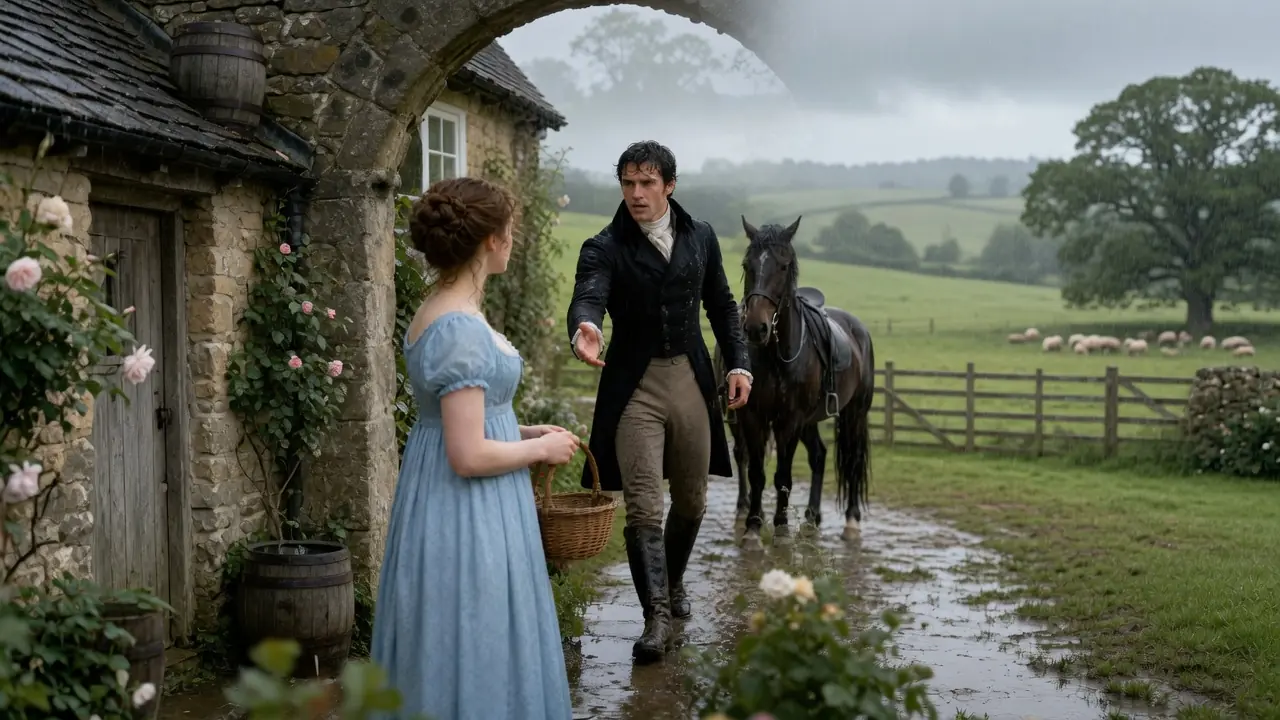
The rain had begun at dawn, a steady, whispering sheet across the rolling acres of Whitby Park. It drummed lightly against the mullioned windows of the library, where Baron Thomas Whitby paced before the fire, jaw tense and gaze fixed on the flames as if answers might emerge between their flickering tongues.


He had always carried duty like a well-fitted coat—a garment tailored from childhood expectations and reinforced by years of responsibility. Whitby Park needed a stable steward. The tenants looked to him, and Parliament—blast Parliament—expected a man of his rank to maintain his holdings in unimpeachable order. He had never once considered failing in any regard, but now failure stalked the edges of his estate in the form of one man: Lord Camden.

Camden was his cousin by an unfortunate accident of blood, a man who had canvassed his way into thinking he deserved Whitby Park by simple proximity. He had recently sent a series of pointed letters suggesting improprieties in the baron's lineage, threatening to contest the inheritance unless Whitby produced a legitimate heir, or at least a wife to prove himself capable of providing one. It was scandalous, insulting, and dangerously persuasive to those restless Parliament men who loved nothing so much as rumor.

The baron paused at the window, resting a hand on the cool glass as he surveyed the storm outside. Marriage! He needed it, and quickly. But not just any woman. This could not be a society debutante hungry for prestige, nor a scheming widow eager to secure his lands. He needed someone trustworthy, someone loyal, someone who would agree to a temporary arrangement—an annulment once Camden relented, leaving them both free.

Only one name rested easily in his mind: Miss Emma Lee.

He exhaled slowly. Emma, his childhood friend. Emma, who had grown up in the neighboring cottage with her father, the late steward. Emma, who had been his most dependable confidante since the age of ten, and whose presence felt as natural as breathing.

He had not seen her in three months, not properly, though she lived but half a mile away. Instead, he had thrown himself into estate matters, certain that distance would make things easier. She had always had a way of softening his sharper edges, of seeing beyond his stoic composure, and lately, looking at her had stirred something he dared not name. Yet she was precisely the kind of woman he needed for this arrangement: someone who understood him, someone he could trust with his life, and someone who—he told himself firmly—he would not hurt by this necessary deception.

Once the danger passed, he would free her. She could marry whomever she pleased. He would ensure she received a generous settlement.

His decision crystallized at last. He summoned his coat, braced himself against the storm, and rode toward Lee Cottage.

***

Emma had always liked the rain. It made the world seem softer, gentler, washed of its harsh edges. In the small parlor of her cottage, she sat threading a needle, mending one of her father's old waistcoats—not because it was needed, but because the familiar motion soothed her. She hummed absentmindedly, her dark lashes lowered over clear gray eyes.

A sharp rap interrupted her. She startled, pricked her finger, and muttered a soft oath unbefitting a lady. When she opened the door, the rain-soaked figure of Baron Whitby filled the frame.

"Thomas," she breathed, surprise blooming into warm pleasure. Her heart, traitor that it was, lifted instantly.

"Emma," he said, with that restrained intensity that always made her pulse flutter. "I must speak with you."

She ushered him inside, fussing for a towel while he unbuttoned his coat. He declined the towel, but accepted the tea she set before him. He did not touch it. Instead, he fixed her with a direct, solemn look.

"Emma, I need your help."

His voice—deep, steady, unwavering—made something inside her go cold and warm all at once.

"Anything," she said softly, and she meant it. She had always meant it.

He hesitated only a moment. "Then I must marry immediately."

Her heart stumbled. "Oh," she said faintly. "I see. And you need help choosing?"

He shook his head once. "No, I have chosen."

Her throat tightened. Of course he had. Some London beauty, no doubt—someone elegant, accomplished, adorned in pearls. "Very well," she managed. "Whom do you—"

"You."

The word fell like a stone into a perfectly still pond. Emma blinked at him once, twice. "Me?"

"Yes."

"But... why?"

He explained: rational, practical, painfully logical. Camden's threat, Parliament's pressure, the need for a wife who would keep his confidence, who understood him, who would agree to a temporary arrangement. An arrangement. Temporary. A marriage in name only, until it was no longer required.

Emma sat very still, the teacup trembling faintly between her hands.

"I would never ask you," he concluded, "if there were another way. I swear, Emma, I would never put you in such a position if it were not absolutely necessary."

She wanted to be strong, reasonable, pragmatic. But the truth she had hidden for years whispered painfully in her chest: she loved him, quietly, completely. And now he was asking her to be his wife, but not his beloved—to marry him only to help him, and later be released.

She swallowed hard. "What would happen afterward?" she asked, her voice low.

"When all is safe, we would annul the marriage," Thomas replied with reassuring firmness. "You would be free to choose your own future."

*Free?* Free from him. Free to marry another man—one who actually wanted her.

Emma forced her hands still. She studied his face: serious, earnest, wholly unaware of the way her soul ached for him. She could refuse. But then she imagined Whitby Park lost to Camden. She imagined Thomas—proud, honorable, burdened with legacy—forced to yield what he cherished. She imagined the regret he would carry.

"Emma," he prompted gently.

Her heart knew its answer before her mind did. "Yes," she whispered. "I will marry you."

He exhaled a soft, relieved sound and reached across the table to take her hands. "Thank you," he said with a sincerity that warmed and shattered her at once. "You are the only person I trust."

She nodded, keeping her smile steady, even as her heart cracked. And so it was settled: they would be married in secret by special license within the week. A marriage without romance, a union without promise, a love—at least on her side—that must remain hidden.


Chapter 2: A Marriage of Convenience

The wedding took place in the Whitby Chapel at dawn, with only the old vicar and Whitby's trusted housekeeper as witnesses. The air smelled of rain-soaked stone. The early light filtered through stained-glass windows in muted colors. Emma wore pale blue, not ivory, and her hands trembled as she held a simple bouquet of wildflowers. Thomas stood tall beside her, solemn and composed, his expression one of gratitude rather than joy. She tried not to let it sting.

The vows were spoken with clarity, though her voice wavered when she said, "I take thee." He spoke his part steadily, his dark gaze fixed on hers, and for a dangerous moment she imagined he might actually feel something. But as soon as the final amen sounded, he stepped back with a polite, respectful bow.

"Thank you, Emma," he said quietly. "I will make this as easy as possible."

It was perhaps the kindest thing he could have said—and the cruelest.

Whitby Park received its new mistress without ceremony. Emma moved into a suite on the east side of the house, a wife's chambers in title, but separate from his. Thomas ensured she lacked for nothing: fresh flowers, warm fires, new gowns ordered from Bath. He dined with her privately for appearances, but rarely stayed long. Yet despite his emotional distance, he was gentle, thoughtful, and always respectful—and that made it infinitely worse.

Emma tried to settle into her new role. She oversaw the house staff, visited tenants, and organized charitable baskets. She knew the estate nearly as well as Thomas; her father had taught her its workings, and she loved the land as dearly as any Whitby. But her new title did not shield her from whispers in the village.

*"Strange, is it not? The baron married so suddenly—barely a gown on her back, and from that cottage, imagine!"*
*"Well, they say she was always underfoot at Whitby Park. Convenient, if nothing else."*

She bore it with dignity, though her cheeks burned more often than she liked.

One afternoon, while walking the terrace, she encountered Mr. Nathan Harrow, a visiting gentleman staying with a neighboring family. He was handsome, light-haired, and charming, with a warm, mischievous smile.

"My lady," he said, offering a bow. "I heard news of your recent marriage. May I offer my congratulations?"

She returned the courtesy. "You may."

"And yet," he continued lightly, "you seem a woman who enjoys conversation. Perhaps we may walk a little. Marriage need not deprive you of company."

His flirtation was clear, though not improper. She declined gently, but he did not give up easily. Over the next few weeks, Mr. Harrow appeared often: once at the tenant school Emma visited, another time at a village fête, and once on horseback near the river where she had paused to sketch the old stone bridge. He praised her kindness, admired her intelligence, and asked after her days. It was wrong to enjoy the attention, but she had been lonely.

And Thomas noticed. The baron, normally inscrutable, had grown increasingly tense. He watched her at dinner with unusual scrutiny. He interrupted conversations between Emma and Harrow with a rigid politeness that barely concealed irritation.

One evening, he confronted her as she prepared to retire. "Emma," he said abruptly. "You have spent a considerable amount of time with Mr. Harrow."

She froze. "We meet by chance," she replied honestly. "He is a neighbor."

Thomas's jaw tightened. "He is also a man known for seeking affection wherever he finds it."

"I assure you," Emma said evenly, "I have given him no reason to imagine such affection."

Thomas stared at her for a long, unreadable moment. "See that you do not," he said at last.

She felt heat rise in her cheeks, not from guilt, but from hurt pride. "Because it would reflect poorly on you?" she asked quietly.

"Because you are my wife," he answered, more sharply than intended. The words struck her like a blow and warmed her unexpectedly. But then he continued, "And because if Camden suspects discord between us, he will use it to undermine our marriage. We cannot afford impropriety."

Her brief flicker of hope extinguished instantly. Of course. Always duty, always practicality, never desire, never love.


Chapter 3: Secrets of the Heart

Weeks passed, and Emma's interactions with Mr. Harrow became the subject of increasing speculation. Though she remained entirely proper, village gossip saw opportunity; and Thomas, who had intended their marriage to be temporary, found himself restless, irritable, and inexplicably possessive.

One night, returning late from estate meetings, he saw candlelight beneath Emma's parlor door. He hesitated, then knocked.

"Come in," she called softly.

She sat on a small sofa, a book open on her lap. Her hair was down, loosely braided, and her feet were tucked beneath her. She looked soft, lovely, entirely unguarded.

"Thomas," she said in surprise. "I did not expect you."

He closed the door behind him. It clicked softly, the sound echoing in the quiet room. "I wish to speak with you."

She waited. He struggled; it felt strange and unsettling how difficult it was to voice words that weren't strictly practical. He had built walls for years, but standing here now, they felt cumbersome.

"Emma, is this arrangement too difficult for you?" he asked.

She blinked. "Difficult?"

"You seem unhappy."

Her gaze dropped. "I am adjusting."

"To being my wife?" His voice thickened unexpectedly.

"To being your *temporary* wife," she corrected.

The pain behind her simple words hit him squarely, harder than he expected. He sat opposite her, palms braced on his knees. "Emma," he said slowly, "I never wish to hurt you. You must know that."

"I do," she whispered. "But intention does not always protect against effect."

His breath caught. Silence stretched as the fire crackled softly. At last, she spoke again, quietly, but with aching honesty.

"You asked me to marry you because you trusted me. Because I would cause no complications. Because I asked for nothing."

Thomas felt something twist inside him. "Emma—"

"You never considered," she continued gently, bravely, "that I might have feelings."

He stared at her.

Her cheeks flushed, but she lifted her chin. "Not improper feelings," she said, "but affection, loyalty—a tenderness I have carried for years. I never expected anything in return, Thomas. Never. But when you asked me to enter a marriage that would end as soon as it began, it required that I give everything while expecting nothing."

He swallowed hard.

Her voice softened. "I accepted because I wanted to help you. But I am only human."

The room felt utterly silent. Thomas felt as though his entire chest had been torn open. He had always known Emma was loyal, dear, indispensable. But he had been too careful, too fearful to consider what lay beneath. Now he saw it clearly—saw *her* clearly. Not just a friend, not just an ally, but a woman: warm, devoted, strong; a woman he had needed for years without realizing, and whom he might now lose.

"Emma," he whispered. "Do you still feel affection?"

Her breath caught. "Thomas, please do not ask what you do not wish answered."

"I *do* wish it," he said, low and rough. "More than you know."

Their eyes held, unshielded at last.

A soft knock shattered the moment. Emma startled; Thomas stiffened.

"Forgive me," he murmured. "I will see who it is."

He opened the door to find a footman carrying an envelope sealed with dark red wax. "From London, my lord. Marked urgent."

Camden's seal. Thomas broke it at once, and the letter inside made his blood freeze. Camden, it seemed, had heard rumors of Emma's frequent association with a certain neighboring gentleman. He suggested, with thinly veiled malice, that a petition for annulment might be justified given such impropriety.

Thomas crushed the letter in his fist.

Emma looked at him, alarmed. "What is it?"

"He dares," Thomas snarled. "He dares to attack you now!"

"Me?"

"He means to claim you have been inattentive to your vows," Thomas said stiffly, her face draining of color.

"But that is not true," she whispered.

"I know," his voice was like steel. "And I will not allow him to shame you." He stepped closer, passion and fury blazing through his restraint. "Emma," he said fiercely, "this marriage will not be annulled."

She stared, breathless. "What? What do you mean?"

Thomas reached for her hands as though compelled. "I mean," he said, his voice low and trembling with feeling, "that I cannot let you go."

Emotion surged in her eyes. "Thomas..."

He lifted her hands to his lips. "I need you," he whispered. "Not for propriety, not for protection, but because I cannot imagine this house, this life, without you in it."

Her heart thundered. "Are you saying—"

"Yes," he answered, a fervent vow. "Emma, I love you."

She gasped, tears sparkling.

"I have been a fool," he continued. "Blind, cautious, and afraid. But no longer. If you will have me, if you can forgive me, let this marriage be real."

A tear slipped down her cheek. "Yes," she whispered. "Yes, Thomas. I want nothing more."

He pulled her gently into his arms. The kiss—soft, reverent—felt like destiny finally claiming them both.


Chapter 4: The Baron's True Bride

Their reconciliation changed everything. Emma moved to the West Wing. Their dinners became intimate, lingering; their walks shifted from polite to playful. Thomas learned to laugh again—a rare sound before, now made richer by the knowledge that she loved him. And Emma blossomed, carrying herself with quiet radiance—no longer merely the baron's temporary wife, but the woman he cherished openly.

But the outside world was not yet satisfied. Camden arrived one afternoon, a smug smile plastered across his face.

"Nephew," he said, strolling into the drawing room uninvited. "I've come to discuss the matter of your questionable marriage."

Thomas stood behind Emma's chair, his expression chilling. "My marriage," he said coldly, "is beyond your reach."

Camden sniffed. "So you claim. Yet rumors abound regarding the Baroness's emotional connection to Mr. Harrow. One might question whether the union was ever—"

"It is real," Thomas said flatly. "And permanent."

Camden sneered. "A convenient declaration."

Emma rose, calm and composed. "Lord Camden," she said with impeccable poise, "I assure you, your accusations are false. I have behaved with full propriety."

Camden waved a hand. "Your word means little."

Thomas stepped forward, fury simmering. "Then take mine." He reached for Emma's hand—a gesture intimate and unmistakable. "I love my wife," he said clearly. "Your attempt to slander her is an insult I will not tolerate."

Emma's breath trembled. Camden stared between them, thrown off balance by the genuine affection in their posture and the unmistakable tenderness between them. It silenced him in a way no legal document ever could. He blustered a few more half-hearted threats, but his power had dissolved. He left in defeat.

When the door closed, Emma released a slow exhale.

"It is over," Thomas murmured, slipping his arms around her waist. "He cannot touch us now."

She leaned against him. "We stood together."

"Always," he promised, brushing a kiss along her temple. "Emma Whitby," he whispered. "My wife in every way that matters."

She turned to him, eyes luminous. "And you, Thomas—my heart's only home."


Epilogue: A Love No Longer Secret

Six months later, Whitby Park burst with summer bloom. Roses lined the garden paths, the lake shimmered under a brilliant sky, and the tenants gathered for a celebration of the baron's restored legacy.

Emma, now a confident baroness, stood at Thomas's side as they greeted well-wishers. The villagers adored her; the gentry, once doubtful, now admired her grace. And Thomas, once reserved and guarded, rarely let her stray far from his touch.

Late in the afternoon, he guided her to a secluded garden bench beneath the elm tree where they had played as children.

"Emma," he murmured, taking her hands. "You saved this estate. But more than that, you saved me."

She smiled softly. "All I ever wanted was your heart."

"And now," he whispered, pressing a kiss to her knuckles, "it is yours entirely."

As the sun dipped over Whitby Park, gilding the world in gold, the baron and his once-secret bride sat entwined—no longer bound by necessity or deception, but by a love that had grown in silence, endured through trials, and finally bloomed in truth. A marriage once meant to be undone had become the deepest vow of their lives.

Tags:

News in the same category

News Post