A quiet younger sister is sent to the altar after her dazzling elder sister steps aside and every guest believes the Duke has accepted a lesser bride out of pride. Honora Thistleby expects duty, pity, and a life spent in another woman's shadow. But when a cruel remark turns her wedding breakfast into a public humiliation, the Duke of Caldermere makes one choice no one in London expected. And Honora must discover whether his protection can become something far more dangerous to hope for.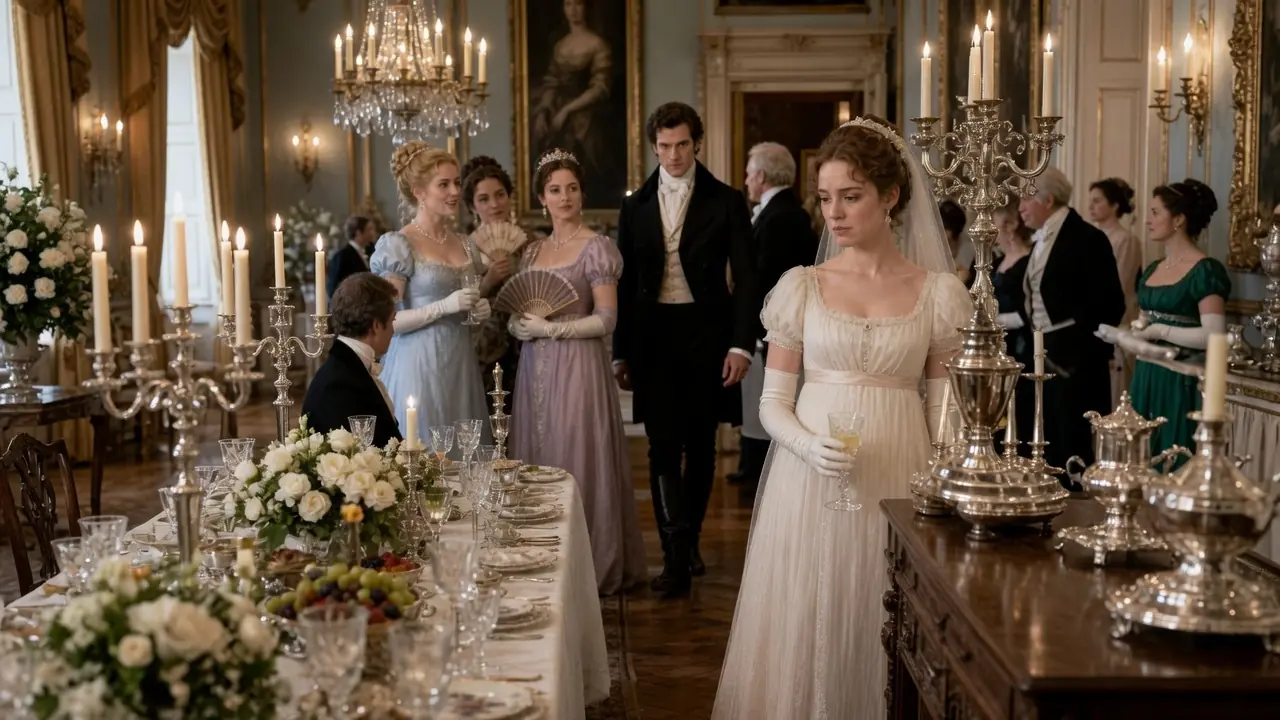
Honora Thistleby had never imagined a bridal gown could feel so much like borrowed clothing. It was not that the gown was plain. The muslin was fine. The sleeves were carefully gathered and the narrow satin ribbon at the waist had been tied twice by her mother's impatient fingers before it satisfied the mirror.
Yet everything about it seemed arranged to suggest that Honora had stepped into a place prepared for another woman. The room still held traces of Sidonie's discarded triumph. Pale gloves on the dressing table, a rejected ribbon, the bright scent of orange blossom that had always suited her elder sister better. Below stairs, the Mayfair townhouse was already filling with guests who had come to see how gracefully a family could recover from embarrassment.
They would not say it so plainly. Society rarely did, but Honora knew the shape of their interest. Sidonie had been expected to marry Gideon Valehurst, Duke of Caldermere, until she decided that a livelier future might be found elsewhere. A marquess with laughing eyes and a taste for late suppers had turned her head enough to make the Duke's formal courtship appear dull.
The Thistlebys were not wealthy enough to offend a Duke without consequence. Nor were they important enough to survive ridicule without repair. So Honora had been placed where Sidonie had stepped away. Mrs. Thistleby moved behind her, adjusting the veil with a sharpness that passed for care.
She had spent the morning speaking of gratitude, prudence, and the necessity of keeping one's expectations modest. Honora had listened without argument. She had learned long ago that argument only invited others to speak more fully what they already believed. Sidonie stood near the window, lovely and pale blue, watching the street as if the wedding were a diversion arranged for her amusement.
She was not cruel in any coarse way. Her cruelty had polish. It wore kid gloves, chose graceful words, and left no mark anyone else could properly condemn. "You must not look so solemn, Honora," Sidonie said.
"A duchess should at least appear pleased, even if the circumstances are not ideal." Mrs. Thistleby turned at once. "Your sister means only that composure is essential. His grace has behaved with great honor. You must do the same." Honora looked at herself in the glass.
Her brown hair had been arranged simply, without the clever curls that framed Sidonie's face so naturally. Her features were pleasant enough, she supposed, but no one had ever paused over them. She was not the daughter who entered rooms and changed their temperature. She was the one sent to fetch shawls, remember names, smooth over discomfort, and accept what remained after Sidonie had chosen.
"I understand," Honora said. That was all. Not because there was nothing else within her, but because she would not offer her heart for inspection. She drew on her gloves and smoothed each finger until the fabric lay neat and white.
If the room below was waiting to see whether she would look ashamed, then it would have to wait in vain. When she reached the landing, the murmur from below softened. Honora heard the change at once. It was not silence, not exactly.
It was a drawing in of curiosity, the polite attention of people who would never admit they had gathered around a wound. Then the front door opened, and a deeper stillness followed. Gideon Valehurst had arrived. Honora had seen the Duke only a handful of times before the arrangement was settled.
Always in rooms where Sidonie had drawn the light. He was 31, tall, and grave in a manner that made even older men choose their words more carefully. He did not possess the easy charm that won assembly rooms in an evening. His consequence was quieter and more difficult to challenge.
It rested in the straightness of his posture, the restraint of his expression, and the sense that he had learned to let silence serve him better than display. At the chapel, Honora stood beside him beneath a pale wash of morning light. She could feel the weight of every guest behind her. Her mother's hope, Sidonie's curiosity, society's appetite for the answer to one question.
Had the Duke accepted the lesser bargain with resentment or merely with pride? Gideon gave none of them the satisfaction of visible disappointment. When Honora reached the altar, his attention did not stray toward Sidonie. He looked at Honora with a steadiness that almost unsettled her more than displeasure would have done.
Honora spoke when required, clearly enough that no one could accuse her of faltering. Yet as she placed her gloved hand where she was instructed, a small unsteadiness betrayed her. Gideon's hand closed lightly around hers. The gesture lasted no longer than it needed to.
There was no flourish in it, no performance for the room. He simply steadied her, then released the pressure enough that she might stand by her own strength. Honora kept her gaze forward, but she felt the difference. A man ashamed of his bride did not need to be gentle when no one else could see.
When the vows were done and they turned from the altar, he offered his arm without hesitation. Honora placed her hand upon it. For one brief walk down the aisle, she was aware not of Sidonie, nor of her mother, nor of the guests measuring every inch of her composure. She was aware of the Duke's sleeve beneath her fingers and the controlled warmth of the man beside her.
Hope was a dangerous thing. Honora knew better than to trust it. Still, it entered quietly, like light beneath a closed door. The wedding breakfast was arranged in the Thistleby's dining room, where polished silver and white flowers attempted to lend grandeur to a table that had hosted too many anxious economies.
Guests came forward with congratulations. Some addressed Gideon first. Some spoke warmly to Mrs. Thistleby. Several turned toward Sidonie as if she, rather than Honora, remained the day's central figure.
Honora received their civility with the calm she had promised herself. She accepted compliments that did not quite meet her face and smiled at remarks carefully designed to avoid the word substitute. Gideon was drawn aside by an older gentleman who wished to discuss a mutual acquaintance. Honora found herself near the sideboard, momentarily apart from the room's safer circles.
She reached for a glass of lemonade, more for occupation than thirst. Sidonie stood only a few paces away with two young married ladies and Lady Marcella Vane, a fashionable woman with a composed face and a gown of excellent taste. Sidonie's voice was low, meant to travel only far enough to wound without seeming to strike. "He married the lesser sister." The words were followed by the smallest stir of amusement, not laughter loud enough to condemn, only the delicate movement of people enjoying a cruelty they could pretend not to have heard.
Honora's hand tightened around the glass. The lemonade inside shifted, catching the light. She set it down before any sign of disturbance could betray her. A sensible woman would move away.
A grateful bride would pretend ignorance. The lesser sister would make herself smaller because that was what everyone expected of her. She had just turned toward the doorway when the room changed again. Gideon had heard enough.
He did not stride or display anger. He crossed the dining room with such controlled purpose that conversation thinned before him. Honora looked up as he approached, already preparing herself for the embarrassment of being rescued in public, but he did not speak over her at once. He offered his arm as he had at the chapel and waited.
The choice was small, but it was hers. Honora placed her hand on his sleeve. Gideon led her to the place beside him at the head of the table, the place that had been left uncertain while guests arranged themselves according to curiosity rather than respect. He seated her there with calm precision.
Only then did he address the room. "I did not marry a lesser woman," he said. "I married the only woman present who has never mistaken attention for worth." No one moved. The words were not loud, yet they reached every corner of the dining room.
Honora felt them settle where Sidonie's insult had struck. She did not look at her sister. If she did, the fragile discipline holding her upright might become too visible. Gideon took his seat beside her as if nothing improper had occurred, as if he had merely corrected an error in the order of service.
The guests followed his lead because people always followed a duke when he made dignity fashionable. Lady Marcella lowered her gaze to her plate. Mrs. Thistleby began speaking too quickly about the excellence of the fruit. Sidonie's smile remained in place, but something within it had hardened.
Then the first guest addressed Honora as "Your Grace" with care rather than convenience. The title felt unfamiliar. It did not yet feel like belonging, but it no longer sounded like a jest. That evening, Caldermere House received her with a quiet grandness that seemed to belong to another life.
The entrance hall was broad and pale, the staircase sweeping upward with a dignity that did not need ornament. Servants moved with practiced discretion, taking cloaks, carrying trunks, and opening doors. Honora thanked them softly, aware that they studied her with the same curiosity everyone else had carried through the day. Gideon gave instructions for her comfort, brief and considerate, then left her in the care of the housekeeper.
There was no coldness in his departure. Yet, after the long strain of being watched, Honora felt the distance keenly. She was Duchess of Caldermere now, but she did not know which rooms were hers. She did not know which customs might be altered or what place a quiet bride could claim in a house built by generations of certainty.
Later, when the lamps had been lit and the house settled into evening, she found the music room. It was not the largest room at Caldermere House, but it drew her at once. The pianoforte stood near tall windows darkened by the hour. A few chairs had been arranged with formal neatness as if the room had been waiting for use but not expectation.
Honora crossed to the instrument and touched the closed lid. As a girl, she had played when no one required brilliance from her. Music had been one of the few places where she could feel without imposing feeling upon anyone else. Sidonie had performed when guests asked.
Honora had played after they left. She sat and began a melody she had known for years. It was simple, tender, and unadorned. Not the kind of piece chosen to impress a room, but one that seemed to remember sorrow without surrendering to it.
The notes filled the quiet space gently. Honora did not have to arrange her face while she played. When the final phrase faded, she became aware that she was not alone. Gideon stood at the doorway.
He had not interrupted and there was something in his stillness that made Honora rise too quickly. Though she managed not to apologize. "I hope I did not disturb you, Your Grace." She said. "No." He replied.
"The house has been too quiet for years." It was not praise in the ordinary sense. There was no flattering excess, no polite claim that she played beautifully. Yet the words reached Honora more deeply than compliments might have done. He had not heard a performance.
He had heard an absence answered. She closed the pianoforte with care. I did not know whether the room was used. It may be used whenever you wish.
The permission was simple, but it held more than courtesy. Honora looked around the music room again. The polished instrument, the waiting chairs, the open space where sound could gather. She had expected a chamber assigned to her out of duty.
Instead, Gideon had offered her a place within the house that might carry her own voice. He remained by the door, respectful of the distance between them. Honora understood then that the day had not ended with certainty. His public defense had given her dignity, not answers.
His kindness had opened a door, not a promise. Beyond that door lay consequence, expectation, and the dangerous question of whether honor could ever grow into love. Still, as Gideon inclined his head and left her with the quiet instrument, Honora rested her fingers once more on the polished wood. For that evening, it was enough to know she had not been asked to disappear.
By the next afternoon, the story of the wedding breakfast had already begun to change hands. In Lady Bellweather's drawing-room, where pale green silk covered the walls and every chair seemed designed for the preservation of rank, Sidonie accepted tea with the air of a young woman injured by her own generosity. She did not raise her voice. She did not need to.
The women around her had gathered close enough to hear the careful pauses between her words. In London, those pauses often carried more force than accusation. Sidonie allowed it to be understood that the Duke of Caldermere had acted with admirable honor, but perhaps too much pride. She suggested with a graceful lowering of her lashes, that a man of such consequence could hardly permit the room to pity his bride, even if the arrangement had not been his first expectation.
She never said Honora was unwanted. She only placed the idea gently into the room and let others admire how delicately it had been done. Lady Marcella Vane listened from the settee near the hearth. She was not a beauty in Sidonie's bright way, but she had the kind of composed elegance that drawing-rooms trusted.
When one of the ladies wondered whether a duke might regret a quiet wife after the first impulse of chivalry had passed, Marcella did not agree. She merely smiled with the mildness of a woman who had no reason to hurry. By the time the tea tray was removed, Honora's public elevation had been turned into something less certain. Perhaps the duke had defended her because he was honorable.
Perhaps she had been stung by Sidonie's withdrawal and refused to appear slighted. Perhaps the new Duchess of Caldermere was fortunate, but not loved. Before the visit ended, an invitation arrived for an assembly two evenings hence. Sidonie read the guest list with a sweetness that did not reach her eyes.
The Duke and Duchess of Caldermere had been invited. So had Lady Marcella Vane. Honora knew nothing of the drawing-room conversation when the invitation arrived at Caldermere House. She saw only the neat card, the familiar names, and the first formal test of her new place.
It was one thing to be defended at a wedding breakfast, where insult had forced the duke's hand. It was another to enter an assembly as his wife and discover whether his courtesy would endure under calmer observation. On the evening of the assembly, Caldermere House moved with quiet efficiency around her.
Her maid arranged her hair with white pins and fastened a gown of soft pearl silk. It had been chosen from the garments hurriedly prepared for her new position. Honora stood before the glass and searched for the woman society would expect to see. A duchess should have looked certain.
Honora looked composed, which was not the same thing. Gideon waited at the foot of the staircase. He wore evening black with the ease of a man who had never needed ornament to be noticed. When Honora descended, his gaze lifted to her face first, not to the gown, not to the pearls at her throat.
It was a small distinction, but she felt it. In the carriage, he did not fill the silence with forced reassurance. He spoke only of the evening's host, the likely crowd, and the shortest path through the assembly rooms, should she grow tired of attention. Honora might have mistaken such practicality for distance once.
Now she wondered whether it was his way of making the room less formidable before she entered it. The assembly was already bright with lamps and movement when they arrived. Conversation shifted as their names were announced. Honora felt the change pass across the room like a ribbon drawn tight.
She saw Sidonie near a column, luminous in blue again, and Lady Marcella beside her in lavender. Both were surrounded by an arrangement of admirers and matrons. For the first quarter hour, civility performed its duties. Ladies congratulated Honora.
Gentlemen bowed. Sidonie came forward with affection polished smooth enough for public use and kissed Honora's cheek. Marcella offered a compliment on the pearl silk, and Honora accepted it without searching for a barb that might not have been there. Then the first set was called.
Sidonie moved almost imperceptibly, yet the room seemed to obey. Marcella found herself placed where Gideon could not fail to see her. She stood poised, elegant, perfectly suited to the sort of first dance that would reassure society a duke still preferred what society admired. Honora prepared herself to remain still.
She would not resent what had not been promised. She would not mistake public kindness for devotion. Gideon crossed the space between them without looking toward Marcella. "Will you dance with me, Duchess?" The title, spoken by him, had none of the stiffness it carried from others.
Honora placed her hand in his. "Yes, Your Grace." The dance began with measured formality, yet Gideon guided her with such attentive steadiness that the watching room receded by degrees. He did not hold her too closely, nor did he treat her as fragile. When the pattern brought them near a cluster of guests whose interest had become too open, he adjusted their turn with skillful ease, placing himself between Honora and the worst of the staring.
"You dislike being arranged where people may examine you," he said quietly. Honora looked at him with more surprise than she intended. "I did not know it showed." "It did not." The answer unsettled her because it was not flattery. He had noticed what others had missed, and he had acted without making her gratitude part of the display.
When the dance ended, he did not abandon her to the edge of the room. He offered his arm again as if the arrangement required no announcement. Sidonie's smile remained intact from across the assembly. Marcella's expression altered only enough to prove she had understood.
Honora, still warm from the dance and careful not to give warmth a reckless name, allowed herself one clear thought. The Duke had not chosen her only when insult demanded it. He had chosen her when everyone watched to see whether he would not. The next morning at Caldermere House, the world seemed less threatening in daylight.
The morning room looked east over a narrow garden, and Honora sat with household books closed before her. Not from disinterest, but uncertainty. She had been Duchess for only days. Every object in the house appeared to have belonged somewhere long before she arrived.
The housekeeper entered to discuss flowers for a small dinner Gideon wished to host. She began by explaining what had been customary in the late Duchess's time, which vases were used, and which arrangements suited the dining room. Honora listened, ready to approve whatever had always been done. Gideon entered during the explanation.
He did not interrupt, but he heard enough. When the housekeeper looked to him for confirmation, he turned instead to Honora. "What would you choose?" The question should not have troubled her. It was only flowers.
Yet, Honora felt the old habit rise. The instinct to step aside before preference could be judged inconvenient. She glanced toward the garden, where pale blooms lifted among darker leaves. "White camellias," she said at last.
"If they may be had." "They may," Gideon answered. No one praised her choice extravagantly. The housekeeper made a note. Gideon moved on to another matter, and the room continued as if a Duchess selecting flowers were the most natural thing in England.
That, more than celebration, touched Honora. She had not been indulged. She had been obeyed. That evening, as servants carried silver and glass through the dining room, Honora saw a single white camellia fastened at Gideon's coat.
He was speaking to an older guest and did not notice her notice him. The flower was small against the dark cloth, but it held her attention with unreasonable force. He might have worn it because it suited the dinner. He might have chosen it because she had chosen it first.
Honora did not permit herself to decide which answer she preferred. The dinner passed without drama, and perhaps for that reason it lingered in her mind. Gideon asked her opinion twice and waited for it. He spoke of her to guests as if she belonged beside him, not as if he were explaining why she had been placed there.
When conversation turned toward a charitable concert, he did not press her to display musical skill. He merely looked once toward her hands and then away, preserving something private. Later, after the guests had departed, Honora found herself once more near the music room. The house had grown quieter, but it no longer seemed quite empty.
She opened the door and saw Gideon standing inside, not at the pianoforte, but near the windows where the last lavender light of evening lay across the floor. "I did not mean to trespass upon your solitude," he said. "It is your house." He turned from the window. "It is yours as well." The words were simple.
Honora had heard similar courtesies from people who meant very little by them. Yet, Gideon's manner gave them weight, as though he understood that belonging was not achieved by marriage lines and household keys alone. She moved toward the pianoforte, but did not sit. The melody from the first night seemed too intimate now that she knew he remembered it.
After a pause, he said, "Would you play the piece I heard before?" Honora rested her fingers against the polished wood. "It is not a fashionable piece." "I did not ask for a fashionable one." She sat then, because refusal would have made the music more revealing than consent.
The first notes came softly. As she played, she felt the difference between performing and allowing someone to hear. There was no room full of guests to please, no sister against whom to be measured. There was only the instrument, the fading light, and the man who had asked without demanding.
When the final note dissolved, Gideon remained quiet for several moments. Honora did not disturb him. The silence was not empty this time. "My mother played in this room," he said at last.
"After she died, my father kept the house correct, respectable, and almost entirely without music. I think I learned too young that peace and happiness were not always the same thing." Honora turned slightly on the bench. His face had not softened into open sorrow, but something guarded had lowered enough for her to see the shape of it.
He had not spoken to be pitied. That made the admission feel more precious. "I am sorry," she said. He looked at the pianoforte rather than at her.
"I have been pursued often enough for Caldermere, less often for anything quieter." There was no bitterness in the words, only fatigue. Honora understood then that Gideon's restraint was not coldness alone. It was a defense built by years of being admired for everything except the part of him that might have needed gentleness.
"You chose a very quiet wife," she said with more courage than she felt. His attention returned to her. "No," he said. "I chose a woman whose courage tries not to be heard."
The words moved through her more deeply than any compliment to beauty might have done. Honora lowered her gaze to the keys, not from shame, but because she needed a moment to keep the feeling within bounds. She did not mistake the exchange for love. She was not so foolish.
But it was recognition, and recognition could become dangerous when it came from the one person whose opinion had begun to matter. The days that followed brought a gentler rhythm, though not a secure one.
Invitations arrived. Calls were paid and returned. Society took careful note of whether the Duke appeared attentive, whether the Duchess appeared comfortable, and whether Sidonie Thistleby's brightness dimmed in the presence of her sister's new rank. At a dinner hosted at Caldermere House, Sidonie began her next effort with more subtlety.
She came on her mother's arm, kissed Honora, complimented the camellias, and praised the house with just enough warmth to remind everyone that she had once expected to belong to something like it. Lady Marcella was present as well, composed and skillful at the table. She spoke of concerts, assemblies, and the newest Italian songs with ease that made several guests turn toward her approvingly. Honora listened without resentment.
Marcella had done nothing unkind. Yet Sidonie's arrangement of the conversation was clear. She wanted the room to compare polish with quietness, and decide that the Duke's public loyalty had been noble but misplaced. When music was mentioned, Honora felt the table's attention shift.
She could almost sense Sidonie's satisfaction. Lady Marcella spoke pleasantly of a difficult piece she had performed at a recent gathering. Mrs. Thistleby praised it at once, then turned to Honora with maternal brightness. Others began to speak over one another, filling the moment with the expectation that Honora would either retreat or be rescued.
Gideon did neither. He looked to Honora and waited. The waiting made space around her. Honora set down her glass.
"I have never thought music happiest when it is difficult," she said. "I like it best when it remembers something one cannot conveniently say." The table grew quiet, not with discomfort, but with attention of a different kind. Gideon's expression did not change greatly, yet approval rested in his stillness. He had not supplied her answer.
He had trusted her to possess one. "That is very prettily said," Sidonie replied after a moment, too sweetly. "Then we must all hear you play at Lady Bellweather's country music hall next week. Such feeling should not be hidden at Caldermere." Honora understood the trap before the sentence ended.
A private melody, once placed before a room, could be turned into evidence. If she played modestly, she would be pitied. If she played well, she would be compared. If she refused, she would appear afraid.
Gideon's gaze moved to her, and this time there was a question in it. He would refuse for her if she wished. She knew it with a certainty that warmed and troubled her at once. Honora lifted her chin slightly.
"If Lady Bellweather asks it, I shall not be discourteous." Sidonie's smile widened. She had expected agreement. She had not expected composure. The country house stood in Surrey, set among lawns clipped into obedience, and old trees that made even new gossip seem ancient by association.
Lady Bellweather welcomed her guests with practiced enthusiasm, placing every person where consequence, curiosity, and ambition might best amuse one another. By the time Honora and Gideon arrived, the story of their marriage had traveled ahead of them in several forms. Some guests treated Honora with marked respect. Others watched her as if waiting for the flaw Sidonie had promised them.
Lady Marcella behaved with unfailing courtesy, though she was often placed near Gideon in ways too convenient to be accidental. Gideon responded with civility, never warmth enough to encourage speculation, never rudeness enough to feed it. Honora tried to trust what she had seen in him, the dance, the camellia, the music room. His words about courage, yet trust, once raised in the shadow of comparison, did not grow straight.
It bent toward doubt whenever society breathed upon it. On the second evening, after dinner, Honora left the drawing room by a side corridor to gather herself before the musicale. The lamps there were fewer, and from the conservatory ahead came the cool scent of damp earth and orange trees. She paused near the open doorway when she heard her name spoken by guests just beyond the palms.
They were not cruel in the manner of Sidonie's first words. That might have been easier to resist. They were thoughtful, speculative, almost sympathetic. "The Duke was honorable," they agreed.
"He had behaved beautifully after the awkwardness with Miss Sidonie. A proud man might well devote himself to proving that he had not been slighted. The new Duchess was fortunate, certainly. Whether she was beloved was another matter." Honora stood very still across the conservatory.
Visible between glossy leaves, Gideon spoke with Lady Marcella. Their conversation appeared formal. There was nothing in his posture to accuse, yet the sight landed upon the bruise already made by the guests' words. For a few moments, Honora could not separate courtesy from preference or restraint from distance.
Sidonie emerged from the shadowed side of the corridor as though she had been placed there by the house itself. Her expression held concern arranged too carefully to be kind. You must not mind them. She said, "People always wonder about marriages made in haste.
His grace has given you dignity, Honora. A sensible woman would be grateful for so much." Honora looked at her sister and the old answer rose easily. "I understand." It had served her for years. It would end the exchange.
It would make her small enough to pass by without further injury. But she did not say it. Instead, she inclined her head with calm precision. "I am grateful for dignity.
I am not certain it is all a wife may hope for." Sidonia's face altered only slightly. It was the first time Honora had seen her sister surprised by resistance that did not raise its voice. Honora left the corridor before Sidonia could recover. She did not return at once to the drawing room.
She walked instead toward the music room where the guests would soon gather, where the pianoforte waited beneath candlelight, and where her private melody was about to be placed before society's judgment. She would play. Not to compete with Lady Marcella. Not to prove that she deserved the duke's name.
Not to beg a room to find worth where her own family had failed to see it. She would play because the music was hers. And if they tried to turn it into another measure of inferiority, she would decide what part of herself they were permitted to hear. The music room at Lady Bellweather's country house had been arranged for display.
Candles burned in wall sconces and along the mantel, casting a flattering light over the pianoforte. Chairs had been placed in neat rows. Not enough to suggest a concert, but enough to let every guest understand that listening was expected. It was a room built for admiration, comparison, and those graceful little judgments society preferred to make while applauding.
Lady Marcella played first. Her performance was elegant, accomplished, and perfectly chosen for the company. The notes moved with bright confidence, and when she finished, approval traveled through the room with ease. Sidonie led the praise as though generosity had been her object all along.
Marcella accepted it without vanity, though she glanced once toward Gideon as if measuring whether the performance had reached him. Gideon's expression remained courteous and unreadable. His gaze, when Honora dared to seek it, was not upon Marcella. Then Sidonie turned.
"Honora has been keeping a very tender piece hidden away at Caldermere," she said, her smile delicate enough to pass for sisterly pride. I am certain we would all be grateful to hear it. The request could not be refused without making more of itself. Honora felt the room lean toward her in spirit, if not in movement.
She rose with measured calm and crossed to the pianoforte. Gideon shifted as though he might intervene, but she gave the smallest shake of her head. This choice, at least, must belong to her. She sat, placed her hands upon the keys, and began.
The melody entered the room softly. It had never been meant for polished display. It carried no clever runs, no glittering passages designed to draw praise. It moved like a remembered path through a quiet garden, simple enough to be vulnerable.
At Caldermere, it had belonged to solitude. With Gideon, it had become recognition. Here, under Sidonie's careful gaze, it was in danger of becoming a measure by which others might decide whether Honora had earned the right to be loved. At first, the room listened.
Some guests seemed touched despite themselves. Then, a rustle moved near the back, followed by the faintest murmur. Honora could not catch the words, but she knew their shape. Marcella had played with brilliance.
The Duchess played with feeling. Which was more suitable to a duke? Which one should have been seated beside him? Honora's hands slowed.
She understood then that she did not have to finish merely because they expected her to endure. She did not have to carry her heart to the end of the piece so that a room might decide whether it pleased them. The final note she struck was not the final note of the melody. It was simply the place where she chose to stop.
She rose from the bench. The room stilled in confusion. "I beg your pardon," she said, her voice steady enough to surprise even herself. "This piece was never intended as a contest." No one answered.
Sidonie's expression sharpened beneath its polish. Marcella lowered her eyes, perhaps from discomfort, perhaps from understanding. Honora did not wait for rescue. She inclined her head to Lady Bellweather with proper courtesy, then left the pianoforte and walked from the room with her dignity intact.
The corridor outside was cooler. Honora did not hurry. She passed beneath portraits of ancestors who had likely watched generations of women learn to swallow grief for the comfort of guests. At the end of the passage, glass doors opened onto a terrace silvered by moonlight.
She stepped outside and let the night air settle around her. A few moments later, Gideon followed. He did not speak at once, which spared her the indignity of answering before she had gathered herself. He came only as far as the stone balustrade and stood beside her, not too near.
"I should have stopped it," he said. Honora looked out across the dark lawn. "No." "Sidonie meant to wound you." "Yes." "I will speak to Lady Bellweather. I will make it clear that you are not to be treated as an amusement." "That will not answer it." He turned toward her then.
She could feel the force of his attention, controlled but troubled. Honora folded her hands before her, not because she felt calm, but because she wanted the truth to have a dignified shape. You have defended me with more honor than I expected, she said, and more kindness than I know how to repay. At the wedding breakfast, at the assembly, tonight when you would have intervened, you have never permitted others to shame me openly.
Nor will I. I know. Her voice softened, though she did not let it weaken. But protection is not the same as love.
The words lay between them, plain and quiet. Gideon said nothing. Honora went on before courage could desert her. I cannot live forever as the woman you are too honorable to let others despise.
I cannot be only the answer to Sidonie's insult, or the proof that you were not wounded by her refusal. If I am your duchess in name, I will bear that name with dignity. But if I am not your wife in your heart, then I must know how to live beside you without pretending. A muscle moved in his jaw, not with anger, but with the effort of a man hearing what restraint had caused.
"I thought," he said slowly, "that giving you my name and my protection would make you safe." "It has made me safe in rooms," Honora replied, "not in my own heart." That reached him. She saw it not in any dramatic change, but in the stillness that followed. He looked down at the white camellia he had worn again that evening. It was slightly bruised at the edge from the heat of the room.
His fingers closed around the stem with care. Honora stepped back from the balustrade. "I am not asking you to perform affection before society. I am asking you not to let society be the only place where I am chosen." She left him there because if she remained, she might soften the words to spare him.
They were not cruel words. They were necessary ones. When Honora returned to the music room, the company had arranged itself into uneasy conversation. Sidonie was near the pianoforte speaking lightly to Lady Bellweather and Marcella making the awkwardness seem like a small lapse of nerves in a younger sister who had not been bred for attention.
Several guests accepted the explanation because it was easier than admitting what they had witnessed. Honora entered quietly and moved toward a chair near the side. She did not seek obscurity this time. She simply refused to ask the room for permission to exist in it.
Gideon came in a few minutes later. The change in him was not loud. He did not enter like a man prepared to punish a room. He entered like a duke who had decided that courtesy would no longer be allowed to conceal falsehood.
Conversations thinned. Sidonie turned still smiling. "Your grace," she began. "We were only regretting that dear Honora felt unable to finish.
Such a sensitive nature can be very affecting, though perhaps not suited to every room." Gideon looked at Sidonie as one might look at a candle burning too close to silk. Then he turned to Honora. "Will you stand with me?" He did not command it. He asked, and the asking mattered.
Honora rose. She crossed the room under the full attention of every guest and stood beside him. She was aware of Sidonie, aware of Marcella, aware of Lady Bellweather's carefully controlled alarm. Yet none of them held the center of her thoughts.
Gideon had asked, and she had chosen to answer. He spoke to the room, but his words belonged to her. "I have permitted too much to be misunderstood because I trusted dignity to speak for itself. That was my error." His voice remained even, and that made it carry farther.
"I did not marry Honora Thistleby because another woman disappointed me. I did not choose her from pride, nor keep her beside me from duty alone." Honora's breath grew shallow, but she did not look away. Gideon turned slightly toward her. "I mistook quietness for safety.
She has taught me that love has no courage if it is never named. My wife is not the sister I accepted. She is the woman I chose and the woman I love." There was no applause. Such a room did not know what to do with honest feeling when it arrived without ornament, but something changed more decisively than applause could have managed.
Lady Marcella was the first to move. She came forward and curtsied to Honora with composed respect. "Your Grace," she said. The words were simple, but the order of the room altered around them.
Lady Bellweather followed. Others did the same, one by one. Not because they had become kinder in an instant, but because influence had turned and they knew it. Sidonie remained near the pianoforte, her expression still beautiful and no longer powerful.
Honora looked at her sister then, not in triumph. Triumph would have kept them bound by the old comparison. She felt instead a release so quiet that it was almost sorrow. Sidonie had spent years placing Honora behind her.
Now she had to stand aside and watch the world make room. Gideon offered Honora his arm. She placed her hand there, not as a rescued woman, but as a wife who had heard the truth she required. Several weeks later, Caldermere House opened its music room for a small afternoon gathering.
It was not a grand occasion. Honora had chosen it that way. There would be tea, a few trusted guests, white camellias in low bowls, and enough music to make the house feel lived in rather than displayed. The doors to the music room stood open before anyone arrived.
Sunlight lay across the floor in pale rectangles, and the pianoforte waited where it always had. Only now, it no longer seemed to be waiting for permission. Invitations had begun arriving, addressed to the Duchess of Caldermere, with a new quality of attention. Some came from hostesses who had once looked past her.
Some came from those who had always been kind, but now dared to be warmer. Sidonie's name still appeared in society pages and on guest lists, but her power over Honora's story had thinned. She could no longer make lesser of a woman whom a duke had loved aloud. Honora stood beside the pianoforte, arranging a camellia that had tilted too far to one side.
She had learned the rooms of Caldermere now, not all at once, and not because a title had made belonging immediate. She had learned them through mornings where Gideon asked what she preferred, through evenings where he spoke more freely than he once had, through quiet hours in which the house no longer seemed to hold its breath. Gideon entered before the guests were due.
He paused at the open doors, and Honora saw his gaze travel from the flowers to the instrument, then to her. "You have left the doors open," he said. "Yes." She touched one pedal lightly. "I think the house may bear a little music." His expression softened in the restrained way she had come to understand better than any flourish.
"The house is improved by it." Honora sat at the pianoforte. She did not ask whether he wished to hear the melody. She knew he did. More than that, she wished to play it.
The first notes rose into the open room, no longer hidden after guests had gone, no longer offered to prove anything, no longer interrupted by shame. Gideon came to stand beside her, close enough that his presence felt like shelter, not confinement. When the melody ended, the house seemed to hold the sound kindly. He rested one hand on the edge of the instrument.
"It sounds like home now." Honora looked up at him. The girl who had stood in a borrowed bridal gown would hardly have known what to do with such words. The bride who had heard herself called lesser might have feared they were only courtesy. But the woman seated in her own music room with the doors open and her husband beside her could receive them without flinching.
Outside, carriage wheels approached along the drive. Soon there would be guests, tea, conversation, and all the small duties of rank. Honora did not dread them. She had no need to hide behind Sidonie's brightness or beneath Gideon's protection.
She could meet the world as herself. She placed her hands once more upon the keys, and Gideon remained beside her as the first guests entered the hall. This time, when the music filled Caldermere House, Honora did not wonder whether she belonged there. She heard the answer in every note, in the open doors, and in the quiet constancy of the duke who had made his heart her home.