In the summer of 1818, amid the manicured estates of England's elite, there lived a Duke whose greatest mistake was believing duty could silence the human heart—until the day the woman he destroyed walked back into his garden and stole the very breath from his lungs. 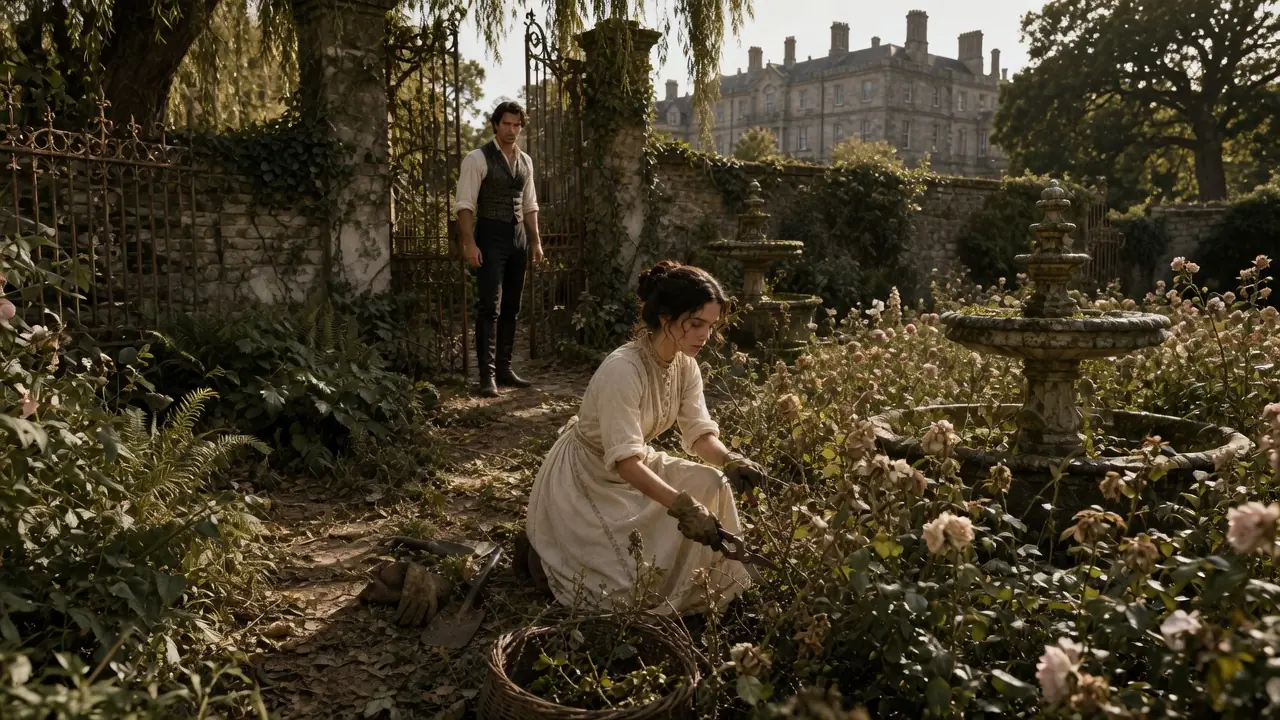
Preston Munos, the Duke of Castile, was a man who had perfected the art of suffocation. For five years, he had worn his title like armor, his silver-threaded waistcoats buttoned to the throat, his schedule calibrated to the minute. He moved through Castile Manor with the efficiency of clockwork, presiding over tenants and ledgers with impeccable precision.
Yet there was one place his polished boots refused to tread: the north garden, where weeping willows drooped over untended paths and roses had long since turned to thorns. The servants whispered that the Duke had forbidden anyone to touch it—a monument to something he would not name. Society whispered louder still, speculating about the vanished girl, Mercedes Ritz, who had been seen weeping beneath those willows before disappearing five years prior, her name scrubbed from every guest list as though she had never existed.
On a suffocating afternoon in late June, Preston made the mistake of walking past the rusted garden gate. Through the tangle of overgrowth, he saw her—a woman in cream and gold, kneeling among the roses with garden shears gleaming in her hands like a queen's scepter. Her hair caught the sunlight, her profile was achingly familiar, and for the first time in five years, the Duke of Castile forgot how to breathe.
---
Preston Munos woke at precisely 6:00, as he had every morning for the past five years. The summer sun had already begun its assault on the heavy damask curtains of his bedchamber, but inside, the air remained cold.
He dressed himself. He had long since dismissed his valet for the morning ritual, preferring the mechanical precision of his own hands, and fastened each button of his waistcoat with the same methodical care he applied to every other aspect of his existence. The silver threading caught the light, but he did not smile at his reflection.
Breakfast was a solitary affair. The dining table could seat twenty, but Preston occupied only the head, a newspaper propped against the silver coffee service his grandfather had commissioned. He read the agricultural reports with the focus of a man trying to forget he had a heart—crop yields, tenant improvements, the price of wool. His steward, Mr. Peyton, had prepared the weekly account books, and Preston reviewed them between bites of toast that tasted like ash. Everything was in order. Everything was always in order.
"Your Grace," Mrs. Helmsley, the housekeeper, appeared in the doorway with the same anxious expression she had worn for half a decade. "The Countess of Bramwell has sent another invitation. A garden party this Saturday."
"Decline it." Preston did not look up from the columns of numbers.
"She specifically mentioned that Lady Vivien Ashford will be in attendance."
"Decline it."
Mrs. Helmsley's lips pressed into a thin line, but she curtsied and retreated.
Preston knew what the whispers said. The Duke of Castile—the most eligible bachelor in three counties, a man of considerable fortune and impeccable lineage—had become a ghost in his own home. Invitations were extended out of obligation and declined with equal predictability. At nine-and-thirty, he should have had an heir, a wife, a house full of noise and laughter. Instead, he had ledgers.
He moved through the rest of his morning like a man underwater. The library, where he reviewed correspondence; the study, where he signed documents that would affect lives he would never see; the gallery, where portraits of smiling Munos ancestors seemed to mock him with their painted joy. He paused before his father's portrait—a man who had loved deeply and died young, leaving Preston with a dukedom and a lesson he had learned too well: duty above all else.
For five years, he had issued explicit orders: no one was to enter the north garden. Let it rot. Let it become a monument to his own stupidity, a physical manifestation of the choice he had made on a summer evening when he had looked into Mercedes Ritz's hopeful eyes and called her a distraction. Let the roses strangle themselves; let the willow weep until its branches broke.
But today, as Preston stood at the window with his hands clasped behind his back in the posture of a man at war with himself, something shifted. Perhaps it was the way the sunlight illuminated the destruction, making it impossible to ignore. Perhaps it was the letter from the Countess reminding him that the world still turned, still expected him to perform the role of the living. Or perhaps it was simply that five years of suffocation had finally become unbearable.
He rang for the housekeeper. "Mrs. Helmsley, place an advertisement," Preston said, his voice flat and emotionless—the tone of a man signing a death warrant. "We require a gardener. Someone capable of restoring neglected grounds. Discreet, professional, no references from local families."
Mrs. Helmsley's eyes widened slightly—the most shock she had displayed in years. "The north garden, Your Grace?"
"Yes." He turned away from the window, away from the garden that had become his prison. "It's time to fix it."
What Preston did not say, what he could not admit even to himself, was that he hoped burying the past beneath new soil might finally allow him to breathe again. He was wrong, of course, but he would not discover that until a woman in cream and gold knelt among his roses and reminded him that some ghosts refused to stay buried.
---
The gardener arrived on a Thursday, which should have been unremarkable, except that Preston had chosen that particular afternoon to walk the eastern grounds—a route that deliberately avoided the north garden by a distance of nearly half a mile. He had not intended to go near it. He had hired someone precisely so he would not have to witness the excavation of his own failure.
But the human heart, that treacherous organ, has never been known for its obedience to intention.
The day was oppressively hot—the kind of heat that turned waistcoats into instruments of torture and made even the act of breathing feel like labor. Preston had abandoned his jacket in the library, a small rebellion that would have scandalized his valet, and rolled his shirt sleeves to his elbows in a gesture that felt almost obscene.
The grounds were deserted; even the gardeners had retreated to the shade. He told himself he was merely inspecting the estate, performing his ducal duties with the same efficiency he brought to everything else. He did not admit, even internally, that his feet had carried him toward the rusted gate with the inexorable pull of a man walking toward his own execution.
He saw the gate first, no longer hanging crooked, but propped open with a heavy stone—an invitation into a space that had been sealed for half a decade. Tools lay scattered near the entrance: shears, a spade, and leather gloves that looked well-worn and capable. Someone was already at work.
Preston's jaw tightened. He had given explicit instructions that he was to be notified before any work commenced. Mrs. Helmsley would hear about this.
He stepped through the gate, and the world tilted.
The north garden was worse than he remembered—a wilderness of neglect where roses had grown monstrous and thorned, where the pathways had disappeared beneath creeping ivy, and where the fountain at the center had become a breeding ground for moss and decay. The weeping willow still stood, its branches so heavy they touched the ground like the trailing hem of a mourner's cloak.
And beneath those branches, kneeling in a pool of golden sunlight that seemed to exist solely to illuminate her, was a woman.
She wore cream muslin—practical and high-necked—with sleeves rolled to reveal forearms that were sun-bronzed and lean with the kind of strength that came from genuine labor, not the delicate pretense of aristocratic ladies dabbling in flower arrangement. Her hair, dark, almost black, was pinned in a simple coil at the nape of her neck, though rebellious strands had escaped to curl against her temples in the heat. She held garden shears in her hands like they were an extension of her own body, cutting away dead growth from a rose bush with the precision of a surgeon excising a tumor.
Preston's lungs forgot their function. It was not possible. It could not be. Mercedes Ritz had vanished five years ago, swallowed by scandal and grief, her name scrubbed from society as thoroughly as if she had never drawn breath. He had made inquiries—discreet, desperate inquiries that yielded nothing but rumors. *Dead,* some said; *married and moved abroad,* others whispered; *ruined and living in shame somewhere in the north.* He had never found her. He had tried to stop looking.
But this woman, this ghost made flesh, had Mercedes's profile—the same elegant slope of her nose, the same determined set to her jaw. Five years had sharpened her features, carved away the softness of youth, and replaced it with something more formidable. She was thinner than he remembered, but stronger, harder, as if she had been refined in a fire that should have destroyed her and emerged as tempered steel instead.
Preston must have made a sound—a sharp intake of breath, perhaps, or the scrape of his boot against stone—because the woman's head turned. Her eyes met his across the tangled garden, and the world stopped.
They were Mercedes's eyes—dark and depthless, and utterly, devastatingly indifferent.
She did not gasp, did not drop her shears, did not press a hand to her heart in shock or recognition, or any of the reactions Preston's paralyzed mind insisted should accompany this impossible moment. Instead, she simply looked at him the way one might look at a stranger who had wandered into the wrong garden at the wrong time—with mild curiosity and the faint impatience of someone interrupted during important work.
Then she turned back to her roses and continued cutting.
Preston stood there, drowning in summer air, while the woman who had haunted five years of his hollow existence treated him like he was nothing at all. And somehow, that indifference was more devastating than any accusation could have been.
---
It took Preston three attempts to find his voice, and when he did, it emerged as something foreign and rough, like a mechanism that had rusted from disuse. "Mercedes."
The woman, because he could no longer pretend she was anyone else, set down her shears with deliberate care and rose to her feet in one fluid motion. She brushed dirt from her skirts, took a handkerchief from her pocket to wipe her hands, and only then did she turn to face him fully. Her expression was pleasant, polite, and utterly blank—the kind of expression one wore when greeting the butcher or thanking a footman for opening a door.
"Your Grace." She dipped into a curtsy so precisely correct it felt like an insult. "I apologize for beginning work without a formal introduction. Mrs. Helmsley indicated time was of the essence, given the deterioration of the grounds."
*Your Grace.* Not Preston, not even *my lord* in the familiar way she had once said it, when his title had been something playful between them rather than a wall. He felt something crack in his chest, a hairline fracture spreading through foundations he had thought were solid.
"I did not realize..." He stopped, struggling. "The agency did not provide a name."
"Miss Rowe." She said it smoothly, without hesitation, and Preston understood with a sick jolt that she had prepared for this moment, had perhaps even orchestrated it. "I specialize in the restoration of neglected botanical spaces. Your housekeeper's advertisement specified discretion and expertise. I believe I meet both requirements."
*Miss Rowe.* A name as false as the distance she had placed between them, yet delivered with such conviction that to challenge it would make him sound mad.
Preston's hands clenched at his sides. He wanted to cross the space between them, to shake her shoulders, to demand she stop performing this grotesque pantomime of strangers. But the Duke of Castile did not shake women, did not make demands driven by emotion rather than logic, and did not allow his voice to rise above the modulated tones of aristocratic control.
"I see." The words tasted like metal. "And your credentials, Miss Rowe?"
Something flickered behind her eyes—amusement, perhaps, or contempt—but it vanished so quickly he might have imagined it. "I trained under Edmund Fairweather at the Surrey Botanical Institute for three years. I have restored gardens in Hampshire, Kent, and most recently, a private estate in Yorkshire. I can provide references if Your Grace requires them."
She had built an entire life, a profession, a new name, and a history that had nothing to do with the girl who had once walked these same paths with hope in her eyes and his empty promises in her ears. Preston felt the ground shift beneath his feet—the terrible understanding that Mercedes Ritz had not merely survived his cruelty; she had erased herself entirely and been reborn as someone who did not need him.
"That will not be necessary." His voice was hollow. "I trust Mrs. Helmsley's judgment."
"Then, if Your Grace will excuse me, the afternoon heat is ideal for transplanting, and I would prefer to complete the work before the soil loses its moisture."
She turned back to her roses before he could respond, dismissing a duke with the casual efficiency of a woman who had more important concerns than the feelings of powerful men. Preston left the garden with his pride in tatters and the sickening realization that the woman kneeling among his roses held all the power now.
---
Preston returned to the north garden three days later with the grim determination of a man approaching a battlefield. He had rehearsed words in his study, discarded them, and rehearsed them again. Apologies felt insufficient; explanations felt like excuses. But silence—silence had already cost him five years, and he would not surrender another day to cowardice disguised as duty.
He found her at the far wall where the climbing roses had once formed an archway, now a snarl of thorns and dead wood. She was on her knees, her leather gloves dark with soil, working at the base of a bush that Preston recognized with a jolt that struck like lightning to his sternum.
The Nightingale Rose. They had planted it together seven years ago, when Mercedes had been twenty and radiant, and convinced that a duke's second son might love her despite his obligations. It had bloomed white that first summer, each petal edged in the palest pink, and she had declared it the most beautiful thing she had ever seen. Now it was barely alive, a twisted skeleton of what it had been.
"That one cannot be saved." His voice emerged too rough, and Mercedes did not startle. She had heard him approach and had chosen not to acknowledge him.
"You would be surprised what can survive, Your Grace, given proper care." She cut away a blackened branch with surgical precision. "Root systems are remarkably resilient. Even when the visible growth appears dead, life persists underground."
Preston stepped closer, close enough to see the deliberate steadiness of her hands, the way she refused to look at him. "Mercedes—"
"Miss Rowe." The correction was sharp as her shears.
"Miss Rowe," then he swallowed against the tightness in his throat. "I owe you... I must... the words tangled. Five years of silence had made him clumsy. "What I said to you that evening, what I did... it was inexcusable."
She sat back on her heels, finally meeting his gaze. Her eyes were black in the shadow of the archway—depthless and cold. "You called me a distraction from your duties. You said that a man in your position could not afford the luxury of sentiment. I believe those were your exact words, Your Grace. I have had considerable time to memorize them."
Each word was a thorn dragged across his skin. "I was a fool."
"No." Mercedes pulled off one glove, finger by finger, with the methodical care of someone performing a ritual. "You were a duke. And I was a girl foolish enough to believe that love might matter more than lineage." She turned her attention back to the rose bush, her voice dropping to something quieter, more dangerous. "Do you know what happened after I left your garden that night?"
Preston could not speak, could not move.
"I went home and told my parents I had been compromised by a man who refused to marry me. Better that scandal than the truth—that I had offered my heart freely and had it returned like a gift that disappointed at Christmas. My father disowned me to preserve what remained of the family name. My mother wept but did not intervene. I had two cousins who might have taken me in, but neither wanted the taint of my shame."
"Mercedes..."
"I sold my jewelry to pay for a coach north. I worked as a scullery maid in an inn for eight months until my hands bled. I learned that hunger is a physical ache and that cold is a kind of death." She looked at him then, and her smile was terrible. "So yes, Your Grace, I died. The girl you knew is buried somewhere between your garden gate and the life I built from nothing. Miss Rowe is who survived, and she does not accept apologies from ghosts."
She returned to her work, and Preston stood there bleeding from wounds that had no visible source, understanding at last the true cost of his cruelty.
---
The Earl of Ashford arrived unannounced on a Tuesday morning, riding a bay gelding that was too fine for a casual visit, and wearing a smile that Preston instantly despised. Thomas Ashford was everything Preston had once been—careless, charming, unburdened by the weight of having destroyed something irreplaceable. He was also, Preston noted with a visceral twist of something dark and primal, precisely the sort of man women found disarming.
"Preston, old friend." Ashford dismounted with easy grace, tossing the reins to a groom. "I heard the most intriguing rumor at White's last week. They say you've hired a female gardener. A Miss Rowe. I had to see this modern marvel for myself."
Preston's jaw tightened imperceptibly. "The north garden required unique expertise. Miss Rowe came highly recommended."
"And you, who once forbade anyone from even entering that cursed place, suddenly discovered a passion for horticulture." Ashford's grin widened. "Forgive me, but I smell a story. Is she hideous? Elderly? Please tell me there's some reasonable explanation for why the Duke of Castile has suddenly become interested in roses."
Before Preston could manufacture a response that would not reveal the truth clawing at his throat, Mercedes appeared from behind the garden gate. She had abandoned her bonnet in the heat, and her hair had worked loose from its pins, curling against her neck in a way that made Preston's chest constrict. She carried a basket of cuttings, her arms bare to the elbow, her skin luminous with perspiration and sunlight.
Ashford's expression transformed instantly from curiosity to something far more dangerous—appreciation, interest, the predatory focus of a man who had just spotted something he wanted.
"Good God," Ashford breathed. "That's your gardener?"
Preston felt something ancient and uncivilized wake in his blood—the urge to step between them, to block Ashford's view, to assert a possessiveness that had no basis in reason or right. He had given up any claim to Mercedes five years ago; he had called her a distraction. He had no grounds for the rage building behind his sternum like steam in a sealed kettle. But reason had never been particularly effective at controlling the human heart.
"Miss Rowe," Preston called, his voice emerging with a sharp edge he had not intended. Both Mercedes and Ashford turned. "May I introduce the Earl of Ashford. Ashford, this is Miss Rowe, the botanical expert I mentioned."
Mercedes's expression remained professionally pleasant, but Preston saw the slight narrowing of her eyes, the calculation behind her courtesy. She curtsied. "My lord."
"The pleasure is entirely mine, Miss Rowe." Ashford bowed with the kind of flourish that made Preston want to plant his fist in the man's perfect teeth. "I confess myself fascinated by your work. It's so rare to find a woman with such practical expertise. You must tell me how you came to this unusual profession."
"I needed to eat, my lord," Mercedes delivered the line with such bland politeness that it took a moment for the barb to land. "Hunger is a remarkably effective motivator."
Ashford laughed, delighted. "Wit, beauty, and a talent with roses. Preston, you have been hiding a treasure. Miss Rowe, I wonder if you might consider consulting on my own estate? The gardens at Ashford Hall have suffered from years of my bachelor neglect."
"Miss Rowe is under exclusive contract here." Preston's voice cut through the morning air like a blade.
Both Mercedes and Ashford stared at him. He had not meant to speak, had not meant to sound like a man desperate to keep something that was already lost.
Mercedes's smile was terrible and knowing. "I was not aware the contract prohibited outside consultations, Your Grace. I shall have to review the terms." She turned back to Ashford. "I would be happy to visit Ashford Hall, my lord. Shall we say Thursday afternoon?"
Preston watched her walk away, Ashford's gaze following her like a starving man observing a feast, and understood with brutal clarity that jealousy was just another form of suffocation.
---
Mercedes had not intended to enter the Duke's study. She had been looking for Mrs. Helmsley to discuss the procurement of imported soil amendments when she had taken a wrong turn in the labyrinthine corridors of Castile Manor and found herself before a door of polished mahogany, slightly ajar.
Through the gap, she could see walls lined with leather-bound volumes and a desk massive enough to serve as a monument to masculine authority. She should have turned away, should have retraced her steps and maintained the professional boundaries she had so carefully constructed. But through the open door she saw it—a wooden box on the corner of the desk, unremarkable except for the way it sat apart from the ordered chaos of ledgers and correspondence, as if it occupied a space of peculiar significance.
The study was empty; the manor was quiet. Mercedes told herself she was simply ensuring no one was present to direct her to the housekeeper. She told herself many lies in the thirty seconds it took her to cross the threshold and approach the desk.
The box was simple walnut, unadorned, with a small brass latch that opened without resistance. Inside lay letters—dozens of them, perhaps hundreds. They were organized by date, she realized with a jolt, the oldest at the bottom, the most recent on top. All written in the same hand, all addressed to the same person: *Miss Mercedes Ritz.*
Her fingers trembled as she extracted the top letter. The paper was thick, expensive, and the seal had never been broken because it had never been sent. She should not read it, should not violate this privacy, should not care about words written by a man who had destroyed her.
She broke the seal.
> *My dearest Mercedes,*
> *Three months have passed since you left my garden, and I find I have forgotten how to sleep. The servants say you have gone north, but no one knows where. I have sent investigators. I have written to every cousin, every friend, every distant connection your family might have claimed. They return with nothing.*
> *I tell myself this is penance, that a man who called love a distraction deserves to lie awake counting the hours until dawn. But the truth is simpler and more pathetic: I was a coward. I am a coward still because I write these letters and do not send them, because what right have I to your forgiveness? I have ordered the north garden sealed. Let it die with my capacity for joy.*
> *— Yours, though I have no claim to the word, Preston.*
Mercedes's hand shook as she reached for another letter, then another. Five years of correspondence—five years of apologies, confessions, and the kind of raw honesty Preston Munos had never been capable of speaking aloud. Letters written at midnight, written drunk, written in the careful script of a man trying to hold himself together through sheer force of penmanship.
In one, he described the scullery-maid inquiry that had nearly found her. In another, he confessed to standing in the garden at dawn, waiting for a ghost. In the most recent, dated merely two weeks before she had arrived, he had written simply: *“I have decided to restore the garden. Perhaps if I fix what I destroyed, I will learn to breathe again. I do not expect to succeed.”*
She stood in his study, surrounded by the evidence of five years of silent suffering, and felt something crack in the armor she had built from hunger and cold and deliberate indifference. He had looked for her, had mourned her, and had written hundreds of letters he was too proud or too ashamed to send.
It changed nothing; it changed everything. Mercedes returned the letters to their box with shaking hands and fled the study before the Duke could return and see that she had been crying.
---
The frost came without warning on a night in early September—unseasonable and vicious. Mercedes woke to the sound of frantic knocking and found Mrs. Helmsley at her cottage door, her face pale in the lamplight.
"Miss Rowe, His Grace requests your immediate presence in the garden. He says... he says the Empress is dying."
The Empress of the Night—a rare, night-blooming cereus that Mercedes had discovered struggling in the greenhouse two weeks prior, its bud swollen with the promise of flowers that would bloom once and never again. She had nursed it, relocated it to the garden's warmest corner, and calculated that it would open tonight. Now, the frost would kill it before dawn.
She arrived in the garden to find Preston already there, coatless despite the cold, holding a lamp that cast wild shadows across his face. He had covered the plant with every blanket the greenhouse possessed, but already she could see the crystalline glitter of ice forming on the exposed leaves.
"We need to move it." Mercedes spoke without preamble, without the careful distance she had maintained for weeks. There was no room for pride when beauty was dying. "To the greenhouse. Now."
They worked in wordless synchrony, the way they had once moved together before duty and fear had carved chasms between them. Preston dug while Mercedes supported the root ball, their hands colliding in the dirt, their breath mingling in white clouds of vapor. The plant was massive, unwieldy, and the greenhouse was across fifty yards of frost-slick grass. They carried it between them like a child—stumbling, catching each other, Preston's hand steady at her waist when she slipped, her fingers gripping his shoulder for balance.
Inside the greenhouse, warmth enveloped them like absolution. They settled the Empress in the central bed, and Mercedes began the delicate work of removing damaged leaves while Preston prepared heating lamps, following her terse instructions without question or hesitation. Somewhere in the desperate choreography of preservation, his hand covered hers on the stem, steadying her grip, and neither of them pulled away.
"There," Mercedes sat back, her breath short. "The bud survived. It will bloom."
Preston was staring at her with an expression that made her chest concrete. His hair had fallen across his forehead, dark with sweat despite the cold. There was dirt on his jaw, his shirt—the kind of dishevelment that made him look human rather than ducal.
"You have soil on your cheek," he said quietly, and reached up to brush it away. His thumb traced her cheekbone, gentle as a question, and Mercedes felt five years of careful armor melt away. She should pull away, should remind him that Miss Rowe did not accept tenderness from men who had once called her a distraction. But her body remembered what her mind refused—the way his touch had once made her feel seen, chosen, cherished.
"Preston..." his name escaped like a confession.
"I read your eyes that night and believed you would wait forever," his voice was raw. "I was wrong about everything, except how it felt to stand beside you."
The Empress chose that moment to unfurl its first petal, white as moonlight, releasing a perfume that was honey and jasmine and desperate beauty. They watched it bloom in silence, standing so close that Mercedes could feel the heat of him, could hear the uneven cadence of his breathing.
When she finally looked at him, she saw the boy he had been before duty had taught him to suffocate. But she also saw the letters he had never sent—the five years of silent suffering and her own reflection in a scullery mirror with bleeding hands.
"We saved it," she whispered. "But saving something once doesn't mean it can survive what comes after."
Preston's hand fell away, and the distance between them felt like drowning.
---
The storm arrived three days later with the violence of something that had been building for years. Mercedes was in the north garden, racing against the darkening sky to secure the climbing roses before the wind tore them from their trelluses. She heard the first crack of thunder and smelled rain on the air seconds before the deluge began—sheets of water so thick she could barely see the garden shed ten feet away.
She ran, but Preston was faster. He caught her arm and pulled her through the shed door, slamming it shut against the wind. Inside, the small space smelled of earth and linseed oil, of tools and time, and all the summers they had lost.
Rain hammered the roof like artillery; lightning turned the world white. They stood dripping, breathing hard, and Mercedes realized with a sick jolt that this was the same shed where Preston had kissed her for the first time seven years ago—where she had believed that a duke's second son might choose love over lineage.
"I cannot do this anymore." Preston's voice cut through the storm, rough and broken. He was not looking at her, but at his hands, at the dirt beneath his fingernails that no duke should possess. "I cannot watch you treat me like a stranger. I cannot pretend that you are Miss Rowe, and I am Your Grace, and that we are merely employer and employee existing in the same space by coincidence."
"Then what would you have me do?" Mercedes heard her voice rise, years of swallowed rage finally finding air. "Forgive you because you wrote letters you were too cowardly to send? Absolve you because you suffered in a palace while I bled in a scullery? You want honesty, Preston? Here is honesty: I hate that I still remember how your hands felt. I hate that I found those letters. I hate that part of me wants to forgive you... and I hate myself for that weakness."
"I was the weak one." He looked at her then, and she saw that he was crying, tears mixing with rain on his face. The Duke of Castile—that monument to control and duty—was breaking apart in a garden shed. "I told myself I was protecting my family's legacy, that duty demanded sacrifice. But the truth is simpler and more pathetic: I was terrified. Terrified of what you made me feel. Terrified that if I loved you the way I wanted to, I would lose myself entirely."
"So you lost me instead."
"Yes." The word was barely audible over the rain. "And I have been lost every day since. You think you died that night, Mercedes? I have been a ghost for five years. Every morning I wake and remember how to breathe only because I must. Every evening I walk past the garden and remember what it felt like to be alive. You survived your death and built something extraordinary. I just stopped."
He dropped to his knees on the dirt floor—this man who knelt for no one—and looked up at her with the kind of naked desperation that made her chest ache. "I am not asking you to forgive me. I am not asking you to love me again. I am asking... I am begging for the chance to prove that the boy who planted roses with you is still buried somewhere beneath the Duke. That maybe, if you stay, we might both remember how to breathe."
Lightning illuminated his face, and Mercedes saw him clearly—not the Duke of Castile, not the man who had broken her heart, but Preston Munos, kneeling in the dirt, drowning in air, finally stripped of every defense. Thunder shook the shed, rain poured, and Mercedes knelt before him on the ground, her hands finding his face, her forehead pressing against his.
"Get up," she whispered. "Dukes don't kneel."
"But men do. And I need you to be a man, Preston. Just a man."
He was sobbing now, his arms coming around her like a man clutching the only thing keeping him from falling. And for the first time in five years, they both remembered what it felt like to breathe.
---
October arrived in a blaze of gold and crimson, and the north garden bloomed like something resurrected. The Nightingale Rose had survived, its white petals edged in pink opening to the autumn sun. The Empress of the Night rested in the greenhouse, its brief glory preserved in Mercedes's careful sketches. The fountain ran clear, the pathways were visible again, and the weeping willow no longer mourned, but provided shade for the iron bench where Preston and Mercedes sat as the afternoon light turned honey-thick.
She wore cream muslin still, but her hair was loose now, tumbling over her shoulders the way it had when she was twenty and believed in fairy tales. Preston wore no jacket, his shirt sleeves rolled to his elbows, dirt under his fingernails—a duke who had learned that some things mattered more than propriety.
"The garden is finished," Mercedes said quietly, her hand resting in his. "My contract is fulfilled."
Preston's fingers tightened reflexively around hers. "Then I require a new contract." He reached into his pocket and withdrew a folded paper, worn at the edges as if he had carried it for days, revising and perfecting it. "I had my solicitor draw it up. I thought you might review the terms."
Mercedes unfolded the document, expecting legal language about ongoing maintenance or perhaps a permanent position as estate botanist. Instead, she found a single paragraph written in Preston's own hand:
> *I, Preston Munos, do solemnly contract with Mercedes Ritz for the restoration and continued cultivation of not only the North Garden, but of the man who thought duty was a substitute for living. In exchange for her partnership—not as my employee, nor as my duchess, but as my equal in all things—I offer every breath I take for the remainder of my life. I promise to choose her above duty, above title, above the ghost I have been. I promise to be the man who kneels in garden sheds and plants roses and forgets how to breathe when she enters a room. Not because I have forgotten, but because she makes me remember what it means to be alive. The compensation for this contract is simple: I will love her until the weeping willow stands no more. And if she will have me, I will spend every day proving that some things, once broken, can be made more beautiful in their mending.*
Mercedes looked up, her vision blurred with tears she did not bother to hide. "This is not a legally binding contract."
"No," Preston's smile was tentative, hope and terror warring in his eyes. "But it is the only promise I know how to make. I am not asking you to marry a title, Mercedes. I am asking you to live with me as we are—without roles or the weight of what we should be. Just two people who plant roses and save midnight flowers and remember how to breathe together."
He slid from the bench and knelt before her on the garden path, in the dirt they had tilled together beneath the willow that had witnessed both their ending and their beginning. "I am not the Duke of Castile asking for your hand. I am Preston Munos asking if you will stay."
Mercedes looked at the man before her—no longer the boy who had broken her heart, not yet the healed version of who he might become, but something in between. A man learning to breathe. A man who had chosen her above everything he had once believed mattered.
She thought of bleeding hands and hunger and the girl who had died in the cold. She thought of letters never sent and five years of parallel suffering. She thought of the Nightingale Rose, which had survived because roots are resilient—because even when growth appears dead, life persists underground.
"Get up," she said softly, pulling him to his feet, her hands framing his face. "We kneel in storms. We stand in gardens."
Preston's laugh was half-sob, his forehead pressed to hers. "Is that a yes?"
"It is a beginning," Mercedes kissed him beneath the weeping willow, tasting salt and sunlight and the promise of seasons yet to come. "Now, breathe with me."
And in the garden they had restored together, they finally began to live.