The first thing Silas Treadwell did when he saw Mabel Ror standing on his porch was shut the door.
Not gently.
Not uncertainly.
He took one look at the broad woman in the brown traveling dress, the battered hat over her thick chestnut hair, and the two canvas bags resting beside her boots, and his expression collapsed into something between disappointment and embarrassment.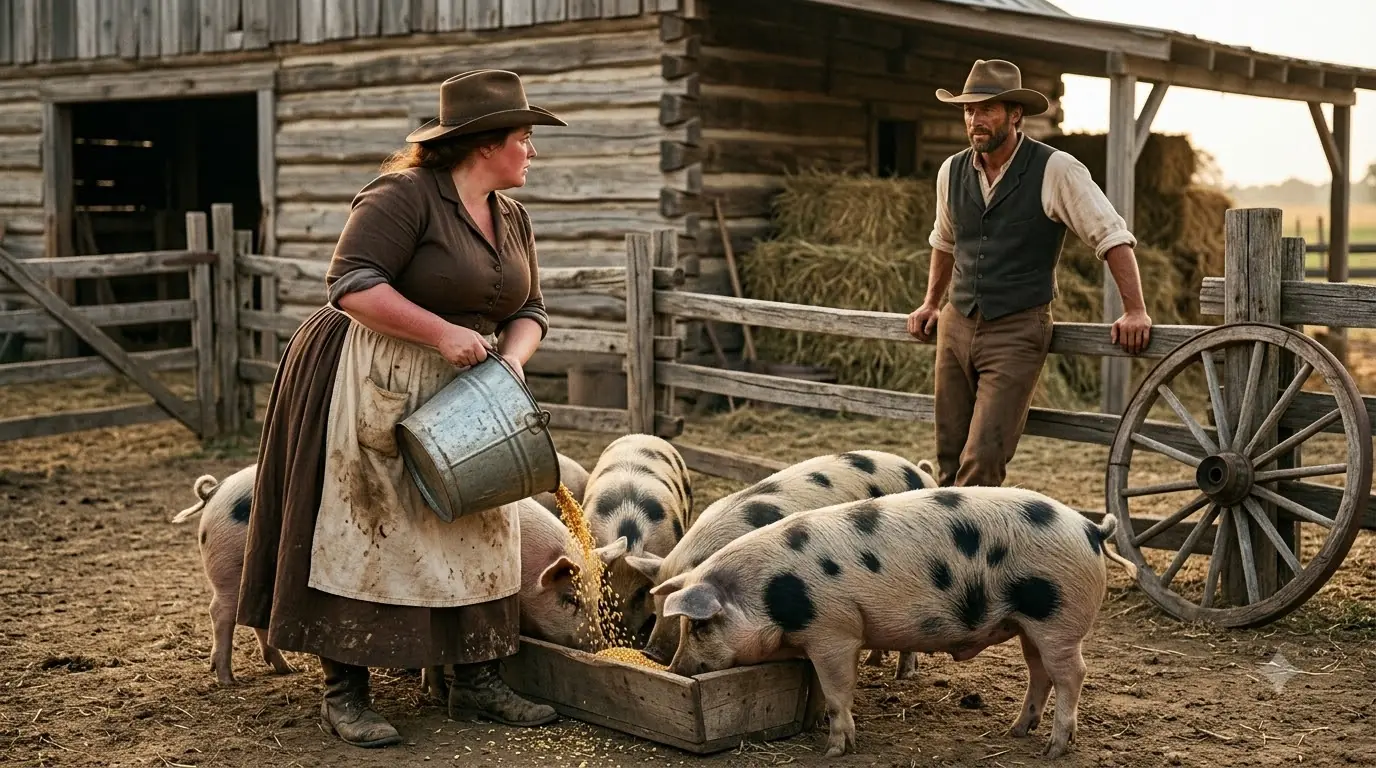
Then the green-painted door slammed directly in front of her face.
Mabel stood there for three seconds.
Maybe four.
She had spent eleven hours aboard two trains, forty minutes in the back of a produce wagon, and nearly a mile walking through Missouri dust to reach Treadwell Farm. Her knees hurt, the right handle of one canvas bag had begun tearing, and she had exactly four dollars and thirty cents left inside the small purse pinned beneath her skirt.
She stared at the door.
Then knocked again.
Silas opened it only halfway.
“I said the position’s filled.”
Mabel looked past his shoulder into the dark farmhouse.
“No, you didn’t.”
His brow furrowed.
“I’m saying it now.”
“You’re lying now.”
That opened the door another few inches.
Silas Treadwell was forty-two, lean and strong from labor rather than comfort, with dark hair beneath a worn hat and a beard that looked as though he trimmed it whenever he remembered. His cream work shirt was faded at the shoulders, and one sleeve carried a fresh patch.
He looked like exactly what the advertisement had suggested.
A farmer with more work than money.
Unfortunately, his face now suggested he had imagined a different woman answering it.
Mabel knew that face too.
She had seen variations of it since she became a girl large enough for relatives to whisper that she had “filled out early.”
At twenty-five, men called her sturdy.
At thirty, substantial.
At thirty-eight, after widowhood and seven years of managing kitchens, livestock, gardens, accounts, and other people’s opinions, she no longer cared what polite word they selected.
Silas stared.
“You came about the advertisement?”
“I did.”
“You’re Mabel Ror?”
“Yes.”
He looked her over again.
Not cruelly this time.
Just obviously.
Mabel’s expression hardened.
“Go ahead.”
“What?”
“Finish whatever judgment you started.”
Silas flushed.
“I’m not judging.”
“You closed a door on me before I finished saying my name.”
He had no answer.
Mabel reached for her bags.
“I’ll go.”
Relief entered his face.
That irritated her more than the insult.
She lifted one bag, then paused.
Across the yard, a Jersey cow stood beside a leaning fence, ribs more visible than they should have been. Nine hens scratched near a dry patch where a garden had almost disappeared under weeds.
Beyond them, willows grew thick and green along the eastern edge of the farm.
Mabel looked again.
Water.
There had to be.
Healthy willow roots did not live on optimism.
She set the bag down.
“How long since your cow dried up?”
Silas blinked.
“What?”
“The Jersey.”
He followed her gaze.
“June.”
“What month is this?”
“September.”
“So three months.”
“Approximately.”
“Her calf?”
“Sold.”
“Feed?”
“Hay, cracked corn when I can afford it.”
“Salt?”
“Yes.”
“Minerals?”
He hesitated.
“Sometimes.”
Mabel nodded toward the chickens.
“Nine hens?”
“Ten.”
“One’s under the porch.”
“Eggs?”
“Three this week.”
“Five on a good one?”
Silas’s face changed.
“How do you know?”
Mabel ignored him.
She pointed east.
“Those willows.”
“What about them?”
“You’ve got subsurface water.”
“There’s a spring.”
“Where?”
“Beyond the ridge.”
“How far?”
“Maybe two hundred yards.”
“Elevation?”
Silas stared.
“What?”
“Higher or lower than the barn?”
“Higher, I think.”
Mabel looked toward him.
“Then why are you hauling water by bucket?”
Silas opened his mouth.
Closed it.
Mabel picked up her bag again.
“That’s what I thought.”
She stepped off the porch.
Silas said:
“Wait.”
Mabel stopped.
There it was.
She turned slowly.
“What do you mean about the water?”
“That depends.”
“On what?”
“Whether the position is still filled.”
Silas looked annoyed.
Mabel waited.
Finally he stepped back.
“The position is open.”
“Good.”
She picked up both bags.
“Now move.”
Treadwell Farm consisted of one hundred eighty acres of potentially useful land and perhaps forty acres that had given up hope.
The barn leaked.
The north fence leaned.
The hog pen smelled worse than hog pens usually did because a drainage trench had collapsed.
The garden contained more pigweed than vegetables.
The nine visible hens appeared personally offended by life.
The Jersey cow, Daisy, was thin but otherwise healthy.
The pigs were better.
There were twelve, all young enough to grow if anyone could afford proper feed.
Silas walked beside Mabel while she inspected everything.
She asked questions.
Too many for his comfort.
“How much corn do you buy monthly?”
“How much hay?”
“Where do you sell hogs?”
“Who holds your note?”
“How much store credit?”
“When did you last lime the garden?”
“Why is that gutter draining toward the foundation?”
Silas finally snapped:
“You always talk this much?”
Mabel looked at him.
“Only when I’m trying to understand why a grown man with decent land managed to make every corner of it unhappy at once.”
Silas stared.
Mabel continued walking.
He followed.
By late afternoon she had seen enough.
“Kitchen.”
Silas frowned.
“What?”
“You have a ledger?”
“Yes.”
“Bring it.”
“You haven’t agreed to anything.”
“Neither have you.”
She entered the house.
Silas stood outside for a second.
Then muttered something.
Followed.
The ledger was worse than the barn.
Store debt: eighty-six dollars.
Seed debt: forty-two.
Veterinary account: twenty-three.
Hardware: thirty-one.
Feed merchant: seventy-eight.
Bank note: one hundred sixty.
Miscellaneous personal debt: seventeen.
Mabel added silently.
Then again.
“Four hundred thirty-seven.”
Silas stared at the table.
“I know.”
“No, you know the number.”
“That isn’t the same as knowing what it’s doing.”
His jaw tightened.
“My farm isn’t your concern yet.”
“You advertised for a wife who could manage a household and help around the farm.”
“Yes.”
“You neglected to write that the household is attached to a financial grave.”
He leaned back.
“You can leave.”
Mabel looked at him.
“You keep saying that.”
“Because you keep insulting me.”
“I’m describing arithmetic.”
Silas stood.
“So what, exactly, did you expect?”
Mabel’s eyes narrowed.
“A man honest enough to admit he needed help.”
“I admitted it.”
“No.”
“You advertised for a woman to cook, clean, and feed pigs.”
“You did not advertise for someone to tell you the whole farm is failing because you’re solving problems in the wrong order.”
Silas stopped.
Mabel tapped the ledger.
“You buy feed on credit.”
“Yes.”
“Then sell hogs cheap because you need cash.”
“Yes.”
“Which means you pay interest to raise animals you’re forced to sell before their best weight.”
Silas said nothing.
“You repair equipment only after it fails.”
“It costs money before it fails too.”
“So does failure.”
He folded his arms.
Mabel pointed toward the window.
“Your cow isn’t dry because she decided she hates you.”
“She’s underfed.”
“Your hens aren’t lazy.”
“They’re missing protein, calcium, probably daylight and clean water.”
“That north fence is wasting time every week because you keep tying temporary wire instead of resetting the posts.”
Silas’s mouth tightened.
“You think you can fix all that?”
“No.”
The answer surprised him.
Mabel continued.
“We can.”
Silas stared.
“We?”
She leaned back.
“You wanted a wife.”
“Apparently you wanted a servant.”
“If I stay, I work beside you.”
“I manage the kitchen because I’m better at it.”
“I manage numbers because I’m clearly better at those too.”
“You keep doing heavy field work because your back is younger than mine.”
Silas almost smiled.
“You’re thirty-eight.”
“And my knees have earned opinions.”
His smile escaped.
Mabel saw it.
Did not comment.
Then she pushed the ledger back toward him.
“Before we discuss marriage, wages, sleeping arrangements, pigs, or whether you’re capable of speaking to me without staring at my hips like they personally offended you, I need one answer.”
Silas flushed again.
“What?”
“Do you want to save the farm?”
“Of course.”
“No.”
She leaned forward.
“Do you want to save it enough to stop defending every mistake you’ve already made?”
That landed.
Silas looked toward the ledger.
For a long time.
Then:
“Yes.”
Mabel nodded.
“Good.”
“Tomorrow we start with water.”
They did not marry immediately.
That surprised Silas.
The advertisement had been direct.
Widowed Missouri farmer seeks capable woman, preferably widow, for practical marriage and farm household partnership. Must cook, manage poultry and garden, assist with livestock as able. Private room available until mutual decision.
Mabel had appreciated the last sentence.
It suggested at least some decency.
After meeting Silas, she decided it suggested more decency than tact.
They agreed to thirty days.
She would work as housekeeper and farm partner for room, food, and one dollar per week.
If either wished to end the arrangement, they could.
If both agreed after thirty days, they would marry.
Silas gave her the east bedroom.
Mabel inspected the mattress.
“Mouse?”
“No.”
“Bedbugs?”
“No.”
“Previous wife?”
Silas froze.
Mabel immediately regretted asking.
“Yes.”
His voice changed.
“Emily.”
“Died six years ago.”
Mabel softened.
“I’m sorry.”
“So am I.”
Silence.
Mabel understood widowhood.
Her husband, Daniel Ror, had died eight years earlier after a logging accident.
Their marriage had not been perfect.
It had been real.
That was enough.
Silas looked toward her.
“You?”
“Widow.”
“How long?”
“Eight years.”
“Children?”
“No.”
“Me neither.”
Neither knew what else to say.
Mabel placed her bag on the bed.
“Tomorrow.”
Silas waited.
“We fix water.”
The spring sat one hundred ninety yards east of the barn and eleven feet higher.
Mabel knew because she measured roughly with stakes, twine, a water level improvised from clear tubing, and patience Silas found suspicious.
“You did this before?”
He asked.