Arthur Whitmore had attended enough farm auctions to know when a family was selling equipment and when a family was dismantling a life.
There was a difference.
At an ordinary sale, men argued cheerfully over tractors, laughed about bad paint jobs, inspected tires, complained about auction fees, and drove home pleased if they believed they had purchased something ten percent below market value.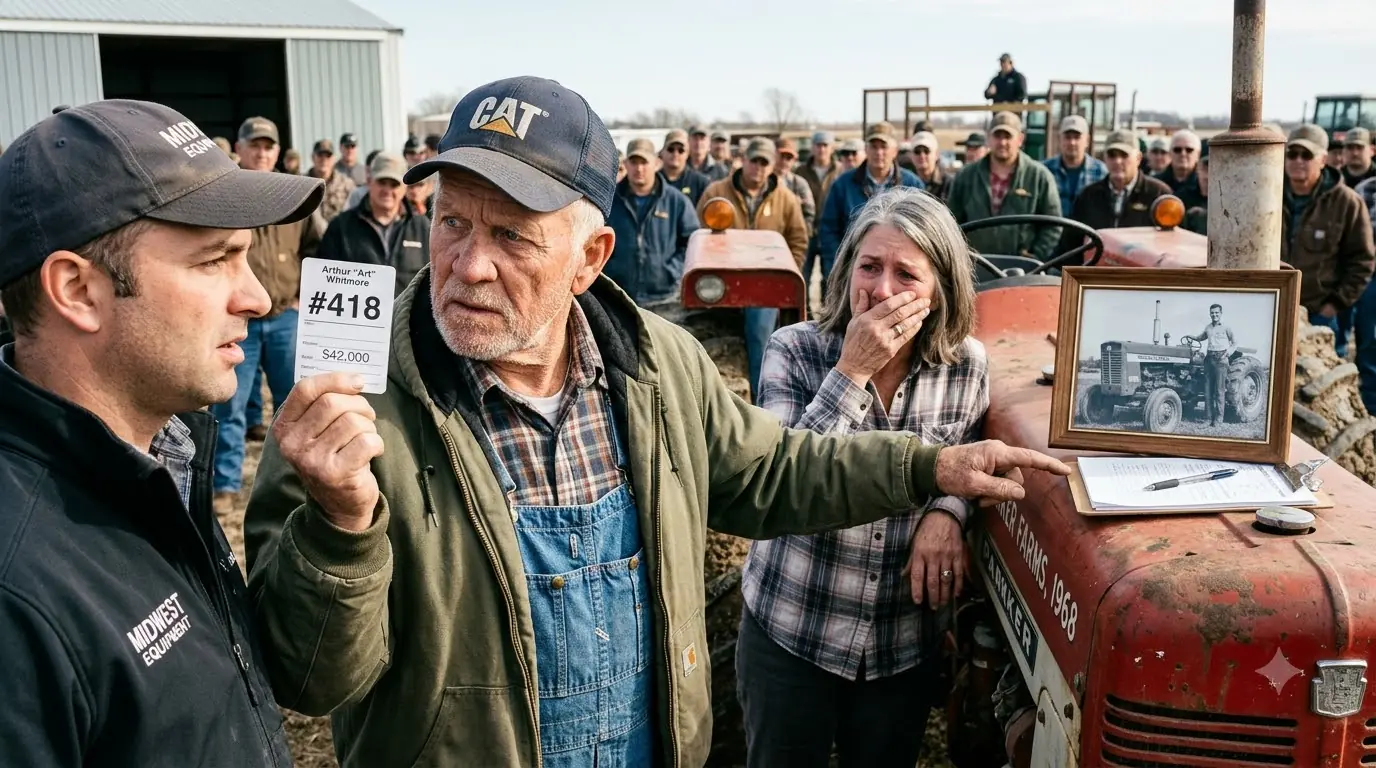
At the Parker farm that Saturday morning, nobody laughed very much.
By nine o’clock, pickup trucks lined both sides of the gravel road outside the ninety-four-acre property in western Missouri. A hand-painted sign near the entrance read:
PARKER FARMS AUCTION
Beyond it stood a weathered farmhouse, a machine shed, two smaller barns, cattle fencing, and rows of equipment arranged in the grass.
Most of the machines showed years of honest use.
A faded hay mower.
A grain wagon with one mismatched wheel.
A stock trailer repaired in three different places.
A pickup old enough that rust had become part of its color.
Tables covered with chains, sockets, grease guns, hydraulic fittings, welding clamps, and coffee cans full of bolts.
Arthur understood immediately.
Nobody had cleaned out the useless things and left the important equipment behind.
Everything was going.
At eighty-two, Art moved more slowly than he once had, but his eyes remained sharp.
He parked his old pickup near the road, pulled his faded navy cap lower against the morning glare, and stepped carefully onto the grass.
To anyone watching him, he looked like another retired farmer.
Plaid shirt.
Worn denim overalls.
Olive work jacket.
Scuffed boots.
Hands still carrying the shape of decades spent around steel.
Nothing about him suggested he was worth nearly eighteen million dollars.
Art preferred it that way.
He had never understood wealthy men who dressed as if they needed strangers to recognize wealth from across a room.
Money was useful.
Attention usually was not.
He walked past a line of used implements and stopped beside an old baler.
Someone had welded the drawbar twice.
The second repair was ugly.
But strong.
Art smiled faintly.
He liked repairs like that.
They told the truth.
A polished machine could hide neglect.
A repaired machine told you somebody had refused to quit on it.
“Looking for anything special?”
Art turned.
A younger equipment dealer stood beside him.
Maybe thirty-eight.
Black work shirt with a dealership logo.
Baseball cap.
Clean jeans.
His name tag read COLE BARRETT.
Art shook his head.
“Just looking.”
Cole tapped the baler with one boot.
“Most of this is tired.”
Art looked at him.
“Tired isn't dead.”
Cole smiled.
“You buy much old equipment?”
“Enough.”
“You restore?”
“Sometimes.”
“Collect?”
“Not really.”
Cole glanced at Art’s jacket and apparently placed him into a familiar category.
Older farmer.
Some land.
Maybe sentimental.
Probably interested in cheap machinery.
“Watch the tractor near the machine shed,” Cole said.
“Red one?”
“Yeah.”
“What about it?”
“Widow thinks it’s special.”
Art looked toward the machine.
A red tractor stood near the barn.
Faded paint.
Large rear tires.
One cloudy headlight.
Worn steps.
Rust around the exhaust.
Not rare.
Not especially collectible.
But maintained.
Art could tell even from thirty yards away.
Cole continued.
“People get sentimental at estate sales.”
Art corrected him.
“Farm sale.”
Cole shrugged.
“Same difference.”
“No.”
Cole looked at him.
Art pointed toward the farmhouse.
“Estate sale means somebody’s gone and people sell what’s left.”
He pointed toward the equipment.
“This woman is still here.”
Cole said nothing.
Art continued walking.
Near the auction table stood Linda Parker.
He had heard her name from the announcement.
Sixty-six.
Gray-streaked brown hair pulled behind her head.
Faded plaid shirt.
Dark work pants.
No makeup.
No jewelry beyond a wedding ring she still wore.
She spoke quietly with the auction clerk, then walked toward an older man who had purchased a set of cattle panels.
“Tom welded the corner bracket,” Linda told him. “It’ll hold. Just don't pull from the top.”
The buyer nodded.
“Thanks, Linda.”
She watched as he carried the panels away.
For one second, her face changed.
Not enough that most people would notice.
Art did.
Loss arrived in small movements.
A hand remaining on an object half a second after someone else purchased it.
A person looking toward a machine as it disappeared behind another truck.
Someone finding reasons to explain how an old tool worked because explaining it delayed saying goodbye.
Art had seen those gestures hundreds of times.
He walked toward a table of shop tools.
Linda appeared beside him.
“Those are mostly SAE.”
Art nodded.
“I figured.”
“Tom hated metric.”
Art smiled.
“Reason?”
“Said America had enough problems without two sets of wrenches.”
Art laughed.
Linda smiled too.
It was the first time he had seen her expression relax.
“My husband thought he was funny.”
“Was he?”
“Occasionally.”
Art picked up an old combination wrench.
Well used.
Initials scratched near the handle.
TP
“Tom?”
“Yes.”
Art set it down carefully.
“How long?”
Linda understood the question.
“Ten months.”
“I’m sorry.”
“Thank you.”
She did not offer details.
Art did not ask.
Some grief did not improve because strangers demanded its story.
The auctioneer climbed onto a portable platform.
“Ladies and gentlemen, we’re going to get started.”
People gathered.
Art moved toward the back.
The first lots were small.
Hand tools.
Chains.
Portable air compressor.
Welder.
Fence supplies.
Prices were average at best.
Art noticed Linda standing near the clerk, checking totals occasionally.
She tried to hide concern.
By eleven-thirty, the grain wagon sold.
Less than Art expected.
A hay rake followed.
Also low.
Cole Barrett bought the baler.
Cheap.
He grinned afterward.
“Half what they want at the dealership.”
Art said nothing.
Around noon, people broke for sandwiches and coffee.
Art walked near the auction trailer.
Two men stood inside speaking quietly.
One was the clerk.
The other wore a bank jacket.
Art did not deliberately listen.
But he heard numbers.
“...still probably eighteen to twenty short.”
“After everything?”
“If tractor brings twenty, maybe a little less.”
“What happens if she doesn't clear it?”
“Depends what lender does.”
“Land?”
“Possibly parcel sale.”
Art continued walking.
He disliked eavesdropping.
But now he understood.
The auction was not simply about reducing equipment.
Linda was trying to prevent the debt from touching the land.
Later he learned the details.
Tom Parker had become sick after a difficult crop year.
Medical bills arrived first.
Then operating debt.
Then equipment payments.
After his death, Linda faced approximately sixty-four thousand dollars she could not reasonably service while running the farm alone.
The house and all ninety-four acres belonged to her.
She wanted them to remain that way.
Her plan was practical.
Sell the machinery.
Pay the debt.
Lease the fields to a younger neighboring farmer.
Stay in the farmhouse.
Keep the land.
No dramatic rescue.
No fantasy that she could suddenly perform every job Tom had handled for thirty-nine years.
Just survival.
Art admired that.
During lunch, he sat on the tailgate of his pickup eating a ham sandwich he had brought from home.
Cole walked by carrying coffee.
“You bidding on the red tractor?”
“Maybe.”
Cole laughed.
“You like trouble?”
“Depends.”
“I looked it over.”
“And?”
“Runs fine.”
“Then what's wrong?”
“Nothing. That's the problem.”
Art looked at him.
Cole continued.
“It's ordinary.”
“Ordinary machinery built a lot of farms.”
“Sure, but bidders don't pay for history.”
“Some do.”
Cole smiled.
“You sentimental?”
“Occasionally.”
Cole pointed his coffee cup toward the tractor.
“Twenty-two tops.”
Art had reached roughly the same estimate.
Perhaps eighteen to twenty-two thousand depending on the crowd.
He looked toward Linda.
She stood beside the tractor.
One hand rested on the red hood.
Her other covered her mouth briefly as the auction crew moved the machine forward.
For the first time all day, she looked close to losing control.
A man standing beside Art whispered:
“That was Tom’s favorite.”
Another said:
“Kept it after he bought bigger ones.”
“Did everything with it.”
“Snow.”
“Hay.”
“Feed.”
“Pulled wagons.”
“Wouldn't sell it.”
Art watched Linda.
The tractor was not simply the largest unsold asset remaining.
It was the last machine that still looked like Tom belonged there.
The auctioneer began.
“Who gives me twelve?”
A hand rose.
“Twelve thousand.”
“Fourteen?”
Another.
“Fifteen.”
“Sixteen.”
Bidding moved normally.
Seventeen.
Eighteen-five.
Nineteen.
Cole entered at twenty.
Art lifted his bidder card.
“Twenty-one.”
Cole looked over.
“Twenty-two.”
Art raised again.
“Twenty-four.”
The auctioneer hesitated.
“Twenty-four thousand, now twenty-five?”