The stagecoach arrived long after sunset. Most people waiting at the station had already gone home, leaving only one tall cowboy standing beneath the faded wooden awning. Snow clouds rolled over the Montana mountains, and the cold wind carried the smell of pine through Copper Ridge.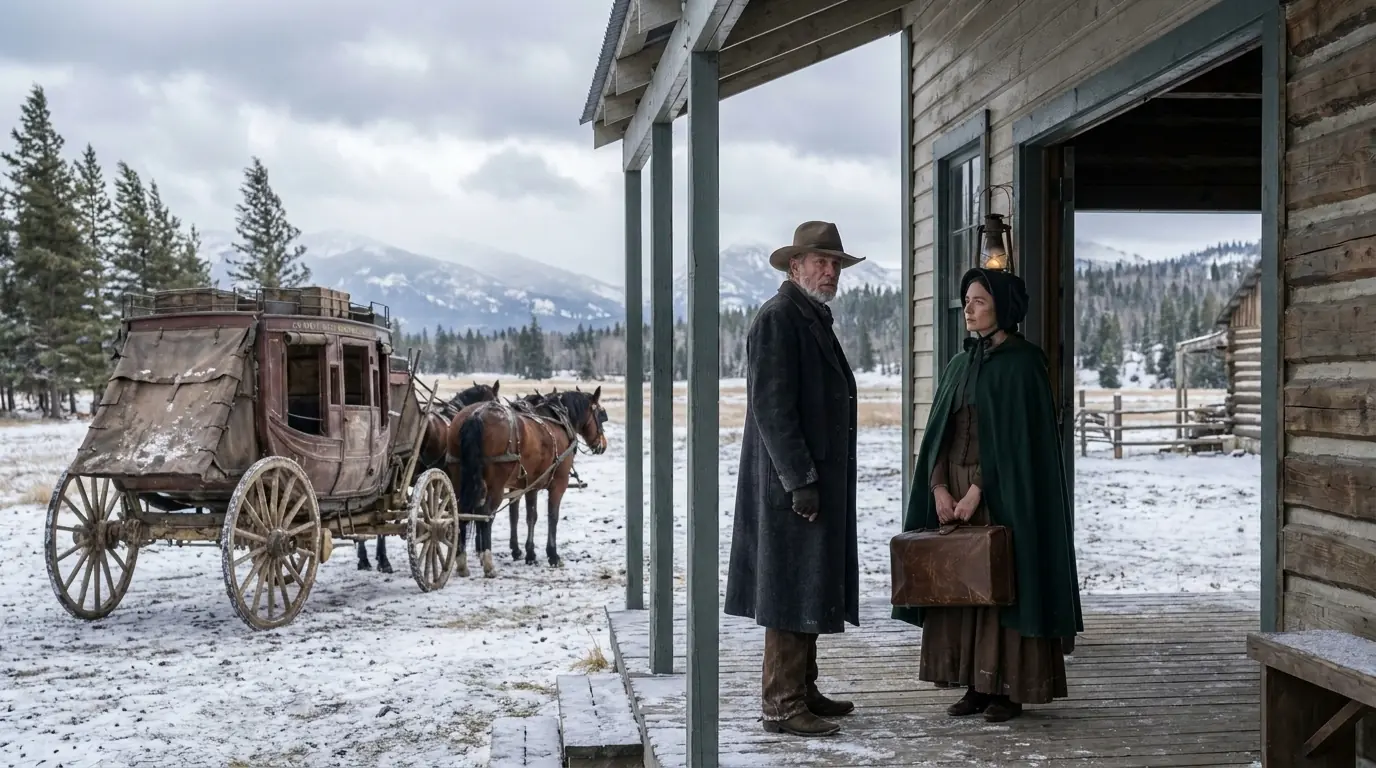
Silas Mercer folded the worn photograph back into his coat pocket. He had stared at it so many times that the woman's face had almost disappeared beneath the creases. It was the only likeness he had of the woman who had agreed to travel west and become his wife. She was a stranger, someone he expected to share his cabin and divide the work with, not someone he expected to reach his heart. He had told himself that companionship was a practical arrangement, no different from buying seed before spring or repairing a roof before winter. Still, he had arrived early and waited long after everyone else had gone home.
When the coach finally stopped, the door opened slowly. One woman stepped down carrying a single weathered suitcase. Her boots were dusty from weeks of travel, and loose strands of chestnut hair escaped beneath her bonnet. She looked directly at Silas without lowering her eyes.
Neither of them smiled.
Silas silently lifted her suitcase onto his horse before climbing into the saddle.
"You can ride behind me," he said.
She nodded once. "My name is Clara Whitfield."
"I know."
Nothing more was said. The long trail climbed into the mountains while daylight slowly disappeared behind dark pines. Clara held the saddle instead of wrapping her arms around him. The distance between them felt as wide as the valley below.
At last, the cabin appeared: old logs, one chimney, and one lonely lantern glowing beside the door. There were no flowers, no curtains, nothing that suggested laughter had ever lived there.
Silas carried her suitcase inside. "The bedroom is yours," he said. "I sleep upstairs."
"You don't have to. You—"
"I do."
He turned away before she could answer. The cabin felt neat enough to satisfy any traveler, yet every shelf, every chair, and every tool sat in exactly the same place. The coffee tin stood square with the edge of the shelf. The cast-iron pan hung from one nail although three others were empty beside it. A second chair remained pushed under the table, unused but carefully dusted. It was as though moving anything would disturb memories no one could see, or admit that the life once arranged there had changed.
Clara slowly opened her suitcase. Instead of dresses, the first thing she removed was a folded white tablecloth embroidered with tiny blue wildflowers. She carefully spread it across the rough wooden table.
Silas stopped walking. His eyes rested on the cloth for several long seconds before he quietly looked away. Neither of them mentioned it.
Later that night, Clara unpacked paper, ink, and several unfinished letters. She sat beside the lantern, writing to her younger sister back in Missouri. Her handwriting flowed across the page with remarkable precision.
Above her, the loft floor creaked. Silas lay awake. Through a narrow gap between the boards, he watched the steady movement of her hand. Those graceful letters did not belong to someone who had spent her entire life washing clothes or cooking over fires. The strokes were disciplined, elegant, and exact, the hand of someone trained to copy words that mattered. She paused before each new line as though considering not merely what she wished to say, but how it might be read by another person. Silas wondered what sort of life she had lived before answering his advertisement, and what part of it she had chosen not to bring west. She was hiding something, though he could not tell whether it was dangerous, painful, or simply private.
The thought stayed with him until sleep finally came.
The next morning arrived wrapped in silver frost. Before sunrise, Clara had already lit the stove, warmed the cabin, and brewed fresh coffee.
Silas climbed down quietly. The hot cup waited beside his chair. He picked it up, drank every drop, then left without speaking.
Day after day, the same quiet routine settled over the cabin. Clara cooked, cleaned, mended worn shirts, and kept the fire alive. Silas repaired fences, chopped wood, and cared for the horses until darkness returned.
Words remained few, yet Clara noticed things. He always hung his coat on the same peg. He always checked the door twice before sleeping. He always paused outside her bedroom before climbing to the loft, as though making certain she felt safe.
She never mentioned any of it.
One afternoon, the first heavy snowstorm swept across the mountains. By sunset, the trail had disappeared beneath deep white drifts. Silas had not returned.
Clara reheated the stew, then reheated it again. Outside, the wind struck the cabin walls hard enough to rattle the windows. Each passing minute stretched longer than the last.
At last, the door burst open. Silas stumbled inside, covered in snow. Ice clung to his beard, and his right shoulder hung lower than the other. He tried to hide the pain.
"You should have eaten," he muttered.
"I wasn't hungry."
She filled a cup with hot coffee and placed it gently into his frozen hands. For the first time, their fingers touched. Neither pulled away immediately.
Steam drifted between them. The room remained silent, but something invisible cracked open. Clara saw how badly his shoulder shook beneath the wet coat and how carefully he tried to keep the cup from rattling against its saucer. Silas slowly lifted his eyes and looked at her as though he were seeing her for the very first time, not as the woman from a photograph or the stranger assigned to his bedroom, but as the person who had waited through a storm because his absence mattered to her.
Then, quietly, almost uncertainly, he spoke.
"I think this is the warmest coffee I've ever had."
Outside, the storm kept raging across the mountain. Inside the cabin, another storm had only just begun.
Snow covered the mountain for three straight weeks. The trail disappeared beneath white drifts so deep that even the tallest fence posts looked like broken sticks. The cabin became its own little world, surrounded by endless silence and frozen trees.
Every morning, Clara rose before daylight. She built the fire, ground fresh coffee, and cooked breakfast before Silas climbed down from the loft. He never asked her to. She simply did it.
One morning, she noticed him rubbing his right shoulder while he thought she was not looking. The movement was small, but his face tightened before he quickly pulled his shirt over it.
She said nothing. Instead, she quietly searched through her suitcase after he left. Wrapped inside a linen cloth sat a small brown bottle containing her late mother's homemade liniment: camphor, pine oil, and wild herbs gathered from the hills back east.
That evening, she placed it beside his coffee cup.
"My mother swore by it," she said.
Silas looked at the bottle. "You've been watching."
"You've been hurting."
He stared into the fire. Finally, he slipped the bottle into his coat pocket.
The next morning, it returned to the table half empty. No words were exchanged, but Clara noticed that he lifted his arm a little easier.
The days settled into gentle routines. Silas repaired the rocking chair without saying a word, and Clara found it standing perfectly level beside the fire. She quietly smiled.
The following afternoon, she reorganized the woodshed. Heavy logs sat where his injured shoulder would not need to reach, and kindling rested beside the door.
When he returned home, he stopped in the snow, staring at the neat stacks.
"You did this."
"It seemed easier."
He nodded once. "It is."
Nothing more was said.
That night, the wind whistled around the cabin. Clara sat writing another letter beside the lantern. From above came a restless voice, soft and broken, almost impossible to hear.
"Emma."
The name drifted through the darkness. Then silence returned.
Clara lowered her pen. She did not cry. She did not ask. She simply folded the unfinished letter and blew out the lamp. In the darkness, she listened to the loft boards creak once and then go still. She understood enough about grief to know that some names are spoken in sleep because the waking mouth has refused them for too many years.
Morning arrived pale and cold. Silas looked exhausted, with dark circles beneath his eyes. Without speaking, Clara poured him an extra cup of coffee.
He looked at it. "You knew I slept poorly."
"I guessed."
His fingers tightened around the warm tin cup. "My wife's name was Emma."
The words came so quietly she almost missed them. Silas stared toward the window, where snow drifted across the yard.
"She died twelve winters ago." He swallowed once. "I left for medicine. The storm trapped me."
His voice stopped. He never finished the sentence. He did not need to. The empty chair beside the table finished it for him. So did the untouched peg near the door, the second tin cup that had been polished but seldom used, and the way he had kept the cabin frozen in the exact arrangement of another woman's life. Clara understood then that the order she had noticed was not discipline. It was preservation.
Clara reached for her sewing instead of his hand. Some grief could only survive if it was allowed to breathe.
Several days passed before either mentioned it again. Late one evening, Silas noticed Clara carefully folding another letter.
"You write beautifully."
"My father insisted."
"He was a teacher?"
She slowly shook her head. "A lawyer."
Silas looked surprised.
"I copied legal papers before I married."
"You never told me."
"You never asked."
He lowered his eyes. The answer stayed with him long after supper ended.
As Christmas drew near, Clara swept beneath the ladder leading to the loft. The broom caught against a small wooden box hidden in the shadows. She hesitated, then lifted the lid.
Inside rested an old wedding ring, a faded photograph, and a neatly folded letter. She closed the box immediately without reading a single word. The faded photograph showed only enough for her to recognize the outline of a smiling woman standing beside a much younger Silas. Clara felt no jealousy, only the solemn discomfort of having opened a door that was not hers. She slid the box back exactly where she had found it, turned the lid in the same direction, and swept the dust across the floor so no mark would betray that she had touched it.
That evening, Silas hardly spoke. Perhaps he knew. Perhaps he simply remembered. Neither said anything, and the cabin seemed quieter than ever.
A few nights later, snow tapped softly against the windows while the fire burned low and Silas sharpened his hunting knife beside the stove. The scraping stopped.
"I've spent twelve years trying not to remember," he said.
Clara remained still.
"I thought marrying again would give this place another pair of hands." He looked toward her. "Instead, it gave it another heartbeat."
Clara slowly placed her sewing in her lap.
"My husband never struck me," she said.
Silas listened.
"He simply lived as though I wasn't standing beside him. When he died, I realized I had forgotten what it felt like to matter."
The fire cracked loudly. Silas stared into the glowing coals.
"So we were both hiding."
She nodded. "For different reasons."
A long silence settled between them. It was not empty or uncomfortable. It was simply shared.
At last, Silas stood and walked toward the window, where snow drifted beneath the moonlight.
Without turning around, he spoke. "Tomorrow, I'll clear the trail to the spring."
"You don't have to."
"I know."
He smiled so slightly it almost disappeared. "But I want your walk to be easier."
Clara looked down before he could see her eyes shine in the firelight.
The mountain remained frozen outside. Inside, something much older had finally begun to thaw. Before either of them realized it, the hardest winter of their lives was quietly becoming the beginning of something neither had expected.
Spring announced itself with the sound of moving water. The creek below the cabin finally broke free from winter ice, rushing through the valley with a voice neither of them had heard in months. Morning sunlight poured across the snow, leaving patches of dark earth along the hillsides.
Clara stepped onto the porch with two cups of coffee. Silas was already outside. He leaned against the fence, his shoulder stronger now, watching the mountains wake beneath the rising sun.
"You healed faster than you expected."
"I had a good nurse."
She smiled without answering. The quiet between them no longer felt empty. It felt lived in.
Life settled into steady days. They planted vegetables beside the cabin, repaired broken fences, and gathered firewood for another winter that would surely come. Clara marked rows for beans, onions, carrots, and medicinal herbs. Silas built a low fence to keep deer from the young shoots and shaped a small wooden bench for the porch from leftover pine. Their work began to overlap naturally. He no longer asked before moving something she had arranged, and she no longer hesitated before leaving her sewing beside his tools.
Neighbors who once believed Silas wanted nothing to do with anyone slowly began stopping by. Some came to trade. Some came only to talk. Most left surprised to find laughter inside the lonely cabin.
One afternoon, three riders appeared on the trail. Silas recognized them immediately as a railroad company survey crew. The man leading them carried rolled maps beneath his arm.
"We're looking for Silas Mercer."
"I'm here."
The stranger removed his hat. "My name is Edwin Barrett, Northern Western Railway."
Silas's jaw tightened. "We're not selling."
Edwin slowly shook his head. "I'm afraid this isn't a request."
He handed over several folded papers. "The company believes part of your land belongs to the railroad."
Silas unfolded the documents. Even before reading them, something felt wrong. The government seal looked poorly stamped. The signatures lacked the careful spacing used in official records. The dates did not match one another, and one survey reference was written in a hand different from the rest of the page. Silas could not have named every flaw, but years of reading brands, deeds, and supply contracts had taught him when paper was trying too hard to look official.
He carried the papers inside without another word. Clara spread them across the kitchen table. She studied every line, every signature, and every seal. She held one page close to the lantern, then another, comparing the fibers and ink. She copied the survey numbers onto a clean sheet, set the dates in order, and drew a quiet line through the contradictions. The confidence in her face changed as she worked. For the first time since arriving in Montana, Silas saw not only a capable wife, but the legal clerk she had once been.
Then she quietly looked up. "These papers are false."
Silas frowned. "You're certain?"
"I copied legal records for years." She tapped one corner. "This seal belongs to another county and another page. The survey number doesn't exist."
Then she pointed to another line. "The witness signed six months after he supposedly died."
Silas stared at her. "You can prove it?"
"I can."
Three days later, they rode into Copper Ridge together. Clara had spent those days collecting certified copies from the county clerk, locating the original Mercer marriage record, and persuading an elderly deputy recorder to open a storage cabinet no one had touched in years. She carried every paper in a leather folder tied with cord. Silas rode beside her in silence, not because he doubted her, but because he was still learning what it meant to place the future of his land in another person's hands and feel relieved instead of afraid. The courthouse buzzed with farmers, ranchers, merchants, and railroad men. Edwin Barrett stood near the judge's bench with two lawyers.
He smiled the moment Silas entered. The smile disappeared when Clara stepped beside him carrying a leather folder.
Judge Nathan Collins opened the hearing. Barrett confidently presented the railroad's claim. Then Clara quietly stood.
She placed one document after another before the judge: original land records, county filings, a marriage certificate, and certified property surveys. Finally, she laid down the railroad papers.
"These documents contain three separate legal frauds."
The courtroom became silent. Farmers who had come merely to watch leaned forward. The railroad lawyers stopped whispering. Even Edwin Barrett's confident smile thinned as Clara arranged the documents in the order she intended to use them.
She pointed calmly. "The seal is incorrect. The witness could not have signed. The land description belongs to another valley."
Judge Collins adjusted his spectacles. He examined every page carefully. Then he looked toward Barrett.
"Can you explain these differences?"
Barrett's face lost its color.
One of his own surveyors slowly stepped forward. Every head turned. The older man removed his hat.
"I can. I drew the original map fifteen years ago."
He pointed toward Clara's documents. "Those are genuine."
Then he pointed toward Barrett's papers. "These were altered. I warned the company this family owned the land legally."
Barrett tried to interrupt, but the surveyor continued.
Judge Collins struck the bench with his gavel. "The railroad's claim is dismissed immediately."
He turned toward Barrett. "I am also ordering a criminal investigation into these documents."
The courtroom erupted. While Barrett hurried toward the door without looking back, Silas remained seated. For several seconds, he could not move.
His land, his home, everything he had built, was safe.
When they stepped outside, warm spring wind drifted through the streets. Silas stopped beside the hitching rail and looked at Clara.
"I would have lost everything."
She gently shook her head. "No."
"You saved this place."
"We saved it."
The single word settled between them with quiet certainty. It was more than gratitude and more than partnership. It was the first time either of them had named the life they were already building, not his home and her labor, but something belonging to them both.
Weeks later, the mountain had turned green. Wildflowers covered the meadow below the cabin. Fresh curtains hung inside the windows, and a small vegetable garden stretched beside the porch.
The lonely cabin no longer looked abandoned. It looked loved.
One evening, Silas walked slowly onto the porch carrying something wrapped in cloth. He handed it to Clara.
Inside rested a beautifully carved bluebird. Every feather had been shaped by hand, and the small wings had been polished until the grain shone beneath the evening light. It was not a grand gift. It was something made slowly during long winter nights by a man who had once believed his hands were useful only for fences, horses, and survival.
"I made it during the winter."
She traced the smooth wood with her fingertips. "It's beautiful."
"So are the mornings since you arrived."
He looked across the valley before speaking again.
"I thought I was asking for a wife," he said, his voice steady. "The truth is, I was asking someone to save me from a life that had already ended."
Clara reached for his weathered hand. "You saved me, too."
Neither moved. The wind carried the scent of pine across the mountains. Below them, the creek sparkled beneath the evening sun.
Silas gently closed his fingers around hers. This time, neither of them let go.
The cabin behind them stood warm beneath its rising chimney smoke while the last light settled across the valley. For the first time in many years, tomorrow no longer looked empty.