I watched enough of life to understand this. The people who change us don't arrive with fanfare. They come quiet through a letter, a handshake, a door we weren't sure we wanted to open. The ones who stay aren't the ones who promised the most. They showed up when it counted.
This story is about a man who believed he needed no one. The stagecoach was 3 hours late. Silas Cade stood outside the station at Copper Creek, back against a wooden post, watching the empty road. His fingers had worn the photograph soft, the woman's face fading to gray. Wind cut through his coat.
October in Montana meant winter was close. Inside the station, laughter, the smell of tobacco. He didn't go in. Then dust on the horizon, the groan of wheels. His hand closed around the photograph.
The coach stirred. The door swung open. A woman stepped down, one battered valise, mud on her hem, eyes that found him and held. She didn't smile. Neither did he.
2 hours on the trail. Clara's thighs ached from gripping the horse's flanks. Her arms stiff from holding the cantle behind Silas without touching him. The wind carried pine and coming snow. He hadn't spoken since the station.
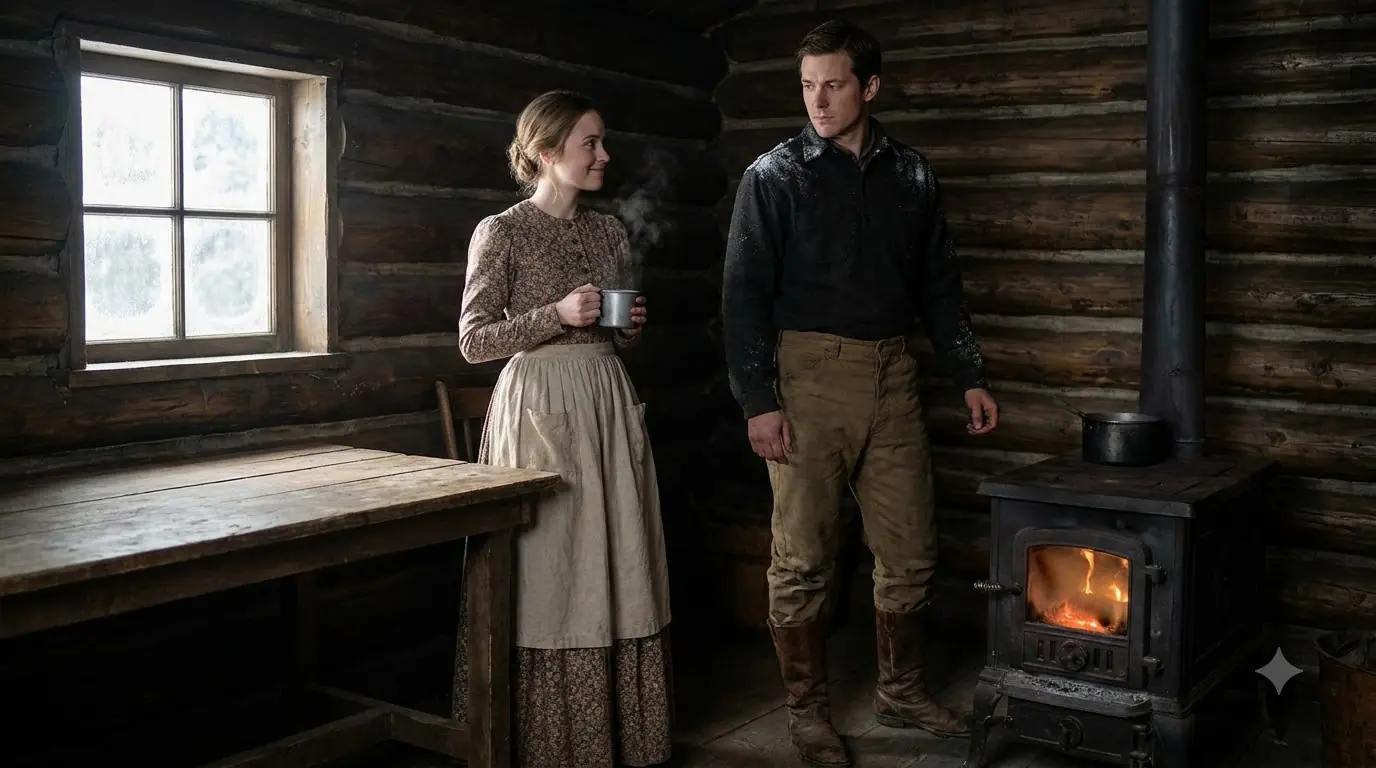
The cabin appeared as the sun dropped behind the ridge, weathered logs, smoke-blackened chimney, one window catching the last orange light. No garden, no curtains, no sign a woman had ever set foot here. Silas swung down, tied the horse, lifted her valise without looking at her. She followed him inside. The door scraped against the floor.
One room, a cast-iron stove squatting cold in the corner, a table with two chairs, shelves lined with tins and jars. Everything arranged with a precision that felt less like order and more like defense. Your room's through there. He pointed to a narrow door. I sleep in the loft.
Clara nodded. Her fingers found the clasp of her valise. You handle the cooking and the house. I handle everything outside. He was already crouching by the stove, feeding kindling into the belly.
We don't need to talk about what came before, either of us. The fire caught. Light crawled up the walls. She opened her valise and pulled out the tablecloth white linen embroidered with yellow daisies, edges frayed from years of washing. Her mother's hands had stitched those flowers.
She spread it across the rough pine table. Silas stood. His eyes moved to the cloth. Something shifted in his jaw, a muscle tightening, releasing. He didn't say anything.
Neither did she. Supper was beans and hard bread. They ate facing each other. The tablecloth between them like a question neither knew how to ask. When he finished, he stood, rinsed his plate in the bucket by the door, and climbed the ladder to the loft without a word.
Clara sat alone. The fire popped. Wind pressed against the window glass. Later, in her narrow bed, she pulled out paper and ink from her valise. The letter to her sister in Ohio came easy.
Her handwriting even. Each letter formed with the care of someone trained to precision. From the loft above, she heard him shift, then stop. She kept writing. She didn't know he was watching through the peephole in the floorboards, studying her hand as it moved across the page, steady, practiced, too perfect for a simple widow.
Two weeks passed in a rhythm Clara learned without being taught. She rose before dawn, when frost covered the inside of the window glass, dressed quickly in the cold wool stockings first, then the heavy skirt, then the shawl wrapped twice around her shoulders. The stove was always her apparent first task, kindling smaller logs, the bigger pieces once the fire caught. By the time Silas climbed down from the loft, the cabin was warming and coffee was ready. He never said thank you, but he never left without drinking a full cup.
She learned other things, too. The way he hung his coat on the same peg every night, the left one, never the right. The way he checked the door latch twice before sitting down to eat. The way his hands moved when he wasn't thinking, always reaching for something to do, to fix, to hold. She learned when to speak and when to stay quiet, mostly quiet.
The days took on a shape. He went out before full light and came back when the sun touched the ridge. She cooked, cleaned, mended, kept the fire burning. They ate together at the table with her mother's tablecloth spread between them, and the silence was heavy, but not hostile. Small things.
She noticed small things. He never started eating until she sat down. She'd tested it once, staying at the stove longer than necessary, stirring the pot that didn't need stirring. He'd waited, fork in hand, plate full, waiting. When she finally sat, he picked up his fork and ate without comment.
She didn't mention it. The first real snow came in early November. Clara watched it through the window all morning, thick flakes falling steady, covering the ground, the wood pile, the path, the outhouse. By noon, the world had turned white. By mid-afternoon, the wind picked up, and the flakes came sideways, hard as sand.
Silas had left at dawn to check the fence line. That was 8 hours ago. She kept the fire burning, swept the floor that didn't need sweeping, mended a tear in her spare dress, the calico one she'd brought from Ohio, ground coffee beans in the hand mill, the crank squeaking with each turn. The light failed early. She lit the oil lamp, reheated the water, let it cool, reheated it again.
The clock on the shelf, a small brass thing she'd found in a drawer, and wound without asking, showed 5:00, then 6:00, then half past. The wind screamed against the walls. Clara stood at the window. But there was nothing to see. Just white.
The snow coming so thick it erased everything beyond the porch. She thought about the trail. The way it narrowed near the ridge. Where rocks jutted out and a man could lose his footing if he couldn't see. She thought about the cold.
How it could take a body down in pieces. Fingers first. Then feet. Then thoughts going slow and strange. She put another log on the fire.
Reheated the water a third time. At seven. The door opened. Silas came in on a gust of wind and snow. His shoulders white with it.
His beard crusted with ice. He stood in the doorway breathing hard. Then pushed the door shut against the storm. Clara's hands pressed flat against her apron. He pulled off his gloves.