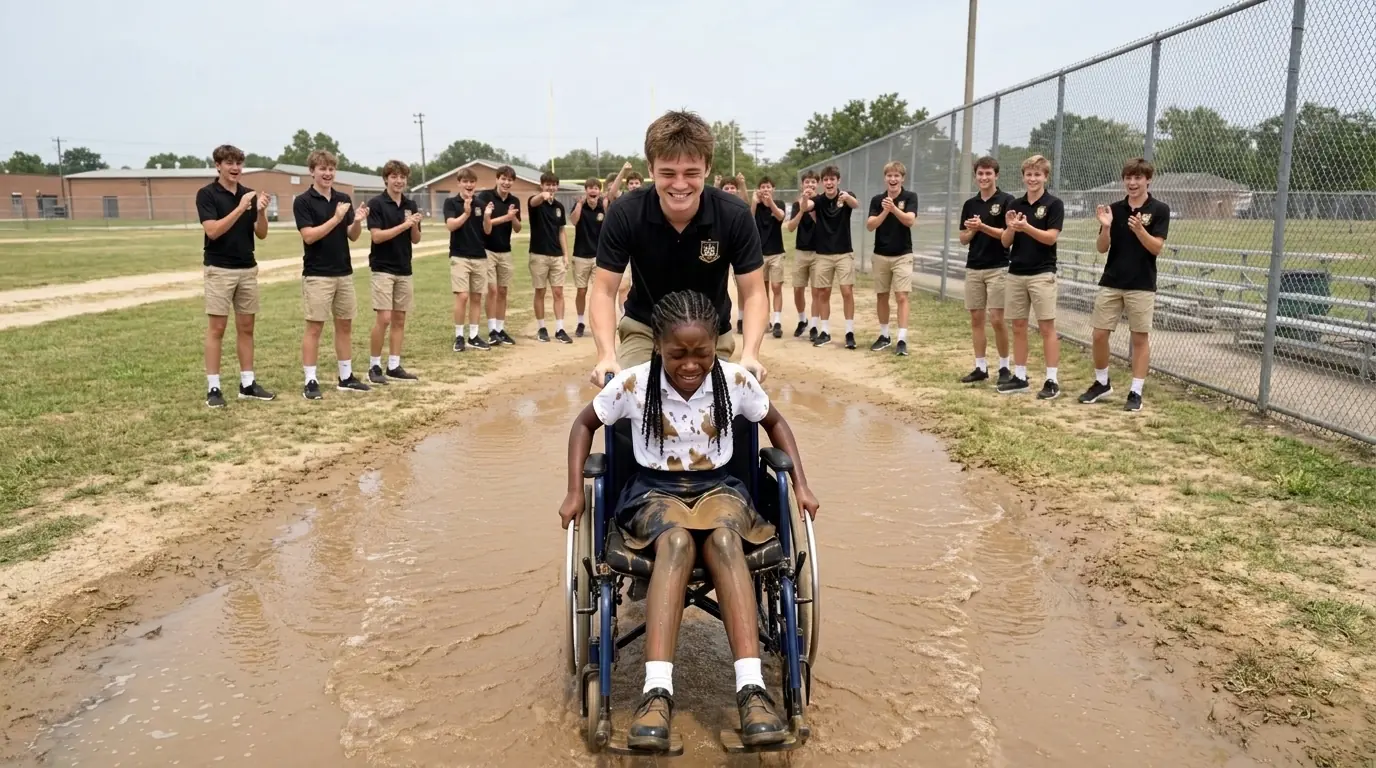
The first thing Hannah Walker felt was the front wheels of her wheelchair drop. One second she was rolling along the dirt path beside the athletic field at Briar Glen Academy, and the next her chair pitched forward into a wide brown puddle left by the previous night’s storm. Mud exploded across her white school polo, navy skirt, arms, and blonde hair while a line of boys in matching black athletic shirts laughed behind her. Hannah screamed and grabbed the wheels, but the chair had already sunk several inches into the soft ground.
Standing directly behind her was Tyler Barrett, seventeen years old, captain of the junior varsity lacrosse team and the person whose hands were still wrapped around the wheelchair handles. He looked over his shoulder at his friends as though he had just completed some clever stunt they had all been waiting to see. Two boys clapped, another doubled over laughing, and somebody near the bleachers had a phone pointed toward them. Hannah twisted around as far as she could and stared at Tyler through tears.
“Get me out.”
Tyler was still smiling.
Anyone watching only those first few seconds might have thought it was a reckless school prank that had gone too far. What they could not see was that Hannah had spent almost seven months telling adults that Tyler’s jokes were becoming more aggressive. They could not see the meetings, the warnings, the accessible ramp he had deliberately blocked, or the video he had once posted of Hannah struggling through a doorway while his friends laughed in the background. Most importantly, they could not see that Tyler had been told in writing not to touch Hannah’s wheelchair again.
The mud pit was not the beginning.
It was simply the moment nobody could call it harmless anymore.
Hannah had not always used a wheelchair. Until the summer before sophomore year, she had been a cross-country runner who complained about six-mile practices and secretly loved every miserable second of them. She was fifteen when a pickup truck ran a red light and struck the passenger side of the car her aunt was driving home from a family birthday dinner. Hannah survived with a spinal cord injury that left her with limited movement below the waist.
For the first months afterward, she hated nearly every inspirational sentence adults said to her. She hated being called brave when she was angry, strong when she was exhausted, and inspirational when she was simply trying to get from physical therapy to the parking lot without dropping her backpack. Her mother, Rebecca Walker, learned quickly not to tell her everything happened for a reason. Her father, Michael, learned that sometimes the best thing he could do was sit beside her without trying to fix anything.
Returning to Briar Glen Academy was Hannah’s idea. The private school outside Raleigh, North Carolina, had offered home instruction for the remainder of sophomore year, but Hannah refused. She wanted classrooms, friends, cafeteria food, stupid announcements, and teachers giving surprise quizzes. She wanted the life she had before, even if she had to enter it differently.
The school promised accommodations. Maintenance installed automatic door buttons in two buildings, teachers rearranged desks, and administrators moved Hannah’s locker to the end of a wider hallway. Most students adjusted faster than adults expected. After the first week, Hannah’s wheelchair became less interesting than whoever had broken up, cheated on a test, or scored the winning goal Friday night.
Tyler Barrett was one of the exceptions.
He and Hannah had known each other since seventh grade. They had never been friends, but before the accident he barely noticed her outside shared classes. Tyler played lacrosse and soccer, surrounded himself with boys who treated every hallway as an audience, and had discovered early that getting people to laugh was an easy way to become important.
At first his comments after Hannah returned were almost normal.
“Need a tow?”
“Bet you never get tired walking between classes.”
“You probably get the best parking spot now.”
Hannah rolled her eyes.
Tyler laughed.
She assumed he would become bored.
Instead, laughter rewarded him.
The first incident happened outside the cafeteria. Hannah had stopped beside a table to put her phone into her backpack when Tyler came up behind her and pushed the wheelchair approximately fifteen feet down the hallway. He did not push hard enough to hurt her, and when Hannah grabbed the wheels, he released the handles immediately.
“Relax,” he said.
“You looked stuck.”
“I wasn’t.”
“Now you’re unstuck.”
His friends laughed.
Hannah did not.
“Don’t touch my chair.”
Tyler held up both hands.
“Message received.”
For two weeks, he kept his hands to himself.
Then he started calling her wheelchair the Ferrari.
At first other students repeated it because Hannah herself had joked that the chair cost more than a used car. The difference was that when Hannah made the joke, the wheelchair belonged to her. When Tyler used it, he said things like, “Move the Ferrari,” or “Somebody valet Hannah,” as though she were an object taking up hallway space.
Her friend Sophie Kim wanted her to report him.
Hannah refused.
“He wants attention.”
“He’s getting attention.”
“Exactly.”
Sophie frowned.
“That logic makes no sense.”
“It will when he gets bored.”
He did not get bored.
By October, Tyler had begun using Hannah as a regular target whenever his friends were nearby. He stood in front of ramps pretending not to notice her. He placed his backpack behind one wheel so she had to ask him to move it. Once, during lunch, he rolled a basketball beneath her footrest and told everyone she had “run it over.”
Individually, every incident sounded childish.
Together, they began changing Hannah’s day.
She stopped using the hallway outside the gym after fourth period because Tyler’s group gathered there. She waited five extra minutes before leaving lunch. She began checking behind herself whenever she stopped near the athletic building.
Rebecca noticed before Hannah admitted anything.
“You keep taking the long path to pickup.”
Hannah shrugged.
“Less crowded.”
“It’s also uphill.”
“I need exercise.”
Rebecca gave her the look mothers developed specifically for detecting nonsense.
“What’s happening?”
“Nothing.”
“Hannah.”
She sighed.
Then explained.
Not everything.
Enough.
Rebecca’s expression changed.
“Has he touched the chair?”
“Once.”
“You told him to stop?”
“Yes.”
“Did he?”
“For a while.”
That afternoon, Rebecca emailed Dean Catherine Morris.
Hannah hated that.
“I could’ve handled it.”
Rebecca stared at her.
“You have been handling it.”
“Exactly.”
“No.”
Her mother sat across from her at the kitchen table.
“You have been adjusting your life around it.”
Hannah started to argue.
Then stopped.
She knew the difference.
Dean Morris met with Hannah the next morning.
She took the complaint seriously enough to interview Tyler but not seriously enough, Hannah later believed, to understand the pattern. Tyler admitted pushing the wheelchair once but called it a joke between classmates. He denied intentionally blocking ramps and said any other incidents had been misunderstandings.
The dean gave him a warning.
Tyler apologized.
Technically.
“I’m sorry if you thought I was messing with you.”
Hannah stared at him.
“That isn’t an apology.”
Tyler smiled.
“It’s what I’ve got.”
Dean Morris interrupted before Hannah answered.
The school considered the matter handled.
Tyler considered it humiliating.
Until then, he had assumed Hannah would continue ignoring him. Getting called into the dean’s office transformed the situation in his mind from jokes to conflict. Worse, his father had been notified because Briar Glen documented student conduct warnings.
Daniel Barrett was not amused.
“You are seventeen years old,” he told his son that evening. “Why is anyone having to explain that you don’t push someone else’s wheelchair?”
Tyler insisted everyone was overreacting.
Daniel asked one question.
“Did she tell you not to?”
“Yes.”
“Then why did you do it?”
Tyler had no answer that made him sound good.
That made him angrier at Hannah.
The harassment changed after that.
Less obvious.
More deniable.
Tyler no longer touched the wheelchair.
Instead, he laughed loudly whenever Hannah passed. His friends sometimes moved to opposite sides of a pathway, forcing her to steer between them. Someone taped a handwritten SPEED LIMIT 5 MPH sign above her locker.
Hannah threw it away.
Sophie did not laugh.
“This is getting worse.”
“It’s paper.”
“That isn’t what I mean.”
“I know.”
“Then tell Morris.”
Hannah looked down the hallway.
“I’m tired of meetings.”
That was the truth adults rarely considered.
Reporting harassment required work.
Dates.
Times.
Descriptions.
Retelling embarrassing moments to people who then asked whether perhaps the person responsible had intended something else.
Sometimes ignoring it required less energy.
Hannah chose less energy.
Then came the ramp incident.
Briar Glen’s athletic complex had a narrow accessible path connecting the gymnasium to the main field. One afternoon in November, Hannah reached the bottom of the ramp and found three lacrosse equipment bags stretched completely across it. Tyler and several teammates were sitting on the grass nearby.
Hannah stopped.
“Move the bags.”
Tyler looked over.
“There’s another path.”
The other path included two steps.
Hannah stared at him.
“You know there isn’t.”
Tyler shrugged.
“Ask someone to carry you.”
Nobody laughed that time.
One teammate, Evan Chase, stood immediately.
“Dude.”
Tyler looked at him.
“What?”
Evan picked up the first equipment bag.
Tyler told him to leave it.
Evan ignored him.
Within seconds, the ramp was clear.
Hannah rolled past without speaking.