The first thing Camille Price noticed was the mist. It came out in short bursts from a travel-size sanitizer bottle, sharp and wet beneath the cabin lights, crossing the space between business-class seats before settling on the cream leather armrest. A few drops landed on the cuff of her camel coat. Camille looked at the cuff first, then at the man in seat 3A. Grant Whitaker held the bottle like evidence.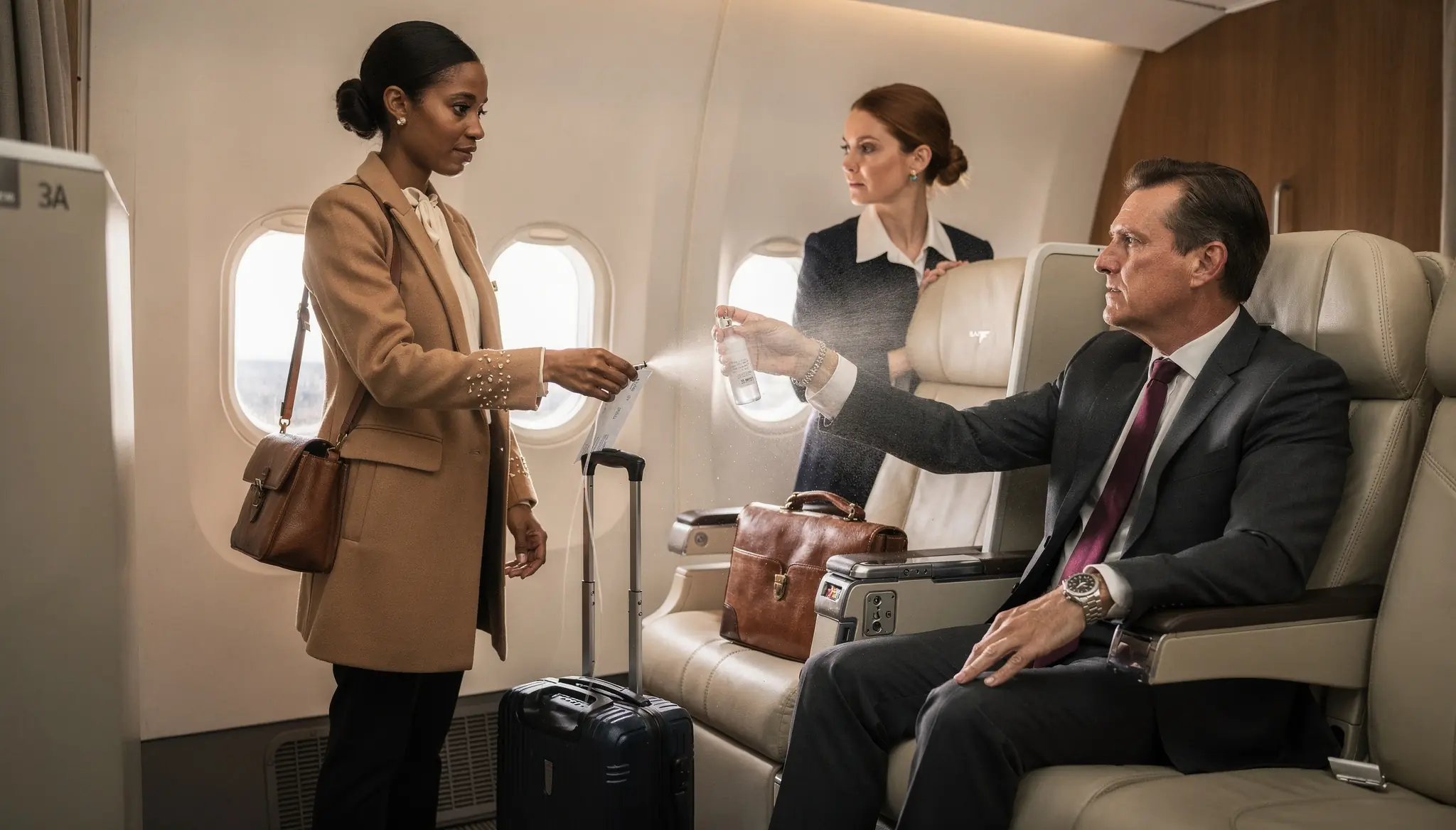
His polished briefcase still sat across the empty seat beside him, blocking 3B. His suit was dark, his watch heavy, his jaw set in the practiced shape of a man used to having small rooms adjust around him. "Move her," he said. The cabin had been boarding in order until then. Wheels clicked into overhead bins.
Seatbelts slid over cushions. A flight attendant closed a closet door near the galley. Now, everything held. Camille kept one hand on the handle of her small carry-on. Her boarding pass rested between two fingers.
The seat number showed clearly, 3B. Grant looked at the pass without taking it. "I paid for a work cabin," he said. "Not a charity row." Camille did not wipe the sanitizer from her sleeve. "That bottle is not doing what you think it is." His eyes narrowed.
"Excuse me." "You are spreading more from your mouth than from your hand." A breath moved somewhere across the aisle. Not laughter. Close enough to make Grant turn his head. A flight attendant stepped in from the front galley. Her name tag read Nora Bennett.
"Ms. Price is assigned to 3B. Mr. Whitaker, I need you to move your briefcase so she can sit." Grant did not touch the briefcase. "Change her assignment." "I cannot move a passenger from a purchased seat because another passenger objects." His mouth tightened. "Another attendant." Erin Shaw stopped behind Camille with a stack of folded blankets in her arms. "Mr. Whitaker," Erin said, "the aisle needs to stay clear." Grant rose halfway, enough to make his height part of the conversation.
"Standards used to mean something in this cabin." Camille looked at him carefully now. Not at the suit, not at the watch, at the control leaving his face in visible pieces. "Standards usually begin with grown men moving their own bags." His face reddened. "You think this is amusing?" "No." Camille's voice stayed level. "I think you saw a Black woman walking to a seat beside you and decided the cabin had made a mistake." Nora shifted slightly between them.
"Mr. Whitaker, sit down." Behind Grant, an older man with silver hair lifted his phone. Camille noticed the movement only because he did not hide it. His thumb touched the screen, then stayed still. Grant saw it, too. He dropped back into his seat, but the briefcase remained where it was.
"She looks like she wandered into the wrong section," he said. "That coat, that bag. I have meetings in New York with people who make actual decisions." Camille's hand tightened once on the carry-on handle, only once. Her mother's brown leather bag rested against her shoulder. Old at the seams.
Polished by years of careful use. Ruth Price had bought it after two extra hospital shifts. Back when Camille's college acceptance letter still smelled of the mailbox. Nora turned to Camille. "There is an open business-class seat two rows forward. You have every right to remain here, but I can move you away from this behavior while I document the incident." Camille looked at Grant's briefcase in her assigned seat, then at the sanitizer drops drying on her cuff.
"I'll take the open seat." Grant leaned back as if a decision had been made in his favor. "Finally." Camille lifted her carry-on. As she passed him, she stopped beside the armrest. "Mr. Whitaker," she said. He looked up.
"By tomorrow morning, you may understand which seat mattered less." He frowned. "What is that supposed to mean?" Camille did not answer. She sat two rows forward by the window. Nora brought water and said she would file a formal report after landing. Camille nodded.
Then she opened a secure message thread with Adrian Cole, general counsel of Hawthorne Crest Capital. "Terminate the Everwell Systems closing. Withdraw the full $120 million. Initiate a leadership integrity review immediately." She pressed send. Behind her, Grant Whitaker reached for the sanitizer bottle again.
The aircraft door closed with him still believing he had protected the seat beside him. Grant Whitaker learned her name above the clouds. The aircraft had reached cruising altitude when the onboard Wi-Fi connected. His phone filled with alerts before the drink cart reached his row. The first came from Blake Mercer, Everwell Systems chief financial officer: "Call me now." The second arrived before Grant unlocked the first: "Hawthorne Crest has terminated the closing." His thumb stopped on the screen for a moment.
The cabin noise dropped behind the blood moving in his ears. He opened the message again, slower this time, as if reading it properly might change the words. It did not. Grant called Blake. "What is this?" Blake answered too fast.
"Where are you?" "On the flight to New York. Did something happen before takeoff?" Grant looked toward the window seat two rows ahead. Camille Price had a tablet open on her tray table. Her coat sleeve still showed the faint dark specks where the sanitizer had landed. "There was a seating issue," Grant said.
"With whom?" "Some woman. She made it difficult." Blake went quiet. Grant hated silence from subordinates. It usually meant they had information he did not. "And what woman?" Blake asked.
Grant lowered his voice. "Black. Young. Camel coat. Old brown bag. Acting like business class was built around her." Blake breathed once into the phone.
"That was Camille Price." Grant's hand tightened around the device. "No." "She founded Hawthorne Crest Capital. She was flying in for tomorrow's closing meeting." Grant looked forward again. Camille turned one page on her tablet. Nothing in her posture had changed.
Blake kept speaking. "Adrian Cole sent formal notice. Full withdrawal. Integrity breach review. Co-investors are freezing their commitments." "Reverse it." "I cannot reverse her instruction." Grant stood before Blake finished.
He walked down the aisle with his jacket buttoned and his face arranged into apology. Camille did not look up until his shadow touched the edge of her tablet. "Ms. Price," he said, "I believe we should speak." She finished reading the line in front of her, then looked at him. "You learned my name." Grant smiled tightly. "There was a misunderstanding." "You sprayed sanitizer around me." "I overreacted." "You called my presence a problem." His smile thinned.
"A decision involving $120 million should not turn on a personal conflict." Camille set the tablet flat on her lap. "It does not." Grant leaned closer. "Then what does it turn on?" "Character. Judgment. Risk." His mouth opened.
She continued before he found a cleaner sentence. "This morning, you gave me information my diligence team could not obtain from your investor deck." Grant looked toward the passengers now watching without pretending. Behind his seat, the older man with silver hair held his phone low against his knee. Camille saw him again. Grant returned to his seat with nothing repaired.
When the aircraft landed at John F. Kennedy, Nora Bennett waited near the forward door with Camille's coat over one arm. "I filed the report," Nora said. Camille took the coat. "Thank you." Nora looked past her toward Grant, who was already on the phone again. "There is someone you should speak to." Camille paused.
Nora removed a folded paper from her uniform pocket. "Monica Hayes. She used to work at Everwell. My cousin said she built one of their hospital platforms. Then she asked for credit." Camille did not open the paper yet.
"What happened?" Nora's eyes stayed steady. "Her reviews changed. Her title disappeared. Then she disappeared from the company." At the Lennox Park Hotel, Adrian Cole was waiting with coffee and a legal folder. Camille placed Nora's paper beside the closing file.
Adrian read the name. "Monica Hayes," he said. Camille looked toward the window where Manhattan moved behind wet glass. "I boarded that plane to decide whether Grant deserved our money." Adrian closed the folder halfway. "And now?" Camille touched the worn handle of her mother's brown bag.
"Now I need to know how many women paid for the version of him I saw." Monica Hayes met Camille the next morning in a small Harlem cafe with rain still clinging to the windows. She brought one folder. Not a thick one. That made it worse. The pages inside were clean, dated, and ordinary enough to survive denial.
Eight years of strong reviews. Product notes for PulseBridge Analytics. Emails naming Monica as the original architect. Then one complaint filed against Grant Whitaker. Two weeks later, the language changed.
Difficult. Reactive. Lacking executive presence. Camille read each page without speaking. Adrian Cole sat beside her, taking notes in a narrow legal pad.
"He told me investors didn't want a Black woman with too much authority in front of the room," Monica said. Camille looked up. Monica's hands stayed folded around her tea. "Then he used my work to raise money." By noon, another former Everwell director called Sofia Reyes. Then an old workplace-justice report surfaced inside Hawthorne Crest's own diligence portal.
The warning had reached Camille's firm six months earlier. It had been archived as reputational noise. Camille closed the report and placed her palm on the table. Not on Monica's folder. On her own company's failure.
"We missed this," she said. Adrian did not soften his answer. "Yes." That evening, Grant tried to take back the story. He stood behind a podium and called the airplane incident a private misunderstanding. He said Camille had put hospital jobs at risk because of personal offense.
Elaine Porter shaped the words from the front row. The next morning, Nora Bennett was suspended by her airline after refusing to rewrite her incident report. Then Henry Whitcomb arrived. He was the silver-haired man from the row behind Grant, a retired federal labor investigator. He carried an old phone, an external drive, and a statement written in careful block letters.
The first recording showed the cabin, Grant's sanitizer, his words, Nora's warning, Camille's calm. The second recording came from the airport lounge after landing. Grant's voice was lower there. "Make her look unstable." Elaine answered. "If she opens the employment files, we have exposure." Then Grant again.
"Deal with the flight attendant before she gives Camille anything useful. Suspend her. Fire her. I don't care." Camille did not move. Henry played the last line.
"If Monica resurfaces, remind her that sick fathers are expensive burdens." Adrian stood before the recording ended. By the next day, Grant took the stage at the American Health Technology Capital Forum to announce replacement financing. Camille entered before the documents were signed. She carried the same brown leather bag. Monica walked behind her with the folder.
Nora came in uniform, her name tag pinned above her heart. Henry followed with the evidence copies. Grant tried to object. The replacement investor closed his folder.
"Let her speak." Camille played the cabin video first. Then Monica laid out the reviews. The complaint. The retaliation. The settlement.
Then Henry's recording filled the ballroom. Grant's own voice did the work. Elaine stood when her emails appeared on the screen. Settlement approvals. Complaint relocations.
Draft language painting Camille as emotional. Instructions to keep the Monica file away from investor review. She did not reach the aisle. Everwell's board chair asked her to remain seated until counsel arrived. The replacement investor withdrew the term sheet before leaving the room.
The financing table stayed set. But no one signed. The microphones remained live long enough for every reporter to hear the sentence. "No capital will proceed under current leadership." Grant looked toward his board. No one stood with him.
Before the summit ended, Everwell suspended Grant and Elaine from all authority. Federal counsel issued preservation orders that afternoon. Elaine's conduct was referred for professional review. Grant's public statement was retracted before market close, with one corrected line added to the company record.
The withdrawal was not caused by investor emotion. It was caused by undisclosed leadership misconduct and retaliation risk. Four months later, Grant's name was gone from Everwell's lobby wall. Monica's employment record was corrected. PulseBridge was publicly credited to her.
Restitution covered wages, benefits, lost equity, and the medical costs the old settlement had buried. Nora was reinstated with back pay, benefits restored, and a cleared file. Her airline issued a written correction stating her original report had been accurate and should not have been softened for a high-value corporate passenger. Hawthorne Crest changed, too. Camille ordered a review of her own firm's failure to escalate the warning report.
The senior diligence director who archived it lost approval authority. The board restored Camille's authority over the Everwell decision and entered its own correction into the minutes. The risk was not Camille's proximity to the harm. The risk was the firm's delay in believing the warning. Every major investment now required an outside workplace equity review and a direct worker reporting channel before capital could close.
Evidence of retaliation triggered automatic funding suspension. Camille flew home with her mother's old bag under the seat. Nora worked the cabin. Monica texted before takeoff: "Daddy came home today. A young engineer accepted a leadership role. She said she stayed because she heard us." Camille looked out the window.
Grant had thought one seat could measure her place. She used one record to measure the whole system.