I never imagined that a simple Tuesday evening would rewrite the course of my life.
There was no screaming when it happened.
No broken plates.
No dramatic discovery on a phone.
No stranger showing up at my door.
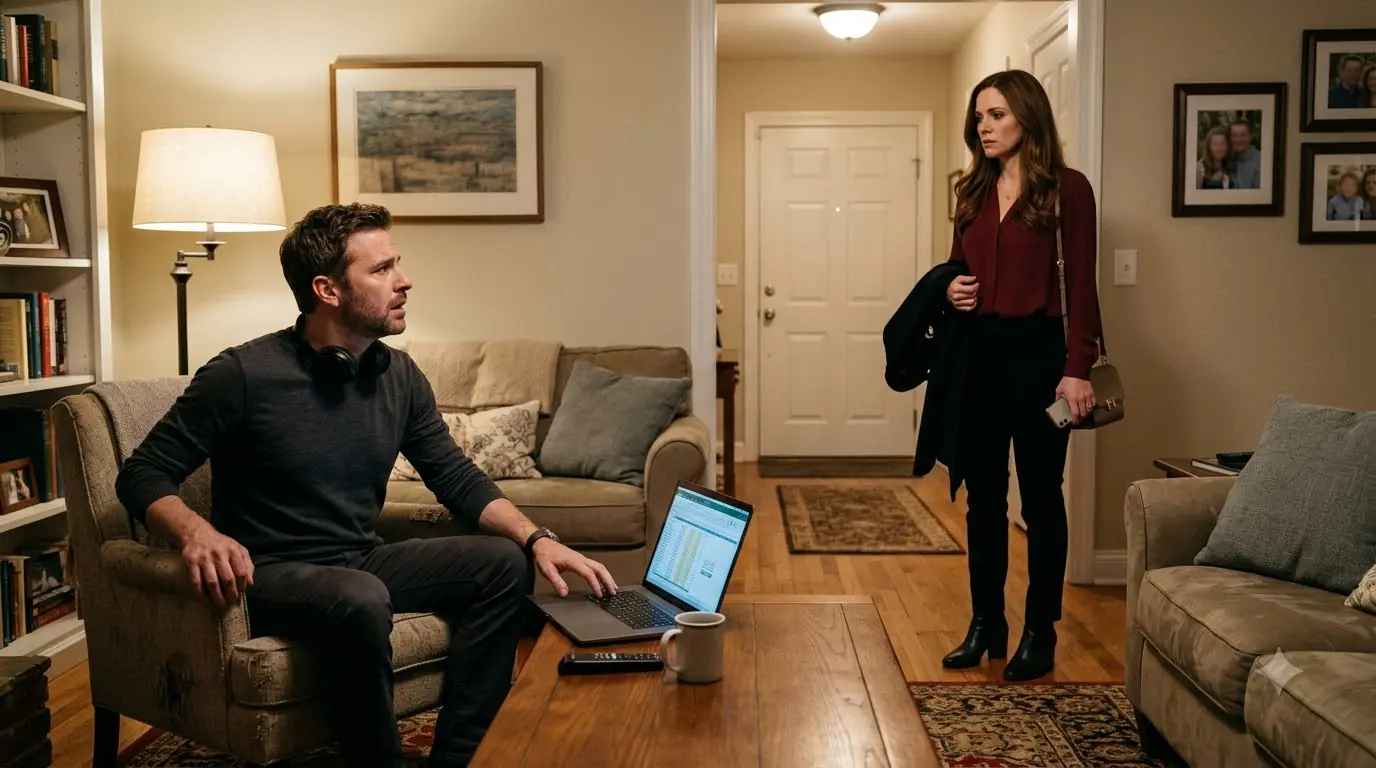
Just my wife standing in the doorway of our living room while I worked on a spreadsheet, telling me another man was taking her out.
My name is Elliot Parker.
I was thirty-nine years old then, and Clara and I had been married for fourteen years.
Fourteen years is long enough to forget what your life looked like before another person became part of nearly every memory.
We had known each other for sixteen.
We had shared apartments, mortgages, vacations, funerals, promotions, illnesses, arguments about laundry, bad restaurants, good Christmas mornings, and one daughter who had somehow inherited Clara's confidence and my stubbornness in equal measure.
Her name was Lola.
She was eleven.
And if you had asked me one week before that Tuesday whether my marriage was in trouble, I would have given you a complicated answer.
If you had asked whether it was ending, I would have said absolutely not.
That was how badly I had misunderstood what was happening inside my own home.
Clara and I met when I was twenty-three.
It happened at a birthday party I had almost skipped.
Theo, my closest friend since college, had spent twenty minutes convincing me to leave my apartment.
“You cannot spend another Saturday reorganizing spreadsheets.”
“I am not reorganizing spreadsheets.”
“You color-coded your grocery budget.”
“That saves time.”
“That proves my point.”
I went mostly to stop him from talking.
Clara arrived forty minutes late.
She walked into the room wearing a red coat, carrying a cake she had accidentally tilted during the car ride, and laughing before anyone had even said anything.
Everyone noticed her.
I certainly did.
Clara had an energy I did not understand but immediately wanted to be near.
She spoke with her hands.
She laughed loudly.
She told stories badly because she constantly interrupted herself with additional details.
She could meet someone once and remember their dog's name six months later.
I was the opposite.
Quiet.
Deliberate.
Organized.
I worked in financial planning for a manufacturing company and could spend forty minutes deciding whether a sentence in an email sounded too aggressive.
Clara once described me as “a man who alphabetizes his feelings before expressing them.”
She meant it affectionately.
At least then.
Our first date lasted four hours.
We ate at a small Mexican restaurant, walked three miles through downtown without planning to, and ended up drinking coffee in a place that was supposed to close before we arrived.
Clara told me she wanted a life that felt big.
Not necessarily rich.
Big.
Travel.
Friends.
Interesting work.
A house where people came over without calling first.
Children, maybe.
A kitchen that always smelled like something cooking.
“What do you want?” she asked.
I thought for a long time.
“Stability.”
Clara laughed.
“That is the least romantic answer imaginable.”
“You asked.”
“Okay. What does stability mean?”
I considered it.
“Knowing who is coming home.”
That stopped her laughter.
For reasons I didn't understand at the time, she reached across the table and took my hand.
“That is actually romantic.”
We married two years later.
For the first decade, I honestly believed we complemented each other.
Clara pushed me into life.
I gave her somewhere steady to return to.
She convinced me to travel through Italy with no hotel booked for the final four nights.
I convinced her that ignoring retirement savings because we were “still young” was not a financial strategy.
She filled our apartment with people.
I remembered to pay the electric bill.
When she wanted to leave a safe administrative job for a marketing role at a technology company, I encouraged her.
When I worried about buying our first house, she reminded me that risk was not automatically irresponsibility.
We were good together.
Not perfect.
Good.
Then Lola arrived.
Clara was extraordinary with her.
She made up songs during bath time.
Turned pancakes into animals.
Built blanket forts large enough to consume the living room.
I handled schedules.
Doctor appointments.
School enrollment.
Savings accounts.
Neither role was assigned.
We simply became ourselves more completely once there was a child watching.
We bought a three-bedroom house in a quiet neighborhood outside the city.
There was a maple tree in the front yard.
A tiny back porch.
A kitchen Clara hated until we renovated it.
On Lola’s fifth birthday, she drew a picture of the three of us standing in front of the house.
Clara was bright yellow.
Lola was pink.
I was gray.
I asked why.
“Because Daddy likes boring colors.”
Clara laughed for almost ten minutes.
That picture stayed on our refrigerator for years.
When did things begin changing?
That question tortured me later.
People want betrayals to have clean beginnings.
One date.
One message.
One obvious decision.
Real marriages rarely fracture that neatly.
If I am being fair, Clara and I had been drifting for several years.
Not because one person woke up cruel.
Because ordinary life can become a machine.
Wake up.
Work.
School.
Dinner.
Homework.
Laundry.
Bills.
Sleep.
Repeat.
Clara’s career accelerated.
She became senior marketing manager for a medical software company.
Then team director.
She loved parts of the work.
She also started working later.
I moved into a more demanding financial analytics role around the same time.
My response to stress was predictable.
I became quieter.
Clara’s was the opposite.
She searched for stimulation.
Friends.
Events.
Work dinners.
Phone conversations.
For years, those differences still worked.
Then they stopped.
Clara began telling me I was emotionally absent.
I told her I was tired.
She said those were not the same thing.
She was right.
I began telling her she never seemed satisfied with being home.
She said home shouldn't feel like another appointment on her calendar.
She was right about that too.
We had arguments.
Not catastrophic ones.
Tired arguments.
“Can you put the phone down?”
“You're on your laptop.”
“I’m finishing something.”
“So am I.”
Or:
“We haven't done anything together in weeks.”
“We went to Lola’s school fundraiser.”
“That isn't a date.”
“When do you want to go?”
“See? You make everything an appointment.”
I would become defensive.
Clara would become louder.
Eventually, one of us would stop.
Then the argument would disappear without actually ending.
That became dangerous.
Unresolved things do not vanish because a house becomes quiet.
They accumulate.
About eight months before the Tuesday night, Clara started mentioning Logan.
Casually.
“Logan thinks the campaign is too conservative.”
“Logan said the client meeting was a disaster.”
“Logan found this restaurant downtown.”
The name meant nothing to me at first.
People have coworkers.
Then it began appearing more often.
Logan was funny.
Logan understood social media.
Logan had traveled through South America.
Logan thought their boss was incompetent.
One night Clara said:
“Logan says I've been playing too small professionally.”
I looked up from the dishwasher.
“What does that mean?”
“He thinks I should be leading regional strategy.”
“Do you?”
“Maybe.”
“Then apply.”
She stared at me.
“What?”
“That’s your answer?”
“What do you want me to say?”
“I don't know.”
She shook her head.
“Something.”
I remember standing there confused.
I thought I had been supportive.
Maybe technically I had.
But technical support was not what she wanted.
She wanted enthusiasm.
Attention.
Curiosity.
I gave her a solution.
Apply.
That difference mattered.
Unfortunately, instead of confronting it honestly, Clara found someone else who gave her the emotional response she wanted.
And instead of confronting my own loneliness, I retreated further into routines I could control.
Looking back, the signs became obvious.
She started smiling at her phone and turning it over when I entered the room.
Not every time.
Enough.
She bought new clothes for work.
Nothing suspicious by itself.
Then began wearing perfume to office meetings when she had rarely bothered before.
She started staying late on Thursdays.
Sometimes Wednesday.
Once she came home at eleven and told me the team had gone out after finishing a campaign.
I asked whether Logan was there.
She looked at me for half a second too long.
“Yes.”
That half-second stayed with me.
I could have asked more.
I didn't.
Why?
Fear.
The simplest answer is fear.
I knew something was wrong.
But naming it would require action.
As long as Clara remained in the house, as long as we still said goodnight, as long as her shoes remained beside mine near the door, I could pretend our marriage was simply going through a difficult season.
People do this more than they admit.
We call avoidance patience.
We call silence trust.
We call distance stress.
Then Tuesday arrived.