“Stand down. Right now.”
Thomas Reed’s warning came half a second too late.
Harlan Brooks’s hand was already moving.
The slap cracked across the concrete plaza in front of hundreds of employees, city officials, rescue specialists, journalists, contractors, and invited families gathered for what was supposed to be a retirement celebration.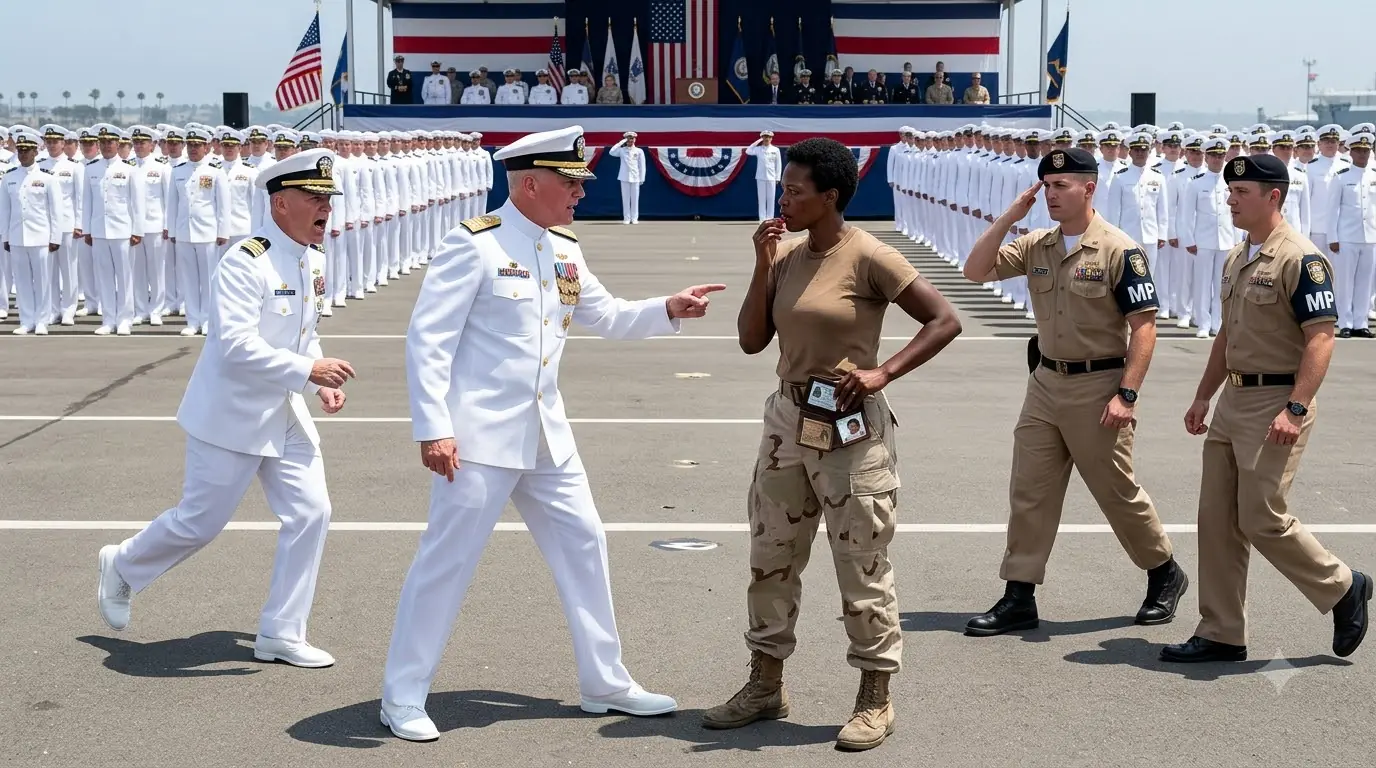
For one stunned second, nobody moved.
Evelyn Tate’s head turned sharply from the impact.
Her body shifted half a step.
That was all.
She did not fall.
She did not shout.
She did not raise her hands.
She slowly brought two fingers to the corner of her mouth.
When she pulled them away, there was a small streak of blood.
She looked at it.
Then looked back at Harlan.
The director of the National Disaster Response Bureau was sixty-one years old, silver-haired, broad through the shoulders, and dressed in the charcoal suit he wore whenever cameras were expected. A blue agency pin gleamed on his lapel. Behind him stood a stage decorated with white chairs, banners, floral arrangements, and a large photograph of Senior Rescue Specialist Daniel Mercer.
The photograph showed Daniel smiling.
Healthy.
Alive.
Ready to retire.
The real Daniel Mercer was three miles away in a hospital intensive care unit, attached to machines after nearly dying forty-eight hours earlier.
Harlan apparently did not know that.
That was worse than the slap.
“You’re a disgrace,” he snapped at Evelyn.
His face had gone red.
“I told you this is a restricted ceremony.”
Evelyn tasted blood.
She remained still.
Harlan pointed toward the gates.
“Leave.”
Nobody spoke.
Thomas Reed, the bureau’s regional operations director, stood ten feet away looking horrified.
“Harlan,” he said carefully.
“Enough.”
Harlan did not even look at him.
Instead he pointed at Evelyn again.
“You come in here dressed like that, ignore three instructions, interrupt my event, and then stand there staring at me?”
Evelyn looked down briefly at herself.
Faded cargo pants.
Dusty tan T-shirt.
Scuffed work boots.
A canvas jacket tied around her waist.
There was dried mud on one knee.
One sleeve had a faint brown stain she had not managed to wash out.
Forty-eight hours earlier those clothes had been inside a collapsed industrial complex where concrete, chemical smoke, rainwater, twisted steel, and human blood had all become the same color.
She had slept six hours since then.
Maybe seven.
She had not come home to change.
She had gone directly from the federal debrief center to the hospital.
Then from the hospital to Daniel’s ceremony because Daniel had made her promise.
If they try to make it sound clean, tell them.
Those had been almost the last clear words he spoke before surgery.
Now Harlan Brooks was standing in front of a stage prepared to do exactly that.
“Security,” Harlan shouted.
Two agency security officers started toward Evelyn.
She looked at them.
Both were younger than her.
One was perhaps thirty.
The other looked barely twenty-six.
Hands near their belts.
Uncertain expressions.
Evelyn did not move.
The first officer said:
“Ma’am, please step away from the stage.”
Evelyn stared at him.
“I’m not going anywhere.”
Harlan laughed without humor.
“There. You heard her.”
He looked around as though expecting agreement.
“Remove her.”
Thomas stepped forward.
“Harlan, stop.”
“This is not helping.”
Harlan turned on him.
“You are not running this ceremony.”
Thomas’s voice lowered.
“No.”
“But I know who she is.”
Harlan paused.
It was the first hesitation.
Tiny.
Barely visible.
Then pride filled the space.
“I don’t care who she is.”
Evelyn almost smiled.
That sentence would not age well.
The younger security officer moved within several feet of her.
The breeze coming off San Diego Bay lifted the hem of Evelyn’s shirt just enough to expose the leather credential holder clipped at her waistband.
The officer saw it.
He stopped.
His partner nearly walked into him.
“What?”
The first officer looked again.
The seal.
The identification strip.
The black-and-silver federal credential casing issued only to senior field personnel with restricted operational clearance.
His entire posture changed.
“Ma’am…”
He straightened.
His partner followed his eyes.
Then recognized it too.
Neither reached for Evelyn.
Instead both stepped back.
Harlan stared.
“What are you doing?”
Neither answered immediately.
“I gave you an instruction.”
The older security officer swallowed.
“Director Brooks…”
“What?”
“I think you should look at her credentials.”
Harlan’s face hardened.
“I don't need to look at anything.”
Evelyn finally spoke.
Her voice was quiet.
“You probably should.”
That made him angrier.
He stepped toward her again.
“Do not tell me what I should do.”
Evelyn reached slowly toward her waistband.
The security officers did not react.
She removed the leather holder.
Opened it.
Held it chest-high.
Harlan’s eyes moved across the card.
EVELYN MARIE TATE
CHIEF FIELD INVESTIGATOR
SPECIAL INCIDENT RESPONSE DIRECTORATE
LEVEL SEVEN OPERATIONAL CLEARANCE
His expression changed.
Not enough.
But something fractured.
Thomas Reed came closer.
“Evelyn led the Blackwater extraction.”
Harlan looked at him.
“What?”
Thomas’s eyes were hard.
“She was the field lead.”
Harlan looked back at Evelyn.
For the first time, uncertainty entered his face.
“You?”
Evelyn closed the credential holder.
“Yes.”
The crowd behind them remained silent.
Journalists near the press platform had begun lifting cameras.
Several employees were recording.
Harlan noticed.
That was when his expression changed again.
Not remorse.
Calculation.
Evelyn knew that look.
She had seen executives use it after explosions.
Agency heads after failed evacuations.
Contractors after safety warnings were ignored.
It was the expression of someone realizing the story had witnesses.
He lowered his voice.
“You should have identified yourself.”
Evelyn touched her lip again.
“I tried.”
“You entered through a controlled gate in field clothes.”
“Because I came from the hospital.”
“You ignored an order to leave.”
“Because you interrupted me every time I spoke.”
“You could have shown your credentials immediately.”
“You told security not to let me approach.”
Harlan looked toward the officers.
Neither helped him.
Then he said:
“This is not the place.”
Evelyn stared.
“You made it the place.”
The photographer nearest the stage clicked another frame.
Harlan heard it.
His shoulders stiffened.
“Thomas.”
“Yes?”
“Move this inside.”
Thomas did not answer.
Evelyn did.
“No.”
Harlan turned.
“What?”
“I’m staying here.”
“This ceremony has guests.”
“So did the operation.”
“What is that supposed to mean?”
Evelyn reached into the cargo pocket of her pants.
Several people tensed.
She pulled out a photograph.
Old-fashioned print.
Bent corners.
Water damage on one side.
Seven people stood beside a shattered concrete loading wall.
Their clothes were dirty.
Faces exhausted.
Daniel Mercer was there.
Evelyn was in the center.
Three of the people in that photograph were now dead.
One had been transferred to a specialist trauma hospital in Germany for reconstructive treatment.
Daniel was unconscious.
Another, Angela Ruiz, had undergone emergency surgery in California.
Only Evelyn had walked out without being admitted overnight.
She held the photograph toward Harlan.
“This was taken seven hours before the collapse.”
He looked at it.
“What am I supposed to be looking at?”
Evelyn pointed.
“Daniel Mercer.”
Harlan frowned.
“I know what Mercer looks like.”
“Do you know where he is?”