CHAPTER 1
An Arrival in the Crescent
May 1814, Miss Prudence Pumphrey had been told a great many things about Bath before she ever set foot in the carriage, most of them by her mother, and none of them encouraging. Bath was the last hope of unmarried women of a certain age. Bath was full of half-pay officers with thinning hair and fuller debts. Bath had killed her great-uncle Augustus by means of the waters, though her mother conceded upon reflection that equally it might have been the brandy.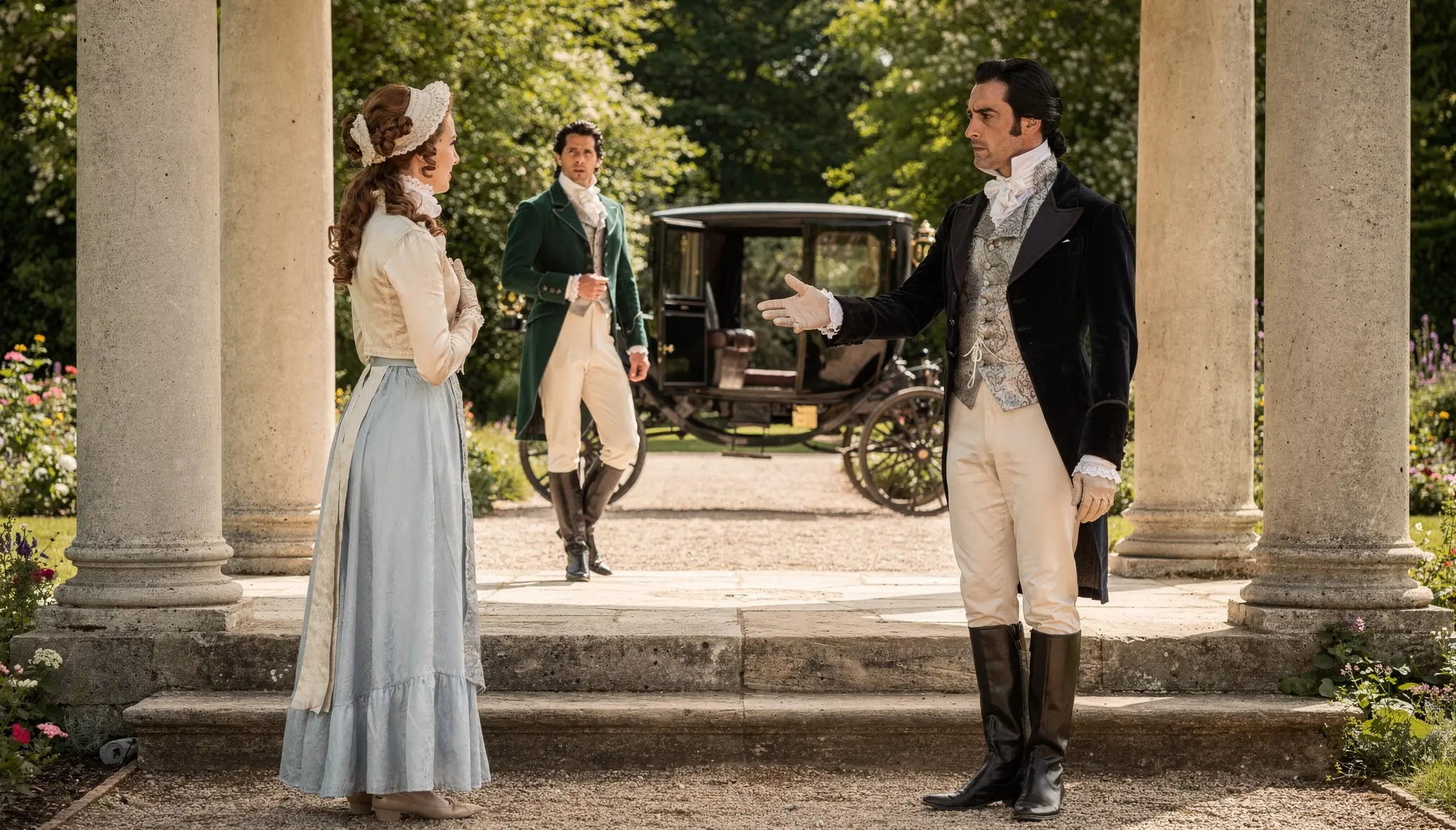
Bath, in short, was where one went when one had run out of better ideas. Prudence, who at four-and-twenty had been quietly running out of better ideas for some years, watched the green country roll past the carriage window and tried to take comfort in the prospect. She had brought three books, two pairs of stout walking shoes, a quantity of plain muslin, and a letter of introduction to her mother's aunt, Lady Bickerstaff of the Royal Crescent. She had also brought, despite her best efforts, herself.
This was, on the whole, the difficulty. Miss Pumphrey was not unhandsome. She had her father's gray eyes, set wide and clear beneath arched brows, and her mother's chestnut hair, a rich, unruly abundance that would have been her best feature if it had ever once consented to remain inside its pins. She had a mouth that turned up at the corners even when she did not mean it to, and a reading voice that had been praised in her own village by the curate.
She had read a great many books and remembered most of them. She was, by every measure she could think of, perfectly suited to becoming somebody's wife. The trouble began only when she stood up. "Miss," said her maid, a placid girl named Hattie, "your reticule." Prudence looked down.
Her reticule was, indeed, on the floor of the carriage, where it had migrated for the third time that morning. She retrieved it and placed it firmly on the seat beside her. The carriage gave a modest lurch, and the reticule slid off again at once, as though offended. "Thank you, Hattie," said Prudence, and put it on her lap.
She turned back to the window. The fields had given way to the first scattered houses of a town. Bath stood in its hollow of green hills, pale and orderly, the long curves of its terraces showing white between the trees. From this distance, it looked, Prudence thought, like a thing arranged for a painting, too neat to be entirely real.
She drew from her sleeve the sheet of parting instructions her mother had pressed upon her at the carriage door, and read it again, although she knew it by heart. "My dearest Prudence," it began, in that hand which managed to convey reproach even in the loops of its capitals. "My aunt, Lady Bickerstaff, has been good enough to receive you for the season, and I trust you will conduct yourself with every credit to your upbringing. Bath is your last opportunity for a respectable establishment, and I beg you to bear this in mind at all times.
Do not, I entreat you, attempt to carry trays. Do not lean upon mantelpieces. Do not handle the better China. If a gentleman speaks to you, answer him as briefly as is consistent with civility, and on no account gesture with your hands."
Prudence folded the letter, put it back inside her sleeve, and looked at her hands for a long moment, as though they were two acquaintances of doubtful character with whom she had been obliged to travel. "Well," she said, to no one in particular, "we shall see." The carriage slowed. The houses had grown taller and paler. The road had taken on that faintly hollow sound that paving stones produced.
They turned into a wide curve of identical fronts, all golden stone and tall windows, all lifted above a broad sweep of lawn, and Prudence looking up found that her breath had gone somewhere she could not immediately reach. "The Royal Crescent, miss," said Hattie, who had been to Bath once before and was disposed to be informative. "Thirty houses, all joined together, only it doesn't look it from outside on account of the pillars."
"It is very grand," Prudence managed.
"Yes, miss. Number eighteen, the coachman says. That will be the one with the green door." The carriage drew to a stop. A footman in dark green livery was already descending the steps. Prudence sat for a moment with her gloved hands folded over the reticule in her lap, gathering herself, and then she gathered herself once more for good measure.
And then she got out. Lady Bickerstaff's house stood behind the green door, severe and respectable in every line. The footman received them with the resigned air of a man who had been admitting relations, parcels, callers, and disappointments for forty years. The trunks were conveyed upstairs.
Hattie was directed to the servants' quarters, and Prudence, drawing in a breath, was shown into the front drawing room. It was a high, pale room with long windows that looked out across the crescent's broad green to the city beyond. A fire was lit, although the morning was mild. On the rug before it, on a velvet cushion the color of claret, sat the smallest dog Prudence had ever seen.
He was a Pomeranian, splendid in russet and cream, with a tail that curled over his back like the plume on a hussar's shako, and a magnificent ruff about his neck and chest. His coat had been brushed to such a state of perfection that the firelight seemed to rest upon it, and at his throat a small medallion engraved with the letter F gleamed against the cream fur. He looked up at Prudence as she entered. His expression suggested that he had been informed of her expected arrival some time ago, and had been reserving judgment ever since.
"My dear child," said Lady Bickerstaff from the high-backed chair beside the fire. "Come in and let me look at you." Lady Bickerstaff was a small, neat woman of seventy or thereabouts, dressed in lavender silk with a quantity of fine white hair pinned up under a lace cap. Her eyes were very black and very alive. She did not rise.
She held out one hand, heavy with rings and perfectly steady, and Prudence crossed the room to take it. "Lady Bickerstaff," she said. "Aunt will do," said Lady Bickerstaff. "Great aunt is accurate, but accuracy is a tiresome thing to bring into a drawing room.
Sit down there opposite. So, you are Frances' daughter?" "I am, ma'am." "You have her hair," said Lady Bickerstaff. "And your father's eyes, which is the better bargain, for Frances' eyes were always a little too close together. No, do not protest.
I have known your mother since she was in leading strings, and I shall say what I please about her eyes. Mr. Fitzherbert, this is your cousin Prudence. Pray be civil."
"The F is for Fitzherbert," said Lady Bickerstaff following Prudence's glance to the small medallion. "Though there are days when I suspect he believes it stands for formidable." Mr. Fitzherbert turned his head an eighth of an inch, regarded Prudence from the cushion, and looked away again.
The dismissal could not have been more complete if he had ordered her carriage. "He is reserving judgement," said Lady Bickerstaff placidly. "He always does. It is one of the finer points of his character.
He has standards you see, and he applies them rigorously, and he is rarely satisfied. He approves of three persons in Bath, of whom I am one, and of perhaps four pastry cooks. He disapproves of footmen who lift him, of ladies who wear too much scent, of small children, of large children, of medium-sized children, and of any gentleman whose tailoring he considers beneath the standard of his own coat. As you will observe, his coat is a very fine one.
He had it from his mother." "I see," said Prudence gravely. "And what does he think of nieces?" "He has not previously had occasion to form an opinion. We shall see what he decides. He is not hasty." "How wise of him," said Prudence before she could stop herself.
"I am rarely improved by first impressions." There was a small silence. Lady Bickerstaff's black eyes brightened. "Well, well," she said. "Frances' letter did not prepare me for that." She rang a small silver bell at her elbow, and a moment later Bates, her elderly butler, appeared in the doorway with the expression of a man who had long ago ceased to be surprised by anything in that house.
"Tea, Bates, and the seed cake. We shall have a proper conversation, niece, and you shall tell me everything your mother has been writing about you, and I shall tell you which parts are nonsense."
"All of it, I should think," said Prudence, sitting at last.
"I should think so, too. We shall do very well together, you and I. Very well indeed." Mr. Fitzherbert, on his cushion, made a small sound that was not quite a sigh. The tea, when it came, came on a tray of such polished silver that Prudence avoided looking directly at it.
The cake was a tall, golden, fragrant thing studded with caraway and glazed with a thin shine of sugar. Bates set it down between them on a low table, bowed, and withdrew. Lady Bickerstaff began to pour. "Now," she said, passing across a cup, "your mother writes that you are clumsy." "I am," said Prudence.
"She writes that you have broken, in the past year, two tea services, a French clock, and a window." "The window was not entirely my fault. There was a wasp." "There is always a wasp," said Lady Bickerstaff, agreeably. "She writes that you have been the despair of three governesses and a dancing master." "Two governesses. The dancing master left for unrelated reasons." "She writes," said Lady Bickerstaff, lifting the cake knife, "that you once set fire to a vicar." "Only slightly," said Prudence, who had been waiting for this.
"His sleeve, and he was perfectly recovered within a fortnight, although he has since been wary of candles." "I see." Lady Bickerstaff cut a generous slice and placed it on a plate. "Well, my dear, I shall tell you something, and I beg you to remember it. Your mother is a fool. A kind fool, I will allow, but a fool of long standing and considerable practice.
She has spent twenty-four years informing you that you are unmarriageable, and she has done it, no doubt, out of love. Have a slice of cake." She held out the plate. Prudence reached for it. The plate, the cake, and Prudence's careful resolution met at precisely the wrong angle.
The slice tipped, slid, and deposited itself neatly in Prudence's lap, glaze side down, leaving a perfect golden seal upon the front of her traveling muslin. Prudence closed her eyes. When she opened them again, Lady Bickerstaff was looking at her with an expression of pure, unholy delight. "My dear child," she said, "you are going to make Bath bearable." Prudence stared at her.
Then, because there was nothing else to be done, she began to laugh. A real laugh, drawn up out of her against her will, the kind of laugh she had not laughed in her mother's drawing room in years. Lady Bickerstaff joined her. Mr. Fitzherbert, on his cushion, opened one eye, surveyed the carnage, and closed it again with the air of a creature whose expectations had been fully met.
When the laughter had quieted at last, and Bates had been and gone with a cloth and a look of long suffering, Lady Bickerstaff leaned a little forward in her chair and lowered her voice, although there was no one to overhear. "Now listen, my dear. Bath is a small place full of large opinions, and you will meet most of them within a week. You will meet women who have not had an original thought since King George was crowned, and gentlemen who think very well of themselves on no good evidence.
You will meet a great many of both. Pay them no mind. Watch instead for the ones who are quiet. Those are the ones worth knowing." "Yes, Aunt," said Prudence.
"Good girl." Lady Bickerstaff sat back, and her voice resumed its ordinary briskness. "Tomorrow, we shall go to the Pump Room. You shall meet what passes for society in this town, and I shall watch them meet you, and we shall see what we shall see. Mr. Fitzherbert will not accompany us.
He has views on the Pump Room, and they are not charitable." Mr. Fitzherbert, without opening his eyes, twitched the very tip of his tail. It was not, Prudence thought afterwards, an encouraging twitch.
CHAPTER 2
The Pump Room Disaster
In his rooms in Laura Place, on the morning Miss Pumphrey was to make her first appearance in Bath society, Lord Adrian Carstairs was in the last stages of being dressed. It was not a ceremony to be rushed. He stood at the center of his bedchamber in shirt sleeves and breeches, while his valet, a grave personage named Stebbins, considered the question of the cravat with the seriousness of a general studying terrain. Three lengths of fine linen lay across the back of a chair.
The fire had been built up. The shutters had been opened to admit the right kind of light, which was the cool, even light of a Bath morning falling across the dressing table from the north. "The mathematical, my lord?" said Stebbins. "Or the oriental?" "The oriental," said Lord Carstairs.
"It is the Pump Room. One does not attempt the mathematical before noon." "Very good, my lord." Stebbins selected the appropriate length of linen and began. Lord Carstairs, who had endured this ritual five mornings a week for nine years, lifted his chin to the precise angle required and let his thoughts wander as they often did at such moments to the subject of his mother. The letter had arrived yesterday.
He could see it from where he stood, propped against the inkwell on the small writing desk by the window. Three pages of crossed handwriting, every inch of paper written over twice. The seal broken, the contents already memorized by virtue of having been read four times in a state of mounting dismay. He did not need to read it again.
Certain phrases had affixed themselves to the inside of his skull and showed no inclination to depart. "Miss Heatheridge has been everything that is gracious during your absence." his mother had written in the tone of a woman delivering a writ. "Her mother and I are quite agreed that the matter wants only your return. I have undertaken on your behalf that we shall be at Brighton in August, where Miss Heatheridge will also be of the party.
You will find her much improved by sea air. I trust you will conduct yourself with the steadiness becoming to a son of your father." Steadiness. His mother used the word as a weapon. His father, Lord Carstairs reflected, had been steady chiefly in the matter of port and had achieved his eventual steadiness in a churchyard at the age of 53, a circumstance for which Carstairs did not entirely blame him.
"My lord," said Stebbins gently. "The chin."
"Forgive me, Stebbins." He raised his chin again.
Stebbins resumed his folding. Miss Heatheridge, Augusta Heatheridge, a girl of nineteen, dispiritingly healthy, who laughed at everything he said in a manner that suggested she had been instructed by her mother to laugh. She was not unhandsome. She had what his own mother described as prospects, which meant a great deal of money and a father perpetually detained by business in Bristol.
He would attend the concerts. He would read. He would speak to no debutantes, attend no balls or assemblies, and keep well clear of any hostess who looked as though she had a daughter to dispose of. He would be, for six weeks, a man without prospects, without obligations, and without conversation that began, "Have you considered, dear Adrian?" "There, my lord," said Stebbins, stepping back.
"I think that will do." Lord Carstairs turned to the glass. The cravat was perfect. The waistcoat, primrose silk embroidered along the edges with a fine running pattern of dark green laurel leaves, was very nearly indecent in its perfection.
The coat, a dark green so deep it was almost black, fitted across his shoulders with the close, easy precision that only Weston achieved. "My hat, Stebbins."
"Your hat, my lord." The hat was placed in his hand.
He took up his stick and his gloves. He drew on the gloves with care. He went out into the bright morning, and walked at his own pace in the direction of the Pump Room, in the full and confident expectation of an unremarkable hour. The Pump Room at eleven o'clock on a fine morning in Bath was, Prudence discovered, not so much a room as a tide.
It moved. From the doorway where she stood beside Lady Bickerstaff, she could see that the company had arranged itself into slow currents, one moving about the great fireplace where the orchestra played, another drifting along the long windows that looked out over the Abbey churchyard, and a third converging at the famous fountain in its alcove, where a woman in a starched apron filled glass after glass with the warm, faintly metallic waters, and handed them out to the hopeful, the ailing, and the merely obedient. The smell of the waters reached Prudence first. Mineral, faintly eggy, and carried on a breath of damp heat.
The smell of a thing trying very hard to be medicinal. Beneath it lay other scents. Pomade, lavender water, hot wool, hothouse roses, and the warm dust of an old building full of people. "Hold up your head, my dear," said Lady Bickerstaff quietly, taking her arm.
"You have nothing to be afraid of in this room. Half of them are deaf. The other half are nearly blind. The remainder are admiring my niece, although they will pretend they are not." "Aunt," whispered Prudence.
"I don't I don't know how." "You do not have to do anything. You have only to be looked at. I shall do the speaking." Prudence glanced down automatically, still half expecting Mr. Fitzherbert's russet plume of a tail beside her aunt's skirts, before remembering that he had declined the Pump Room on the grounds that it contained too many small dogs of insufficient breeding, and that he would not lower himself. Prudence almost laughed.
The almost laugh steadied her. She lifted her head, as instructed, and walked forward into the room on her aunt's arm. The first ten minutes passed in a blur of presentations. A Mrs. Something who had known Lady Bickerstaff since the last century, a Colonel Something with white whiskers who bowed over Prudence's hand and pronounced her charming, which she suspected he pronounced of all young women on principle.
A pair of pale sisters in identical bonnets who stared at her without speaking, and then drifted away in unison like two small fish. Prudence remembered none of their names. She kept her hands carefully clasped in front of her. She did not, as her mother had directed, gesture.
It was while she was nodding gravely at a remark of the Colonel's about the weather, that she happened to look across the room. A gentleman was standing by one of the long windows, alone, half turned away, with a glass of the waters held in one gloved hand at the elegant, negligent angle of a man who had no intention of drinking it. His coat was a dark green so deep it was almost black. His waistcoat, where the coat fell open, was the pale yellow of primroses.
And there was something disciplined about the line of his jaw, and something dark, and not at all disciplined about the wave of hair that had been brushed back from his forehead, and was, even now, considering the question of escape. Prudence forgot, for a moment, that she was a woman of four and twenty who had been told she ought to know better. She forgot the Colonel and the weather. She thought, with the helpless clarity of a heroine in one of the novels her mother had warned her against, "Oh." It was not a sensible thought.
It was not even, she suspected afterwards, an entirely original one. It was the thought of every young woman in every drawing room in England upon being confronted unexpectedly with a gentleman who had been very thoroughly tailored. Prudence, who knew better, had time to recognize this and to be embarrassed by it. And then he turned his head a little, and the morning light caught his profile, and she had to begin being embarrassed by it all over again.
"My dear," murmured Lady Bickerstaff, who had not missed the direction of her gaze. "Do close your mouth. We will go to the fountain. A glass of the waters will be very steadying."
"Yes, Aunt," said Prudence faintly, and allowed herself to be steered. The fountain stood in its shallow alcove at the far end of the room, surrounded by a low press of people waiting their turn. Prudence, with Lady Bickerstaff's hand still firm at her elbow, found herself given a small glass of warm water by the woman in the starched apron. The water was the color of weak tea, and smelt strongly of itself.
"Drink, child," said Lady Bickerstaff. "All of it. It is medicinal." "Is it?"
"It is undrinkable. That is how one knows." Prudence raised the glass to her lips and was preparing to be brave about it, when a small fawn pug, escaping the lap of a stout lady on the bench beside her, crossed the flagstones at speed in pursuit of some urgent object of its own, and inserted itself, with great determination, between Prudence's right slipper and her left. What followed occupied, by Prudence's later account, no more than four seconds. She stepped sideways to avoid the pug.
Her slipper, encountering the pug's hindquarters, did not so much step as skate. Her balance, never her strongest suit, departed entirely. The glass of mineral water traced a short, bright arc through the air. A gentleman who had been standing at her shoulder, in the act of turning to address his companion, met the arc squarely with the front of his coat.
The glass, completing its journey, struck the brim of his hat, knocked it from his head, and went on to introduce itself to the flagstones, where it shattered in a small, clean, musical sound that seemed to Prudence audible in every corner of the room. There was a silence. Into the silence, slowly, the room turned to look. Prudence stood with her empty hands still raised, looking for all the world like a woman who had just thrown mineral water at a stranger, which was regrettably what she had become.
The pug, its mission accomplished, ambled away and was retrieved by the stout lady, who addressed it in terms of deep reproach. The gentleman beside her, Lord Adrian Carstairs, though she did not yet know his name, looked down at the front of his primrose waistcoat, on which the warm waters of Bath were even now completing a slow and thorough application. Then at his hat upon the floor, and then, very slowly, up at her. "I am so very sorry," she whispered.
Prudence had braced herself for fury. She had braced herself for a public rebuke, a cold word, a turning of the back. She had not braced herself for what she actually saw. There was anger in the set of his jaw, and in the white line about his mouth.
But beneath it, quick and startled and not at all under his command, something else flickered in his eyes. It was the look of a man who had just been struck by something more disconcerting than mineral water. The flicker lasted perhaps half a second, then he saw her seeing it, and his face shut like a door. The anger came back in pure form.
He stepped back, bowed with the smallest possible inclination of his head, and walked from the room without a word. Prudence stood at the fountain with the broken glass at her feet and felt the entire Pump Room beginning to murmur. "That," said Lady Bickerstaff at her elbow, in a tone of profound satisfaction, "was a great deal more interesting than I had hoped."
CHAPTER 3
Encounters Multiplied
Lord Carstairs spent the night after the Pump Room disaster in a state of considerable inner argument. He had, on returning to Laura Place, removed the ruined waistcoat himself. Stebbins, on seeing the condition of the primrose silk, had made a small sound suggestive of a man assisting at a deathbed, and Lord Carstairs had proceeded to bathe and dress for dinner with the silent efficiency of a gentleman who did not wish to be addressed. He had dined alone.
He had read for an hour without remembering a word of what he read. He had retired early, slept badly, and risen at half past seven with a feeling of grim resolve. He stood now at the window of his sitting room, looking out across the small garden of the square, and addressed himself with the seriousness of a magistrate. "The matter is settled," he said aloud to the window. I shall avoid her. It is not difficult. Bath is a small place, but not so small as that.
"One has only to be elsewhere." He had, he reflected, been startled. That was all. A respectable gentleman, struck unexpectedly by mineral water and a small pug, might be forgiven a moment of disordered attention.
The fact that the woman responsible had gray eyes, which had, in that disordered moment, struck him as remarkable, was a fact of no significance whatever, because the moment had passed and his attention had returned to its proper objects, which were his coat, his hat, and the broken glass at his feet. He had walked from the room with composure. He was composed now. He intended to remain composed.
It was an excellent morning for a walk to the lending library. He arrived at Duffield's a little before ten o'clock. The library at that hour was largely empty. A single elderly clergyman in the corner with a periodical, a young woman with her governess at the far shelves, and Mr. Duffield himself behind the counter polishing a pair of spectacles.
Lord Carstairs nodded to Mr. Duffield, was permitted with a deferential murmur to ascend the small wooden stair to the upper room where the better bound volumes were kept, and disappeared with relief among the shelves. He had been there perhaps 4 minutes. He had selected a volume of Cowper, replaced it, selected a volume of Pope, considered it, and replaced it also, when he heard from the lower room the unmistakable sound of a small dog announcing itself. Lord Carstairs froze.
He was not a man who froze. He had stood in his time before Miss Heatheridge and her mother, before Almack's patronesses, before his mother's lawyer, and he had not frozen. He froze now. The small dog was being addressed in a voice he had heard only once and had, against his will, retained.
Aunt, I shall just look at the new novels. Mr. Fitzherbert, you must not bark in the library. He is not barking. Came a second voice, dry and amused.
He is announcing. There is a distinction. Mr. Duffield, I require something improving. Have you anything improving?
Sermons, my lady. Certainly not. Something in the nature of a memoir. A memoir of a wicked woman if you have one.
I find them very steadying. There was a soft footstep on the stair. Lord Carstairs, behind a shelf of large folios, considered his position with a clarity that did him credit under the circumstances. The upper room had only one door.
It was the door by which he had entered. It was also, unfortunately, the door at the top of the stairs. And the stairs were, even now, being ascended by Miss Pumphrey, whose tread was light, and by the small dog, whose tread, by the clicking of small claws on wood, was lighter still. He stepped further behind the shelf of folios.
He was not, he reminded himself, hiding. He was choosing his moment. It was at this point, with some inevitability, that the shelf of folios chose it. Miss Pumphrey reached the top of the stairs, turned left, found no one, turned right, found no one there, either, and slipped into the upper room.
She had told her aunt she would look at the new novels. The new novels were, in fact, downstairs. She had come up, she now admitted to herself, because she had not been able to bear another minute of being looked at. The whole of Bath was looking at her this morning.
She had been unable to walk 50 yards down Milsom Street without a head turning, a fan rising, a whisper. The Pump Room incident had become, by the standards of Bath, a sensation. By breakfast, it had spread. By ten o'clock, Prudence had reason to believe that she had wept, been insulted, been defended, and accepted an offer of marriage, though happily not all in the same version.
In one telling, Lord Carstairs had rescued her from humiliation with noble severity. In another, she had thrown a cup at him. In a third, which appeared to be gaining ground with alarming speed, they had understood one another perfectly over the tea urn, and were only waiting for permission to announce it. By noon, no doubt, someone would have drowned.
Lady Bickerstaff had borne her through it with magnificent indifference. "Hold up your head, my dear. They are vulgar. We shall give them no further satisfaction." Prudence had held up her head.
She had held it up so steadily that the back of her neck now ached. She had escaped to the upper room of Duffield's library because the upper room of Duffield's library was the one place in Bath where, for a few minutes at least, no one would look at her. She turned the corner of the first shelf, breathed in, breathed out, and began to feel a little more herself. It was at this moment that the shelf of folios at the far end of the room, overburdened by some optimistic arrangement of Mr. Duffield's, began to surrender.
She turned in time to see a heavy calf-bound volume on the upper shelf tilt slowly outward. The one beneath it followed, nudged by some private treachery of leather and gravity. Only then did Prudence discover what the books had been concealing. A gentleman in a dark coat and pale waistcoat standing behind a large open volume.
Whether he had been reading it or merely using it as a defensive screen against Bath society, she could not immediately determine. She did know him, however. It would have been difficult not to. Lady Bickerstaff had supplied his name before they were halfway home from the Pump Room.
Adrian, Lord Carstairs. His family history, income, and several incompatible accounts of his character had followed before luncheon. Unfortunately, he had chosen the worst possible place to hide. Within three seconds, the books would come down upon him.
"Sir," she said. She moved. He moved. The open volume dropped from his hands, and he caught the two folios as they fell with a quickness that surprised her, and stood holding them, breathing rather carefully, his expression entirely unreadable.
He, it appeared, knew her, too. Miss Pumphrey, I believe. Lord Carstairs, said Prudence. There was a small silence, made more awkward by the fact that they had not, in any proper sense, been introduced.
I beg your pardon, he said. Bath has been generous with information this morning. Excessively generous, said Prudence. Her eyes went to the books still in his hands.
I am extremely sorry. You did not push them, Miss Pumphrey. I am sorry nevertheless. Pray, do not be.
He set the two folios carefully back up on the shelf, taking some trouble over their alignment. He did not look at her while he did this. It is, I think, the nature of folios to fall. They are top-heavy, a defect of the form.
"Yes," said Prudence. She had, in twenty-four years, said many foolish things. Yes was, on this occasion, the foolishest. She tried to think of something else.
A mother's voice arrived in her head with all the dreadful punctuality of maternal instruction and reminded her, sternly, not to gesture with her hands. She kept her hands clasped in front of her. She produced, with effort, a sentence. I had not thought to find you here, my lord.
Nor had I expected to find you, Miss Pumphrey, he said. He turned at last and looked at her directly, and she discovered that her best resolution, to meet his eye steadily and to think nothing whatever, was not equal to the thing it was being asked to do. His eyes were a very dark brown. They had, she noticed for the second time, a slight unevenness about them.
The right eyebrow set a little higher than the left, as though he were always on the point of asking a question he had not quite formulated. I had thought, he went on, in a tone she could not quite read, to read poetry. Cowper, perhaps, or Pope. I had not decided.
Pope, said Prudence, before she could stop herself. Cowper is a melancholy man. He will not do for a Tuesday. A pause.
Indeed. Said Lord Carstairs slowly. He will not. And to Prudence's astonishment, and possibly to his own, he smiled.
It was a small smile, and it lasted perhaps half a second, and it disappeared so quickly that she suspected afterwards she had imagined it. But it had been there. She had seen it. She had also seen, in the same half second, the small pleased flicker behind the smile, as though he had been told an unexpected joke, and was now turning it over in private.
A small clicking of claws on the wooden floor announced the arrival, behind her, of Mr. Fitzherbert. He arrived, considered the company, and proceeded with the composed deliberation of a small magistrate, past Prudence's hem to the gentlemen standing by the shelves. He stopped. He looked up.
He examined the gentlemen's boots with the careful attention of an expert assessing a horse, and then, very slightly, he condescended to wag the tip of his tail. Prudence, watching, felt the corner of her mouth tug. Your dog approves of my boots, Miss Pumphrey. Said Lord Carstairs.
My aunt's dog, and he approves of very little, my lord. You should consider it a great honor. I shall. Said Lord Carstairs.
Endeavor to be worthy of it. Mr. Fitzherbert blinked once, as if accepting the promise. And Prudence, who had come upstairs to avoid being looked at, found herself very much afraid that she did not mind being looked at by him. They descended the stairs together.
Lord Carstairs, with rather more dignity than the circumstances deserved. To remain behind until Miss Pumphrey had gone below would have been possible. It would also have been cowardice, and Lord Carstairs, who had taken refuge behind a shelf of folios only from motives of strategy, could not permit the distinction to collapse entirely. Lady Bickerstaff, at the counter below, looked up from a small volume she had been examining, and took them both in with magnificent blankness.
It was the blankness of a woman who had been a girl in the reign of George the Second, and had subsequently survived three London seasons, two husbands, and a winter in St. Petersburg, and who was not, accordingly, easily surprised. "Lord Carstairs," she said pleasantly, "good morning." "Lady Bickerstaff." "You have met my niece, I believe." "I have had that honor." "Yesterday in the Pump Room, unless I am mistaken," said Lady Bickerstaff. "Yesterday in the Pump Room," agreed Lord Carstairs, with the steadiness of a man surrendering a position he had no hope of defending. "I trust you have recovered." "Entirely, ma'am." "And the waistcoat?" "The waistcoat, ma'am, is at peace." "Ah," said Lady Bickerstaff, "a noble end."
"Mr. Fitzherbert, come." Mr. Fitzherbert, who had been inspecting the toes of Lord Carstairs' left boot with a thoroughness that bordered on insolence, came. Lord Carstairs bowed. Lady Bickerstaff inclined her head with the elegance of a woman who had practiced the gesture since 1761. Prudence, finding suddenly that her hands required occupation, opened the small reticule at her wrist, discovered nothing in it that she wished to occupy them with, and closed it again.
"Good morning, Miss Pumphrey," said Lord Carstairs. "Good morning, my lord." He left. The door of the library closed behind him. Lady Bickerstaff counted out the price of the memoir with unnecessary care, then took her niece's arm, and they emerged into the bright morning of Milsom Street.
Lady Bickerstaff said nothing whatever upon the subject for a full thirty seconds, which was, by her standards, a generous indulgence. Prudence had begun to hope that her aunt had heard nothing from the upper room. This hope was extinguished almost at once when Lady Bickerstaff said thoughtfully, "Cowper is a melancholy man, of course." "Aunt?" "He will not do for a Tuesday." "Aunt?" "My dear, I said nothing. I merely objected to melancholy before luncheon." Prudence walked the length of Milsom Street with her aunt and Mr. Fitzherbert, and with a small crawling warmth at the back of her neck that no amount of holding her head high would dislodge, she had, she discovered, almost forgotten by Quiet Street that anyone in Bath was looking at her at all.
It was only as they turned into the gate of Sydney Gardens, for Lady Bickerstaff had announced that they would walk in the gardens, and a person did not refuse Lady Bickerstaff, that Prudence first saw the rose bush. It had not yet had occasion to regret the acquaintance, but that was still a quarter of an hour away.
CHAPTER 4
A Thorny Encounter
Sydney Gardens at noon on a fine May morning was, Prudence discovered, the most agreeable place in Bath. It was also, regrettably, full of roses. The roses had taken possession of the gravel walks in great rambling hedges, white and pink and a deep crimson which her aunt informed her was called apothecary's rose, and had been planted by some Roman or monk or other. Prudence, who had told herself very firmly while turning in at the gate that she would notice no flowers, attempt no leaves, and on no account lean in to smell anything.
Bore herself with the upright caution of a woman crossing a frozen pond. "My dear," said Lady Bickerstaff on her arm, "you look as though you expect the gravel to bite." "I am being careful, aunt." "You are being stiff. There is a difference."
"Mr. Fitzherbert, do not eat that." Mr. Fitzherbert, who had been investigating something on the path with the air of a connoisseur, lifted his head, considered the rebuke, and abandoned the investigation with dignity.
They walked on. It happened, as these things do, in a perfectly ordinary moment. They had come to a turning where the path narrowed between two great hedges of crimson roses. A lady ahead of them stopped suddenly to admire something her companion had pointed at, and Prudence, stepping aside to let them pass, encountered with the back of her hem the lowest cane of the nearest bush.
The cane, equipped with a quantity of small backward-pointing thorns, declined to release her. She heard the small, clean sound of muslin parting. Prudence went very still. When she looked down, she discovered two things at once.
The first was that her hem was now decorated with a long diagonal tear of perhaps six inches, from which a single thorn protruded with an air of mild satisfaction. The second was that Lord Carstairs, walking the other way along the same path with a book under his arm and every appearance of wishing himself somewhere else, had stopped at a distance of perhaps four yards, and was looking at her with the resigned weariness of one who had begun, in the last 24 hours, to suspect a pattern. "Miss Pumphrey," he said. "My lord." "You have," he observed, "a thorn." "I am aware of it, my lord. Thank you." He came forward. Lady Bickerstaff, beside Prudence, did something with her face which Prudence did not entirely understand at the time and would only afterwards identify as the expression of a woman not laughing. Mr. Fitzherbert sat down on the path to watch. Lord Carstairs knelt.
Prudence was aware, with a small distant horror, that he had placed one perfectly tailored knee upon the gravel in garments that almost certainly cost more than her quarter's allowance. He disengaged the thorn from her hem with great care. As the cane sprang free, another thorn caught the inside of Prudence's wrist just where her glove and sleeve did not quite meet. "Oh," she said before she could prevent it.
Lord Carstairs stood at once. "You are hurt." "It is nothing." It was not quite nothing. A thin red line had appeared across the pale skin, bright and mortifyingly dramatic. He drew from the pocket of his coat a folded square of fine white linen monogrammed at one corner with a small dark C and offered it to her.
"For your wrist," he said. "My lord, I cannot." "Miss Pumphrey," said Lord Carstairs with the patience of a man addressing someone determined to be unreasonable. "You are bleeding in a public garden. Pray do not require me to argue the case." Prudence took the handkerchief.
It was warm. It smelled very faintly of bergamot and of something else, clean linen perhaps, or whatever it was that gentleman's handkerchief smelt of when they had spent the morning in a gentleman's pocket. She found, holding it, that she did not entirely know where to put her eyes. "I shall return it, my lord," she said.
"When it is laundered." "As you wish." He bowed to Prudence, then to Lady Bickerstaff, and glanced at Mr. Fitzherbert, who returned the glance from the path with the level civility of one gentleman acknowledging another. Then Lord Carstairs walked on along the rose walk, turned a corner, and was gone. There was a small silence. "Aunt," said Prudence carefully.
"Please do not say anything." "My dear," said Lady Bickerstaff, taking her arm again. "I had not the smallest intention of saying anything in a public garden. Come. We shall sit on the next bench.
You shall bind your wrist. I shall pin your hem, and Mr. Fitzherbert shall consider whether he approves of the arrangement." They walked on. On the next bench, Lady Bickerstaff, who had every appearance of keeping her promise with difficulty, settled herself with the small contented sigh of a woman whose afternoon was proving better than she had hoped. She produced two pins from her reticule, secured Prudence's torn hem with brisk efficiency, and then took Mr. Fitzherbert into her lap, while Prudence pressed Lord Carstairs' handkerchief to her wrist, and tried not to think about bergamot.
Lady Bickerstaff stroked the dog's ears and observed, to no one in particular, that the gardens were very fine in spring. The next morning, at breakfast, Lady Bickerstaff set down her cup and announced that they were going to Bristol. "To Bristol, Aunt?" "To Bristol. There is a matter of urgent business.
A modiste of my acquaintance has acquired a quantity of French silks by means I do not inquire into, and I have a fancy to view them before they are sold to women of less discrimination than myself. We shall go on Thursday, and stay one night at the Bush Inn. We shall return on Friday. Mr. Fitzherbert is coming.
He likes a coaching inn." "Yes, Aunt." "It is several hours on the road. I have ordered a post chaise."
"Very well, Aunt."
"It happens," continued Lady Bickerstaff, with the elaborate carelessness of a woman approaching a piece of news that interested her very much, "that Lord Carstairs is also bound for Bristol on Thursday on a matter of his own. He has very kindly offered to escort us. It seemed to me a great convenience." Prudence set down her own cup very carefully.
"How?" she said. "Did Lord Carstairs come to know that we were going to Bristol on Thursday?" "My dear, I cannot recall. He may have called."
"Did he call?"
"I believe a card was left. The matter is settled. I have told Hattie to pack your green pelisse. You will want it for the road. Inns are drafty, and the country is always cooler than one expects."
"Aunt..."
"You may pour me another cup of chocolate, my dear, and we shall say no more about it." Prudence poured. Mr. Fitzherbert, on his cushion by the fire, opened one eye, closed it again, and settled deeper into the velvet with the air of a creature whose expectations had been entirely confirmed.
That same morning in his rooms at Laura Place, Lord Carstairs was discovering, with a cold sense of grievance, that he had been managed. He had not, on reflection, called at the Crescent. He had not offered to escort anyone to Bristol. What he had done three days previously was make the fatal error of mentioning to Lady Bickerstaff that he had thought of going to Bristol shortly to attend to a small matter involving a horse.
Lady Bickerstaff had received this information with polite indifference, which Lord Carstairs now understood to mean that she had stored every word of it for future use. The note from her had arrived at half past nine. "My dear Lord Carstairs, what a happy coincidence. We shall be very glad of your company on Thursday.
I have ordered the chaise for ten and shall rely upon your punctuality. Yours, et cetera, A. Bickerstaff."
He read it twice.
He stood for a long moment at his window. Then he laughed once, shortly, in pure unwilling admiration, and went to his desk to write a reply expressing himself honored and obliged. He sealed it, sent it, and sat down afterwards to consider his position. His position, he was forced to acknowledge, was that he had been outflanked by a woman of 70 without her rising from her chair.
He had entirely failed to prevent it, and he was, to his own astonishment, looking forward to Thursday. At ten o'clock on Thursday, the morning was fine and cool with high cloud and a fresh wind. Lady Bickerstaff emerged from the door of the crescent, escorted by Lord Carstairs. The broad satin ribbons of her bonnet streaming in the fresh wind, its high poke crowned with a single sweeping plume.
Behind them came Prudence in her green pelisse and a more modest bonnet, with Mr. Fitzherbert in her arms, for Mr. Fitzherbert, on the morning of a journey, did not walk. He was conveyed. The post-chaise was a comfortable one. Its interior lined with dark blue cloth, the seats well padded and faintly smelling of leather, dust, and the road.
Lord Carstairs handed the ladies in. Lady Bickerstaff took the forward seat, and Lord Carstairs discovered, with no surprise whatever, that Miss Pumphrey had been placed by her aunt's deft hand on the opposite seat beside him, with Mr. Fitzherbert installed between them as a small russet chaperone. The chaise moved off. For perhaps twenty minutes, Lady Bickerstaff carried the conversation.
She spoke of the road, of the inn, of the French silks, and of a memoir she had recently read. She inquired after Lord Carstairs' mother and received a brief and creditable reply. She asked whether Prudence had had the sense to bring a book. Prudence had.
Lady Bickerstaff approved. And then, at a turning of the road outside Saltford, she leaned her head against the side of the chaise and fell asleep as though sleep were another arrangement she had made in advance. There was a silence. Mr. Fitzherbert between them sighed.
She is asleep, said Prudence in a low voice. She is asleep, agreed Lord Carstairs. She was not asleep a moment ago. She was not.
A pause. She has, said Prudence very carefully, a great gift for sleep. She has, said Lord Carstairs, a great gift for many things. Their eyes met briefly over the top of Mr. Fitzherbert.
Prudence looked down at her hands. Lord Carstairs cleared his throat. Outside the hedgerows were bright with new leaves, and a lark was carrying on at some height above a field. Miss Pumphrey, My lord, we have, I think, some hours before us.
We have. It seems to me, he said slowly, looking at the hedgerow rather than at her, that we may either remain in the awkward silence of two strangers or resign ourselves to the situation and converse. I confess to a preference. Prudence considered this.
She considered Mr. Fitzherbert, who had laid his small chin upon her knee with the gravity of an ambassador. She considered the fields beyond the window, the larks, her aunt's steady breathing, and a small unfamiliar warmth somewhere beneath her ribs. Pope, my lord, or Cowper? Lord Carstairs looked at her, his right eyebrow lifted very slightly as though about to ask a question.
"Pope," he said. "It is, I believe, a Thursday." "Of course," said Prudence, but the words escaped on a laugh.
"A Thursday?" Mr. Fitzherbert opened both eyes, registered the sound with profound disapproval, and closed them again. The chaise rolled on toward Bristol.
CHAPTER 5
The Italian Count
They had been home from Bristol for less than half an hour when Bates appeared at the drawing room door. A gentleman to see you, my lady. He said, and presented a card on a small silver tray. Lady Bickerstaff took it, read the name, and lifted one eyebrow.
Count Antonio Bellucci, she said. And a letter, my lady. From Mrs. Trevisham. That, apparently, altered matters.
Lady Bickerstaff held out her hand for the letter, broke the seal, and read it with the expression of a magistrate examining a writ. Mrs. Trevisham recommends him? Said Prudence. Mrs. Trevisham says he was recommended to her, said Lady Bickerstaff.
There is a distinction. Prudence looked at the card again. Lady Bickerstaff folded the letter. Very well, she said.
Show him in. The gentleman who entered did so as if entrances were a serious art, and he had studied it. He was, Prudence thought, remarkably handsome. Black hair, very glossy, brushed back from a high forehead, a clean dark eye, very white teeth.
His waistcoat was a figured silver silk that caught the light whenever he moved, and his linen so immaculate that it seemed less worn than displayed. A scent of something expensive and faintly foreign attended him. He addressed, she thought, not merely to please, but to produce an effect. Lady Bickerstaff, he said, and bowed over her hand with finished elegance.
Forgive the boldness of an unintroduced caller. I bring a letter from your friend Mrs. Trevisham. You will see that she commends me. I am Count Antonio Bellucci.
He pronounced the name with a small, soft flourish on the final syllable. Lady Bickerstaff took the letter without rising from her chair. She read it with the expression of a magistrate examining a writ. Mr. Fitzherbert, on his cushion by the fire, opened both eyes, lifted his head, considered the visitor, and produced a small, dry growl from somewhere very deep in his chest.
Mr. Fitzherbert, murmured Lady Bickerstaff. We do not growl before tea. Mr. Fitzherbert growled again, more clearly. Ah, said Count Bellucci charmingly.
In Italy, dogs expect adoration. Your English breeds, I perceive, prefer first to pass judgement. This one prefers it absolutely, said Lady Bickerstaff, and set the letter aside. My niece, Miss Pumphrey, Prudence said.
The Count took her hand and bowed over it. Then he produced, quite without warning, a smile of such direct warmth, such uncomplicated admiration, that Prudence, who had been complimented in her life by exactly three persons, two of them relations, felt her face become uncomfortably warm. Miss Pumphrey, said the Count. Mrs. Trevisham has spoken of you.
Mrs. Trevisham is too kind, sir. Mrs. Trevisham is frequently kind, said Lady Bickerstaff. It is one of her dangers. Pray be seated, signor.
Bates will bring tea. The count seated himself with graceful obedience. Lady Bickerstaff watched him do it. And what brings you to Bath, signor Bellucci?
"My physician, my lady," said the Count with a graceful little sigh. Ah, he has the most tyrannical opinions on the subject of mineral waters. The waters, said Lady Bickerstaff. The waters.
They are very celebrated in my country. Are they? Most celebrated. Curious.
I had thought your country chiefly celebrated for its own. There was the smallest pause. Perhaps half a second, in which Prudence, who knew her aunt very well by now, recognized that a sword had been drawn. Count Bellucci, who did not yet know her aunt, recovered with a charming laugh.
Ah, my lady, but a man may tire even of paradise when paradise is familiar. He must travel for variety, as I have traveled. I see, said Lady Bickerstaff. And to find such company in Bath He turned again to Prudence with the easy gallantry of a man laying down an ace.
Is recompense for a great deal of traveling. Prudence, lacking any acceptable reply, applied herself to the careful arrangement of her hands in her lap. Mr. Fitzherbert, on his cushion, growled a third time. "Mr. Fitzherbert, we do not deliver opinions to visitors."
Count Bellucci smiled. I fear I have not made the conquest. Not yet. Mr. Fitzherbert is deliberate in his attachments.
Two days later, Lady Bickerstaff and Prudence went out for an afternoon turn along the South Parade. They had gone no farther than the second crossing when Count Bellucci appeared from the opposite pavement with an air of delighted surprise so perfect that Prudence, who had not yet learned to distrust perfection, believed in it at once. Lady Bickerstaff. He said, sweeping off his hat.
Miss Pumphrey. Bath is generous beyond expectation. Lady Bickerstaff looked at him for half a second longer than politeness strictly required. Signor Bellucci.
The count bowed, smiled, admired the weather, deplored the wind, praised the prospect, and with the smoothness of a man who had often turned accident into opportunity, obtained permission to walk with them as far as the end of the parade. Prudence took his offered arm because refusing it would have seemed pointed, and because Lady Bickerstaff, after one glance at Mr. Fitzherbert, did not forbid it. Mr. Fitzherbert, conveyed in Lady Bickerstaff's arms, watched the gentleman in silver with the fixed unblinking attention of a small assassin awaiting his moment. It was at this point that Lord Carstairs saw them.
He had come to the South Parade, he later told himself, for reasons of his own, none of which had anything to do with Miss Pumphrey. It was therefore unfortunate that the first person he noticed, at a distance of perhaps 50 yards, was a small figure in pale blue muslin on the arm of a tall gentleman whose silver figured waistcoat appeared to have been designed to catch the afternoon sun. Lord Carstairs slowed. He could, he reflected, turn down the next street and avoid them entirely.
He did not turn down the next street.
"Lord Carstairs!" called Lady Bickerstaff in a voice that filled the parade. "What a coincidence. Pray come and be introduced." He came. "Signor Bellucci, Lord Carstairs. Lord Carstairs, Count Antonio Bellucci, born in Italy, lately of London, and now by a happy accident of health of Bath." "Sir," said Lord Carstairs. "My lord," said the Count with a bow of moderate depth.
The bow of a man weighing in a fraction of a second the rank of the gentleman before him and adjusting his courtesies accordingly. "Count Antonio Bellucci." He laid a careful stress upon the second syllable of his surname as though he had only recently made its acquaintance. "You are recently arrived, I believe." "This week, my lord." "The London air is too thick for a man of my constitution." "Indeed, and in London you stayed?" "At the Clarendon, very pleasantly." "Lord Petersham is lodged there also. I had the great honor of meeting him at a small evening of cards." "Charming man." "He was good enough to give me his opinion of the new color for waistcoats this season." There was a small pause.
Lord Carstairs' right eyebrow performed a slight private movement that Prudence beside the Count did not see, but Lady Bickerstaff behind them did. "How fortunate," said Lord Carstairs evenly. "Lord Petersham is rarely in London this time of year." "I had understood him to be at Cheveley Park." "Ah," said the Count smoothly. "Perhaps the gentleman was another of the same name." "There are so many lords in England." "I confess I find your nobility most confusing." "Yes," said Lord Carstairs.
Prudence, looking from one to the other, registered nothing of this exchange except that Lord Carstairs was being unusually short and that the Count was being charming about it. She concluded, with a small sinking feeling, that Lord Carstairs had disliked him on sight and was disappointed in him for it. My lord, said the Count. You are acquainted with Miss Pumphrey, I think.
Her aunt has done me the great kindness of receiving me. I had hoped, should Lady Bickerstaff permit and Miss Pumphrey condescend, to call upon them tomorrow. How kind, said Prudence. How kind, echoed Lady Bickerstaff from behind them in a tone that was not the same tone at all.
At the next crossing, the count released Prudence's hand with another elegant bow, explaining that he was expected elsewhere. He smiled, expressed his enchantment once more, and departed in a shimmer of silver silk. Lord Carstairs stood for a moment looking after him. Lady Bickerstaff looked at Lord Carstairs.
Mr. Fitzherbert, in her arms, met Lord Carstairs' eye with the level, steady gaze of a creature of clear convictions and did not blink. My lord, said Lady Bickerstaff pleasantly. I have just remembered a small matter at Duffield's. Would you be so good as to escort us there?
It will not detain you above a quarter of an hour. Ma'am, I am at your service. Prudence, looking from one to the other, observed only that her aunt and Lord Carstairs both seemed in slightly low spirits and that Mr. Fitzherbert, ordinarily so composed, was bristling along the whole length of his small back. Upon arriving at Duffield's, Lady Bickerstaff asked Prudence to look for a new memoir for her.
Prudence, my dear, I require a memoir of a wicked woman, not a merely foolish woman, mind you. Wicked. There is a distinction and I rely upon your education to detect it. Prudence, who had never before been asked to apply her education to wickedness in a lending library, went obediently to the shelves.
Lady Bickerstaff waited until Prudence's back was turned. Then she glanced across the room at Lord Carstairs and made the smallest motion with her fan toward the private parlor. It was not, strictly speaking, an invitation. It was a command in kid gloves.
In the small private parlor behind Duffield's shop, Lady Bickerstaff shut the door, sat down upon the settle with Mr. Fitzherbert in her lap, and wasted no time. Lord Petersham is at Cheveley Park. He is. He has been at Cheveley Park since Easter.
He has. And the Clarendon is a coaching inn. Lord Petersham does not stay at inns. Lord Petersham stays at Petersham House.
Just so. Lady Bickerstaff stroked the small russet head in her lap. I have known one or two Italian gentlemen in my life. An Italian may be careless with an English place name.
He is not careless with his own. Signor Bellucci has pronounced his surname three different ways since Tuesday. There was a silence. Mr. Fitzherbert sighed contentedly.
My niece is the kindest creature in the world and shrewder than she gives herself credit for, except when a man has been pleasant to her. Then she becomes deplorably generous. She has been told all her life that she is not the sort of girl gentlemen pursue. Signor Bellucci pursues her.
She thinks it a compliment. I suspect he thinks it an investment. Lord Carstairs went very still. Her fortune?
A handsome one. Handsome enough to make a silver waistcoat feel itself underdressed. I do not propose to enlighten her. No?
"No," said Lord Carstairs. "I propose to wait until the signor enlightens her himself, which he will in time do by some action it will be impossible to misread." "In the interval, my lord, I should be very much obliged if you would contrive to be often in our company." Lord Carstairs did not reply at once.
He stood at the window looking out into the small back garden of Duffield's, where a single thin cat was attempting to catch a sparrow without success, and he thought, with the slow careful surprise of a man taking the inventory of his own house and discovering rooms he had not known were furnished, that he had not in eight and twenty years ever been asked a question he was so pleased to answer. It would be no trouble at all. I rather thought, said Lady Bickerstaff, that it would not. She rose.
She returned Mr. Fitzherbert to the floor, where he stretched with a small dignified shake. She inclined her head with the elegance of a woman who had concluded a successful campaign before luncheon. Lord Carstairs bowed. The door of the private parlor closed behind him.
When he had gone, Lady Bickerstaff addressed her companion. There, my love, the trap is laid. We have only to wait for the gentleman to walk into it himself. Mr. Fitzherbert, who agreed entirely, sneezed.
CHAPTER 6
A Crescent Breakfast
It was a Tuesday morning in the second week of June, and the breakfast room at the back of Lady Bickerstaff's house was full of light. It looked east into a small walled garden where a single old apple tree was throwing its early shade across a square of grass, and the long sash windows had been opened a little to admit the cool air of the morning. A round table stood in the center of the room, dressed in a cloth so white it seemed to make a small light of its own. On the cloth, set out with the careful informality of a meal arranged for friends, were the comforts of a bath breakfast.
A chocolate pot in white china banded with gold, a coffee pot of polished silver, a basket of warm rolls under a folded linen napkin, a dish of buttered eggs glistening pale yellow, a cold ham glazed dark amber with honey and cloves, a glass dish of preserved apricots glowing like small captured suns, and a jug of Devonshire cream rich and yellow as butter. Lady Bickerstaff sat in her place. Mr. Fitzherbert sat in his, near the hearth, on a small cushion of claret velvet with gold braid reserved for daytime use. His nose pointed toward the cold ham with the steady attention of a small Napoleon studying a map.
Prudence sat opposite her aunt in a sprigged muslin gown of pale yellow, her chestnut hair pinned up loosely, the curls already in mild rebellion at the nape of her neck. She was, she noted with a kind of distant wonder, not afraid this morning. The note had come at nine o'clock, folded and sealed, and brought up by Hattie while Prudence was still in her dressing gown. My dear, Lord Carstairs breakfasts with us at half past ten o'clock.
He returns the volume of Crabbe he borrowed last week. Pray dress simply and without fuss. Aunt B. There had been no time to be afraid.
There had been time only to be helped into the yellow muslin by Hattie, who had remarked that the color suited her, and to fix her hair in the careful loose way her aunt had taught her. "Not flat to the head, child. You are not a Quaker." And to descend at the appointed minute into a room arranged as though nothing in it meant her harm. "You look very well," said Lady Bickerstaff, lifting her eyes from her chocolate.
"Sit. Eat something before he arrives. Hunger is very bad for dignity and worse for conversation." "Yes, Aunt." She sat. She accepted a roll.
She broke it in half with her fingers in the way she always broke a roll and buttered it. Mr. Fitzherbert, on his cushion, registered the breaking of the roll and returned with regret to the contemplation of the ham. Lady Bickerstaff, without looking at him, cut a morsel of ham from her plate and lowered it between two fingers. Mr. Fitzherbert accepted it with the solemnity of a creature receiving what was due to him.
The bell at the front door rang. At half past ten o'clock precisely, Lord Carstairs was shown in. He entered without haste, as though haste were a thing he had considered and found poorly bred, wearing a coat of plain dark blue and a waistcoat of figured cream silk with a volume in one hand. He bowed to Lady Bickerstaff, then to Prudence.
He greeted Mr. Fitzherbert by name, surrendered the volume with a brief and credible remark on its merits, and took the place laid for him at Lady Bickerstaff's right, between her and Prudence, and breakfast began in earnest. For perhaps ten minutes, Lady Bickerstaff directed the table. A remark on crab, an inquiry about his mother, a comment on a piece of news from London. Lord Carstairs answered her with the easy composure of a man who had been brought up in such conversations.
Prudence between them ate her roll, drank her chocolate, and was steadied by the ordinariness of it. The chocolate was very good. The roll was warm enough that the butter sank into it. The breakfast was, against all her expectations, proceeding without disaster.
It was at this point that Bates appeared in the doorway with the particular look of a butler bearing inconvenient news and announced that Mrs. Lambert's housekeeper had come round on a matter of some urgency concerning a hat that had been borrowed and not returned. And would my lady be so good as to spare a few minutes? Lady Bickerstaff set down her napkin as though the moment had arrived precisely on schedule. "Pray excuse me," she said.
"I shall return directly. Lord Carstairs, will you be so kind as to manage the chocolate pot in my absence?" Ma'am. It is a treacherous article and I distrust the handle. I shall be back in a quarter of an hour.
Mr. Fitzherbert, you are in charge. Mr. Fitzherbert, from his cushion, briefly closed both eyes, acknowledging the weight of command. Lady Bickerstaff went. There was a small silence.
Not an awkward one. A silence with weather in it. The pause of a room readjusting itself. Prudence, who had been about to lift her cup, set it carefully back upon its saucer.
Lord Carstairs, after a moment, reached for the chocolate pot. "Miss Pumphrey," he said. "May I refill your cup?" Thank you, my lord.
He poured. He did it with the practiced attention of a man who had been pouring things into cups since he was old enough to be trusted with hot liquids. His sleeve did not catch the rim. His hand was steady.
The dark, fragrant chocolate flowed into her cup without so much as threatening the saucer. He set down the pot and resumed his seat. "My aunt," said Prudence after a careful interval, "is seldom detained by accident." "No," said Lord Carstairs. I should not have supposed so.
She is very fond of arrangements. So I perceive. And of pretending they are not arrangements. He almost smiled.
She saw it begin and watched him put it away. Your aunt is a great commander. He picked up his own cup. Miss Pumphrey, may I ask you something?
Of course, my lord. You break your rolls with your fingers. Prudence looked down at the evidence. So it appears, my lord.
My grandmother broke her rolls so. He said, looking into his chocolate rather than at her. I have not seen anyone else do it in some years. It is, I think, the older fashion.
May I ask where you learned it? From my father. He said a knife disturbed the crumb. He was correct.
Said Lord Carstairs gravely. A knife disturbs the crumb. Prudence looked at him. He looked at his chocolate.
Mr. Fitzherbert, having concluded that his cushion offered no advantage in the present negotiations, rose from it. With the unhurried ceremony of a small judge taking his bench, he installed himself upon the rug at Prudence's feet. She looked down at him and the corner of her mouth betrayed her. Lord Carstairs glanced up from his cup and saw it before she could compose herself.
He approves of you, Miss Pumphrey. He approves of my proximity to the ham, my lord. That is no small distinction. Mr. Fitzherbert does not distribute his good opinion at random.
I am honored. She broke a small piece from the corner of her roll and let it fall beneath the table. Mr. Fitzherbert inspected the offering. It was evidently found wanting.
Prudence, accepting the rebuke, detached a morsel of ham from the edge of her plate and conveyed it down by such careful means that not even the cloth stirred. This Mr. Fitzherbert received with the air of one whose standards had at last been acknowledged. When she looked up, Lord Carstairs was watching her with an expression she could not quite interpret. It was not the startled look he had worn in the Pump Room.
It was not the resigned weariness she remembered from the rose bush. It was something quieter and more attentive. The look of a man reading a sentence twice in order to be certain he had understood it. "My lord," she said.
"I beg your pardon." He glanced away. "The apricots. May I pass them to you, Miss Pumphrey?" He lifted the glass dish and offered it to her. Prudence reached to take it.
His hand remained upon the rim a fraction longer than necessity required, or perhaps she only imagined it did. Their fingers met. His bare, hers gloveless at breakfast, for the duration of a single drawn breath. Then they parted.
She drew breath, found no useful word waiting there, and closed her mouth again. "After you," he said. She took an apricot. She did not, afterwards, recall its taste.
Lady Bickerstaff was gone considerably longer than the quarter of an hour she had promised. When she returned at last, considerably later than any hat, borrowed or otherwise, could justify, she found her two guests deep in conversation about a novel neither of them had finished. And Mr. Fitzherbert fast asleep with his small chin laid upon Prudence's slipper. Lady Bickerstaff stood for a moment in the doorway, wearing the expression of one who has returned to find providence behaving with unusual good sense.
Then she resumed her place, took up her cold cup, and inquired pleasantly whether they had managed without her. "Tolerably, ma'am," said Lord Carstairs. "I am glad to hear it. Mr. Fitzherbert appears to have made himself comfortable." "He has," said Prudence, who did not dare move her foot.
Lord Carstairs took his leave a little while after, with great propriety. His bow to Lady Bickerstaff was entirely correct. His bow to Prudence, by Lady Bickerstaff's private calculation, lasted two seconds longer than civility required. When the door of the breakfast room had closed behind him, Lady Bickerstaff took up her chocolate again, discovered it was cold, and set it down.
She made no remark upon Lord Carstairs' visit. This Prudence understood at once was not silence. It was commentary. A little while later, Prudence excused herself and went upstairs.
In her room, she closed the door and crossed to the small writing desk by the window, where her books were arranged upon the shelf above. From between the pages of the second volume of a novel by Miss Burney, she drew out a folded square of fine white linen, marked in one corner with a small dark C. She held the handkerchief for a long moment, folded small and neat against her palm. The bergamot had faded.
There was only the faint clean scent of her own room now, lavender water, old paper, and the linen itself. She had meant to launder it and return it, as she had promised. She had meant it quite sincerely. She had even, on two separate occasions, carried it as far as the washstand.
And yet there it was, still folded between the pages of Evelina, where no handkerchief had any business to be. She considered the morning very deliberately. The chocolate pot, his easy pouring, the way he had asked about her father without mockery or impatience, the apricot dish, and the half second of touched fingers, and the quiet courtesy with which he had said, "After you." Mr. Fitzherbert asleep upon her slipper, the conversation about the novel neither of them had finished, the bow at the door. Each recollection had a warmth to it, which made the exercise more dangerous than useful.
So, Prudence turned with great care to the truth. The truth was that Lord Carstairs could be kind. She knew he was not always agreeable. She had seen him on the South Parade, cool and short with Count Bellucci, while the count himself had been all elegance and charm.
She had disliked Lord Carstairs for it then. She disliked still the memory of that coldness. But to her that morning, he had been kind. He was a man brought up in good drawing-rooms, a man who knew how to manage a chocolate pot when a hostess was called away.
A man who broke his rolls with a knife, but did not condescend to a guest who broke them with her fingers. He was capable of kindness to a girl who had ruined his waistcoat in a public room, and torn her hem on a public path. Capable of it because he had been raised to be kind, because his honor required it, and because perhaps he was a little sorry for her. That was all.
He was being kind. She had for a few hours been in some danger of forgetting it. She would not forget it again. Prudence folded the handkerchief carefully, returned it to its place inside the second volume of Miss Burney, closed the book, and set it back upon the shelf.
Then she sat down at the writing desk and opened her workbox. After a small search, she found her best needle and a length of pale silk. She drew the torn green muslin into her lap, and set herself to mending the hem, stitch by careful stitch, with all the steadiness of a young woman determined to take herself firmly in hand.
CHAPTER 7
A Pomeranian Defects
The Morning Post brought, among other things, a letter from Mrs. Trevisham. Lady Bickerstaff read it with her customary attention, set it aside with rather less interest, and made a small sound that was not quite a sigh. My dear. Yes, aunt.
I wonder if I might say a word to you about Signor Bellucci. Prudence, who had been engaged with a piece of needlework that had not, in the last quarter hour, advanced by any visible measure, looked up. Of course, aunt. I have made some inquiries since his arrival in Bath.
The answers I have received are, I will say, less complete than I should like. I do not say the gentleman is dishonest. I say only that he is not, on present evidence, the gentleman he gives himself out to be. Prudence considered this.
Mrs. Trevisham vouches for him. Mrs. Trevisham is a kind woman, and not, I think, a particularly observant one. She has never met any member of his family. She has met him on three occasions, of which two were at parties of 50 persons or more.
This is not vouching, my dear. This is being charmed at a distance. I see. I should be obliged to you if you would not accept any further invitations from him that involve private society.
He has not yet asked you upon such an outing. I think it likely that he will. When he does, I should prefer that you decline. Prudence was silent for a moment.
Yes, aunt. Lady Bickerstaff regarded her niece with very dark and very living eyes for the space of three seconds. In Lady Bickerstaff, three seconds could do the work of a quarter hour's scolding. Then she returned to her correspondence with the air of a woman who had said all that could be said and several things besides.
Mr. Fitzherbert, on his cushion, opened one eye, registered that the moment of consequence had passed, and closed it again. Later that morning, Lord Carstairs called. His pretext involved a book. Bates showed him into the drawing room with the gravity of a man announcing the arrival of a foreign ambassador.
The book was a slender memoir. He had borrowed it from Lady Bickerstaff 3 days before after she had described its subject as a woman of disappointing morals but excellent punctuation. He had not, in fact, read it. That is to say, he had taken it back to Laura Place, opened it, held it open, and turned its pages at intervals which corresponded approximately to the speed at which a man might be supposed to read, but his attention had not been on the page.
His attention had not, this past week, been reliably on anything at all. He returned the book now, because 3 days was, by every reasonable standard, a decent interval between calls. He had considered 2 days and found it too eager. He had considered four and found it intolerable.
Lady Bickerstaff was at her writing desk at the far end of the room. She wore a morning gown of dark grey silk and had a quantity of correspondence spread before her, though whether any of it commanded her attention was doubtful. Prudence sat on the small sofa near the fireplace in pale lilac muslin with a piece of needlework in her lap. She had set it aside upon his entrance.
Mr. Fitzherbert occupied the velvet cushion beside Lady Bickerstaff, four paws neatly arranged, chin lifted, and expression severe, as though no one could possibly accuse him of having fallen asleep on Prudence's slipper 3 days before. "Lord Carstairs." Lady Bickerstaff looked up with unconcealed pleasure. "How good of you to come. You bring back a book.
How conscientious. Pray sit. Bates will bring coffee. My niece was at her embroidery." "I am sorry to disturb you, Miss Pumphrey." "Not at all, my lord." She did not, he noticed, pick up the embroidery again.
He sat. He surrendered the book. Lady Bickerstaff inquired after his health. He inquired after hers.
She inquired after his mother. "Quite well, thank you," he said. Lady Bickerstaff accepted the answer and asked no more. The coffee came.
He took his cup. To steady himself, he took also a careful private inventory of the room. A writing desk, a sofa, a fireplace, a clock, a porcelain shepherdess of indifferent quality, Lady Bickerstaff at her correspondence, Mr. Fitzherbert on his cushion, Miss Pumphrey beside the fire, her embroidery set aside beside her. At that point, his inventory became rather less orderly.
Mr. Fitzherbert was watching him with an attention he had not previously been favored with. Prudence broke the small silence. "My lord, are you very fond of memoirs?" "I am, Miss Pumphrey, when they are honest." "Aunt prefers them when they are incriminating." "Then Lady Bickerstaff has the advantage of me. I merely ask to be entertained." "I believe she considers that the same thing." Mr. Fitzherbert on his cushion across the room lifted his head.
What happened next happened quietly. Lord Carstairs would not afterwards be sure whether the dog had moved during Prudence's laughter or just after it. Mr. Fitzherbert rose from his cushion. He stretched in the practiced manner of small dogs everywhere, four legs extended, back arched, tail high.
Then he stepped down onto the carpet with the solemnity of a dog who had reached a decision. He crossed the room. He passed Lady Bickerstaff's writing desk without a glance. He passed the small table beneath the looking glass.
He passed Lord Carstairs' chair without so much as a sniff in the direction of his boot. At last, he arrived at the sofa near the fireplace. There he paused, considering. Then, with the careful deliberation of a creature who knew his own mind and saw no reason to conceal it, he gathered himself and leapt with surprising force for so small an animal into Prudence's lap.
Prudence gave a soft sound of astonishment. Mr. Fitzherbert turned once, arranged himself to his satisfaction, laid his chin upon her wrist, and closed his eyes. There was a brief, complete silence in the drawing room. Lady Bickerstaff's pen paused above her paper.
She looked very slowly across the room. Prudence looked down at the russet head in her lap and did not at first know what to do with her hands. Then she placed one of them, with quiet wonder, upon the dog's back. Lord Carstairs sat motionless, his coffee cup halfway to his mouth, as though the purpose of coffee had temporarily escaped him.
Well, Lady Bickerstaff's voice was composed, though her eyes were bright. Mr. Fitzherbert has made up his mind. It would seem so, Aunt. I wondered whether he would.
He has been considering the matter with great seriousness. Prudence looked down at him. Has he? My dear, you do not imagine he bestows his affections lightly.
He has been observing you and weighing the case. And what tipped the scale? The footman. Last Thursday, James, who is new, made the mistake of supposing Mr. Fitzherbert could be moved like a cushion.
He had already bent and put out both hands to lift him when you saw the danger. You went down on one knee, addressed Mr. Fitzherbert as sir, and waited until he permitted you to take him. Then you restored him to his proper place with all the ceremony he considers his due. He has not forgotten.
I had not thought it of consequence. It was of the deepest consequence to him. A gentler silence settled over the room. Mr. Fitzherbert sighed once with the contentment of a creature who had reached a difficult decision and now intended to sleep upon it.
Lord Carstairs set his coffee cup very carefully back upon its saucer. He was watching Prudence. He could not afterwards remember choosing to watch her. He found only that he was watching her and had been for some time.
She was looking down at Mr. Fitzherbert with an expression of quiet, surprised pleasure that had not been arranged for anyone's benefit. A single curl had escaped her pins and lay against the side of her neck. Her embroidery remained forgotten beside her. Her hand rested lightly on Mr. Fitzherbert's back as though she had been entrusted with something delicate and meant to prove worthy of the charge.
A small smile touched the corner of her mouth before she knew it was there. Lord Carstairs thought, with a clarity so sudden and settled that he would afterwards remember the moment as one remembers the ringing of a clock, that he was jealous of a Pomeranian. Mr. Fitzherbert was in possession of Miss Pumphrey's wrist. Lord Carstairs, who had never envied a dog in his life, found this intolerable.
He thought, in the same long instant, that he, Lord Adrian Carstairs, was in love with a young woman who had once, by her own account, set fire to a vicar. He did not laugh. He did not flinch. He sat in Lady Bickerstaff's drawing room and received the information with the inward stillness of a man who has been handed a writ he had, on some level, been expecting for weeks.
His life, he understood, was over. He could not at once tell whether he was appalled or delighted. He bowed to Lady Bickerstaff and inquired whether he might be of any service. If there were any small errand he might perform before returning to Laura Place, he would be happy to attend to it.
Lady Bickerstaff, with the air of a woman plucking an errand from the very atmosphere, immediately discovered that a note must be left at Duffield's. He bowed to Prudence, who was obliged to acknowledge it from the sofa on account of Mr. Fitzherbert asleep in her lap. His bow lasted, by Lady Bickerstaff's silent count, three seconds longer than civility required. Upon leaving the room, he inquired the way to the front door, which he had found without assistance for more than a month, and had, for the moment, entirely forgotten.
Bates showed him out with the long, careful patience of a man assisting someone through a temporary disorder. The morning was bright on the Crescent. Lord Carstairs stood on the step for a moment, looking out across the wide green to the city beyond. A nursemaid was crossing the grass with two small children.
A gentleman on horseback was walking his horse along the road. The world was proceeding with no apparent recognition that anything had altered. He drew on his gloves and set off. He walked the half mile back to Laura Place in a state of considerable inward disturbance.
He did not afterwards recall the walk. He did not recall leaving Lady Bickerstaff's note at Duffield's, either, though the thing had evidently been done, for the note was no longer in his hand. He recalled only that he had set off from the Crescent, and that at some later point he found himself in his own sitting room, in the middle of his own carpet, with his hat upon his head, his stick under his arm, and his gloves in his hand. He stood there for some time without removing any of them.
Stebbins, encountering him there, paused in the doorway. "My lord."
"Stebbins."
"My lord, your hat."
"Yes, Stebbins."
"Shall I take it from you, my lord?"
"In a moment, Stebbins. I find I am attending to a matter."
Stebbins, who had been in his lordship's service for nine years, and who had not, in those nine years, once seen his lordship attend to a matter while wearing his hat indoors, withdrew tactfully to the dressing room. For the next quarter of an hour, he gave a coat the most unnecessary brushing of its life. When at last Lord Carstairs removed his hat, surrendered his stick, and sat down in the armchair by the window, he remained there for some time, looking at nothing in particular, with the small, still smile of a man who had received unexpected news, and had not yet decided what to do about it. Outside the window, a sparrow alighted on the railing and considered him for a moment with no opinion whatever.
"Quite so," said Lord Carstairs to the sparrow. The sparrow flew away.
CHAPTER 8
A Noble Mistake
In the week following Mr. Fitzherbert's defection, Lord Carstairs altered. He did not alter in any way society could particularly remark. His coat remained fine, his cravat exact, his manners at the Pump Room perfectly composed, but Prudence had spent several weeks trying not to notice Lord Carstairs, and had become in consequence painfully alert to every small change in him. He called more often.
He called, sometimes without a pretext. Where his bow had once lasted the precise civility of two seconds, it now lasted three. Where his eyes had once gone briefly to her face, and then politely elsewhere, they now stayed on her face. And she was twice, three times, five times that week obliged to be the first to look away.
On Wednesday, he brought her a small volume of Pope from his own library with a remark to the effect that Pope was very steady reading for unsettled weather, unsettled spirits, or any day of the week which required fortification. Then he took his leave before she could form a proper reply. He had begun, she perceived with a kind of distant horror, to court her. There could be no other explanation.
She had spent five evenings reasoning with herself upon the subject. She had taken the handkerchief from the second volume of Miss Burney, looked at it again, and returned it to its place. She had reviewed every encounter from the Pump Room onward with the cold, determined honesty of a magistrate examining evidence, and by the small hours of Saturday morning, she had reached a single conclusion which she could no longer evade. Lord Carstairs had been kind to her.
At first, because he was capable of kindness. He had been kind to her after that, because his honor required it. He was now, she perceived, courting her because his honor required something more. He had been thrown together with her by her aunt's contrivance on a great many occasions.
Her aunt, her dear, scheming, well-meaning aunt, had made it impossible for him to disengage. He had been seen calling at the Crescent with increasing regularity. He had bowed to her at the Pump Room, walked with her at Sydney Gardens, and spoken with her at Duffield's. In a town so well supplied with leisure and spectacles, such things did not remain innocent for long.
A gentleman of Lord Carstairs' standing, in such circumstances, had only one honorable course remaining to him, and it was that course Prudence now perceived him to be embarking upon with the steady dread of a man walking calmly toward a duty he had not chosen. He intended, she understood, to make her an offer. He had been brought to it by her aunt's diligence and his own decency. She could see it now in the careful courtesy of his manner, in the steady deliberation of his calls, in the way he looked at her, as though he had resolved upon something and was only waiting for the proper moment to suffer for it.
He must, she thought, on no account be permitted to. She would not be the agent of Lord Carstairs' destruction. He had been kind to her. She would be, in return, kinder still.
She would release him. She would relieve him gently from an obligation he had been pressed into by circumstance, and she would do so with such dignity and such grace that he would afterwards remember her without bitterness, as a young woman who had at the last moment perceived the situation clearly and behaved nobly. She had, in twenty-four years, never resolved upon anything more thoroughly. That a few tears accompanied the resolution was, she decided, neither here nor there.
The opportunity presented itself on Monday morning at the Pump Room. Lady Bickerstaff had gone to consult a modiste in Milsom Street and had declared with suspicious firmness that Prudence could not possibly accompany her. The workroom was too close, the stairs too narrow, the woman too easily distracted. And Prudence, having complained of a small headache, would do far better to take the waters like a sensible creature.
Prudence had submitted, but not without uneasiness. The modiste had taken her measurements only the week before, and Lady Bickerstaff, who had already declared Prudence's hair fit for no one but a Quaker, held equally severe opinions upon her wardrobe. Prudence feared that in the matter of gowns, her aunt could not be trusted to know where elegance ended and exposure began. Left alone with a modiste and an opinion, she was capable of ordering a gown which she would call becoming, the modiste would call fashionable, and Prudence would call insufficiently acquainted with her collarbone.
It had therefore been arranged that Prudence would meet her aunt at the Pump Room at half past eleven o'clock. With Hattie in attendance, Prudence walked to the Pump Room, took a glass of the waters, and managed to drink it without incident. This small success fortified her enough to station herself in the alcove near the second of the long windows, where the morning light fell in a steady, bright shaft across the flagstones. From there, she could see the door, but was not so exposed as to seem to be waiting for anyone in particular.
There, she waited. Lord Carstairs arrived, as she had known he would, ten minutes before the half hour. He was alone. He saw her at once, crossed the room with the unhurried grace she had come to know far too well, and bowed.
Miss Pumphrey. My lord. Lady Bickerstaff is not with you. My aunt is detained in Milsom Street.
Prudence drew a careful breath. I find I'm glad of it. There is something I wish to say to you, my lord, and I should prefer to say it without my aunt's observation. She saw in his face the smallest flicker of something, alertness, perhaps, or hope, which she resolutely declined to interpret.
I am at your service, Miss Pumphrey. Will you walk with me to the far window, my lord? I believe we may speak more quietly there. He bowed and offered his arm.
Prudence took it. They crossed the Pump Room at a measured pace and came to rest beside the farthest window. There were witnesses enough for propriety and distance enough for privacy. Prudence drew a careful breath.
She had rehearsed the opening sentence five times by candlelight and once in the carriage. It came out, against her best efforts, rather quicker than she had intended. My lord, I beg you will not think me presumptuous, but I find I must speak frankly. You have been very kind to me and to my aunt these many weeks past.
You have called when civility could not have required it. You have shown me a courtesy which has been, I think, far beyond anything a gentleman of your standing could owe to a young woman in my circumstances. I have observed it with gratitude. I should not wish you to suppose that I have not.
She paused. He said nothing. His face, she noted, had become very still. My lord, she went on, looking carefully at the embroidery on his waistcoat rather than at his eyes.
My aunt is very fond of arranging matters. I am sure you have perceived it. She has thrown us together with a frequency which cannot have been accidental. I should be very sorry to think that her kindness, however well-meant, had placed you in a position you did not choose for yourself.
She folded her hands more tightly together. You are under no obligation. I beg you to understand that. Whatever the appearance to society, you are entirely free of any expectation from me.
I cannot speak for my aunt, but I can speak for myself. I should think very ill of myself if I permitted you to believe otherwise. She stopped, swallowed, and forced herself to continue. You are released fully and gratefully from any obligation to me, and when you choose a lady, I sincerely hope you may choose her freely and for your own happiness.
There. She had said it. There was a long silence. Lord Carstairs stood very still, one hand upon the head of his cane.
Prudence looked anywhere but at his face, yet she felt his silence all the same. She lifted her eyes at last to his face. He looked like a man who had been handed a verdict before discovering there had been a trial. Miss Pumphrey, he said.
My lord. He drew very slightly half a breath. From what particular obligation do you suppose yourself to be releasing me? It was, Prudence thought afterwards, the gentlest possible question.
She had in her resolution not anticipated being questioned. She had anticipated being thanked, perhaps with grave courtesy and a small bow, and then left to compose herself as best she could. She had not anticipated this. She had not anticipated his stillness, or the careful softness of his voice, or the strange, dreadful possibility that he was not relieved at all.
For one dangerous instant, Prudence wondered whether she had mistaken him. The thought frightened her so much that she rejected it at once. My lord, she began. Miss Pumphrey, The voice was smooth, charming, and unmistakable.
Across the room, having entered as he so often entered at exactly the wrong moment, Count Antonio Bellucci was crossing the flagstones toward them with a glass of the waters in one hand and a smile that seemed to presume rather more than it asked. In the great mirror behind her, Prudence saw three matrons turn discreetly to observe his approach. Signor, said Prudence faintly. Miss Pumphrey, I have been searching the room for you.
Lord Carstairs, sir, I beg your pardon for the interruption. I have but a small matter to put to Miss Pumphrey and then I shall release you both to your conversation. Lord Carstairs bowed with great correctness and said nothing. Miss Pumphrey, said the Count with the easy pleasure of a man laying down a card he had long held in his hand.
I have hired a curricle and a very fine pair of bays for tomorrow morning. There is, I am told, a small ornamental folly some little way from the city, much admired for its prospects. With Lady Bickerstaff's permission, naturally, I had hoped you might do me the honor of accompanying me. Your maid may attend you, of course.
The road is excellent. The morning promises to be fine. I shall drive with the greatest care. Tomorrow, Signor?
I beg you will not refuse me. I have arranged everything. She felt Lord Carstairs go very still beside her. She felt, also, the eyes of the three matrons in the mirror, the sting of her own resolution, and the small terrible logic of a woman who had just told one gentleman he was under no obligation to her and must now prove she had meant it.
You are very kind, Signor. She heard herself say, I thank you. I shall come. Splendid.
At ten o'clock then. I shall call for you in the Crescent. Until tomorrow, Miss Pumphrey. My lord.
Count Bellucci bowed himself away with great elegance, leaving them once more alone at the window. Lord Carstairs did not move. After a moment, he said very quietly, Miss Pumphrey, I must ask you to be careful of that gentleman. Her face altered.
Signor Bellucci Yes. My lord, I cannot think this generous of you. Generous? You disliked him from the first.
I mistrusted him from the first. There is a difference. Perhaps there is, said Prudence with a brittleness she had not known she possessed. But I do not think this is the moment to explain it to me.
Miss Pumphrey, if you will permit me No, my lord. I think we have said enough. I beg you will excuse me. My aunt will be expecting me.
Good day. She turned from him and walked the length of the Pump Room, her chin lifted and her eyes fixed upon the door. Behind her, she felt Lord Carstairs' silence as surely as if he had spoken. At the window, Lord Carstairs stood for some seconds without moving.
Then he transferred his cane to his left hand. His other hand closed slowly around the silver head. And the knuckles whitened beneath his glove. They remained white for some considerable time.
CHAPTER 9
The Folly
Lord Carstairs did not sleep that night. He sat by the window with a glass of brandy he did not drink, and a candle whose wick he had forgotten to trim, reviewing the Pump Room conversation sentence by sentence. He did so with the slow, careful patience of a man examining a wound, and arrived, by 3:00 in the morning, at three conclusions. The first was that Miss Pumphrey believed him to be making her an offer out of duty.
The second was that this misapprehension was so far from the truth, so entirely the opposite of the truth, that he had been unable in the moment to find the words to address it. "I am offering you nothing of the kind, Miss Pumphrey." would have been technically correct and entirely useless. "Miss Pumphrey, I am in love with you." would have been the truth, but the truth, in a public room with three matrons watching and a charming impostor advancing across the flagstones, could not be delivered like a visiting card. The third was that he had let her go.
He had let her, in his slowness and his civility, walk from him out of the Pump Room and into a curricle ride with a man he knew to be a fraud and an opportunist. He had, by his calculation, perhaps 7 hours to undo it. By half past 5:00, he had a plan. It was not, strictly speaking, a plan of great sophistication.
It consisted chiefly of going at once to the Royal Crescent, placing the whole matter before Lady Bickerstaff, and trusting that lady's authority to accomplish what his own could not. At a little past seven o'clock, he sent his man for the carriage. At a quarter to eight o'clock, he was at the door of the Crescent. Lady Bickerstaff sat in the morning room in an ivory silk morning dress, with coffee at her elbow.
She looked up with composed warmth, though her expression sharpened when she saw his face. "Lord Carstairs, this is an early hour for a call." "Forgive me, the matter could not wait." He told her of Bellucci's invitation, of the folly, and of the exchange at the Pump Room which had left Prudence persuaded of a thing entirely untrue. He invited her yesterday in the Pump Room, ma'am, to view a folly on Sir Anthony Wright's estate. She accepted.
He is to call for her at ten. My niece left the house at half past seven o'clock. She informed me that she intended to take an early walk in Sydney Gardens. Hattie accompanied her.
The clock on the mantel ticked once, twice. At half past seven? Yes. And she has not returned?
No. His hand tightened upon the silver head of his cane. I do not think she has gone to the gardens. Nor do I. For the first time, something in her expression altered.
A narrowing, a hardening, and beneath both, the faintest shadow of self-reproach. I warned her, but I fear she thought me merely cautious, not alarmed. A note was soon found in Prudence's room. Lady Bickerstaff read it, and by the time she reached the signature, her mouth had become very thin.
She passed it to Lord Carstairs. My dear Miss Pumphrey, I am in the greatest mortification to trouble you with an alteration in our little expedition, but I find myself obliged to return the bays to their owner by ten o'clock, a circumstance which was not made plain to me yesterday. Rather than disappoint myself of the honor you have granted me, may I beg that we begin earlier. The horses are fresh, and my groom advises that they should not be brought into the crescent while the streets are crowded.
If you would be so good as to meet me at the entrance to Sydney Gardens at half past seven with your maid in attendance, I shall be waiting there, and shall drive with all possible care. I I you will forgive the liberty of this request. Your most obedient servant, Antonio Bellucci. He altered both the hour and the place.
The bays must be returned by 10. The groom advised against the crescent, and her maid was to attend her. Very neat. He gave her three reasons to think herself sensible, and not one to think herself trapped, said Lady Bickerstaff.
"Yes," said Lord Carstairs. That is what concerns me. He has met them at Sydney Gardens. Prudence would have shown Hattie the note, or repeated enough of it to satisfy her.
Hattie would dislike the arrangement, but she cannot refuse her mistress when her mistress has a note in her hand and an engagement already made. They are in the curricle now. The folly is three miles north of the city. I know it.
Then we shall go there. Five minutes later, Lady Bickerstaff descended the stairs in her traveling pelisse. Mr. Fitzherbert trotting solemnly at her heel, his small leather collar and lead giving him the air of a prisoner who had accepted his sentence. Mr. Fitzherbert has been informed of his duties, she said. Lord Carstairs looked down.
Mr. Fitzherbert looked back up with the calm severity of a creature who had accepted command. Then let us go, said Lord Carstairs. By the time the curricle had passed the last houses of Bath, Prudence had discovered that guilt was not, as she had always supposed, a sensation of the heart. It was a sensation of the gloves.
Her fingers worried the seams and tugged uselessly at one another. She had lied to Lady Bickerstaff. Not greatly, perhaps, not wickedly, but a lie need not be large to make itself felt. A pebble in a slipper was not large either, and yet it could ruin a morning.
Hattie sat behind them, very straight and very silent. Signor Bellucci, meanwhile, appeared to be in excellent spirits. He spoke of Lady Bickerstaff's authority, of cages made by kindness, and of Prudence's right to choose for herself. The words found the very place in her mind already bruised from the day before.
She did not belong to Lord Carstairs. She did not belong to anyone. The thought ought to have strengthened her. Instead, it made her feel colder.
The folly appeared after a turn in the road. A small Grecian temple upon a rise with pale columns and a shallow dome. Below it lay a sheet of ornamental water. Beyond the rise stood the great house, half concealed by beeches.
Bellucci drew the horses to a halt. There. He said. Is it not enchanting?
It is very pretty. Pretty? Miss Pumphrey, you wound the place. It is sublime.
Prudence thought privately that the folly was not in the least sublime, but as she had already committed one act of rebellion that morning, she did not feel equal to another over architecture. Bellucci helped her down. Hattie began to follow, but he turned to the maid. I had arranged for something warm to be sent over from the house.
Ask for Mrs. Wilks and say the tray may be brought directly. I do not think refreshment is necessary, said Prudence. My dear Miss Pumphrey, I brought you out too early. Lady Bickerstaff would never forgive me if I permitted you to take cold.
It is but 5 minutes to the house. And we are entirely in view of the road. She could not object too strongly without admitting that there was something to fear. And if there was something to fear, then perhaps Lady Bickerstaff and Lord Carstairs had been right.
That she could not bear. Go, Hattie. She said quietly. But, return directly.
Hattie went, not happily. Then the trees swallowed Hattie's cap, and Prudence was alone with the Count. They climbed the shallow steps to the temple. How quiet it is, how removed from interference.
Interference? In Bath, there are always eyes, always tongues, always some aunt, some lord arranging the pieces upon the board. My aunt is not unkind. No. But, she is determined, and Lord Carstairs is very determined.
At that name, Prudence felt herself color. Bellucci saw it. He has warned you against me, I think. He has expressed an opinion.
An unfavorable one. I am capable of forming my own opinions, Signor. That is what I admire in you. Prudence looked at him more directly.
Signor, I think we ought to return. So soon? Yes, Hattie will be wondering where we are. Hattie is at the house.
Then I shall meet her there. We shall both meet her, Miss Pumphrey, when she returns. She moved to pass him. He moved also, not quite blocking her way, but enough that she had to stop.
My dear Miss Pumphrey, wait. I think Lord Carstairs has wounded you. I think Lady Bickerstaff would govern you. I think you are an heiress whom everyone wishes to direct, and no one wishes to hear.
Prudence stared at him. There it was, heiress. The word sat between them like a dropped coin. I mean only that you are a lady of consequence.
A lady who may choose. Yes, I may. Then choose boldly. He lowered his voice.
Come away with me, to Gretna Green. The words were so absurd that Prudence could only look at him. You ask me to deceive my aunt, abandon my maid, travel with a gentleman I scarcely know, and marry him over the border? I ask you to be free.
It does not sound like freedom. He reached for her hand. She withdrew it. I offer you a title, a devoted husband, a life beyond those who would manage you.
And in return? said Prudence, with a calmness that surprised her. You receive my fortune. His face changed, only a little, only for an instant. But it changed.
Prudence saw it, and something inside her settled. She had been foolish. Her aunt had been right. Lord Carstairs had been right, and she had mistaken concern for interference, and warning for pride.
I think that we shall go to the house now and collect Hattie. Then you will drive us home. My dear girl, do not be childish. I am not your dear girl.
He caught her by the elbow, not violently, but firmly enough that the pressure of his fingers made her gasp. You are making a mistake. I have made several mistakes this morning. I do not intend to add eloping with you to the number.
Release me. Instead, he drew her half a step toward him. At that precise moment, from somewhere beyond the beeches, came the furious barking of a very small dog. A carriage had come flying up the gravel drive, and had scarcely stopped before Lord Carstairs sprang from it.
Lady Bickerstaff followed with somewhat more dignity, and far more menace. Hattie, pale and breathless, was behind them. Mr. Fitzherbert waited for no human arrangement. He shot across the gravel like a russet cannonball.
Bellucci had time only to say, What the devil? in an accent which had suffered a sudden and fatal collapse before Mr. Fitzherbert reached the steps and delivered upon the gentleman's right ankle the considered judgment of two months careful observation. It was a precise and dedicated bite. Ah, the little devil's bit me. Prudence was released.
Lord Carstairs reached the temple steps with his face white and his eyes fixed upon her. Miss Pumphrey, are you hurt? No. Bellucci stumbled backward, still attempting to dislodge Mr. Fitzherbert. His heel met the small ornamental curb.
He lost his balance, waved both arms in a manner no Italian nobleman would have sanctioned, and descended into the ornamental water. The water was 18 inches deep. He sat in it. You little began Bellucci from the pond in an accent that had in the space of a syllable given up the ghost.
Oh, lovely. Lovely this is. Me boots are ruined, me coat weighs a ton, and I've got half the blasted pond up me sleeve. Prudence stared at him.
Bellucci stared back. That is to say, he said with dignity. I am greatly inconvenienced. Lady Bickerstaff took Prudence's hand.
My dear, Prudence looked at her aunt. I lied to you. You did, said Lady Bickerstaff. I am very sorry.
You may be sorry in the carriage. At present, I should prefer you to be safe. Bellucci climbed from the ornamental water. You have misunderstood everything.
"No," said Prudence. I understood you at last. Lady Bickerstaff looked at Bellucci. "If you are still here in two minutes, sir, I shall make you the most entertaining man in Bath before dinner." That, apparently, was enough.
Bellucci climbed into his curricle, dripping from every point of his person, and addressed the company in a sustained and unmusical stream of South London, not one syllable of which had ever crossed the Alps. Then he rattled away down the drive. In the small Grecian temple, Prudence stood very still. Mr. Fitzherbert placed one paw upon her hem.
Lord Carstairs halted at the entrance and did not cross the space between them. That restraint undid her more nearly than any rescue could have done. "Are you frightened, Miss Pumphrey?" She looked at the pond, the departing curricle, her aunt's pale face, Hattie's trembling hands, and Mr. Fitzherbert's triumphant ears. Then she looked at Lord Carstairs.
"No," she said. "I am angry." "Yes," he said. "I had imagined you might be." The carriage home was quiet. Hattie sat beside Prudence in a state of subdued misery, twisting her gloves in her lap.
Prudence sat opposite Lady Bickerstaff with Mr. Fitzherbert in her lap. Lord Carstairs sat beside Lady Bickerstaff, looking at Prudence only at intervals, with the careful rationing of a man who suspects he has not yet earned the privilege. Prudence looked down at Mr. Fitzherbert's small russet head and reviewed the morning. The light of her aunt, Hattie's frightened face, the pull on her elbow, Bellucci's face at the mention of her fortune, Lord Carstairs running up the gravel drive without his hat.
Beneath it all, one thought had begun to form. Lord Carstairs had warned her. She had called it ungenerous. He had called it mistrust.
She understood the difference now. She had been wrong about him. She was not yet ready to know how wrong. The carriage drew up at the Crescent.
Lord Carstairs handed the ladies down. Lady Bickerstaff paused upon the step and turned. "My lord, I find I have not yet thanked you sufficiently for your assistance this morning." "Madam, there is no occasion." "There is every occasion. And I am reminded that I have neglected to mention something else." She drew a small folded card from her reticule.
"The masquerade ball at the Sydney Hotel is tomorrow evening. I have had three masquerade dominos made up." Prudence looked up. "Three?" "Three. Mr. Fitzherbert will, of course, remain at home as the Sydney Hotel does not admit dogs of opinion." Mr. Fitzherbert blinked as though he considered this a grave defect in the establishment.
"My niece and I shall expect you, my lord, at half past eight. Pray do not be late." Lord Carstairs was silent for the smallest possible moment. "Madam." Lady Bickerstaff went into the house. Prudence followed, holding Mr. Fitzherbert rather tightly.
Lord Carstairs remained upon the pavement for a long moment. Then he bowed to the closed door and went home to consider what one wore beneath a domino selected by Lady Bickerstaff.
CHAPTER 10
A Masquerade and a Goat
It had rained briefly in the late afternoon. By half past seven, the rain had passed and Sydney Gardens, as the carriages began to draw up at the hotel gate, lay under a clear darkening blue sky with the smell of wet grass rising from the paths. There were a great many lanterns. They had been hung in the trees along the principal walks, along the lower terrace of the hotel, and around the great fountain at the center of the formal garden, where they cast small swimming pools of light upon the water.
Behind them, between the trees, a small orchestra had been disposed in a temporary pavilion, and the first thin notes of a country dance were already drifting out across the gravelled paths. The garden filled slowly with masked figures in dominoes, black, scarlet, midnight blue, pale rose, moving among the lights with the unhurried curiosity of a society that had agreed, for one evening, not to recognize itself. Prudence stood with her aunt upon the upper terrace and looked down at the scene with the careful composure of a young woman who had spent the day not thinking about a great many things. Lord Carstairs, who had accompanied them from the crescent with faultless civility and very few words, had been claimed upon their arrival by a Mr. Bexley and was now standing a little way off in conversation with that gentleman.
Prudence had been trying, with indifferent success, not to know precisely where he was. She had been dressed, by Hattie and her aunt jointly, in a domino of the palest possible blue silk lined with cream, and a gown which, just as Prudence had feared, was cut with considerably more confidence than its wearer possessed. Lady Bickerstaff had declared it enchanting. Her hair, which had been pinned up by Hattie and adorned with a single white silk rose, was already, by some private resolve of its own, beginning the long careful work of escape.
She had been told by Hattie that she looked very well. Lady Bickerstaff had pronounced her most becoming, and instructed her on no account spill anything upon herself, an instruction she had received with a small, unsteady laugh. "My dear," said Lady Bickerstaff quietly beside her. "Are you composed?" "I am, Aunt." "Are you indeed?" "As composed as I am able to be." "That will do. Listen to me, child. There is a great deal of nonsense going on tonight that does not concern us." "Nonsense, Aunt?" "A pair of foolish young people from London were overheard at Lady Linton's rout last night discussing a wager of all things concerning a tiara belonging to one of their party. The wager requires that the tiara be borrowed without its owner's knowledge for the duration of an hour. I have my information from Mrs. Morton, who had it from her sister-in-law.
I anticipate accordingly a small commotion at some point this evening, and I beg you to ignore it. Is that understood?" "Yes, Aunt." "There is also, I am told, the matter of a goat." "A goat?" "Yes, a goat. It belongs, apparently, to a gentleman of the Agricultural Improvement Society, who intended to conduct a demonstration outside the gate, of all places. The goat, however, has formed other plans.
A goat is not a thing one notices unless it is immediately underfoot. We shall not notice it." Her eyes brightened with sudden purpose. "Lord Carstairs has escaped Mr. Bexley and is making his way towards us. Pray be civil. I am going to find Lady Dunworth, who is somewhere about the lower terrace, and I shall take care to be entirely out of earshot for some time."
"Aunt?"
"You may thank me later when you are less inclined to be ungrateful."
She moved away.
The lanterns flickered. Across the upper terrace, in a domino of black and a black mask, came the unmistakable straight-backed figure of Lord Carstairs. He bowed. Miss Pumphrey.
My lord. Will you walk with me? She walked with him. They walked the length of the upper terrace in a silence that was not, at first, the silence of strangers.
It was a more difficult silence than that. The silence of two people who had each rehearsed separately several openings and were each discovering that none of the rehearsed openings would now serve. They passed beneath the trees and down the shallow steps to the lower terrace. There, without consultation and without quite looking at one another, they took the long curving path toward the great fountain at the center of the formal garden.
Miss Pumphrey, said Lord Carstairs at last. I have something I must say to you. It is the same thing I attempted to say at the Pump Room. I should have said it more clearly then.
I propose to say it more clearly now. My lord, perhaps you should not. Perhaps not, but I said too little once. I do not mean to do so again.
They had reached the fountain. It stood in its broad shallow basin in the center of a small circular plaza of pale gravel, lit by a ring of lanterns hung from slender iron poles. The fountain itself was a single spout rising perhaps 4 feet from a central plinth, with the water falling in a thin steady veil into the basin below. It was the kind of fountain a city erects when it cannot afford a statue and does not wish to admit it.
He stopped. He turned to her. He drew a breath. It was at this point that the night, with the air of an event which had been waiting some considerable time for its cue, intervened.
From the direction of the upper terrace, there came a high female cry. My tiara! Stop! She has my tiara!
And through the lantern light came a young woman in a midnight blue domino running at speed, her mask askew, a great glittering object held high above her head and scattering brightness like stars. Behind her, at no great distance, flew a second young woman in scarlet, calling out indistinct things about wagers, limits, and Caroline, you have carried this much too far. Down the steps, around the curve of the path, and directly towards the fountain they came. From the direction of the gate came a small white goat, trotting with the steady determination of a creature pursuing some private agricultural objective.
Its tether streamed behind it. It was making excellent speed. The two young women in dominos, the goat, and the steady drifting current of masked spectators all converged, by pure geometrical inevitability, upon the small gravel plaza around the fountain at the same instant. Prudence, attempting to step out of the way of the first young woman, encountered with the back of her slipper the trailing tether of the goat.
Her ankle, in the way her ankles had been turning all her life, turned. Her balance, as her balance had been departing all her life, departed. She fell sideways, with a small involuntary sound, over the low marble lip of the fountain basin, and into 18 inches of cold ornamental water. Lord Carstairs, attempting to catch her, succeeded in catching her elbow but not her balance, and joined her in the same moment, in the same fountain, in his black domino and black mask.
There was a single instant of perfect silence. It was broken by the goat, which had reached the gravel plaza and now stood there with the air of a creature reconsidering its options. It then expressed an opinion. It was broken further by the arrival of perhaps 30 masked persons from the surrounding paths, drawn by the cries about the tiara.
They came expecting theft, scandal, and possibly jewelry. They found instead Lord Carstairs and Miss Pumphrey of the Royal Crescent sitting together in the basin of the fountain soaked from the waist down while a small white goat regarded them from the gravel with bland interest. Several persons laughed. Several persons gasped.
At the edge of the plaza, the young woman with the tiara was quietly apprehended by her companion and the tiara restored to its owner without further drama in the manner of all the best society scandals. Prudence and Lord Carstairs might have found this interesting had they not been sitting in a fountain. Lord Carstairs' hat had departed and lay floating beside him. His hair, which two minutes earlier had known its duty, was plastered flat to his head.
His mask had slipped sideways. He pushed it up and looked at her. She was looking at him with an expression of such pure, stricken horror that his own amusement died at once. Even here, in this ridiculous fountain with her hair coming down, her domino dragging in the water, and her face only inches from his, she had contrived to think first of him.
Worse, she believed he must hate her for having made him part of her disgrace. He saw the thought cross her face and could not bear it. "No," he said. Prudence blinked at him.
Whatever you are about to blame yourself for, do not. But You have given me the most public opportunity in Bath to ask what I should have asked before now. His hat bumped gently against his elbow. He ignored it.
She stared at him. "My lord, you are..."
"In a fountain," said Lord Carstairs. "I am aware of it."
Her lips parted. No sound came. I should have asked you at the Pump Room and did not. I should have asked you on the road home from the folly and could not.
I am asking you now because if I wait for a dry coat, a proper room, and a more dignified arrangement of my hair, I shall have wasted another opportunity and I cannot bear to do it. He drew a breath. His hat drifted gently against his sleeve. He ignored it.
I love you. I am not asking out of duty. I am not asking out of obligation. Your aunt has no part in this except in so far as I am certain she will later claim to have arranged it.
I am asking because I cannot imagine any happiness in which you are not the principal part. Prudence looked at him as if the world had become suddenly unfamiliar. I have loved you, I think, since the morning you threw water on me in the Pump Room, though it took me some weeks to discover it. I have certainly loved you since Mr. Fitzherbert made his way across your aunt's drawing room to you.
I love you now in this fountain before half of Bath with your domino in the water and my hat disgracing itself beside me. He drew a breath. "Prudence, will you marry me?"
"Yes."
"A life that does not include you, and I should very much like... What?"
"Yes, my lord."
"Yes?"
"I have been listening, my lord."
"You have been listening?"
"Very carefully."
"And you said yes?"
"I did."
"You may finish your sentence, my lord, but I have already given you my answer." Lord Carstairs sat in the fountain. He had been, over the course of the last forty seconds, more various things than he had previously been in any single 40-second period of his life. He was now, to the considerable interest of the watching public, beginning to laugh.
It was not a polite laugh. It was the laugh of a man who had stepped at last off a tightrope. It rang across the gravel plaza and over the heads of the masked spectators and into the trees beyond. And it was perhaps the sound that, more than any other detail of that famous evening at the Sydney Hotel, was afterwards remembered.
He took her hand. He kissed it there in the fountain, with his mask askew, his hair flat to his head, and his domino soaked to a degree no domino had ever been soaked before. He kissed it with the particular elaborate gravity of a man whose dignity had departed for good and who found himself, against every expectation, free. "Miss Pumphrey."
"My lord?"
"Adrian," he said quietly.
Her smile grew. "Adrian."
"May I assist you out of this fountain?"
"I should be very obliged." He stood.
Water cascaded from his coat. He stepped over the marble lip onto the gravel with the small unsteady dignity available to a soaked gentleman and turned to offer her his hand. She took it and rose, with her domino streaming, with her hair fully down at last about her shoulders. She stepped out of the fountain after him, stood on the gravel in eighteen inches of ruined silk, met his eyes, and smiled.
It was the smile she had not yet, in all her careful life, given anyone. Far off, at the edge of the upper terrace, Lady Bickerstaff, who had arrived in time to witness the whole of it, and who had not announced herself, closed her hand around the head of her walking stick, and permitted herself, at last, to look as pleased as she felt. The goat, having concluded that it had no further business, ambled toward the lower terrace in search of supper. It found, instead, the silk rose that had lately adorned Prudence's hair, chewed it once, and looked deeply betrayed.
Some considerable time later, when the dominoes had been removed, when dry clothes had been borrowed from a kindly lady patroness of the Sydney Hotel, when carriages had been called, and when the engaged couple had been driven home in silence in a state of mutual disbelief, Lady Bickerstaff at last saw her niece up the stairs to her bedchamber. There, she pressed a single kiss upon Prudence's forehead and shut the door behind her. Then, Lady Bickerstaff came down again to her drawing-room. The fire had been built up.
Mr. Fitzherbert was upon his cushion. Lady Bickerstaff sat in her chair beside him. "Well," she said quietly. Mr. Fitzherbert, who had agreed entirely with everything she had not said, sneezed once and laid his small chin upon his paws.
EPILOGUE
A Year Later
The country seat of the Carstairs family lies in a fold of the Wiltshire hills, some seven miles south of Marlborough, in a country of low chalk downs and slow streams and small ancient woods. The house is of pale stone, neither very large nor very small, with long sash windows that look out across a south-facing lawn toward a stand of beeches beyond. It is the kind of house that has been quietly inhabited for 150 years by the same family without anyone troubling to add a wing. On a Tuesday afternoon in late May, in the second year of our acquaintance with its inhabitants, the long windows of the south drawing-room were standing open to the garden, and a soft warm air smelling of cut grass and of the first roses was drifting through into the room.
The fire was not lit. A square of sunlight lay across the carpet from the center window, and within the square of sunlight a russet and cream Pomeranian was asleep upon a pair of green silk slippers. He had been asleep for some little while, and had moved only once, and that to assert his ownership of the slippers more thoroughly. In an armchair beside the window sat Lady Carstairs.
She was reading aloud from a novel. She was, by the careful evidence of her posture and the small soft mound beneath the muslin of her gown, some five months advanced toward an event which had been quietly anticipated since February, and received throughout the house with calm and happy certainty. Her hair was pinned up with only partial success. A small sprig of hawthorn blossom, brought in from the garden an hour before and not noticed since, was caught in the bow of her sash.
Her husband sat opposite her in the matching chair, in shirt sleeves, his coat draped over the back of another chair across the room. By the standards of his younger self, this would once have required explanation. His present self had learned that comfort in one's own drawing-room required no defense. His teacup balanced on the arm of his chair, forgotten while he watched his wife.
She had a gift for reading aloud. She had been told so once, many years ago, by a curate in the village near her childhood home, and she had not, until this past year, quite believed it. But she believed it now, in the steady contented way one believed in things one had been told often enough by a person whose opinion one trusted. Her voice carried softly across the warm room and out through the open window into the garden, where bees were going about a more pressing business in the lavender beneath the sill.
"She had not, until that moment, considered that the gentleman might be in earnest," read Lady Carstairs aloud. "And the discovery being now made occasioned in her a confusion which she could neither immediately master nor entirely conceal." She paused.
She turned the page. She prepared, with a small breath of pleasure, for the next sentence, which she had been waiting all afternoon to read. And in the small movement of her preparation, her hand caught, without her noticing it, the rim of the teacup at her own elbow. The cup tipped.
The tea rose in a small amber wave against the rim. The cup itself began to slide from its saucer toward the edge of the table. It got no farther. Lord Carstairs' right hand, which had been at rest upon the arm of his chair, closed around the handle with a movement so unhurried it might have been rehearsed, and restored the cup to safety without any particular emphasis.
He spared neither the cup nor his hand a glance. His attention remained fixed upon his wife's face, undisturbed by so much as a degree. He had developed, over the past year, quite remarkable reflexes. Lady Carstairs turned the page as if nothing whatever had happened.
"That was very neatly done, Adrian," she said, without looking up.
"I had hoped it might pass unnoticed."
"My dear, you caught a teacup six inches from disaster."
"Even a novel cannot conceal that."
"I have become attentive to cups." She looked at him over the top of the page. "Because of the Pump Room?"
"Naturally."
"You did not catch that glass."
"No, that is why I began practicing." She tried to look severe.
It was not in her present condition of happiness a very successful attempt. "Shall I continue?"
"If you please." She returned to the page.
Lady Bickerstaff had come to stay for a fortnight and had shown no particular urgency about naming the day of her departure. In the garden beyond, she was making her way along the lavender border at the slow pace of a woman who had observed in her time a great many bees and who proposed to observe a great many more before the afternoon was out. Then she walked on with the small private smile of a woman whose visit was proceeding precisely as she had arranged it. In the square of sunlight on the carpet, Mr. Fitzherbert, who had heard the small clink of the cup returning to its saucer, opened one eye and made a brief survey of the room.
Lady Carstairs in her chair, Lord Carstairs watching her from the other, the bees beyond the window, the soft afternoon and the slippers beneath his chin. He observed finally that his own lady was safely occupied in the garden and that the younger people appeared for the moment unlikely to require management. He closed the eye again. Outside, somewhere along the line of beeches, a thrush began to sing.
Lady Carstairs turned the page. Lord Carstairs, without looking away from her, moved the teacup another inch from her elbow.
THE END