The evening had been quiet until the first patrol car came hard around the corner of Rosewood Avenue. Leonard Brooks and his wife, Evelyn, were sitting on the porch of the same two-story brick house they had owned for thirty-seven years, drinking iced tea while the last heat of the day settled over the neighborhood. At seventy-four, Leonard moved more slowly than he once had, while Evelyn, seventy-one, still watered the flowers every morning before breakfast and complained whenever he tried to help. Neither of them had any reason to believe the police cruiser stopping at the curb had anything to do with them.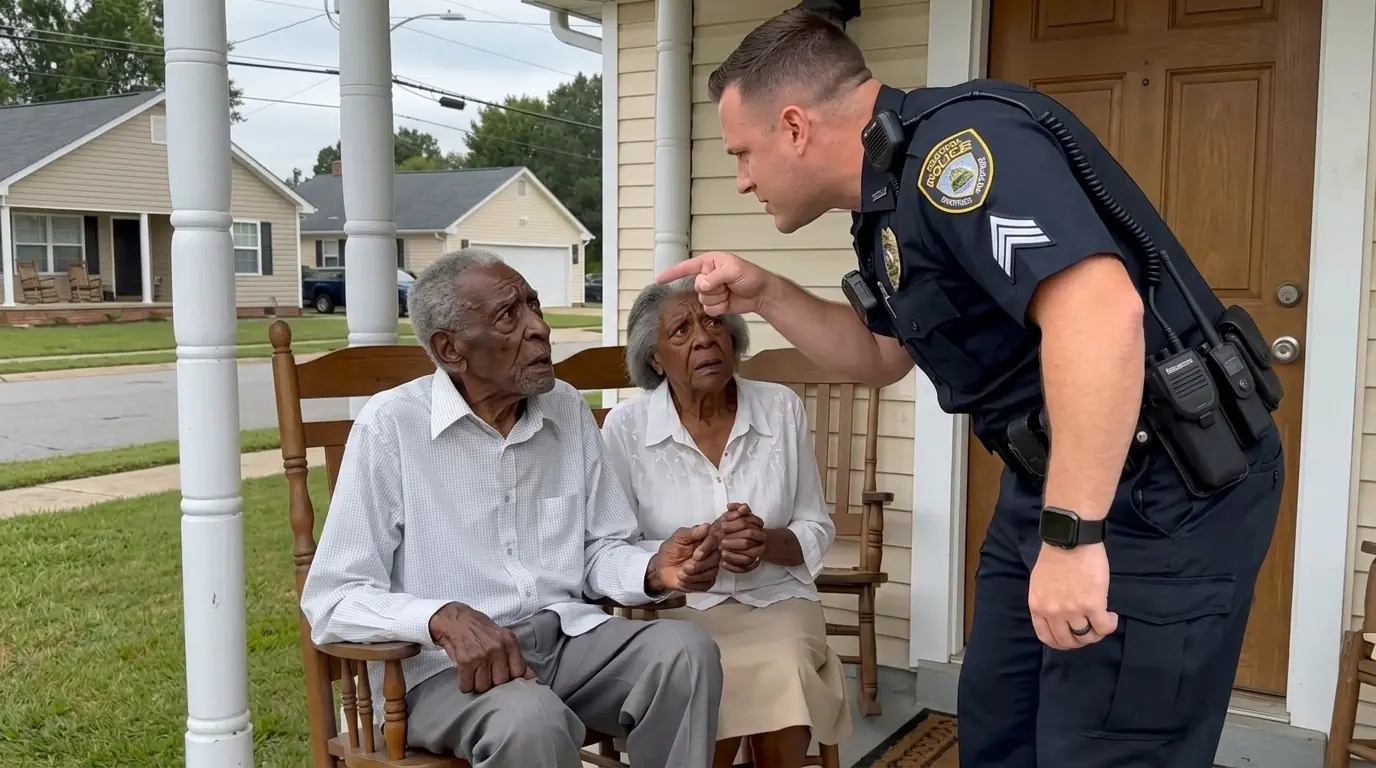
Officer Frank Delaney stepped out before the engine had fully gone quiet. He had been with the Briarwood Police Department for eighteen years and had developed the kind of reputation that sounded different depending on who was speaking: dependable to some supervisors, aggressive to younger officers, and frightening to many residents who had encountered him on the wrong night. His right hand stayed near his belt while he walked toward the porch without greeting either of them. “Both of you need to get inside,” he said.
Leonard looked toward his wife, then back at Delaney. “Officer, is something going on?” Delaney came closer and repeated the order with more force, telling them there had been a complaint about suspicious people in the area. Evelyn glanced toward the flowerpots beside her chair as if the absurdity might somehow be hiding between them.
“We live here,” Leonard said. Delaney’s eyes moved across the porch, the couple, and the house as though he had already decided the answer was not enough. “I didn’t ask where you claim to live,” he said. “I told you to move.”
Evelyn straightened. She had spent part of her youth marching in civil-rights demonstrations with her older sister, and she had spent the rest of her life believing that progress, however slow, had to mean something. “Young man, we bought this house before you were old enough to drive,” she said. Delaney’s jaw tightened immediately.
A few neighbors had begun noticing the confrontation. Mrs. Carver from across the street stepped onto her porch, and two teenagers stopped their bicycles near the corner. Leonard lifted one hand in a calming gesture because he recognized something in Delaney’s posture that told him pride had already joined the conversation. “Nobody here wants trouble,” he said.
Delaney stepped onto the first porch stair. “Then stop giving me a problem.” Leonard remained seated and asked whether the officer wanted identification. Delaney ignored the offer and told him to stand.
Evelyn’s fingers closed around the wooden armrest. “He has arthritis in his knees,” she said. Delaney looked toward her and replied, “Then he should have thought about that before refusing a lawful order.”
Leonard’s expression changed. “What law am I breaking?” Delaney reached toward his arm.
The movement happened too quickly for anyone on the street to understand at first. Delaney grabbed Leonard above the elbow and pulled him forward, forcing the older man out of the porch chair before his legs were ready beneath him. Evelyn reached instinctively toward her husband, and Delaney shoved her arm away hard enough that she struck the side table beside the swing. Her tea glass fell and shattered against the porch boards.
Mrs. Carver shouted from across the street. One teenager immediately lifted his phone. Leonard caught himself against the porch railing and turned toward Evelyn, whose wrist had already begun reddening where it hit the table. “Are you all right?” he asked.
Delaney stepped between them. “Both of you stop moving.” Leonard stared at him in disbelief.
“You just hurt my wife.” Delaney pointed toward him. “Keep challenging me and you’re going in cuffs.”
Evelyn rose slowly, cradling her wrist. “We were sitting on our own porch.” Delaney looked toward the gathering neighbors and seemed to realize an audience had formed, but rather than slow down, he became more forceful.
“Everybody back inside,” he shouted toward the street. Nobody moved. Phones multiplied.
Leonard looked directly at Delaney. “You should call your supervisor.” The officer gave a short, humorless laugh.
“I know how to do my job.” Leonard answered, “Then start doing it.”
Delaney’s face hardened. His hand closed around Leonard’s shoulder again, and this time he shoved him backward toward the porch column. Leonard struck the wood with enough force to make Evelyn cry out.
Then another voice came from the sidewalk. “Officer Delaney.”
It was not loud. It did not need to be. Something in the tone made Delaney’s hand fall away from Leonard before he even turned.
A Black man in his mid-forties was walking quickly up the stone path. He wore dark slacks and a light blue dress shirt with the sleeves rolled above his wrists, and a department identification wallet was already open in one hand. He had been approaching from a car parked farther down the block and had witnessed enough of the last thirty seconds to understand what was happening. His name was Marcus Brooks.
Delaney recognized him immediately. Everyone at Briarwood headquarters did. Marcus had been sworn in as the city’s new police chief only nine days earlier.
“Chief Brooks,” Delaney said. The anger disappeared from his face so quickly that several neighbors noticed. Marcus kept walking until he stood between the officer and the porch.
“Step away from them.” Delaney hesitated only briefly before obeying. Marcus looked toward Evelyn first.
“Mom?” That single word changed the entire street.
Delaney’s face went pale. Evelyn held her injured wrist against her chest while Leonard steadied himself beside the porch column. Marcus looked from one parent to the other and then back toward Delaney.
“These are your parents?” Delaney asked. Marcus stared at him.
“They are citizens you just put your hands on.” Delaney opened his mouth, but Marcus continued before he could speak. “Their relationship to me is not what determines whether that matters.”
The teenagers near the corner kept recording. Mrs. Carver had crossed halfway into the street. More neighbors stood along driveways, watching the city’s new police chief confront one of the department’s longest-serving patrol officers outside the home where Marcus himself had grown up.
Delaney tried to recover. “Chief, we had a report of suspicious activity, and they refused instructions.” Marcus looked toward his father. Leonard gave a tired shake of his head.
“What suspicious activity?” Marcus asked. Delaney said dispatch reported an argument near the block and that the couple had been uncooperative. Marcus looked at the broken tea glass, the porch chairs, and his mother’s swelling wrist.
“You found two people sitting on a porch.” Delaney replied that the situation had become hostile. Marcus’s voice stayed controlled.
“Did either of them threaten you?” Delaney said no. “Did either have a weapon?” Again, no.
“Did you ask their names?” Delaney did not answer. Marcus waited.
“No,” the officer finally admitted. The word seemed louder than it should have been.
Marcus looked toward a second patrol unit turning onto Rosewood Avenue. “You are relieved from field duty effective immediately.” Delaney’s eyes widened.
“Chief, you cannot be serious.” Marcus replied, “I am very serious.”
Delaney lowered his voice. “You’re doing this because they’re your parents.” Marcus stepped closer.
“No.” He glanced toward the phones around them. “If anything, their being my parents means I will not personally decide the final discipline.”
Delaney looked confused. Marcus continued, “But I watched you use force against two unarmed elderly residents without establishing a crime, and that requires immediate removal from duty while the incident is investigated.” The second patrol car stopped.
Sergeant Alicia Monroe stepped out. Marcus told her to collect Delaney’s body camera, secure his weapon according to departmental procedure, and contact internal affairs. Delaney stared at the younger sergeant as though waiting for her to resist the order.
She did not. “Officer Delaney, please give me your duty belt.” For the first time that evening, he looked uncertain.
Marcus turned away from him. He walked onto the porch and examined his mother’s wrist.
“You need a doctor.” Evelyn looked annoyed rather than frightened now. “I need ice.”
“Mom.” She gave him the same look she had used when he was fourteen.
Leonard touched his son’s arm. “Handle your department first.” Marcus looked toward him.
“You’re bleeding.” A small cut had opened near Leonard’s temple where his head brushed the wooden column.
“I have had worse.” Marcus shook his head. “That is not the standard.”
An ambulance arrived several minutes later. Evelyn’s wrist was bruised but not broken, and Leonard needed two stitches for the cut near his temple. They refused transport to the hospital and agreed to visit their physician the following morning.