Smoke curled from a stove pipe over a kitchen that fed 12 men and earned nothing. A woman in a travel-worn dress stood in the doorway of a Wyoming ranch house counting the gaps in the floorboards, the cracks in the ledger, the holes in everyone's hope. They had bought her to cook. By winter she would own a piece of the future. Three weeks earlier a railroad agent had told Adeline Burke something she would not forget. "
Folks see a kitchen. "he'd said tipping his hat at the depot in Omaha,"They see supper. Smart folks see a storefront. "She had laughed then, a tired woman with a single trunk and a marriage contract folded in her glove. But the words stuck like a burr.
A kitchen was only a kitchen until someone decided it was something more. She intended to be that someone wherever the train carried her. The train carried her to Bitterroot Junction, a smear of buildings on the high plains where the wind never rested. Adeline Burke gathered her trunk and stepped onto a platform of warped pine scanning the faces for the man whose letters she had answered. Caleb Hartley was not hard to find.
He was the only one not smiling. Tall, sun-darkened with a jaw set like a fence post, he held his hat against his chest more from habit than welcome. " Miss Burke. "he said. "Wagons this way.
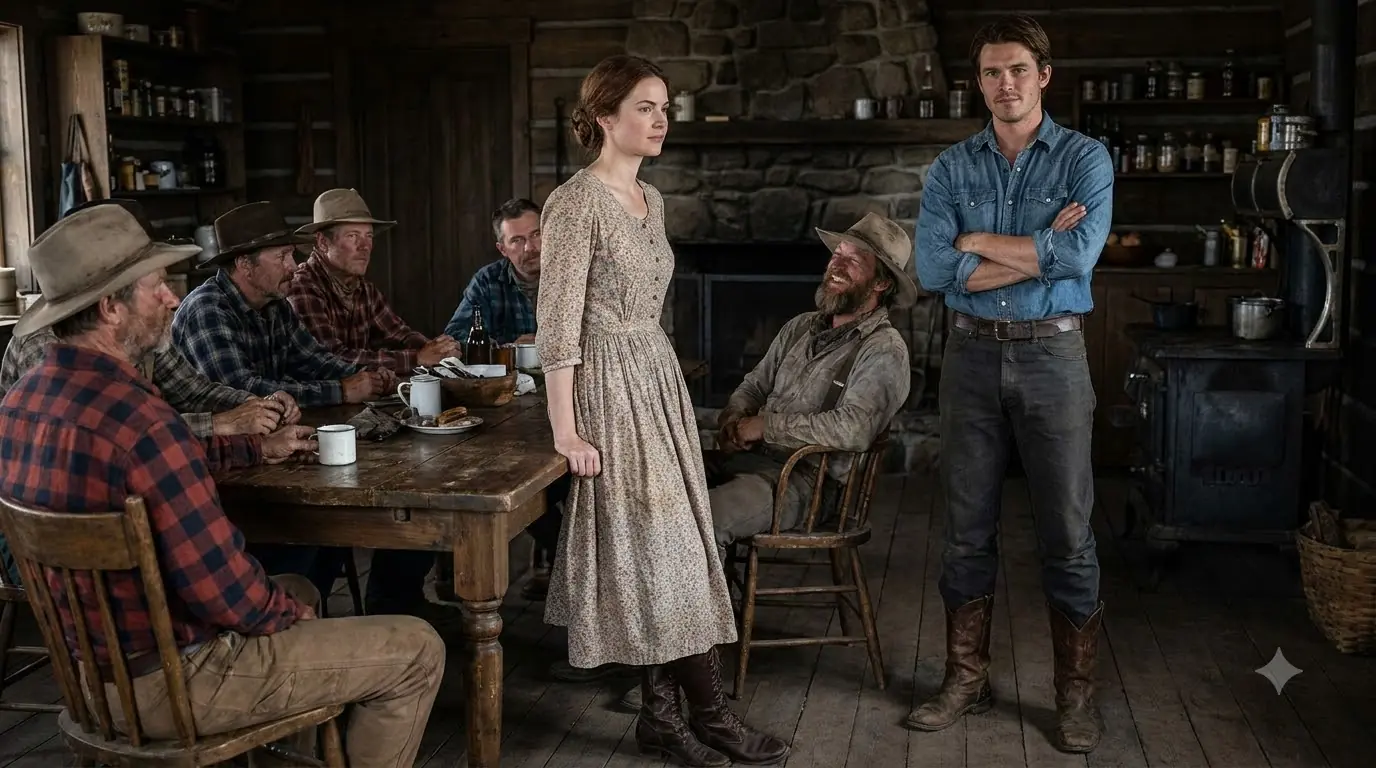
"The ride to the Hartley ranch took two hours over rutted ground. Caleb spoke 11 words the entire trip and four of them were about the weather. Adeline used the silence to study everything. The thin cattle, the sagging barn roof, the dust that lay over the land like a verdict. The ranch house surprised her.
It was larger than she expected and emptier than she feared. A long table dominated the main room scarred from years of elbows and tin plates. Beyond it the kitchen sprawled. A great cast iron stove, a dry sink, shelves of mismatched crockery, and everywhere the evidence of feeding many men badly. " 12 hands,"Caleb said, setting her trunk down.
"They eat at dawn, noon, and dusk. Beans, mostly. Salt pork when there's pork. "He looked at her as though measuring whether she might break. "My first wife passed two winters back.
The men have cooked for themselves since. Poorly, Adeline. "Adeline removed her gloves. "I gathered that from the smell. "Something flickered in his face, not quite a smile, but the place a smile might one day grow.
"Supper's your charge starting tomorrow. The hands are rough, but decent. Don't expect thanks. They don't have it to give. "That evening she met them.
Weathered men named Pike and Russ and old Henry, a boy called Tully who couldn't have been 17, and eight others who blurred together in flannel and fatigue. They eyed her the way men eye weather they can't change. "A bride with a frying pan,"Pike muttered, loud enough to be heard. Caleb finally found a way to make the beans worse. The men laughed.
Caleb said nothing. Adeline smiled pleasantly and said nothing, either. But that night, by candle stub, she opened the ranch ledger she'd found beneath a stack of unpaid bills. The numbers told a story crueler than any of the men's jokes. The Hartley Ranch was three seasons from ruin, and supper, she suspected, was only the beginning of what was wrong.
The numbers would not let her sleep. By lamplight, Adeline traced columns down the page and found waste in every line. They bought flour by the half barrel and let mice take a third of it. They ordered coffee that arrived stale because no one negotiated the freight. They butchered cattle they could have sold and sold cattle they should have kept.
But it was the figure at the bottom that made her sit upright. Beside the column for the railroad camps, the survey and grading crews laying track 10 miles north, someone had scrawled a note in Caleb's blocky hand. They got no cook. Pay a dollar a plate for hot food. Too far to bother 10 miles.
A dollar a plate. 40 men in a grading camp three times a day. Adeline closed the ledger softly, her heart drumming. Too far to bother, he'd written. She intended to bother.
But intending and doing were separated by a husband, a kitchen she did not yet command, and 12 men who thought her a joke. She rose before dawn and made breakfast. Proper biscuits, eggs fried in clean grease, coffee she'd salvaged by roasting the stale beans a second time over low heat. The men ate in startled silence. Tully had three helpings.
Even Pike, who had named her the bride with a frying pan, wiped his plate with a biscuit and said nothing. Which from Pike was a standing ovation. Caleb lingered after the others rode out. That was a good breakfast. It was an ordinary breakfast made with attention, Adeline said.
I'd like to talk to you about the ledger. His face closed like a barn door. The ledger's ranch business. I'm your wife. By the contract we both signed, the ranch is my business, too.
She set down the coffee pot. You wrote a note about the railroad camp. 40 men with no cook paying a dollar a plate. I wrote that in a low moment. It's a fool's idea.
He pulled on his gloves. I can't spare a single hand for cooking schemes, and I won't have my wife driving a wagon 10 miles to a camp full of strangers. It isn't done. Many things aren't done until someone does them. Adeline.
He said her name carefully, the first time he'd used it. I bought I arranged for a cook and a wife, not a merchant. The men already laugh. If you go peddling plates to railroad crews, they'll laugh at me, too. And a ranch boss can't be laughed at and keep his men.
Do you understand? She did understand. That was the trouble. She understood his pride, his fear, the way two bad winters had taught him that reaching for more usually meant losing what little remained. She understood that he was not cruel, only cornered.