Grant Holloway arrived at Whitaker Farm expecting the hardest part of the afternoon to be convincing an old man that his land was worth less than he imagined. He stepped from a black Mercedes in polished brown shoes, looked across one hundred and sixty-three acres of soybeans, pasture, and aging fence, then glanced at the red tractor parked beside the equipment shed as though it belonged in a museum. Samuel Whitaker was waiting beside it in faded overalls, a gray work shirt, and boots permanently darkened by red Georgia clay. He was seventy-four, lean, sun-browned, and calm in the way men become calm after spending half a century learning that weather does not care how loudly they complain. Grant shook his hand, opened a leather portfolio, and said, “Mr. Whitaker, I think we can finally put a number on the future of this property.”
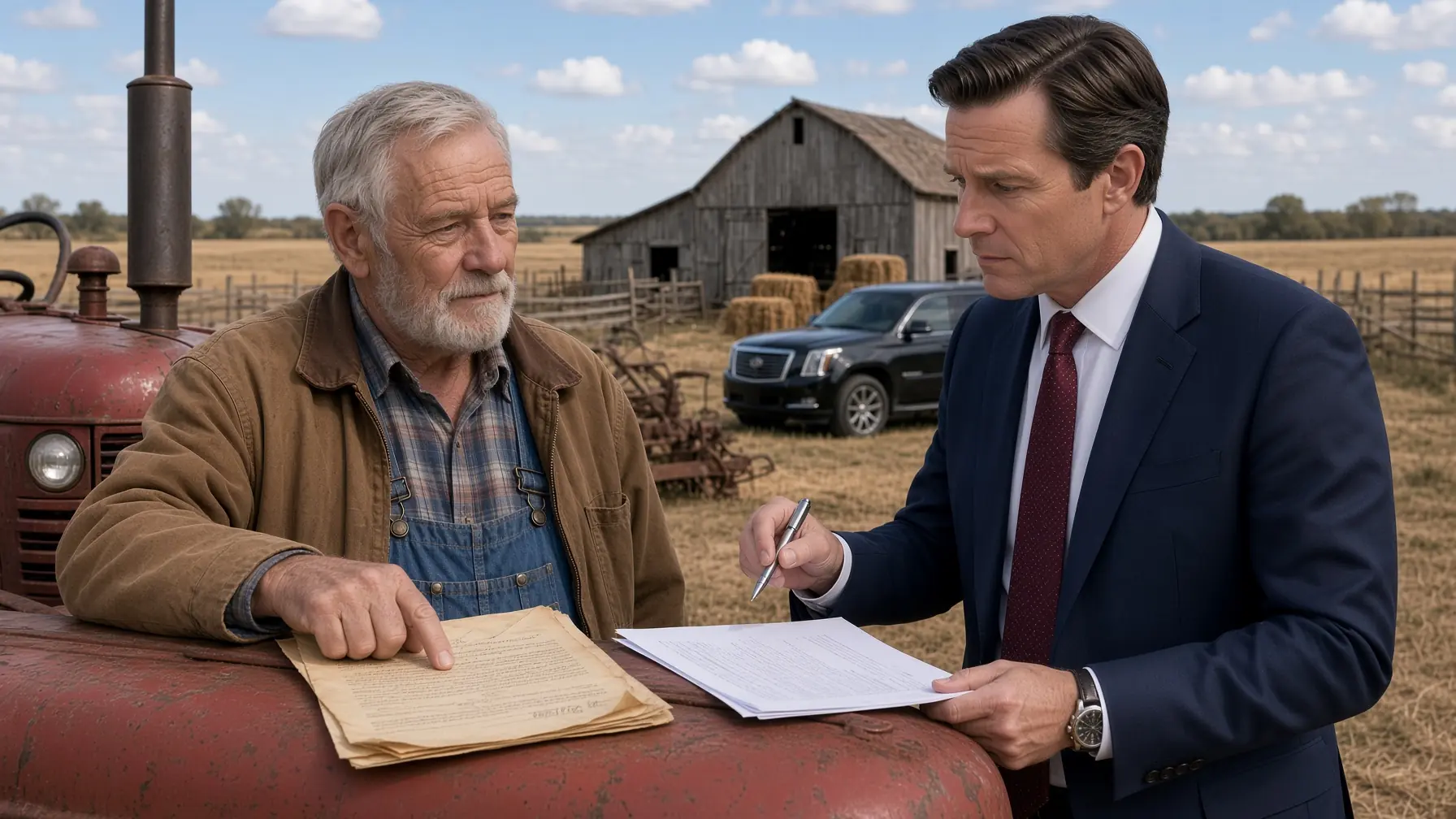
Samuel nodded toward the wooden table beside the shed. “You can put a number on anything.”
Grant smiled because he thought that was agreement.
The two men sat beneath the shade of an old pecan tree while cicadas rattled in the September heat. Grant represented Holloway Development Group, a regional company that had spent almost three years assembling land for a massive mixed-use project along the new interstate connector. The project was called North Creek Commerce Park, although the name disguised its scale. Plans showed warehouses, light manufacturing, a hotel, restaurants, a medical office complex, and more than eight hundred homes spread across nearly twelve hundred acres. Holloway already controlled most of the land through purchase agreements and options. Samuel Whitaker’s farm sat along the western edge.
Grant opened an aerial map.
“Your tract is important because it gives us continuity,” he said.
Samuel looked at the colored blocks.
“Continuity.”
“Roads. Utilities. Stormwater. Emergency access. It allows the entire western section to function as one site instead of separate parcels.”
Samuel nodded.
“So you still need it.”
Grant paused.
“We want it.”
Samuel smiled faintly.
“That wasn’t what I said.”
Grant had negotiated with landowners for twenty years. He knew the difference between stubbornness and leverage, and until that moment he had not believed Samuel possessed much of the second. Whitaker Farm was productive but aging. The main barn needed a roof. Several fence lines sagged. Samuel’s wife had died five years earlier. His only son lived in Nashville and had no interest in farming. County tax records showed no major mortgage, but everyone in town knew agricultural margins had been thin for years.
Grant assumed Samuel needed an exit.
That assumption shaped his offer.
“We’re prepared to pay three million two hundred thousand dollars,” he said. “Cash closing. We cover ordinary transaction costs and give you eighteen months to remain in the farmhouse.”
Samuel did not react.
Grant continued. “That is considerably above agricultural value.”
“How much above?”
“Our appraisers put pure farm value around one point nine.”
“And development value?”
Grant smiled.
“That depends on development.”
“Which is why you’re here.”
Grant leaned back.
“Mr. Whitaker, with respect, development value exists because our company is assembling the project, obtaining zoning, building infrastructure, and taking the risk. A farmer selling dirt doesn’t automatically receive the value of what somebody might build on it ten years from now.”
Samuel looked across the pasture.
“Fair enough.”
Grant waited.
Samuel said nothing else.
The silence became uncomfortable.
Grant filled it.
“We’re also taking on uncertainty. Utility extensions. Road approvals. Wetland work. Market conditions. Interest rates. There’s real risk.”
Samuel nodded.
“I imagine there is.”
Grant opened another page.
“If we don’t reach terms, the project can be redesigned.”
Samuel looked at him.
“Can it?”
“Yes.”
“How?”
Grant hesitated.
“We have alternatives.”
“Which ones?”
“We don’t generally share internal design scenarios.”
Samuel gave the smallest smile.
“Then I suppose I don’t generally have to believe them.”
Grant closed the portfolio halfway.
“You’re a difficult man to negotiate with.”
“No.”
Samuel looked toward the old tractor.
“I’m slow. People confuse the two.”
Grant had come prepared for sentimentality. He expected Samuel to talk about his grandfather clearing the fields, his children growing up there, his wife’s garden, perhaps some promise made beside a deathbed. Developers were trained for those conversations. Respect the history. Acknowledge the emotional connection. Then return to price.
Samuel did none of that.
Instead he asked, “Your western entrance still comes through County Road Twelve?”
Grant’s eyes narrowed slightly.
“Yes.”
“And the four-lane road starts here?”
Samuel pointed to a pale yellow line crossing the southern end of his farm.
Grant looked at the map.
“That is the planned alignment.”
“Runs beside the old Miller drainage ditch?”
“Approximately.”
“Then crosses my lower pasture?”
“Yes.”
“And connects to the state highway?”
Grant nodded.
“Subject to final engineering.”
Samuel leaned back.
“How wide?”
“Right-of-way would ultimately be about one hundred ten feet.”
“That road carries the warehouses?”
“Among other traffic.”
“Fire access?”
“Yes.”
“Water main?”
“Likely.”
“Sewer?”
“Yes.”
“Fiber?”
“Probably.”
Samuel nodded slowly.
“So three point two million buys you a farm and the western throat of an eleven-hundred-acre development.”
Grant’s pleasant expression became thinner.
“It buys us your property.”
Samuel smiled.
“Same dirt. Different sentence.”
Grant glanced at his watch.
He had a four-thirty meeting in Atlanta.
“Mr. Whitaker, I don’t want this to become adversarial.”
“It isn’t.”
“We’ve increased our offer twice.”
“You have.”
“The first was two point six.”
“I remember.”
“Then three million.”
“I remember that too.”
“Now three point two.”
Samuel nodded.
“You’re very good at remembering numbers.”
Grant looked at him.
“You have a number?”
“No.”
“Then what are we doing?”
Samuel stood.
Grant watched him walk toward the farmhouse.
For the first time that afternoon, the developer looked uncertain.
Samuel returned several minutes later carrying a narrow metal document box. It was dull gray, dented along one corner, and looked old enough to have survived three generations of bad filing decisions. He placed it on the table, opened the latch, and removed a folded piece of thick paper protected inside a clear archival sleeve.
Grant exhaled.
“If this is another family survey, our title team already has the property description.”
Samuel sat.
“It isn’t a survey.”
He unfolded the document carefully.
The paper had yellowed.
Blue typewriter ink had faded around the edges.
A notary stamp remained visible at the bottom beside several signatures.
Grant leaned closer despite himself.
The heading read:
ROADWAY AND UTILITY ACCESS AGREEMENT
Grant’s expression changed slightly.
Samuel noticed.
“You’ve seen one before.”
“Of course.”
“Seen this one?”
“No.”
Samuel placed one finger beside a date near the first paragraph.
October 17, 1984.
Then he moved his finger lower.
TERM: FORTY YEARS FROM DATE OF EXECUTION.
Grant stopped breathing for half a second.
Samuel said nothing.
Grant read the line again.
Then another.
The agreement had been signed by Samuel’s father, Henry Whitaker, and Cedar Valley Timber Company, which at the time owned more than six hundred acres west of the farm. Cedar Valley needed temporary access across a narrow strip of Whitaker land to move logging equipment and eventually install a private gravel road serving its timber holdings.
The agreement granted a forty-foot access corridor.
Not ownership.
Not a permanent easement.
Forty years.
Grant looked toward Samuel.
“When did you find this?”
“About six weeks ago.”
“Where?”
“My father’s records.”
“This should have been recorded.”
“It was.”
Grant’s head lifted.
Samuel handed him another page.
Book and page number.
County deed records.
Grant stared.
“Then our title report would show it.”
“It does.”
“No, it doesn’t.”
Samuel looked at him.
“It shows an access agreement.”
Grant’s expression tightened.
Samuel continued.
“Your people just stopped reading before they got to the expiration.”