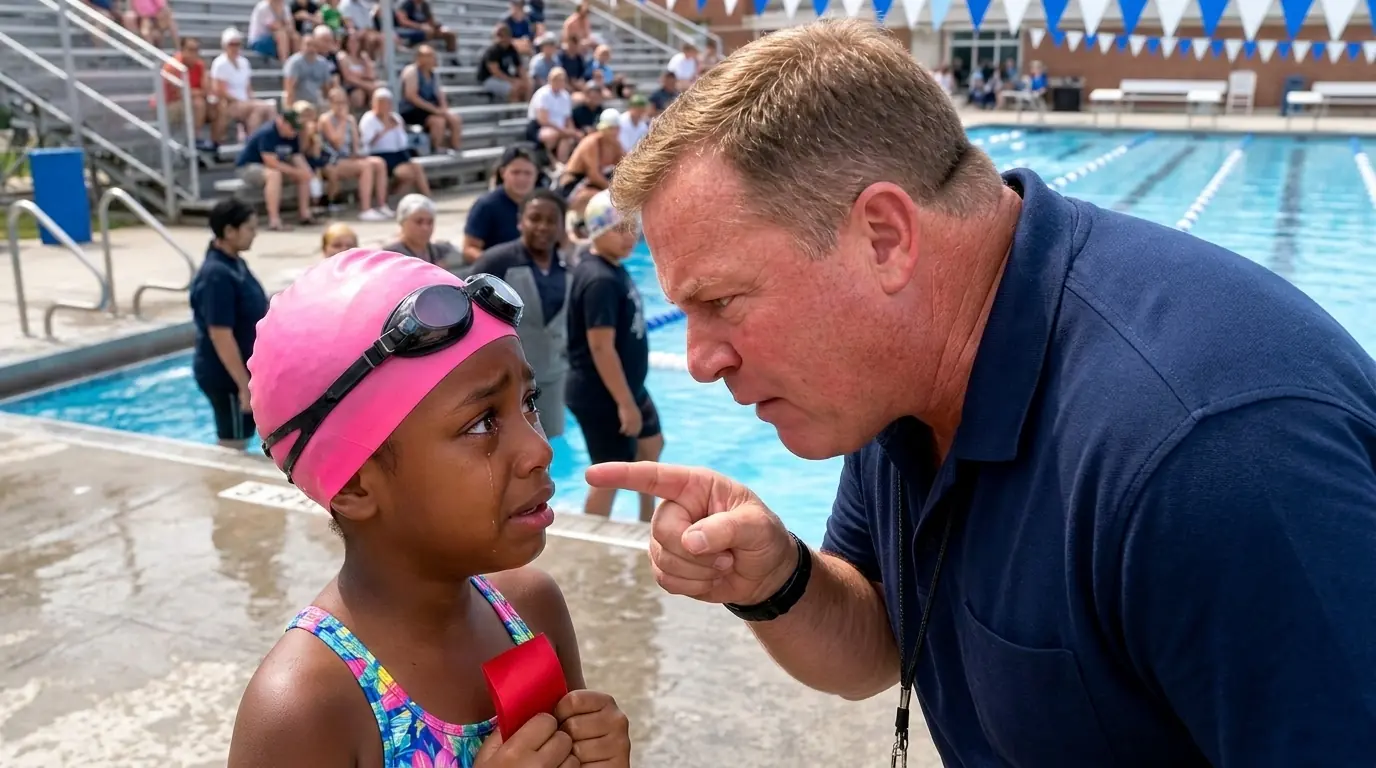
When nine-year-old Ava Coleman touched the wall at the end of the 50-meter freestyle, she had no idea she had won. She surfaced gasping, pushed wet goggles onto her forehead, and looked toward the scoreboard with the same frightened expression she wore before every race. For several seconds the electronic board showed nothing but lane numbers and blinking dashes. Then LANE 4 — 36.81 appeared at the top.
Ava stared at it.
Her coach screamed first.
Then her mother.
Then nearly everyone wearing the navy-and-red colors of Brookside Aquatics began cheering from the aluminum bleachers beside the outdoor pool. Ava looked from the scoreboard to the people jumping behind the fence, and only then did she understand that she had just won the biggest race of her young life. She covered her mouth with both hands and started crying before she was even out of the water.
The victory should have become one of those simple childhood memories families kept forever.
Instead, fifteen minutes later, a grown man would be standing inches from Ava’s face, pointing at her while she clutched a red winner’s ribbon against her chest.
And the person who eventually came running across the pool deck would be Ava’s twenty-year-old sister, Nia Coleman.
But the story did not begin with the ribbon.
It began almost a year earlier, when Ava refused to put her face underwater.
Their mother, Felicia Coleman, had enrolled Ava in swim lessons after the family moved into an apartment complex with a community pool outside Charlotte, North Carolina. Felicia worked long shifts as a respiratory therapist and had seen enough emergency-room cases involving children and water to make swimming non-negotiable. Ava hated the idea immediately. During her first lesson, she stood on the shallow-end steps with both arms folded and informed the instructor that she would learn “everything except drowning.”
Nia had laughed from a lounge chair.
Ava did not.
Nia had been swimming competitively since she was eleven. She had been good enough in high school to attract interest from several small colleges, but a torn ligament in her knee during senior year had interrupted those plans. Instead of leaving North Carolina, she enrolled at a local community college, helped her mother with Ava, and took a part-time job teaching swim lessons at Brookside.
For Ava, that changed everything.
She trusted Nia.
More importantly, she hated the idea of disappointing her.
Nia never forced her underwater. She sat beside Ava on the pool steps after everyone else left and taught her to blow bubbles, then float, then kick while holding the wall. When Ava panicked, Nia did not tell her to stop being scared. She told her fear was information, not a command.
“Your brain is telling you something feels new,” Nia said.
Ava frowned.
“My brain is annoying.”
“Very.”
“Can I replace it?”
“Warranty expired.”
Ava laughed.
A month later, she swam ten yards without touching the bottom.
By winter, she could cross the entire pool.
Coach Teresa Whitmore, who ran Brookside’s youth program, began paying attention. Ava was still awkward on backstroke, hated butterfly, and sometimes forgot to breathe correctly when she became excited, but freestyle came naturally to her. She was small, quick through the water, and surprisingly aggressive once a race started.
“She turns into a different child when there’s a lane line beside her,” Teresa told Felicia.
Felicia watched Ava climb out after another practice.
“That concerns me.”
“It should.”
Nia smiled.
Ava joined Brookside’s developmental team in January.
The team practiced three evenings a week at a city aquatic center with chipped blue paint and lane ropes that had probably been older than half the swimmers. Brookside was not a wealthy club. Parents volunteered as timers, coaches repaired equipment instead of replacing it, and swimmers occasionally shared caps when somebody forgot one.
Ava loved it.
Especially the ribbons.
Developmental meets awarded colored ribbons instead of medals to younger swimmers. Blue meant first, red meant second, white meant third, though some invitationals used their own system. Ava collected every ribbon she earned inside an old cookie tin Nia had decorated with waterproof stickers.
The first one was white.
Third place in the 25-meter freestyle.
Ava carried it to school in her backpack for four days.
The second was red.
Then another white.
Then a blue.
By spring, the girl who once refused to put her face underwater was asking Coach Teresa whether shaving half a second from her turn could help her win regional qualifying time.
Nia watched the change with equal parts pride and amusement.
“You’re becoming intense.”
“I’m focused.”
“You yelled at your goggles yesterday.”
“They leaked.”
“They’re goggles.”
“They know what they did.”
The Carolina Youth Summer Invitational became Ava’s first major meet.
It was held in late June at Ridgeway Swim Center, a large outdoor complex with eight competition lanes, a diving well, concrete bleachers, and faded blue-and-white flags hanging across the pool. Nearly four hundred swimmers from clubs across the Carolinas were registered.
Brookside arrived before seven in the morning.
Ava wore a bright floral swimsuit, a pink cap, and purple goggles that made her look far more confident than she felt. Nia wore Brookside’s navy warm-up jacket over her own black training suit because she had volunteered to help Coach Teresa organize swimmers behind the starting blocks. Felicia sat in the bleachers with a thermos of coffee and enough snacks to survive a natural disaster.
That morning was also the first time the Colemans met Graham Dalton.
Graham was fifty-three and served as head coach of Pinecrest Swim Club, one of the strongest youth programs in the region. He was broad-shouldered, red-faced from years of outdoor coaching, and seemed permanently attached to a stopwatch and whistle. Pinecrest athletes wore matching navy warm-ups with embroidered names; their parents occupied nearly an entire section of the bleachers.
Graham had coached for more than twenty years.
He was knowledgeable.
He was successful.
He was also accustomed to being obeyed.
His eleven-year-old daughter, Emily Dalton, swam for Pinecrest, and his niece Molly was entered in Ava’s age group.
Molly was talented.
Everyone knew it.
She had dominated the nine-and-under freestyle events all season and entered the Invitational as the fastest seeded swimmer in Ava’s race. Her personal best was nearly two seconds faster than Ava’s.
Coach Teresa told Ava none of that mattered once they were on the blocks.
“Seeds tell you what happened before today.”
Ava adjusted her goggles.
“What tells me what happens today?”
“You.”
Ava considered that.
“That sounded like something from a movie.”
Teresa sighed.
“I’m never motivating you again.”
The morning events went normally.
Ava finished fourth in backstroke.
Sixth in breaststroke.
Then second in the 25-meter freestyle behind Molly Dalton.
She was thrilled with the red ribbon.
Graham Dalton was not interested in Ava at that point.
He barely knew her name.
That changed during the 50-meter freestyle.
Ava had been seeded in lane four.
Molly was in lane five.
The starter called them forward.
Ava stepped onto the block and looked immediately toward Nia.
Nia stood near the far end holding a clipboard.
She raised two fingers to her eyes, then pointed toward Ava.
Their old signal.
Stay in your lane. Swim your race.
Ava nodded.
The whistle blew.
The swimmers bent.
The start sounded.
Molly exploded off the block first.
Ava entered slightly behind her.
For twenty-five meters, Molly led.
Ava saw nothing except bubbles and the black line beneath her.
At the turn, something changed.
Molly touched long.
Ava hit the wall almost perfectly.
She tucked, pushed, and came off underwater nearly half a body length ahead.
By forty meters, Molly was closing.
The bleachers were screaming.
Ava stopped breathing for the final six strokes.
Both girls reached.
Ava touched first.
36.81.
Molly followed at 36.94.
Thirteen hundredths of a second.
Ava had beaten the fastest girl in the field.
Nia nearly dropped the clipboard.
Felicia screamed so loudly that a woman beside her spilled coffee.
Even Molly looked shocked when she saw the board.
Then she smiled at Ava.
“That turn was crazy.”
Ava pushed her goggles up.
“I thought you won.”
“So did I.”
They laughed.
That should have been the end of the race.
But Graham Dalton had seen something from the opposite side of the pool.
Or believed he had.
He immediately approached the meet referee.
Ava, he argued, had left the wall incorrectly during her flip turn.
The referee disagreed.
Two stroke-and-turn officials had been positioned specifically to watch the lane.
Neither signaled a violation.
The timing system showed a legal race.
Graham continued arguing.
The official repeated the same answer.
“No disqualification.”
Graham walked away furious.
Molly did not know any of this.
Neither did Ava.
The girls went to the awards area.
Because that invitational used red ribbons for event winners in the developmental division, the volunteer handed Ava a long bright-red first-place ribbon with the event printed in gold letters.
Ava held it with both hands.
She read her name twice.
Then ran toward Nia.
“I beat thirty-seven!”
“Thirty-six.”
“Thirty-six!”
“You’ve been swimming too long. Your brain stopped.”
“I won!”
“I noticed.”
Ava hugged her.
Nia lifted her off the ground.
Felicia took photographs.
Coach Teresa sent one immediately to the team group chat.
Ava asked whether she could keep the ribbon in her room instead of the cookie tin.
“Of course,” Felicia said.
Nia pointed at her.
“Frame it before she sleeps with it.”
“I’m not sleeping with it.”
Ava paused.
“Probably.”
The next event began.
Coach Teresa needed Nia to help escort Brookside’s older swimmers to staging.
Felicia went to find bottled water.
Ava remained near the pool deck because another Brookside girl was racing.
She stood close to the fence, still wearing her pink cap, the red ribbon folded carefully in both hands.
That was when Graham Dalton saw her.
He had just finished another unsuccessful conversation with meet officials.
His frustration had become certainty.
In Graham’s mind, the officials were refusing to admit an obvious mistake.
And the ribbon in Ava’s hands represented that mistake.
He approached her.
Ava noticed the whistle before she noticed his face.
She assumed he was an official.
Most children at swim meets believed any adult with a whistle had authority over them.
Graham stopped less than two feet away.
“You’re lane four?”
Ava nodded.
“Brookside?”
“Yes.”
“Give me that ribbon.”
Ava looked down.
“What?”
“The ribbon.”
She pulled it closer to her chest.
“Why?”