"I need a hired hand, not a husband." Josephine Marsh had written the Denver agency, never guessing a mixed-up letter would change everything. On a gray September morning in 1884, on the platform at Split Rock, Wyoming, she watched a stranger named Elias Crane step down off the train with four children trailing behind him and a letter folded in his coat pocket that carried an entirely different story than the one folded in hers.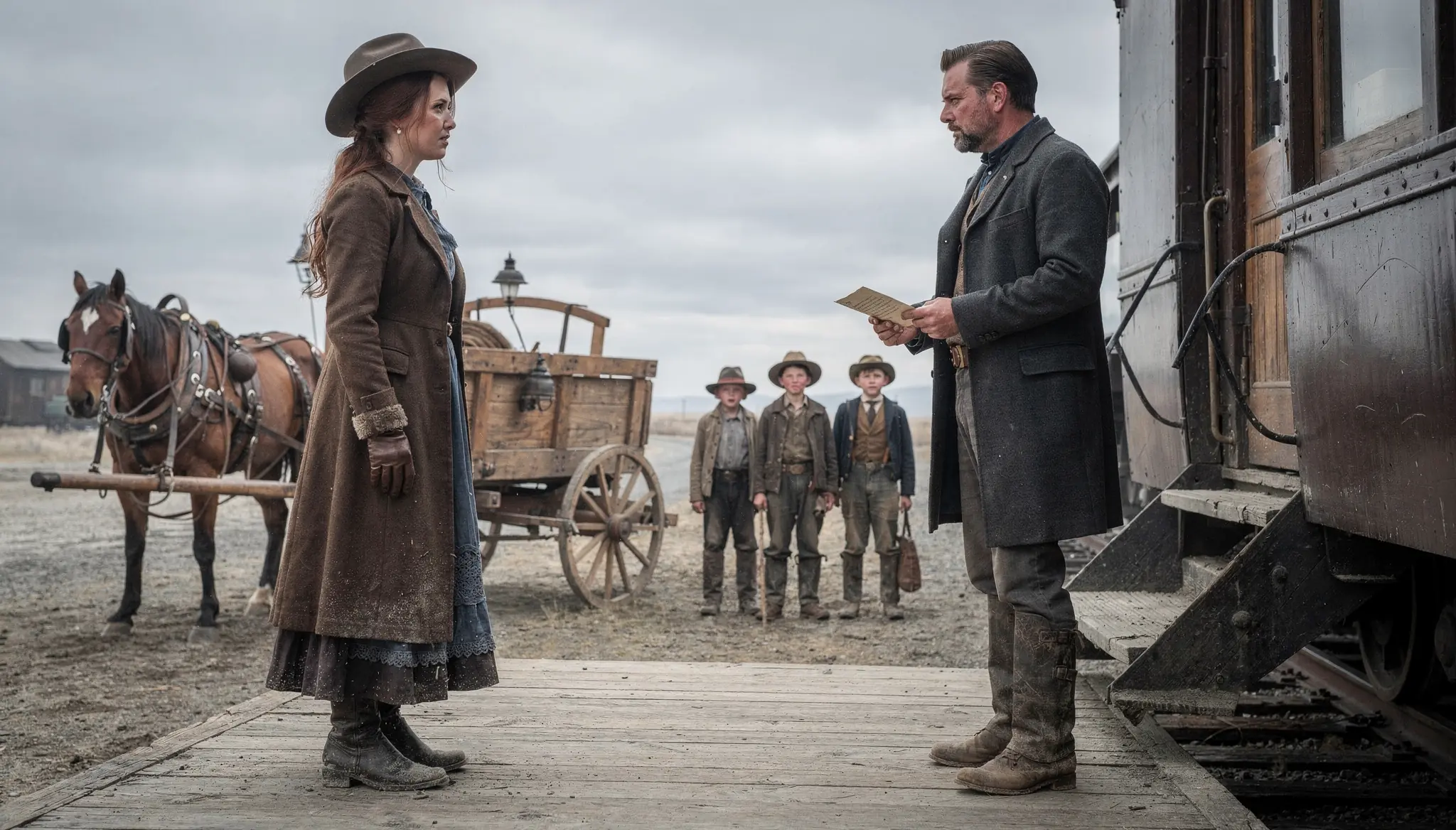
Josephine Marsh had buried her husband two winters earlier, after he was thrown from a spooked horse while crossing Antler Creek during a spring flood that took out half the lower fence line with him. Daniel Marsh had built the Circle M with his own hands, 14 miles out of Split Rock under the shoulder of the Wind River Range. And when he died, Jo had two choices laid out plain in front of her. Sell the place to the first man who offered or run it herself.
She was twenty-nine years old and she had never once in her life been the kind of woman who took the easy road when a harder one led somewhere better. She ran it herself. She kept the account books in a hand steadier than her husband's had ever been. She could rope a calf, doctor a sick heifer through the night, and read weather off the color of the mountains better than most men who had worked that country three times as long.
Six hands lived in the bunkhouse and needed feeding every morning before first light, and Jo had been doing the cooking herself since the last cook quit in March, on top of the branding, the books, the fence lines, and the thousand small decisions a ranch asks of the person who runs it. She was not tired in the way that shows. She was tired in the way that settles into the bones and stays there. She was also, whatever the hands liked to say, not lonely in the way people assumed.
She missed Daniel the way you miss a limb, as a constant dull awareness rather than a fresh wound. What she wanted was not company. What she wanted was help. And she was honest enough with herself to write exactly that in the letter she sent to the placement agency in Denver in June, four months before that gray September morning.
Her request had been plain: "Experienced hand, cooking and household both. Widowed preferred. Private room, fair wage." She had not written lonely.
She had not written husband. She had written what she needed and trusted the agency to send exactly that.
Elias Crane's fire burned a different color out on a rented quarter section in Ellsworth County, Kansas, where his wife Ruth had died of a fever two winters back, the same fever that took a dozen families in that county that year and left the rest of them digging graves in frozen ground. Elias had four children and a lease he could no longer make the payments on and a particular kind of grief that men of his sort carry quietly, working through it with their hands because their mouths were never built for saying such things out loud. Nathaniel was 15, tall enough now to be mistaken for a man from a distance, and he had carried the weight of being the oldest since the day his mother died, watching his father's shoulders bow a little more each season. Caleb was 12, watchful, and nearly silent, the kind of boy who noticed everything and kept most of it to himself.
Sam was nine and talked enough for the whole family combined, a boy who had never met a silence he didn't feel obligated to fill. Toby was six, the baby, and had not yet learned that trust was supposed to be handed out slowly with conditions attached. When the lease fell through in August, Elias wrote to a placement agency in Denver, the same one, as it happened, though neither he nor Jo would learn that for some time. He was plain about his situation and vague about his hope, the way a proud man is vague when he wants something he's half ashamed to want.
The train ride took the better part of four days. Sam talked through most of Nebraska. Toby fell asleep against his father's arm somewhere past the Wyoming line. Nathaniel sat with his jaw set the way it had been set for two years, watching the country go by and trying not to hope too hard, because hoping too hard was a thing that had cost him before.
The platform at Split Rock was thin with cold that morning, the kind of September chill that promises an early winter in the mountains. Jo had driven the wagon in before dawn, tied it at the rail, and stood there for the better part of twenty minutes with her coat collar up, watching the track for smoke. She had pictured, if she pictured anything, an older man, weathered, maybe a widower, with grown children already gone, someone who could take half the work off her shoulders without adding much to the household. What stepped off that train was not that.
A man not yet 40, broad through the shoulders in the particular way of someone who had spent his life behind a plow and a fence post, with tired eyes and a face that hadn't shaved in two days, and behind him four children in a stairstep line, the tallest boy carrying a trunk nearly as big as he was. He found her among the handful of people on the platform the way a man finds the one thing he's looking for. He stopped in front of her. "Mrs. Marsh?"
It was not quite a question, and the voice was not quite sure of itself either. "Mr. Crane." She looked past him at the four children. "The agency did not mention four."
"No, ma'am." He shook his head slightly. "I do not suppose it mentioned much of anything to you at all."
Something in the way he held himself made her look at him harder. He held her gaze, and for a moment neither of them moved to explain, because neither of them yet understood there was anything to explain. Jo looked at the boys one more time, tall to small, and something in her, some accounting instinct that ran under everything else she did, did the arithmetic of four extra sets of hands against a ranch that never had enough of them. "Good."
Her tone was plain as she turned back toward the wagon. "This ranch could use more hands than mine." She meant it exactly the way it sounded, plain and practical, the way she meant most things. Elias didn't answer right away.
He picked up the trunk instead and set it in the wagon bed. And if something in his face fell a little at the word hands, rather than any warmer word, he didn't let it show for long. Toby, half asleep on his feet, reached up and took hold of two of Jo's fingers without being invited to, the way small children do when they've simply decided a person is safe. Jo looked down at him and did not pull her hand away.
That was how it started. Neither of them, in that first exchange on a cold platform, thought to ask the one question that would have spared them both several weeks of quiet confusion. Jo had hired help. Elias believed he had walked into a family.
The agency, it would become clear much later, had written two different letters and given two different people two different truths and put them both on the same train without either truth catching up to the other.
The ride out to the Circle M took two hours over a rutted road. The Wind River peaks held their first dusting of early snow off to the west, and the grass had already gone the color of old rope. Sam talked the whole way about the train, about a peddler two cars up who'd sold him a jackknife, about a jackrabbit he'd seen from the window that he swore was the size of a dog. Jo let him talk.
Caleb sat with his hands folded and his eyes moving over everything. The fence lines, the cattle scattered on the far hills, the shape of the mountains, filing it all away behind a face that gave nothing back. Nathaniel rode in the wagon bed and watched the back of Jo's head the way a man watches a card player he hasn't decided whether to trust. Toby slept against his father's side until the wagon crested the last rise and the ranch came into view below them.
Below them stood the house, the barn, the bunkhouse, and the water tower Daniel had built the summer before he died. Toby woke at the sound of the wagon slowing. He looked at the house, the barn, and the corrals full of horses, then turned to his father with the flat, serious voice of a six-year-old settling an important question. "Is it ours?"
Elias told him it belonged to Mrs. Marsh. Toby considered this with the gravity small children bring to matters that concern them directly, then asked whether he could see the horses. "After supper," Jo said before Elias could answer. Toby nodded like a man closing a deal and then he held up his arms to be lifted down from the wagon and he held them up not toward his father but toward Jo looking at her the whole time he did it.
Jo lifted him down and set him on the ground. It was such a small thing. She would think about it later and never entirely know what to make of it, except that something in her chest had shifted the way a gate shifts on an oiled hinge: quietly and completely, before she had even decided to let it.
The kitchen that first evening was in worse shape than Jo generally let it get. The cook had quit in March, and Jo had managed only the basics since then. Elias looked at the stovetop, the state of the pantry, the good skillet shoved under the table for reasons no one could explain and, after supper, rolled up his sleeves and started scrubbing before anyone had to ask him twice. Caleb appeared at his elbow without a word and began drying what his father washed.
It was the first thing Jo noticed about Elias Crane that revealed more than his letter ever could: he worked without prompting and without making a show of it, in the same way she did. The bunkhouse hands were slower to warm. Amos Witt and the two Odom brothers had run the place alongside Jo for two years and were plainly unsure what to make of a man showing up with four children and no clear standing in the household. They watched Elias the way ranch hands watch anyone new, not unkindly, just waiting to see what he was made of.
On the second morning Jo put breakfast on the table before dawn, only this time it was Elias's biscuits and Elias's coffee and eggs he'd fried while she was out checking a heifer that had gone down in the night. Witt took one bite of the biscuit and set it down slowly, like a man setting down something he was afraid of dropping. "Lord have mercy," he said in a low voice, like a man startled by his own coffee.
"Do not blaspheme at the table," one of the Odom brothers said. "That was not blasphemy." Witt pointed his fork toward the ceiling. "That was a prayer." By noon, the hands were entirely on Elias's side, which was not nothing on a ranch where a man's standing was decided by what he did before breakfast and confirmed by what he did afterward.
Nathaniel was slower to warm to her. He was fifteen and carried a weight most boys his age never had to touch: the awareness of being the oldest in a family with a hole where a mother used to be. He had watched his father hope before and watched that hope cost him. He didn't offer help.
He didn't offer conversation. He mostly stood at a distance and watched. On the third day, Jo found him in the barn while she was working a stuck bolt on the hay wagon's axle, cursing it under her breath in a way that would have scandalized the church ladies in town. Nathaniel stood in the doorway a while before he found the nerve to say anything.
"Hand me that wrench." Jo didn't look up. "Left side."
He handed it to her. They worked in silence the better part of an hour, and at the end of it, Jo wiped her hands on a rag and looked at him properly for the first time. "You've got a good eye for what's out of line." There was real respect in her voice now.
"That's not a small thing on a ranch." Nathaniel didn't answer, but he came back to the barn the next morning, and the one after that, and within a week he had become, without either of them naming it out loud, Jo's second set of hands whenever there was ironwork to be done.
Caleb found his place differently, the way quiet children do, by watching until he understood a place well enough to be useful in it without being told. Three days into the second week, he appeared at Jo's side while she was checking the water level in the tower, and without being asked, handed up the measuring stick the moment her hand went out looking for it. "You watch things closely," Jo said, studying him. "Yes, ma'am."
"What do you see when you watch?" Caleb considered the question seriously before answering. "I see you check that tower every morning before the hands are up. I see you walk the east fence most evenings by yourself, and I see you have not gone into the room at the end of the hall since we arrived."
Jo went still. "I think that was Mr. Marsh's room," he added. It came out as a fact rather than a guess, the way Caleb delivered most things. She did not answer immediately.
When she did, her voice had gone quieter than usual. "You are right. It was." Caleb kept his eyes on the waterline.
"My mama used to say some rooms just need time. She meant my father's tools after he died. She could not go near them for a long while either." Jo fitted the cap back onto the waterline with hands that were not quite as steady as they had been a minute earlier.
"Your mama sounds like she understood a thing or two." "Yes, ma'am." Caleb went back to whatever he'd been doing before, and Jo stood at the top of that tower a good while longer than the job required looking east toward the fence line and the mountains beyond it.
Sam talked, Caleb watched, Nathaniel worked, and Toby followed Jo everywhere the way a shadow follows the sun. He stayed three steps behind her from the house to the barn, offering nothing and asking for nothing, simply present and shouting useful information whenever she climbed into the hayloft. "There is a barn cat with kittens under the ladder." "Pa says supper is nearly ready."
"Mrs. Marsh, I cannot find my other boot. Have you seen it?" On the fifth evening, Toby fell asleep at the supper table, chin dropped to his chest, entirely given over to sleep. Elias started to rise and carry him away.
"I will take him," Jo said, already standing. Something crossed Elias's face, there and gone, and he sat back down. "Second door on the left."
It was all he managed. Jo lifted Toby the careful way you lift something you're trying not to wake, his head dropping heavy against her shoulder, and carried him down the hall and laid him in his bed and pulled the quilt up over him. He didn't stir, but his small hand in his sleep closed around two of her fingers the same way it had on the platform and held on. Jo stood there longer than the moment required before she made herself go back to the kitchen where Elias was looking hard at his coffee and neither of them had much to say for a while.
Every morning after that before the sun cleared the mountains, Jo stood at her bedroom window and looked out at the dark shapes of the barn and the corrals and thought more than once that this had become a good place again, better than it had been in two years. And then she would think about the letter she had written and the four children now asleep down the hall. And the fact that she had never once, in the whole plain business of it, confirmed with Elias Crane exactly what he believed he'd come here for.
It was Elias who found the answer to that first and not on purpose. On the eleventh day, a letter arrived on the Thursday mail run addressed to him, forwarded on from the Denver agency after he'd written weeks back asking after his final placement terms. He read it standing in the yard with the horses stamping behind him and his face for a long moment did not do very much at all. He found Jo in the kitchen, elbow-deep in a pot of stew that smelled like it had taken half the afternoon.
"There is something you should see." He held out the letter. Jo dried her hands on her apron and read it standing in the doorway. It confirmed that Elias Crane, widower, had been matched by the Denver Placement Bureau with a suitable widow, Mrs. Josephine Marsh of Split Rock, Wyoming, for a domestic arrangement with the intent of marriage.
"With the intent of marriage." Jo set the letter down on the table very carefully, the way you set down something that might shatter. "I wrote to that agency asking for a hired hand," she said flatly.
"Cooking and household, both. I never once wrote the word husband, wife, or marriage." "I know that now," Elias said with a slow exhale.
"I did not know it when I got on that train. I promised my children we were coming to a home. I promised Toby there would be a mother waiting at the end of the line." He looked at the floor and began again more quietly.
"He has been calling you Mrs. Marsh to my face and something a good deal warmer than that in his own head for three weeks. I let him believe it because I believed it too." Jo did not have an answer ready. She had never in her life been at a loss for words, and she found she did not like it much.
"I will write to the agency." Elias met her eyes. "Set it straight. You hired a man for the work. I will do the work and nothing you did not ask for, if that is what you need from me." "Yes." It was the only word Jo could find that felt true and safe at the same time. Elias folded the letter and put it back in his coat and went out to check the herd and Jo stood in her own kitchen a full minute before she remembered the stew was about to scorch.
She did not tell the children what she and Elias had agreed. That fell instead to Elias himself. Three nights later, while Jo was out checking a stretch of fence the wind had taken down, he sat all four of them at the kitchen table and explained plainly and without drama that there had been a misunderstanding about why they'd come and that they were here as hired help now, not as family and that they'd stay through winter and find a new place come spring.
Caleb nodded and volunteered nothing more, which was the way he took in most things. Sam had several practical questions about whether they'd get to keep the same room. Nathaniel looked at the table a long moment and kept his silence, which was how he showed the things that hit him hardest.
Toby piped up. "But I like it here." "I know, bud."
Elias reached over and squeezed his shoulder. "Does Miss Marsh know it is a misunderstanding?" "She knows."
Toby considered that with the whole of his six-year-old attention. Then he asked, plain as anything, "Did you ask her what she wants? Pa, I do not think she wants us to go." He delivered it with the flat certainty small children bring to things they have not yet been taught to doubt.
Elias didn't have an answer for that, either. He was still turning it over when Jo came in from the fence line, cold and quiet, said supper smelled good, and sat at the table with the look of someone who had already made up her mind about something and was not ready to discuss it. And Elias watched her carefully all through the meal and came away no wiser.
The second letter, the one that mattered even more, arrived nine days after that. It came addressed to Elias and had been forwarded from a cattle outfit near Bozeman, Montana, called the Bar T, where he had written back in July, before Ruth had been in the ground even a year, half hoping and half certain nothing would come of it. The Bar T ran nearly four thousand head and needed a permanent foreman. The position came with a real house containing four rooms, a school within riding distance for the children, and wages more than double what Jo could afford to pay a hired hand on the Circle M.
They needed his answer within sixteen days. Elias sat with that letter a long while on the porch steps, turning it over the way a man turns over a decision he doesn't want to make but feels obligated to consider. It was, by any honest measure, a better offer than the one he currently had, which was work and board and no clear name for what he and his children were to the woman whose kitchen they lived in. It was stability.
It was the kind of thing a responsible father was supposed to choose without hesitating. He did not show the letter to Jo. He folded it into the bottom of his trunk under a shirt he never wore and tried to think clearly, which turned out to be a good deal harder than it should have been. The problem, he kept telling himself, was not Jo specifically.
He tried very hard to think about it that way. The problem was the rhythm of the place: mornings cold and clean, the particular gold the light took on over the eastern range at supper time, the sound of Jo's boots on the porch before dawn, steady as a clock, the way the hands had started calling his children by name like they belonged there. The problem was that somewhere in six weeks he had stopped thinking of the Circle M as a stop on the way to somewhere else and started thinking of it as home. And he had not been hired to feel that way.
He'd been hired to fix fences and haul feed and nothing more.
Jo noticed the change in him before he mentioned it. She noticed most things that happened on her own land the way a person notices a horse gone off its feed or a cloud bank that means weather coming. Elias had gone quieter in a way that wasn't tiredness. There was something working under his stillness that hadn't been there before.
She didn't ask. It wasn't her place, she reminded herself. She had made that plain enough three weeks earlier, with considerable and total stupidity, standing in her own kitchen telling a good man he was hired help and nothing more. Yet every night since then, she had found some reason to walk past the barn a little slower, set an extra biscuit on his plate before anyone noticed, or listen for his voice in the yard the way she used to listen for Daniel's.
She thought about everything she had swallowed rather than spoken in that kitchen three weeks earlier: that the arrangement described by the agency did not sound like something she would have minded if she had considered it honestly, and that she had stopped sleeping easily for reasons that had nothing to do with the ranch. None of it had crossed her lips because Jo Marsh had spent twenty-nine years being a woman who did not put a thing into words until she was sure of the ground under her boots and the ground at the moment felt considerably less sure than she liked.
It was Nathaniel who finally moved things forward eight days before the Bozeman letter's deadline, as it was often the quiet, wary ones who ended up carrying the truth nobody else would say aloud. He found Jo in the barn same as always and sat on a hay bale watching her mend a bridle for a while before he broke the quiet. "My pa has been writing letters," Nathaniel said, keeping his eyes on the barn floor. "Long ones. He writes them nearly every night." Jo kept her eyes on the leather in her hands. "Writing or reading?" "Both, some nights. There is one he keeps in the bottom of his trunk. I was not snooping. I was looking for a shirt he borrowed from me." Nathaniel picked at a piece of straw.
"It is from a big outfit in Montana. A foreman's job. A real house. He has not told any of us, but I think he is going to say yes. I think he believes he has to, on account of us." Jo set the bridle down. "Do you want to know something?" Nathaniel's voice had gone flat and careful, the voice of a boy who had learned to weigh his words before spending them.
"Toby used to wake almost every night after Mama died. Bad dreams, crying, the whole house up with him. It happened at every place we stayed. He has not done it once since we arrived here. Not one time in six weeks." Jo did not trust her voice enough to answer immediately. "I am not asking you to do anything about it." Nathaniel stood.
"I just thought you should know before he says yes to Montana." He moved toward the barn door, then stopped with his hand on the frame. "He is going to take it if nobody stops him. It was sixteen days. Now it is eight. Then the offer will be gone." He left. Jo stood alone in the barn a long time after, listening to the wind picking up outside, watching clouds gather over the peaks that would mean an early snow by morning.
There was fencing that needed mending before winter came in hard, a hundred small chores stacked up the way they always were on a working ranch, and Jo Marsh stood perfectly still in the middle of all of it because a fifteen-year-old boy had just rearranged something in her chest that she hadn't given him permission to touch.
She found Elias two evenings later sitting on the porch steps in the last of the light, the Bozeman letter folded in his hand like he'd been reading it again. He looked up when he heard her boots on the boards and something in his face braced itself the way a man braces for a door about to close. "Nathaniel let it slip about Montana," Jo said before he could speak, because she had decided somewhere in the previous two days that she was done letting the right moment pass her by. Elias didn't try to deny it.
"It is a good position. Real wages, a house with enough rooms that the boys would not have to share, and a school close enough to ride to." He looked out at the corrals instead of at her. "It is the kind of thing a father is supposed to want for his children."
"Is it the kind of thing you want?" He was quiet for a long moment. "I want them safe. I want a place that is truly ours, not borrowed."
"That is not the question I put to you." Jo held his gaze. He looked at her then, and whatever he'd been holding steady in his face for six weeks slipped a little. "I promised the boys, when we stepped off that train, that we had found a home. I believed it for the length of about one supper before I learned it was hired work and nothing more. I have spent every day since trying to be the kind of man who does the job he was hired for and does not ask for what was never offered." "And Montana?" "Montana does not ask me to want something I cannot have."
He looked down at his hands. "It only asks me to work." Jo sat down on the step beside him, close enough that their shoulders nearly touched, and for a while neither of them had anything more to say. The wind moved through the yard.
Somewhere in the bunkhouse, one of the Odom brothers was singing something low and off-key to himself. "I only ever wrote that agency for a hired hand," Jo finally said. "That was the only kind of help I let myself believe I was allowed to want. I have spent two years telling myself this ranch was enough, that Daniel's memory was enough, and that I did not need anything more than what I could earn with my own two hands."
She looked at him. "I was wrong about that. I have known it for about three weeks, and I have been too proud or too frightened to say it aloud." Elias went very still.
"Toby stopped having his bad nights." Jo held his gaze. "Caleb understood things about that empty room at the end of my hall that I had never spoken aloud to another living soul. Sam has found more to talk about at my supper table than he found during that entire train ride. And your Nathaniel has become the best hand with iron I have had on this place since my husband died." She took a breath. "That is not hired help, Elias. That is a family that happened to me while I was not looking for one."
"Elias, write to Montana." Her voice was steady. "Tell them no. Not because I am asking you to give something up, but because I am asking all five of you to stay permanently, and not as employees."
He turned to face her fully, searching her face for the catch in it, the condition, the qualification, and finding none. "Good." The word landed differently than it had on the platform six weeks earlier, softer and heavier at once. "This ranch needs a family. It has needed one for two years, and I was too stubborn to admit it. I am admitting it now." Elias reached over and took her hand carefully, the way you take hold of something you've wanted a long while and are still half afraid might not be real. "I never wrote to correct that letter," he said, lowering his voice.
"The one that named marriage. I promised you I would, and I never did. I kept putting it off, and every day I found a reason not to." "I noticed you had not."
Jo had not pressed him for a reason either. "Some part of me was hoping the mistake might turn out to be true anyway." "Me too."
Jo laughed short and real, a sound that surprised them both, the kind she hadn't let out of herself in longer than she could easily count. "Then write to them tomorrow and tell them the agency, for once, got something exactly right." He kissed her hand instead of answering. And then, when she didn't pull away, kissed her properly, quiet and certain, out on the porch steps with the mountains going purple behind them, and the first hard frost of the year settling soft over the whole ranch.
In the morning, Toby was up before any of them, trailing his blanket down the hall with his hair standing every direction sleep could arrange it. He found his father and Jo in the kitchen, standing close together over two cups of coffee that had gone cold from neglect. And he looked at the two of them with the particular seriousness only a six-year-old can summon before breakfast. "Are we staying?"
Jo looked at Elias. Elias looked at his son. "Get your boots." Jo held out a hand toward the door.
"I'll show you how to feed the horses before breakfast, since you're going to be doing it most mornings from here on out." Toby's whole face opened up like a window thrown wide to spring, and he dropped his blanket right there on the kitchen floor and ran for his boots without another word needed.
Laura Ingalls Wilder once wrote that home is the nicest word there is. And if you had stood on the porch of the Circle M that particular morning, watching a six-year-old boy race a widowed cowgirl to the barn while his father and three brothers looked on from the kitchen window, you would have understood exactly what she meant by it. Some things get decided in a letter mailed off in good faith and misread by strangers who never meant any harm by it. Some things get decided on a cold platform in six careless words a woman didn't yet know.
And some things get decided on a porch step at dusk, in a kitchen at first light, or in the single unthinking moment when a small boy holds up his arms to a woman he has already quietly chosen as his own. That was how it started at the Circle M. That, as near as I've ever been able to tell it, is how it stayed.