In the gilded cages of Mayfair, reputation is a currency more volatile than gold. Lady Eleanor has spent her life ensuring her accounts are beyond reproach. But when a barbarian prince from the rugged north arrives, smelling of salt air and insolence, the rigid lines of her world begin to blur. It is a collision of two empires. One built on ancient suffocating etiquette and the other on the wild unyielding truth of a man who refuses to be tamed.
The rain in London did not fall. It drifted in a spiteful gray shroud that clung to the wool of one’s cloak and turned the cobblestones into treacherous glass. Inside the drawing room of the Earl of Stanhope, however, the air was thick with the scent of beeswax, dried lavender, and the suffocating weight of three hundred years of tradition. Lady Eleanor adjusted the lace at her wrists, her movements precise, practiced, and utterly devoid of joy. She was four and twenty, a success by the ton’s standards, only because she had never once tripped, never once giggled too loudly, and never once allowed her heart to beat faster than a polite waltz.
“He is late,” her father remarked, his pocket watch clicking shut with the finality of a guillotine. “A prince should understand that punctuality is the soul of business.” “He is not a prince of St. James, Father,” Eleanor said softly, her gaze fixed on the door. “He is a prince of the Aovian Steps. I doubt they mark time by the chime of a French clock.” The heavy oak doors swung open, and the barbarian prince did not enter so much as he invaded.
Prince Lucas did not look like the sketches in the morning post. He was tall, uncomfortably so, with shoulders that seemed to shrink the room, and hair the color of a winter hearth, dark and unruly. He wore a coat of deep charcoal that lacked the fussy embroidery of the English court, and his boots, though polished, bore the faint, stubborn dust of a man who preferred a saddle to a carriage. But it was his eyes that caught Eleanor off guard. They were a piercing crystalline blue, scanning the room with a predatory intelligence that felt entirely out of place amidst the porcelain teacups.
“Prince Lucas,” her father announced, bowing with a stiffness that bordered on a slight, “may I present your instructress in the ways of our court, my daughter, Lady Eleanor.” Lucas stepped forward. He did not bow. Instead, he reached out, took Eleanor’s hand, and rather than the chaste kiss to the air required by propriety, he held her fingers with a firm, warm grip that sent a jolt of pure electricity up her arm. “The lady who will teach me how to sit, how to sip, and how to lie with a smile,” Lucas said, his voice a low, gravelly baritone that vibrated in her chest. “His English was fluent, though flavored with a harsh rhythmic accent.” “A heavy task for such a delicate creature.”
Eleanor pulled her hand back, her pulse thrumming in her throat. “Propriety is not lying, Your Highness. It is the grease that keeps the wheels of society from grinding to a halt. If you wish for your country to secure the trade treaty, you must learn to navigate these waters without sinking the ship.” Lucas let out a short, sharp bark of a laugh. “In my country, we do not grease wheels. We build stronger wagons.”
Lucas looked up, a slow, mocking smirk spreading across his face. “And you, my lady, are intentionally hollow. Do you ever breathe, or is that corset tightened so high it has squeezed the soul out of you?” Eleanor felt the heat rise to her cheeks. Not a blush of modesty, but a flash of genuine, unadulterated rage. “My soul is none of your concern. My concern is ensuring you do not disgrace yourself at the Duchess of Devonshire’s ball tonight. It is the pinnacle of the season. If you fail there, your treaty is dead.”
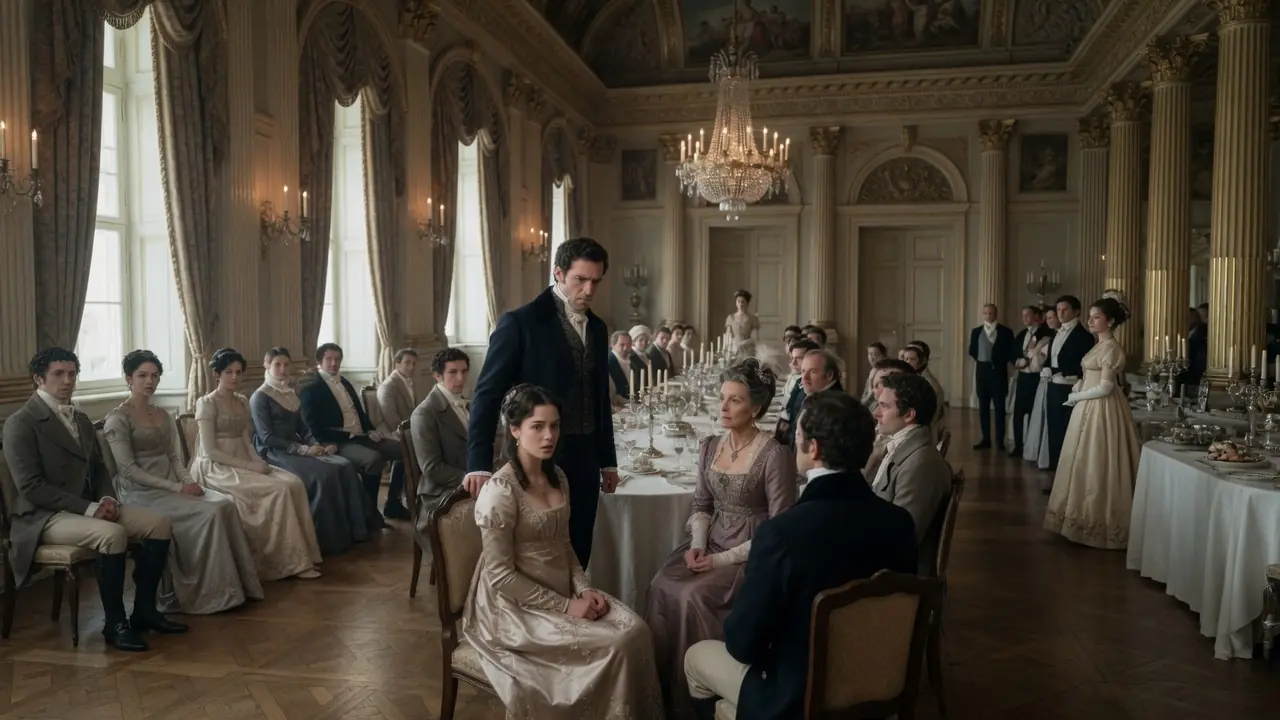
The ball was a shimmering nightmare of silk and candlelight. Eleanor moved through the crowd like a ghost, her eyes constantly tracking the towering figure of Lucas. He looked magnificent in formal dress, a wolf in a silken leash, but his disdain for the proceedings was palpable. The breaking point came during the midnight supper. The Dowager Marchioness of Thistlewood, a woman whose tongue was more lethal than a dueling pistol, made a biting remark about the quaint, rustic customs of the North.
Instead of the polite, vapid smile Eleanor had spent hours coaching him to deliver, Lucas turned. He looked the marchioness up and down with a chilling deliberateness. “It is true,” Lucas said, his voice carrying across the silent table. “In my country, we do not have such fine lace. We spend our time defending our borders so that women like you may sit in safety and grow fat on the bitterness of your own words.” The silence that followed was deafening. Eleanor felt the world tilt. The marchioness gasped, her fan clattering to the floor. The social ruin was instantaneous.
Eleanor saw the whispers beginning, the cold shoulders turning. She had failed. “Take me home,” she whispered to him, her voice trembling with humiliation as they escaped to the carriage. Inside the dark, swaying interior of the brougham, the silence was thick. Eleanor stared out the window, her heart an aching knot. “You destroyed it. All of it. They will never accept you now.”
“I do not care for their acceptance,” Lucas said. His voice was no longer mocking. It was quiet, almost gentle. “I do,” she hissed, turning to him. “It is the only world I have.” Lucas leaned forward, the scent of sandalwood and cold air enveloping her. “She insulted your mother’s lineage three minutes before I spoke. She called your family ambitious upstarts to the woman on her left. Did you think I didn’t hear? Did you think I would let a parasite like that bleed you for the sake of propriety?”
Eleanor froze. She hadn’t heard the slight. She had been too busy ensuring the wine was poured correctly. He had defended her. He had understood the social nuances better than she had imagined. He had simply chosen to burn them down in her honor. “It was still a mistake,” she whispered, though the rage had leaked out of her, replaced by a terrifying hollow warmth. “Perhaps,” he said, his gaze dropping to her lips before he pulled back into the shadows.
Later that night, unable to sleep, Eleanor sought out Lucas to give him the schedule for the next day’s damage control. She found his study door ajar. He was gone, likely to the stables, but his desk was littered with papers. She went to straighten them, a habit of order she couldn’t break, when her hand stopped. There, spread across the blotter, were three miniature portraits. They were beautiful, noble-born women of the Aovian court, their hair braided with pearls, their expressions demure.
Beside them lay a letter in a language she couldn’t read, but the royal seal was unmistakable. A cold, familiar ache settled in her chest. He wasn’t just here for a treaty. He was a prince shopping for a bride, comparing features like a man at a horse fair. The apology in the carriage, the defense of her honor, it was all the practiced charm of a man who knew how to handle women. He was no barbarian. He was a diplomat, and she was nothing more than a temporary tutor, a distraction before he chose a queen.
Eleanor blew out her candle, leaving the room in darkness. The image of the golden-haired princesses burned into her mind. The following morning, the Stanhope estate felt less like a home and more like a mausoleum dedicated to the almost-was. Eleanor sat in the breakfast parlor, the silver spoon clicking rhythmically against the rim of her porcelain bowl, a hollow metallic sound that echoed the emptiness in her chest.
Lucas had not appeared for breakfast. When he finally emerged, he was not dressed for a lecture. He wore a heavy leather coat and winded riding breeches, looking entirely too much like a man who intended to break things. “You are late, Your Highness, and inappropriately dressed for a lecture on the corn laws.” “No more lectures, Eleanor,” he said, omitting her title with a casualness that made her pulse skip. “You have spent a fortnight trying to drag me into your world of gilded cages. Today I am taking you into mine.”
“I have obligations.” “You have a stagnant life,” he countered, crossing the room in three predatory strides. He leaned over the table, his shadow falling over her like a dark wing. “Come, unless you are afraid of what you might see when the silk is stripped away.” She should have refused. She should have summoned her father. Instead, she rose, fueled by a defiant need to prove she wasn’t as fragile as the china she handled.
He did not take her to the park. He took her east, past the soot-stained brick of the city’s heart, to a district where the air tasted of salt, coal smoke, and roasting meat. This was the docks, the sprawling, vibrant immigrant quarter, where men with sun-darkened skin and women in brightly dyed headscarves bartered in a dozen tongues. “This is where my people live,” Lucas said, guiding her through the throng. He didn’t offer his arm. He stayed close, his body a solid, protective presence against the press of the crowd.
They come here for the work the English refused to do, and they dream of the homes they had to leave. They stopped at a small cramped apothecary smelling of dried herbs and sharp vinegar. Lucas spoke to the proprietor in their native tongue, a language Eleanor now realized wasn’t barbaric, but melodic, filled with deep vowels and soft rolling trills. He looked different here. The tension in his jaw had eased, replaced by a weary, soulful kindness.
Later, as they sat on a low stone wall overlooking the churning Thames, he pulled a small, battered book from his pocket. “My country’s poetry,” he said softly. He read a few lines, the words vibrating with a raw, earthy passion. “It says, the mountain does not ask the wind for permission to stand. The heart does not ask the king for permission to break.” “It’s beautiful,” Eleanor admitted, the grit of the city settling on her skin, feeling more real than the lavender water she bathed in.
“Those portraits you saw,” Lucas said suddenly, his gaze fixed on the gray river. “The women with the pearls, they are for my brother, the king. He is a man of duty, but he is lonely. I am the one sent to find his match, to find the woman who can stabilize our throne through a British alliance. I am not the buyer, Eleanor. I am the scout.” The revelation hit her like a physical blow. The coldness she had felt since the previous night vanished, replaced by a scorching, complicated guilt.
He wasn’t shopping for himself. He was sacrificing his own freedom to secure his brother’s. “I am sorry,” she whispered. “I thought—” “I know what you thought. You thought me a common libertine.” He turned to her, his blue eyes burning. “I am many things, but I am not that.” In the days that followed, the air between them changed. The lessons shifted. Eleanor no longer lectured. She strategized. She taught him the nuance of the snub, the power of the well-placed silence, and how to use the English obsession with propriety as a weapon rather than a shield.
She saw his brilliance then, how he absorbed the social architecture of London, not as a student, but as a general. The tension, however, was no longer a war of words. It was a physical weight. It broke on a Tuesday evening during a private waltz lesson in the darkened ballroom. There was no music, only the rhythmic hush-hush of Eleanor’s silk skirts and the heavy thud of their boots on the parquet.
“One, two, three,” she counted, her hand trembling where it rested on his shoulder. “Do not look at your feet.” “I am not looking at my feet,” he rasped. She looked up. He was looking at her, his hand at her waist tightened, drawing her an inch closer than decorum allowed. She could smell him, the scent of rain, cedarwood, and the faint musky heat of his skin. The silence of the room was absolute, save for the frantic drumming of her own heart.
The steps faltered. They stopped. “Eleanor,” he breathed, her name a prayer and a curse. “We shouldn’t,” she whispered, her fingers curling into the wool of his coat. “You are a prince. I am… I am supposed to be the one who knows the rules.” “Then break them,” he said. He leaned down, and when his lips met hers, it wasn’t the tentative kiss of a suitor. It was a collision of two starving souls. It tasted of desperation and the salt of the sea.
It was a betrayal of everything she had been taught to value: her reputation, her future, her father’s plans. And yet, as his hands tangled in her hair, Eleanor felt for the first time in her life entirely and dangerously alive. She pulled away, breathless, her chest heaving against the constraints of her corset. They stared at each other in the moonlight, both horrified by the bridge they had just burned, and both knowing there was no going back.
The arrival of King Victor was not the thunderous intrusion his brother’s had been. It was something far more clinical, and therefore far more terrifying. He arrived at the Stanhope estate in a carriage of lacquered obsidian, flanked by a retinue that moved with the silent precision of a clockwork mechanism. If Lucas was the storm, Victor was the frost that followed, elegant, biting, and absolute.
“My brother has a tendency to exaggerate the wildness of our borders,” Victor said, his English polished to a mirror sheen as he bowed over Eleanor’s hand. “Unlike Lucas, he did not grip. He touched her fingertips with a lightness that felt like the brush of a spider’s web.” “But I see now why he has lingered so long in London. He was not merely securing a treaty. He was discovering a jewel.”
Eleanor felt Lucas’s presence behind her, a tectonic plate of suppressed fury. She could almost hear the grinding of his teeth. “Your Majesty is too kind,” Eleanor replied, her voice sounding thin to her own ears. “I have merely been performing my duty as a hostess.” “Duty?” Victor echoed, his eyes a paler, colder blue than his brother’s, sweeping over her with the calculation of a man measuring a conquest. “A noble sentiment, one I find we share.”
The days that followed were a masterclass in psychological torture. Victor was everything the ton adored: witty, generous, and possessing a charm that smoothed over every social friction. He took to the London ballrooms like a swan to a lake, and everywhere he went, he kept Eleanor at his side. He treated her not as a tutor, but as a consort in waiting. The cruelty lay in the fact that Lucas was forced to orchestrate it.
By royal decree, Lucas was named his brother’s equerry during the visit. It was Lucas who had to hand Eleanor into the king’s carriage. It was Lucas who stood three paces behind them at the opera, watching the back of Eleanor’s neck, seeing the way she stiffened whenever Victor’s hand lingered on her elbow. They found a single stolen moment in the library, the air thick with the scent of old parchment and the dying embers of the hearth.
“I cannot do this,” Eleanor whispered, her back to a bookshelf as Lucas hovered in the shadows, his face a mask of agony. “He speaks of the future, Lucas. He speaks of our kingdom. He is looking for a queen, and he has decided I fit the mold.” Lucas stepped into the sliver of candlelight, his hair disheveled, his cravat undone. He looked like a man who hadn’t slept in a week. “He sees what I see,” Lucas rasped, his voice breaking. “He sees the fire behind the propriety. But he wants to bottle it. He wants to use you to buy the respect of the West.”
“Lucas,” she reached for him, but he recoiled as if burned. “Do not,” he choked out. “If I touch you, I will not be able to let you go. And if I do not let you go, my people starve.” The reality of their positions was a jagged blade between them. Lucas’s reform project—the irrigation systems, the schools, the trade routes that would save his province from famine—depended entirely on Victor’s signature. And Victor’s signature now had a price: Eleanor.
The climax of the charade came at a state dinner hosted by the Earl. The table groaned under the weight of silver and hothouse grapes, but the atmosphere was brittle. As the ladies withdrew, Victor signaled for Lucas to remain. The king swirled a glass of deep red claret, the light catching the heavy signet ring on his finger. “She is perfect, Lucas,” Victor said, his voice conversational as if they were discussing the points of a stallion. “Poised, brilliant, and already beloved by the English court. She will make an excellent queen. The people will adore her, and the treaty will be unbreakable.”
Lucas remained standing, his hands clenched behind his back. “She is a woman, Victor, not a piece of parchment.” Victor’s gaze snapped up, the charm vanishing. “She is a necessity, and you, brother, are becoming a liability. I have seen the way you look at her. I have seen the way she looks at the door when you are not in the room.” The king stood, walking slowly toward Lucas. “Let us be clear. You will facilitate this match. You will convince her of the glory of our crown. You will see her seated on the throne beside me. Do this and your grain elevators are built, your schools are funded. Your reforms become reality.”
Victor leaned in, his voice dropping to a lethal whisper. “Fail me or touch her again, and I will burn your province to the ground. I will leave your people to eat the dirt they walk on. Do you understand?” Lucas’s face went white, the muscles in his jaw bulging. He stood before his king, his brother, and his executioner. The weight of a thousand lives resting on his shoulders. “I understand,” Lucas whispered.
Behind the heavy velvet curtains of the dining room door, Eleanor stood paralyzed, her hand pressed against her mouth to stifle a sob. She had heard every word. The choice was no longer about her heart. It was about the blood and survival of a nation she had only just begun to love. The dawn was a bruised purple over the London skyline when Lucas found her. He had tracked her to the conservatory, a glass-walled cage filled with exotic ferns that seemed to shiver in the cold morning light.
He looked ravaged, the sharp lines of his face carved deeper by the agony of his brother’s ultimatum. “I cannot do it, Eleanor,” he said, his voice a jagged ruin. He didn’t approach her. He stayed by the door as if afraid the mere proximity would shatter his resolve. “He told me the price. Your hand for my people’s bread. Your life in a crown for the survival of my home.” Eleanor turned from the frosted glass. Her eyes were red-rimmed, but her chin was set with a terrifying icy stillness. “I heard him, Lucas. I heard it all.”
Lucas crossed the room then, his movements frantic. He seized her hands, his grip almost painful. “Then you know I am a coward. Because despite the threat, despite the famine, I cannot stand to see you walk toward him. I offer you nothing but ruin. Choose me and we flee. We will be ghosts in Europe, stripped of titles, hunted by my brother’s shadow. Choose him and you are a queen. You will save a nation. You will have the world at your feet. And I will be the brother who watches from the edges of your life until the day I die.”
He was shaking. This was the barbarian prince unmasked, not a conqueror, but a man drowning in a sea of impossible loyalties. Eleanor looked at his hands, calloused and warm, then up at his face. “You think so little of your pupil, Lucas. You think I have spent these weeks merely learning how to hold a fan.” She pulled her hands away, but not in rejection. She smoothed the front of her silk gown, her spine turning to steel.
“The king wants a bridge between our worlds. He wants the stability of my reputation and the sharpness of my mind. Very well, I shall give him exactly what he needs, but not in the way he demands.” The confrontation with King Victor took place in the Earl’s study two hours later. The king sat behind the massive oak desk, the morning sun glinting off the gold of his cuffs. He looked bored, as if the fate of three lives were a mere footnote in a ledger.
“Lady Eleanor,” Victor said, leaning back. “I trust my brother has made the advantages of our union clear.” “He has made your threats clear, Your Majesty,” Eleanor said. She did not curtsy. She stood in the center of the room, her presence filling the space with a sudden sharp authority. “But you are making a strategic error. You want me as a queen because I am poised. But a queen who is forced into a marriage of blackmail is a liability. I would be a silent enemy in your bed, a shadow in your court, and a woman who would spend every waking breath undermining the very authority you seek to bolster.”
Victor’s eyes narrowed. “A bold speech for a lady of the ton.” “It is a practical speech,” Eleanor countered, her voice ringing with the clarity of a bell. “You need the British treaty. You need a diplomatic envoy who understands both the intricacies of London’s parlors and the raw needs of your Steps. I offer you a formal alliance. I will act as your chief ambassador, a bridge between our parliaments and your throne. I will secure your trade, manage your image in the West, and ensure Lucas’s reforms are the jewel of your reign. I will give you my mind, my loyalty, and my political life, but I will never give you my hand.”
She stepped forward, leaning her palms on the desk, meeting the king’s icy gaze with a fire of her own. “Grant Lucas his freedom, fund his project, give us your blessing to depart as your representatives, or I will walk into the Duchess of Devonshire’s breakfast this morning and tell every gossip in London exactly how the gracious king treats his allies. Your treaty will be dead before the sun sets.”
The silence in the room was absolute. In the corner, Lucas watched her, his breath held, seeing the woman he had called hollow dismantle a monarch with the very tools she had once used to pour tea. Victor began to laugh, a low, genuine sound of appreciation. “Lucas was right. You are a barbarian, Eleanor. You simply hide it better than he does.” He stood, walking to the window. “You offer me a powerhouse of diplomacy in exchange for a marriage that would likely end in my own poisoning. It is a cynical, brilliant trade.”
“It is the only trade I am making,” she said. The king turned, his expression sober. “Go. Take him. Build your schools and your bridges. You have my blessing and you have my exile. You will never be welcome in my court again, for I cannot have a woman who outplayed me sitting at my table.” The salt spray of the English Channel was a cold, bracing shock against Eleanor’s face.
They stood at the railing of the Northern Star, the white cliffs of Dover receding into a mist of memory. Lucas stood behind her, his arms wrapped around her waist, his chin resting on her shoulder. The heavy wool of his coat shielded her from the wind, and for the first time in her life, the air didn’t feel thin or suffocating. It tasted of freedom.
“You realize, Lucas,” he whispered into her ear, his breath warm against the chill, “that we have nothing but each other and a mountain of work ahead of us. No balls, Eleanor, no velvet drawing rooms.” Eleanor turned in his arms, her fingers tracing the line of his jaw. The man who had taught her that propriety was a mask and love was the truth beneath it. “I find,” she said, a small, wicked smile touching her lips, “that I have always preferred the wagon to the cage. Let us go home, Lucas. We have a world to build.”
As the ship crested a wave, heading toward the wild, unwritten horizon, Eleanor realized that the greatest decorum was not in the following of rules, but in the courage to rewrite them for the sake of a heart finally set free. In the end, she had traded a crown of gold for a crown of stars, finding that the only throne worth holding was the space beside a man who saw her not as a prize to be won, but as a soul to be matched.