What the hell are you doing? She didn't move. Chef, the broth burned. I used my own recipe. A cold smile.
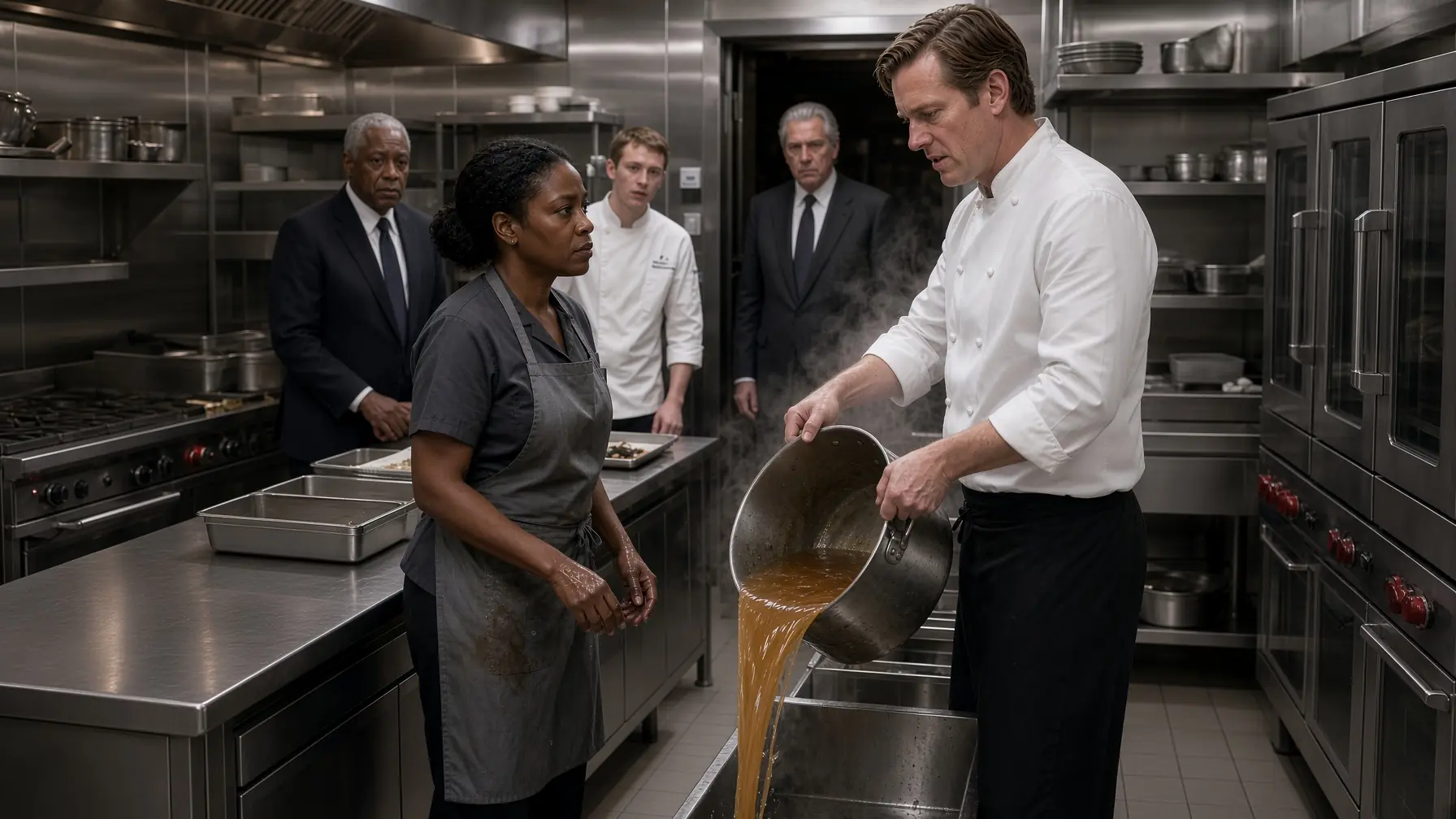
Did I order you to do that? But we have to serve it on time. The smile vanished. He snatched the spoon, lifted the lid, sniffed. What kind of swampy mixture is this?
Did you put animal feed in it? Grace's voice stayed low. It's gumbo. He didn't taste it. He dragged the pot to the sink at Maison Levine, two Michelin stars, Tribeca.
Garbage! Even a dog wouldn't eat this. The amber broth poured down the drain. A waiter approached. Chef.
At the kitchen door, a stranger in a charcoal suit stood. He wasn't looking at the chef. He was looking at her. Six months from tonight, the whole world will taste that pot is to die for. Three hours earlier, Maison Levine ran the way it always ran.
Tribeca's most decorated French house. Two Michelin stars for 11 straight years. A polished walnut dining room where single tasting menu cost $385, and the reservation list closed eight months in advance. The man at the top was Tobias Hargrove, 42 years old, executive chef since 2018, two James Beard semifinalist nominations, host of Hargrove's House on Bravo, Tuesdays at 9:00. His brand was technique, lineage, respect for the craft.
In his kitchen, the dishwashers had no names. He called them by the number painted above their stations. Station three, station five, station eight. Grace Thornton was station eight, 38 years old, fifth-floor walk-up in Inwood. A hot plate, a cast-iron skillet, a single shelf of cookbooks, $50,000 in medical debt, what was left after her mother, Evette, had died of pancreatic cancer three winters ago.
The hospice bills, the morphine pump, the casket she had refused to pick from the cheaper catalog. Grace had washed dishes in three Manhattan kitchens since the funeral. Maison Levine was the fourth. She had worked the dish pit for 14 months without missing a shift, without speaking unless spoken to. What no one in that kitchen knew was that Grace had once been the top student in her class at the Culinary Institute of America.
She had withdrawn six months before graduation when her mother got the diagnosis. She had never gone back. What no one knew either was the leather-bound journal on the top shelf of her locker. The cover was cracked, the pages had yellowed. The first entry was dated June 9th, 1962, in pencil, in the handwriting of her grandmother, Phaedra Thornton, a Gullah Geechee cook from Beaufort, South Carolina.
Phaedra had filled the first 200 pages with recipes. Then, deliberately, she had left 60 pages blank at the back. The book is not finished, child. The book is never finished. That was the last thing Phaedra had ever written in it.
Grace had been filling those blank pages for 6 years. Each entry dated, each entry a small experiment. Phaedra's Gullah originals rebuilt with the classical French techniques Grace had learned at the institute. Clarification rafts, gastriques, stable emulsions. 60 pages of failure and discovery, written in pencil, locked in a dish pit 8 miles from where her grandmother had died.
Page 64 was gumbo, version four. Grace had been testing it on a hot plate in her Inwood apartment for 6 months. She had never served it to anyone but herself. Every shift before tying her apron, Grace touched the spine of the journal once. A small ritual.
A promise to her grandmother made every night for 14 months that the book would not stay closed. Two people in that kitchen saw her. The first was Hayden Brennan, 28, a white sous chef Tobias had hired out of the French Laundry the year before. Three weeks back, Hayden had broken a beurre blanc. The emulsion split, the sauce ran.
He had been about to throw it out. As Grace walked past his prep counter with a tray of stemware, she set a single ice cube down on his marble without breaking stride. Hayden had stared at it. Then he had understood. He dropped the cube into the sauce, whisked, and the emulsion came back.
He looked up to thank her. She was already gone. He had never said the words. The second was Reginald Sutton, 64 years old, black, Charleston-born, three decades in fine dining. Every time Grace passed him in the service corridor, Reginald gave her a small nod.
Once, he had asked her quietly, "You have a cook for your folks, baby?" Grace had paused. "Used to." Reginald nodded again. "Mhm.
Thought so." Tonight was different. Tonight, Bravo's eight-camera crew was setting up for the photo shoot that would launch Crown of New York, the network's new docu-series, a tasting menu showdown among Manhattan's one- and two-star chefs. Tobias had been told he was the favorite. He had also been told that one of tonight's guests, a quiet man who had booked under the name M.
Beaumont, was the Michelin inspector Maison La Vine had been chasing a third star with for 3 years. At 5:48 p. m., 48 minutes from service, Hayden Brennan stood at the consommé station sweating into his collar. The clarified broth was the anchor of course three. It needed 90 minutes to set. Tobias was upstairs in his office adjusting his collar in the mirror.
Grace walked past the consommé station. She glanced at the flame. She frowned once. She said nothing. She disappeared into the dish pit.
The week before tonight, the kitchen had been teaching Grace something it teaches every black woman who works inside it long enough. There's a kind of cruelty that does not need a fist. It needs an audience. It started Monday. Tobias called an all hands at 2:00 in the afternoon.
Fresh whites, hands on his hips, laying out the week. The Bravo shoot, the tasting menu, the third star push. When he got to the floor plan, he flicked a hand toward the dish pit. "And let me be very clear. I don't want anyone from support staff near the dining floor during service.
Customers don't pay $385 to look at" He waved his fingers in Grace's direction. "Well, you know what I mean." A line cook laughed under his breath. Hayden Brennan stared at his knife. Reginald Sutton did not look at anyone.
Grace kept folding. Wednesday made it worse. She was eating a wrap in the staff room, the journal open on her lap. Tobias passed the door, stopped. "What's this?
Recipes? Did your mama leave you that?" Grace closed the journal. "Cute," he said. He walked away.
4 hours later, a notice appeared on the staff board. The staff room was now reserved for kitchen team and front of house only. Support staff would take meals in the basement. Signed, T. Hargrove.
The basement had no chairs, no window. It smelled of bleach and brine. Grace carried a plastic chair down from storage and set it next to the trash bins. She ate the rest of her sandwich there. Friday made it law.
Tobias hung a varnished oak frame by the pass. Inside an embossed card titled Maison Levine standards of service. Rule four said dish pit staff would not engage with plating stations. Rule six said dish pit staff would not speak unless directly addressed. Rule eight said failure was grounds for immediate termination.
The frame named no one. The kitchen knew who it was for. By Sunday Grace had been told three times she was less than the porcelain she washed. She kept touching the spine of the journal every night before she tied her apron. At 6:32 on Sunday Hayden Brennan made his mistake.
He turned the flame too high. The raft broke. The broth scorched. Hayden poured it down the drain and started a new batch knowing it needed 90 minutes and service began in 50. Tobias hissed something at him and went back upstairs.
At 6:51 Grace untied her apron. She walked to the back burner where her own pot had been simmering since 4:53 that morning. Oxtail, smoked turkey neck, blue crab shells, spices ground at lunch on the basement prep counter. This was page 64. Gumbo version four.
The recipe she had tested on a hot plate in Inwood for six months and never served to anyone but herself. She built a raft of egg white and tomato strained through muslin into a clean pot finished with okra coins, lump crab, a single Gulf shrimp, and a crown of micro celery. Nine bowls. She ladled. Reginald lifted the tray.
At table seven, the quiet man in a charcoal suit had reserved under the name M. Beaumont, Reginald set the bowl in front of him with both hands. Phaedra's consommé, sir. The chef hopes you'll find the okra agreeable. The man looked up.
Phaedra was not on the menu. He bent over the bowl, smelled, picked up the spoon. He tasted once, set the spoon down, tasted again, a third time. He did not finish. He took a leather notebook from his breast pocket and wrote three lines in pencil.