"You hurt?"
"My wrists. I can't move."
"Okay. We're going to get you out. Chief, we need bolt cutters and medical."
"Please, hurry."
A detective is about to walk into her own boss's house looking for a set of case files. And behind a locked door in that house, she is going to find something that ends his career, his freedom, and the careful, decades-long reputation of a man half the department still refers to as one of the good ones. This is not a story about a stranger hiding in plain sight. It's a story about a badge and about how far that badge can get someone before anyone with the authority to stop him is willing to believe what's standing right in front of them.
Detective Naomi Suarez, 34, was one of those officers. She had worked directly under Ambrose for 6 years, considered him a genuine professional mentor, and had, on more than one occasion, credited him publicly with teaching her the investigative instincts that had made her one of the department's most effective detectives. Colleagues throughout the department would later describe Ambrose in strikingly consistent terms. A chief who remembered officers' family details, who showed up personally to hospital visits when someone on the force was injured on duty, who had a reputation cultivated carefully over nearly a decade for treating the department less like a bureaucracy and more like an extended family he took genuine pride in leading.
He had been profiled twice in regional publications for community policing initiatives he'd championed and had in the years before his arrest been floated more than once as a potential candidate for statewide law enforcement leadership positions. That reputation, built methodically over more than two decades in law enforcement, would become, once the case broke, one of the most examined aspects of the entire story. Not because it was insincere in every respect, but because investigators would come to understand it had also functioned, whether by design or convenient accident, as a nearly impenetrable shield against the kind of scrutiny that might otherwise have caught him years earlier. This is important because everything about what happened over the following months depends on understanding just how completely Naomi Suarez trusted the man she would eventually help convict.
The case that led Naomi to Ambrose's front door had nothing to do with him directly, at least not at first. Naomi and her partner, Detective Ray Okafor, had spent nearly 3 months working the disappearance of a young woman named Bree Halverson, 26, last seen leaving a downtown bar on a Friday night. Her car later found abandoned on a side street with no clear indication of what had happened to her. The case had gone cold in the way many of these cases do: no witnesses, no clear suspect, no physical evidence beyond a handful of ambiguous surveillance clips from businesses along her likely route home.
Naomi and Ray had, over those three months, pursued every conventional lead the case offered, reviewing Bree's phone records, interviewing her co-workers and ex-boyfriend, canvassing the bar and surrounding businesses repeatedly for any additional footage. Chief Ambrose himself had, throughout that period, remained closely involved in the case's oversight. A level of personal attention from department leadership that both detectives had, at the time, read as evidence of how seriously he took a missing person case in his jurisdiction, checking in regularly on their progress, offering suggestions about which leads to prioritize, and, on at least two occasions, personally reviewing case files during evening hours after the rest of the department had gone home. Neither detective thought anything of this involvement at the time.
A chief taking personal interest in a high-profile missing-person case was, by every standard either of them understood, a sign of good leadership rather than anything requiring scrutiny.
What broke the case open, eventually, was not a lead related to Bree Halverson at all. It was an entirely separate, unrelated matter. A routine internal audit of case file storage that revealed a set of physical evidence logs from an unconnected prior case had gone missing from the department's records room. According to the sign-out sheet, the logs had last been checked out by Chief Ambrose himself nearly two years earlier, for reasons the audit could not immediately reconstruct.
Naomi and Ray were asked to help track down the missing files, a task that, on its surface, had nothing to do with anything sinister. Evidence logs get misfiled, checked out and never properly returned, lost in the ordinary churn of a busy department, all the time. Ambrose himself, when asked directly, told them he vaguely remembered pulling the files for a training presentation and likely never returned them to storage, suggesting, without much concern, that they check his home office, where he sometimes kept work materials he hadn't yet filed. He gave them a key and told them to let themselves in if he wasn't home, since he had a departmental meeting that would run late that afternoon.
Ambrose's house sat on a quiet street on the edge of town, a modest single-story home he'd lived in for over a decade, unremarkable in every visible way. Naomi and Ray let themselves in around 4:00 in the afternoon, expecting nothing more complicated than locating a box of misplaced case files somewhere in a home office.
The home office itself, when they found it, contained nothing related to the missing evidence logs. What it did contain, tucked in a closet, was a single key on its own ring, unlabeled, sitting in a drawer that otherwise held nothing but old pens and expired coupons, the kind of drawer everyone has somewhere in their house, full of small, forgotten objects nobody has bothered to sort through in years. Ray noticed it first, mostly by accident, and joked lightly that it looked like the kind of key that opened something interesting. Naomi, only half paying attention, suggested they check the basement door, since Ambrose had mentioned once, in an offhand comment months earlier, that he kept an old workshop down there he rarely used.
The basement door was in fact locked. Both detectives would later note that this was unusual for an interior door in a private home with no children or security concerns of any kind. Naomi tried the key. It fit.
They opened the door and started down the stairs, still operating by both their own later accounts, well within the ordinary unremarkable frame of mind appropriate to searching a colleague's home office for misplaced paperwork. Ray has since described making a small unremarkable joke on the way down about finally locating Ambrose's supposed workshop. It was the kind of casual banter that fills most uneventful stretches of routine police work, with absolutely no indication in either detective's mind that they were walking toward anything other than a dusty collection of old tools and forgotten hobby equipment.
It was a sound from behind a second door at the base of the stairs that changed everything in the span of a single moment. A dull, deliberate thud, then a pause, then another. The unmistakable rhythm of someone striking something from the inside. Trying with whatever strength remained available to them to be heard.
Naomi has said, in her own statement given afterward, that her training took over almost instantly. Her mind shifted from the mundane errand she had walked in expecting to the sudden, urgent recalibration required when a sound like that occurs in any context at all. She drew her weapon. Ray radioed for backup immediately, describing an unknown situation at the chief's residence requiring additional units.
Dispatchers would later note that the call generated confusion throughout the department for several minutes, given who the address belonged to.
The second door was also locked. Naomi did not wait for the same key to work a second time. She and Ray forced it. What they found in the seconds immediately after that door gave way is the part of this case that would eventually make national news, examined and re-examined by nearly every major outlet that covered true crime and police accountability stories for the following year.
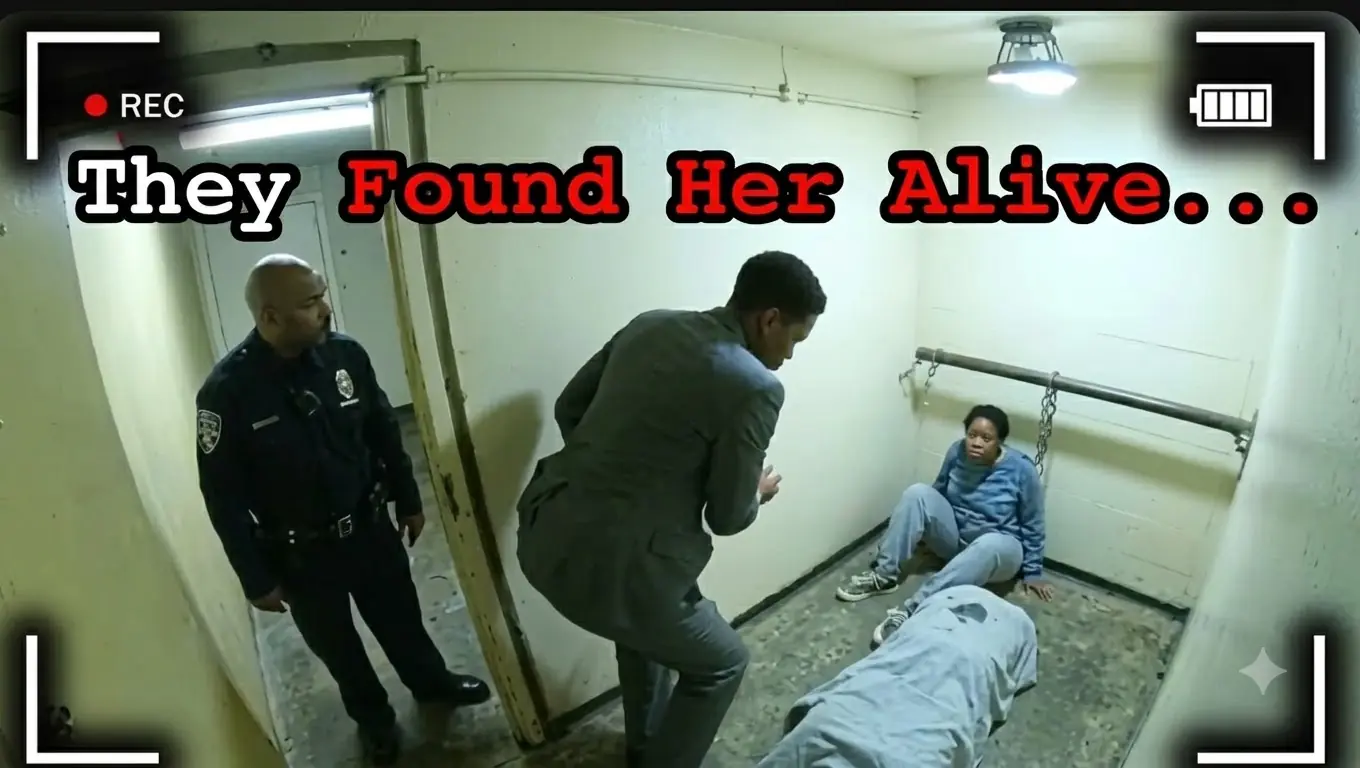
A young woman, alive, chained by one ankle to an exposed pipe running along the basement wall, thin, visibly dehydrated, her wrists showing the marks of restraints that had clearly been in place for an extended period. She was conscious, and upon seeing the two detectives, began sobbing immediately, repeating, according to both officers' statements, some version of "Please, please, is this real?" It was the specific, disoriented relief of someone who had spent an unknown length of time uncertain whether rescue would ever actually arrive. Naomi has said, in her official statement, that the several seconds immediately following that door giving way remain the most disorienting of her career. Not simply because of what the scene contained, but because of how completely it contradicted every assumption she had walked into that basement holding.
She has described a kind of cognitive whiplash, her training telling her exactly how to process an active rescue scene, while some separate, slower part of her mind was still struggling to reconcile the location itself. Even as she moved to secure the woman's restraints, she understood that she was standing inside her own boss's house doing this.
Roughly 8 feet away, on the concrete floor beneath a section of heavy plastic sheeting, was a second shape. Still, unmistakably human, and unmistakably, even before any closer examination, beyond any possibility of rescue.
The woman chained to the pipe was identified, within minutes of her rescue, as Bree Halverson, the same young woman Naomi and Ray had spent 3 months searching for, found not through any lead connected to their actual investigation, but through an unrelated administrative errand that happened to lead them into the one place in the entire county nobody had ever thought to look.
Chief Walter Ambrose had, according to evidence eventually assembled by the outside prosecutor's office brought in specifically because of his position, been responsible for Bree's abduction on the same Friday night she was reported missing. He used his position and his familiarity with the department's own surveillance blind spots to select a route and a method that made her disappearance appear, to any investigator working the case in good faith, like the work of an unknown stranger rather than someone embedded within the very institution investigating it.
The second victim, recovered from beneath that plastic sheeting, was identified through dental records over the following days as a woman named Priscilla Denton, 23, reported missing from a neighboring county nearly 14 months earlier. Her case had never been connected to Ambrose's department at all and had instead been investigated by a separate agency that had, like every other jurisdiction touched by this case, no reason whatsoever to suspect a police chief two counties away.
Priscilla's original case had followed a familiar, frustrating arc for the investigators who'd worked it. An initial burst of activity, a handful of promising but ultimately dead-end leads, and a gradual narrowing of active investigation as no new evidence emerged over the following months. The lead detective on her original case, interviewed after Ambrose's arrest, described the experience of learning where Priscilla had actually been held as the kind of gut punch that makes you question every cold case sitting in your own file cabinet. He acknowledged that nothing in the original investigation could reasonably have pointed toward a chief of police in another jurisdiction entirely, and that the connection was only made possible by the sheer coincidence of Naomi and Ray's unrelated errand months later.
The medical examiner's findings would establish that Priscilla had been held in that same basement for an extended period before her death, and that her case, like Bree's, had gone cold specifically because the location where she was held sat entirely outside the reach of any department that might otherwise have connected the two disappearances. Naomi Suarez has said, in her own account given after the case concluded, that the several minutes immediately following that basement door giving way are the ones she has replayed most often since. Not because of what she found, though that alone would be enough to replay for years, but because of the specific, vertiginous realization that the man she had trusted for 6 years, the mentor she credited with her entire investigative instinct, was the person the two of them had unknowingly been protecting through nearly 3 months of good faith, well-intentioned police work.
Chief Ambrose was not at the residence at the time of the discovery, having remained at the department meeting he'd mentioned that morning. He was taken into custody roughly 2 hours later at the department itself by an outside agency called in specifically to avoid any conflict of interest given his position. He was arrested in the same building where, until that afternoon, he had been the highest-ranking authority present. Officers present for the arrest have described the moment as unlike anything most of them had experienced in their careers, watching an outside agency's officers walk into their own department, badges displayed, to take their chief into custody in front of the same staff who had answered to him for years.
Several officers interviewed afterward described a kind of stunned, disbelieving silence settling over the building in the hours that followed. The specific institutional vertigo of watching the person at the very top of a chain of command removed from it in handcuffs, with no warning and no opportunity for the department to process what was happening before it had already occurred.
At trial, prosecutors built their case around the physical evidence recovered from the basement. Prosecutors presented forensic analysis connecting Ambrose directly and exclusively to both victims, along with testimony establishing a pattern of surveillance and premeditation that investigators believe likely extended to additional cases never fully connected to him, given how effectively his position had shielded the investigation from ever looking in his direction.
The defense did not meaningfully contest the physical evidence. It argued, unsuccessfully, that Ambrose's position within the department should not itself be treated as an aggravating factor by the jury.
Ambrose was convicted on all counts, including two counts of kidnapping and one count of murder after 11 hours of deliberation.
The trial drew intense national coverage, in large part because of the unusual and deeply unsettling institutional dimension at its center. It was a case in which the very authority meant to investigate crimes of exactly this kind had for years been the person committing them, protected specifically by the trust and deference his rank commanded within his own department.
Legal analysts and law enforcement accountability advocates covering the proceedings noted that the case forced an uncomfortable public reckoning with a specific vulnerability in police oversight structures. Internal affairs mechanisms designed to investigate misconduct among officers are rarely built to seriously scrutinize the person at the very top of the chain, precisely because that person is usually the one who initiates or approves such investigations in the first place. The case triggered an extensive independent review of the department's own practices, examining not just how Ambrose had evaded detection for as long as he had, but what specific institutional trust, the kind of trust that gives a chief virtually unquestioned access to his own department's evidence rooms, surveillance blind spots, and case assignments, had made that evasion possible in the first place.
The review's final report concluded that no single failure enabled the case to go undetected for as long as it did. Rather, it was the ordinary, reasonable deference every officer in that department had extended to their chief for years. That same deference, which any well-functioning department depends on to operate at all, had made him, in the review's own words, the single least scrutinized person in a position to have done exactly this.
That review ultimately recommended a series of structural changes adopted by the department within the following year, including mandatory external oversight of any case involving current department leadership as a person of interest, and a revised evidence handling protocol requiring dual sign-off on any material removed from storage, regardless of rank. The state's broader law enforcement accreditation body has since cited the case in training materials distributed to departments across the region, specifically addressing the blind spots that unchecked institutional authority can create.
Naomi Suarez remained with the department following the case's conclusion, though she has said publicly that her relationship to the job changed permanently the moment that basement door opened. She has spoken on a limited number of occasions about the specific difficulty of continuing to work within an institution she once trusted without question. She now carried the knowledge of exactly how completely that trust had been exploited by the person at its top. She has said she does not regret the errand that led her there.
She has described Bree Halverson's survival, however narrow, as the reason she has been able to continue doing the job at all.
She has also spoken about her partner, Ray Okafor, and the particular bond formed between two colleagues who shared a single unrepeatable experience of this kind. They walked into a basement expecting misplaced paperwork and walked out having rescued a kidnapping victim and uncovered their own chief's crimes in the same 90 minutes. Naomi has said the two of them rarely discuss that afternoon directly anymore, communicating about it instead through a kind of shorthand understanding that doesn't require the details to be spoken aloud. The specific quiet solidarity of two people who know exactly what the other one saw.
Bree Halverson has spoken publicly on a limited number of occasions since her rescue, describing the specific horror of understanding, over the course of her captivity, that the man holding her was someone whose position meant that no one, including the police themselves, would ever think to look for her in his house. She has said that hearing footsteps on the basement stairs that final afternoon, not knowing whether it was her captor returning or something else entirely, remains the single hardest moment of her life to revisit. She considers herself alive today only because of an unrelated errand that had nothing to do with her case at all. She has since become involved in a limited advisory capacity with a nonprofit focused on victim advocacy within law enforcement adjacent cases, drawing on her own experience to help push for exactly the kind of external oversight mechanisms the department's later review ultimately recommended.
She has said she does this work not out of any desire to relive the experience publicly, but because she does not want another victim's case to depend the way hers did on the sheer coincidence of two detectives being sent to the right house on an unrelated errand.
Priscilla Denton's family has said, in the only public statement they have given, that they spent 14 months believing their daughter's case had simply gone cold through no one's fault, and that learning the truth, that she had been held less than 60 miles from their home by a man whose position placed him entirely outside the scope of any search that might have found her, has been a grief compounded by a specific, bitter kind of unfairness that they say they are still learning how to carry. They have said, through their family spokesperson, that they hold no anger toward the original investigators who worked Priscilla's case, understanding fully that nothing available to those detectives at the time could reasonably have led them toward a police chief in an entirely separate jurisdiction, and that their anger instead belongs to the institutional structures that allowed someone in his position to operate for as long as he did beyond the reach of the very oversight mechanisms to catch exactly this kind of crime.