Adrien had not even been looking. He had been walking past when the Panhead's knock caught his ear, a sick metallic scream that stopped him dead.
"What are you looking at, kid?"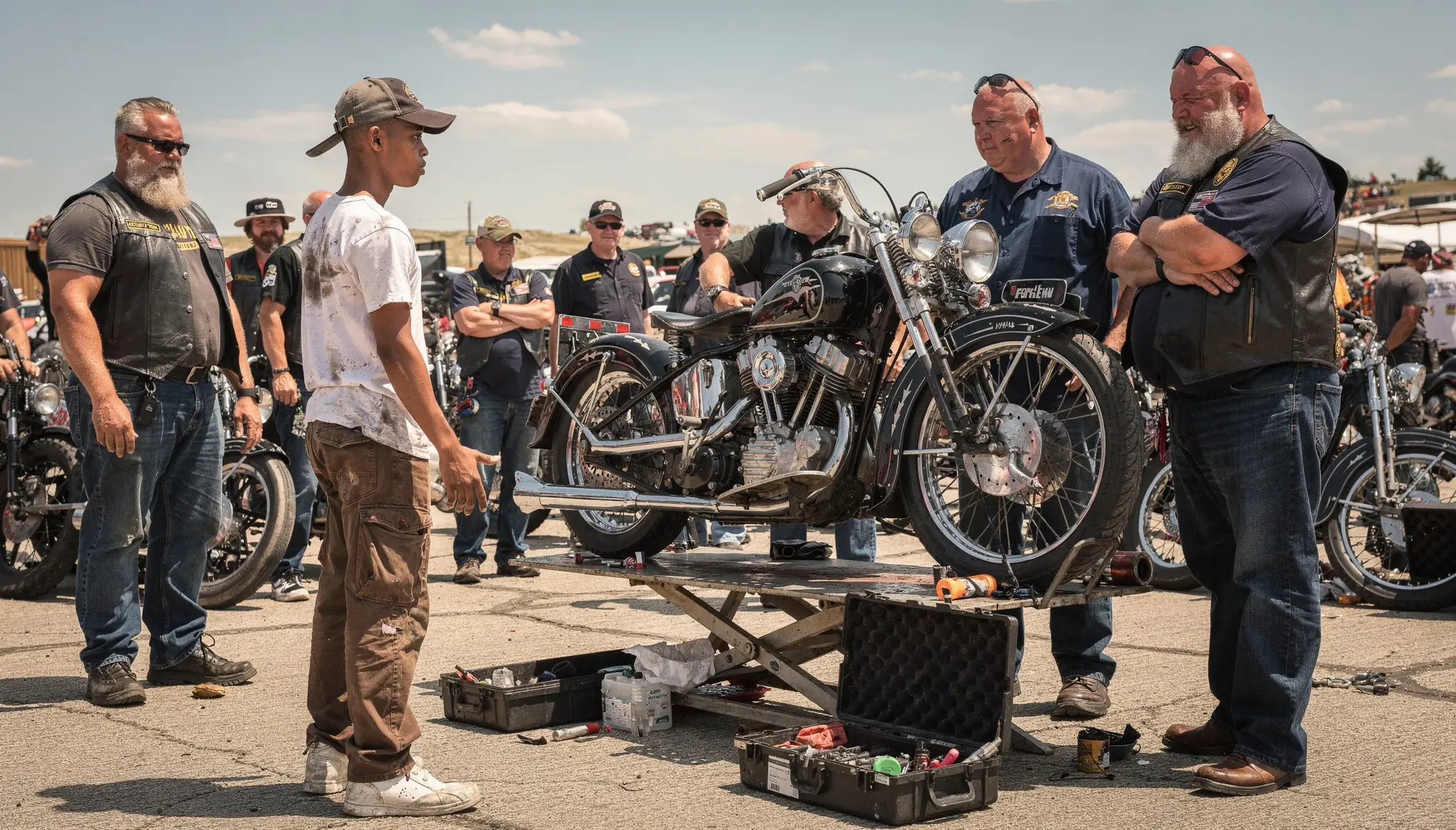
"Your engine, sir. I can fix it. Three minutes. Free."
Earl laughed first, then the crowd. Fourteen mechanics. Four and a half million dollars. Earl shoved him back and sneered, "And some street kid in busted sneakers thinks he has the answer?"
"Please. Just let me listen to it."
"Touch that bike and I'll break your fingers."
Vince chewed his cigar, his eyes fixed on the kid's hands: oil-black knuckles and old scars.
"Let him."
"Vince, this kid--"
"I said let him. We've burned four million on worse. But boy, if you make it worse, you don't leave."
Adrien nodded and closed his eyes. What those three minutes did, no amount of money could undo.
The engine coughed like something trapped inside was trying to die but could not. A deep metallic knock, steady and relentless, pounded through the Arizona garage like a fist striking a coffin lid from the inside. Then a high-pitched whine sliced through it, thin and sharp, the kind of sound that made twenty-year mechanics wince and look away. Oil wept from gaskets that had been replaced three times, while the exhaust coughed black smoke in uneven bursts, choking the desert air with the stink of burning legacy.
This was the 1948 Panhead Harley-Davidson, crown jewel of the Hells Angels Motorcycle Club's Arizona chapter. It was a machine that had thundered across Route 66 when Eisenhower was still in office, a machine that bar fights had started over, funerals were led by, and brotherhood was sworn upon. Its original owner had ridden it from Tucson to Sturgis eleven times without a single breakdown. Four generations of scarred hands had polished that chrome.
Now it sat on a hydraulic lift, shaking like a sick animal and refusing to run cleanly for more than forty seconds.
The chapter had spent $4.5 million trying to fix it. Not a typo. Four and a half million dollars. Over twenty-four months, fourteen mechanics had walked into that garage carrying toolboxes and confidence. Every one of them had walked out carrying excuses.
The first lasted six weeks. He replaced the entire valve train: pushrods, lifters, rocker arms. Sixty-two thousand dollars. The knock stayed.
The second stripped the top end, rebuilt the heads, and lapped every valve seat by hand. Eighty-nine thousand dollars. The knock laughed at him.
Mechanic number five shipped the entire engine to a vintage restoration shop in Milwaukee. They kept it for four months, tore it down to the bare cases, inspected every bearing surface under magnification, and reassembled it with new-old-stock parts sourced from three countries. The bill was $214,000, including a mahogany crate lined with velvet for shipping.
The knock was waiting when the engine came home.
Nobody laughed at that story anymore.
A prospect suggested selling it once. He was not a prospect much longer.
Then came Earl Stanton. Earl was supposed to be the final answer: an ASE master technician with twenty-three years in the trade, a shop in Scottsdale so clean a person could eat from its floors, a rate of $500 an hour, and a six-month waiting list. His walls were covered with framed certificates and photographs of him shaking hands with NASCAR engine builders.
Earl spent six months on the Panhead. He replaced the camshaft, rebuilt the carburetor from scratch twice, tore the primary chain assembly apart link by link, and replaced the entire drive system. Three hundred eighty thousand dollars in parts and labor.
The knock did not flinch.
On his last day, Earl stood in the clubhouse with sweat darkening the collar of his navy work shirt, the one with EARL stitched neatly above the pocket. He slid off his Oakley sunglasses, polished them slowly against his sleeve, and delivered his verdict to a room full of men who could fold him in half without standing up.
"This engine is dead. You're burning cash on a ghost."
Vince "Iron Jaw" Caldwell sat at the head of the table. He weighed 286 pounds, with sun-scorched skin and prison ink crawling up both arms. His leather cut sagged beneath its patches: the one-percent diamond, the death's head, and the Arizona bottom rocker. A dead cigar sat clenched between his teeth, its filter chewed flat. His knuckles were scarred white from decades of conversations that had not involved words.
"Get out," Vince said.
Earl got out.
That night, Vince sat alone in the garage. A fluorescent tube buzzed overhead, throwing sick yellow light across the Panhead's chrome. The bike sat still and silent, its reflection showing a warped version of a man who had never met a problem that money or violence could not solve.
He ran his palm across the gas tank. Cold steel. No pulse. Four and a half million dollars, twenty-four months, fourteen experts.
And somewhere on the South Side of Chicago, a nineteen-year-old kid in a stained white T-shirt was tightening a lawn mower blade for a neighbor who would pay him with a plate of rice and beans. He had not heard about the Panhead yet.
But he would.
Harold's Garage sat near the corner of 63rd and Lowe like a rotten tooth the block had refused to pull. The sign hung crooked from one chain, its paint peeling and letters fading. The H had fallen off six years earlier, and nobody had fixed it.
Inside, the floor was stained so deeply with motor oil that the concrete had turned black and would remain that way forever. A single bulb dangled from the ceiling on a wire that probably violated nine fire codes. The walls were lined with pegboards holding wrenches, sockets, and screwdrivers, all organized by size, every outline traced in white chalk so anyone would know if a tool was missing.
This was where Adrien Fletcher learned everything he knew.
His grandfather, Harold, built the garage in 1974 with scrap lumber and a bank loan nobody expected him to repay. It took eleven years, but he paid every cent. The neighborhood knew him as the man who could fix anything: lawn mowers, generators, truck engines, church-van transmissions, and the school bus that broke down every February.
He never advertised. He never needed to. Word of mouth on the South Side traveled faster than any billboard.
Adrien started coming to the garage at five. By seven, Harold had him holding flashlights and handing over tools, not because the boy had asked, but because he would not leave.
"Engines don't lie, boy," Harold used to say, his voice like gravel rolling downhill. "People lie. Mechanics lie. But an engine tells you exactly what's wrong. You just have to listen."
Adrien listened.
By nine, he could tell the difference between a rod knock and a wrist-pin tick with his eyes closed. By twelve, he was rebuilding carburetors alone while Harold sat in the folding chair by the door, sipping coffee from a thermos that had lost its cap years earlier and nodding slowly whenever the boy got it right, which was almost always.
The gift was not in Adrien's hands. It was in his ears.
He heard engines the way some people heard music. A misfire was not merely a misfire. It had pitch, rhythm, and texture. A bad bearing sang differently from a worn cam lobe. A cracked gasket whispered while a failing valve train screamed.
He did not need a diagnostic computer. He did not need a manual. He needed thirty seconds and silence.
Harold died when Adrien was sixteen, a heart attack on the garage floor between a 1997 Civic and a riding mower with a seized blade. Adrien found him, called 911, sat beside him on the oil-stained concrete, and held his hand until the ambulance came. The paramedics said Harold had been gone before he hit the ground.
The garage went dark for three months.
Adrien's mother worked double shifts at a nursing home on the West Side. His father had been gone since Adrien was four. There was no forwarding address, no birthday cards, and no story worth telling.
There was no money for college. No money for trade school. Some months, there was barely enough for the electric bill.
Adrien reopened the garage at sixteen and a half. He did not change the name, repair the sign, or replace the fallen H. He simply unlocked the door one Tuesday morning, turned on the single dangling bulb, and waited.
Mrs. Patterson from down the block brought in her Buick that same afternoon. Alternator whine. Adrien fixed it in forty minutes. She paid him with a casserole and twelve dollars in loose change.
That became the business model. Fix what people brought. Charge what they could afford. Sometimes that was fifty dollars. Sometimes it was a plate of food. Sometimes it was nothing at all.
Adrien would only nod and say, "Next time."
He never turned anyone away.
By nineteen, Adrien had repaired more engines than most certified mechanics twice his age. He had never held a certification, never applied for one, and never saw the point. Engines did not ask for paperwork. They only needed someone who could hear what was wrong.
He wore the same kind of clothes most days: a faded white T-shirt yellowed at the collar, brown cargo pants with the right pocket bulging from the stubby wrench set he carried everywhere, Air Force Ones with a cracked sole, and always the John Deere cap turned backward.
Harold's cap. Its brim was bent and warped from years of sweat. It was the only thing his grandfather had left him that still fit.
The cap and the ears. That was all Adrien Fletcher had.
It was enough.
The first mechanic had arrived in January with a diesel-stained résumé and a handshake that could crack walnuts. His name was Gene Whitmore. He had thirty years in Harley restoration and flew in from Memphis with a crate of specialty tools and a promise that the job would take six weeks at most.
He spent four of those weeks disassembling the top end: pushrods, lifters, rocker arms, valve springs. He replaced every piece with machined reproductions from a German shop that accepted orders only by fax. Sixty-two thousand dollars.
Gene buttoned it up on a Thursday, hit the starter, and heard the knock return before the engine completed its first full revolution. He stared at the bike for eleven minutes without speaking. Then he packed his tools and caught a flight home.
He never returned the chapter's calls.
The second mechanic blamed Gene. Of course he did. His name was Dale Prescott, out of Albuquerque, and Dale said Gene had lapped the valve seats incorrectly.
Dale stripped the heads, relapped every seat by hand with three grades of compound, replaced the guides, and shimmed the springs to factory specification. Eighty-nine thousand dollars.
The knock stayed.
Dale blamed the cases. Number three blamed the crank. Number four blamed the oil pump. Number five, a full restoration house in Milwaukee called Heritage Iron, blamed everyone who came before.
They crated the engine in mahogany lined with velvet, shipped it north, and kept it for four months. They tore it down to the bare cases and inspected every journal, bearing surface, and thread under magnification. They sourced new-old-stock parts from England, Japan, and a barn in Iowa where a late farmer's widow did not know what she had.
Two hundred fourteen thousand dollars.
The knock was there on the first start, as if it had been waiting.
By mechanic number seven, the bills had crossed two million dollars. Vince Iron Jaw Caldwell stopped reading the invoices. He would look at the total, grunt, and sign.
His sergeant-at-arms, Big Ray Thompson, stood behind him. Six feet five, 310 pounds, with a bald head that gleamed like a cannonball. Big Ray rarely spoke, but the way his jaw tightened each time a new mechanic failed said everything.
Number eight was a professor, an actual PhD in mechanical engineering from Arizona State University. He brought an oscilloscope, a spectral analyzer, and two graduate students. They recorded the engine's acoustic signature at forty-seven different RPM points, published a paper about it, and charged $112,000 in consulting fees.
The knock did not read academic journals.
Number nine was a psychic. It had been Vince's former wife's idea. The visit cost four hundred dollars and included a crystal that was supposed to absorb negative energy from the crankcase.
The crystal cracked on day two.
Nobody talked about number nine.
Numbers ten through thirteen blurred together: a retired Indian Motorcycle engineer, a custom builder from Orange County who had appeared on reality television, a German specialist who flew in from Stuttgart and communicated only through a translator, and a YouTube mechanic with three million subscribers and a sponsorship from a tool company.
Each arrived confident. Each departed quiet.
By month twenty-four, the total damage had climbed to roughly $4.2 million. The Panhead had become the most expensive repair failure in the history of the American motorcycle community. Forums debated it. Podcasts covered it. Rival clubs made jokes about it in bars from San Diego to Boston.
Then Vince made one last call.
Earl Stanton.
Earl did not simply arrive at the Arizona clubhouse. He drove in behind the wheel of a matte-black Ford F-350 with custom plates that read FIXEDIT. He wore his navy shirt pressed stiff, with EARL stitched above the pocket in cursive, Oakley sunglasses pushed up onto styled salt-and-pepper hair, a TAG Heuer on his left wrist, and boots that had never touched a puddle of oil.
His shop in Scottsdale charged five hundred dollars an hour. The waiting list ran six months. Every wall was covered with framed ASE certifications and photographs of Earl shaking hands with people who built engines for Hendrick Motorsports.
Earl spent six months with the Panhead. He was methodical, thorough, and expensive. He replaced the camshaft with a precision-ground reproduction, rebuilt the S&S carburetor twice, tore apart the primary chain assembly, inspected every roller, link, and bushing, and replaced the entire drive system.
Three hundred eighty thousand dollars.
The knock persisted, unchanged, unmoved, and almost mocking.
Earl stood in the clubhouse on his last day with sweat creeping down the collar of that navy shirt. He looked at Vince. He looked at Big Ray standing behind Vince like a wall of silence.
"This engine is dead," Earl said. "You're burning cash on a ghost."
Vince's cigar had not been lit in three hours. Its filter was chewed to pulp.
"Get out."
Earl got out, but he did not go far. He would be at Sturgis in three weeks.
So would someone else.
Sturgis, South Dakota. The first week of August. Half a million bikers packed into a town built for seven thousand.
The air tasted like exhaust and sunscreen. Main Street was a crawling river of chrome: Harleys, Indians, custom choppers with ape hangers and suicide shifts. The rumble never stopped, not at noon and not at midnight.
It was the kind of bass that settled into a person's ribs and remained there like a second heartbeat. Vendors sold leather beneath white tents. Tattoo needles buzzed inside pop-up parlors. Somewhere behind the Iron Horse Saloon, a cover band murdered "Born to Be Wild" for what felt like the nine-hundredth time that week.
Adrien Fletcher rode in on a 1972 Honda CB350.
Among the sea of thousand-pound American iron, his bike looked like a bicycle with an engine bolted to it. The paint was primer gray where it was not rust. The exhaust pipe was wrapped in header tape that had begun unraveling somewhere near Sioux Falls. The seat foam poked through cracked vinyl.
He had bought it for three hundred dollars from a man in Gary, Indiana, who claimed the clutch was mostly fine.
The clutch was not mostly fine.
Adrien rebuilt it in a rest-stop parking lot outside Rapid City with a flathead screwdriver and a paper clip.
He had not come to Sturgis to show off. He came because Harold used to talk about it. Every August, the old man would lean back in his folding chair with the thermos in his hand and tell stories about the year he rode out in 1988: the crowd, the noise, and the feeling of being surrounded by a hundred thousand engines all breathing at once.
Harold never returned because he could not afford to. But he spoke about Sturgis like church.
Adrien saved for eleven months to afford the gas. He slept in a tent borrowed from Mrs. Patterson's son and ate peanut butter straight from the jar.
This was his pilgrimage.
He spent the first two days walking and listening. Every engine that passed was a voice, and Adrien's ears cataloged them automatically: healthy, sick, dying, dead.
A Street Glide with a compensator knock. A Sportster running lean. A Road King with a primary chain so loose it sounded like a bag of wrenches rolling downhill.
He heard them all.
He fixed none of them. He was not there for work.
Then, on the third morning, he heard something different.
He was cutting through the back lot behind the main vendor row with his helmet dangling from one hand when a sound reached him and stopped him in mid-step. A deep, rhythmic knock. Beneath it, however, was a faint metallic ticking that rose and fell with changes in RPM.
Most people would have heard one sound. Adrien heard two.
The second one was the one that mattered.
He turned his head. Sixty yards away, past a row of trailers flying Hells Angels flags, a cluster of men in leather cuts stood around a bike on a portable lift. One of them twisted the throttle.
The engine barked, knocked, and wheezed. Another twist. The same result. The men shook their heads.
Adrien knew that sound. Not the knock. Every mechanic in the country could hear the knock.
It was the ticking beneath it, high and thin, almost musical. It lived in a frequency most ears filtered out as background noise. Adrien's ears did not filter. They collected.
A cracked primary-chain tensioner. A hairline internal fracture, invisible from the outside. The crack created a micro-vibration that resonated through the entire engine assembly, producing a knock that mimicked a dozen other failures.
Every mechanic who had touched the engine had chased the knock.
Nobody had listened beneath it.
Adrien stood there for perhaps forty-five seconds, though it felt longer. His feet wanted to keep walking while his mind did the arithmetic.
That was a Hells Angels camp. Those were full-patch members. He was a skinny Black kid from Chicago, standing alone in a back lot with no business being anywhere near their iron.
But his ears would not let him leave.
Harold's voice spoke from somewhere in the back of his skull.
Engines don't lie, boy.
Adrien shifted his weight, swallowed once, and began walking toward the trailer.
He did not know that Earl Stanton stood in that same cluster, arms crossed, watching the failed start with an expression somewhere between boredom and guilt. He did not know that the next five minutes would change both of their lives.
He only heard a sick engine, and he could not walk away from a sick engine.
Harold never could either.
Adrien was fifteen feet away when the first voice struck him.
"What are you looking at, charity case?"
A patched member with a beard hanging to his belt turned and squared up, arms spread as though blocking a doorway. Two others turned with him, then three more. Within five seconds, every eye in the camp was fixed on Adrien.
He stopped, swallowed, and kept his voice level.
"Your engine, sir. I can hear what's wrong with it. I can fix it. Three minutes. I won't charge anything."
Silence. Two full seconds of it.
Then laughter. Not chuckles or snickers. The kind of laughter that rose from the belly and was meant to bury a person alive.
More than twenty men in leather cuts, chains, and boots laughed at a skinny kid in a stained white T-shirt standing alone on hot asphalt.
"You hear that?" A member with a shaved head elbowed the man beside him. "The little street mechanic says he can fix the Panhead. Somebody check his pockets. He probably already stole a spark plug."
"Maybe he's casing the trailers. That's what people like him do."
Earl Stanton stood at the edge of the group with his arms crossed and his Oakley sunglasses perched on his head. He had not laughed yet. He studied Adrien the way a cat studied a mouse it did not consider worth killing.
Then he stepped forward.
"Kid." Earl's voice was flat and slow, the way some people spoke to animals. "I spent six months on this engine. I've been building Harleys since before you knew what a wrench was. You think you know something I don't?"
Adrien did not look at Earl. He looked past him at the Panhead.
"Yes, sir. I do."
More laughter, louder this time. Someone threw a crushed beer can. It bounced across the ground near Adrien's feet.
He did not flinch.
"Go back to wherever you came from," Earl said, "before someone here loses patience."
"Please." Adrien's voice dropped, not weak, only steady. "Let me put my hand on the engine case. Thirty seconds. If I'm wrong, I'll leave."
"You'll leave now."
"I know what every one of those mechanics missed. All fourteen of them, including you."
That killed the laughter.
Earl's jaw tightened. His neck flushed red above the pressed collar of his navy shirt. The TAG Heuer on his wrist caught the sunlight as his fists clenched.
"What did you just say to me?"
"I said they all missed it. Every one of them." Adrien's voice remained flat. "Because they were looking. Nobody listened."
A member stepped toward Adrien with one hand raised.
Big Ray Thompson moved first, not toward Adrien, but into the other man's path. Six feet five, 310 pounds, his bald skull shining in the August sun. He did not say a word. He simply stood there and blocked the swing with his presence.
Nobody touched Adrien.
Vince Iron Jaw Caldwell had leaned against the trailer throughout the exchange, watching with a dead cigar in his teeth and his arms crossed over his patch-heavy cut. His eyes moved from Adrien's face to his hands the instant the kid stepped close enough.
Oil-black knuckles. Fingernails rimmed with grease that would not wash away. Scars across the fingers, old and deep, the kind created by slipped wrenches and hot metal.
Not soft hands. Not student hands.
Working hands.
The kind Harold Fletcher had possessed.
Vince pushed himself away from the trailer. The crowd quieted before he opened his mouth. That was how it worked around Vince. Silence preceded him like a shadow.
"How old are you?"
"Nineteen, sir."
"Where did you learn engines?"
"My grandfather's garage. South Side of Chicago."
"Your grandfather fixed Panheads?"
"He fixed everything."
Vince chewed his cigar and studied the kid for one more second.
"Three minutes."
Earl snapped forward. "Vince, you can't be serious. This little--"
"Three minutes." Vince did not raise his voice. He did not need to. "We've burned four million on men with better shoes and bigger mouths."
His eyes shifted to Earl and stayed there.
"Three minutes won't kill us."
Then Vince looked back at Adrien. The cigar moved from one side of his mouth to the other.
"But boy, if you make it worse, you're not walking out of here the way you walked in."
Adrien nodded once. He did not look at Earl or at the crowd. He walked straight to the Panhead, pulled the John Deere cap tighter against his head, and placed both palms flat on the engine case.
Then he closed his eyes.
Adrien's palms pressed against the engine case. The metal was warm, not hot, but warm in the way a body remains warm for hours after a fever breaks.
He did not move. He did not open his eyes.
Thirty men stood around him in a semicircle, arms folded. Some smirked. Some glared. Most waited for the joke to finish itself so they could return to their beers.
"Start it," Adrien said.
Nobody moved.
Vince gave a short nod to the prospect standing nearest the handlebars. The prospect, barely older than Adrien, reached over and pressed the starter.
The Panhead barked to life.
The knock came immediately, deep, metallic, and rhythmic. It was the same sound that had consumed $4.5 million over twenty-four months, the same sound that had humiliated fourteen mechanics and turned the most legendary bike in the Arizona chapter into a punch line.
Adrien kept his eyes closed. His fingertips moved slowly and deliberately across the engine case, like a blind man reading a face. His left hand rested on the cylinder base, his right on the primary cover.
He tilted his head five degrees to the left, then two degrees back.
He was listening beneath the knock.
Somewhere under the deep metallic hammering, buried in a frequency that diagnostic machines rounded off and human ears dismissed, there was a second sound: a ticking, thin, high-pitched, and almost musical.
It rose and fell with the RPM, but not