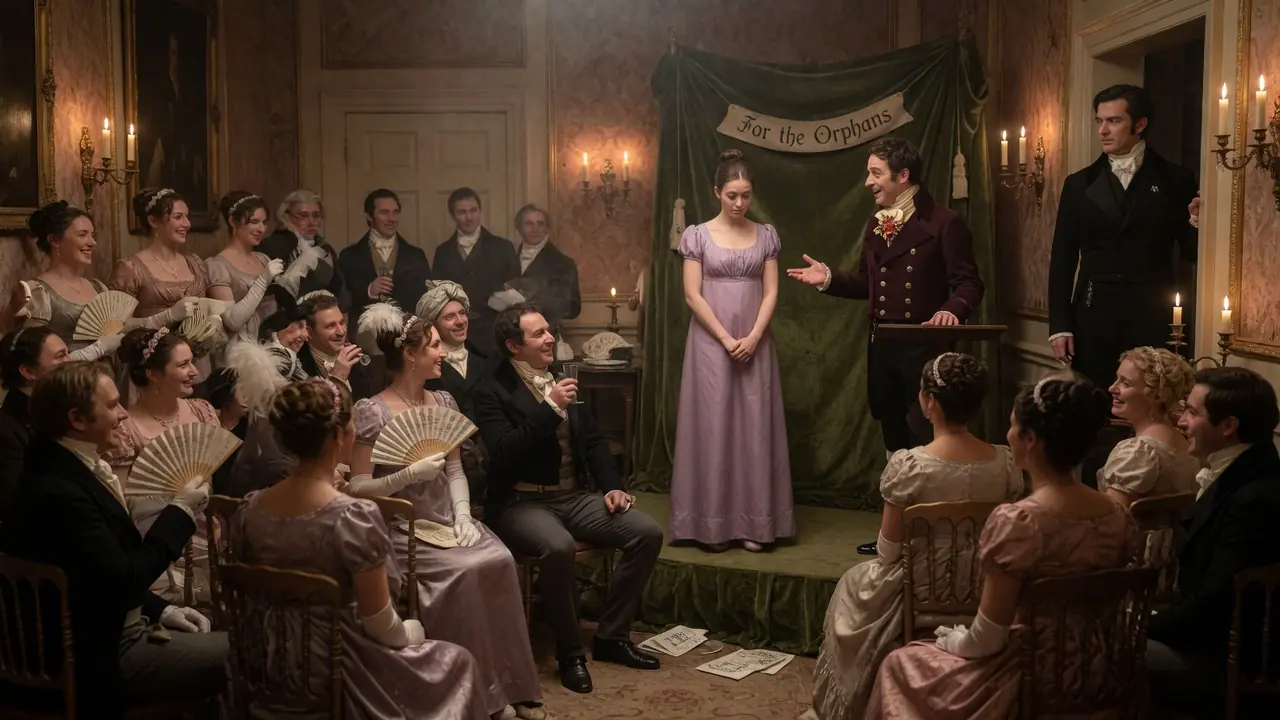
The laughter was the worst part. Not the words. I had survived my family's words for 23 years. Not the hand on my elbow steering me forward like livestock. Not even the sea of faces in Lady Peton's drawing room. Every eye bright with amusement at the Whitmore family's latest entertainment. No, it was the laughter. Because laughter meant they were all in on it, and I was the only one standing outside the joke, wearing it like a gown I hadn't chosen.
And of course, my stepfather announced, his voice carrying that oiled theatrical warmth he reserved for audiences. "No Whitmore charity auction would be complete without our final offering." He paused. Timing. Gerald Cavendish had always understood timing. "A dance. Nay, a full evening's companionship with the last unmarried Whitmore daughter." He gestured toward me and the room rippled.
I should explain what I looked like in that moment because it matters. I was not ugly. I was not deformed. I was simply unmemorable. Brown hair without the courtesy of being chestnut or auburn. A face that was pleasant but never stopped anyone mid-sentence. A figure neither willowy nor voluptuous. I was the kind of woman people's eyes moved past on the way to my sister Cecilia, who was golden and devastating and already married to an earl's second son. Gerald knew this. That was the joke.
"Shall we start the bidding at, oh, let us be generous, £5?" He grinned at the room. "For charity, naturally." Silence. The particular silence of people deciding how to laugh. My mother sat in the third row, her fan moving in precise mechanical strokes. She did not look at me. She had not looked at me once since Gerald had explained the evening's program that morning when I had stood in the breakfast room and said very quietly, "Please don't do this." And she had said without raising her eyes from her toast, "Don't be dramatic, Eleanor. It's for the hospital fund."
"Come now," Gerald pressed, and I could hear the first tremor of irritation beneath his joviality. The joke only worked if someone played along. "Surely one of you fine gentlemen. £500." The voice came from the back of the room. It was not loud. It did not need to be. It cut through the noise the way a blade cuts through silk, without effort, without resistance, leaving silence in its wake.
Every head turned. I had not seen him come in. Later I would learn he had arrived only minutes before, that he had not been expected, that Lady Peton had nearly fainted when her butler announced him, because the Duke of Ashworth had not attended a London social function in over 2 years, and his presence in her drawing room was roughly equivalent to the king wandering into a village pub. He stood near the doorway, one shoulder against the frame, as though he had been watching for some time.
He was tall, tall enough that the posture read as deliberate restraint rather than laziness. Dark hair cut shorter than fashion dictated. A face that was not handsome in the way portraits flattered, but striking in the way storms were striking. All severity and shadow, with eyes so pale they seemed to hold no color at all. He was looking directly at me, not through me, not past me, at me, as though I were the only solid thing in a room full of smoke.
"I... I beg your pardon, your grace." Gerald's voice had climbed half an octave. "£500." The Duke straightened from the doorframe. He did not smile. "For the lady's evening. That was the offer, was it not?" The room had gone so quiet I could hear the candles. Gerald laughed. A sharp, uncertain sound. A dog that had been surprised by something larger in its territory. "Your grace, this is merely a bit of fun, a charity diversion."
"Then you should be delighted." The Duke reached into his coat and produced a leather billfold. He did not open it with haste. He did not fumble. He extracted the notes with the unhurried precision of a man settling a bill at his tailor and held them out to no one in particular. "£500 for the hospital fund, I believe you said." Lady Peton made a sound like a tea kettle reaching boil. Gerald's face had gone a shade I had never seen before, somewhere between chalk and ash, with two spots of livid color high on his cheeks.
"I... well, this is most generous, your grace." "Is the offer accepted?" It was not really a question. It was the tone of a man who had never in his adult life been told no, not because he was cruel, but because he was so thoroughly, immovably certain that people simply found themselves agreeing before they had decided to. Gerald took the money. His hand was shaking. I could see it from six feet away.
"Wonderful," the Duke said. He looked at me again, that same unwavering, colorless gaze, and inclined his head in the barest sketch of a bow. "Miss Whitmore, I shall call for you at 7 tomorrow evening." Then he left. He simply left. No pleasantries, no mingling, no acceptance of Lady Peton's breathless invitation to stay for supper. He walked out of the drawing room, and from the sound of it, directly out the front door, leaving behind £500 and a room full of people who had entirely forgotten how to speak.
I stood on that little stage alone, my hands clasped in front of me so tightly my knuckles ached. And I thought, what just happened? And then underneath that thought, a smaller, more dangerous one. Why?
I did not sleep. I lay in my narrow bed in the room at the back of the house, the room that had been a servant's quarter before Gerald decided I did not warrant the bedroom I had grown up in. And I stared at the ceiling and tried to understand. The Duke of Ashworth. I knew the name, of course. Everyone knew the name. James Hartwell, 7th Duke of Ashworth, master of Blackmir Park in Derbyshire and a London house on Grosvenor Square that he reportedly never used. 31 years old, unmarried, enormously, almost obscenely wealthy, and for the past two years, a ghost retreated from society after the death of his younger brother in a riding accident that the gossip sheets whispered had not been entirely accidental.
He was not the kind of man who attended charity auctions in Mayfair drawing rooms. He was not the kind of man who bid on anything. He was the kind of man who, if he wanted something, simply acquired it the way one acquires an estate or a painting, without ceremony, without competition, because competition implied the outcome was in doubt. So why me?
I turned the question over like a stone in my palm, examining every face of it. Pity, perhaps? A rich man's whim to rescue a mouse from a trap the way one might toss a coin to a beggar. Generous but impersonal. Political maneuvering. Gerald had connections in Parliament, minor ones, but connections nonetheless. Could the Duke want something from him? Or, and this was the thought that kept me awake longest, the one that made my stomach tighten with something I refused to call hope. Had he seen something? When he looked at me with those colorless eyes, had he seen something the rest of the room had missed?
"Don't," I told myself. "Don't be the fool who mistakes transaction for tenderness." I had been that fool before. I would not be her again.
He arrived at 7 precisely. I know this because I had been standing at the upstairs window since 6, watching the street, which I will admit to here and nowhere else. The carriage was black and unadorned except for a small crest on the door, a hawk in flight, no gilding, no ostentation. The horses were matched bays, beautiful and immaculately kept, and the driver wore dark livery without a single unnecessary detail. Everything about the equipage said the same thing the Duke himself had said the night before. "I do not need to impress you. I am simply here."
Gerald intercepted me in the hallway. "A word, Eleanor." He was smiling. That was always dangerous. "This is a remarkable opportunity," he said, keeping his voice low. The front door was 10 feet away, and behind it, a duke was waiting. "A man like Ashworth, the connections alone." "You auctioned me as a joke," I said. "And now you would like me to be useful." Something flickered behind his eyes. Gerald did not like to be reminded of things he had reframed. Last night's humiliation had already been rewritten in his mind as a master stroke. Naturally, he had put me forward. Naturally, a duke had seen the value. Naturally, Gerald Cavendish was the kind of man whose stepdaughters attracted the highest bidders.
"I would like you to remember," he said, and the warmth left his voice like heat leaving a room when the fire dies. "Who keeps the roof over your head?" I held his gaze. I had learned over the years that Gerald could not tolerate being looked at steadily. He needed you to flinch, to drop your eyes, to give him the small submission that confirmed his authority. When you didn't, something in him stuttered. "The Duke is waiting," I said. I walked past him and out the front door.
The footman handed me into the carriage. The Duke was already seated inside. He did not rise. There was no room. But he inclined his head with that same spare precision. "Miss Whitmore." "Your grace." He studied me for a moment as the carriage lurched into motion. In the close confines, I could see details that the candlelight at Lady Peton's had obscured. A thin scar along his jaw, nearly hidden by the sharp line of his face. Hands that were large and ungloved, unusual for a man of his rank, with a writer's callus on the middle finger of his right hand. And those eyes which I had thought colorless, but which were in fact the palest gray, like winter light through glass.
"You are wondering why," he said. It was not a question. He said it the way one might observe that it was raining, a simple acknowledgement of what was already obvious. "I would be a fool not to." "You would," he paused. "And I do not think you are a fool, Miss Whitmore, despite your family's energetic efforts to present you as one." The words landed like a slap, not to my face, but to Gerald's. Precise. Deliberate. This was a man who chose every word the way a surgeon chose every cut.
"You saw what they were doing," I said quietly. "I saw what everyone in that room saw and chose to find amusing." His jaw tightened, the faintest movement, but I was watching closely. "I did not find it amusing." "So, this is pity." "No," he said it so flatly that I believed him instantly. "Pity is passive. I paid £500. That is not a passive act."
The carriage rattled over cobblestones. We were heading west, away from Mayfair toward I was not certain. "Then what is it?" I asked. He was quiet for a long time. Long enough that I thought he would not answer and I began composing in my mind the careful, dignified response I would give to his silence. But then he spoke.
"Three years ago," he said, "I attended a lecture at the Royal Institution. The speaker was discussing the mathematics of architectural loadbearing, an obscure topic poorly attended. There was a woman in the third row who asked a question about the distribution of lateral force in Gothic vaulting that made the lecturer stop and stare. It was the most intelligent question I had ever heard asked in a public forum, and it came from someone the rest of the audience had been ignoring entirely."
My heart stopped. I remembered that lecture. I remembered the question. I remembered the embarrassed silence afterwards, the way the lecturer had fumbled his answer. The way the man beside me had shifted uncomfortably as though my curiosity were a social violation. "That was 3 years ago," I whispered. "Yes." "You remember that?" He looked at me with those pale, steady eyes, and for the first time I saw something behind the severity, something that was not softness exactly, but depth, as though there were entire rooms behind that gaze that he kept locked. "Miss Whitmore," he said, "I have an exceptional memory for things that matter."
I did not know what to say to that. I did not know what to do with the sudden vertiginous feeling that the ground I had been standing on, the certainty that I was forgettable, unremarkable, a footnote in every room I entered, had just cracked beneath me. So I said nothing, and he seemed to find that acceptable.
He took me to Blackmir House on Grosvenor Square. Not to a restaurant, not to the theater, not to any public venue where we would be observed and cataloged and reported on in tomorrow's gossip sheets. To his home, where a table had been laid for two in a library so vast that the candlelight did not reach the ceiling, and the walls were books from floor to gallery, and there was a fire burning in a hearth large enough to stand in.
"I thought," he said, with the faintest trace of something that might have been uncertainty, "that you would prefer privacy to spectacle." He was right. And the fact that he knew that, that he had intuited it without being told, unsettled me more than anything else that had happened in the past 24 hours.
We dined. The food was simple and exquisite, roasted pheasant, early asparagus, a wine that tasted like the memory of summer. We talked, or rather, he asked questions and I answered them. And slowly, with the weariness of an animal emerging from a long winter, I began to ask questions in return. He had read widely and thought deeply, and had the rare ability to be genuinely interested in ideas that were not his own. He asked about architecture, about the mathematics I had taught myself from books borrowed and sometimes stolen from Gerald's study, about what I would build if I could build anything.
"A bridge," I said without thinking. "What kind?" "One that doesn't need to be beautiful, just sound. Strong enough to hold." I paused. "I think there is something noble about a structure that exists purely to bear weight, to carry people from one side to the other. No ornamentation. Just function and faith."
He set down his glass. The firelight caught the angles of his face, and for a moment he looked less like a duke, and more like a man who had just heard something he had been listening for without knowing it. "You are not what they say you are," he said. "What do they say I am?" "Nothing." His voice was very quiet. "That is the problem. They say nothing because they have decided you are nothing. And they have been so thorough in that decision that even you have begun to believe it."
The words hit something inside me that I had kept buried so deep I had forgotten it was there. Not a wound exactly. A room. A locked room where I kept the version of myself that still believed she deserved to take up space. My eyes burned. I did not cry. I had not cried since I was 16, and Gerald had sold my father's books, the only things I had left of him, to pay a gambling debt. I had decided then that tears were a currency I could not afford, and I had not spent a single one since. But I came close. In that library, with the fire dying and a duke watching me with eyes that saw too much, I came dangerously, terrifyingly close.
"I should like to see you again," he said. "Why?" "Because I am not finished." "Finished with what?" He almost smiled. Not quite. His mouth moved a fraction. His eyes shifted, but the ghost of it was there, and it transformed his face so completely that I felt the breath leave my body. "Finding out what else they were wrong about."
He called again four days later, and again the following week, and on the third visit he brought something that changed everything. It was a Tuesday, gray London light through the parlor windows. My mother installed on the settee as chaperone, though she had fallen asleep over her embroidery within the first quarter hour, a habit Gerald would have exploited had he known. The Duke sat across from me, and between us on the low table he placed a leather folio.
"I brought this for your opinion," he said. I opened it. Inside were architectural drawings, plans for a footbridge on the Blackmir estate, commissioned 10 years ago by his father and never built. The design was competent but uninspired, a simple stone arch over what the notation indicated was a 30-foot span across a stream. "The original engineer died before construction," the Duke said. "The plans have sat in my study since. I have been told the design is sound."
I studied the drawings. The proportions were adequate, the materials appropriate, but the load calculations bothered me. The approach was conservative to the point of waste. The abutments were twice the mass they needed to be, and the arch curve was wrong for the span, creating unnecessary lateral thrust that the oversized abutments were meant to absorb. "It is sound," I said carefully. "In the way a fortress is sound when what you need is a house."
Something shifted in his expression. Interest sharpening. "Go on." "The arch is semicircular, but for this span, a segmental arch would distribute the load more efficiently. You could reduce the abutment mass by a third and gain a more elegant rise. And here," I turned the drawing toward him, tracing the line with my finger, forgetting for a moment that I was speaking to a duke and not a fellow student of mathematics, "the voussoirs are uniform, but if you taper them toward the crown, the compression line follows the arch more naturally. It is, forgive me, it is rather like building a sentence with too many words. The meaning is there, but the structure is clumsy."
I looked up. He was not looking at the drawings. He was looking at me, not the way men usually looked at me, through me, past me, assessing and dismissing in the same glance. He was looking at me the way I had seen scholars look at a proof that had just resolved itself on the page, with recognition, with something dangerously close to wonder. "You see it," he said. Not a question. "Of course I see it. The mathematics are quite straightforward."
"Not the mathematics. The wastefulness. The gap between what is built and what is needed. You see it everywhere, don't you?" He leaned forward. His elbows were on his knees now. The formal distance between us collapsed without either of us deciding to collapse it. "In structures, in conversations, in rooms full of people saying nothing that matters. You have been seeing it your whole life and no one has ever." He stopped, his jaw tightened, and for the first time I saw the control crack. Not dramatically, not with raised voices or broken objects, but in the way his hands pressed together until the knuckles whitened, and in the way he looked away from me toward the rain-streaked window, as though he needed a moment to master something that had gotten loose.
"Forgive me," he said. His voice was rough. "I am not... I am not accustomed to this." "To what?" "To wanting to be understood." He said it so quietly I almost missed it. "My brother was the only person who ever... and after he died I decided that solitude was simpler. Safer. That I could live inside the walls and they would hold." He turned back to me. His eyes were bright, not with tears but with the effort of containing them. "And then you asked a question about Gothic vaulting in a room full of strangers, and the walls came down, and I have spent three years trying to rebuild them, and I cannot. I have tried, Miss Whitmore. I cannot."
My mother snorted softly on the settee. The clock ticked. The rain drew crooked lines down the glass. I reached across the space between us and laid my hand over his. I knew what I was doing. I knew the rules I was breaking. Not just propriety, not just the careful architecture of chaperones and formal distance, but my own rules. The ones I had built after the last time I trusted someone. After the last time I let myself want something and watched it be taken away. I was dismantling my own fortifications, and I was doing it with my eyes open.
His hand turned beneath mine, his fingers closed around my fingers. He held my hand the way I had described the bridge. No ornamentation. Just function and faith. Just the weight of one person holding on to another. "You should call me Eleanor," I said. "Eleanor." He said it like he was learning a new language, like the syllables were something precious and foreign and his. "And I should like," I said, "to redesign your bridge."
That was when he smiled. Not the ghost, not the fraction, the real one, rare and crooked and devastating, the one that took apart every wall it touched. And I understood with a clarity that felt like stepping into cold water that I was not falling. I had already fallen. I had fallen three years ago in a lecture hall when a question I asked into silence was heard by exactly one person in the room, and he had carried it with him like a stone in his pocket ever since.
The letter arrived on a Tuesday. It was waiting on the breakfast table when I came down, propped against the teapot with Gerald's studied casualness. The kind of placement that said, "I want you to know I have read this before you." I opened it. My hands were steady because steadiness was something I had practiced until it became armor.
It was from a solicitor, Mr. Henry Pratt of Pratt and Hodges, Lincoln's Inn Fields, and it informed me in the dry, bloodless language of the law that my stepfather had accepted an offer of marriage on my behalf, not from the Duke of Ashworth, from Sir Edmund Travalik, a baronet from Cornwall, 53 years old, twice widowed, a man I had met exactly once at a dinner party 6 weeks prior, where he had stared at my collarbones throughout the fish course and told Gerald within my hearing that he admired a quiet temperament in a wife.
Gerald had sold me. Not as a joke this time. As a transaction. I read the letter twice. I folded it along its original creases. I placed it beside my plate, and then I stood and walked to Gerald's study, where he sat behind his desk with the particular expression of a man who has done something monstrous and decided in advance to call it reasonable.
"Ah, Eleanor. You've seen." "You cannot do this." "I have done it. The settlement is agreed. Travalik is generous. £1,500 a year to the family upon the marriage. Your mother and I." "I am not yours to sell." Gerald leaned back. He was a large man, not tall, but broad, with the kind of physical presence that filled a room and pressed against everyone in it. He had used that presence on me for years, the subtle intimidation of sheer mass, the understanding that he could, if he chose, simply stand too close, and there was nothing I could do about it.
"Your father," he said, "left you nothing. No dowry, no income, no property. You live in my house, eat my food, wear clothes I provide. You are in every legal and practical sense dependent upon my goodwill." He smiled. "And my goodwill has a price, Eleanor. It has always had a price. You have simply been too expensive to maintain and too plain to sell until now."
The cruelty of it was so clean, so precise that I almost admired the craftsmanship. He had waited 23 years to say those words. He had been composing them in his head every time he looked at me and saw not a person but a debt. "Travalik will come to London next week," Gerald said. "You will be presented to him. You will be docile and pleasant and grateful. And if you are not..." He let the threat hang.
"If I am not, then I will make very certain that the Duke of Ashworth hears about your mother's history. The full history, including the parts that would make his association with this family untenable." My blood went cold. He knew. Of course he knew. Gerald always knew which cards to hold and when to play them.
My mother's first marriage to my father had been happy but impoverished. What no one in society knew, what Gerald had buried when he married her, was that between my father's death and Gerald's proposal, my mother had spent 11 months in a debtor's prison. I had been 8 years old, living with a cousin who resented the imposition, while my mother rotted in a cell and tried to negotiate her way out. If that became known, if it reached the gossip sheets, the drawing rooms, the ears of a duke whose family name was spotless, it would destroy us. Not just me. My mother. My sister Cecilia, whose earl's son would discover his wife's mother was a convicted debtor. The entire fragile edifice Gerald had built.
He was not threatening me. He was threatening everyone I loved. "You have until Friday," Gerald said. "I suggest you spend the time wisely."
I did not go to the Duke. I could not. What would I say? "My stepfather is selling me to a 53-year-old baronet, and if I resist, he will destroy my family with a truth I cannot deny." I was not the kind of woman men rescued. I was the kind they overlooked. And the fact that one extraordinary man had briefly decided otherwise did not change the fundamental mathematics of my life. But I could not simply submit either. I had held his hand. I had heard his voice break on the word "understood." I had watched him smile, and I knew the way you know a beam will hold or a calculation is correct, with bone-deep mathematical certainty, that what was between us was real, and that surrendering it to Gerald's cruelty would be a demolition I could not survive.
So on Wednesday, 2 days before the deadline, one day before I had expected to see James again, I did something I had never done. I went to Grosvenor Square alone. It was reckless, a woman of no particular standing, unchaperoned, arriving at the home of an unmarried duke. If anyone saw me, the scandal would do half of Gerald's work for him. I knew this. I went anyway, because recklessness, I was learning, was sometimes just courage that couldn't afford to wait.
The butler admitted me with an expression of carefully managed alarm. James came down within minutes, and the moment he saw my face, his own changed, the composure falling away like a coat shrugged off. "What has happened?" I told him. All of it. Gerald. Travalik. The solicitor's letter. The threat against my mother. I told it clearly and completely because if I was going to ask this man for help, I would not do it in fragments and implications. He deserved the full architecture of my disaster, loadbearing walls and all.
When I finished, he was very still. Then he walked to the window and stood with his back to me, and I watched his hands clench at his sides once, twice, before he mastered himself. "Travalik," he said. The name sounded different in his mouth. Flatter. Harder. "You know him?" "I know of him. His second wife died of a fall. The coroner's report was accommodating." My stomach turned to ice. "And your stepfather?" He turned from the window. His face was the same, composed, controlled, precise. But his eyes had changed. They were no longer winter light. They were steel. "He believes your mother's debt is leverage." "It is leverage. If it becomes known..." "It will not become known." He paused. "But I cannot simply make this disappear, Eleanor. The original creditor. I will need to find the records, trace the debt through whatever hands it has passed. The prison records are another matter. These things take time, and your stepfather has given you two days."
The honesty of it, the admission that he could not simply wave his hand and resolve everything, startled me. I had expected the certainty I had seen in Lady Peton's drawing room. Instead, I saw a man calculating, strategizing, genuinely working through a problem that did not have an easy answer. "I will set my solicitors to it today," he said immediately. "But I need you to understand it may not be complete by Friday. I may be able to settle the debt but not destroy every record. There may be a gap." "Then Gerald will use the gap." "Yes." He met my eyes. "Which means we need something else. Something that removes his power whether or not the records are gone." "What?" "I don't know yet." He said it plainly, without shame. The Duke of Ashworth, standing in his own study, admitting he did not have the answer. It should have frightened me. Instead, it made me trust him more than his certainty ever had. "But I will find it. And so, I suspect, will you."
He was right. Because on Thursday night, the night before Gerald's deadline, lying in my narrow bed in the servant's quarters, staring at the ceiling I had stared at a thousand times before, the answer came to me. Not from hope. Not from desperation. From mathematics.
Gerald's power rested on a single loadbearing assumption: that exposure of my mother's debt would destroy the family. But exposure only worked if the information was new. If it was a weapon, it was a weapon that could only be fired once. And if it was fired at me, if I was the one to reveal it, then Gerald lost the trigger entirely. I could not destroy the records, but I could destroy the secret.
I told James the next morning. I sent a note to Grosvenor Square at dawn, and he came to me again. Improperly. Again recklessly. Again in a way that said the rules of society were suggestions he would follow only until they stood between him and something that mattered. "You want to tell people yourself?" He said we were in the morning room, the door open for propriety's sake. My mother still asleep upstairs. "Before Gerald can. If I go to Lady Peton, she is the worst gossip in Mayfair, which makes her the most efficient, and I tell her myself, as a confession, as a private grief. The story changes. It is no longer a scandal Gerald is exposing. It is a sorrow I am trusting someone with. And if the Duke of Ashworth is known to be courting me despite this knowledge, then it has no teeth."
He was looking at me with an expression I could not immediately read. "You would do that? Expose your own mother's shame to the worst gossip in London." "I would expose it as tragedy rather than let Gerald wield it as disgrace." "Yes. It will cost you." "Everything costs me. I would rather choose the price."
He was quiet for a long moment. Then he said very softly, "You are the bravest person I have ever met, and I have met soldiers." "I am not brave. I am cornered, and I am good at mathematics. Those are not mutually exclusive." He did smile then, and my heart turned over in my chest. "Go to Lady Peton," he said. "Tell her what you need to tell her. My solicitors will work on the records, and I will work on Gerald." "What do you mean?" "I mean that while you are dismantling his leverage, I'm going to find out exactly what else Gerald Cavendish has been hiding. A man who forges one transaction does not stop at one. I'm going to pull every financial thread he has until the entire fabric comes apart."
I went to Lady Peton that afternoon. It was the hardest thing I had ever done. Harder than standing on that stage while the room laughed. Harder than reading the solicitor's letter. Harder than walking to Grosvenor Square alone. Because those were acts of endurance, bearing what was done to me. This was an act of exposure. I was taking the most painful truth of my childhood and placing it deliberately into the hands of someone who would spread it across every drawing room in London within the week.
Lady Peton listened. To her credit, and she had more credit than the ton gave her, beneath the gossip and the sharp tongue, she listened with genuine feeling. When I finished, she reached across the tea table and took my hand. "My dear girl," she said. "What a wretched man your stepfather is." "Yes," I said. "He is." "And the Duke knows. The Duke knows everything." Her eyes gleamed, not with malice, with something sharper. The satisfaction of a woman who understood, perhaps better than anyone in London, that information was only as dangerous as the way it was delivered. "Leave it to me," she said.
By Saturday, the story had traveled through Mayfair like water through cracks in stone. But it was not the story Gerald would have told. It was the story of a little girl whose mother went to prison, and a young woman who had carried that shame alone for 15 years, and a duke who, upon learning the truth, had not flinched. Lady Peton had reframed my humiliation as dignity and Gerald's weapon as evidence of his own cruelty, and the ton, fickle, ruthless, endlessly hungry for narrative, had swallowed it whole.
Gerald discovered what I had done on Sunday morning. I was not present for his reaction, but Cecilia described it to me later in a letter. The broken vase, the overturned desk, the language so vile that the servants had retreated to the kitchen and refused to come up. He was not finished. I knew that. A man like Gerald did not lose his primary weapon and simply concede. He would find another. He would escalate. And he did, faster and more viciously than even I had predicted.
Lady Ashford's ball. The event of the season. I learned what Gerald had done only when Cecilia found me near the terrace doors, her face white, her voice barely above a whisper. "Gerald has written to Sir Edmund Travalik. He has told him you are compromised. That Ashworth has... Eleanor. He has fabricated a letter with details. He has asked Travalik to confront the Duke publicly tonight. Here." Gerald had manufactured the one scandal my confession to Lady Peton could not preempt. Not my mother's history. My virtue. A lie about what had happened between me and the Duke, weaponized in a ballroom designed to force James into either a marriage under duress or a public withdrawal.
"Where is Travalik?" I said. "Near the refreshment table." "Eleanor, you cannot." But I was already moving. I found him before James did. Sir Edmund Travalik, 53 and soft-faced, standing with a glass of champagne and a folded letter and the particular expression of a man who has been given a weapon and is savoring the moment before he uses it. He saw me. He smiled. The smile of a man who believed he owned something. "Miss Whitmore, how delightful. I was just..." "You were just about to make a spectacle based on a forgery," I said. My voice was low, but it carried. It carried because I had spent 23 years being quiet, and I was finished. "That letter was written by my stepfather, who has debts he cannot pay, and a stepdaughter he cannot sell, and you are the fool he found willing to do his work for him."
Travalik's smile curdled. "I beg your pardon." "You should. You should beg my pardon. You should beg this entire room's pardon for what you are about to do. But you will not, because you are not a man who begs. You are a man who stares at women's collarbones at dinner and calls it admiration. And you are a man whose second wife fell to her death in circumstances that an honest coroner would have investigated further. And if you unfold that letter in this ballroom, I will say every word of that aloud here, now, in front of everyone whose good opinion you have not yet managed to forfeit."
The ballroom had gone quiet. Not entirely. The orchestra still played. Couples still danced at the far end. But the cluster of guests nearest to us had stopped talking, stopped moving, stopped breathing. Travalik's face was gray. His hand, the one holding the letter, had dropped to his side. "You..." he began. "She is not finished." James, behind me. I had not heard him approach, but I felt him, the way you feel a wall at your back, solid and immovable. He stepped forward until he stood beside me, and his hand found the small of my back, and the touch, light, deliberate, unmistakable, said everything his words had not yet said.
"But I believe I am," he continued. He was looking at Travalik with the calm, precise attention of a man who has assessed a structural weakness and knows exactly where to press. "Sir Edmund, you have two choices. You may leave this ball with the letter in your pocket and your reputation intact, or you may open it, in which case I will ensure that every detail of your financial arrangement with Gerald Cavendish, including the terms under which you agreed to purchase a woman, becomes a matter of public record by morning." He paused, not for drama, for precision, because James Hartwell did not make threats. He made statements of fact.
"I have been investigating Mr. Cavendish's finances for some weeks now," he said, and his voice carried farther than Travalik's had, farther than Gerald's had, farther than anyone's, because the room was silent now, fully silent. 300 people holding their breath. "What I have found includes forged securities, fraudulent estate valuations, and the systematic theft of his stepdaughter's maternal inheritance. This information is currently with my solicitors and will be presented to the appropriate authorities on Monday." A murmur ran through the crowd like wind through wheat.
"Miss Whitmore came to this ball tonight knowing what you intended," James continued, "and she walked up to you anyway, alone, before I could reach you. Because Eleanor Whitmore has more courage in her smallest finger than you and Gerald Cavendish possess between you, and I will not stand here and allow either of you to mistake her kindness for weakness ever again."
He turned to me. The coldness left his face. What replaced it was the thing I had seen in his study when he admitted he did not have the answer. Not certainty, but something better. Faith in me, in us, in the bridge we were building together, span by span, stone by stone. "Eleanor," he said, "I have spent three years trying to be the kind of man who deserves to say this to you." His voice faltered. James Hartwell, seventh Duke of Ashworth, whose voice had never wavered in my hearing, faltered. "I love you. Not the idea of you. Not the project of you. You. The woman who asked a question in a silent room and changed the entire architecture of my life."
300 people. Not a whisper. "You impossible man," I said. My voice was wrecked. I did not care. I did not care about 300 witnesses or Lady Ashford's carpet or the gossip sheets or any of it. "You absolute impossible man." "Is that a yes?" "It has been a yes," I said, "since the moment you said £500."
He kissed me. In the middle of Lady Ashford's ballroom, in front of 300 members of the ton, the Duke of Ashworth kissed Eleanor Whitmore, the nobody, the nothing, the final offering at a charity auction, and the sound that erupted around us was so loud it rattled the chandeliers.
Gerald fled before the investigation was complete. The evidence James' solicitors assembled, years of fraud, forgery, and theft, was enough to ensure he would not return. He took a packet to Calais and vanished into the kind of anonymous continental poverty he had spent his life inflicting on others. My mother, freed from him, wept for two days, and then began, with a resolve I had not known she possessed, the slow work of becoming someone I could forgive.
We married in June at Blackmir Park, in a chapel so old the stones remembered a time before titles existed. The ceremony was small, just vows spoken in a voice that did not falter, and a voice that did, because the tears I had been hoarding since I was 16 arrived all at once, and James held my hands through every one of them.
A year later, I stood in the library at Blackmir and looked at the plans spread across the desk. Not the old plans, the ones his father had commissioned with their oversized abutments and wasteful arches. Mine. A segmental arch, tapered voussoirs, a clean 30-foot span across the stream in the lower meadow. Function and faith. Nothing more, nothing less.
Through the window, I could see the bridge, finished last month, already carrying villagers across the water as though it had been there forever. James came in and stood behind me, close enough that I could feel the warmth of him along my back. "It holds," he said. "Of course it holds." He pressed his lips to my temple. "Rather like you." I leaned back against him and looked out at the bridge I had built and the stream that caught the afternoon light and held it bright and unbroken, carrying everything forward.