“You cannot be serious, Cordelia.”
The words, sharp and cold as the March wind rattling the windowpane, were not a question. They were a judgment.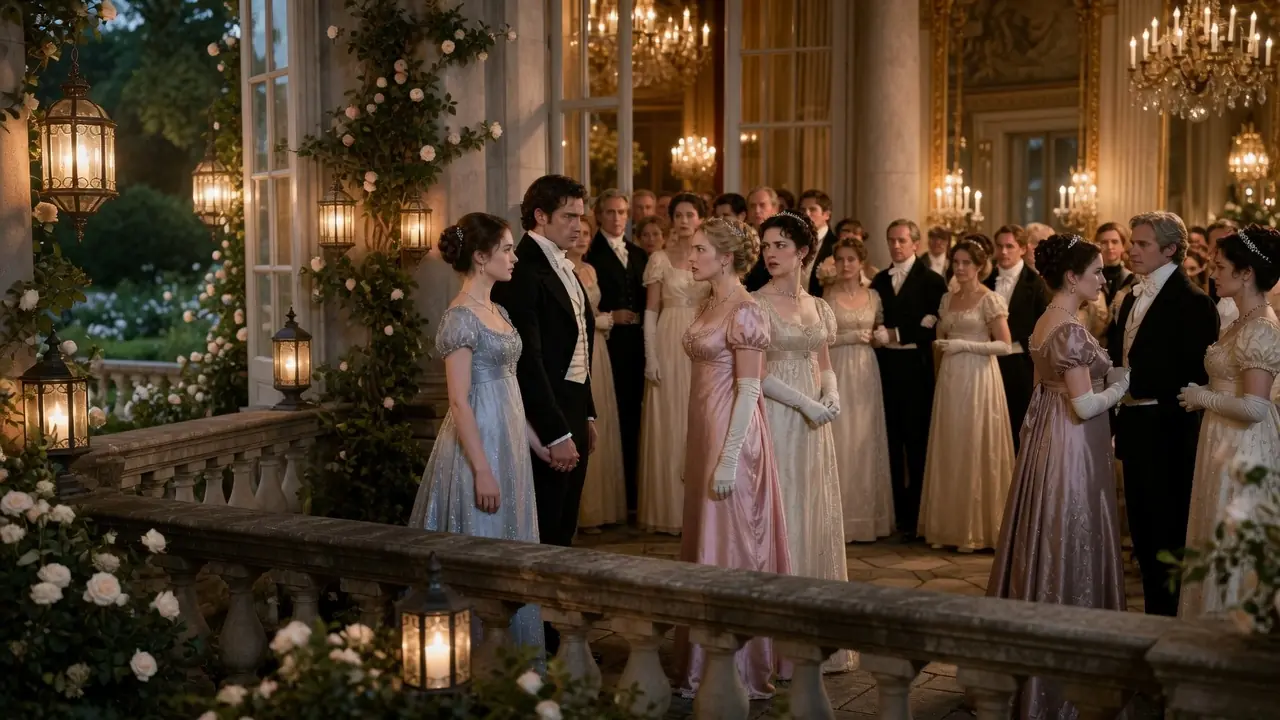
Phoebe Holt did not look up from the small mending task in her hands, the needle moving with a steadiness she did not feel.
The drawing room of their London townhouse felt smaller that day, the floral wallpaper closing in, the air thick with the scent of her mother’s lily water and disapproval.
“Her name is Phoebe, Mama,” her younger sister Juliet murmured, not in defense, but as a casual correction, as one might point out a misplaced teacup.
Juliet, at nineteen, was all vibrant rose and gold, her gown a confection of silk that rustled with every impatient tap of her foot.
“It hardly matters what her name is,” Mrs. Holt retorted, her voice a blade wrapped in velvet. “At six and twenty, with prospects dwindling to around zero, she proposes to wear that to the Danbury ball. It is an act of aggression. That is what it is. An insult to me. An insult to your sisters.”
Phoebe’s fingers paused their work.
The gown in question was dove-gray muslin, refitted for the third time. It was perfectly clean, perfectly modest, and perfectly invisible.
That was, of course, its purpose: to allow her to fade into the damask-hung walls of a ballroom, a quiet shadow trailing in the incandescent wake of her sisters.
Rosalind, the middle sister and the season’s acknowledged beauty, laughed. It was a sound like tiny, brittle bells.
“Oh, let her, Mama. It is her particular brand of martyrdom to appear so plain that gentlemen might pity her. The problem is they do not even notice her enough to pity her.”
“They will notice the family she belongs to,” Mrs. Holt snapped. “They will see her, a drab little wren, and wonder what is wrong with the Holt stock. It affects your chances, Rosalind. Your chances, Juliet. Everything she does or fails to do reflects upon us.”
Phoebe set her sewing aside in her lap.
She finally raised her eyes.
Her family was a portrait of fashionable impatience. Her mother, still handsome, her ambition for her daughters a palpable force in the room. Rosalind, dark-haired and imperious, already practicing the cool gaze of the viscountess she intended to become. Juliet, fairer and softer, but with a core of the same flint.
They were all waiting for her to speak, to defend herself, to weep.
She did not cry.
She had learned a long time ago that tears were exactly what they wanted. They were a currency of surrender.
“It is a perfectly respectable gown, Mama,” Phoebe said, her voice low and even. “I do not wish to draw attention.”
“You will draw the wrong kind.” Mrs. Holt’s face was flushed. “You will look like a governess, a poor relation. We are not poor relations, Phoebe. Your father may have his difficulties, but we are not yet destitute. And it is your duty, all of your duties, to marry well and secure this family. A duty at which you are spectacularly failing.”
The mention of their father’s difficulties hung in the air.
Debts.
Gambling debts that coiled around their respectable life like a serpent, squeezing tighter with every passing season.
This was the true source of her mother’s frantic, cruel energy.
Fear.
“Perhaps,” Phoebe said, her gaze steady, “if I am so detrimental to your prospects, it would be best if I did not attend at all.”
It was a gamble, a small, desperate bid for an evening of peace.
It failed.
“And have Lady Danbury ask after you? Have me invent some sudden illness?” her mother declared, waving a dismissive hand. “The gossip would be worse. No, you will come. You will stand near the potted ferns. You will smile pleasantly if spoken to, which is unlikely, and you will make every effort not to look as though you are counting the minutes until you can return to your books. Is that understood?”
Phoebe inclined her head.
“Perfectly, Mama.”
The silence that followed was heavy with their victory.
She was dismissed, an object arranged to their satisfaction.
She picked up her sewing again, the simple repetitive motion a small anchor in the churning sea of their contempt.
She knew what they did not.
Her quietness was not emptiness.
It was a fortress.
And inside its walls, she was weary, but she was not broken.
Not yet.
That night, the chandeliers of Danbury House blazed with the light of a thousand candles. Their brilliance reflected in the jewels and shimmering silks of the ton. The air was a symphony of string music, laughter, and the murmur of a hundred conversations.
For Phoebe, it was simply noise.
As instructed, she found a place near a towering arrangement of ferns and lilies, a small alcove that offered a degree of obscurity.
Her sisters were immediately swallowed by the glittering crowd, flanked by admirers. Her mother was already deep in conversation with another ambitious mama, their heads bent together like scheming generals.
Phoebe watched.
It was what she always did.
She was a student of these events, an anthropologist of the marriage market. She saw the subtle calculations in a glance, the victory in a shared dance, the defeat in a turned shoulder. She saw the desperation behind the brightest smiles.
And she saw him.
The Duke of Velmore.
He was the season’s great unattainable prize: impossibly wealthy, impossibly handsome, and impossibly cold.
He stood near the French doors leading to the garden, a figure of stark, austere elegance in a sea of color. Marcus, his given name, was dark-haired, with a face that looked as though it were carved from granite and eyes the color of a winter storm.
He spoke to no one.
He did not smile.
He simply observed, his presence a vortex of silence that drew every eye in the room.
Rumor clung to him like a shroud. He was thirty-two and had inherited the title years ago, but had only just emerged into society after a long, mysterious seclusion at his northern estate, a place called Thornhurst.
Some said he was grieving a lost love. Others whispered of a family tragedy.
Rosalind had declared her intention to be the one to thaw the ice prince. She had tried earlier in the evening, approaching him with her most dazzling smile.
He had given her a nod so brief it was almost an insult, and turned away.
Phoebe watched her sister retreat, watched the tightening of her smile and the flush of anger on her cheeks.
She felt a familiar, weary pang, not of pity, but of recognition.
The sting of being dismissed.
A young lord, emboldened by champagne, stumbled near Phoebe’s alcove, jostling her.
A splash of lemonade from her glass arced onto the sleeve of her gray gown.
“Oh, beg pardon, miss,” he slurred, barely glancing at her before being drawn away by his friends.
Phoebe blotted at the damp spot with her handkerchief.
It was nothing, a minor inconvenience, but then she saw Rosalind watching from across the floor, a smirk playing on her lips.
Rosalind caught her eye, and with theatrical subtlety, she whispered something to the girl beside her. They both tittered, their fans fluttering like cruel birds.
It was a small moment, a pinprick of malice in a room full of them.
But Phoebe felt the heat rise in her cheeks.
It was the public nature of it, the casual, unthinking cruelty.
She lowered her gaze, willing herself to become invisible again, to let the moment pass.
One second.
Two seconds.
Three.
A shadow fell over her.
“It seems you have had an unfortunate encounter, Miss Holt.”
The voice was low, deep, and utterly devoid of warmth.
Phoebe looked up.
He was standing before her, so close she could see the intricate knot of his cravat and the faint silver threads at his temples.
His storm-gray eyes were not looking at the stain on her dress.
They were looking at her face.
She felt a jolt, a strange sense of being caught.
“It is nothing, Your Grace,” she said. “A clumsy accident.”
“Was it?”
His gaze flickered for a moment across the room in the direction of her sister. When his eyes returned to hers, she saw something in them.
Not pity.
Recognition.
He had seen the whole exchange.
The spill, the smirk, the whispered comment.
He had seen it, and he had understood.
This was a new and terrifying feeling.
To be seen.
“Some accidents are more deliberate than others,” he said.
It was not a question.
It was a statement.
Phoebe’s heart was beating a frantic rhythm against her ribs. She should murmur something polite and meaningless. She should lower her eyes.
But she found she could not.
His gaze held hers, and for the first time that evening, she did not feel like a shadow.
She felt solid.
Real.
“Indeed, Your Grace,” she managed, her voice steadier than she expected.
Something moved at the corner of his mouth.
Not quite a smile.
The almost of a smile.
It was the most expressive thing she had seen him do all night.
“Your family is well this evening?” he asked, a formal, almost banal question.
But the way he said it, the slight emphasis on the word family, told her it was anything but.
“They are enjoying the ball immensely,” she replied, the words tasting like ash.
“And you?”
The question was direct.
Simple.
And no one had asked her that all evening.
No one ever did.
They asked after her sisters, her mother, her father.
They did not ask after her.
She took a breath.
“I find the ferns to be excellent company, Your Grace.”
The almost smile returned, a fraction wider this time.
He held her gaze for another long moment, a silence that stretched and hummed with unspoken things.
Then, with a curt nod, he was gone, melting back into the crowd as silently as he had appeared.
Phoebe stood frozen, her hand clutching her damp handkerchief.
Her heart was still racing.
The spot on her sleeve was forgotten.
The whispers of her sister were forgotten.
All she could think of was the unnerving sensation of his gray eyes and the impossible, terrifying thought that had lodged itself in her mind.
He saw me.
Three days later, the Duke of Velmore’s carriage, a severe, glossy black thing pulled by two magnificent gray horses, drew up outside the Holt residence.
The arrival sent a shock wave through the house. The maids scattered in a panic. The butler fumbled with his coat, and Mrs. Holt nearly swooned with triumphant excitement.
“Rosalind. Juliet. To the drawing room at once,” she commanded, her voice trembling. “He is here. I knew it. It is for Rosalind. It must be.”
Rosalind, preening, smoothed her hair.
“Of course it is, Mama. My dance card was nearly full. He must have noticed.”
Phoebe, who had been in the small back parlor attempting to reconcile the household accounts, a task that had fallen to her by default, heard the commotion and felt a cold dread.
She stayed where she was, hidden away.
This had nothing to do with her.
The butler, Mr. Finch, appeared at her door, his face pale.
“Miss Phoebe, His Grace, the Duke of Velmore, has asked to see your father and…”
He hesitated.
“And you, Miss.”
Phoebe’s pen slipped, leaving a black smear across the ledger.
“Me?”
“Specifically, Miss. He was most particular.”
A strange quiet fell over the drawing room when Phoebe entered.
Her mother and sisters stared at her as if she were a ghost. Her father, a man diminished by his worries, stood nervously by the mantelpiece.
And there, in the center of the room, stood the Duke.
He looked even taller and more imposing by daylight.
He acknowledged her with a slight inclination of his head. His expression was unreadable.
“Your Grace,” her father began, wringing his hands. “This is an unexpected… an honor.”
“Mr. Holt,” the Duke cut in, his voice clipping the words with precision. “I would have a private word with you and with your eldest daughter.”
The silence that followed was thick with astonishment and outrage.
Mrs. Holt opened her mouth to protest, but one look from the Duke silenced her.
With visible reluctance, she herded a stunned Rosalind and a bewildered Juliet from the room.
When the door closed, the Duke did not waste time with pleasantries.
He turned to Phoebe.
“Miss Holt, at the Danbury ball, I observed you for some time. You possess a quality I find rare: a quiet composure, a dignity under duress.”
Phoebe’s hands were clasped so tightly in front of her that they were bloodless. She could feel her father’s baffled gaze on her.
The Duke continued, his voice as cool and impersonal as if he were discussing a business transaction.
“I find myself in need of a wife. A duchess. A woman to be mistress of my households and to bear the title with the requisite grace. I do not seek a love match. I do not deal in sentiment. I require a partner who is sensible, intelligent, and without artifice.”
He paused.
“I have concluded that you are that woman.”
Phoebe stared at him.
The room seemed to tilt.
This could not be happening.
It was a dream, a cruel, elaborate jest.
Her father made a choking sound.
“Your Grace. I… my daughter, Phoebe…”
The Duke’s gaze did not waver from Phoebe’s face.
“I am aware of your financial circumstances, Mr. Holt. Your debts are considerable. Upon my marriage to your daughter, I would see them settled in their entirety. She would be provided for, as befits her station, as the Duchess of Velmore, with a generous settlement in her own right.”
It was a business deal.
Cold, stark, brutal.
He was buying a wife.
He was buying her.
And in doing so, he was buying her family’s salvation.
He was offering her a cage, but it was a different cage from the one she was already in.
This one was gilded, vast, and came with a title.
Most importantly, it came with distance.
Distance from her mother’s scorn and her sisters’ petty cruelties.
It was an escape.
“Why?” The word was a whisper torn from her throat. “You could have anyone. My sister Rosalind.”
“I do not want your sister Rosalind,” he stated flatly. “I do not want a woman who measures her worth in the number of compliments she receives. I want a woman who knows her own mind. I believe you know yours.”
He took a step closer.
“I am offering you an arrangement, Miss Holt. A partnership in return for your name and your presence as my duchess. I offer you security, a title, and a life away from this.”
His brief gesture encompassed the room, the house, the life she had known.
He saw it all.
She looked from the Duke’s implacable face to her father’s, which was a mess of shock, hope, and dawning greed.
She thought of her mother and sisters on the other side of the door, their world about to be turned upside down.
She thought of a lifetime of being told to stand by the ferns, of wearing gray so as not to offend, of being the family’s failure.
And in that moment, she felt a surge of something she had not felt in years.
Power.
The power of the underestimated.
He had chosen her.
Not for her beauty, not for her connections, but for the very qualities her family despised: her quietness, her watchfulness, her resilience.
She met the Duke of Velmore’s stormy eyes.
She would not be a blushing bride.
She would not pretend this was a fairy tale.
She would be a partner in a transaction.
She would hold up her end of the bargain.
And she would be free.
She straightened her shoulders.
“I accept your proposal, Your Grace.”
The aftermath of her acceptance was a storm of disbelief and fury.
When her mother and sisters were allowed back into the room and the news was announced, the scene was one worthy of the stage.
Mrs. Holt actually sank into a chair, her face ashen.
Rosalind’s beauty was twisted into a mask of pure, venomous rage.
“It is a joke,” Rosalind shrieked, her voice cracking. “He cannot be serious. Her? He chose her?”
“He did not choose her,” Mrs. Holt said, her voice a low, dangerous hiss, her eyes fixed on Phoebe. “He bought her. He saw our desperation, and he bought the plainest, most pliable one, like a farmer buying a broodmare.”
The words were meant to wound, and they did.
But the Duke was still there, a silent, formidable witness.
He turned his cool gaze upon Mrs. Holt.
“On the contrary, madam,” he said, his voice dangerously soft. “I chose the one with the most value. You were simply unable to see it.”
He then turned to Phoebe, ignoring the sputtering rage of her family.
“I will have my man of business call on your father tomorrow to make the arrangements. We will be married by special license at the end of the week.”
And with that, he was gone, leaving chaos in his wake.
Phoebe did not stay to endure the recriminations.
For the first time in her life, she simply turned and walked out of the room, leaving them to their rage.
She went to her own small bedroom and closed the door. She stood by the window, looking out at the unremarkable London street, her hands pressed against the cold glass.
Duchess of Velmore.
It sounded like a name from a book, a character someone else had written.
Could she play the part?
The wedding was as stark and impersonal as the proposal.
It took place in a cavernous, empty church with only her father and the Duke’s grandmother, the Dowager Duchess of Velmore, as witnesses.
Phoebe wore a simple traveling dress of deep blue. The Duke wore his customary black.
He spoke his vows in a clear, firm voice.
When it was her turn, Phoebe found her own voice did not tremble.
She was making a bargain.
She would keep it.
The Dowager Duchess Hortense was a woman who looked as though she were carved from the same granite as her grandson, but her eyes, a startlingly bright blue, were sharp with intelligence and a flicker of something that might have been kindness.
As they signed the register, she laid a cool, dry hand over Phoebe’s.
“You have a steady hand, child,” she murmured, her voice raspy with age. “Good. You will need it.”
The journey north to Thornhurst was undertaken in near total silence.
The Duke, her husband, sat opposite her in the perfectly sprung carriage, his gaze fixed on the passing landscape.
He did not seem angry or tense or anything at all.
He was a void, a handsome, well-dressed, titled void.
Phoebe did not try to force conversation.
She watched the green hills of the home counties give way to the wilder, more dramatic landscapes of the north. The air grew colder. The sky seemed larger.
It felt as though they were traveling not just to a different part of the country, but to a different world entirely.
They arrived at Thornhurst at dusk.
The carriage turned off the main road through a gatehouse whose stone was dark with age, then down a long drive lined with ancient oaks.
And then she saw it.
The house was not a house.
It was a fortress, a sprawling edifice of dark gray stone that seemed to grow from the very land it stood on.
It was magnificent, imposing, and utterly without welcome.
Light shone from only a handful of its dozens of windows.
As the carriage drew to a halt, the great front doors opened, and the staff lined the steps: an elderly butler, a housekeeper in black bombazine, and a dozen or so maids and footmen.
They stood in perfect, silent formation.
Marcus, she had to start thinking of him as Marcus, alighted and turned to help her down.
His hand was cool and firm around hers.
“Welcome to Thornhurst, Your Grace,” he said, the title sounding strange and formal on his lips.
Inside, the great hall was vast and cold, the sound of their footsteps echoing on the black-and-white marble floor. A fire roared in a fireplace large enough to roast an ox, but it did little to warm the cavernous space.
Everything was shrouded in shadow, the furniture looming like ghosts under dust covers.
The air smelled of old stone, beeswax, and something else.
Sadness.
The house itself felt as though it were holding its breath.
The housekeeper, a stern-faced woman named Mrs. Finch, no relation to their London butler, she would later learn, curtsied.
“Your Grace, welcome. We have prepared the Duchess’s suites in the West Wing.”
“Thank you, Mrs. Finch,” Marcus said. “My wife is tired from the journey. See that a meal is sent up to her.”
He was dismissing her.
On their wedding night.
Phoebe felt a flicker of something she was not sure how to name.
Relief, perhaps.
Humiliation, perhaps.
She was too tired to tell.
She simply nodded.
“Yes, I am rather tired. Thank you.”
He looked at her then, a long, searching look.
For a moment, she thought he might say something more, but he only inclined his head.
“I have work to attend to in my study. We will speak in the morning.”
Her rooms were beautiful: a large sitting room, a bedroom with a grand four-poster bed, and a dressing room, all appointed with exquisite but faded furniture.
A young maid with wide, curious eyes introduced herself as Agnes and helped her out of her traveling dress. A tray arrived with soup, bread, and cheese, but Phoebe had little appetite.
After Agnes had left, Phoebe walked through the silent, opulent rooms.
This was her home now.
This vast, sleeping castle.
And its master was a man she did not know at all, a man who had married her for reasons of cold logic and now seemed to regret even that.
She walked to the window and looked out.
There was no gaslight here, no city glow, only a profound, unnerving darkness with a faint outline of brooding hills against a star-dusted sky.
She felt a loneliness so sharp and deep it almost stole her breath.
“What have I done?”
The question echoed in the silent room.
She had escaped one prison only to find herself in another, larger and more elegantly appointed, but a prison nonetheless.
The next morning, Phoebe awoke to pale, watery sunlight filtering through the heavy curtains.
For a moment, she did not know where she was.
Then the memory of the previous day settled upon her like a shroud.
She was the Duchess of Velmore.
She was at Thornhurst.
She dressed in a simple gown of dark green wool, another of her own refitted creations.
When she made her way downstairs, the house was silent. She found the breakfast room, a cavernous chamber where a single place had been set at one end of a dining table that could have seated thirty.
Marcus was not there.
A footman served her tea and toast.
She ate alone, the silence of the room pressing in on her.
This was to be her life then.
Solitary meals in echoing rooms.
A ghost in her own home.
After her lonely breakfast, she decided to explore.
She would not be a prisoner in her rooms.
This was her house now, and she would know it.
She wandered through the ground floor, her footsteps soft on the Turkish carpets. Room after room was shrouded in Holland covers. Gilt-framed portraits of grim-faced ancestors stared down at her from the walls, their eyes seeming to follow her.
She found the library.
It was the one room that felt truly alive.
Two stories high, with towering shelves of books reaching up to a coffered ceiling. A ladder on a rail ran along the upper gallery. The air smelled of leather and paper and time.
Unlike the rest of the house, the furniture here was not covered. Two worn leather armchairs sat before a cold hearth. Desks were clear, surfaces polished.
Someone used this room.
Marcus.
She ran her fingers along the spines of the books: history, philosophy, poetry, the classics in Latin and Greek.
It was a scholar’s library.
A reader’s library.
For the first time since arriving, Phoebe felt a flicker of something other than dread.
A connection.
Here, at least, was a language she understood.
She spent the rest of the morning there, pulling down volumes at random, losing herself in their pages.
It was a sanctuary.
She was so engrossed in a book of botanical drawings that she did not hear him enter.
“I see you have found my library.”
She started, the heavy book slipping in her lap.
Marcus stood in the doorway watching her. He was dressed for riding in immaculate boots and breeches.
“Forgive me, Your Grace,” she said, her cheeks flushing. “I did not mean to intrude.”
“It is your library now as well,” he said, his tone neutral.
He walked into the room, his presence seeming to shrink its vast proportions.
“You may use it as you wish.”
He gestured to the book in her lap.
“Do you have an interest in botany?”
“I enjoy gardens,” she said simply. “And the drawings are very fine.”
He came to stand beside her chair, looking down at the page. It was a detailed rendering of a moss rose.
For a moment, they stood in silence, looking at the drawing together.
It was the closest they had been since the wedding.
She was acutely aware of him, of the scent of leather and cold morning air that clung to him.
“Thornhurst once had famous rose gardens,” he said, his voice quiet. “They have been neglected.”
He did not elaborate.
He did not need to.
The neglect was everywhere. It was in the dust covers, the cold hearths, the very air of the place.
“Perhaps they could be revived,” Phoebe suggested softly.
He looked at her, and his expression was bleak.
“Perhaps.”
He seemed about to say more, then checked himself.
“My grandmother will be arriving this afternoon. She will take tea with you at four.”
He turned and walked away, leaving her alone in the quiet of the library.
The Dowager Duchess arrived in a flurry of activity that seemed to shake the house from its slumber.
Unlike her grandson, Hortense, Duchess of Velmore, was not a quiet presence. She was a small, bird-like woman with an iron will and eyes that missed nothing.
She swept into the drawing room, which had been hastily uncovered for her visit, and surveyed Phoebe from head to toe.
“So,” the Dowager said, her voice a dry rasp. “You are the one he chose. The sensible little mouse from London.”
Phoebe, who had been steeling herself for this encounter, simply met the old woman’s gaze.
“I am Phoebe, Your Grace.”
The Dowager gave a short, sharp laugh.
“You have a spine at least. Good. Marcus has enough gloom for ten men. He does not need a wife who will weep in the corners.”
She sat, arranging her black silk skirts.
“He chose you for your composure, he tells me. A ridiculous reason to marry someone. He might as well have married his desk. It, too, is composed.”
Phoebe felt a surprising urge to smile.
“His desk, I imagine, would make a far less demanding duchess.”
The Dowager’s bright blue eyes glittered.
“Ha. I think I shall like you. Now tell me, what do you make of this mausoleum my grandson calls a home?”
“It is quiet,” Phoebe said carefully.
“It is dead,” the Dowager corrected her bluntly. “It has been dead for a year. Ever since Edmund…”
She stopped, her lips tightening. She looked away toward the tall windows.
“Marcus has let his grief poison this house. He has shut out the light. He walks these halls like a ghost, and he has turned his staff into ghosts along with him.”
Edmund.
The name from the rumor mill.
The lost brother.
“He has closed the east wing entirely,” the Dowager continued, her voice lower. “Edmund’s rooms. He will not enter them. He will not allow anyone else to enter them. He thinks by locking a door, he can lock away the past. The fool.”
She turned back to Phoebe, her gaze sharp as a needle.
“He married you because he needed a duchess to silence the matchmaking harpies in London. He thinks he can install you here like a piece of furniture and continue his brooding. It is up to you, child, whether you intend to be furniture or not.”
Phoebe thought of the long, empty dining table, the solitary breakfast, the dust covers.
“I do not intend to be furniture, Your Grace,” she said.
The Dowager smiled.
It was a real smile, and it transformed her stern face.
“I did not think so.”
That evening, Phoebe made her first move.
When she went down for dinner, she found Marcus already there, standing by the fireplace in the immense dining room. Two places had been set, one at each end of the long, polished expanse of mahogany. They were separated by at least twenty feet of empty space.
“Your Grace,” she said, her voice clear and steady in the cavernous room.
He turned.
“I trust your tea with my grandmother was informative.”
“It was. Thank you.”
Phoebe looked at the table.
“I find this arrangement to be impractical.”
He raised an eyebrow.
“In what way?”
“In every way,” she said. “It is unsociable, inefficient for the staff, and I have no desire to shout down the length of a table to ask you to pass the salt.”
She walked over to a footman who stood rigidly by the wall.
“Would it be possible to have a small round table brought in here for our meals? One that seats two, or perhaps four for when the Dowager visits.”
The footman looked at her, then at the Duke, his eyes wide with panic.
Marcus was silent for a long moment.
Phoebe held her breath.
She had overstepped.
She had challenged his authority in his own home on her second day.
He looked at the long, empty table, then at her.
A flicker of something, surprise, annoyance, amusement, crossed his face.
“See to it,” he said to the footman, and then to Phoebe, “An eminently sensible suggestion. I wonder why no one has made it before.”
Perhaps, Phoebe thought, because no one had dared.
The next day, a small, elegant rosewood table appeared in the dining room.
When they sat down for dinner that evening, they were close enough to speak in normal voices.
The silence was still there, a tangible presence between them, but it was a smaller, less intimidating silence.
He spoke first.
“My grandmother seems to have taken a liking to you.”
“She is a formidable woman,” Phoebe said.
“She is a tyrant,” he corrected.
But there was no heat in his words.
“She believes I am handling my affairs badly.”
“And are you?” Phoebe asked, her boldness surprising her.
He looked at her, his gray eyes unreadable.
“That remains to be seen.”
The days settled into a strange rhythm.
Phoebe spent her mornings in the library or walking the grounds, exploring the vast, overgrown park.
She found the old rose garden, a skeleton of its former self, choked with weeds and thorns.
On an impulse, she asked the head gardener, a taciturn man named Thomas, for a pair of gloves and shears.
She began the slow, arduous work of clearing the weeds, of pruning back the dead wood.
It was methodical, satisfying work. Her hands, accustomed to needlepoint, grew calloused. She worked for hours each day, losing herself in the physical labor.
The sun and the wind on her face were a balm.
She was not thinking of her husband or her family or the gilded cage she inhabited.
She was simply tending a garden.
From his study window, which overlooked that part of the grounds, Marcus watched her.
He had expected her to be a quiet, decorative presence. He had expected her to occupy herself with correspondence, with morning calls, if any neighbors dared, with needlework.
He had not expected this.
He saw her day after day in a plain dress and a straw bonnet, her face smudged with dirt, her hands grappling with the thorny, resistant canes.
She did not direct the gardeners to do the work.
She did it herself.
There was a strength in her, a persistence that he had not anticipated.
He had chosen her for her quiet dignity, but he was discovering she possessed a formidable will.
One evening, he came into the library to find her curled in one of the leather armchairs, a book open in her lap, fast asleep.
A stray curl had escaped her pins and lay against her cheek. The firelight flickered on her face, softening its usual composure.
In sleep, she looked younger.
More vulnerable.
He stood there for a long time, just watching her.
He had married her to solve a problem.
She was a means to an end, a shield against the ambitions of London society and a placeholder for a title that required a bearer.
He had offered her a bargain, and he intended to keep his side of it.
He would give her wealth, status, and respect.
He had not, however, intended to give her any part of himself.
He had nothing left to give.
His heart had been hollowed out a year ago on the day he lost his brother.
But as he looked at her sleeping in his library, her hands resting on a book of poetry, a strange, unwelcome feeling stirred within him.
A flicker of warmth in the frozen landscape of his grief.
It was unsettling.
He turned and left the room without waking her.
A week later, a letter arrived bearing her mother’s crest.
It announced, in tones of breathless excitement, that she, Rosalind, and Juliet had taken a short lease on a house in the nearby market town. They were so eager to see dear Phoebe settled in her new home, and they would be calling upon her very soon.
Phoebe read the letter with a sinking heart.
The world she had escaped was coming to reclaim her.
Their arrival was an invasion.
Mrs. Holt and her daughters swept into Thornhurst’s great hall, their colorful silks and loud voices an assault on the house’s solemn quiet.
“My dearest Phoebe,” her mother cried, embracing her with a theatricality that was entirely for the benefit of the watching staff. “Oh, this house, it is a palace. You have done so well for yourself. We are so proud.”
Rosalind’s eyes, however, were sharp and envious as they swept the hall.
“It is very gray,” she commented. “And so quiet. Do you not find it terribly dull after London?”
“I find it peaceful,” Phoebe replied, disengaging from her mother’s embrace.
Marcus appeared at the top of the stairs.
He descended slowly, his face an impassive mask.
The sight of him, so tall and commanding in his own home, seemed to momentarily silence them.
“Mrs. Holt. Miss Holt. Miss Juliet Holt,” he said, his voice cool. “An unexpected pleasure.”
The visit was an exercise in veiled hostilities.
Her mother alternated between fawning over Marcus and making pitying comments about Phoebe’s plain dress. Rosalind attempted to engage the Duke in flirtatious conversation, which he deflected with chilling politeness.
They stayed for tea.
Phoebe, now mistress of the house, poured.
Her hand was steady.
She met their little barbs with a quiet calm that seemed to infuriate them more than any retort would have.
She was no longer the frightened mouse in the corner.
She was the Duchess of Velmore, and this was her territory.
Marcus watched the entire exchange, his expression unreadable.
But Phoebe saw the way his eyes would occasionally meet hers over the rim of his teacup, a silent, shared understanding passing between them.
He saw their cruelty.
He saw her strength.
After they had finally, blessedly departed, leaving a trail of cloying perfume and discontent in their wake, Marcus found Phoebe in the library.
“Your family is energetic,” he said, his tone dry.
Phoebe was standing by the window, looking out at the gardens.
“That is one word for it,” she said, her voice tight.
He came to stand beside her.
“They did not succeed.”
“In what?”
“In unsettling you,” he said. “They came here to prove to themselves that you are still the same woman they tormented in London. To see you diminished. You were not.”
His words were a balm.
He had not only seen the battle, he had understood the stakes.
“I am the Duchess of Velmore now,” she said softly. “It is a difficult role to diminish.”
“It is not the title that gives you strength, Phoebe,” he said, using her first name for the first time since their wedding vows.
It sounded different in the quiet of the library.
Softer.
“You brought the strength with you.”
She turned to look at him, and his gray eyes were dark with an emotion she could not name.
The space between them felt charged, the air humming.
Why had he stopped?
Why had he not continued?
He held her gaze for a heartbeat longer, then turned away.
“I must return to my work,” he said, his voice once more cool and distant.
But the wall between them had been breached.
A small, almost imperceptible crack had appeared in his armor, and for the first time, Phoebe began to wonder about the man behind it.
Not just his grief, but his heart.
The key was small and made of brass, with an ornate trefoil head.
Phoebe found it in the back of a drawer in a small writing desk in the Dowager Duchess’s private sitting room.
Hortense had invited her for a morning of companionable silence, reading by the fire.
The Dowager had fallen asleep, her book slipping to the floor.
As Phoebe retrieved it, she noticed the desk drawer was slightly ajar.
The key lay inside on a bed of yellowed letters.
She knew, with a certainty that chilled her, what it was for.
The east wing.
The Dowager’s bright blue eyes fluttered open.
“Curiosity is a virtue, my dear,” she murmured without preamble. “Indecision is a sin. He has mourned long enough.”
Her eyes closed again.
It was permission.
A directive.
That afternoon, when the house was quiet and Marcus was out riding the estate, Phoebe took the key and walked to the end of the long gallery.
The door to the east wing was no different from any other, but it felt heavier.
Colder.
A palpable sadness seemed to emanate from the wood.
Her hand trembled as she inserted the key into the lock.
It turned with a well-oiled click.
She pushed the door open.
The air that met her was not stale or musty.
It was cool and still, smelling faintly of lemon oil and old books.
The corridor was dim, the light from the tall windows diffused by heavy velvet curtains.
This was not a place of decay.
It was a place frozen in time.
She walked down the corridor, her footsteps echoing softly.
She opened the first door on her right.
It was a gentleman’s sitting room.
Books were piled on a table. A half-finished game of chess sat on a small stand, and a riding crop lay on a chair.
It was as if its owner had just stepped out and would be back at any moment.
This was Edmund’s room.
There was a vibrancy to the space, a youthful energy that stood in stark contrast to the rest of the house.
On the mantelpiece was a silver-framed drawing, a caricature of a very stern-looking Marcus, signed, “With deepest apologies for your lack of humor, Evie.”
Phoebe felt a pang of sorrow for the young man she would never know and for the brother who had lost him.
She moved to the desk.
It was littered with papers, an almanac, and several letters.
One lay open.
Her eyes fell on the script, a bold, confident hand so different from Marcus’s precise lettering.
Brother, you worry too much. The new hunter is spirited, I grant you, but I can handle him. You treat me as if I am still a boy in leading strings. Come riding with me tomorrow. I will show you what he can do. I wager a bottle of your best claret I can beat you to Blackstone Tor.
Phoebe’s hand flew to her mouth.
She felt as though she were intruding on the most private of sorrows.
This was not just grief.
It was guilt.
Marcus had worried.
His worry had been dismissed.
And then the very thing he had feared had come to pass.
She backed away from the desk, from the letter that felt like a living wound.
She would not read anymore.
She had seen enough.
She understood now.
Marcus had not just lost his brother.
He felt responsible for his death.
He had locked this wing, not just to lock away his grief, but to lock away his failure.
She quietly closed the door to the sitting room and turned to leave the wing.
He was standing at the far end of the corridor by the door she had entered, a silhouette against the light.
He did not look angry.
That was what she noticed most sharply.
He looked hollowed out.
She did not startle or cry out.
She simply stood her ground at the other end of the long hall.
The distance between them felt like a mile.
“You went inside,” he said.
His voice was flat, without emotion.
Phoebe did not lie or make excuses.
“Yes.”
He walked toward her, his footsteps unnervingly silent on the runner.
He stopped a few feet away. His face was a pale, taut mask.
“What did you see?”
“I saw the rooms of a man who must have been full of life,” she said, her voice soft but clear. “I saw his books and his drawings. He seems to have been a wonderful man.”
She did not mention the letter.
She did not mention his guilt.
She simply stated the truth of what she had seen.
A life, not a death.
His composure, the iron control he maintained at all times, seemed to fracture.
A muscle jumped in his jaw.
He closed his eyes for a moment, as if in pain.
“He was,” he said, his voice rough. “He was all the light in this house.”
He opened his eyes, and they were filled with a bleakness that stole her breath.
“I should have stopped him that morning. I should have forbidden him from taking that horse.”
“You could not have known,” she whispered.
“I did know.”
The words were torn from him, a raw cry of anguish.
“I knew the horse was too green for him. He was reckless, always so charmingly, brilliantly reckless. I warned him. He laughed at me.”
His voice broke.
“He called me a worrier, and I let him go.”
The story from the letter.
He had been living it over and over again for a year.
He fell silent, his breathing ragged.
The silence in the long, dim corridor was absolute.
Phoebe took a step closer.
She did not know what to do, what to say.
There were no words for this kind of pain.
So she offered the only thing she had.
A quiet, steady presence.
She reached out and laid her hand gently on his arm.
His muscles were rigid beneath the fine wool of his coat.
He did not pull away.
“Marcus,” she said.
It was the first time she had said his name to his face.
It was not a title.
It was not a bargain.
It was a name.
His name.
He looked down at her hand on his arm, then up at her face.
The bleakness in his eyes was still there, but it was joined by something else, a profound, soul-deep weariness.
And in that moment, she did not see the cold Duke of Velmore.
She saw a man drowning in grief, who had finally, after a year of silence, spoken his sorrow aloud.
He did not weep.
He did not break down.
He simply stood there, letting her share the weight of it for a moment.
And in the dusty, silent east wing of Thornhurst, the house began, just barely, to breathe again.
The change was not sudden.
It was a slow, quiet thaw.
The doors to the east wing were not locked again.
The next day, Marcus went in alone and emerged hours later, his face pale but settled.
A few days after that, the house staff were instructed to clean and air the rooms, to take down the heavy curtains and let in the light.
A new atmosphere began to permeate Thornhurst.
The staff seemed to walk a little lighter, to speak in tones above a whisper.
Mrs. Finch was even seen to smile.
Phoebe continued her work in the rose garden, and one afternoon, Marcus came and stood watching her.
He did not offer to help, but he stayed for almost an hour, speaking of small things.
The weather.
A tenant’s new roof.
A book he was reading.
It was the longest, most normal conversation they had ever had.
He began to join her for breakfast.
They would sit at the small table, the morning light streaming in, and talk.
She learned about his passion for estate management, his plans for improving crop yields.
He learned about her love of poetry, her quiet childhood spent in the shadow of her more glittering sisters.
He was a good listener, his gray eyes attentive, his rare questions insightful.
He was beginning to see her not just as a solution to a problem, but as a person.
And she was beginning to see the man behind the ducal coronet.
One evening, he sought her out in the garden at dusk.
She was staking a climbing rose, her hands dirty, her hair coming loose from its pins.
“My grandmother informs me,” he began, his tone formal, “that it is time we re-entered society. As a married couple, she suggests we host a ball.”
Phoebe straightened, her heart giving a little jump.
“A ball at Thornhurst.”
“She feels,” he continued, a hint of dry amusement in his voice, “that we must show the county we are not, in fact, ghouls who live in a crypt.”
“And what do you feel, Marcus?” she asked softly.
He looked around at the gardens beginning to show signs of life under her care, at the house where light now shone from most of the windows.
“I feel it is time to open the windows,” he said. “If you are agreeable.”
“I am agreeable,” she said, a real smile touching her lips.
The preparations for the ball consumed Thornhurst for the next month.
The dust covers came off everything, revealing treasures Phoebe had not known existed.
The ballroom, a magnificent chamber with a painted ceiling and crystal chandeliers, was polished until it gleamed.
Invitations were sent.
The county buzzed with excitement.
The mysterious Duke and his surprising Duchess were finally emerging.
Phoebe worked with Mrs. Finch on the menus, the flowers, the music.
She found she had a talent for it, a quiet efficiency that brought order to the chaos.
For the first time, she felt truly the mistress of the house.
Her family, still residing nearby, were naturally invited.
Their acceptance letter was filled with feigned delight that Phoebe was finally doing her duty as a duchess.
Phoebe knew they were coming to judge, to look for cracks in her new life, to see if the mouse had truly changed her skin.
On the night of the ball, Phoebe stood before the mirror in her dressing room.
Agnes had just finished her hair, styling it in a simple but elegant chignon that highlighted the line of her neck.
Her gown lay on the bed.
It was not gray.
It was not brown or beige.
It was a shimmering silk the color of a twilight sky, a deep, luminous silver-blue that her modiste had sworn would match her eyes.
A gift from Marcus.
He had simply had it delivered with a note that said only, “For the Duchess of Velmore.”
When she put it on, she barely recognized herself.
The woman in the mirror was not the plain, overlooked Phoebe Holt.
She was elegant.
Confident.
She was the Duchess.
There was a soft knock on the connecting door to Marcus’s chambers.
It opened, and he stood there.
He was dressed in formal black, a diamond pin glittering in his cravat.
He stopped short when he saw her.
His eyes widened almost imperceptibly.
“Phoebe,” he breathed.
He walked toward her, his gaze sweeping over her from the pearls in her hair to the hem of her silver-blue gown.
“You are…”
He seemed lost for words.
“Is the gown acceptable, Your Grace?” she asked, a hint of teasing in her voice.
“It is more than acceptable,” he said.
Something shifted in his eyes, a warmth that made her heart beat faster.
“The woman wearing it is magnificent.”
He reached out, his fingers gently brushing her cheek.
It was a gesture of such unexpected tenderness it almost undid her.
He offered her his arm.
“Shall we, my dear?”
As they descended the grand staircase together, a hush fell over the guests assembled in the hall below.
Phoebe saw her mother and sisters standing near the entrance to the ballroom.
She saw the shock on their faces, the undisguised envy.
She saw Camilla Vane, a local beauty who had considered herself the frontrunner for the Duke’s hand, her pretty face tightening with spite.
For a moment, the old Phoebe, the one who stood by the ferns, felt a flicker of fear.
But then she felt Marcus’s hand, warm and steady on her arm.
She lifted her chin.
The evening was a triumph.
Thornhurst was alive, blazing with light and music.
And Marcus was a revelation.
He was not the cold, aloof Duke of London.
He was a gracious host, moving through the crowd with an easy authority.
He smiled.
He actually smiled.
And he did not leave her side.
He introduced her to his neighbors, his eyes warm with pride.
He danced the first waltz with her, holding her as if she were the most precious thing in the world.
As they swirled around the floor, Phoebe felt a dizzying happiness.
This was real.
This man, her husband, was looking at her as if he truly saw her.
As if he cherished what he saw.
The bargain had become something else entirely.
But the past was not yet finished with her.
Later in the evening, as Marcus was speaking with a local magistrate, Phoebe stepped onto the terrace for a breath of cool air.
She was not alone for long.
“Well, well,” a voice said. “The little gray mouse cleans up quite nicely.”
Phoebe turned.
It was Camilla Vane, flanked by Rosalind.
Their smiles were sharp with malice.
“Miss Vane. Rosalind,” Phoebe acknowledged, her voice calm.
“We were all so surprised when the Duke made his choice,” Camilla went on, her voice carrying so that others on the terrace might hear. “To bypass all the acknowledged beauties of the season for… well, for you. It was an act of such charity. He must be commended.”
“He is a very charitable man,” Rosalind added, her eyes glittering. “Taking on Papa’s debts and finding a place for you. He must have a fondness for lost causes.”
It was the old cruelty, the same poison, just repackaged in silk and lace.
But it had lost its power to wound her.
Phoebe simply looked at them, a faint, pitying smile on her lips.
They were still fighting the same old battles while she had moved on to an entirely new world.
“I am sorry you feel that way,” she said simply. “Now, if you will excuse me, my husband is waiting.”
She turned to go, but Camilla blocked her path.
“Tell me, Duchess,” she hissed, her voice low and venomous. “When he is alone with you, does he ever regret his bargain? Does he ever wish he had chosen a real woman instead of a quiet little ghost he could purchase?”
The words hung in the air, ugly and sharp.
“There is no need for her to answer that question.”
The voice was quiet, cold as ice, and it came from directly behind them.
Marcus.
He had come up silently, and he had heard everything.
Camilla and Rosalind froze, their faces paling in the moonlight.
Marcus stepped forward, moving to stand beside Phoebe.
He did not raise his voice.
He did not have to.
The quiet fury emanating from him was more terrifying than any shout.
He took Phoebe’s hand in his, his grip firm and protective.
“Miss Vane,” he said, his gaze pinning her. “You are a guest in my home, a home presided over by my wife, the Duchess of Velmore.”
He looked from her to Rosalind, his eyes filled with a chilling contempt.
“For a year, this house has been silent with grief. Tonight it is filled with light and music because of her. You speak of bargains. Let me tell you of the bargain I made. I went to London seeking a woman of quality, of substance, of grace. I found only one.”
He turned his head to look at Phoebe, and the love in his eyes was so open, so profound, it made her breath catch.
The entire terrace had gone silent.
Everyone was watching.
Everyone was listening.
“I did not choose a duchess,” he said, his voice ringing with a fierce clarity that carried across the flagstones. “I chose Phoebe. I chose the finest woman I have ever known. My choice was not an act of charity. It was the single wisest decision of my life.”
He raised Phoebe’s hand to his lips and kissed it, his eyes never leaving hers.
“Any insult to her is an insult to me, and it is one I will not tolerate.”
He then turned his gaze back to the two women, who looked as though they had been turned to stone.
“I believe your carriage is waiting.”
It was a dismissal, a social execution delivered with quiet, devastating precision.
Without another word, Camilla and Rosalind turned and fled, their public humiliation complete.
Phoebe looked at her husband, her heart so full it felt as if it might burst.
He had not just defended her.
He had declared himself in front of the world.
He had given her the one thing she had never had.
A champion.
Later that night, when the last guest had departed and the house was quiet again, Marcus led her not to her rooms, but to his.
He closed the door and turned to her, his face serious in the soft lamplight.
“Phoebe,” he began, his voice rough with emotion. “What I said on the terrace, it was not for their benefit. It was the truth. All of it.”
He took both her hands in his.
“I married you for the most cynical of reasons. I needed a shield, a convenience. I offered you a business arrangement because it was all I thought I had left to offer. I was wrong.”
He looked into her eyes, and the last of his walls came down.
“I have fallen in love with you, Phoebe. I love your quiet strength, your intelligence, your kindness. I love the way you brought my home back to life. You brought me back to life. You did not try to fix me. You simply gave me the space to heal. You saw me when I was a ghost, and you waited.”
Tears welled in Phoebe’s eyes.
Tears not of sorrow, but of a joy so profound it was painful.
“Oh, Marcus,” she whispered. “I love you, too.”
He pulled her into his arms, his mouth finding hers in a kiss that was not part of any bargain.
It was a kiss of homecoming, of promises kept and new promises made.
It was the sealing of a love that had grown in the quiet spaces, in a silent library and a neglected garden.
A love that had proven itself stronger than grief and louder than cruelty.
One year later, the rose garden at Thornhurst was a riot of color and scent.
The late afternoon sun cast long golden shadows across the lawn where a small party was gathered for tea.
The Dowager Duchess, a contented smile on her face, watched as her grandson pushed his wife on a swing that hung from the boughs of an ancient oak tree.
Phoebe, her face glowing with health, her body full with the promise of their first child, laughed as the swing soared higher.
Her laughter was a sound that had become as much a part of Thornhurst as the cawing of the rooks in the trees.
Marcus’s face, once a mask of cold grief, was relaxed and open, his eyes full of adoration as he watched his wife.
He had learned to laugh again, a deep, warm sound that sent the Dowager’s heart soaring every time she heard it.
There was no news from the Holts.
After their public disgrace, they had retreated from society, selling the London house and retiring to a small cottage in Bath, their ambitions in tatters.
Phoebe occasionally felt a pang of pity for them, for their smallness, their fear-driven cruelty, but she did not miss them.
Her family was here now.
Her family was Marcus and the formidable old woman sipping her tea and the new life growing within her.
As the sun began to set, Marcus slowed the swing and brought it to a stop.
He knelt before her, taking her hands in his.
“Happy, my love?” he asked, his voice soft.
Phoebe looked at him, her husband.
She looked at the house behind them, no longer a mausoleum, but a vibrant, loving home.
She thought of the woman she had once been.
The quiet, overlooked girl in the gray dress, told to make herself invisible.
She was no longer that woman.
She was not invisible.
She was seen.
She was loved.
She had not been chosen as an act of charity.
She had been chosen because a man drowning in darkness had recognized her light.
She had not been told to stay out of the way.
She had been the one to show the way home.
“More than I ever thought possible,” she whispered.
And she leaned in to kiss him.