Then I shall take the daughter. The words slid across the gaming table like a blade. Dice stopped rolling. Cards froze midair.
Even the servants at the wall seemed to forget how to breathe. Lord Edmund Bellamy did not immediately lift his head. His hand still rested on the cards before him, trembling slightly against the green felt. "You cannot mean that." he said at last.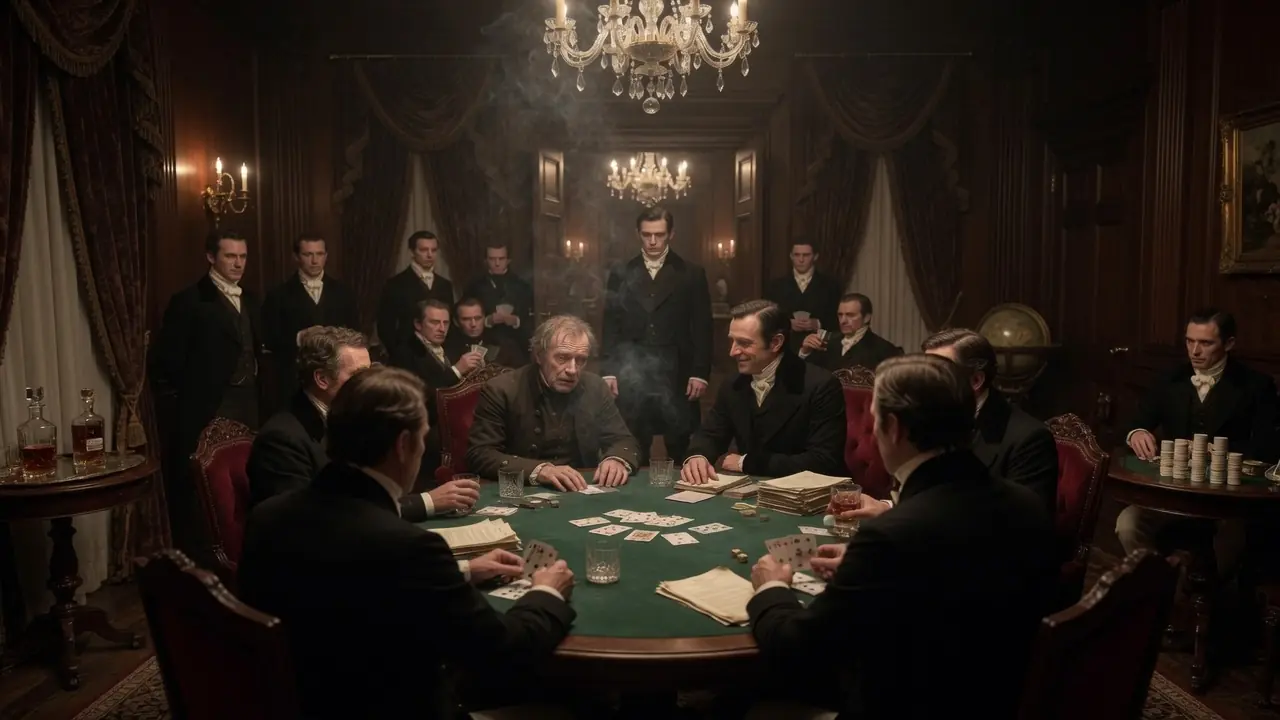
Across the table, Lord Ashford smiled with the slow satisfaction of a man savoring cruelty. "Oh, but I do." Around them, the private chamber of White's Club glowed with candlelight and smoke. London's most powerful men sat in velvet chairs pretending to study their drinks while secretly watching a gentleman's ruin unfold. "Your debts," Ashford continued lightly, tapping the stack of promissory notes, "are considerable.
Estate sold, carriages gone, credit exhausted." He leaned back. "But there remains one asset of value." Bellamy's voice cracked. "My daughter is not—" "Miss Margaret Bellamy is three and twenty," Ashford interrupted. "Unmarried, attractive enough.
I am a widower with a respectable estate." His smile widened. "Marry her to me and every debt disappears tonight." The silence that followed was suffocating. Even among men accustomed to ruthless bargains, this felt obscene. A daughter traded for gambling losses.
Bellamy's face turned the color of chalk. "You would humiliate her." he whispered. "I would marry her." Ashford corrected coolly. "A respectable arrangement." He slid the papers forward.
"Or refuse and lose everything." The watching gentlemen shifted uncomfortably. No one intervened. That was the unspoken rule of such rooms. Ruin was a private matter.
Bellamy stared at the table as if the wood might split open and swallow him. "My daughter." he murmured hoarsely. And then, a voice came from the doorway, cold, deep, controlled. "I will match whatever is on that table." Every head turned.
Framed in the entrance stood a man whose mere presence altered the air of the room. Tall, broad-shouldered, dark-haired, the pale gray gaze of Maximilian Ashford, Duke of Kingsley, swept across the table with quiet authority. At 35, he was already legend in London society. Ruthless in business, unmoved by gossip, feared by men who themselves inspired fear.
Ashford straightened in his chair. "Your Grace," he said stiffly, "this is a private game." "And yet half of London will hear of it by morning," the Duke replied calmly. He walked forward. Each step carried the easy confidence of a man who knew no one present could challenge him.
The Duke stopped beside the table and looked down at the scattered cards. "Let us end this spectacle." Ashford's smile sharpened. "And why would Your Grace involve yourself in Lord Bellamy's difficulties?" The Duke's gray eyes lifted slowly. "Because you are not truly interested in his daughter." A pause.
"You are interested in watching him beg." The words landed with quiet precision. Ashford's jaw tightened. "I merely proposed a practical solution." "Yes," Kingsley said softly, "a cruel one." He pulled a chair forward and sat without invitation. "I will pay Bellamy's debts." Ashford laughed.
"You presume too much." "20,000 pounds." The room went utterly still. The sum was staggering, enough to restore the Bellamy estate entirely. Ashford's expression faltered. "And what do you gain, Your Grace?" he asked suspiciously.
The Duke did not hesitate. "I will take the daughter." Shock rippled through the room. Bellamy looked up, stunned. Ashford leaned forward slowly.
"You propose the same arrangement." "No." Kingsley's voice turned colder. "I propose marriage with dignity, without humiliation." He met Ashford's gaze. "Or would you prefer the pleasure of bankrupting a gentleman more than the profit of 20,000 pounds?" Ashford hesitated. Greed battled pride.
Lord Bellamy, he said quietly, we should speak privately. 20 minutes later Edmund Bellamy stepped out into the night air of St. James's Street with the hollow expression of a man who had exchanged one doom for another. He climbed into a hired carriage. His voice trembled as he gave the address.
Mayfair. At that very moment inside the Bellamy townhouse library, Margaret Bellamy sat reading Wordsworth beside the dying fire. She sensed the moment her father entered the room before she even looked up. There was something in his silence, something heavy.
She closed the book slowly. Father? He looked older than he had that morning. My dear, he whispered.
What has happened? He swallowed. Our debts have been purchased. Her heart began to race.
By whom? He hesitated. The Duke of Kingsley. The name stirred faint memory.
A tall figure seen once at a ball, a man women whispered about, a man men avoided offending. That is fortunate news, she said carefully. Her father closed his eyes. No. He forced the words out.
It is not fortune. It is a bargain. Margaret's fingers tightened on the arm of her chair. What bargain?
His voice broke. He wishes to marry you. The room seemed suddenly too quiet. And if I refuse?
Her father said nothing. He did not need to. Refusal meant ruin, servants dismissed, her brother expelled from school, her mother reduced to charity, her family destroyed. Margaret felt a strange calm settle over her.
When does he expect an answer? He will call tomorrow. She nodded slowly. Then she spoke the words that would change her life forever.
Then I shall meet the Duke. The Duke of Kingsley arrived the next afternoon with the punctuality of a man who believed time itself should obey him. At precisely 2:00 the Bellamy household heard the deep rumble of carriage wheels upon the cobbled street outside. Margaret stood near the drawing room window watching the vehicle pull to a stop.
Her pulse beat loudly in her ears. The Kingsley crest gleamed upon the carriage door. A footman opened it and the Duke stepped down. Even from the window she could feel the gravity of him.
Tall, imposing, controlled, the kind of man whose presence altered every room he entered. Behind her her mother fluttered anxiously with a handkerchief. "Good heavens." Lady Bellamy whispered, "He's even more intimidating in daylight." Margaret said nothing. She only straightened her shoulders.
A moment later the butler opened the drawing room doors. "His Grace, the Duke of Kingsley." The man who entered seemed carved from darker stone than the rest of the world. His coat was black, perfectly tailored. His hair brushed his collar in an unfashionably careless way.
But it was his eyes, cool gray, sharp as winter steel, that held Margaret's attention. They rested on her for a long, thoughtful moment. Not appraising, not possessive, simply attentive. He bowed.
"Miss Bellamy." She curtsied. "Your Grace." The Duke declined tea with a quiet shake of his head and took the chair opposite her. Lady Bellamy positioned herself nearby with a book she did not read. A proper chaperone, a silent witness.
Kingsley folded his gloved hands. "I believe your father has explained the situation." "Yes." Margaret replied calmly. "You purchased my father's debts." "Correct." "And in return you request my hand in marriage." "I do." There was no hesitation in his voice, no attempt at softening the reality. Margaret studied him carefully.
"You speak of it as if we are negotiating a business contract." The Duke inclined his head slightly. "That is precisely what we are doing." Her mother gasped softly behind her. But Margaret did not flinch. "And what sort of marriage do you expect from such a contract, Your Grace?" His gaze sharpened.
"An honest one." He leaned back slightly in his chair. "You will become the Duchess of Kingsley. You will manage my household, attend the necessary functions, and represent my family with dignity. And in return?
Your family's debts vanish. Your estate is restored. Your parents will receive an income sufficient to maintain their household. The offer was staggering.
Security, stability, salvation. Yet, something in his expression made her ask quietly, "And affection?" For the first time, the Duke's gaze flickered. A shadow crossed his features. "I do not pretend to offer romance." The bluntness startled her.
"You would rather begin with truth than with false promises." "Yes." Silence lingered between them. At last, Margaret spoke again. "You could marry any woman in England, Your Grace." His lips curved faintly. "That is precisely the problem." She frowned.
"Women who marry Dukes expect devotion, admiration, declarations of love." "And you believe I cannot provide those things?" "I believe disappointment is crueler than honesty." The words were spoken so quietly they felt almost like a confession. Margaret looked at him more carefully now. Beyond the power, beyond the title, there was something else there. Something guarded, something wounded.
"And children?" she asked softly. "Yes." His tone steadied again. "Eventually, an heir will be necessary." Her cheeks warmed slightly. The Duke did not appear embarrassed at all.
It was merely another fact, another expectation. Margaret folded her hands together in her lap. "I will accept." Lady Bellamy dropped her book in shock, but Margaret continued calmly, "On one condition." Kingsley's brow lifted. "Name it." "My brother George remains at Eton.
His education must continue uninterrupted, and he must be established properly in life." The Duke did not hesitate even a second. "Done." Relief flickered through her chest. "And my parents?" "They will want for nothing." The certainty in his voice left no room for doubt. Margaret nodded slowly.
Then we have an agreement. The Duke rose. So we do. He looked down at her with an expression that softened just slightly.
I will obtain a special license. Her breath caught. So soon? Delay serves no purpose.
His gaze lingered on her face. We will be married by the end of the week. A strange stillness passed through Margaret. Four days.
In four days she would belong to him. Legally, socially, completely. Yet the Duke's voice gentled unexpectedly. Miss Bellamy.
She looked up. Yes? I understand the nature of what I ask. His gray eyes held her steadily.
You're not entering this blindly. The words were careful, almost respectful. Then he bowed again. Good afternoon.
Moments later the door closed behind him. Lady Bellamy collapsed into a chair. Oh heavens, she whispered faintly. The Duke of Kingsley.
Margaret stood motionless by the window. Her future had just been decided. A marriage without love. A husband known across England for his coldness.
A life she had never imagined. Yet strangely, she did not feel trapped. She felt as if she had stepped onto a road whose end she could not yet see. And somewhere in London at that very moment the Duke of Kingsley stood alone beside a window of his own house thinking about the woman who had just agreed to become his wife.
The wedding was held four days later beneath the pale stone arches of St. George's Church in Hanover Square. London society loved spectacle, yet there was none that morning. No orchestra, no crowd of curious onlookers, only a handful of witnesses. It was not a celebration.
It was the quiet execution of a bargain. Margaret walked slowly down the aisle on her father's arm. Her pale blue silk gown whispering softly across the marble floor. Her hands were steady.
Her heart was not. At the altar stood the man who had purchased her future, the Duke of Kingsley, tall, still, watching her approach with that same unreadable expression. If he felt triumph or hesitation, he did not show it. The vicar began the ceremony.
His voice echoed gently through the nearly empty church. Margaret listened as if from a distance. To love, to honor, to cherish. Words written for marriages born of affection.
Yet when her moment came, she spoke them clearly. I do. The Duke's gaze lowered briefly. Then he repeated his vows with the calm certainty of a man signing a contract.
When he slid the ring onto her finger, his hand was warm, unexpectedly warm. "You may kiss the bride," the vicar said. Kingsley leaned down. The kiss was brief, formal, yet not entirely cold.
A whisper of warmth brushed her lips before he stepped away. And just like that, she was the Duchess of Kingsley. The wedding breakfast took place at the Duke's London residence in Grosvenor Square. The townhouse alone seemed to confirm the magnitude of the life she had entered.
Grand staircases, crystal chandeliers, servants moving with quiet precision. Everything in the house felt powerful, controlled, just like its master. Margaret moved through the small gathering in a daze. Congratulations, polite smiles, carefully hidden curiosity.
Her mother wept softly with relief. Her father avoided meeting the Duke's eyes entirely. "Are you well?" The voice beside her was low. She turned.
Kingsley stood close enough that no one else could hear him. "Quite well, Your Grace." A faint shadow of amusement touched his mouth. "You need not lie for my comfort." She lifted her chin slightly. "I am managing." His gray eyes studied her thoughtfully.
"That is more honesty than most brides would offer." "Most brides," she replied quietly, "are not sold at card tables." For a moment he said nothing. Something dark flickered behind his gaze. "Maximilian," he said at last. She blinked.
"My name." The word felt strangely intimate. "Maximilian," she repeated softly. The way she said it seemed to please him. And you, he added, must call me that when we are alone.
Very well, it's Maximilian. The syllables felt unfamiliar, dangerous. Before she could say more, guests approached them again. The Duke turned away to greet them.
Margaret slipped quietly toward the edge of the room, grateful for a moment to breathe. She touched the ring on her finger, the symbol of a marriage that had begun as a debt. A quiet voice behind her interrupted her thoughts. You look as though you might need this.
A footman offered her a glass of champagne. She accepted it gratefully. Across the room, she caught sight of her husband again, surrounded by men who treated him with wary respect, commanding, untouchable. And suddenly, Margaret wondered something she had not allowed herself to ask before.
What kind of husband would the Duke of Kingsley truly be? A stranger, a protector, or something far more dangerous to her heart? The reception ended by late afternoon. Carriages were called.
Guests departed. At last, only the two of them remained in the quiet drawing room. We leave for Kingsley Park tomorrow morning, Maximilian said. The country estate?
Yes. She nodded. And tonight? You may remain with your family if you wish.
The unexpected gentleness of the offer startled her. I thought tonight would be our wedding night. His gaze darkened slightly. It will be.
A pause followed, but not tonight. Her breath caught. I see. I thought, he said carefully, you might appreciate one final night in familiar surroundings before your life changes entirely.
The kindness of it unsettled her more than cruelty might have. Thank you, she said softly. He inclined his head. I will collect you at 9:00.
And with that, the Duke of Kingsley left his new bride alone in the vast, silent room. Margaret stood there for several long moments trying to understand the man she had just married, a man feared across England, a man who had purchased her future, and yet, a man who had chosen not to claim her on their wedding night. The journey to Kingsley Park took two days. Margaret spent most of the time watching the English countryside roll past the carriage window.
Green fields softened into hills. Villages appeared and vanished like small paintings. Inside the carriage, silence settled between her and the Duke like a careful agreement. Maximilian worked through correspondence with efficient focus, occasionally glancing up to ensure she was comfortable.
"You may ask the driver to stop whenever you wish." he said once. "I am quite well." And strangely and she was. The fear she had expected to feel was muted, not gone, but quieter. Late on the second afternoon, the carriage turned down a long tree-lined drive.
"Kingsley Park." Maximilian said simply. The estate revealed itself slowly. First the lake glittering in the distance, then the formal garden stretching across gentle slopes. Finally the house itself, a vast Palladian mansion of honey-colored stone glowing in the late sunlight like something from another world.
Margaret's breath caught. "It is enormous." "Yes." "And it belongs to you." He studied her expression. "It belongs to us now." The carriage rolled to a stop beneath the grand portico. Maximilian stepped down first and offered his hand.
His grip was firm, steady. "Ready?" "No." she thought, but she nodded. Inside the entrance hall stretched upward toward painted ceilings and towering windows. But what caught Margaret's attention most was the line of servants waiting in perfect formation.
There must have been 30 of them. Housemaids, footmen, butlers, kitchen staff, all silent, all watching. Maximilian's voice carried easily through the hall. "Mrs. Thornton." A woman with iron-gray hair stepped forward.
Her posture could have rivaled a military officer's. "This is her grace, the Duchess of Kingsley." The housekeeper curtsied with impeccable precision. "Welcome to Kingsley Park, Your Grace. Thank you, Margaret replied.
Mrs. Thornton's sharp eyes softened ever so slightly. The Duchess's chambers are prepared. Maximilian turned to Margaret. You may rest after the journey.
Dinner will be served at 8:00. And you? I have matters to attend. Of course he did.
The Duke of Kingsley never appeared idle. Her rooms were astonishing. A suite of chambers overlooking the gardens, cream silk walls, golden curtains, a bed large enough to seem absurdly grand. This door, Mrs. Thornton said politely gesturing to one at the far wall, connects to his grace's chambers.
Margaret's stomach tightened. But the door remained firmly closed. His grace rarely intrudes upon the Duchess's privacy, the housekeeper added. The reassurance surprised her.
Dinner that evening was strangely formal. They sat at opposite ends of a long mahogany table that could have seated a dozen guests. Footmen moved silently between them. Are your rooms satisfactory?
Maximilian asked. Very much so. Tomorrow Mrs. Thornton will explain your duties as Duchess. I understand.
The quiet between them stretched again. At last Margaret spoke. May I ask you something? Of course.
Why did you truly intervene that night at White's? His fork paused midair. That question was inevitable. You could have paid my father's debts without marrying me.
Yes. Then why didn't you? For a moment he said nothing. When he finally spoke his voice was measured.
I required a wife. The answer felt rehearsed. And you believed a woman whose family was desperate would accept a practical arrangement. Yes.
She studied him carefully. Efficient. His mouth curved faintly. You dislike the word.
I dislike hearing marriage described as if it were estate management. He met her gaze calmly. I never promised romance. No, she admitted quietly.
You promised honesty. And honesty is what you shall always receive. After dinner, he excused himself to his study. Margaret returned alone to her rooms.
Lucy, her maid, had already turned down the enormous bed. The connecting door between her chambers and the Duke's remained closed. She changed slowly into her nightgown, then slipped beneath the covers. Her heart began to beat faster.
Tonight, she realized, was truly their first night beneath the same roof as husband and wife. At any moment, the door might open. Her husband might come to claim what was now legally his. Minutes passed, then an hour.
The house grew silent. The door never opened. Eventually, exhaustion claimed her. Margaret drifted into uneasy sleep, still alone, still wondering why the Duke of Kingsley, who had purchased her future so decisively, had chosen not to touch her at all.
The first weeks at Kingsley Park passed with quiet, measured rhythm. Mornings began with household accounts and discussions with Mrs. Thornton. Afternoons were spent walking the gardens or reading in the vast library. Evenings brought dinner with the Duke, polite conversation, measured distance, perfect civility, yet the door between their chambers remained closed every night without fail.
And though Margaret had once feared the moment it might open, now she found herself wondering why it never did. One morning, she wandered into the library, unable to concentrate on the book in her hands. Wordsworth again. The deep voice behind her made her start.
She turned. Maximilian stood in the doorway, still dressed in riding clothes. His dark hair was windswept. For the first time since their wedding, he looked less controlled, almost human.
"I enjoy poetry," she said. "As do I." He stepped closer and picked up a volume from the shelf. "Byron," he said lightly, "a man with dangerous opinions about love." "And you disagree with him?" "Not entirely." He glanced at her. The moment stretched strangely between them.
Then he asked quietly, "Are you content here, Margaret?" The use of her name startled her. "I have everything I could need." "That is not what I asked." She hesitated. "I am adjusting." His gaze lowered briefly. "You are lonely." It was not a question.
The honesty of it left her momentarily speechless. "You have been very correct with me," she said carefully. "Correct," he repeated. "That is a polite word for distant." She did not argue because it was true.
Maximilian set the book aside. "When I arranged our marriage, I believed distance would make things easier for you." "Easier?" "Yes." His voice lowered slightly. "You had no choice in becoming my wife. The least I could offer was time." The realization struck her unexpectedly.
"You stayed away for my sake?" "I stayed away," he said quietly, "because I would not have you share my bed out of obligation alone." Her heart skipped. "And if I never wish to?" "Then you would remain Duchess of Kingsley regardless." The calm certainty of the answer stunned her. No anger, no wounded pride, simply acceptance. For a long moment neither of them spoke.
Then Maximilian cleared his throat slightly. "There is something I hoped you might do with me tomorrow." "What is that?" "Ride." She blinked. "Ride?" "Yes." He gave a small, almost reluctant smile. "I should like to show you the estate properly." The unexpected warmth of the invitation surprised her.
"I would like that very much." The next morning they rode together across the wide lands of Kingsley Park. Fields rolled endlessly across the countryside. Tenant farms dotted the hills. Villages appeared in the distance.
Maximilian matched his horse carefully to her pace. "This land supports over 300 families," he explained. "Every harvest affects them." "You carry quite a responsibility." "It is the burden of titles." She studied him thoughtfully. "And yet you seem to prefer the countryside to London." "I despise London." The bluntness made her laugh softly.
He looked at her surprised. You laugh easily. Only when something is amusing. He shook his head slightly.
You are unlike anyone I've ever known, Margaret Bellamy. A compliment? A fact. They rode in silence for a while, then he spoke again.
I served briefly in Crimea. She looked at him sharply. I did not know that. It changes a man, he said simply.
When you see death often enough, the games of society feel hollow. The quiet weight of the confession surprised her. You are not cold, she said gently. You are careful.
Maximilian looked at her with something almost like astonishment. No one has ever said that to me before. Perhaps no one bothered to see it. Something shifted between them then.
Something subtle. Something warmer. When they returned to the house hours later, the distance between them felt slightly smaller. And that evening, for the first time since their wedding, the Duke lingered in the library after dinner instead of retreating immediately to his study.
He watched her as she played the pianoforte. Beethoven, he said quietly when she finished. You play beautifully. I play adequately.
His mouth curved faintly. You deflect compliments. You distrust them. Perhaps.
Their eyes met across the room. The silence between them felt different now. Charged. Curious.
As if both of them had begun wondering the same dangerous question. What if this marriage was becoming something real? London returned to them with whispers. By the time the carriage rolled into Grosvenor Square at the beginning of the season, half the town had already revived the old story.
The Duke who bought a wife. The girl sold to settle debts. Every drawing room seemed to know it. Every ballroom waited to see it.
Margaret felt the weight of those whispers the moment they entered the Devonshire ball. Chandeliers blazed overhead. Silks rustled. Fans flicked open with subtle excitement.
Conversation dipped just slightly as the Duke of Kingsley stepped inside with his Duchess on his arm. Maximilian paused. His hand tightened faintly over hers. "Ready?" he murmured.
"No." She met his eyes steadily, "But we go anyway." A hint of pride flickered in his gaze. "Good." Instead of retreating to the edges of the ballroom as many couples might, he guided her straight toward the center of the floor. The orchestra struck up a waltz. He turned to her formally, "May I have this dance, Your Grace?" The use of the title was deliberate, public, claiming.
"You may." The waltz began. They moved across the floor with smooth precision, the Duke's height and strength guiding her effortlessly through the turns. Around them eyes followed every movement, every whisper, every glance. "Let them stare," Maximilian murmured.
"They are." "Then let them see the truth." "And what truth is that?" His arm tightened slightly at her waist. "That you are mine." Heat rose to her cheeks. "And you are mine." Something dark and satisfied flickered in his eyes. The dance ended to polite applause, but the whispers had grown louder.
They had just stepped away from the floor when a familiar voice approached. "Well, Lord Ashford." The same man who had once tried to purchase her life. He bowed stiffly. "Your Graces." Maximilian's expression turned instantly cold.
"Ashford." "I wish to offer congratulations." His eyes flicked briefly toward Margaret. "A fortunate arrangement for everyone involved." The insult lay just beneath the politeness. Before Margaret could respond, Maximilian stepped forward. The shift was subtle, but dangerous.
"You will address my wife properly." Ashford blinked. "I meant no offense." "You implied she should be grateful for rescue." Maximilian's voice dropped lower, colder. "She owes me nothing." The ballroom around them had grown very quiet. "You misunderstand," Ashford said carefully.
"I merely remarked upon her improved circumstances." Maximilian's gaze hardened. "My wife's worth has never depended upon her circumstances." He leaned slightly closer. "If you speak of her again as if she were a purchased object" His voice lowered enough that only the three of them could hear. "You will discover precisely how unpleasant I can be." Ashford paled.
"I see." "Good." Maximilian offered the faintest nod. The dismissal was absolute. Ashford retreated quickly. The music resumed.
Conversation slowly returned, but Margaret could still feel the echo of what had just happened. "You did not have to defend me." she murmured. "I did." His voice was firm. "You are my Duchess." "And your wife?" "Yes." He turned to face her fully now.
"And the woman I love." The words landed softly between them. Her breath caught. "You have never said that before." "I should have." His gray eyes held her steadily. "I love you, Margaret." The ballroom faded around them.
The music, the whispers, the watching crowd, all of it disappeared. "I love you, too." she whispered. His hand lifted slowly to her cheek. He kissed her then, not politely, not briefly, but with a tenderness that left no doubt.
And when he finally drew back, his voice dropped to a quiet murmur against her ear. "Come home with me." Three years later, the house that had once echoed with silence rang with laughter. Kingsley Park was no longer the austere estate of a solitary duke. It had become something far warmer, something alive.
A small girl's laughter drifted through the long gallery as Victoria Ashford, daughter of the Duke and Duchess of Kingsley, ran determinedly toward the library with her nurse close behind. "Papa!" Maximilian looked up from his desk just in time to catch the child as she launched herself into his arms. "You will one day terrify the entire peerage." he told her gravely. Victoria giggled.
"I already do." From the doorway, Margaret watched the scene with quiet amusement. Once London had called the Duke of Kingsley cold, feared, untouchable. Now he sat on the library floor with his daughter in his lap and a wooden horse clutched in one large hand. She leaned against the doorframe.
You spoil her. I prepare her, he replied. For what? To rule the world.
Victoria nodded solemnly. I will. Life had settled into something Margaret once believed impossible. Peace.
Their marriage had begun with a bargain written in debts and desperation, but what followed had been built slowly. Morning rides across the estate, long evenings in the library, conversations that stripped away the walls Maximilian had built around himself for years. And eventually, love. Not the fragile fantasy she once imagined during her London seasons, but something steadier.
Something chosen every day. Their son Edmund now slept upstairs barely a year old, watched over by a vigilant nurse and a father who checked on him far more often than necessary. The household staff had long since grown accustomed to the sight of their formidable Duke carrying children through the halls. Later that evening, when the house had grown quiet again, Margaret and Maximilian sat beside the library fire.
The same room where their understanding had first begun. Do you ever think about that night at White's? She asked softly. He did not need to ask which night.
The night everything had begun. Sometimes. And? He leaned back in his chair watching the flames.
I think about how easily I might have walked away. You would not have. Perhaps not. His gaze shifted toward her, but I did not intervene for noble reasons.
She tilted her head slightly. No. I had already noticed you. The confession surprised her. At several balls that season, he continued quietly.
You were always at the edges of the room watching everyone as if you saw through the entire performance and that interested you. It intrigued me. A faint smile touched his mouth. When Ashford spoke your name that night, I knew exactly who he meant.
And you decided to buy me. Yes. The blunt honesty made her laugh softly. That should sound scandalous.
It does. Are you angry? She considered the question, then shook her head. No. Why not?
Because you never treated me like something you owned. She moved closer and rested her hand over his. You gave me time. You deserved it.
You gave me respect. You earned it. And you gave me love. Maximilian's fingers tightened around hers.
That was never a gift. What was it then? Something you took from me the moment you walked into that drawing room and refused to be frightened. The firelight flickered across his face.
You were never a debt, Margaret. The words felt older than the moment, as if he had carried them for years. You were always my destiny. Her eyes softened.
And you were mine. Outside the vast estate lay quiet beneath the stars. Inside, the Duke of Kingsley held the woman he had once purchased with 20,000 pounds. But the truth neither of them could deny was simple.
He had not bought a wife. He had found the love that changed the course of his life. And Margaret, the girl once sold to pay a gambler's debts, had discovered something far greater than rescue. She had discovered a man who saw her not as a transaction, not as a solution, but as the one person he would choose again and again for the rest of his life.