Elena Whitmore heard her name spoken like a debt being paid off. Her father's voice came through the thick door of the drawing room, sharp and certain, and every word landed on her like a slap she could not return. He was selling her, and he did not even lower his voice to do it.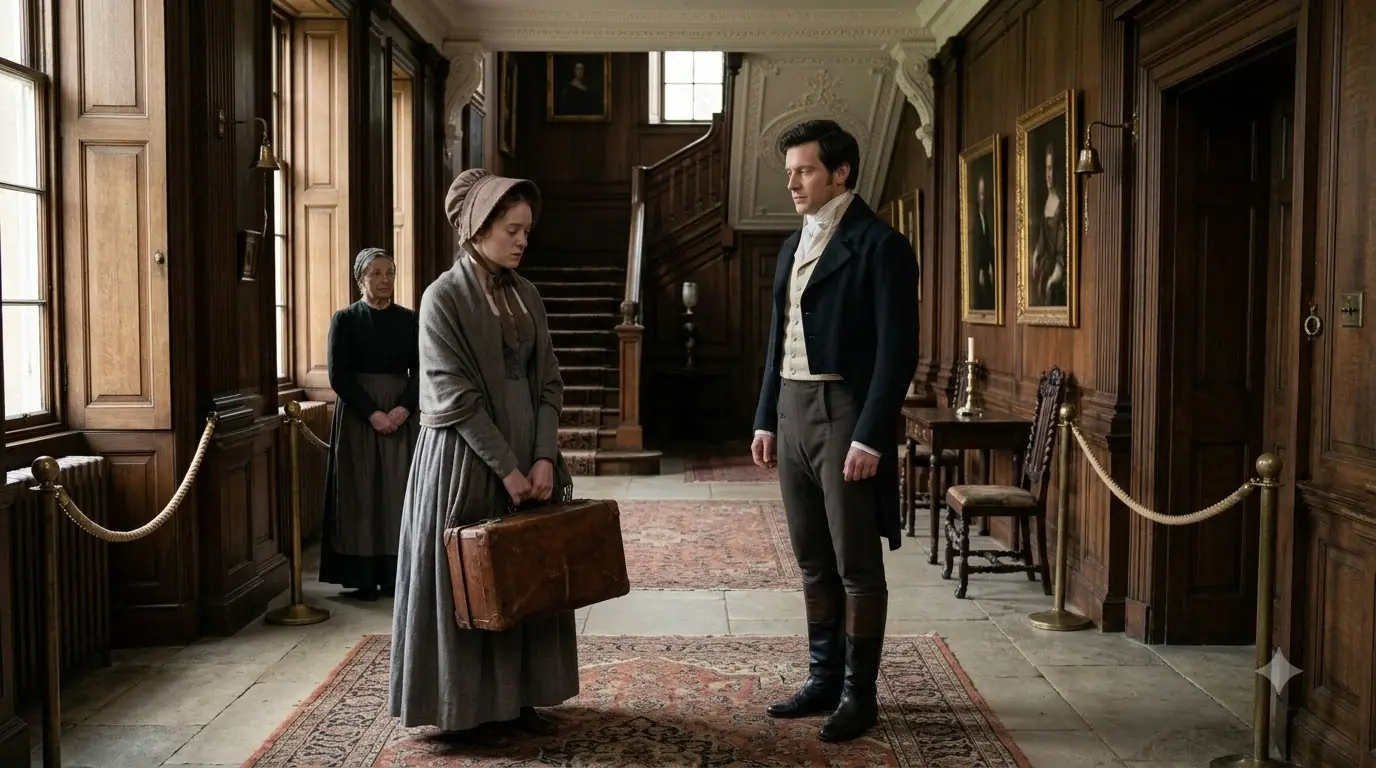
"The Duke of Ashkum needed a wife. Not a beauty," her father said. "A woman who could run a house and stay out of sight." He laughed when he said it. A short, ugly laugh. And the man across from him laughed, too.
Elina stood frozen in the hallway with her hand pressed to the wood, her heart pounding so hard she thought they might hear it through the wall. She had spent her whole life being told what she was not: not pretty enough to marry for love, not clever enough to be praised, not loud enough to be noticed. She had learned to disappear in rooms, to become furniture, because disappearing hurt less than being seen and rejected. Now her father had found a use for that skill. He was handing her to a blind man because a blind man would never know the difference.
The carriage came for her 3 days later. Her father did not walk her to the door. He simply told her to behave, to be useful, and to remember that families like theirs did not get second chances. Elena climbed into the carriage alone, her trunk strapped to the back, her future decided by men who had never once asked what she wanted.
The road to Ashkcom Hall was long and gray, and she watched the fields pass without really seeing them. She kept thinking about the Duke's laugh through the wall. She wondered if he laughed like her father, cold and satisfied. She wondered if he would speak to her the way her father did, as if she were a problem to be managed rather than a person to be known.
When the carriage finally stopped, the house rose up in front of her like something out of an old story, tall and gray stone, ivy climbing one wall like it was trying to escape. A servant opened the door before she could knock, and inside the air smelled of beeswax and old wood, quiet in a way that felt deliberate, as if the whole house had been trained to hold its breath.
She was led through a hallway lined with rope along the wall, waist high, worn smooth by years of hands. She did not understand it yet. She only knew that everything here felt different, careful, arranged for a purpose she could not name.
At the end of the hallway, a man stood waiting. He was tall, his shoulders set straight, his eyes open, but still, fixed on a point just past her shoulder. He did not look at her the way men usually looked at women, sizing them up, deciding if they were worth the trouble. He simply turned his head slightly toward the sound of her footsteps and said in a voice that was quieter than she expected, "Welcome home."
Alina did not know yet that those two words would change everything her father had planned.
The first days at Ashkcom Hall taught Elena a new kind of silence. It was not the silence she knew from her father's house. The silence of being ignored, of being spoken over, of being told to sit still and say nothing. This silence had a shape to it. It was built on purpose, like a room designed for a single task. Clocks chimed instead of ticked. Doors had small bells fixed above them so a person entering would announce themselves without needing to speak. Rugs were kept in the same place year after year so that a man walking without sight could count his steps and know exactly where he stood.
Elena noticed all of it and slowly she began to understand that the Duke, Julian, had not built a house that hid his blindness. He had built a house that worked with it.
She met him properly on her second morning in a study lined with books she doubted he could read anymore, though a stack of papers with raised markings sat on his desk, and she later learned these were letters written in a system of dots that his fingers could read like eyes. He asked her to sit, and she did, arranging her hands in her lap the way she had been taught, quiet and small.
He asked her questions no one had ever asked her before. Not about her appearance, not about her father's debts, but about what she thought of the gardens, whether she preferred silence or music while she worked, what she had wanted to be before the world told her what she would become. Elena answered carefully at first, testing each word before she gave it away, waiting for the trap she was certain must be hidden somewhere in his kindness.
There was no trap. He simply listened, his head tilted slightly the way a person leans toward warmth they cannot see but can still feel.
Over the following days, Alaner began to notice something strange happening inside her. She stopped rehearsing her sentences before she spoke them. She stopped smoothing her skirts nervously when she entered a room because she realized Julian could not see the state of her dress, only hear the steadiness or unsteadiness in her voice. And so for the first time in years, she let her voice be unsteady when it needed to be.
One afternoon, walking past his study, she caught herself apologizing to a servant for stepping into a hallway at the same time he did. An old habit from a house where taking up space was a mistake.
Julian, who happened to be nearby, said without turning his head, "You have stopped apologizing for entering rooms. Good."