By the third week of May, Mrs. Hartwell's list had acquired a blue silk ribbon, three supplementary pages, and the authority of an Act of Parliament. It lay upon the breakfast table between the silver chocolate pot and a vase of pink tulips, its first page headed in Mrs. Hartwell's finest hand: Gentlemen of amiable character, suitable fortune, and matrimonial promise.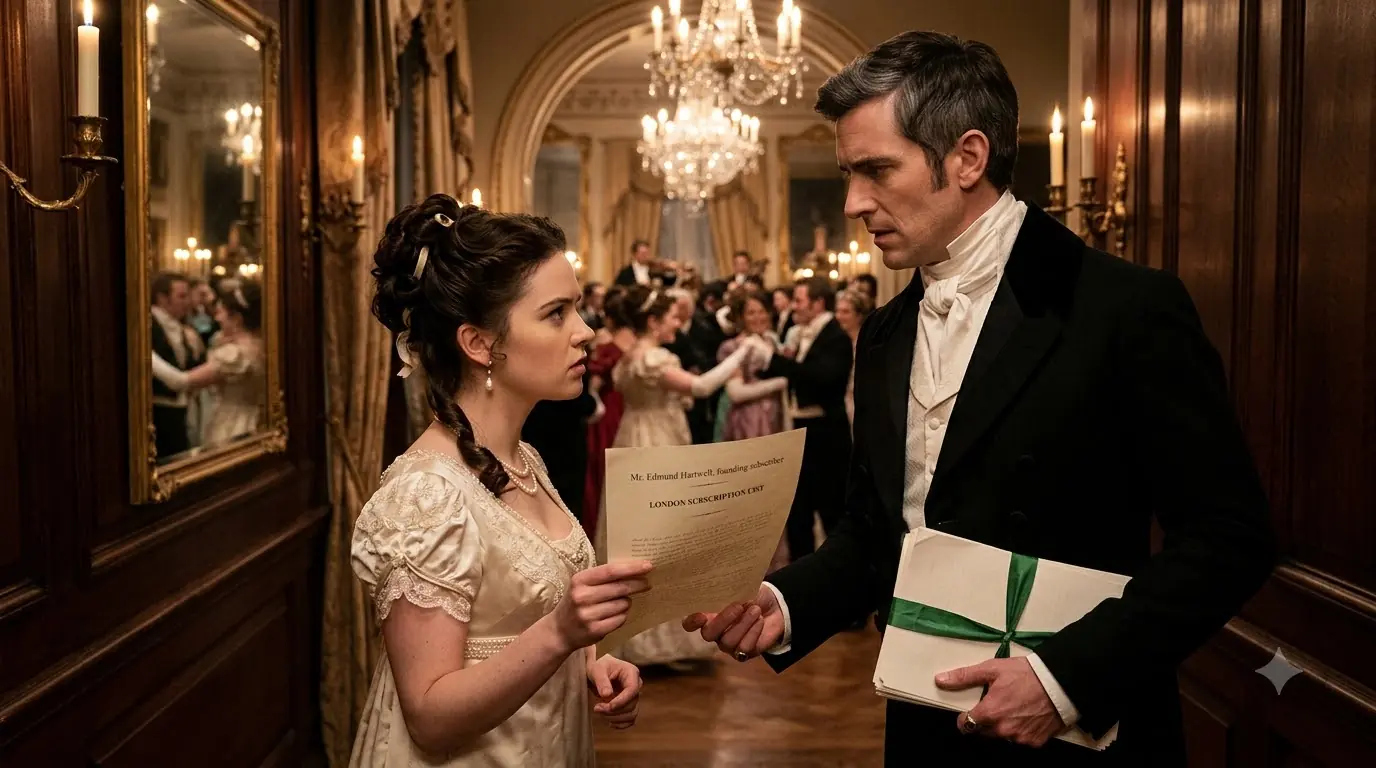
Several names bore stars. One was underlined twice. Another had been amended in the margin from "excellent teeth" to "teeth uncertain in profile." At the bottom of the second page, a name had been crossed through so emphatically that the paper had nearly torn: Lord Alexander Wickliffe—handsome, heartless, and quite unsuitable.
Miss Penelope Hartwell, who was enduring her third London season with the composure of a soldier returning to an unwinnable campaign, set down her cup.
"Mama," she said, "I cannot marry a list."
"Certainly not, darling. Lists are very poor dancers, nor do I intend to marry any of the gentlemen upon it." Mrs. Hartwell looked genuinely troubled. She was a soft, pretty widow of forty-eight, with hopeful blue eyes and a faith in romance that two disappointing seasons had bruised but not diminished. Her late husband had left them comfortably provided for, though not richly, and she wanted no title for Penelope merely for its own sake. What she wanted was more alarming: perfect happiness, preferably announced in the morning post.
"You have not spoken properly to all of them," she protested.
"I have spoken to forty-three eligible gentlemen since I was presented."
"Forty-one. Mr. Bellingham was engaged to a lady in Yorkshire, and Sir Thomas spoke only of his spaniels, so I do not count either conversation."
"I do." Mrs. Hartwell folded her hands. "Your first season was spoiled by your father's illness. Your second was spent refusing every man who could not discuss anything more interesting than the weather. I sympathize, dearest, but the weather is how Englishmen approach emotion."
Penelope tried not to smile. "I wish to go home to Hartwell Lodge. I wish to manage the tenants' school, read books without pretending they are sermons, and live peacefully."
"At twenty-two?"
"Peace has no minimum age."
Her mother regarded her for a long moment. Beneath the ribbons, lists, and romantic schemes, Mrs. Hartwell possessed an inconvenient capacity to understand her daughter.
"Very well," she said at last. "I shall abandon matchmaking."
Penelope narrowed her eyes. "Entirely?"
"Entirely! Upon one condition: you will attend five final engagements and converse with each gentleman I have selected, one gentleman per engagement. You need not encourage anyone. You need only be open-minded and civil, and afterward I shall burn the list."
"Not put it away until Christmas?"
"Burn it."
"Not make another list from memory?"
Mrs. Hartwell pressed a hand to her heart. "Penelope, you have a remarkable memory."
"Five engagements," her mother repeated. "Then I will take you home and never again point out an unmarried man unless he is standing in the path of our carriage."
Penelope held out her hand. "Agreed."
The first engagement was Lady Sefton's musical evening, where Mr. Percival Drew performed a tragic Italian song in a cheerful baritone and afterward asked Penelope whether she believed a wife ought to accompany her husband at the pianoforte every evening.
"What if she dislikes music?" Penelope asked.
Mr. Drew looked startled. "A wife?"
Before Penelope could determine whether he thought wives incapable of dislikes, a low voice beside her said, "You have frightened him, Miss Hartwell. He has imagined an eternity of unaccompanied solos."
Lord Alexander Wickliffe stood at her shoulder. He was taller than most men in the room and dressed with a severity that made the jeweled gentlemen around him resemble decorations upon a cake. His evening coat was black, his cravat immaculate, and his dark hair showed the faintest silver at the temples. His face was lean rather than handsome in the pretty fashion, his gaze direct, and his expression habitually reserved.
Penelope had seen him at balls and dinners for three seasons. He rarely danced, never lingered near matchmaking mothers, and was widely considered arrogant because he did not soften a plain statement merely to make it prettier.
She glanced toward Mrs. Hartwell. Her mother was watching from across the room with alarm.
"Lord Wickliffe," Penelope said, "are you in the habit of rescuing frightened musicians?"
"Only the public from encores."
The corner of his mouth moved. It was not quite a smile, but it transformed him.
Mr. Drew, recovering, bowed and escaped toward the lemonade.
"You have cost me a place upon Mama's list," Penelope said.
Wickliffe's brows lifted. "Was I ever upon it?"
"Briefly, I suspect."
"And what caused my removal?"
She ought not to have answered, yet something in his dry composure invited honesty. "You were judged handsome, heartless, and quite unsuitable."
For one suspended second he stared at her, then he laughed. It was not a polite drawing-room laugh; it was warm, surprised, and so unlike his reputation that two ladies turned to look.
"Your mother is admirably concise," he said. "On which point was the ink darkest?"
"I did not examine the evidence closely."
"A sensible precaution."
A nervous young footman approached and murmured something to him. Wickliffe's amusement vanished. He excused himself at once and crossed the room to an elderly woman seated behind a potted palm. Penelope recognized Mrs. Bell, the widow of a naval clerk. Wickliffe bent to listen, screening her distress from the room. He did not look heartless.
At the second engagement, a breakfast in Regent's Park, Penelope's appointed gentleman was Sir Walter Creswell, who possessed a pleasant face, £8,000 a year, and seventeen opinions about the proper boiling of an egg. Lord Wickliffe was also present. Penelope saw him receive a folded note from Mrs. Bell and conceal it quickly in his coat.
At the third engagement, an exhibition at Somerset House, the listed gentleman was Viscount Trowbridge, who praised Penelope's intelligence until she disagreed with him about a painting. He then explained the painting more loudly.
Wickliffe appeared beside a landscape of storm-bent trees.
"Your admirer is retreating," he observed. "He has gone to find a less argumentative wife."
"Then the nation owes you a debt." She turned toward him. "Do you follow Mama's list, my lord? I had begun to wonder whether you followed me."
"You were here first. A damaging fact."
He looked tired. There were shadows beneath his eyes, and when a portly gentleman approached him to ask too casually whether certain rumors were true, his face closed like a door.
"No," Wickliffe said. "They are not."
The gentleman bowed and moved away.
"What rumors?" Penelope asked.
"Nothing that need concern you."
His tone was not cruel, but it was final. Penelope felt the small sting of being dismissed.
"How fortunate," she said. "I should hate to be concerned by anything beyond boiled eggs and agreeable paintings."
She walked away before he could answer.
The fourth engagement was Lady Jersey's ball. By midnight the rooms at Almack's blazed with wax light, feathers trembled above jeweled heads, and every open window admitted warm air scented with horses and rain.
Penelope's fourth candidate, Lord Clavering, danced beautifully and listened attentively. For twelve minutes she wondered whether Mama might have chosen well. Then he explained that after marriage, he intended his wife to give up charitable committees because public benevolence encouraged unfeminine independence.
"How reassuring," Penelope said. "I feared you might object only to my opinions."
She left him beside the orchestra.
In the passage near the retiring room, she nearly collided with Lord Wickliffe. He held a sheaf of papers tied with green tape. One slipped free and fell at her feet. Penelope picked it up. Across the top was printed: The Saint Anne's Ladies Charitable Lending Society. Beneath it appeared a familiar name: Mr. Edmund Hartwell, founding subscriber.
"My father," she whispered.
Wickliffe reached for the paper, but she held it fast. "Why do you have this?"
"Not here."