There is a particular kind of grief that does not announce itself. It does not arrive with tears or raised voices or the dramatic collapse that others might notice and rush to comfort. It arrives quietly on an ordinary morning in the space between one breath and the next. It settles into the body like cold weather settles into old stone, gradually, completely, until you cannot remember what warmth felt like before it.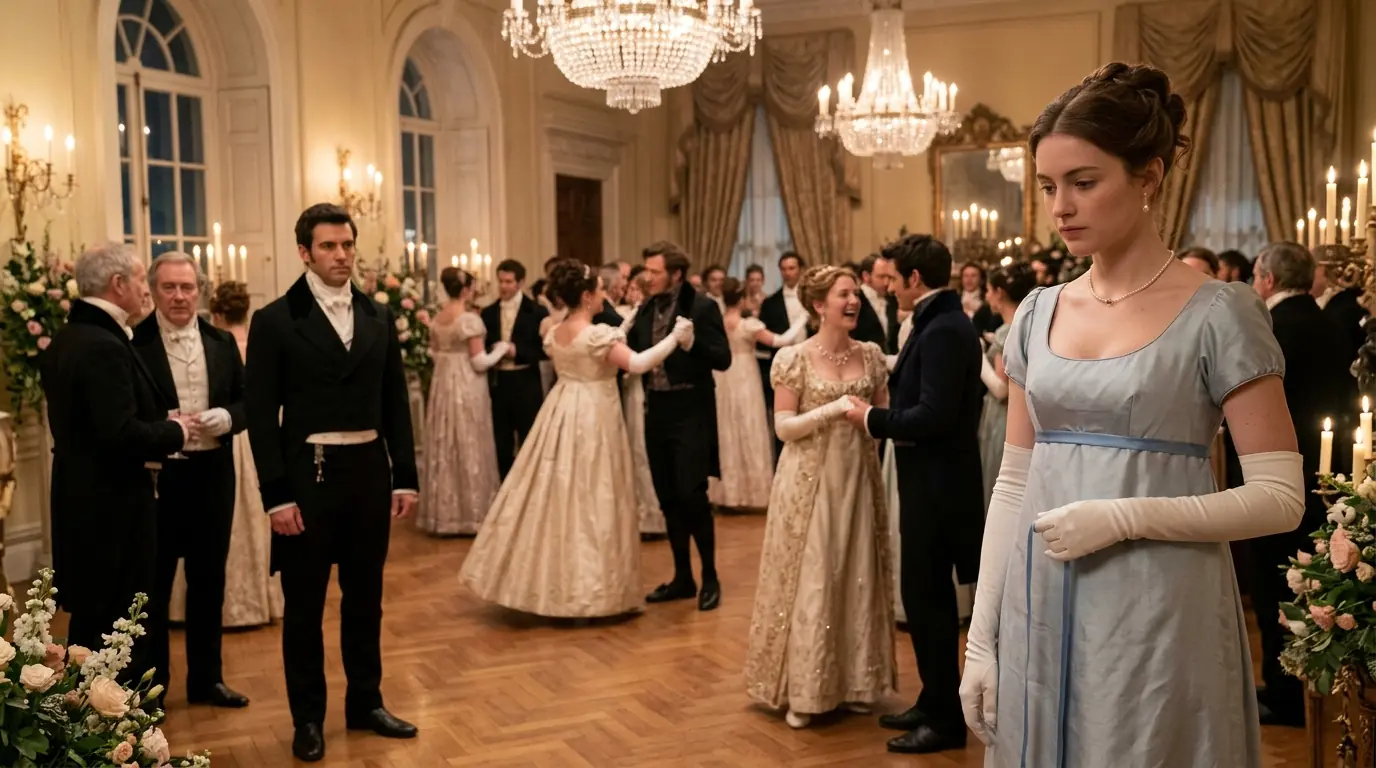
Maria Voss had known that grief for 11 days when she attended the Crestwell Winter Ball. She had not wanted to come. She had stood before her mirror for a long time that evening, longer than the occasion warranted, smoothing the same ribbon at her waist with fingers that had nothing useful to do and everything to feel.
Her reflection had looked back at her with the careful, composed expression she had been practicing since the morning her mother had delivered the news in the sitting room at Voss Park. Voice gentle, hands folded, as though the softness of her tone might cushion what the words themselves could not. Lord Pemberton had made his offer. Not to Maria, to her sister Augusta. It had been accepted. The wedding was planned for March.
Maria had thanked her mother for telling her. She had excused herself. She had walked to the far end of the garden where the yew hedges grew tall enough to block the house from view, and she had stood very still with her hands pressed flat against her sides until the shaking stopped. It had taken longer than she expected.
She had not wept since. She was not certain she had the right to. Three years of stolen moments did not constitute a formal understanding. Thomas Pemberton had never spoken plainly. He had simply looked at her in a way that she had believed, with the whole trusting architecture of her heart, meant something specific. Perhaps that was the cruelest part. The loss of what had been promised. The loss of what she had been so certain she had correctly read.
So, she had come to the ball. Because not coming would have said something she was not yet prepared to have said about her. And because Augusta would be there, radiant in the way Augusta was always radiant, entirely untroubled by the geometry of what she had accepted. And Maria had decided quietly and absolutely that she would not give anyone in that room cause to pity her.
She had managed it well enough. She had smiled at the right moments. She had danced once with a young lieutenant recently returned from the continent who asked pleasant questions about Wiltshire with the eager courtesy of someone with nothing complicated to navigate. She had not looked at Thomas more than twice.
What she had not prepared for was the Duke of Crestwell.
She had seen him before at a distance. Every person in three counties had seen Nathaniel Roe, Duke of Crestwell, at a distance. He was not the sort of man one approached without reason. He stood near the far doors of his own ballroom in conversation with two older gentlemen, tall, composed, with the particular stillness of someone for whom the room held no surprises.
She had no reason to think about him at all. He was Thomas Pemberton's superior in rank and nothing else she had ever considered. Thomas held a courtesy lordship through their father, the Earl of Pembridge. The Duke of Crestwell occupied an entirely separate altitude of society, connected to Thomas's family only through the loose geography of neighboring estates. Maria had been in the same room as him perhaps four times in her life and had exchanged perhaps 12 words. She had not counted them at the time. She was not certain why she counted them now.
And then Augusta laughed, that bright effortless laugh that had always carried across any room. And Maria watched the Duke's gaze move, not toward Augusta, but with a slow deliberate calm toward Maria's face, as though he had been watching long enough to know the difference between the sister who was celebrated and the one who was enduring. He did not look away. Maria did.
She smoothed the ribbon at her waist again, turned back toward the room, and arranged her expression into something that could pass in poor light for contentment. She did not know what he had seen. She did not know what he had concluded. She only knew that being seen, truly seen, by someone she had no name for yet in the architecture of her new life, on an evening she was working so hard to be invisible, was the one thing she had not thought to prepare for. It was the most undone she had felt in 11 days, and she did not understand, not yet, what that meant.
She avoided him for 3 weeks after the ball. It was not difficult, precisely. The social calendar of a Wiltshire winter offered limited collision between a duke and a baronet's second daughter, and Maria was practiced now at the particular art of being present without being available. She attended what was required. She smiled where smiling was expected. She helped her mother plan the details of Augusta's wedding with a steadiness that she suspected would one day cost her something, though she could not yet calculate what.
Augusta did not ask her how she was managing. That was, Maria had decided, probably a mercy. She was not certain she trusted herself to answer with the composure she had committed to, and she understood, in the honest hours before sleep, that Augusta's silence was not cruelty but its own particular form of cowardice: the refusal to name a thing so that no one would be required to reckon with it. They moved around each other in the house at Voss Park with the careful choreography of two people sharing a room where something fragile had been broken and neither had agreed on whose responsibility it was to clear the glass.
Thomas came to dinner on a Thursday in December. He was easy and warm and looked at Augusta the way Maria had once believed he looked at her, which told her something she had spent 3 years attempting to establish. The look was simply his manner. It had not been specific to her. She had made it specific through the force of her own hoping, and the fault of that, she was honest enough to acknowledge, was at least partly hers. She passed him the salt when he required it and asked about his mother's health and felt, beneath the whole performance of a normal evening, something very quiet and very final settle into place. Not healing, not yet, but the first faint outline of acceptance, which is perhaps the thing that healing eventually grows from, if one is patient enough to wait. She was attempting patience. It was not her most natural quality.
What she had not anticipated was the letter that arrived on a Friday morning in the second week of January, delivered by a footman in Crestwell livery, whose presence at the Voss Park door caused her mother to appear in the hallway with a speed that suggested she had been somewhere nearby awaiting precisely this kind of development.