Her stepfather put her in a gig at four o'clock on the coldest afternoon of the year with a sealed letter and no return journey arranged, and told her to wait for an answer.
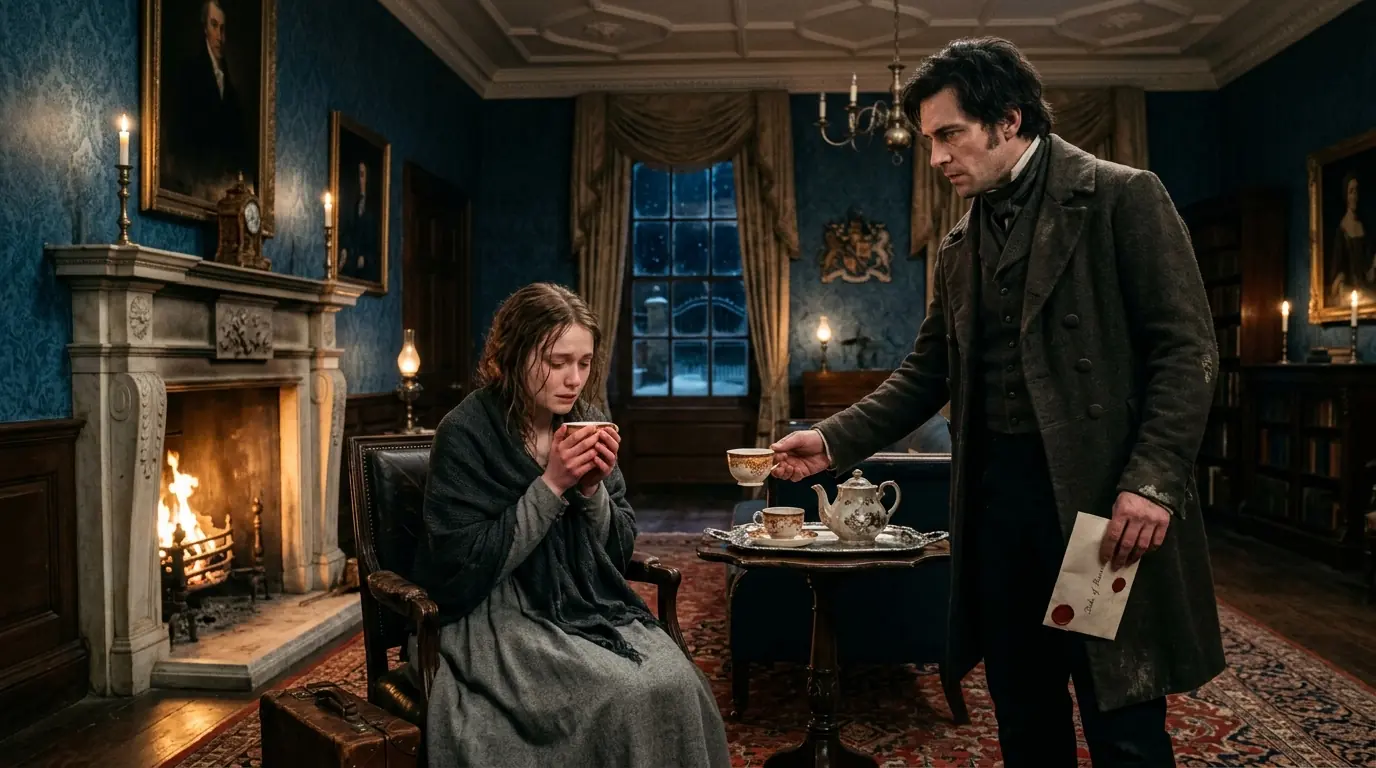
Charlotte Neave had never seen the Duke of Ravensworth in her life. She stood in his hall in a wet shawl, expecting to be turned out inside a minute. Instead, he read the letter, set it down, and looked at her for a long moment. And the first thing he said to her was not about the letter at all.
The gig had turned back at the lodge gates. Charlotte had assumed it would wait. She had assumed it right up until the moment the driver leaned over, set her small case down in the snow beside her, said, "Beg pardon, miss," in the voice of a man doing something he had been paid not to think about, and turned the horse.
She stood in the road and watched him go. It was half past four in the afternoon on the eleventh of January, and the light was already failing. The drive up to Ravensworth ran a mile and a quarter between bare limes. Behind her, the gates were the last thing she knew. She could walk back to Marsden; it was nine miles. She would not be there before ten o'clock, and the road went over open ground for four of them. It had been snowing since noon.
Charlotte picked up the case and started up the drive.
Her mother had married Gerald Hurst eleven months after Charlotte's father died. Charlotte had been fifteen, and she remembered thinking at the time that her mother had done it out of fright rather than affection. She had turned out to be right, and it had turned out not to matter.
Papa had been a wine merchant in a middling way in Marsden. Not rich, but comfortable. Enough for a decent house and a girl to help, and eleven years of Charlotte having a piano, lessons, and books. He had died of a growth in his stomach at forty-six, and there had been debts nobody knew about. Gerald Hurst had appeared inside the year with a manner like warm milk and a plan for the business.
He had a way of being reasonable. That was the thing Charlotte had never been able to explain to anybody. He never shouted. He explained at length, in a patient voice, why the thing he had already decided was the only sensible course. By the end of it, you were the difficult one for having asked.
Her mother had gone quiet inside two years. Not unhappy, exactly. Quiet, the way a room goes quiet when the fire dies down. There were two little ones now, Charlotte's half-brothers, six and four. Charlotte had raised the pair of them because her mother was tired in a way that had no name. Charlotte was twenty-two years old and had never once in seven years been asked what she wanted.
That morning, Gerald had come into the kitchen and spoken in his reasonable voice. She was to go to Ravensworth.
"There's an old obligation between the family and your father's people. It goes back a good way. I have written it out, and you're to carry it and wait for the answer."
"What obligation?"
"It would take an hour to explain, and you'd not follow the half of it." He had put the sealed letter into her hand. "Wear the gray, and Charlotte, you'll be civil, and you'll not be proud, and you'll wait for an answer however long it takes. Do you understand me?"
She had understood him to mean that they wanted money and were too ashamed to ask for it in person. That was what she had understood. She had felt sick about it in the gig for eleven miles.
The house came up out of the dark all at once, and it was enormous. Charlotte stood on the gravel with the snow going sideways past the lit windows. She understood, with the particular clarity that comes to a person who is very cold and very frightened, that she was about to knock on a door where a servant would look at her boots, her case, and her wet shawl. In about four minutes, she would be walking back down that drive with nowhere to walk to.
She knocked anyway.
The man who opened it was elderly and had a face like the side of a hill. He looked at her exactly as she had expected he would.
"I have a letter for the Duke of Ravensworth," Charlotte said, her voice coming out steadier than she had any right to expect. "From Mr. Gerald Hurst of Marsden. I am to wait for an answer."
The butler looked past her at the empty drive. "Your carriage, miss. It has gone back."
Something happened in the old man's face. It was not surprise. Charlotte, who had spent seven years learning to read faces very fast, would have said it was closer to anger, and it was not directed at her.
"Step inside out of it," he said. "I'll not have you on the step."
The hall was the size of the whole ground floor of the house in Marsden. It was colder than she'd expected and smelled of woodsmoke and stone. She stood on the mat, not going further in, dripping, and heard the butler's feet go away across the boards and come back.
Then there were other feet.
The Duke of Ravensworth was younger than she had pictured and considerably less magnificent. He was perhaps four-and-thirty, dark, badly shaved, in a coat that had been good five years ago. He came into the hall reading the outside of the letter with a slight frown, the way a man does when a name is familiar and he cannot place it.
Then he looked up and saw her.
Charlotte watched him take her in: the wet shawl, the case, the snow melting off her hem onto his floor. She watched his face change, and it changed in a direction she had absolutely not been prepared for. He looked, for about half a second, appalled.
"Fenn," he said, "the blue room, the fire made up properly, and tea. Now, please. And send Mrs. Ives to me."
"Your Grace, I only—"
"Miss—" He stopped. "I don't know your name."
"Charlotte Neave."